
Chapter 23—Liquidity Management
1. Of the four components involved in the concept of “float”, which two are generally the same from the
perspectives of both the payee and payer?
a.
processing and clearing
b.
clearing and mail
c.
mail and processing
d.
processing and availability
e.
availability and clearing
2. Box Lock has annual sales of $s million and is considering implementing a lockbox system, which
would reduce customer collection float by four days. Box Lock has a cost of capital of r percent. The
annual after-tax cost of the lockbox system is $atc. Assume a 365-day year, Box Lock should:
a.
implement the system as it has a net benefit of $w1
b.
implement the system as it has a net benefit of $ans
c.
implement the system as it has a net benefit of $w2
d.
not implement the system as it has a net cost of $w3
e.
not implement the system as it has a net cost of $w4
3. Gouge-M is considering adding a cash discount to its credit terms. If Gouge-M offers r / d net a rather
than its current net a policy, what annualized rate is the company charging customers who do not take
the discount? Assume a 365-day year.
a.
w1 percent
b.
w2 percent
c.
w3 percent
d.
ans percent
e.
w4 percent
4. Zero-balance accounts (ZBAs):
a.
provide firms an opportunity to earn interest on corporate checking account balances.
b.
provide firms with cash concentration systems the opportunity to write checks against an
interest-earning account.
c.
provide firms an opportunity to maximize the use of float on each check without altering
the float time for their suppliers.
d.
are identical to controlled disbursement accounts.
e.
are identical to positive pay accounts.
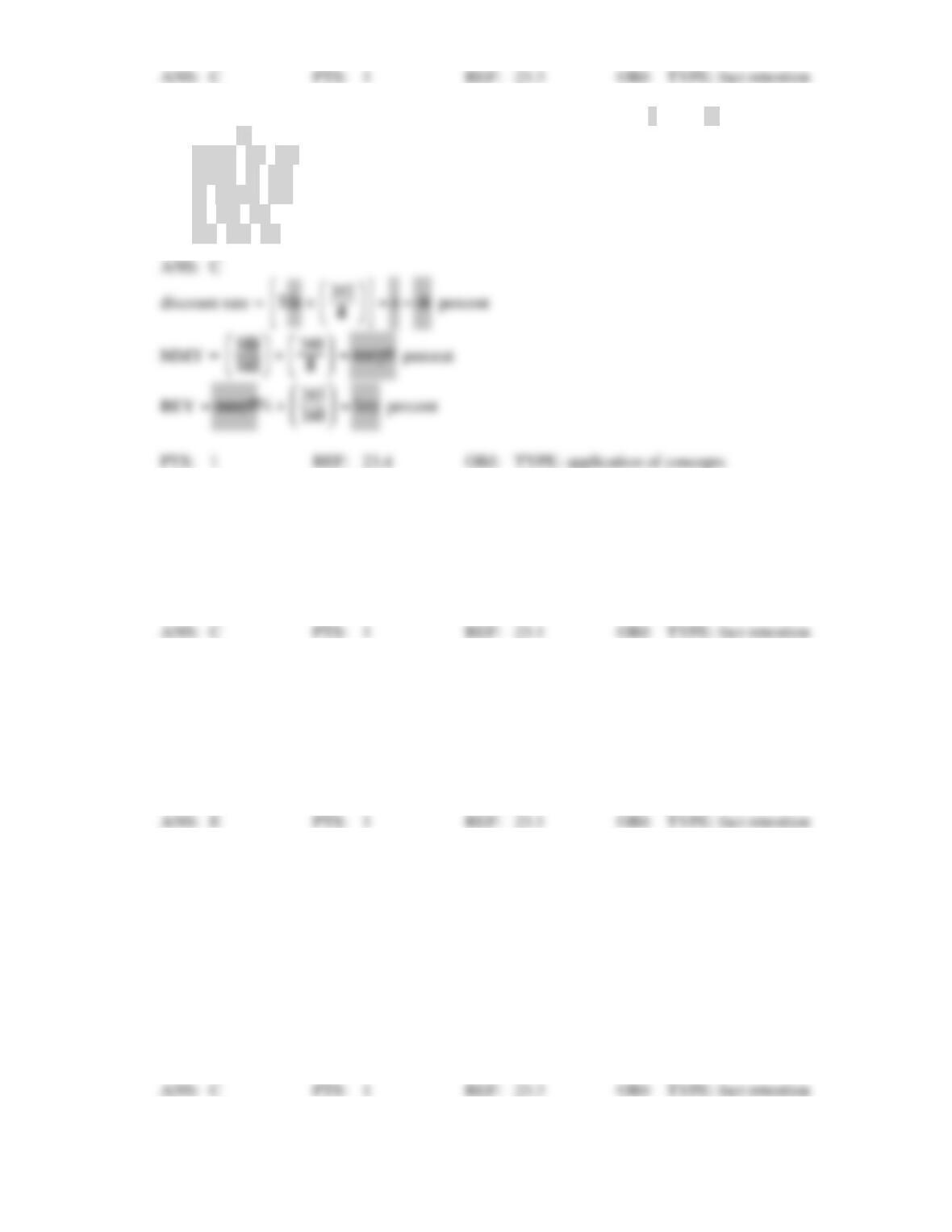
5. The discount rate, money market yield, and bond equivalent yield on a d-day, $s0 million T-bill that is
selling at $s2 are __________, __________, and __________ percent, respectively.
a.
mmy0; w1; bey
b.
mmy0; dr; bey
c.
dr; mmy0; bey
d.
dr; bey; w2
e.
bey; bey; w2
6. __________ float is the time between receipt of the payment and its deposit into the firm’s account.
a.
Mail
b.
Available
c.
Processing
d.
Clearing
e.
Time
7. Many companies, especially smaller ones, do not engage in active cash position management, but
rather set a __________ for their checking accounts.
a.
average cash balance
b.
positive dollar amount
c.
floating cash balance
d.
fixed cash balance
e.
target cash balance
8. Positive pay is best described as:
a.
a system where corporate checks presented for clearing will only be processed when the
corporate account has a positive balance
b.
a system where corporate bank disbursement accounts pay out the positive balance to
cover checks during the day but are left with a zero-balance at the end of the day
c.
a system where the corporation transmits a checks-issued file to its bank which allows the
bank to verify the accuracy of checks presented for payment
d.
a system where a corporation will not issue a check for payment of goods and services
without first verifying the invoiced amount
e.
a system where corporations use a purchasing card to reduce the cost of low-dollar indirect
purchases and then pay the issuers of the card in single, large payments

9. Clearing float is:
a.
the time delay between when payment is placed in the mail and when payment is received
b.
the time between receipt of the payment and its deposit into the firm’s account
c.
the time between deposit of the check and availability of the funds to the firm
d.
the time between deposit of the check and presentation of the check back to the bank on
which it is drawn
e.
the total time necessary for a firm to process a check through its accounting department
and through its bank for clearing
10. A company offers credit terms r/d net 30. What is the effective annual rate (i.e., the rate incorporating
compounding) faced by borrowers who do not take the discount?
a.
ans%
b.
w1%
c.
w2%
d.
w3%
e.
w4%
11. What is the effective borrowing rate for the following 6-month line of credit:
CL = total credit line $cl
AL = Average outstanding amount $al
CF = Commitment fee cf% (not annualized) on unused line
IR = Interest rate ir1% over LIBOR (which is currently ir2%)
a.
ebr
b.
w1
c.
w2
d.
w3
e.
w4
12. What is the “all–in–rate” for the following short-term loan:
LIBOR with a spread of a%
LIBOR is currently b%
a.
w1%
b.
w2%
c.
ans%
d.
Can not be determined given the information
13. What is a corporate obligation used for short term investments that take advantage of the “dividend
exclusion” rule?
a.
commercial paper
b.
adjustable rate preferred stock
c.
t-bills
d.
commercial bonds
14. The primary corporate obligation in the short-term market, typically structured as an unsecured
promissory note with a maturity of less than 270 days, is called
a.
commercial paper
b.
adjustable rate preferred stock
c.
commercial bonds
d.
t-bills
15. A bank service that provides an early notification of checks that will be presented against a firm’s bank
account on a given day is called
a.
positive pay
b.
controlled disbursement
c.
integrated accounts payable
d.
zero balance account
16. Which type of firm may benefit more from a bank that offers an integrated accounts payable service?
a.
Large publicly traded firm
b.
Mom and pop bookstore
c.
Small regional production firm
d.
Financial institution
17. What type of collection system is characterized by many collection points where transactions are
received at retail outlets or collection offices?
a.
Field-banking system
b.
Electronic systems
c.
Lock-box systems
d.
Automated clearinghouse systems
18. Mercer Marionettes, Inc. (MEMI) can transfer balances using EDT at a cost of $edt and requiring one
day to clear, or using a wire transfer that costs $wtc and clears the same day. MEMI earns memi% on
short-term investments (assume a 365-day year). What transfer amount would result in MEMI being
approximately indifferent between a wire transfer and an EDT?
a.
$w1
b.
$w2
c.
$ans
d.
$w3
19. Beguiling Telecom Corp.’s customers send payments by check, which spend an average of d1 days in
the mail. Processing of the checks requires d2 days, and BTC’s bank delays availability of the checks
for d3 days. Customers send their checks an average of d4 days after they receive their statements.
Beguiling Telecom has _______ of collection float.
a.
w1
b.
ans
c.
w2
d.
w3
e.
w4
20. An investor who faced high state income taxes would be particularly well suited for investments in
__________.
a.
Federal agency issues
b.
Yankee CDs
c.
Treasury bills
d.
Banker’s acceptances

21. Fickle Sickles collects c checks per 365-day year with average amount $a and total delay td days. A
lockbox system would reduce that delay to d days, and it would also reduce FISI’s check processing
costs by $pc per check. The annual fee on the lockbox would be $af. What is the annual net benefit
associated with using the lockbox? FISI has an r% cost of capital.
a.
– $w1
b.
– $nb
c.
$w2
d.
$w3
e.
$w4
22. Gore-M wishes to earn an annual interest rate of r% on any customers foolish enough to not take a
discount. If the credit terms to be offered are X/d, net 30, what must X be, to the nearest percent?
a.
w1%
b.
x%
c.
w2%
d.
w3%
e.
w4%
23. What is the effective borrowing rate for a 1-year line of credit, if the total credit line = $tcl, average
loan outstanding = $alo, commitment fee = cf% on the unused portion, and interest rate = LIBOR + r%
(LIBOR is currently libor%)? There are no compensating balances, and the year basis is 365 days.
a.
w1%
b.
w2%
c.
w3%
d.
ans%
e.
w4%
24. The bond equivalent yield on a t-day Treasury Bill is r%. The face value is $fv. What is the selling
price?
a.
$pp
b.
$w1
c.
$w2
d.
$w3
25. The primary goal of a cash manager is to __________ collection float and ____________
disbursement float
a.
Maximize; maximize
b.
Minimize; minimize
c.
Maximize; minimize
d.
Minimize; maximize
26. Which of the following in not a component of float?
a.
Mail
b.
Processing
c.
Clearing
d.
Computing
27. What is the annualized rate of not taking a r/d net t discount?
a.
rd%
b.
w1%
c.
w2%
d.
w3%
28. What is not an advantage of cash concentration?
a.
Reducing transaction costs
b.
Preserving invested balances
c.
Improving internal control of cash
d.
Reducing mail float
MATCHING
Match the term with the description:
a.
mail float
b.
processing float
c.
availability float
d.
clearing float
1. time between receipt of payment and deposit in the firm’s account
2. time between when payment is placed in the mail and when it is received
3. time between deposit of the check and presentation of the check back to the bank on which it is drawn
4. time between deposit of the check and availability of the funds to the firm
Match the federal agency with the underlying assets:
a.
Ginnie Mae
b.
Vinnie Mac
c.
Fannie Mae
d.
Sallie Mae
e.
CoBank
5. student loans
6. loans to agricultural cooperatives
7. VA home loans
8. home mortgages backed by Federal government
9. home mortgages backed by government sponsored enterprises (GSEs)
SHORT ANSWER
1. What is the primary objective in the collections process?
2. Gotta Deal offers its customers a cash discount of r percent if payment is made with in d days, rather
than its current net t policy. Assuming a 365-day year, what is the annual rate Gotta Deal is charging
its customers who do not take the discount?
3. You are considering an investment in one of two money market securities with t days to maturity. The
first offers a money market yield of r1 percent and the second offers a bond equivalent yield of r2
percent. Which of these two investments represents the better choice for your firm?
4. A lockbox will reduce float by t days for any check directed to it. The lockbox costs $c at the end of
each month plus $emp per check. Assume that you have the ability to choose which checks are
directed to the lockbox. There are no processing costs if your firm processes the checks outside of the
lockbox. An appropriate discount rate is r% per month. You process the following checks each month:
Check Amount
Number of Checks Per Month
$c1
nc1
$c2
nc2
$c3
nc3
$c4
nc4
$c5
nc5
It turns out that the NPV of the lockbox is positive (you could find the overall NPV, but you do not
need to). Which checks would you route through the lockbox? (Hint: There should be a threshold that
separates lockbox checks from non-lockbox checks)
5. What are imaging services?
6. What is meant by the term cash concentration?
7. What is a depository transfer check (DTC)?
8. Define an automated clearinghouse debit transfer (ACH)?
9. Is a wire transfer preferred to an EDT (electronic depository transfer)? Why or why not? When are you
indifferent between the two?
10. A firm has a collection service in place with its bank that gives its customers an average float of t1
days. If the firm undertakes a new lockbox system it can reduce its customer float to t2 days. The firm
has a cost of capital of r%. If the firm has annual sales of $s0 million, and the lockbox system will cost
$c per year, should the firm switch collection procedures?
11. What are some advantages of using an electronic invoice presentment and payment system?
12. A bank offers a Zero Balance Account at a monthly fee of $b. Firm X can earn r% interest on its short-
term investments. What is the minimum average cash balance for firm X, such that the ZBA would be
acceptable? Assume a 365-day year.
13. Our firm will receive rc checks this year, each with amount $a. In years to come, the number of checks
will rise by r1% annually, and the per-check amount will also rise by r1%. A lockbox has cost $c per
year + $cc/check (fees paid at the end of the year, which can be assumed to last 365 days), but each of
these fees will rise by r1% per year. The lockbox can reduce float by t days per check. Suppose that
our firm’s r2% cost of capital is an appropriate discount rate for all of the cash flows. What is the NPV
of the lockbox?
14. Iterated Exclamations Corp. (ITEX) receives r1 checks per year of $c1 each, delayed by t1 days, and it
also receives r2 checks of $c2 each, delayed by t2 days. What would be the annual benefit of entirely
eliminating the float for ITEX? ITEX has a r% cost of capital. Assume a 365-day year.
15. A $fv face value, t-day Treasury Bill is currently selling at a quoted discount of r%.
A. What is the purchase price?
B. What is the money market yield?
C. What is the bond equivalent yield?
16. What is one way, related to cash management, that banks get around the federal prohibition on paying
interest on corporate checking accounts, even without creating zero-balance or sweep accounts?
ESSAY
1. Discuss the various aspects of accounts payable management, including new developments. Include
some mention of how the different details relate to achieving the goals of the firm.