
Biology: A Guide to the Natural World, 5e (Krogh)
Chapter 23 Animals: The Diversity of Life 3
1) The single characteristic that all animals have that other organisms don’t is that they:
A) possess the ability to change location.
B) are single celled.
C) possess sensory systems.
D) undergo a blastula stage in development.
E) are terrestrial.
2) Which of the following would be a valid characteristic of animals that may also be shared by
other groups of organisms?
A) Some animals have cell walls.
B) All animals are multicellular.
C) Some animals are sessile their entire lives.
D) Some animals are photosynthetic.
E) All animals are relatively large.
3) The overwhelming majority of animals are:
A) invertebrates.
B) vertebrates.
C) unicellular.
D) mammals.
E) sessile.
4) The phylum of animals that does not show true tissues or symmetry is:
A) Nematoda.
B) Annelida.
C) Platyhelminthes.
D) Cnidaria.
E) Porifera.

5) Which of the following animal phyla are most closely related?
A) Echinodermata and Chordata
B) Arthropoda and Annelida
C) Porifera and Cnidaria
D) Platyhelminthes and Nematoda
6) Which of the following is not an advantage of a body cavity?
A) It allows flexibility and safe storage of organs.
B) It allows for the storage of eggs or offspring.
C) It provides a safe place for an expandable digestive tract.
D) It provides for movement.
7) Bilateral symmetry refers to distribution of body parts:
A) randomly in pairs from top to bottom.
B) around a central axis.
C) similarly on right and left sides.
D) in pie-slice sections.
E) in no particular order.
8) Sponges, cnidarians, and flatworms all lack which characteristic found in most other animal
groups?
A) tissues
B) a coelom
C) symmetry
D) the blastula embryo
E) motility

9) “Collar cells” perform what function for sponges?
A) create a current to pull water through pores
B) ingest food particles
C) help the sponge move through water
D) anchor the sponge to a base
E) produce a body cavity
10) Cnidarians typically obtain food by:
A) filter feeding.
B) stinging and pulling prey to the mouth with tentacles.
C) amoeboid-like engulfing of prey.
D) forming cooperative arrangements with photosynthetic organisms.
11) The typical “jellyfish” demonstrates which stage of the cnidarian life cycle?
A) blastula
B) polyp
C) medusa
D) serpentine
E) sessile
12) A characteristic that is common to cnidarians is:
A) an osculum.
B) a medusa stage in the life cycle.
C) that they create coral reefs.
D) stinging cells.
E) a complete digestive tract.

13) As a general, common feature, what characteristic do flatworms (Platyhelminthes) have in
common with some of the more advanced animal phyla?
A) bilateral symmetry
B) segmentation
C) complex sensory organs
D) a shell
E) a coelom
14) Flatworms are the most primitive animal phylum to have:
A) asymmetry.
B) radial symmetry.
C) organs.
D) a circulatory system.
E) muscle tissue.
15) Which of the following is a group of parasitic flatworms?
A) annelids
B) flukes
C) nematodes
D) leeches
E) sea anemones
16) A characteristic of annelids is:
A) freshwater existence.
B) parasitism.
C) ocean-dwelling existence.
D) a radula.
E) body segmentation.

17) Leeches are in the phylum:
A) Nematoda.
B) Mollusca.
C) Annelida.
D) Cnidaria.
E) Platyhelminthes.
18) Which characteristic is common to all molluscs?
A) mantle
B) tentacles
C) radula
D) brain
E) open circulatory system
19) Snails and slugs are in which mollusc group?
A) cephalopod
B) bivalve
C) gastropod
D) arthropod
E) radula
20) Which of the following parasites is a roundworm (Nematoda)?
A) hookworm
B) fluke
C) leech
D) tapeworm

21) Which statement about nematodes is most accurate?
A) They are mainly parasites.
B) They are mainly crop pests.
C) They all have straight, flattened bodies.
D) They fit into numerous ecological roles including detritivores.
E) They have exoskeletons made of cellulose.
22) Ticks and horseshoe crabs are members of subphylum:
A) Urochordata.
B) Chelicerata.
C) Crustacea.
D) Insecta.
E) Uniramia.
23) The term “arthropod” best translates as:
A) human-like.
B) outside skeleton.
C) sharp jaws.
D) jointed leg.
E) hairy legs.
24) Which group is most closely related to the echinoderms?
A) Arthropods
B) Molluscs
C) Chordates
D) Nematodes
E) Annelids

25) Which would be a fact supporting the hypothesis that echinoderms such as sea stars evolved
into radial symmetry from bilateral symmetry?
A) Their larvae have bilateral symmetry.
B) They use their appendages in a bilateral manner.
C) Their brains show the mirror image development of bilateral symmetry.
D) They swim like animals with bilateral symmetry.
26) Nearly all echinoderms are found in which habitat?
A) lakes
B) rivers
C) beaches
D) ocean surface
E) ocean floor
27) At some point in their lives, all chordates have:
A) jaws.
B) gills.
C) a brain.
D) a dorsal nerve cord.
E) a ventral nerve cord.
28) A notochord is a:
A) tough yet flexible support structure.
B) dorsal nerve cord.
C) ventral nerve cord.
D) specialized tail adapted for swimming.
E) tube for circulating water through gills.
29) Which statement about the vertebrates is most accurate?
A) They are the dominant phylum in the animal kingdom.
B) There are more vertebrate species than flatworms or cnidarians but fewer than there are
insects.
C) They are the only group to have evolved aquatic, terrestrial, and flying lifestyles.
D) They evolved from echinoderms.
E) They evolved from molluscs.
30) As part of your independent study in field biology, you are sent to a small, inland sea. In one
of your samples, you discover a small eel-like creature. It has a stiff, rod-shaped structure
running the length of its dorsal side, with a line of nervous tissue running along with it. You
would begin the process of classifying this organism by placing it in phylum:
A) Vertebrata.
B) Arthropoda.
C) Chordata.
D) Cnidaria.
E) Mollusca.
31) The creature is likely to be related to:
A) Arthropods such as lobsters.
B) Echinoderms such as sea cucumbers.
C) Poriferans such as sponges.
D) Chordates such as sea squirts.
E) Cnidarians such as Obelia.

32) The type of reproduction you are observing is:
A) sexual reproduction.
B) asexual budding.
C) parthenogenesis.
D) oviparous.
E) viviparous.
33) A form of asexual reproduction in which an unfertilized egg can develop into an adult
organism is:
A) budding.
B) fission.
C) oviparous reproduction.
D) parthenogenesis.
E) hermaphrodism.
34) A hermaphrodite is an organism that:
A) generally reproduces asexually.
B) does not require males for sexual reproduction.
C) possesses both male and female sex organs.
D) can select the sex of its offspring.
E) usually stores sperm in female structures for months after copulation.
35) External fertilization of eggs in animals is:
A) rarely seen except in aquatic environments.
B) most common in arthropods.
C) less common in cnidarians.
D) absent in vertebrate species.
E) most common among hermaphroditic species.

36) In addition to maintaining a wet environment necessary for survival of the embryo, what
other essential characteristic does the amniotic egg possess?
A) a shell that most predators cannot break
B) ability to absorb nutrients from the environment
C) easier fertilization
D) low energy/material for the mother to produce
E) ability to allow for gas exchange
37) Extra protective behaviors toward young may have evolved from a common ancestor in
evolutionary lines leading to the:
A) mammals, turtles, and snakes.
B) crocodiles, dinosaurs, and birds.
C) turtles, snakes, and lizards.
D) amphibians, lizards, and fish.
E) dinosaurs, turtles, and lizards.
38) What replaces the membranes and nutrition source of amniotic eggs in organisms that exhibit
live birth without amniotic eggs?
A) yolk sac
B) amnion
C) placenta
D) allantois
E) chorion
39) Reptiles, birds, and some mammals share which of the following characteristics?
A) are predators
B) are warm-blooded
C) exhibit live birth
D) have light, hollow bones
E) produce amniotic eggs
40) When we say an animal has an “open circulatory system,” this means that:
A) a small amount of blood may leak out of vessels.
B) blood flows out of vessels and into spaces or sinuses.
C) the animal has a single-chambered heart, so blood mixes from all areas.
D) there are no vessels–blood simply fills all spaces inside the coelom.
E) movement of the animal is solely responsible for moving circulatory fluid.
41) Molting is necessary for:
A) all animals.
B) all animals with skeletons.
C) all animals with exoskeletons.
D) all animals with endoskeletons.
E) only animals with endoskeletons and scaly skin.
42) What type of skeleton is found in annelids?
A) endoskeleton
B) exoskeleton
C) dermal skeleton
D) hydrostatic skeleton
E) notochords
43) Invertebrate animals greatly outnumber vertebrates.
44) Whereas all animals are multicellular, some are nevertheless microscopic.
45) There is far more animal diversity in the ocean than on land in part because animals first
evolved in the ocean.
46) Sponges were the earliest animals to evolve true tissues.
47) Asymmetry refers to arrangement of body parts evenly around a central point.
48) Platyhelminthes is the first phylum to possess a coelom.
49) Most species of sponges live in freshwater environments, but a few species are marine.
50) Cnidarians such as jellyfish have muscle and nervous tissues.
51) Annelids demonstrate the important animal characteristic of body segmentation.
52) Corals exhibit the polyp body form only.
53) There are both aquatic and terrestrial species in the phylum Mollusca.
54) There are more species in the insect group of phylum Arthropoda than all other animal phyla
combined.
55) A marine animal with tube feet and radial symmetry is certainly an echinoderm.

56) All chordates are vertebrates.
57) Copulation is necessary for all animals using internal fertilization.
58) Mammals are the only group of animals to demonstrate significant protection of their young.
59) Blood stays within vessels in a closed circulatory system.

Match the following.
A) medusa stage
B) crustaceans
C) trichinosis
D) bivalves
E) collar cells
60) Nematoda
Topic: Section 23.3
Skill: Knowledge/Comprehension
61) Mollusca
Topic:
Skill: Knowledge/Comprehension
Section 23.3
62) Cnidaria
Topic: Section 23.3
Skill: Knowledge/Comprehension
63) Arthropoda
Topic: Section 23.3
Skill: Knowledge/Comprehension
64) Porifera
Topic: Section 23.3
Skill: Knowledge/Comprehension
Match the following.
A) unfertilized egg develops into an adult
B) cushioning membrane
C) Obelia polyps producing medusae
D) both male and female reproductive organs
E) fertilized egg laid outside mother’s body
F) fertilized egg develops in the mother’s body
65) Parthenogenesis
Topic: Section 23.4
Skill: Knowledge/Comprehension
66) Asexual budding
Topic: Section 23.4
Skill: Knowledge/Comprehension
67) Hermaphrodite
Topic: Section 23.4
Skill: Knowledge/Comprehension
68) Viviparous
Topic: Section 23.5
Skill: Knowledge/Comprehension
69) Amnion
Topic: Section 23.5
Skill: Knowledge/Comprehension
70) Oviparous
Topic: Section 23.5
Skill: Knowledge/Comprehension
71) Animals that do not have a backbone are called ________.
72) Sponges acquire food by ________ as water passes through.
73) The structure in cnidarians with both digestive and circulation functions is the ________.
74) The features common to all chordates are: ________, ________, ________, and ________.
75) What are the benefits and challenges of an exoskeleton?
76) The animal phyla with the most diversity and greatest representation in the animal kingdom
have developed tissues, organs, and body cavities. Less successful phyla have not. Evaluate and
explain why this is so.
77) We see a great deal of variation in reproductive strategies in the animal kingdom. Evaluate
the basic strategies and trends in egg fertilization and protection in sexually reproducing animals.
78) Discuss why nearly all larger animals have circulatory systems, and describe the differences
between the open circulatory system and the closed circulatory system.
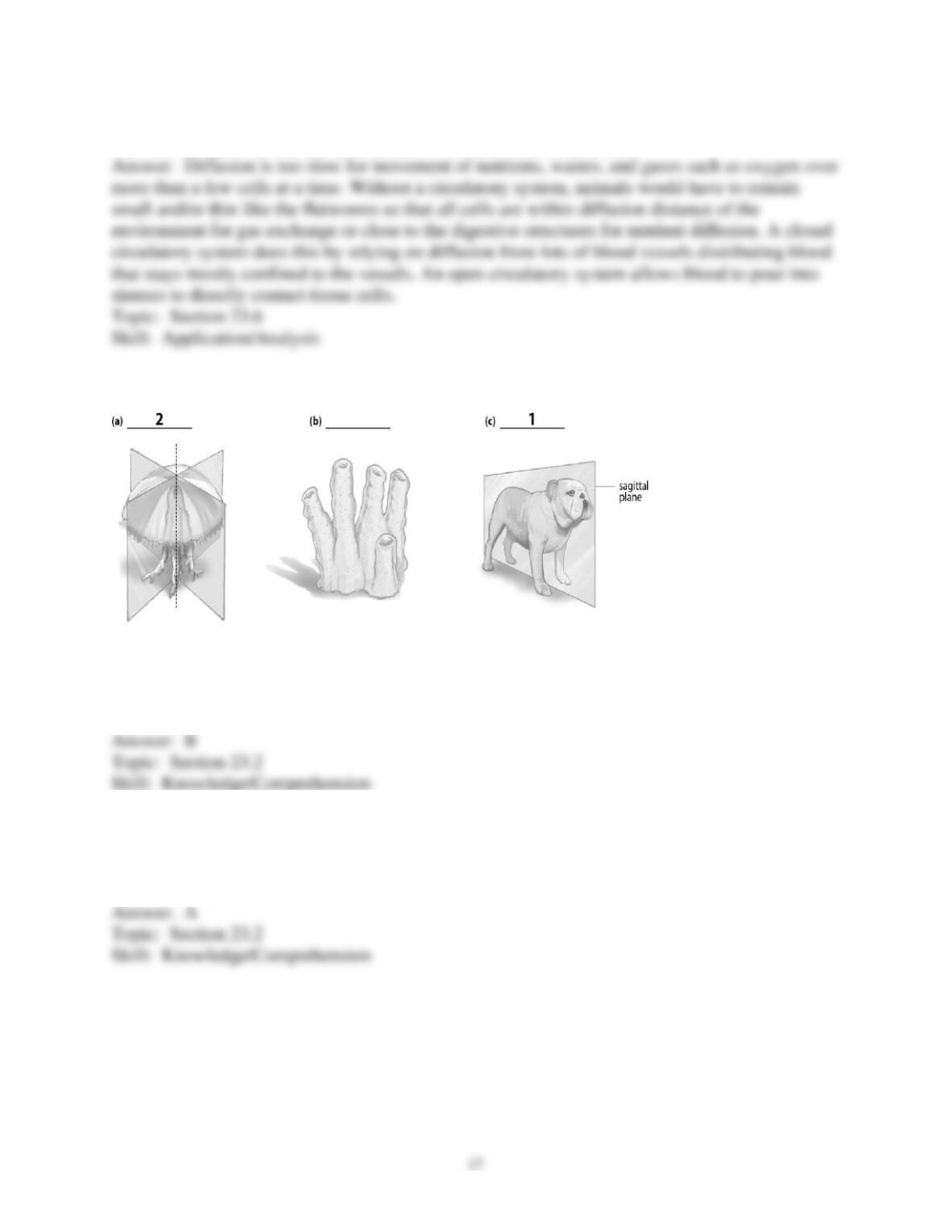
Refer to the figure below, and then answer the following question(s).
79) The missing label indicated by a “1” corresponds to the:
A) radial symmetry.
B) bilateral symmetry.
C) asymmetry.
80) The missing label indicated by a “2” corresponds to the:
A) radial symmetry.
B) bilateral symmetry.
C) asymmetry.