Corporate Finance, 3e (Berk/DeMarzo)
Chapter 23 Raising Equity Capital
23.1 Equity Financing for Private Companies
Use the following information to answer the question(s) below.
Suppose that Galt Ventures, a venture capital firm, raised $250 million of committed capital.
Each year over the 10-year life of the fund, 2% of this committed capital will be used to pay
Galt’s management fee. As is typical in the venture capital industry, Galt will only invest $200
million (committed capital less lifetime management fees). At the end of 10 years, the
investments made by the fund are worth $800 million. Galt also charges 20% carried interest on
the profits of the fund (net of management fees). Assume that Galt collects the $250 of
committed capital and invests $200 million of it immediately. Also assume that Galt collects all
proceeds from its investments at the end of the ten year life.
1) The IRR on the investments made by Galt Ventures is closest to:
A) 9.9%
B) 12.4%
C) 14.9%
D) 15.8%
2) The IRR on the investment of a limited partner into Galt Ventures net of all management fees
and expenses is closest to:
A) 7.8%
B) 9.9%
C) 12.4%
D) 14.9%
3) Which of the following statements is NOT true regarding Angel Investors?
A) They are typically arranged as limited partnerships.
B) For many start-ups, the first round of outside private equity financing is often obtained from
them.
C) Because their capital investment is often large relative to the amount of capital already in
place at the firm, they typically receive a sizeable equity share in the business in return for their
funds.
D) These investors are frequently friends or acquaintances of the entrepreneur.
4) Which of the following statements is NOT true regarding venture capitalists?
A) They can provide substantial capital for young companies.
B) They firms offer limited partners a number of advantages over investing directly in start-ups
themselves as angel investors.
C) They use their control to protect their investments, so they may therefore perform a key
nurturing and monitoring role for the firm.
D) They might invest for strategic objectives in addition to the desire for investment returns.
5) Which of the following is NOT a common name for a corporation that invests in private
companies?
A) Strategic investor
B) Corporate partner
C) Venture partner
D) Strategic partner
6) Which of the following statements is FALSE?
A) A venture capital firm is a limited partnership that specializes in raising money to invest in
the private equity of young firms.
B) Venture capitalists typically control about three-quarters of the seats on a start-up’s board of
directors, and often represent the single largest voting block on the board.
C) The initial capital that is required to start a business is usually provided by the entrepreneur
herself and her immediate family.
D) Individual investors who buy equity in small private firms are called angel investors.
7) Which of the following statements is FALSE?
A) The general partners work for the venture capital firm and run the venture capital firm; they
are called venture capitalists.
B) An important consideration for investors in private companies is their exit strategy—how they
will eventually realize the return from their investment.
C) When a company founder decides to sell equity to outside investors for the first time, it is
common practice for private companies to issue common stock rather than preferred stock to
raise capital.
D) Institutional investors such as pension funds, insurance companies, endowments, and
foundations manage large quantities of money.
8) Which of the following statements is FALSE?
A) The preferred stock issued by young companies typically does not pay regular cash dividends.
B) The preferred stock issued by young companies usually gives the owner an option to convert
it into common stock on some future date, so it is often called callable preferred stock.
C) If the company runs into financial difficulties, the preferred stockholders have a senior claim
on the assets of the firm relative to any common stockholders.
D) Preferred stock issued by mature companies such as banks usually has a preferential dividend
and seniority in any liquidation and sometimes special voting rights.
Use the information for the question(s) below.
You founded your own firm three years ago. You initially contributed $200,000 of your own
money and in return you received 2 million shares of stock. Since then, you have sold an
additional 1 million shares of stock to angel investors. You are now considering raising capital
from a venture capital firm. This venture capital firm would invest $5 million and would receive
2 million newly issued shares in return.
9) The post-money valuation of your firm is closest to:
A) $12.5 million
B) $5.2 million
C) $10.0 million
D) $5.0 million
10) Assuming that this is the venture capitalist’s first investment in your firm, what percentage of
the firm will the venture capitalist own?
A) 50%
B) 40%
C) 25%
D) 33%
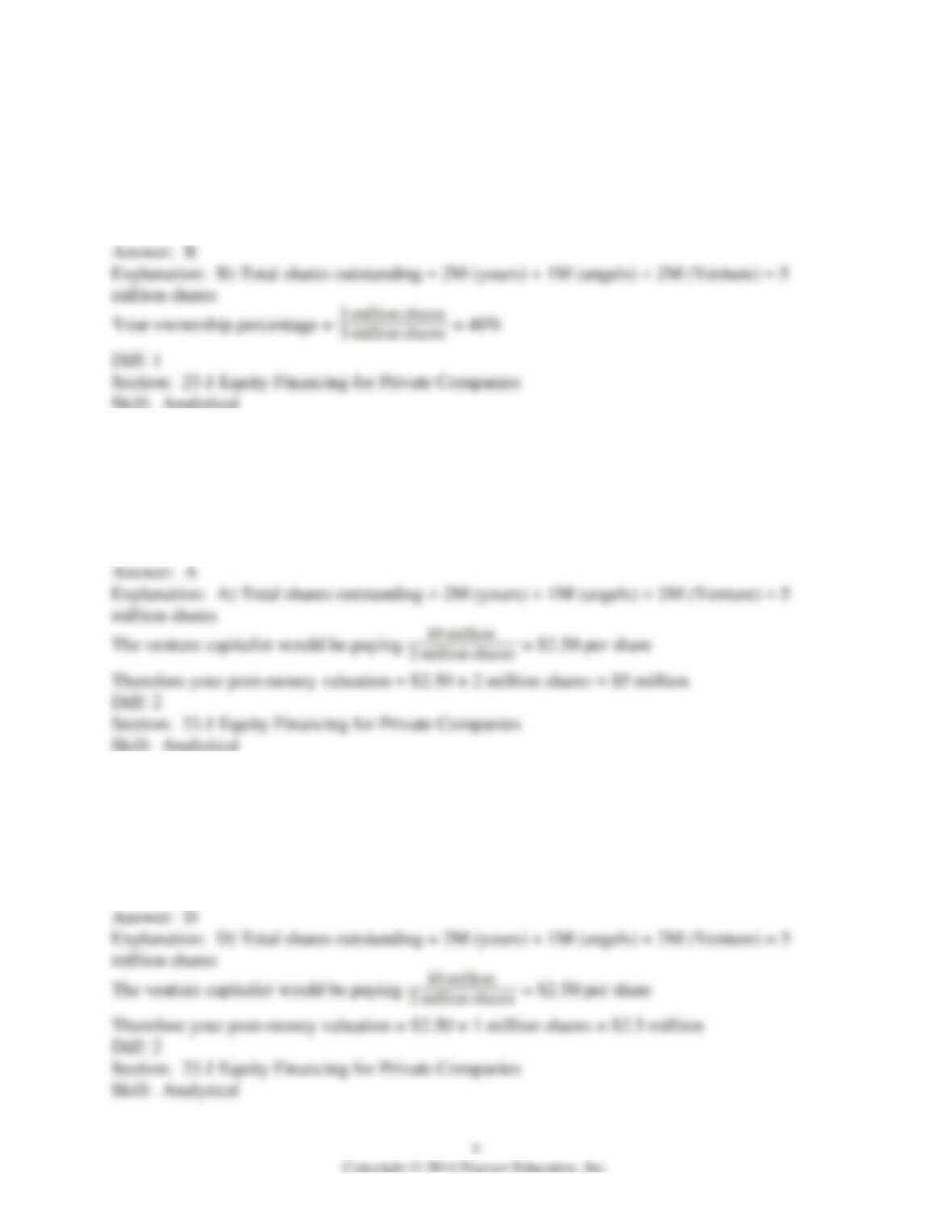
11) Assuming that this is the venture capitalist’s first investment in your firm, what percentage of
the firm will you own?
A) 50%
B) 40%
C) 33%
D) 25%
12) Assuming that this is the venture capitalist’s first investment in your firm, the post-money
valuation of your shares are closest to:
A) $5.0 million
B) $12.5 million
C) $4.0 million
D) $2.5 million
13) Assuming that this is the venture capitalist’s first investment in your firm, the post-money
valuation of the angel investor’s shares are closest to:
A) $12.5 million
B) $4.0 million
C) $5.0 million
D) $2.5 million
14) The share of any positive return generated by venture capital firms that is taken by the firm’s
partners is known as:
A) carried interest.
B) partner return.
C) carried capital.
D) angel interest.
15) When a private equity firm purchases the outstanding equity of a publicly traded firm,
thereby taking the company private, the transaction is called a(n):
A) private leveraged transaction.
B) leveraged buyout.
C) cash offer.
D) initial public offering.
16) A(n) ________ invests in the equity of existing privately held firms.
A) venture capital firm
B) private debt firm
C) vulture fund
D) private equity firm
23.2 The Initial Public Offering
1) Which of the following statements is FALSE?
A) The process of selling stock to the public for the first time is called a seasoned equity offering
(SEO).
B) Public companies typically have access to much larger amounts of capital through the public
markets.
C) By going public, companies give their private equity investors the ability to diversify.
D) The two advantages of going public are greater liquidity and better access to capital.
2) Which of the following statements is FALSE?
A) Once a company goes public, it must satisfy all of the requirements of public companies.
B) Organizations such as the Securities and Exchange Commission (SEC), the securities
exchanges (including the New York Stock Exchange and the Nasdaq), and Congress (through the
Sarbanes-Oxley Act of 2002) adopted new standards that focused on more thorough financial
disclosure, greater accountability, and more stringent requirements for the board of directors.
C) The major advantage of undertaking an IPO is also one of the major disadvantages of an IPO:
When investors diversify their holdings, the equity holders of the corporation become more
concentrated.
D) Several high profile corporate scandals during the early part of the twenty-first century
prompted tougher regulations designed to address corporate abuses.
3) Which of the following statements is FALSE?
A) After deciding to go public, managers of the company work with an underwriter, an
investment banking firm that manages the offering and designs its structure.
B) The shares that are sold in the IPO may either be new shares that raise new capital, known as
a secondary offering, or existing shares that are sold by current shareholders (as part of their exit
strategy), known as a primary offering.
C) Many IPOs, especially the larger offerings, are managed by a group of underwriters.
D) At an IPO, a firm offers a large block of shares for sale to the public for the first time.
4) Which of the following statements regarding best efforts IPOs is FALSE?
A) For smaller IPOs, the underwriter commonly accepts the deal on this basis.
B) The underwriter does not guarantee that the stock will be sold, but instead tries to sell the
stock for the best possible price.
C) Often these arrangements have an all-or-none clause: either all of the shares are sold in the
IPO, or the deal is called off.
D) If the entire issue does not sell out, the underwriter is on the hook.
5) Which of the following statements regarding firm commitment IPOs is FALSE?
A) If the entire issue does not sell out, the remaining shares must be sold at a lower price and the
underwriter must take the loss.
B) The underwriter purchases the entire issue (at a the offer price) and then resells it at a slightly
higher price to interested investors.
C) It is the most common underwriting arrangement.
D) The underwriter guarantees that it will sell all of the stock at the offer price.
6) Which of the following statements is FALSE?
A) In recent years, the investment banking firm of W.R. Hambrecht and Company has attempted
to change the IPO process by selling new issues directly to the public using an online auction
IPO mechanism called Open IPO.
B) The lead underwriter is the primary banking firm responsible for managing the deal. The lead
underwriter provides most of the advice and arranges for a group of other underwriters, called
the syndicate, to help market and sell the issue.
C) Because of the potential conflict of interest, the underwriter will not make a market in the
stock after the issue.
D) The SEC requires that companies prepare a registration statement, a legal document that
provides financial and other information about the company to investors, prior to an IPO.
Company managers work closely with the underwriters to prepare this registration statement and
submit it to the SEC.
7) As part of the registration statement, called the preliminary prospectus, circulates to investors
before the stock is offered. This preliminary prospectus is also called a(n):
A) IPO filing.
B) 10-K filing.
C) blue whale.
D) red herring.
8) Which of the following statements is FALSE?
A) Once the issue price (or offer price) is set, underwriters may invoke another mechanism to
protect themselves against a loss–the over-allotment allocation.
B) Before the offer price is set, the underwriters work closely with the company to come up with
a price range that they believe provides a reasonable valuation for the firm.
C) Before an IPO, the company prepares the final registration statement and final prospectus
containing all the details of the IPO, including the number of shares offered and the offer price.
D) A “road trip” is where senior management and the lead underwriters travel around the country
(and sometimes around the world) promoting the company and explaining their rationale for the
offer price to the underwriters’ largest customers–mainly institutional investors such as mutual
funds and pension funds.
9) Which of the following statements is FALSE?
A) Underwriters appear to use the information they acquire during the book-building stage to
intentionally under price the IPO, thereby reducing their exposure to losses.
B) The blue tooth option allows the underwriter to issue more stock, amounting to 15% of the
original offer size, at the IPO offer price.
C) The lead underwriter usually makes a market in the stock and assigns an analyst to cover it.
D) In most cases, the preexisting shareholders are subject to a 180-day lockup; they cannot sell
their shares for 180 days after the IPO. Once the lockup period expires, they are free to sell their
shares.
10) Which of the following is NOT one of the four characteristics of IPOs that puzzle financial
economists?
A) On average, IPOs appear to be underpriced.
B) The long-run performance of a newly public company (three to five years from the date of
issue) is superior to the overall market return.
C) The number of issues is highly cyclical.
D) The costs of the IPO are very high, and it is unclear why firms willingly incur such high
costs.
11) Which of the following statements regarding exit strategies is FALSE?
A) An alternative way to provide liquidity to its investors is for the company to become a
publicly traded company.
B) An important consideration for investors in private companies is their exit strategy or how
they will eventually realize the return from their investment.
C) Often large corporations purchase successful start-up companies. In such a case, the acquiring
company purchases the outstanding stock of the private company, allowing all investors to cash
out.
D) Roughly 25% of venture capital exits from 2002-2012 occurred through mergers or
acquisitions.
12) Aaron Inc went public at $10 per share. Aaron’s investment banker charged them $0.70 per
share for the IPO. This fee is called a(n):
A) allocation spread.
B) underwriting spread.
C) greenshoe fee.
D) IPO fee.

11
Use the information for the question(s) below.
Luther Industries is in the process of selling shares of stock in an auction IPO. At the end of the
bidding period, Luther’s investment bank has received the following bids:
Price ($)
Number of Shares Bid
$19.50
50,000
$19.25
25,000
$19.10
25,000
$19.00
100,000
$18.75
125,000
$18.50
75,000
$18.25
150,000
$18.00
240,000
$17.75
80,000
$17.50
125,000
$17.25
150,000
$17.00
100,000
$16.90
60,000
$16.75
80,000
$16.50
75,000
$16.25
200,000
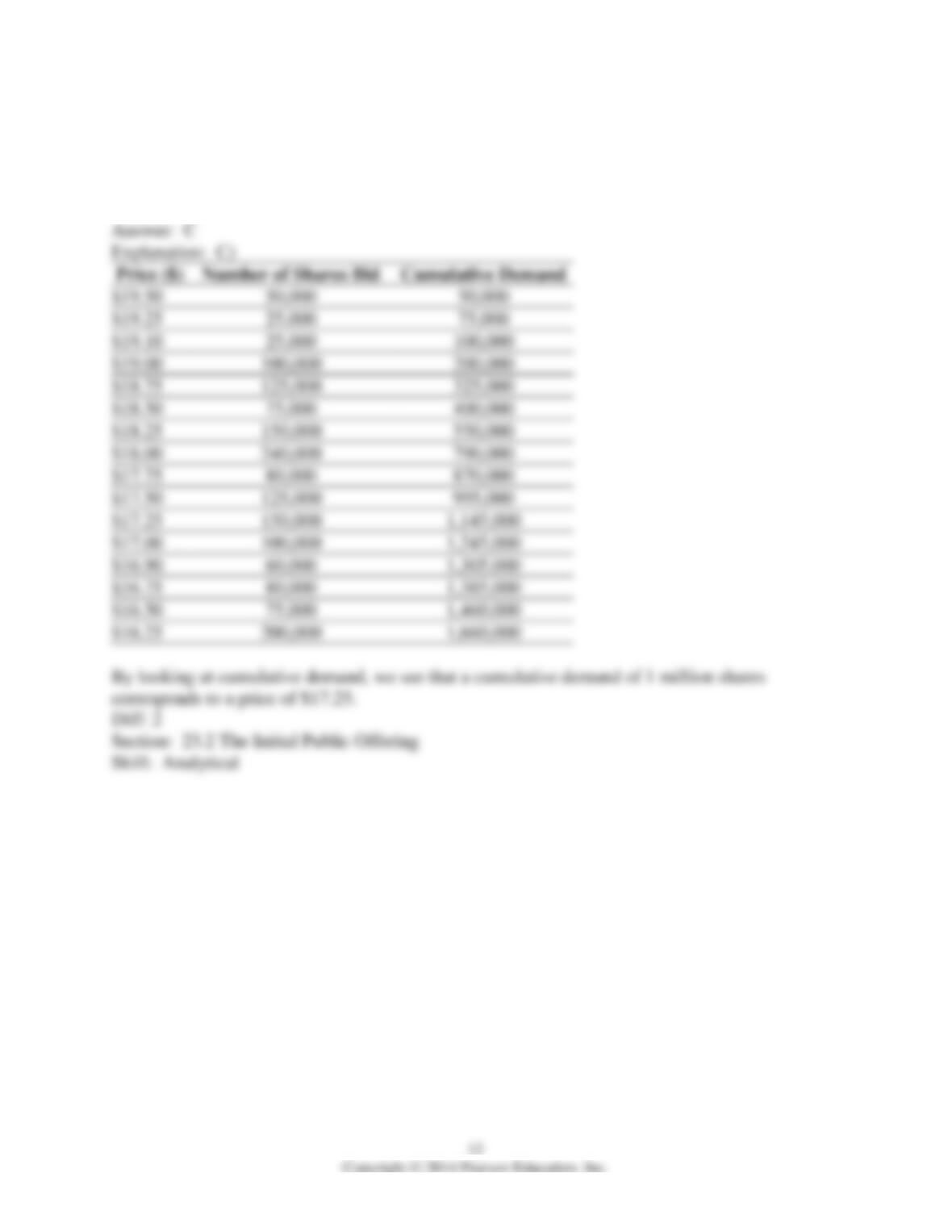
13) What will the offer price of these shares be if Luther is selling 1 million shares?
A) $17.00
B) $17.50
C) $17.25
D) $16.75