Elements of Ecology, 9e (Smith)
Chapter 23 Terrestrial Ecosystems
23.1 Short Answer Questions
1) A(n) ________ is a biotic unit of plant formations and associated animal life based on the
predominant plant types, with at least eight major terrestrial types.
2) Leaves that live for only a single year or growing season are classified as ________.
3) There are consistent patterns in the distribution and abundance of dominant plant life-forms
across the biosphere because these life-forms share ________ to the selection pressures of
climate and the physical environment.
4) Tropical rain forests are restricted primarily to the ________ zone between latitudes 10° N
and 10° S.
5) Tropical ________ refers to vegetation in the drier tropics and subtropics that is dominated by
a ground cover of grasses with scattered shrubs or trees.
6) Native grasslands of North America, influenced by declining precipitation from east to west,
consist of three main types distinguished by the ________ of the dominant species.
7) Arid environments that occur in the rain shadow of mountain barriers or are located far inland
where moist maritime air rarely penetrates are referred to as ________.
8) A(n) ________ climate is characterized by hot, dry summers and cool, moist winters.
9) A belt of coniferous forest, known as ________ forest, occurs in the high latitudes of the
Northern Hemisphere.
10) ________ is the perennially frozen subsurface that develops in boreal and arctic systems
where the ground temperatures remain below 0°C for extended periods of time.
23.2 Multiple-Choice Questions
1) Distribution patterns of biomes can be determined based almost entirely on
A) only mean annual temperature.
B) both mean annual temperature and precipitation.
C) the distribution of soils.
D) global weather patterns.
2) The broad categories of grasses, shrubs, and trees represent a diverse range of species and
characteristics, and they have fundamentally different patterns of
A) nutrient allocation and morphology.
B) carbon allocation and morphology.
C) carbon allocation and nutrient allocation.
3) Which of the following allocates the greatest amount of biomass to photosynthetic tissue and
the least amount to supportive tissue?
A) trees
B) shrubs
C) lianas
D) grasses
4) Which of the following is the predominant leaf form of environments where the growing
season is very short or where nutrient availability severely constrains photosynthesis and plant
growth?
A) winter-deciduous leaves
B) drought-deciduous leaves
C) broadleaf evergreen leaves
D) needle-leaf evergreen leaves
5) What kind of trees dominate in ecosystems characterized by warm, wet climates with no
distinct seasonality?
A) broadleaf evergreen
B) drought-deciduous
C) winter-deciduous
D) needle-leaf evergreen
6) Tropical forests make up 6 percent of total land mass but contain an estimated ________ of all
species on Earth.
A) 1 percent
B) 6 percent
C) 50 percent
D) 90 percent
7) The highest diversity of plant and animal life occurs in
A) tropical savannas.
B) tropical rain forests.
C) temperate deciduous forests.
D) boreal forests.
8) Plants that root and grow on other plants in the tropical rain forest are called
A) phreatophytes.
B) succulents.
C) epiphytes.
D) halophytes.
9) Deeply weathered soils, with no distinct horizons characteristic of the tropical rain forest, are
A) mollisols.
B) andosols.
C) oxisols.
D) alfisols.
10) Decomposition rates in the tropical rain forest are
A) slow due to inhibition of decomposition by moisture.
B) fast due to near optimal conditions for decomposers.
C) fast due to highly fertile soils.
D) slow due to stored soil organic matter pools from which plants draw nutrients.
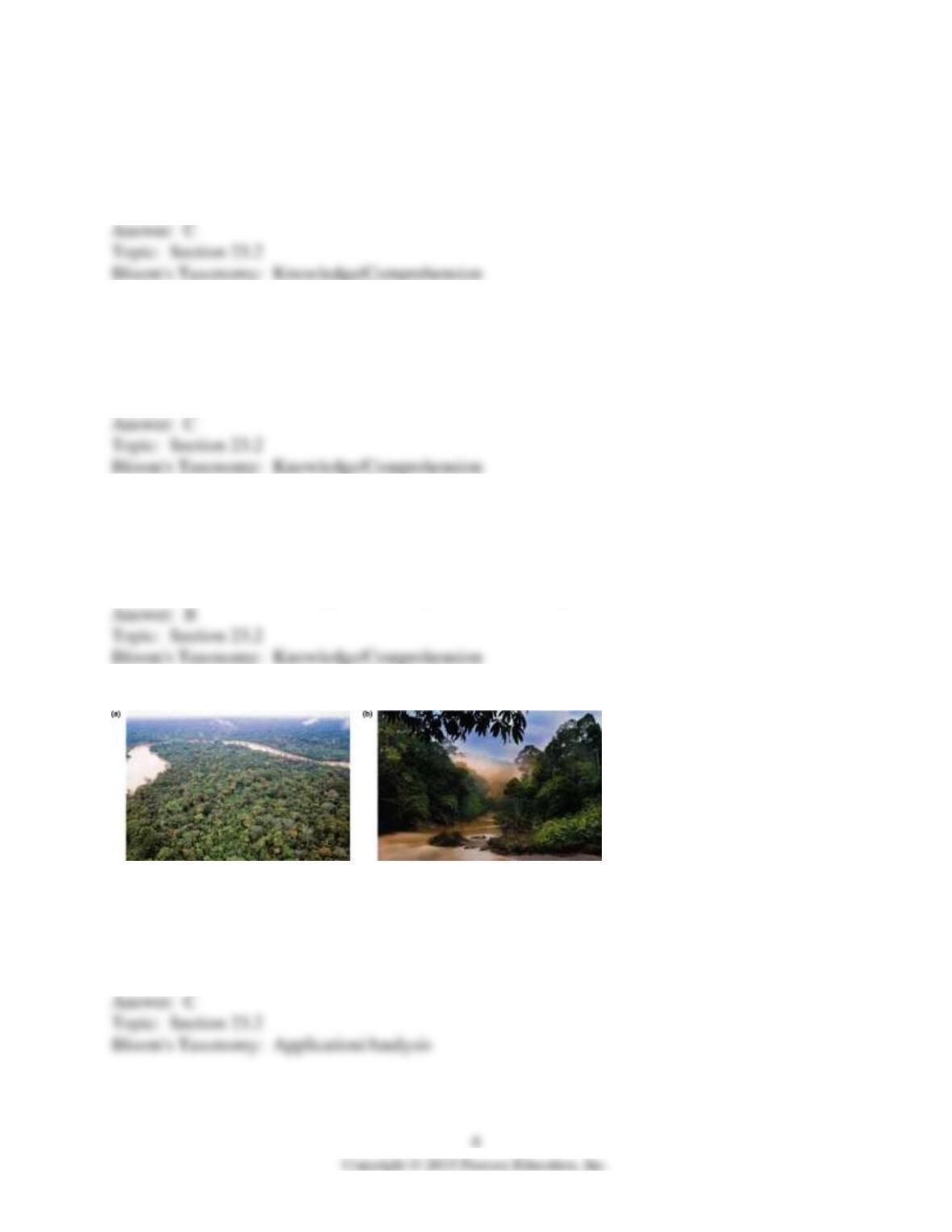
11)
Which type of biome is depicted here?
A) deciduous forest
B) coniferous forest
C) tropical forest
D) savanna
12) Climate diagrams are valuable because they show
A) seasonal variation in temperature and precipitation.
B) abundance of dominant vegetation.
C) diversity of plant species present.
D) variation in carbon availability.
13) What is the primary difference between savannas and tropical forests?
A) Tropical forests are typically warmer.
B) Savannas have less precipitation.
C) Tropical forests have more variable temperatures.
D) There are no climate differences between the two.
14) Savannas typically occur in
A) cold areas with little rainfall in polar regions.
B) cold areas with little rainfall at high altitudes in the tropics.
C) very dry areas in the rain shadow of mountains of both temperate and tropical latitudes.
D) warm areas with seasonal rainfall in the tropics.
15) Campos, llano, and cerrado are all areas of
A) tropical rain forest.
B) tropical savanna.
C) mediterranean shrubland.
D) desert.
16) The density of woody vegetation in a savanna is controlled through
A) mean annual temperature.
B) mean annual temperature, soil texture, and water-holding capacity.
C) mean annual precipitation.
D) mean annual precipitation, soil texture, and water-holding capacity.
17) Large grazing ungulates and burrowing animals are most abundant in
A) deserts.
B) tropical rain forest.
C) temperate shrubland.
D) temperate grassland.
18) The relationship between mean annual precipitation (MAP) and aboveground net primary
productivity (ANPP) is ANPP = 0.50 × (MAP) + (70) in mm MAP and (g/m2/yr) for ANPP in
grassland systems. If precipitation is currently 1000 mm and MAP increases by 25 percent, then
ANPP will be approximately
A) 570.
B) 625.
C) 695.
D) 713.
19) Which of the following is not a type of temperate grassland?
A) veld
B) pampas
C) prairie
D) chaparral
20) Which of the following organisms are adapted to living in a desert?
A) spadefoot toads
B) oak trees
C) lemmings
D) spruce trees
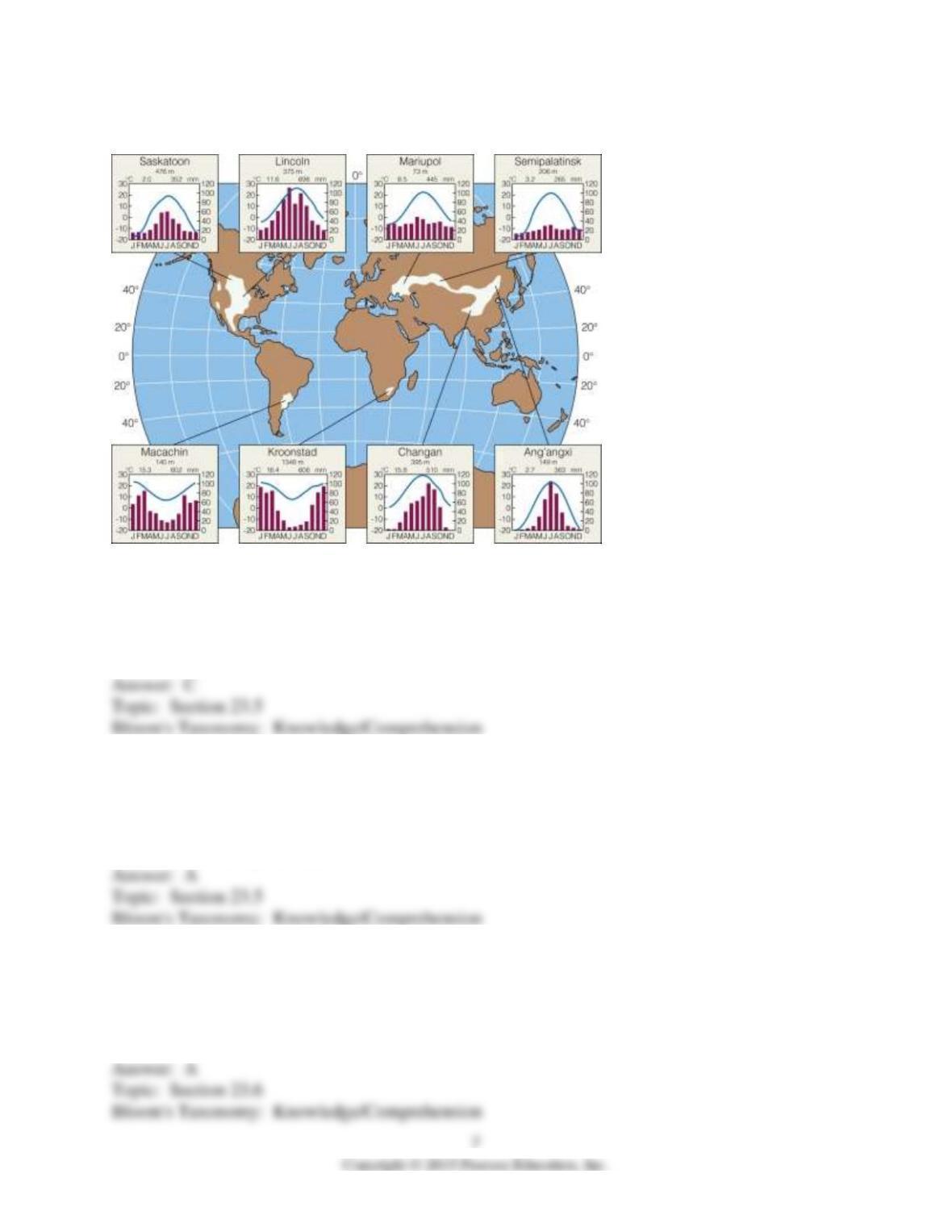
21)
Which biome is represented by the map and climate diagrams?
A) deciduous forest
B) temperate grassland
C) desert
D) savanna
22) Cool deserts are dominated by
A) shrubs such as Artemisia tridentata.
B) trees such as willow or poplar.
C) tall-growth forms of saguaro.
D) ground-dwelling succulents.
23) The dominant biome in mediterranean climates found between 30° and 40° latitude is
A) temperate shrubland.
B) temperate deciduous forest.
C) desert.
D) tropical savanna.
24) The dominant vegetation types in temperate shrublands are
A) pine trees.
B) evergreen shrubs and sclerophyllous vegetation.
C) dwarf willows and Atriplex.
D) grasses and dwarf oak.
25) In which biome would one find sclerophyllous vegetation?
A) tundra
B) taiga
C) shrubland
D) tropical forest
26) In what layer would one find salamanders in a deciduous forest?
A) canopy
B) shrub layer
C) understory
D) ground
27) Typical soils of the temperate forest region are
A) alfisols and inceptisols.
B) oxisols.
C) andosols.
D) aridisols and vertisols.
28) The vegetation formation dominated by needle-leaf evergreen trees and occurring where
growth is restricted to a few months of the year due to low temperatures is referred to as
A) temperate deciduous forest.
B) tundra.
C) boreal forest.
D) temperate shrubland.
29) Increases in elevation are accompanied by decreases in temperature. The rate at which
temperature drops as elevation increases is referred to as the dry adiabatic lapse rate, which gives
a drop in temperature of rising unsaturated air of about 10°C for every 1000 meters. If the
temperature is 25°C at the base of the mountain, what temperatures do organisms experience
3000 meters upslope?
A) 5°C
B) 0°C
C) -5°C
D) -15°C
30) Fire in the taiga
A) damages trees, resulting in excessively slow recovery due to low temperatures.
B) alters nutrient cycling, making nutrients unavailable for trees.
C) occurs often, resulting in decreased competition of vegetation adapted to repeated burning.
D) results in systems dominated by grassland species.
31) Which biome contains the largest tree species in the world?
A) coniferous forest
B) deciduous forest
C) tropical forest
D) arctic forest
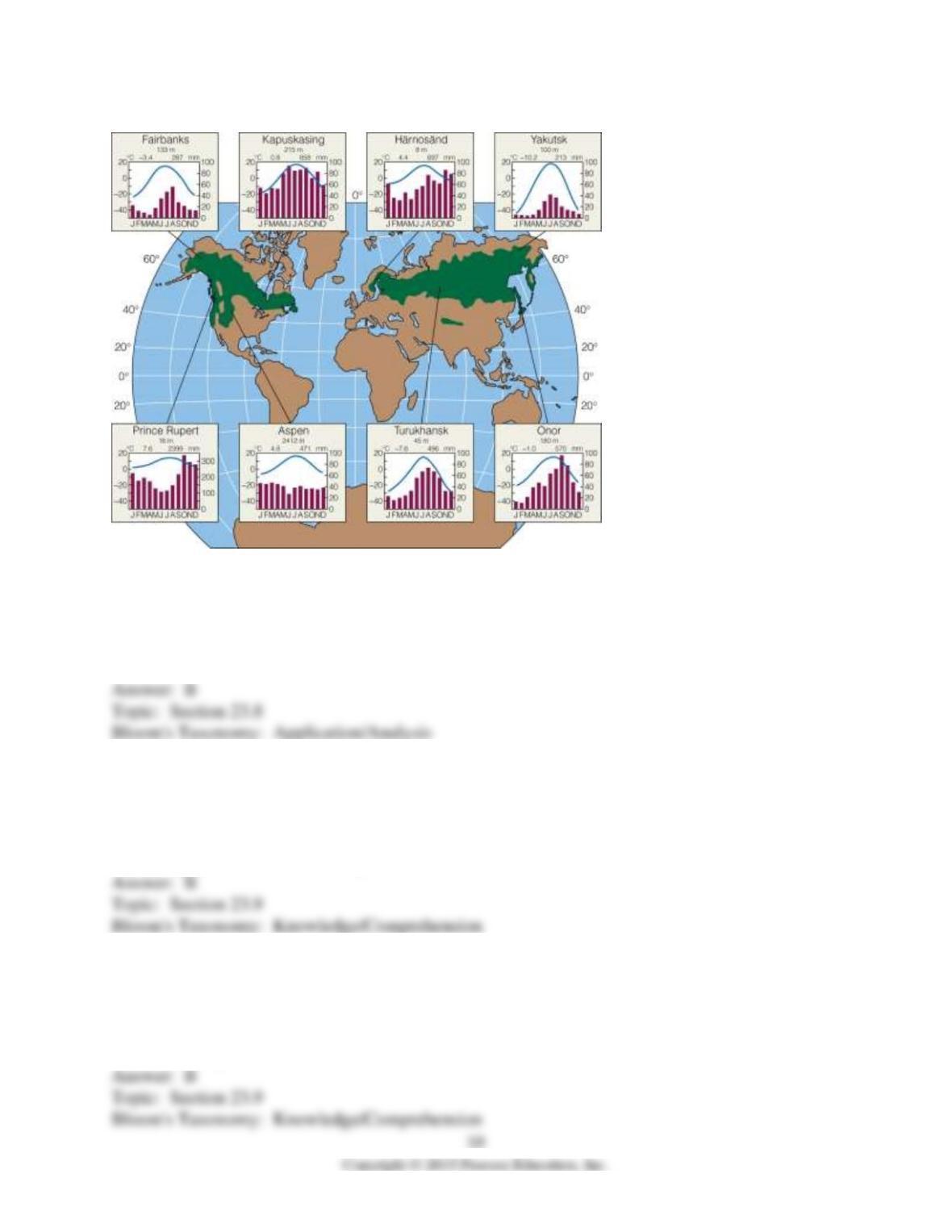
32)
Which biome is represented by the map and climate diagrams?
A) deciduous forest
B) coniferous forest
C) tropical forest
D) tundra
33) The vegetation of tundra is dominated by
A) broadleaf deciduous trees.
B) short plants such as sedges, heaths, and willow.
C) needle-leaf evergreen trees.
D) sclerophyllous broadleaf evergreen shrubs.
34) Which of the following biomes contains permafrost?
A) taiga
B) tundra
C) desert
D) temperate grassland
35) Which of the following is a management technique to reduce the effects of logging?
A) clear-cutting
B) shelterwood
C) top harvest
D) controlled burns
23.3 True/False Questions
1) Classification of the world’s major terrestrial biomes is based on the dominant forms of plant
life.
2) Similar climates produce similar vegetation structure around the world.
3) Deciduous leaves usually live for more than a single year or growing season.
4) Leaf characteristics are useful indicators of the trade-offs plants make to combat
environmental constraints.
5) The largest and most continuous region of tropical rain forest in the world is in South
America.
6) Covering only 6 percent of the land surface, tropical rain forests account for more than 50
percent of all known plant and animal species.
7) Tropical rain forests typically have a thick layer of litter on the forest floor.
8) In the tropical latitudes, the length of the dry season increases with distance from the equator.
9) Topographic features, such as mountains and valleys, influence the climate of a region.
10) Tropical savannas typically lack trees or shrubs.
11) Grasslands formerly covered 42 percent of the land surface of the Earth.
12) Grazing at moderate levels stimulates plant productivity in grassland systems.
13) Grazing ungulates are relatively common and burrowing rodents are relatively rare in
temperate grasslands.
14) Deserts are typically hot throughout the year and rarely have freezing temperatures.
15) Deserts often occur in the rain shadow of mountain ranges.
16) Mediterranean climates are characterized by relatively dry summers and wet winters.
17) Vegetation that is sclerophyllous is adapted to areas with ample moisture and moderate
temperatures.
18) Rainfall is greater in temperate deciduous forests than in temperate shrublands and
grasslands.
19) In temperate deciduous forests, the greatest concentration and diversity of life occur in the
canopy.
20) Coniferous forests are dominated by needle-leaf evergreen trees.
21) Net primary productivity of boreal forest is generally lower than in temperate deciduous
forest.
22) Tundra occurs only at high latitudes in polar regions.
23) Tundra occurs at high elevations on mountains.
23.4 Essay Questions
1) Describe four types of leaf forms and the characteristics of the environment in which each leaf
type typically occurs. Be sure to explain why an economic model might be appropriate to
describe the costs of leaf production in different environments.
2) Discuss the differences in structure and climate between tropical rain forest and dry tropical
forest.
3) Explain why the soils of rain forests are poor for agriculture.
4) Discuss the factors that limit the growth of trees in savannas and grasslands.
5) Discuss the differences in structure and climate between tropical savannas and deserts.
6) Describe the climatic and topographic factors that favor the formation of deserts.
7) Describe the soil conditions in boreal forest and how vegetation affects and is affected by the
soil conditions.
8) How do plants in tundra differ from plants in other biomes in terms of size, growth form, and
contribution to belowground systems? What specific environmental constraints are organisms in
this environment exposed to, and how does their form and function allow them to survive in this
area?