128. Boger Company makes 30,000 lawnmowers each year. To date, all components have been made in house.
All fixed costs are unavoidable. Recently, Exeter Extruding offered to supply Boger with the metal handles for
the lawnmowers for $5 each. Boger analyzed the cost of the handles and came up with the following per unit
information:
Direct materials
$1.60
Direct labor
0.50
Variable overhead
1.75
Fixed overhead
1.30
A. If Boger accepts Exeter’s offer, operating income will be
$ ___________________
Higher or Lower?
B. What is the highest price that Boger would pay an outside company for the handles?
129. Salley Company makes pagers. Currently, Salley purchases 10,000 plastic housings per year from an
outside company for $1 each. One of Salley’s engineers suggested that the company make its plastic housings
in-house. Estimated unit costs are as follows:
Direct materials
$0.30
Direct labor
0.20
Variable overhead
0.15
Fixed overhead*
0.40
* Fixed overhead is $2,400 per year in equipment costs specifically traceable to the plastic housing line and $1,600 per year in general overhead costs
to be allocated to this line
A. If Salley makes the housing in-house, net income will be $__________________ Higher or Lower?
B. What is the highest price per unit that Salley would pay an outside company for the housings?
C. Now assume that all of the fixed overhead is allocated fixed overhead and will not be affected by making the product in-house or purchasing it. If
Salley makes the housing in-house, net income will be $__________________ Higher Lower (circle one)
130. Figure 23-11.
Goutam Company prints a variety of publications and colored inserts for newspapers. Currently, Goutam
produces its own ink, including a special metallic color. India Inks has offered to supply Goutam with the
25,000 ounces of metallic ink that it needs each year for $1.24 per ounce. Goutam is interested because this is a
particularly difficult ink to make. The purchasing department must make special efforts to locate suppliers, the
metallic component requires special handling, and, since the metallic ink uses machinery that is also used to
make other colors of ink, the machinery must be cleaned very well before every batch of metallic. The
accounting department supplied the following unit costs:
Direct materials
$0.40
Direct labor
0.15
Variable overhead
0.06
Fixed overhead*
0.50
*Fixed overhead is applied on the basis of a plantwide rate based on direct labor hours and are unavoidable costs.
Refer to Figure 23-11.
A. Based on the cost figures, if Goutam purchases metallic ink from the outside supplier, operating income will be $__________________ Higher or
Lower?
B. What is the highest price per ounce that Goutam would pay an outside supplier for the ink?
131. Figure 23-11.
Goutam Company prints a variety of publications and colored inserts for newspapers. Currently, Goutam
produces its own ink, including a special metallic color. India Inks has offered to supply Goutam with the
25,000 ounces of metallic ink that it needs each year for $1.24 per ounce. Goutam is interested because this is a
particularly difficult ink to make. The purchasing department must make special efforts to locate suppliers, the
metallic component requires special handling, and, since the metallic ink uses machinery that is also used to
make other colors of ink, the machinery must be cleaned very well before every batch of metallic. The
accounting department supplied the following unit costs:
Direct materials
$0.40
Direct labor
0.15
Variable overhead
0.06
Fixed overhead*
0.50
*Fixed overhead is applied on the basis of a plantwide rate based on direct labor hours and are unavoidable costs.
Refer to Figure 23-11. Upon hearing of the analysis of the cost of making the metallic ink in-house versus buying it from an outside supplier, Jim
Webb, the production supervisor said “That’s nuts! This ink is a real pain to make and $1.24 per ounce sounds like a bargain to me!” Based on Jim’s
feelings, Anna Ruiz (a new CMA in the accounting office) did an ABC analysis of ink production. She came up with the same direct materials, direct
labor and variable overhead, as well as the following information on activities required by metallic ink production.
Setups
$ 60,000
600 setups per year
Purchasing
$270,000
9,000 purchase orders per year
The metallic ink requires 300 purchase orders per year and 80 setups.
A. If Goutam purchases the ink from the outside supplier, operating income would be $__________________ Higher Lower (circle one)
B. What is the highest price per ounce that Goutam would pay an outside company for the ink?
132. Sherpa Company manufactures tents and sleeping bags. Tents are priced at $80, have variable cost of $55,
and direct fixed costs of $120,000. Sleeping bags are priced at $60, have variable cost of $35, and direct fixed
costs of $66,000. Common fixed costs equal $200,000. Last year, the division sold 5,000 tents and 10,000
sleeping bags.
A. What was the segment margin for tents last year?
B. What was the segment margin for sleeping bags last year?
C. What was Sherpa’s operating income last year?
D. If Sherpa stopped making tents, what would operating income be?
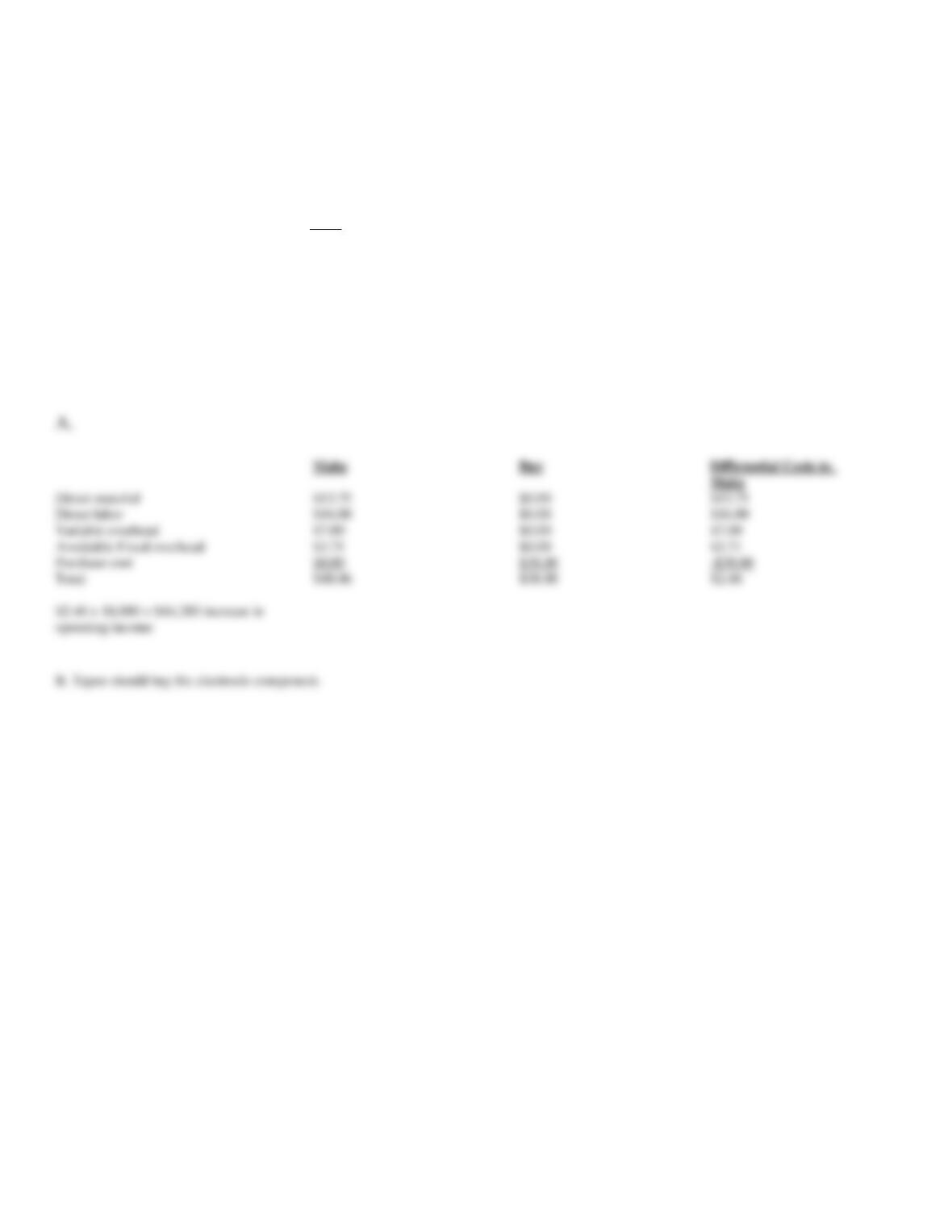
133. Tapeo Company has always made its electronic components that go into their GPS systems in-
house. Streeter Company has offered to supply these electronic components at a price of $38 each. Tapeo uses
18,000 units of these components each year. The cost per unit of this component is as follows:
Direct material
$13.75
Direct labor
$16.00
Variable overhead
$7.00
Fixed overhead
$8.25
Total
$45.00
Assume that 45% of Tapeo Company’s fixed overhead would be eliminated if the electronic component was no longer produced in-house.
Required:
A. If Tapeo decided to purchase the electronic component from Streeter Company how much would its operating income increase or decrease?
B. Should Tapeo continue to make the electronic component or buy it from Streeter Company?
Direct material
$13.75
$0.00
$13.75
Direct labor
$16.00
$0.00
$16.00
Variable overhead
$7.00
$0.00
$7.00
Avoidable Fixed overhead
$3.71
$0.00
$3.71
Purchase cost
$0.00
$38.00
-$38.00
Total
$40.46
$38.00
$2.46
134. Tyler Company has been approached by a new customer with an offer to purchase 6,000 units of its
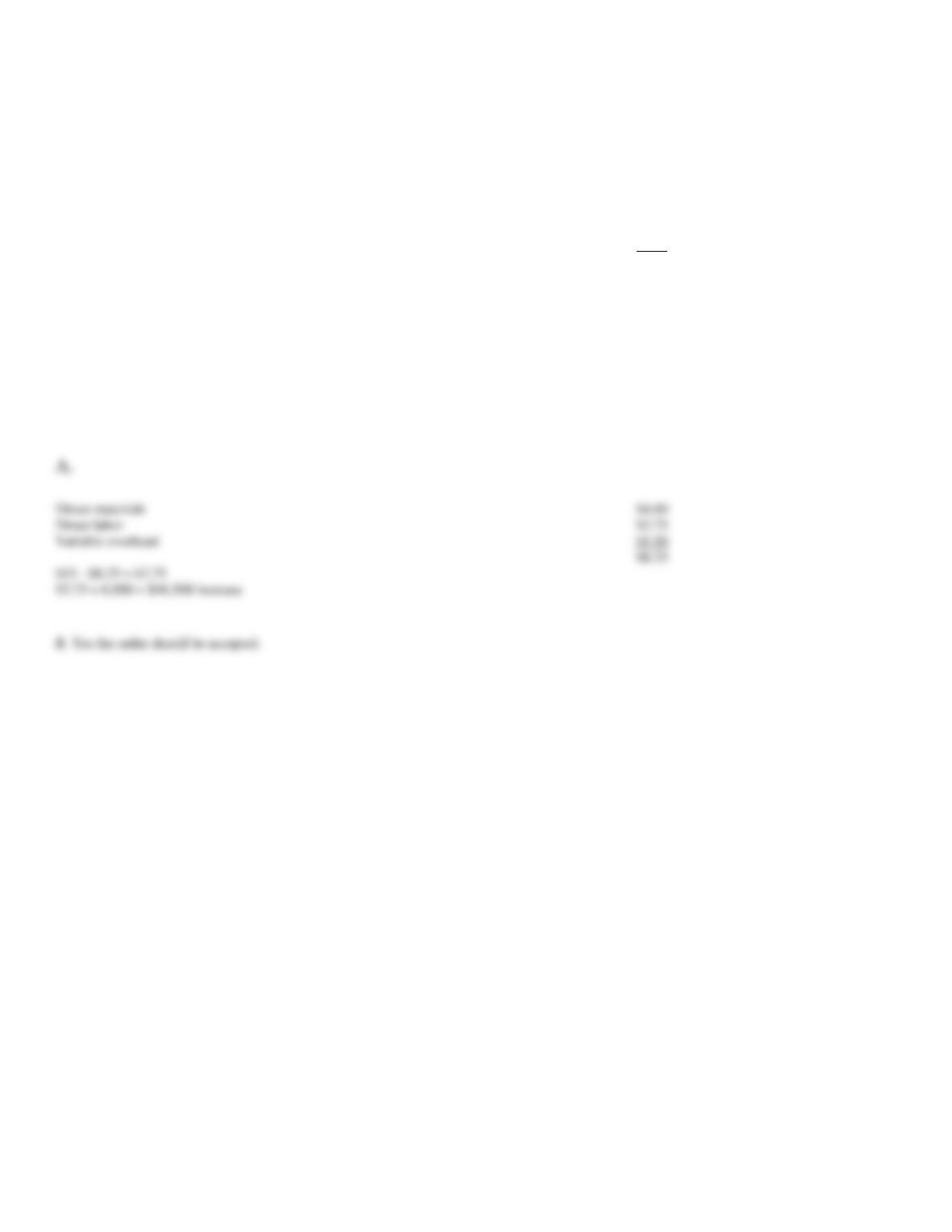
product KR200 at a price of $11 each. The existing sales would not be affected by this special order. Tyler
normally produces 40,000 units but plans to produce and sell 30,000 in the coming year. The normal sales
price is $18 per unit. Unit cost information is as follows:
Direct materials
$4.00
Direct labor
$2.75
Variable overhead
$1.50
Fixed overhead
$3.25
Total
$11.50
If Tyler accepts the order, no fixed manufacturing activities will be affected because there is sufficient excess capacity.
Required:
A. By how much will profit increase or decrease if the order is accepted?
B. Should Tyler accept the special order?
Direct materials
$4.00
Direct labor
$2.75
Variable overhead
$1.50
$8.25
$11 – $8.25 = $2.75
$2.75 x 6,000 = $16,500 increase
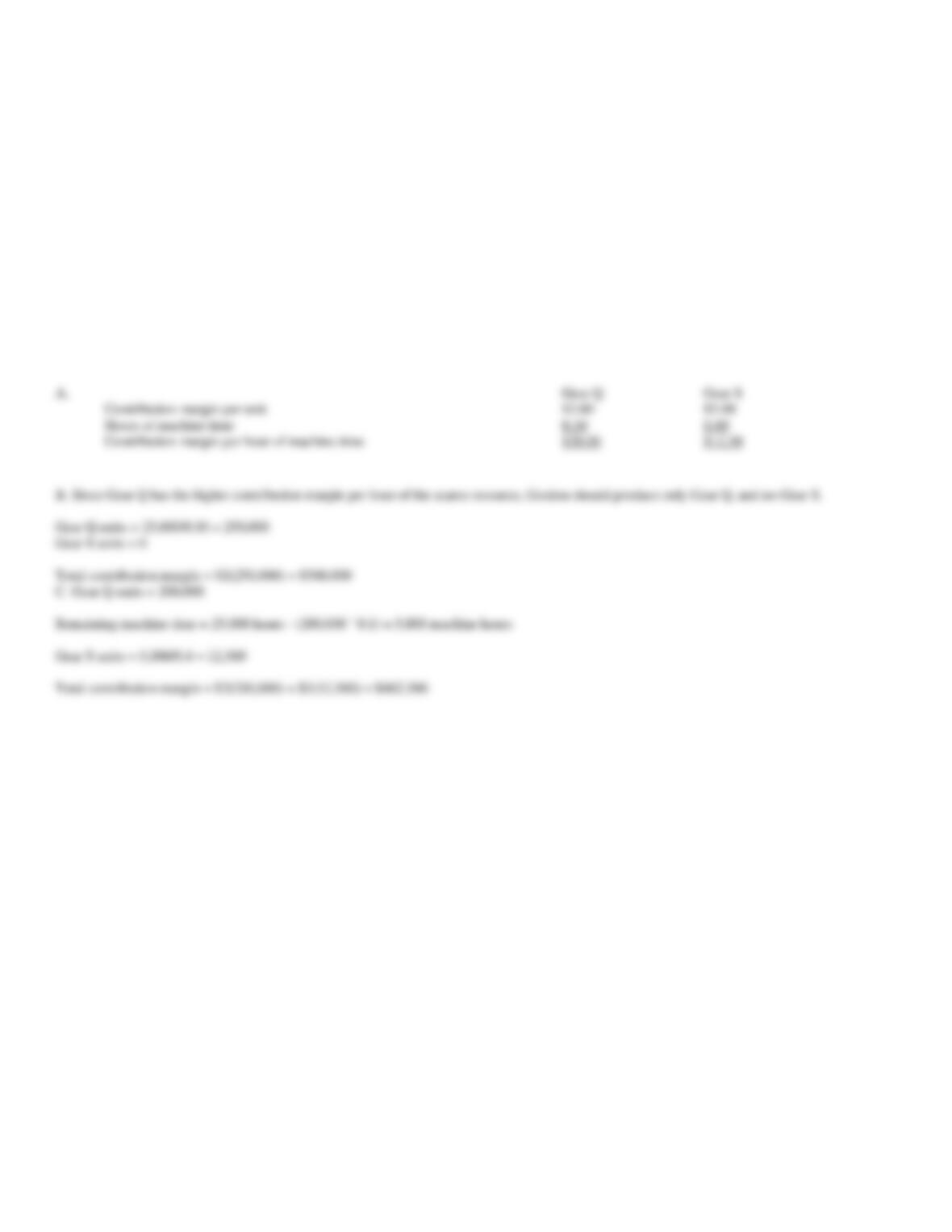
135. Gordon Company produces two types of gears, Gear Q and Gear S, with unit contribution margins of $2
and $5, respectively. Each gear must spend time on a special machine. The firm owns ten machines that
together provide 25,000 hours of machine time per year. Gear Q requires 0.10 hours of machine time; Gear S
requires 0.4 hours of machine time.
A. What is the contribution margin per hour of machine time for Gear Q? Gear S?
B. If Gordon faces only the production constraint (25,000 hours of machine time), how many units of Gear Q
should be produced? Gear S? What is the total contribution margin from this product mix?
C. Now suppose that Gordon cannot sell more than 200,000 units of each type of gear. How many units of Gear
Q should be produced? Gear S? What is the total contribution margin from this product mix?
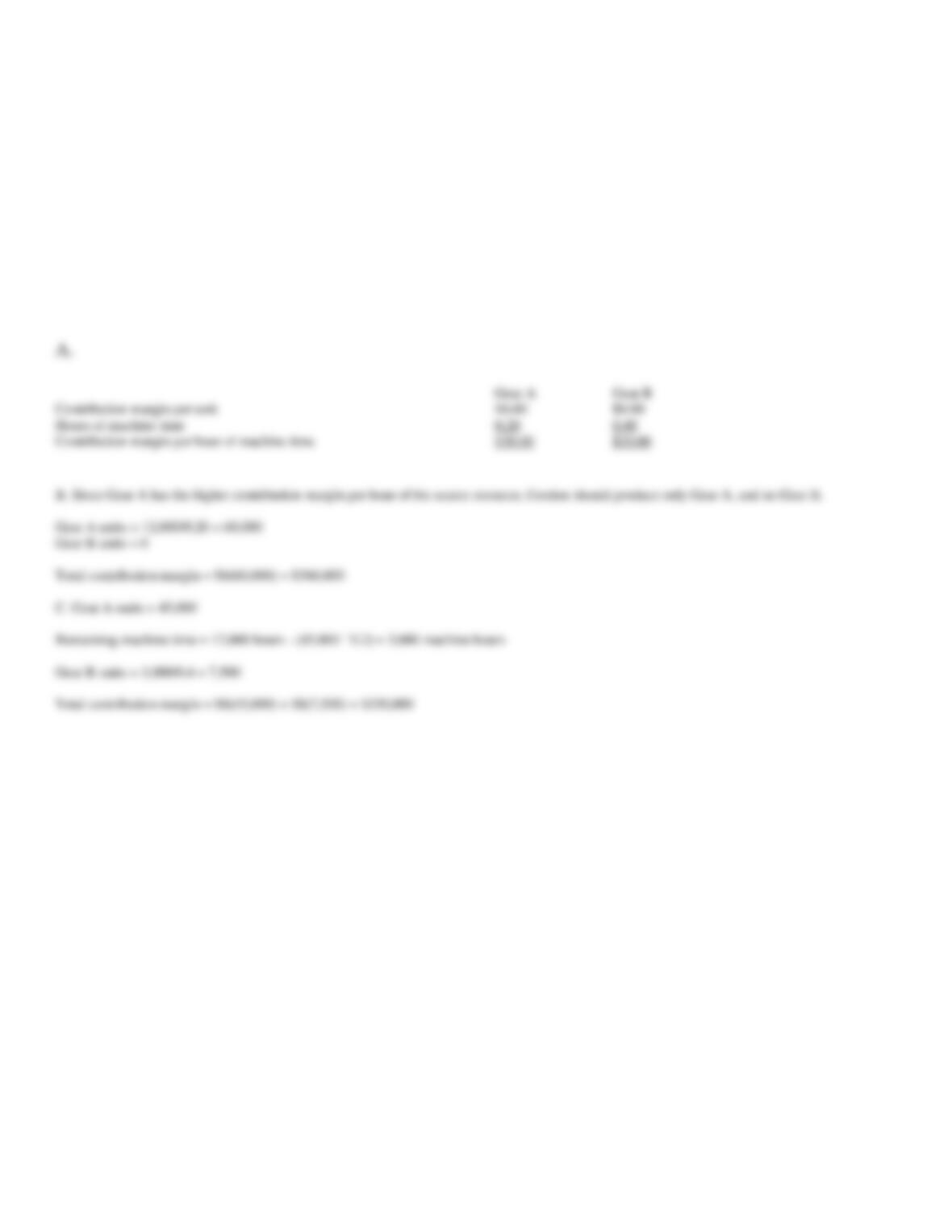
136. David Company produces two types of gears, Gear A and Gear B, with unit contribution margins of $6 and
$8, respectively. Each gear must spend time on a special machine. The firm owns five machines that together
provide 12,000 hours of machine time per year. Gear A requires 12 minutes of machine time; Gear B requires
24 minutes of machine time.
A. What is the contribution margin per hour of machine time for Gear A? Gear B?
B. If David faces only the production constraint (12,000 hours of machine time), how many units of Gear A
should be produced? Gear B? What is the total contribution margin from this product mix?
C. Now suppose that David cannot sell more than 45,000 units of each type of gear. How many units of Gear A
should be produced? Gear B? What is the total contribution margin from this product mix?
137. Auden makes three types of vitamin supplements, all of which require the use of encapsulating machines
that have capacity of 10,000 hours. Information on the three types (per case) follows:
Basic
Vita-Stress
Antioxidant+
Selling price
$100
$125
$160
Variable cost
50
70
90
Machine hours
0.4
0.50
0.8
A. What is the contribution margin per case for each type?
B. What is the contribution margin per hour of machine time for each type?
C. Based on your analysis in requirement B, if the company can sell all that it can make of all of the products, how many of each type should be sold
to maximize total contribution margin?
Basic
Vita-Stress
Antioxidant+
Price
$100
$125
$160
– Variable cost
Contribution margin
138. Classy Carry manufactures two types of handbags, the Clutch and the Tote, with unit contribution margins
of $9 and $15, respectively. Regardless of the type, each handbag must go through a stitching machine. The
company owns 4 stitching machines and each provides 3,000 hours of machine time per year. Each Clutch
handbag requires 12 minutes of machine time and each Tote handbag requires 30 minutes of machine
time. There are no other constraints.
Required:
A. What is the contribution margin per hour of machine time for each type of handbag?
B. What is the optimal mix of handbags?
C. What is the total contribution margin earned for the optimal mix?
139. The Exchange Company is in the process of developing a new product called LS500. The company
requires a 35% profit. The LS500 current design carries with it a total cost of $125.
Required:
A. What is the sales price of the LS500 using markup costing?
B. Assume that the Exchange Company’s marketing department has determined that consumers are willing to
pay $140 for the LS500. What is the target cost for this product?
Clutch
Tote
Contribution margin per unit
Required machine time per unit
0.2
0.5
Contribution margin per hour of machine time
12,000 hours = 60,000 Clutch bags
.20 hour per Clutch handbag
140. Rudd Company uses 40,000 micro-chips each year in its production of digital cameras. The cost of
placing an order is $75. The cost of holding one unit of inventory for one year is $8. Currently Rudd places 20
orders of 2,000 units per order.
Required:
A. Compute the annual ordering cost.
B. Compute the annual carrying cost.
141. “The decision making model is not useful in real life because it only looks at the numbers.” Critique this
statement and give an example for which it does not hold true.
142. Why does a special order decision frequently ignore fixed overhead?
143. You decide
The managers of Computer World are trying to determine the best method of deciding the price of their new
ultra minicomputer. This computer will present the customers with several unique features that their other
computers do not offer. They have asked you to explain the advantages and disadvantages of the two costing
methods they are considering; markup costing and target costing.
144. List three problems inventory was meant to solve. How does the JIT producer handle these problems?