Chapter 23—Short-Run-Decision Making: Relevant Costing and
Inventory Management Key
1. The first step in making a short-run decision is to identify alternatives as possible solutions to the problem.
2. In making a short-run decision, all alternatives need to be considered.
3. In short-run decision making, the alternative with the lowest overall cost is always chosen.
4. Irrelevant costs are costs that are the same for more than one alternative.
5. The benefit sacrificed when one alternative is chosen over another is called sunk cost.
6. Short-run decision making only involves short-run decisions that have nothing to do with the firm’s overall
strategy.
7. A sunk cost isalways relevant.
8. Future costs that differ across alternatives are relevant costs.
9. Fixed costs are never relevant.
10. Resources that are acquired in advance of usage are flexible resources.
11. Flexible resources may have unused capacity.
12. A choice between internal and external production is a keep-or-drop decision.
13. Typically in a special-order decision, a customer wants to pay more than the usual price.
14. In keep-or–drop decisions, both the segment’s contribution margin and its segment margin are useful in
evaluating the performance of the segment.
15. A segment margin is always greater than or equal to zero.
16. At split-off, the joint costs of production for joint products are not relevant to the sell-or-process-further
decision.
17. In deciding the optimal mix of products that use a constrained resource, it is important to determine the
contribution margin per unit of scarce resource.
18. Linear programming is a special technique that can be used to determine the optimal product mix when
there are multiple constraints.
19. A situation in which management tells divisions that they must reduce costs by 10% is called target costing.
20. Bellair Company produces a product that has manufacturing cost of $30 per unit. Bellair’s policy is to
charge a price equal to cost plus 30%. The 30% is pure profit to Bellair.
21. In determining the target price of a good, the company must first determine the target cost and the desired
profit.
22. Demand is one side of the pricing equation; supply is the other side.
23. The markup includes desired profit and any costs not included in the base cost.
24. Many companies start with cost to determine price since revenue must cover cost for the firm to make a
profit.
25. A major advantage of markup pricing is that standard markups are easy to apply.
26. Target costing is a method of determining the cost of a product or service based on the price (target price)
that customers are willing to pay.
27. Target costing can be used most effectively in the design and development stage of the product life cycle.
28. The costs of not having a product available when demanded by a customer are called stockout costs.
29. Total inventory-related cost consists of ordering cost and carrying cost.
30. JIT relies on a push system to control finished goods inventory.
31. A major drawback to the JIT inventory approach is that it increases carrying costs.
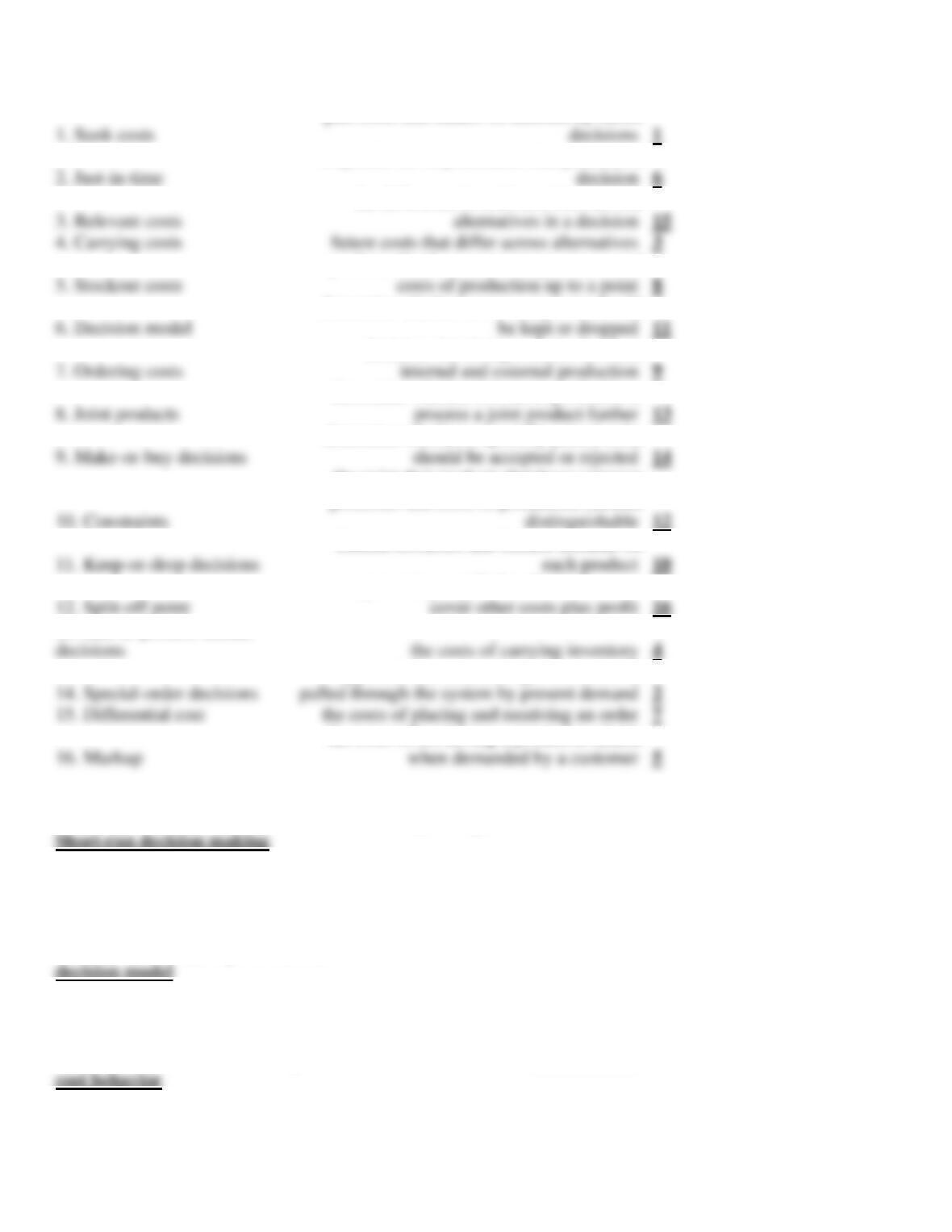
32. Match each statement with the correct item below.
past costs that cannot be affected by future
a specific set of procedures that produces a
the difference in total cost between the
products that have common processes and
determine whether or not a segment should
decisions involving a choice between
determine whether it is more profitable to
determine whether a specially priced order
the point that products that have common
processes and costs of production become
limited resources and limited demand for
a percentage applied to the base cost to
13. Sell-or-process-further
approach that maintains goods should be
the costs of not having a product available
33. ____________________ consists of choosing among alternatives with an immediate or limited end in view.
34. A _________________ can be used to structure the decision maker’s thinking and to organize the
information to make a good decision.
35. Most short-run decisions require extensive consideration of ___________.
36. If a future cost is the same for more than one alternative, and it has no effect on the decision is known as
a(n) _____________ cost.
37. In order to be classified as a _________________, a cost must possess two characteristics, that they are
future costs and they differ across alternatives.
38. The benefit sacrificed or foregone when one alternative is chosen over another is known as the
____________________.
39. A cost that cannot be affected by any future action is called a(n) _______________.
40. A manager will make a __________________ when determining if a specially priced order should be
accepted or rejected.
41. Segmented reports are helpful for managers to make _______________ decisions.
42. The decision on whether to produce a product internally or purchase it from a supplier is an example of a
_______________.
43. __________________ have common processes and costs of production up to a split-off point.
44. ______________ is the point at which products become distinguishable after passing through a common
process.
45. Limited resources or a limited demand for a product are examples of ______________.
46. In the presence of multiple constraints the solution is considerably more complex than for one constraint and
requires a technique known as ____________________.
47. ________________ refers to the relative amount of each product manufactured by a company.
48. The percentage that is applied to the base cost is known as the _____________.
49. A method of determining the cost of a product or service based on the price that customers are willing to
pay is called ________________.
50. Inventory taxes, obsolescence, and insurance are examples of _______________.
51. Lost sales and costs of expediting shipments of goods are examples of _______________.
52. The ______________ approach maintains that goods should be pulled through the system by present
demand rather than being pushed through on a fixed schedule based on anticipated demand.
53. Pasha Company produced 50 defective units last month at a unit manufacturing cost of $30. The defective
units were discovered before leaving the plant. Pasha can sell them “as is” for $20 or can rework them at a cost
of $15 and sell them at the regular price of $50. Which of the following is not relevant to the sell-or-rework
decision?
54. Which of the following is not a step in the decision-making model?
55. The act of choosing among alternatives with an immediate or limited end in view is termed
56. Future costs that differ across alternatives are
57. Depreciation of equipment is an example of a(n)
58. Resources that can be purchased in the amount needed and at the time of use are
59. A company is considering a special order for 1,000 units to be priced at $8.90 (the normal price would be
$11.50). The order would require specialized materials costing $4.00 per unit. Direct labor and variable factory
overhead would cost $2.15 per unit. Fixed factory overhead is $1.20 per unit. However, the company has excess
capacity and acceptance of the order would not raise total fixed factory overhead. The warehouse, however,
would have to add capacity costing $1,300. Which of the following is relevant to the special order?
60. Walloon Company produced 150 defective units last month at a unit manufacturing cost of $30. The
defective units were discovered before leaving the plant. Walloon can sell them as is for $20 or can rework
them at a cost of $15 and sell them at the regular price of $50. The total relevant cost of reworking the defective
units is:
61. A decision involving a choice between internal and external production is what kind of decision?
62. A decision that focuses on whether a specially priced order should be accepted or rejected is what kind of
decision?
63. A decision in which a manager needs to determine whether a product line (or segment) should continue or
be eliminated is what kind of decision?
64. A decision that involves potential further processing of joint products is which kind of decision?
65. Piersall Company makes a variety of paper products. One product is 20 lb copier paper, packaged 5,000
sheets to a box. One box normally sells for $18. A large bank offered to purchase 3,000 boxes at $14 per box.
Costs per box are as follows:
Direct materials
$8
Direct labor
3
Variable overhead
1
Fixed overhead
5
No variable marketing costs would be incurred on the order. The company is operating significantly below the maximum productive capacity. No
fixed costs are avoidable.
Should Piersall accept the order?
66. Aerotoy Company makes toy airplanes. One plane is an excellent replica of a 737; it sells for $5. Vacation
Airlines wants to purchase 12,000 planes at $1.75 each to give to children flying unaccompanied. Costs per
plane are as follows:
Direct materials
$1.00
Direct labor
0.50
Variable overhead
0.10
Fixed overhead
0.90
No variable marketing costs would be incurred. The company is operating significantly below the maximum productive capacity. No fixed costs are
avoidable. However, Vacation Airlines wants its own logo and colors on the planes. The cost of the decals is $0.01 per plane and a special machine
costing $1,500 would be required to affix the decals. After the order is complete, the machine would be scrapped. Should the special order be
accepted?
67. Figure 23-2.
ColorPro uses part 87A in the production of color printers. Unit manufacturing costs of part 87A are:
Direct materials
$8
Direct labor
2
Variable overhead
1
Fixed overhead
4
ColorPro uses 100,000 units of 87A per year. Filbert Company has offered to sell ColorPro 100,000 units of 87A per year for $12. Fixed overhead is
unavoidable.
Refer to Figure 23-2. Should ColorPro make or buy the part?
68. Figure 23-2.
ColorPro uses part 87A in the production of color printers. Unit manufacturing costs of part 87A are:
Direct materials
$8
Direct labor
2
Variable overhead
1
Fixed overhead
4
ColorPro uses 100,000 units of 87A per year. Filbert Company has offered to sell ColorPro 100,000 units of 87A per year for $12. Fixed overhead is
unavoidable.
Refer to Figure 23-2. Now suppose that ColorPro discovers that other costs will increase by $7,000 per year if the component is purchased rather
than made internally. Should ColorPro make or buy the part?
69. Figure 23-2.
ColorPro uses part 87A in the production of color printers. Unit manufacturing costs of part 87A are:
Direct materials
$8
Direct labor
2
Variable overhead
1
Fixed overhead
4
ColorPro uses 100,000 units of 87A per year. Filbert Company has offered to sell ColorPro 100,000 units of 87A per year for $12. Fixed overhead is
unavoidable.
Refer to Figure 23-2. Which of the following is a qualitative factor that might affect ColorPro’s decision?
70. Figure 23-6.
Autry Company manufactures veterinary products. One joint process involves refining a chemical (dactylyte)
into two chemicals – dac and tyl. One batch of 5,000 gallons of dactylyte can be converted to 2,000 gallons of
dac and 3,000 gallons of tyl at a total joint processing cost of $12,000. At the split-off point, dac can be sold for
$3 per gallon and tyl can be sold for $4 per gallon. Autry has just learned of a new process to convert dac into
prodac. The new process costs $4,000 and yields 1,700 gallons of prodac for every 2,000 gallons of dac. Prodac
sells for $5 per gallon.
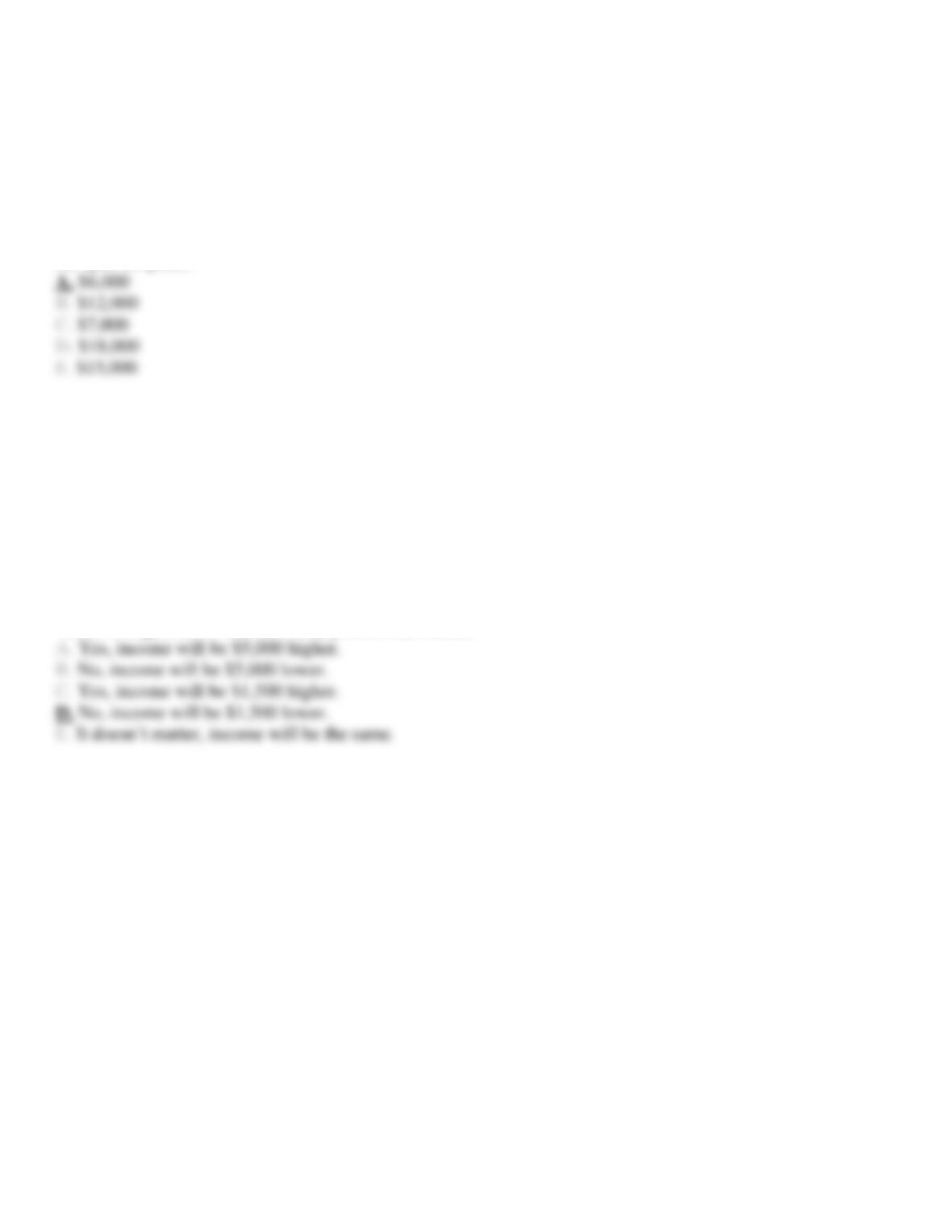
Refer to Figure 23-6. What is Autry’s profit from refining one batch of dactylyte if both dac and tyl are sold at
the split-off point?
71. Figure 23-6.
Autry Company manufactures veterinary products. One joint process involves refining a chemical (dactylyte)
into two chemicals – dac and tyl. One batch of 5,000 gallons of dactylyte can be converted to 2,000 gallons of
dac and 3,000 gallons of tyl at a total joint processing cost of $12,000. At the split-off point, dac can be sold for
$3 per gallon and tyl can be sold for $4 per gallon. Autry has just learned of a new process to convert dac into
prodac. The new process costs $4,000 and yields 1,700 gallons of prodac for every 2,000 gallons of dac. Prodac
sells for $5 per gallon.
Refer to Figure 23-6. Should Autry process dac further?
72. Figure 23-7.
Ring Company makes telephones. Currently, Ring makes all components of the telephones in-house. An outside
company has offered to supply one component, part number X76, for $12 each. Ring uses 22,000 of these
components per year. Costs of X76 are as follows:
Direct materials
$3.00
Direct labor
$1.50
Variable overhead
$2.75
Fixed overhead
$5.00
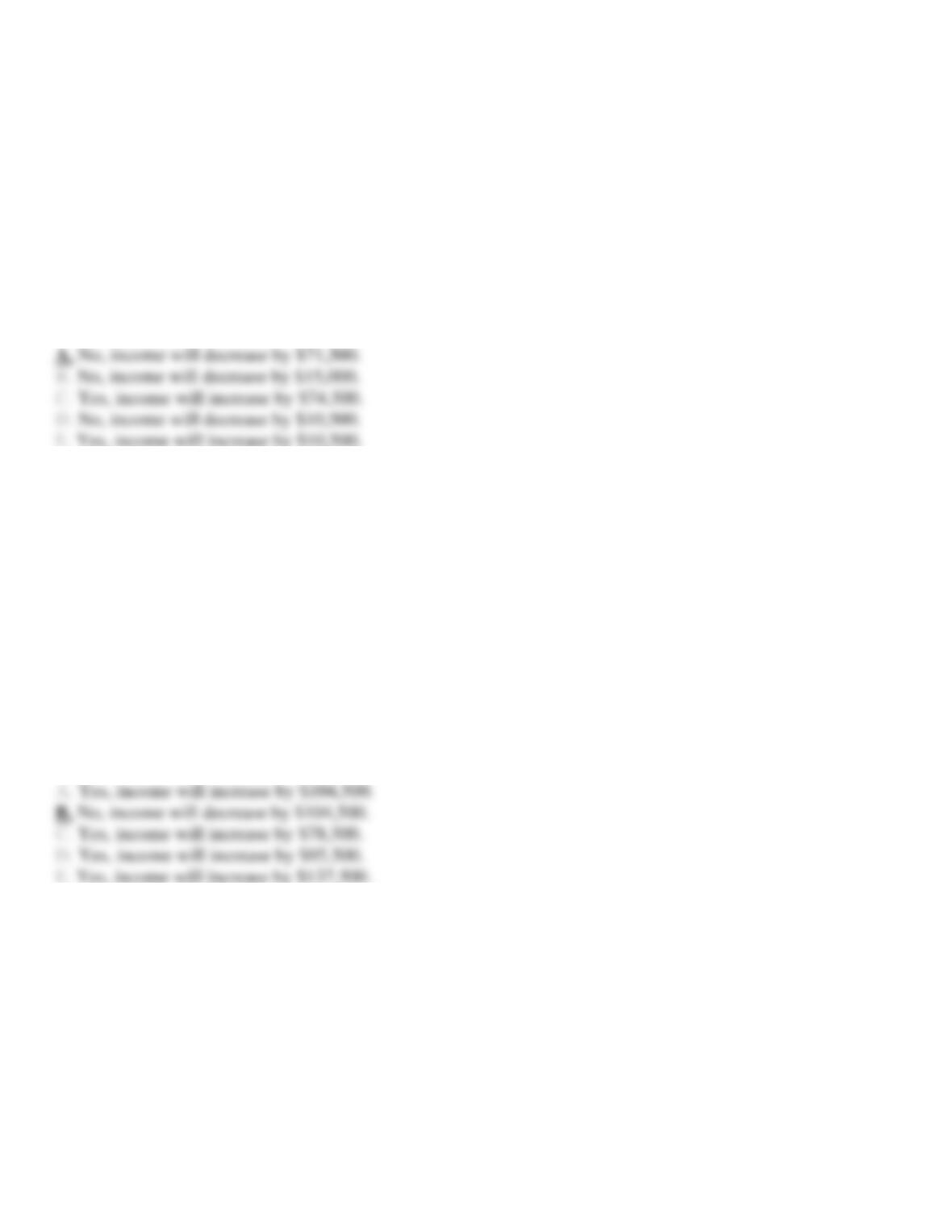
Refer to Figure 23-7. Suppose that 30% of the fixed overhead is avoidable if part X76 is not made by Ring. Should Ring purchase the part from the
outside supplier?
73. Figure 23-7.
Ring Company makes telephones. Currently, Ring makes all components of the telephones in-house. An outside
company has offered to supply one component, part number X76, for $12 each. Ring uses 22,000 of these
components per year. Costs of X76 are as follows:
Direct materials
$3.00
Direct labor
$1.50
Variable overhead
$2.75
Fixed overhead
$5.00
Refer to Figure 23-7. Assume that all of the fixed overhead is allocated and cannot be avoided. Should Ring purchase the part from the outside
supplier?
74. Figure 23-8.
Kerrigan Lumber Yard receives 12,000 large trees each year that they process into rough logs. Currently,
Kerrigan sells the rough logs for $75 each. Kerrigan is considering processing the logs further into refined
lumber. Each log can be processed into 200 feet of refined lumber at an additional cost of $0.40 per foot. The
refined lumber can be sold for $0.95 per foot.
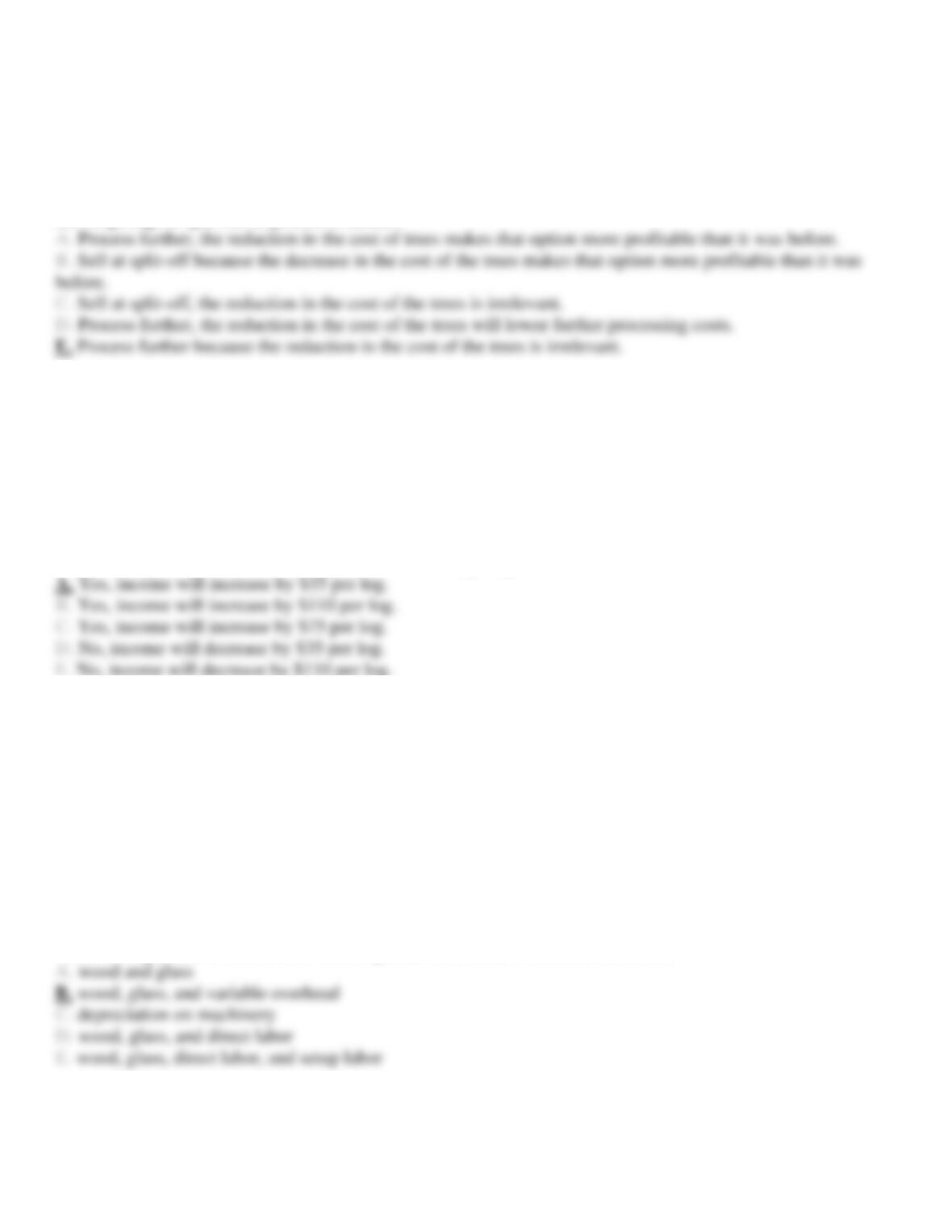
Refer to Figure 23-8. Assume that the cost of getting the 12,000 large trees falls by half. Should Kerrigan sell
the rough logs at split-off or process it further?
75. Figure 23-8.
Kerrigan Lumber Yard receives 12,000 large trees each year that they process into rough logs. Currently,
Kerrigan sells the rough logs for $75 each. Kerrigan is considering processing the logs further into refined
lumber. Each log can be processed into 200 feet of refined lumber at an additional cost of $0.40 per foot. The
refined lumber can be sold for $0.95 per foot.
Refer to Figure 23-8. Should Kerrigan process the rough logs into refined lumber?
76. Figure 23-1.
Fuller Company makes frames. A customer wants to place a special order for 600 frames in green with the
company logo painted on the frame, to be priced at $40 each. Normally, Fuller would charge $90 per frame for
this type of order. Fuller figures that wood and glass will cost $16 per frame, variable overhead (machining,
electricity) is $4 per frame, direct labor is $12 per frame, and one setup will be required at $1,000 per setup. The
set-up charge costs are 100% labor. Currently, the workers needed to set up for and make the frames are
working at Fuller. Their wages will be paid whether or not the special order is accepted. Fuller’s policy is to
avoid layoffs to the extent possible.
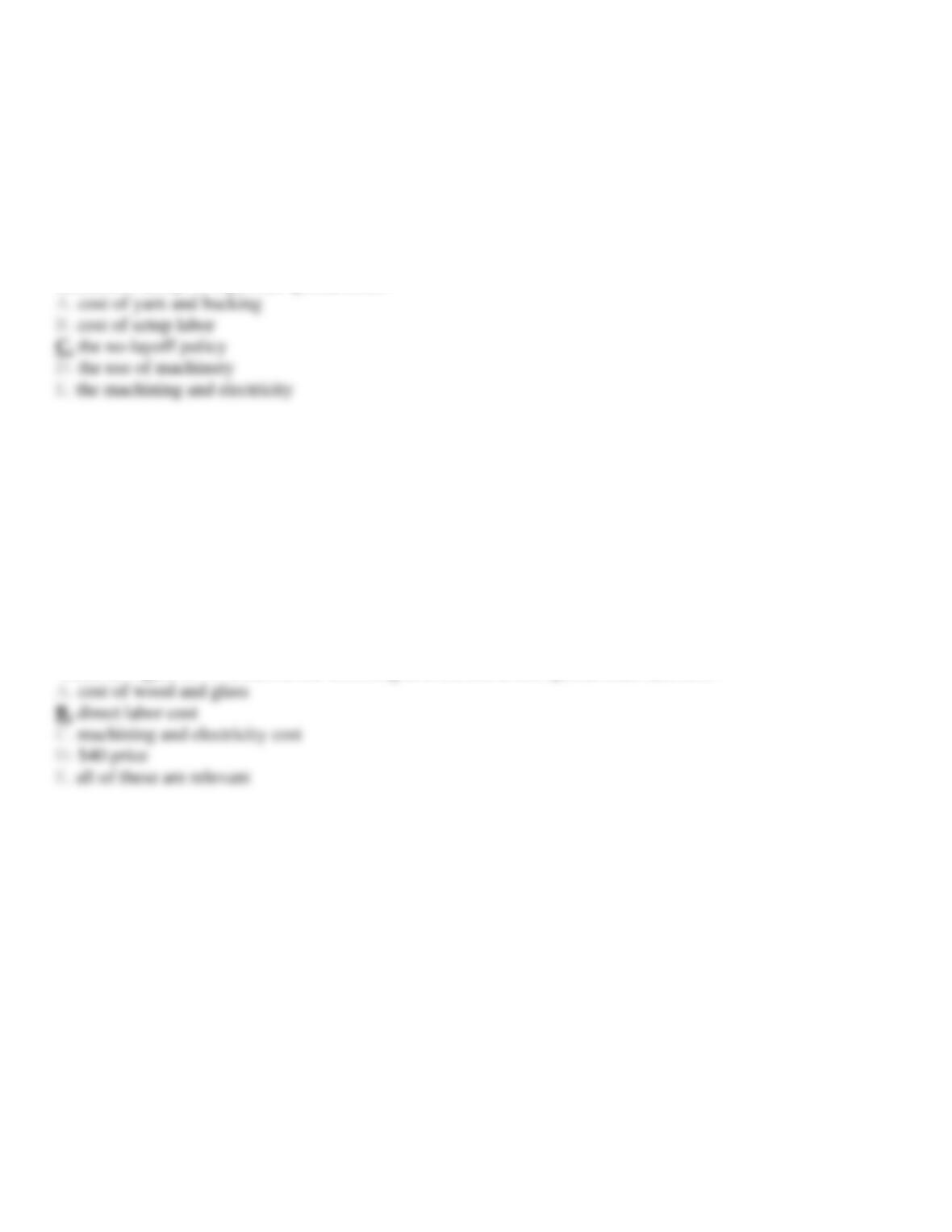
Refer to Figure 23-1. Which costs of the special order relate to flexible resources?
77. Figure 23-1.
Fuller Company makes frames. A customer wants to place a special order for 600 frames in green with the
company logo painted on the frame, to be priced at $40 each. Normally, Fuller would charge $90 per frame for
this type of order. Fuller figures that wood and glass will cost $16 per frame, variable overhead (machining,
electricity) is $4 per frame, direct labor is $12 per frame, and one setup will be required at $1,000 per setup. The
set-up charge costs are 100% labor. Currently, the workers needed to set up for and make the frames are
working at Fuller. Their wages will be paid whether or not the special order is accepted. Fuller’s policy is to
avoid layoffs to the extent possible.
Refer to Figure 23-1. Which of the following is a qualitative factor that Fuller would consider in making the
decision to accept or reject the special order?
78. Figure 23-1.
Fuller Company makes frames. A customer wants to place a special order for 600 frames in green with the
company logo painted on the frame, to be priced at $40 each. Normally, Fuller would charge $90 per frame for
this type of order. Fuller figures that wood and glass will cost $16 per frame, variable overhead (machining,
electricity) is $4 per frame, direct labor is $12 per frame, and one setup will be required at $1,000 per setup. The
set-up charge costs are 100% labor. Currently, the workers needed to set up for and make the frames are
working at Fuller. Their wages will be paid whether or not the special order is accepted. Fuller’s policy is to
avoid layoffs to the extent possible.
Refer to Figure 23-1. Which of the following is irrelevant to the special order decision?
79. Figure 23-1.
Fuller Company makes frames. A customer wants to place a special order for 600 frames in green with the
company logo painted on the frame, to be priced at $40 each. Normally, Fuller would charge $90 per frame for
this type of order. Fuller figures that wood and glass will cost $16 per frame, variable overhead (machining,
electricity) is $4 per frame, direct labor is $12 per frame, and one setup will be required at $1,000 per setup. The
set-up charge costs are 100% labor. Currently, the workers needed to set up for and make the frames are
working at Fuller. Their wages will be paid whether or not the special order is accepted. Fuller’s policy is to
avoid layoffs to the extent possible.
Refer to Figure 23-1. If Fuller accepts the special order, by how much will operating income increase or
decrease?
80. When managers are considering the optimal product mix, they are most concerned with
81. Limited resources and limited demand for a product are generally referred to as
82. The solution of the product mix problem in the presence of multiple constraints requires the use of
83. Figure 23-3.
Elegance Bath Products Inc. (EBP) makes a variety of ceramic sinks and tubs. EBP has just developed a line of
sinks and tubs made from a mixture of glass and ceramic. The sinks sell for $150 each and have variable costs
of $80. The tubs sell for $600 and have variable costs of $450. The glass and ceramic sinks and tubs require the
use of specialized molding equipment. The specialized molding equipment has 4,050 hours of capacity per year.
A sink uses an average of 2 hours of specialized molding equipment time; a tub uses an average of 5 hours of
specialized molding equipment time.
Refer to Figure 23-3. What is the contribution margin per hour of specialized molding equipment time for
sinks?
84. Figure 23-3.
Elegance Bath Products Inc. (EBP) makes a variety of ceramic sinks and tubs. EBP has just developed a line of
sinks and tubs made from a mixture of glass and ceramic. The sinks sell for $150 each and have variable costs
of $80. The tubs sell for $600 and have variable costs of $450. The glass and ceramic sinks and tubs require the
use of specialized molding equipment. The specialized molding equipment has 4,050 hours of capacity per year.
A sink uses an average of 2 hours of specialized molding equipment time; a tub uses an average of 5 hours of
specialized molding equipment time.
Refer to Figure 23-3. Assume that EBP can sell as many as 1,000 sinks and 500 tubs per year. How many tubs
should EBP produce?
85. Figure 23-3.
Elegance Bath Products Inc. (EBP) makes a variety of ceramic sinks and tubs. EBP has just developed a line of
sinks and tubs made from a mixture of glass and ceramic. The sinks sell for $150 each and have variable costs
of $80. The tubs sell for $600 and have variable costs of $450. The glass and ceramic sinks and tubs require the
use of specialized molding equipment. The specialized molding equipment has 4,050 hours of capacity per year.
A sink uses an average of 2 hours of specialized molding equipment time; a tub uses an average of 5 hours of
specialized molding equipment time.
Refer to Figure 23-3. What is the contribution margin per hour of specialized molding time for tubs?
86. Figure 23-3.
Elegance Bath Products Inc. (EBP) makes a variety of ceramic sinks and tubs. EBP has just developed a line of
sinks and tubs made from a mixture of glass and ceramic. The sinks sell for $150 each and have variable costs
of $80. The tubs sell for $600 and have variable costs of $450. The glass and ceramic sinks and tubs require the
use of specialized molding equipment. The specialized molding equipment has 4,050 hours of capacity per year.
A sink uses an average of 2 hours of specialized molding equipment time; a tub uses an average of 5 hours of
specialized molding equipment time.
Refer to Figure 23-3. Assuming that specialized molding equipment time is the only constrained resource, and
that EBP can sell as many tubs and sinks as it can produce, how many sinks should be sold?
87. Figure 23-4.
Connolly Company produces two types of lamps, classic and fancy, with unit contribution margins of $13 and
$21, respectively. Each lamp must spend time on a special machine. The firm owns four machines that together
provide 18,000 hours of machine time per year. The classic lamp requires 0.20 hours of machine time, the fancy
lamp requires 0.50 hours of machine time.
Refer to Figure 23-4. What is the contribution margin per hour of machine time for a classic lamp?
88. Figure 23-4.
Connolly Company produces two types of lamps, classic and fancy, with unit contribution margins of $13 and
$21, respectively. Each lamp must spend time on a special machine. The firm owns four machines that together
provide 18,000 hours of machine time per year. The classic lamp requires 0.20 hours of machine time, the fancy
lamp requires 0.50 hours of machine time.
Refer to Figure 23-4. What is the contribution margin per hour of machine time for a fancy lamp?
89. Figure 23-4.
Connolly Company produces two types of lamps, classic and fancy, with unit contribution margins of $13 and
$21, respectively. Each lamp must spend time on a special machine. The firm owns four machines that together
provide 18,000 hours of machine time per year. The classic lamp requires 0.20 hours of machine time, the fancy
lamp requires 0.50 hours of machine time.
Refer to Figure 23-4. How many of each type of lamp must be sold to optimize total contribution margin?
90. Figure 23-4.
Connolly Company produces two types of lamps, classic and fancy, with unit contribution margins of $13 and
$21, respectively. Each lamp must spend time on a special machine. The firm owns four machines that together
provide 18,000 hours of machine time per year. The classic lamp requires 0.20 hours of machine time, the fancy
lamp requires 0.50 hours of machine time.
Refer to Figure 23-4. What is the total contribution margin of the optimal mix of classic and fancy lamps?
91. Figure 23-5.
Santorino Company produces two models of a component, Model K-3 and Model P-4. The unit contribution
margin for Model K-3 is $6; the unit contribution margin for Model P-4 is $14. Each model must spend time on
a special machine. The firm owns two machines that together provide 4,000 hours of machine time per year.
Model K-3 requires 15 minutes of machine time; Model P-4 requires 30 minutes of machine time.
Refer to Figure 23-5. What is the amount of machine time for model K-3 in terms of percent of a machine
hour?