Cost Accounting: A Managerial Emphasis, 6e
Chapter 23 – Transfer Pricing and Multinational Management Control Systems
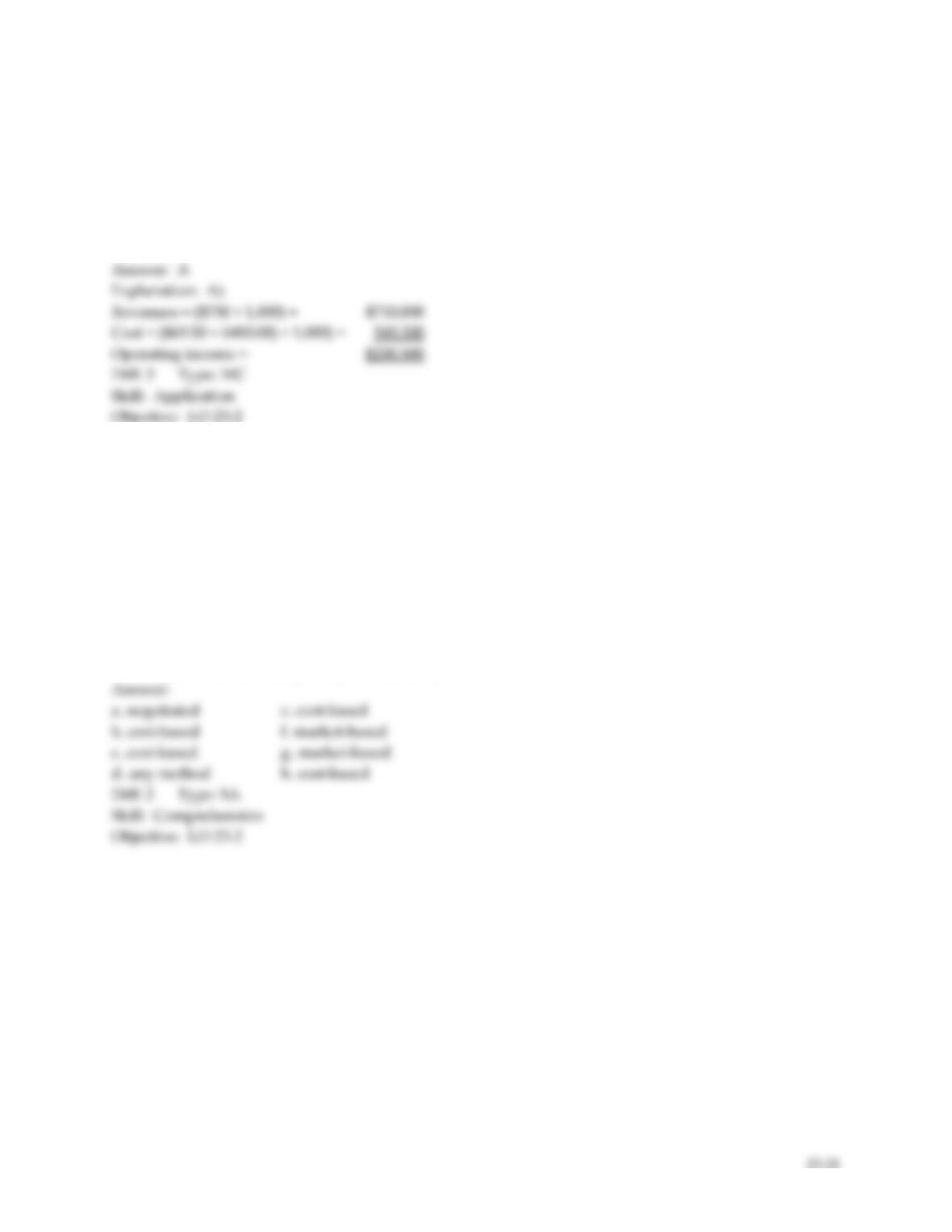
37) If the Assembly Division sells 1,000 air conditioners at a price of $750.00 per air conditioner to
customers, what is the operating income of both divisions together?
A) $200,500
B) $207,000
C) $194,000
D) $165,750
E) $230,500
38) For each of the following transfer price descriptions or operating situations, tell which of the general
methods of transfer pricing it is probably categorized as:
a. Bargaining between selling and buying units.
b. Budgeted costs.
c. 145% of full costs.
d. Internal product transfers are required if goods are available internally.
e. Manufacturing plus marketing plus distribution plus customer service costs.
f. Prices listed in a trade journal.
g. Selling price less normal sales commissions.
h. Variable manufacturing cost plus a mark-up.
Cost Accounting: A Managerial Emphasis, 6e
Chapter 23 – Transfer Pricing and Multinational Management Control Systems
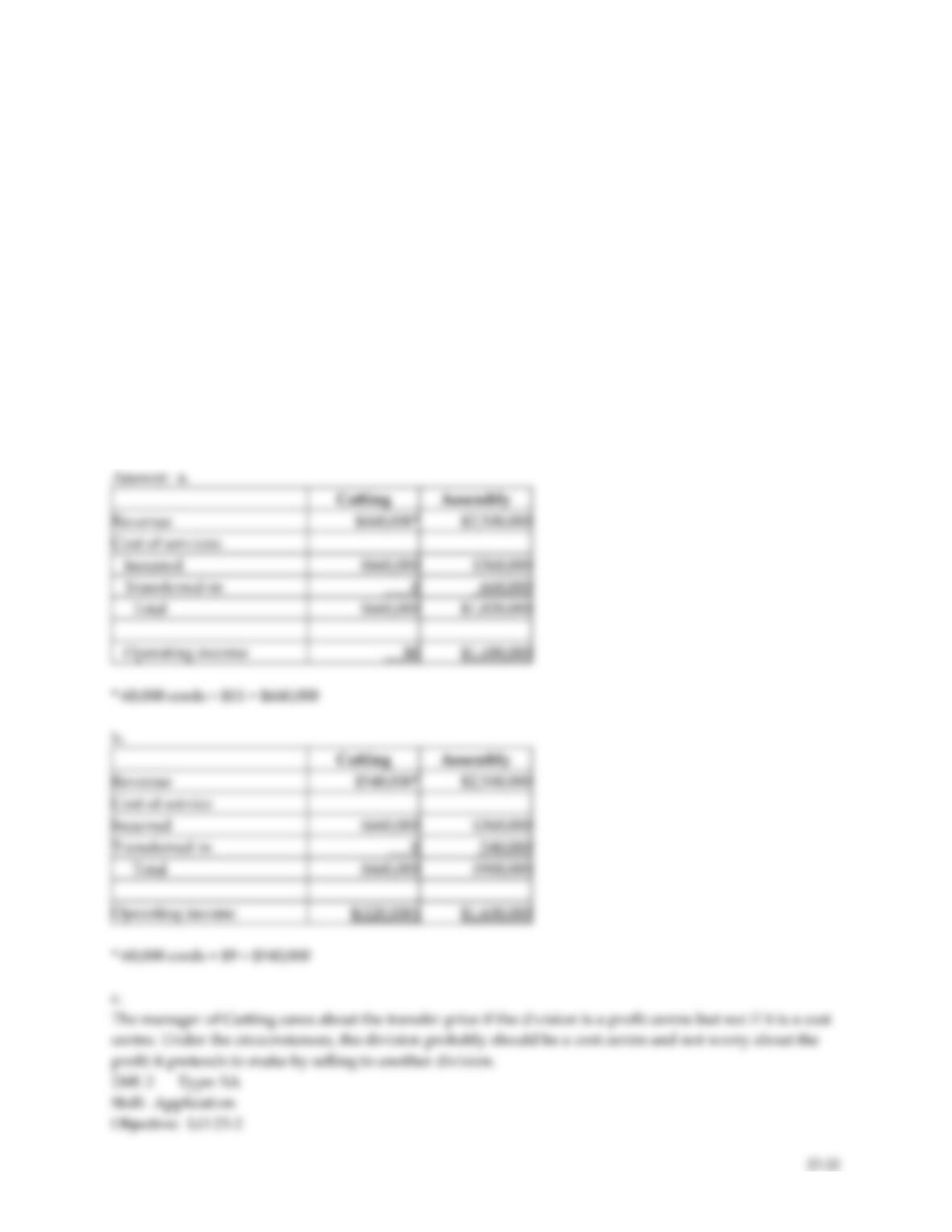
39) The Mill Flow Company has two divisions. The Cutting Division prepares timber at its sawmills. The
Assembly Division prepares the cut lumber into finished wood for the furniture industry. No inventories
exist in either division at the beginning of the year. During the year, the Cutting Division prepared 60,000
cords of wood at a cost of $660,000. All the lumber was transferred to the Assembly Division, where
additional operating costs of $6 per cord were incurred. The 600,000 boardfeet of finished wood were sold
for $2,500,000.
Required:
a. Determine the operating income for each division if the transfer price from Cutting to Assembly is at
cost — $11 a cord.
b. Determine the operating income for each division if the transfer price is $9 per cord.
c. Since the Cutting Division sells all of its wood internally to the Assembly Division, does the manager
care what price is selected? Why? Should the Cutting Division be a cost centre or a profit centre under the
circumstances?
Cost Accounting: A Managerial Emphasis, 6e
Chapter 23 – Transfer Pricing and Multinational Management Control Systems
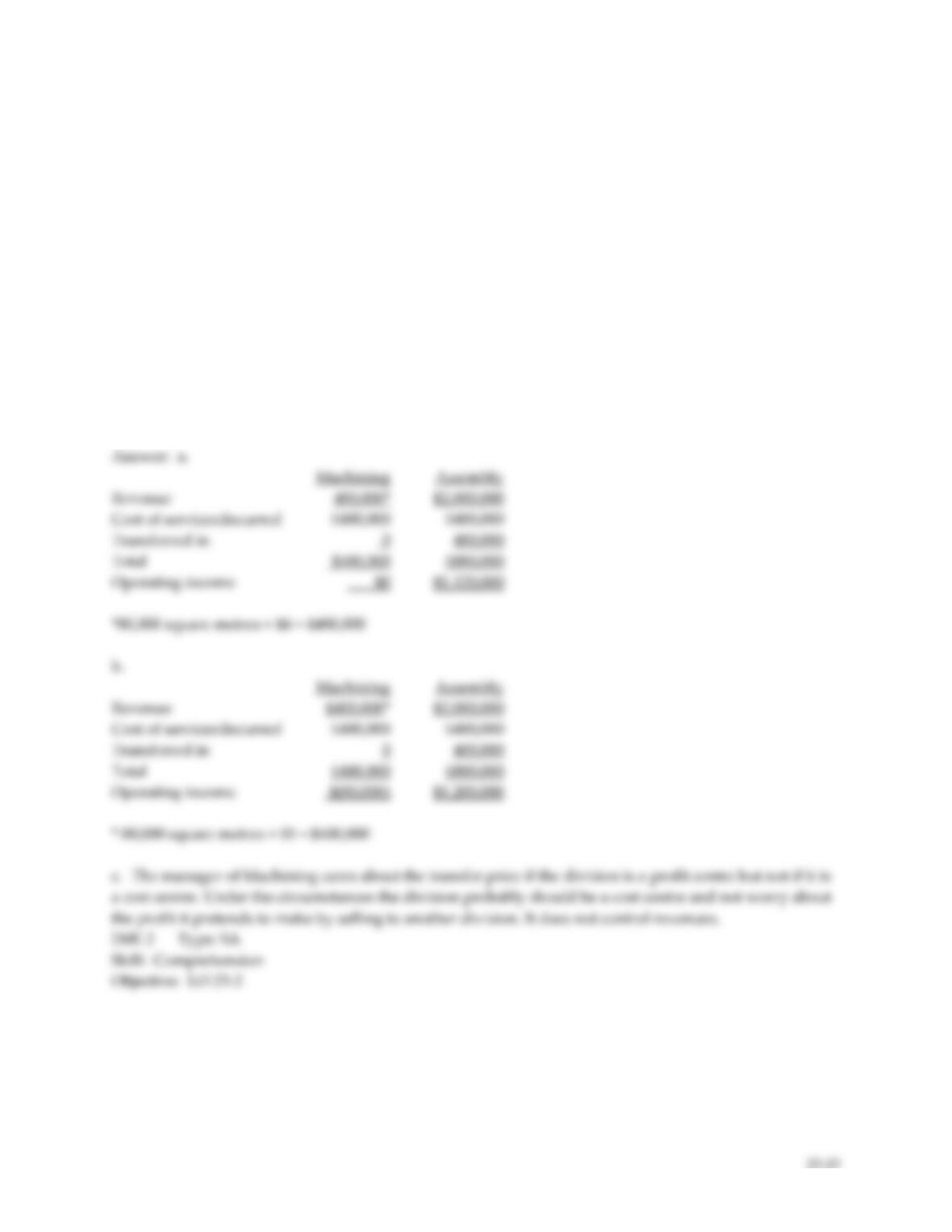
40) Alsation Ltd. has two divisions: Machining and Assembly. The Machining Division prepares the raw
materials into component parts and the Assembly Division assembles the components into finished
product. No inventories exist in either division at the beginning of the year. During the year the
Machining Division prepared 80,000 square metres of sheet metal at a cost of $480,000. All production
was transferred to the Assembly Division where the metal was converted into 800,000 units of finished
product at an additional costs of $5 per unit. The 800,000 units were sold for $2,000,000.
Required:
a. Determine the operating income for each division if the transfer price from Machining to Assembly is
at cost, $6/square metre.
b. Determine the operating income for each division if the transfer price is $5/square metre.
c. Since the Machining Division has all of its sales internally to the Assembly Division, does the
manager care what price is selected? Why? Should the Machining Division be a cost centre or a profit
centre under the circumstances?
Cost Accounting: A Managerial Emphasis, 6e
Chapter 23 – Transfer Pricing and Multinational Management Control Systems
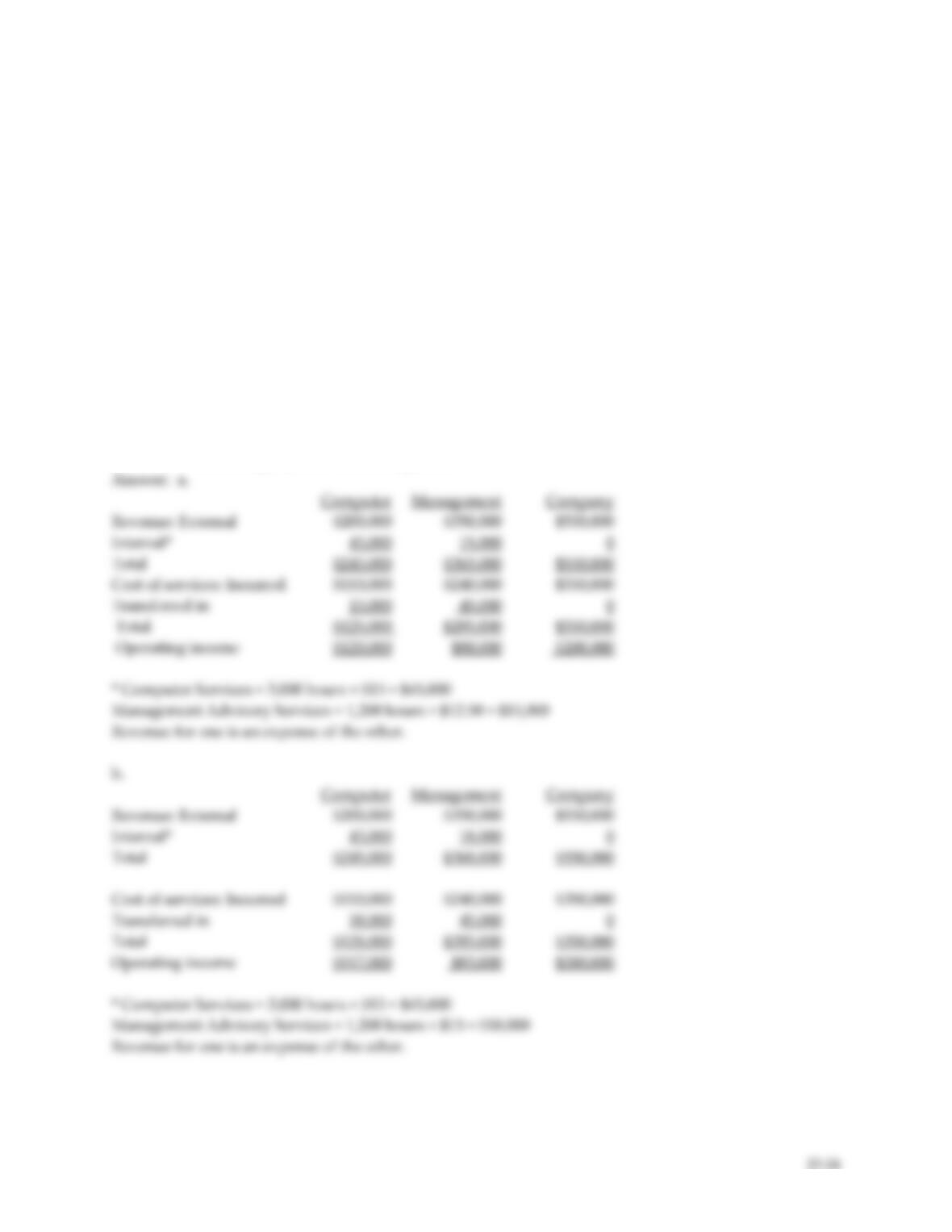
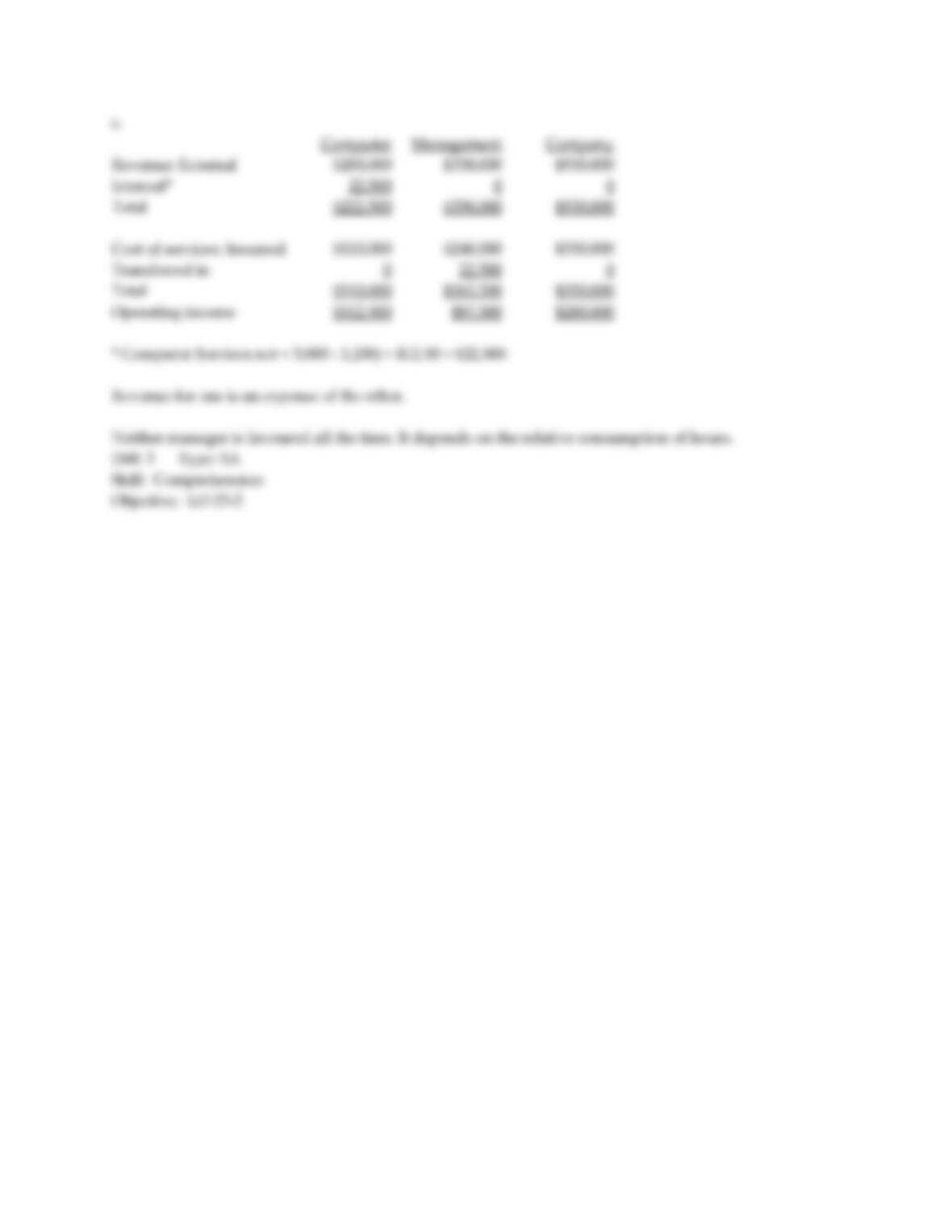
41) Vancouver Valley Ltd. has two divisions, Computer Services and Management Advisory Services. In
addition to its external customers, each division performs work for the other division. The external fees
earned by each division in the past year were $200,000 for Computer Services and $350,000 for
Management Advisory Services. Computer Services worked 3,000 hours for Management Advisory
Services and Management Advisory Services in turn worked 1,200 hours for Computer Services. The total
costs of external services performed by Computer Services were $110,000 and $240,000 by Management
Advisory Services respectively.
Required:
a. Determine the operating income for each division and for the company as a whole if the transfer
price from Computer Services to Management Advisory Services is $15 per hour and the transfer price
from Management Advisory Services to Computer Services is $12.50 per hour.
b. Determine the operating income for each division and for the company as a whole if the transfer
price from each to the other is $15 per hour.
c. What are the operating income results for each division and for the company as a whole if the two
divisions net their hours worked for each other and charge $12.50 per hour for the one with the excess?
Which division manager prefers this arrangement?
Cost Accounting: A Managerial Emphasis, 6e
Chapter 23 – Transfer Pricing and Multinational Management Control Systems
23–25
Cost Accounting: A Managerial Emphasis, 6e
Chapter 23 – Transfer Pricing and Multinational Management Control Systems
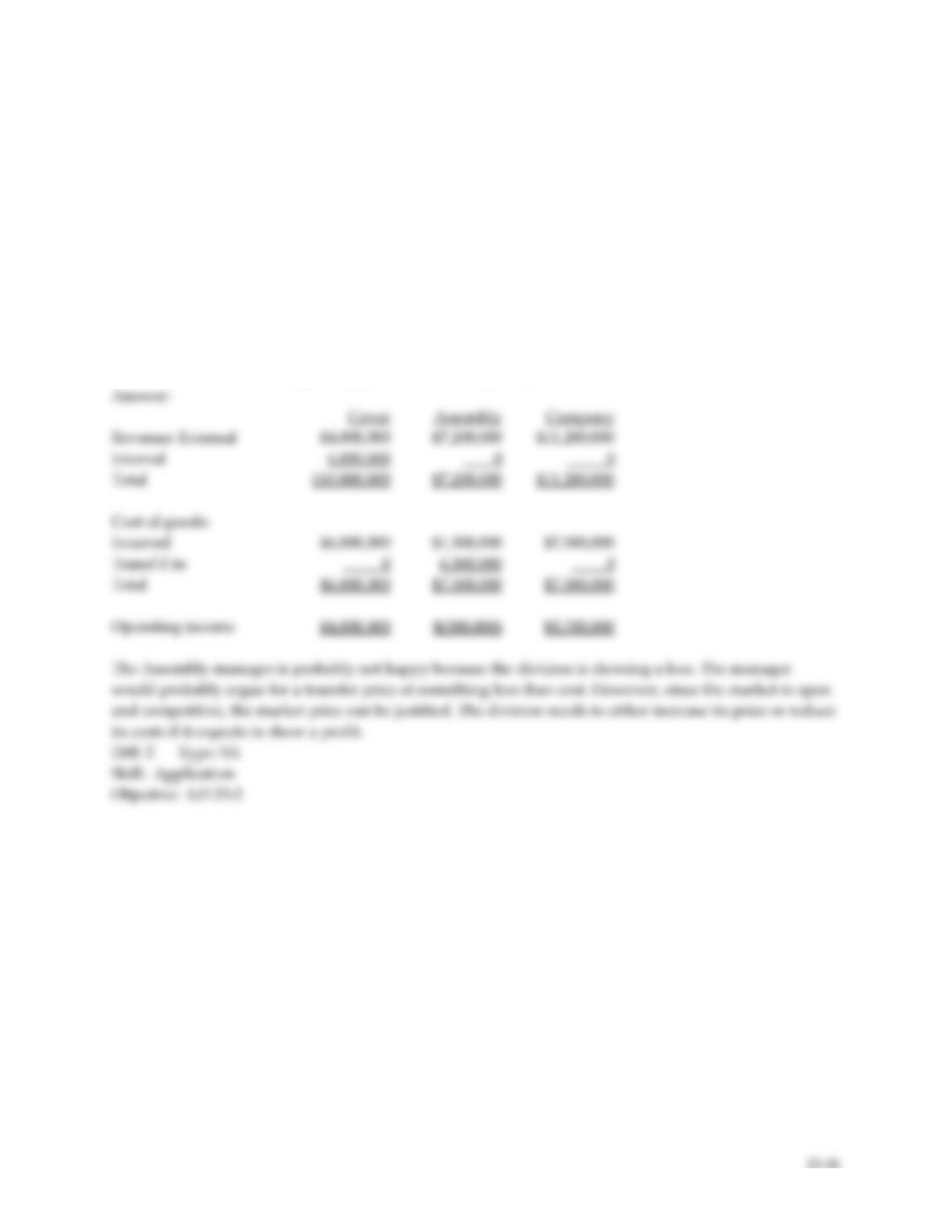
42) Bedtime Bedding Ltd. manufactures pillows. The Cover Division makes covers and the Assembly
Division makes the finished products. The covers can be sold separately for $5.00. The pillows sell for
$6.00. The information related to manufacturing for the most recent year is as follows:
Cover Division manufacturing costs $6,000,000
Sales of covers by Cover Division $4,000,000
Market value of covers transferred to Assembly $6,000,000
Sales of pillows by Assembly Division $7,200,000
Additional manufacturing of Assembly Division $1,500,000
Required:
Compute the operating income for each division and the company as a whole. Use market value as the
transfer price. Are all managers happy with this concept? Explain.
Cost Accounting: A Managerial Emphasis, 6e
Chapter 23 – Transfer Pricing and Multinational Management Control Systems
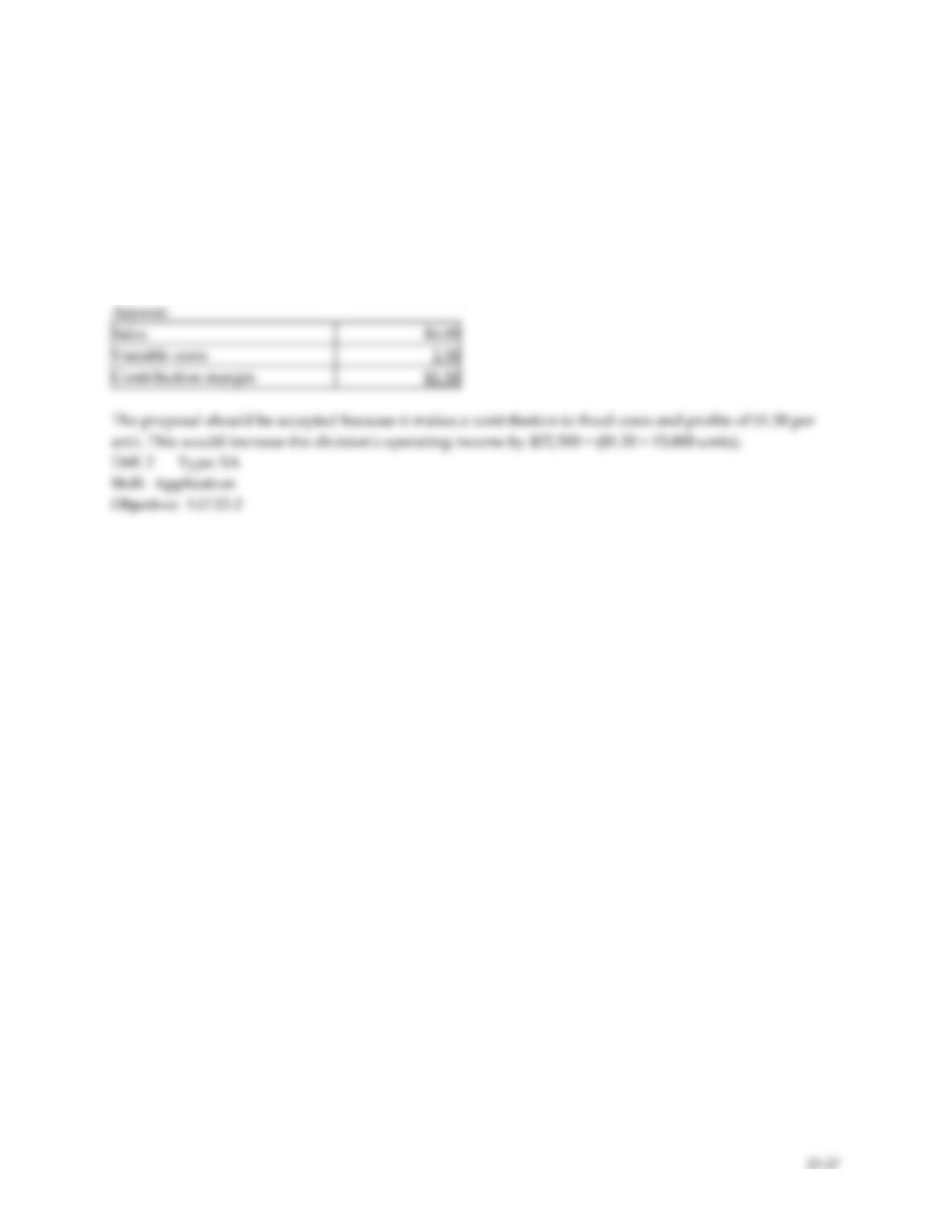
43) Sportswear Ltd. manufactures socks. The Athletic Division sells its socks for $6 a pair to outsiders.
Socks have manufacturing costs of $2.50 each for variable and $1.50 for fixed. The division’s total fixed
manufacturing costs are $105,000 at the normal volume of 70,000 units.
The European Division has offered to buy 15,000 socks at the full cost of $4. The Athletic Division
has excess capacity and the 15,000 units can be produced without interfering with the current outside
sales of 70,000. The 85,000 volume is within the division’s relevant operating range.
Explain whether the Athletic Division should accept the offer.
Cost Accounting: A Managerial Emphasis, 6e
Chapter 23 – Transfer Pricing and Multinational Management Control Systems
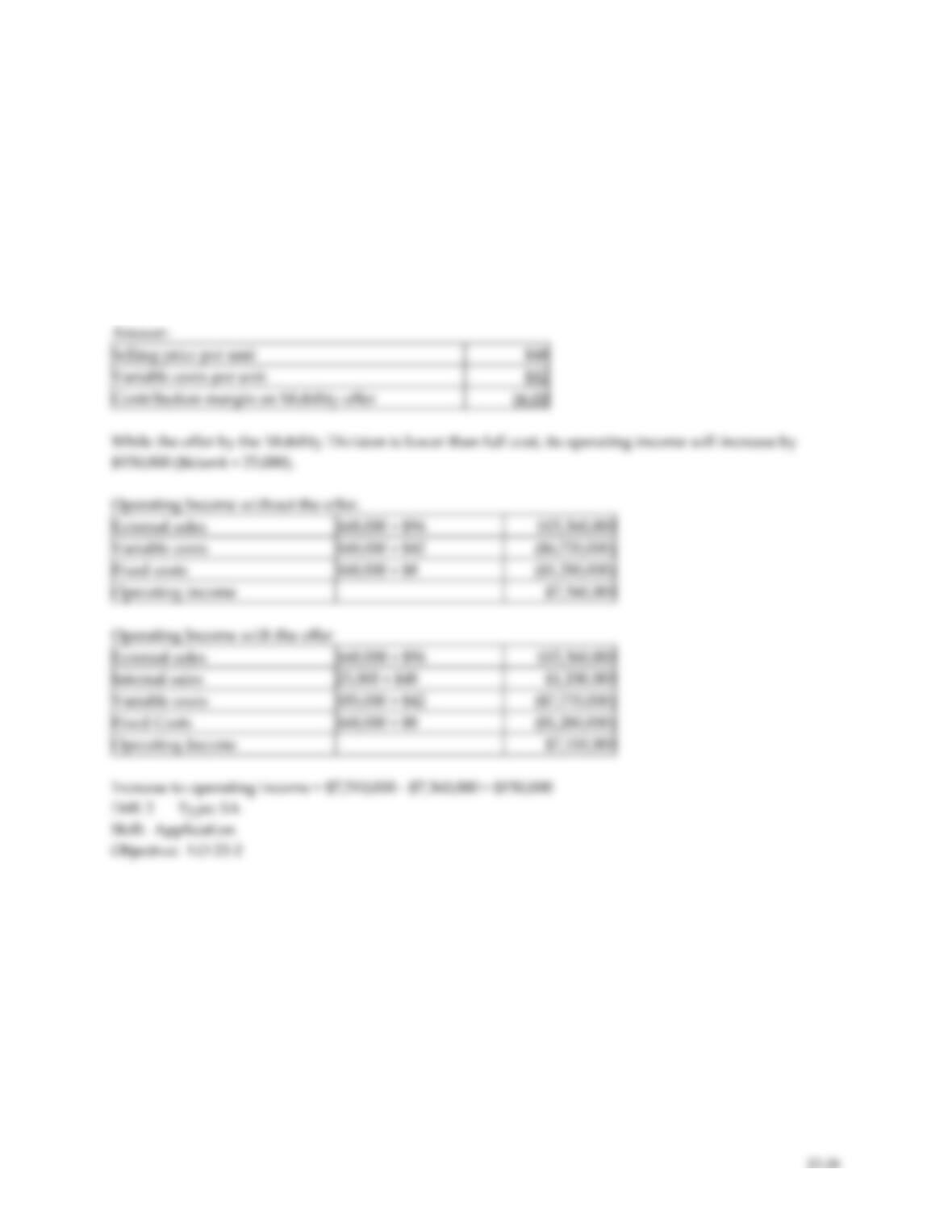
44) Centralia Components Ltd. manufactures cable assemblies used in transportation, recreational
products and medical industries in its Assemblies Division. The capacity of the Assemblies Division is
currently 200,000 units and it sells 160,000 units to the outside market at an average price of $96/unit.
Cost to manufacture the cable assemblies are $42 variable and $8 fixed. Fixed costs per unit are based on
its normal volume of 160,000 units.
Centralia’s Mobility Division uses cable assemblies in the manufacture of wheelchairs. It has offered to
buy 25,000 units from the Assemblies Division at $48 per unit. Calculate the operating income of the
Assemblies Division with and without the offer from the Mobility Division. Should Assemblies accept the
offer?
Cost Accounting: A Managerial Emphasis, 6e
Chapter 23 – Transfer Pricing and Multinational Management Control Systems
23–29
45) The Brownshoe Company has three specialized divisions. The Casual Shoe Division has asked the
Sole Division to supply it with a large quantity of soles. The Sole Division is currently at capacity. The
Sole Division sells soles outside for $5.00 each. The Casual Shoe Division, which is operating at 50 percent
capacity, has offered to pay $4.00 per sole. The Sole Division has a variable cost of $3.60 per sole. The
Casual Shoe Division has the following cost structure:
Direct materials, except soles $60.00
Soles 4.00
Conversion costs 36.00
Fixed overhead 20.00
Total cost per pair of shoes $120.00
The manager of Casual Shoe believes that the $4 price from Sole is necessary if the division is to compete
in the market for casual shoes.
Required:
a. As manager of Sole Division, would you recommend that your division supply the soles to Casual
Shoe? Why?
b. Would it be desirable for the division to supply Casual Shoe with the soles for $4 assuming the Sole
Division had excess capacity? Why?
c. What would be the corporate position assuming the Sole Division has excess capacity?
46) Explain what transfer prices are, and what are the four criteria used to evaluate them?
Cost Accounting: A Managerial Emphasis, 6e
Chapter 23 – Transfer Pricing and Multinational Management Control Systems
47) Briefly explain each of the three general methods used to determine a transfer price.
48) Briefly describe the arm’s length principle and how it applies to transfers among international
divisions.
49) Transfer prices among divisions within Canada are irrelevant. Do you agree with this statement?
Explain.
23.3 Assess the market-based transfer price method.
1) When the intermediate market is perfectly competitive, interdependencies of subunits are minimal,
and there are additional costs to the corporation as a whole in using the market instead of transacting
internally.
Cost Accounting: A Managerial Emphasis, 6e
Chapter 23 – Transfer Pricing and Multinational Management Control Systems
2) When demand outstrips supply, market prices may drop below historical averages. These prices are
known as distress prices.
3) Under distress pricing conditions, long run average prices may be used in setting transfer prices. Such
actions negatively affect the supplying division.
4) Market-based transfer prices are ideal in perfectly competitive markets when there is idle capacity in
the selling division.
5) A market is said to be perfectly-competitive when
A) there is no opportunity costs incurred by the vendor nor by the buyer.
B) the market may be dominated by one or two major companies, but there are many smaller companies
also in the market.
C) there is a homogeneous product, equivalent buying and selling prices, and no individual buyers or
sellers can affect those prices by their own actions.
D) there are any number of products, equivalent buying and selling prices, and individual buyers or
sellers can affect those prices by their own actions.
E) there are any number of products, equivalent buying and selling prices, and individual buyers or
sellers can affect those prices by their own actions, but there are no opportunity costs for buyers or sellers.
Cost Accounting: A Managerial Emphasis, 6e
Chapter 23 – Transfer Pricing and Multinational Management Control Systems
6) In a time of distress prices, which of the following is true?
A) The vendor division should set the transfer price at the distress price on a long-term basis for stability
within the overall company.
B) The vendor division should cease production.
C) The purchasing division should pay normal prices.
D) In the short-term, the transfer price should be the distress price as long as this exceeds the incremental
costs.
E) The distress price should be ignored as it is a function of the market, not of the internal capacities of
the overall company.
7) When industry has excess capacity, market prices may drop sizably below their historical average. If
this drop is temporary, it is called
A) distress prices.
B) dropped prices.
C) low-average prices.
D) substitute prices.
E) fire sale.
8) The objectives of setting transfer prices include
A) goal congruence.
B) maximizing the selling subunit’s income.
C) subunit autonomy.
D) minimizing the purchasing subunit’s costs.
E) goal congruence and subunit autonomy.
Cost Accounting: A Managerial Emphasis, 6e
Chapter 23 – Transfer Pricing and Multinational Management Control Systems
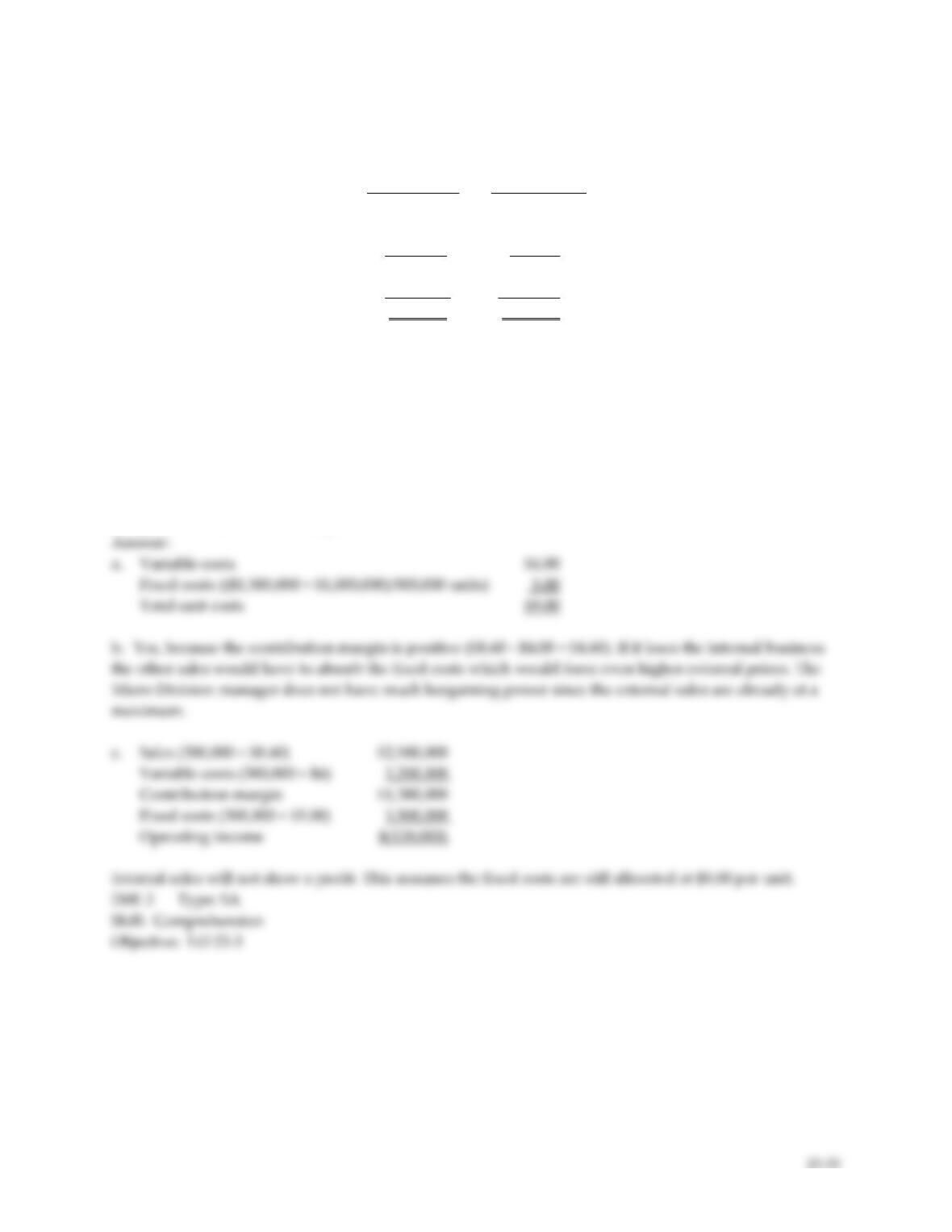
9) The Micro Division of Silicon Computers produces computer chips that are sold to the Personal
Computer Division and to outsiders. Operating data for the Micro Division are as follows:
Internal Sales External Sales
Sales: 300,000 chips at $10 $3,000,000
200,000 chips at $12 $2,400,000
Variable expenses at $4 1,200,000 800,000
Contribution margin $1,800,000 $1,600,000
Fixed cost (allocated on units) 1,500,000 1,000,000
Operating income $300,000 $600,000
The Personal Computer Division has just received an offer from an outside supplier to furnish chips at
$8.60 each. The manager of Micro Division is not willing to meet the $8.60 price. She argues that it costs
her $9.00 to produce and sell each chip. Sales to outside customers are at a maximum of 200,000 chips.
Required:
a. Verify the Micro Division’s $9.00 unit cost figure.
b. Should the Micro Division meet the outside price of $8.60? Explain.
c. Could the $8.60 price be met and still show a profit for the Micro Division sales to the Personal
Computer Division? Show computations.
Cost Accounting: A Managerial Emphasis, 6e
Chapter 23 – Transfer Pricing and Multinational Management Control Systems
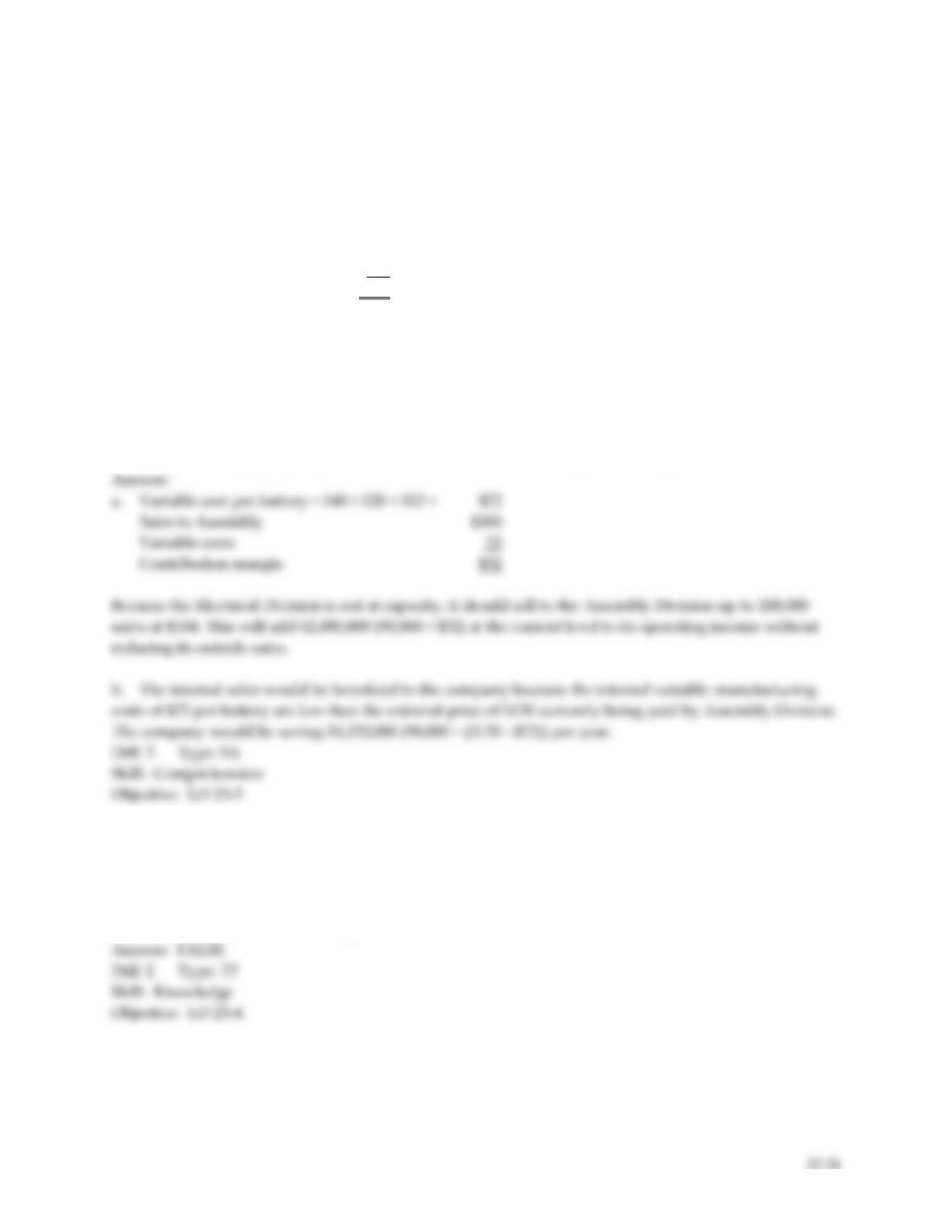
10) The Assembly Division of Canadian Car Company has offered to purchase 90,000 batteries from the
Electrical Division for $104 per unit. At a normal volume of 250,000 batteries per year, production costs
per battery are as follows:
Direct materials $40
Direct manufacturing labour 20
Variable factory overhead 12
Fixed factory overhead 40
Total $112
The Electrical Division has been selling 250,000 batteries per year to outside buyers at $136 each. Capacity
is 350,000 batteries per year. The Assembly Division has been buying batteries from outside sources for
$130 each.
Required:
a. Should the Electrical Division manager accept the offer? Explain.
b. From the company’s perspective, will the internal sales be of any benefit? Explain
23.4 Apply relevant costs and tax considerations to evaluate the selection of cost-based
and negotiated transfer prices.
1) Outlay costs are defined as the maximum contribution foregone by the supply division if the products
or services are transferred internally.
Cost Accounting: A Managerial Emphasis, 6e
Chapter 23 – Transfer Pricing and Multinational Management Control Systems
2) Full-cost transfer prices are adequate and lead to goal congruence for decisions that require knowledge
of short-run variable costs.
3) Full-cost transfer pricing may be used because it yields relevant costs for short-run decisions even
though full-cost allocations may lead to poor long-run decisions.
4) There is seldom a single transfer price that simultaneously meets the criteria of goal congruence,
management effort, and subunit autonomy.
5) Some companies use dual pricing, using two separate transfer-pricing methods to price each
interdivisional transaction.
6) Dual pricing is widely used as it reduces the goal–congruence problems associated with a pure cost–
plus based transfer-pricing method.
7) Opportunity costs represent the cash flows directly associated with the production and transfer of the
products and services.
Cost Accounting: A Managerial Emphasis, 6e
Chapter 23 – Transfer Pricing and Multinational Management Control Systems
8) If the product sold between divisions has no intermediate market, the opportunity cost of supplying
the product internally is the variable cost of the product.
Use the information below to answer the following question(s).
Soft Cushion Company is highly decentralized. Each division is empowered to make its own sales
decisions. The Assembly Division can purchase a key component-stuffing-from the Production Division
or from external suppliers. The Production Division has been the major supplier of stuffing in recent
years. The Assembly Division has announced that two external suppliers will be used to purchase the
stuffing at $20 per kilogram for the next year. The Production Division recently increased its unit price to
$40. The manager of the Production Division presented the following information; variable cost $32, fixed
cost $8, to top management in order to attempt to force the Assembly Division to purchase the stuffing
internally. The Assembly Division purchases 20,000 kg per month.
9) The Production Division has no alternative use for the facilities used to manufacture the stuffing. What
is the monthly operating income advantage (disadvantage) if the goods are purchased internally?
A) $400,000
B) $640,000
C) $240,000
D) $(240,000)
E) $(400,000)
Cost Accounting: A Managerial Emphasis, 6e
Chapter 23 – Transfer Pricing and Multinational Management Control Systems
10) What is the monthly operating advantage (disadvantage) of purchasing the goods internally
assuming the Production Division is able to utilize the facilities for other operations resulting in monthly
cash-operating savings of $40,000?
A) $400,000
B) $40,000
C) $(240,000)
D) $(280,000)
E) $(400,000)
11) What would be the monthly operating advantage (disadvantage) of purchasing the goods internally
assuming the external supplier increased its price to $50 per kilogram and the Production Division is able
to utilize facilities for other operations, resulting in a monthly cash-operating savings of $30 per
kilogram?
A) $1,000,000
B) $360,000
C) $(240,000)
D) $(400,000)
E) $(640,000)
12) In analyzing transfer prices
A) the buyer will not willingly purchase a product for less than the incremental costs incurred to
manufacture the product internally.
B) the seller should not sell a product for less than the incremental costs incurred to make the product.
C) the buyer will willingly pay more than the ceiling transfer price.
D) the buyer will not pay less than the ceiling transfer price.
E) the buyer will not pay the incremental costs.
Cost Accounting: A Managerial Emphasis, 6e
Chapter 23 – Transfer Pricing and Multinational Management Control Systems
13) Cash outflows that are directly associated with the production and transfer of the products and
services are called
A) additional costs.
B) opportunity costs.
C) outlay costs.
D) transfer costs.
E) variable costs.
14) The profit foregone by the seller if the products or services are transferred internally instead of selling
them externally are called
A) additional costs.
B) opportunity costs.
C) outlay costs.
D) transfer costs.
E) variable costs.
15) The seller of product A has no idle capacity and can sell all it can produce at $20 per unit. Outlay cost
is $4. What is the opportunity cost assuming the seller sells internally?
A) $4
B) $16
C) $20
D) $24
E) $44
Cost Accounting: A Managerial Emphasis, 6e
Chapter 23 – Transfer Pricing and Multinational Management Control Systems
16) The seller of product A has idle capacity and has no alternative use for the excess capacity. The seller
can sell each unit at $10. Outlay cost is $2. What is the opportunity cost of selling internally?
A) $0
B) $8
C) $10
D) $12
E) $16
17) The general guideline for determining the minimum transfer price is
A) cover all employee costs incurred in production.
B) fixed-cost plus opportunity costs per unit to the vendor division.
C) variable-cost plus opportunity costs per unit to the vendor division.
D) fixed-cost plus incremental costs per unit up to the point of transfer.
E) additional incremental costs per unit up to the point of transfer, plus opportunity costs per unit to the
vendor division.
18) The Transportation Division of Petrolia Paint Company can purchase paint from an independent
producer at $18 per litre. The company has three divisions: Production, Transportation, and Paint. The
company’s Transportation Division is currently buying paint from the Paint Division for$24 per litre.
Transfer prices are based on 125 percent of full cost. The market-based transfer price per litre is $12.60.
Which of the following would NOT occur if the company uses dual pricing to record the Transportation
Division purchases of paint from the Paint Division?
A) credit the Paint Division for $22.50
B) debit the corporate account for $9.90
C) debit the Transportation Division for $12.60
D) credit the Paint Division for $12.60
E) credit the Paint Division for $32.40
Cost Accounting: A Managerial Emphasis, 6e
Chapter 23 – Transfer Pricing and Multinational Management Control Systems
19) Under what conditions would transferring products or services at market prices lead to optimal
decisions within the organization?
A) when the immediate market is a monopoly
B) when there is minimal interdependence between subunit divisions
C) when there is excess capacity
D) when the immediate market is not a monopoly, and there is minimal interdependence between
subunit divisions
E) when the immediate market is only somewhat competitive and there is excess capacity
20) Many companies do not want to use market prices, or find it too costly, and they use ________ prices,
even though sub optimal decisions may occur.
A) average-cost
B) full-cost
C) long-run cost
D) short-run average cost
E) variable cost
21) Crush Company makes internal transfers at 180% of full cost. The Soda Refining division purchases
30,000 containers of carbonated water per day, on average, from a local supplier, who delivers the water
for $30 per container via an external shipper. In order to reduce costs the company located an
independent producer in Manitoba who is willing to sell 30,000 containers at $20 each, delivered to Crush
Company’s shipping division in Manitoba. The company’s Shipping Division in Manitoba has excess
capacity and can ship the 30,000 containers at a variable cost of $2.50 per container.
What is the total cost to Crush Company if the carbonated water is purchased from the local supplier?
A) $900,000
B) $1,200,000
C) $1,501,000
D) $1,620,000
E) $1,721,150