92. Figure 23-5.
Santorino Company produces two models of a component, Model K-3 and Model P-4. The unit contribution
margin for Model K-3 is $6; the unit contribution margin for Model P-4 is $14. Each model must spend time on
a special machine. The firm owns two machines that together provide 4,000 hours of machine time per year.
Model K-3 requires 15 minutes of machine time; Model P-4 requires 30 minutes of machine time.
Refer to Figure 23-5. What is the contribution margin per unit of scarce resource (machine time) for Model K-
3?
93. Figure 23-5.
Santorino Company produces two models of a component, Model K-3 and Model P-4. The unit contribution
margin for Model K-3 is $6; the unit contribution margin for Model P-4 is $14. Each model must spend time on
a special machine. The firm owns two machines that together provide 4,000 hours of machine time per year.
Model K-3 requires 15 minutes of machine time; Model P-4 requires 30 minutes of machine time.
Refer to Figure 23-5. What is the contribution margin per unit of scarce resource (machine time) for Model P-
4?
94. Figure 23-5.
Santorino Company produces two models of a component, Model K-3 and Model P-4. The unit contribution
margin for Model K-3 is $6; the unit contribution margin for Model P-4 is $14. Each model must spend time on
a special machine. The firm owns two machines that together provide 4,000 hours of machine time per year.
Model K-3 requires 15 minutes of machine time; Model P-4 requires 30 minutes of machine time.
Refer to Figure 23-5. Now suppose that Santorino Company can sell only 5,500 units of each model. How
many units of Model K-3 should be produced?
95. Figure 23-5.
Santorino Company produces two models of a component, Model K-3 and Model P-4. The unit contribution
margin for Model K-3 is $6; the unit contribution margin for Model P-4 is $14. Each model must spend time on
a special machine. The firm owns two machines that together provide 4,000 hours of machine time per year.
Model K-3 requires 15 minutes of machine time; Model P-4 requires 30 minutes of machine time.
Refer to Figure 23-5. Now suppose that Santorino Company can sell only 5,500 units of each model. How
many units of Model P-4 should be produced?
96. Figure 23-5.
Santorino Company produces two models of a component, Model K-3 and Model P-4. The unit contribution
margin for Model K-3 is $6; the unit contribution margin for Model P-4 is $14. Each model must spend time on
a special machine. The firm owns two machines that together provide 4,000 hours of machine time per year.
Model K-3 requires 15 minutes of machine time; Model P-4 requires 30 minutes of machine time.
Refer to Figure 23-5. What is the amount of machine time for model P-4 in terms of percent of a machine
hour?
97. Figure 23-9.
Sabor Inc. is a medical testing laboratory that performs several tests and analyses for hospitals in the area. Four
of the tests that they perform require the use of a specialized machine that can supply 14,000 hours per year.
Information on the four lab tests follows:
Test A
Test B
Test C
Test D
Charging rate
$65
$51
$48
$32
Variable cost
$25
$18
$13
$8
Machine hours
3
2
1
0.5
Refer to Figure 23-9. What is the contribution margin per hour of machine time for Test A?
98. Figure 23-9.
Sabor Inc. is a medical testing laboratory that performs several tests and analyses for hospitals in the area. Four
of the tests that they perform require the use of a specialized machine that can supply 14,000 hours per year.
Information on the four lab tests follows:
Test A
Test B
Test C
Test D
Charging rate
$65
$51
$48
$32
Variable cost
$25
$18
$13
$8
Machine hours
3
2
1
0.5
Refer to Figure 23-9. What is the contribution margin per hour of machine time for Test B?
99. Figure 23-9.
Sabor Inc. is a medical testing laboratory that performs several tests and analyses for hospitals in the area. Four
of the tests that they perform require the use of a specialized machine that can supply 14,000 hours per year.
Information on the four lab tests follows:
Test A
Test B
Test C
Test D
Charging rate
$65
$51
$48
$32
Variable cost
$25
$18
$13
$8
Machine hours
3
2
1
0.5
Refer to Figure 23-9. What is the contribution margin per hour of machine time for Test C?
100. Figure 23-9.
Sabor Inc. is a medical testing laboratory that performs several tests and analyses for hospitals in the area. Four
of the tests that they perform require the use of a specialized machine that can supply 14,000 hours per year.
Information on the four lab tests follows:
Test A
Test B
Test C
Test D
Charging rate
$65
$51
$48
$32
Variable cost
$25
$18
$13
$8
Machine hours
3
2
1
0.5
Refer to Figure 23-9. What is the contribution margin per unit of machine time for Test D?
101. Raffles Company routinely bids on construction jobs. Raffles first determines the budgeted product cost of
the job and then applies a markup of 50%. If a bid of $15,000 is submitted for a new job, which of the following
is true?
102. The method of determining the cost of a product or service based on the price that customers are willing to
pay is called
103. Wilson Custom Cabinetry makes cabinets to order and prices the completed jobs at product cost plus 40%.
Recently, Wilson finished a job and billed the customer $560. If direct materials for the job cost $130, and
direct labor cost $180, what was the applied overhead for the job?
104. Shear-it Inc. produces paper shredders. Shear-it is considering a new shredder design for home offices. The
marketing vice president believes that a basic unit in a variety of attractive colors could be sold for $70. Shear-it
requires that all new products yield 30% profit. What is the target cost of the new shredder?
105. Brorsen Inc. has just designed a new product with a target cost of $64. Brorsen requires new product to
have a profit of 20%. What is the target price for the new product?
106. Teller Company has designed a caller ID machine with a large screen that can be seen easily from across
the room. The Sales Department believes that this product can be sold for $30 each. Teller requires that all new
products yield 15% profit. What is the target cost of the new product?
107. Fester Company was making a product for $60 and selling it for $80. A competitor began selling the same
product for $68. If Fester is to meet the competition’s price, and maintain the same amount of profit per unit,
what is target cost?
108. Moss Company charges cost plus 35%. What is the price of an item with cost equal to $65?
109. Stadium Company charges cost plus 60%. If the price of an item is $260, what is the item’s cost?
110. Super Pet Supplies sets prices at cost plus 70% of cost. The cost of an aquarium start-up kit is $110. What
price does Super Pet Supplies charge for the aquarium start-up kit?
111. Curtis Company sets price equal to cost plus 50%. Recently, Curtis charged a customer a price of $150 for
an item. What was the cost of the item to Curtis?
112. Welker Company is designing an all-in-one grill and cooler aimed at sports fans. The company believes
that the product can be sold for $180; and it requires a 30% profit on new products. What is the target cost of
the all-in-one grill and cooler?
113. Figure 23-10
Victor’s Detailing customers would be willing to pay $57 per detail. The company requires a 40% profit on each
job. The average job would cost $30.
Refer to Figure 23-10. Victor’s Detailing uses target-costing to set price on each job. What is the price they
should quote a new customer?
114. Figure 23-10
Victor’s Detailing customers would be willing to pay $57 per detail. The company requires a 40% profit on each
job. The average job would cost $30.
Refer to Figure 23-10. Victor’s uses target costing. Victor’s Detailing should:
115. Figure 23-10
Victor’s Detailing customers would be willing to pay $57 per detail. The company requires a 40% profit on each
job. The average job would cost $30.
Refer to Figure 23-10. Victor’s Detailing customers would be willing to pay $57 per detail. The company
requires an 80% markup on each job. The average job would cost $30.
Victor’s Detailing uses markup to set price on each job. What is the price Victor should quote a new customer?
116. The two major costs associated with inventory are
117. The inventory cost that can include insurance, inventory taxes, and obsolescence is called
118. The inventory cost that can include processing costs, cost of insurance for shipping, and unloading is
called
119. The inventory cost that can include lost sales, cost of expediting, and cost of interrupted production is
called
120. Which of the following is not a traditional reason for carrying inventory?
121. Under a JIT system,
122. JIT responds to the problems traditionally solved by carrying inventories by
123. Sherrell Washington owns a successful hole-in-the-wall bagel shop called Big Apple Bagels. Sherrell
wants to expand the shop by leasing the space next door for $500 per month, and adding tables and chairs so
that customers can dine in. She figures that the tables and chairs will cost $4,000 and that the bagel machine,
that cost $3,500 five years ago, would have to be scrapped in favor of a larger machine costing $6,400. She
thinks sales would increase by $4,000 per month. Variable costs are 50% of sales.
A. What are the relevant costs and benefits of expanding into the new space?
B. What are the irrelevant costs and benefits of expanding into the new space?
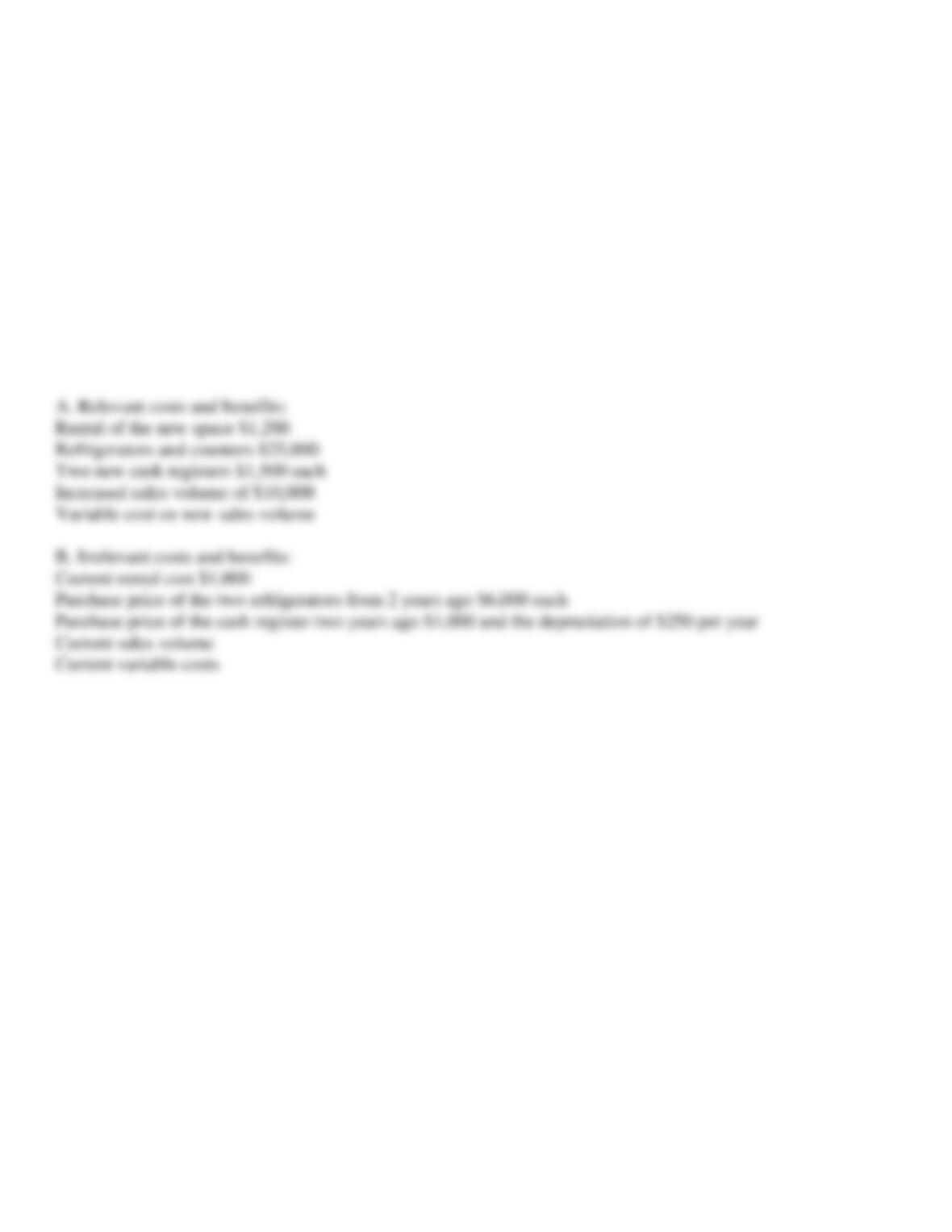
124. Kara Ring owns a successful flower shop called Always Blooming. Kara wants to expand the shop by
leasing the space next door for $1,200 per month, and adding refrigerators to keep the flowers fresh and two
checkout counters so the customers do not have to wait in long lines. She currently pays $1,000 per month for
her current store space and has two refrigerators that cost her $6,000 each two years ago. She figures that the
new refrigerators and counters will cost $25,000. She also has determined that the current cash register that
initially cost her $1,000 two years ago and has been depreciated $250 each year would have to be replaced with
two new cash registers costing $1,500 each. She thinks sales would increase by $10,000 per month. Variable
costs are 40% of sales.
Required:
A.
What are the relevant costs and benefits of expanding into the new space?
B.
What are the irrelevant costs and benefits of expanding into the new space?
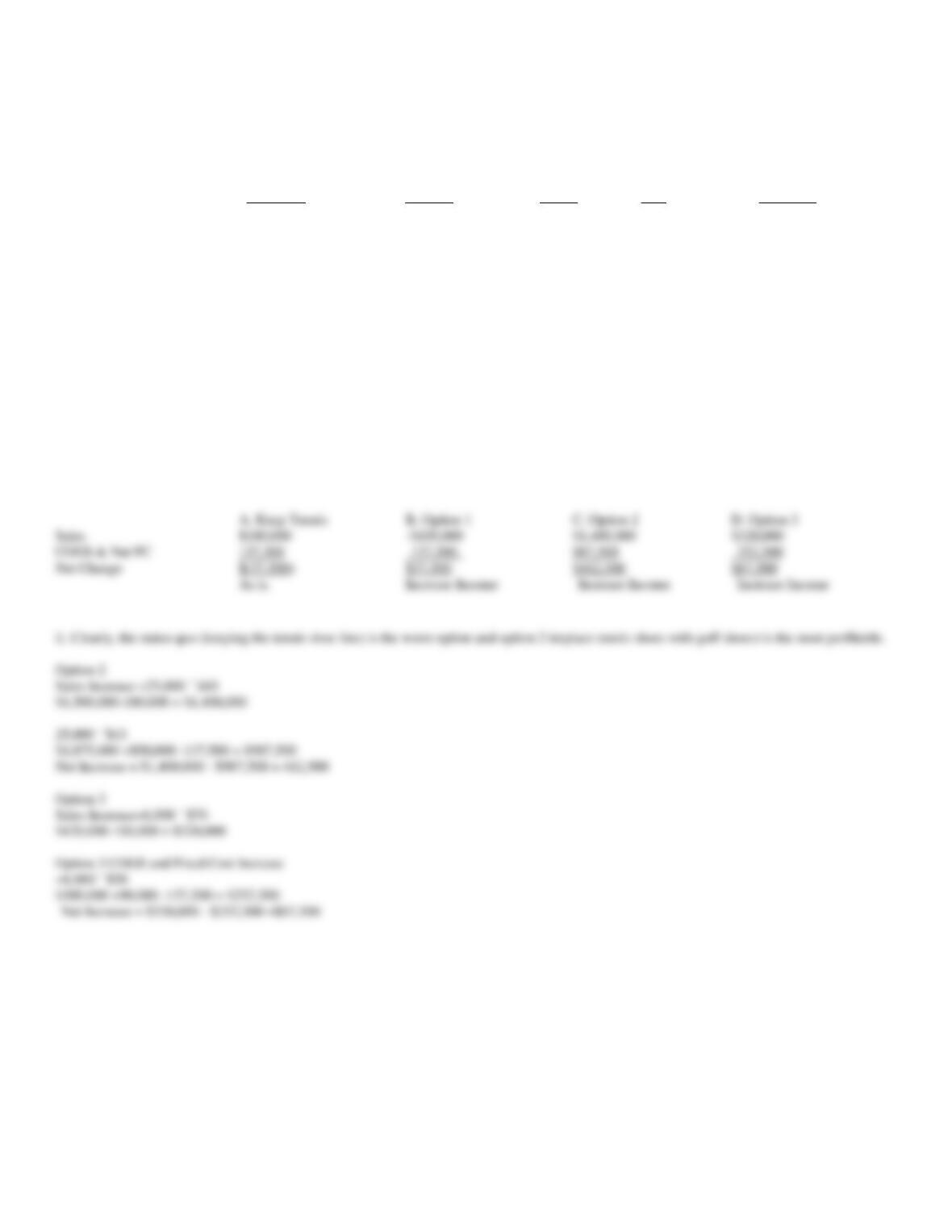
125. Veblen Company manufactures a variety of athletic shoes: basketball, running, and tennis. Sales of the
tennis shoes have fallen off. Veblen is considering several options: 1) drop the tennis shoe line; 2) replace the
tennis shoe line with golf shoes; 3) retool the tennis shoe line to make “Airtennies.” Price and cost data are as
follows:
Basketball
Running
Tennis
Golf
Airtennies
Price
$90
$65
$40
$60
$70
Variable cost/unit
$45
$40
$35
$43
$50
Fixed costs
$200,000
$210,000
$50,000
$50,000
$90,000
Number of units
10,000
15,000
2,500
25,000
6,000
If the tennis shoe line is dropped, the $50,000 fixed cost is totally avoidable.
A. Calculate the impact on operating income, using relevant amounts only, for keeping the tennis shoe line.
B. Calculate the impact on operating income, using relevant amounts only, for option 1.
C. Calculate the impact on operating income, using relevant amounts only, for option 2.
D. Calculate the impact on operating income, using relevant amounts only, for option 3.
E. Which option is best?
A. Keep Tennis
B. Option 1
C. Option 2
D. Option 3
Sales
$100,000
-$100,000
$1,400,000
$320,000
COGS & Net FC
137,500
137,500
987,500
252,500
Net Change
$(37,500)
$37,500
$412,500
$67,500
As is.
Increase Income
Increase Income
Increase Income
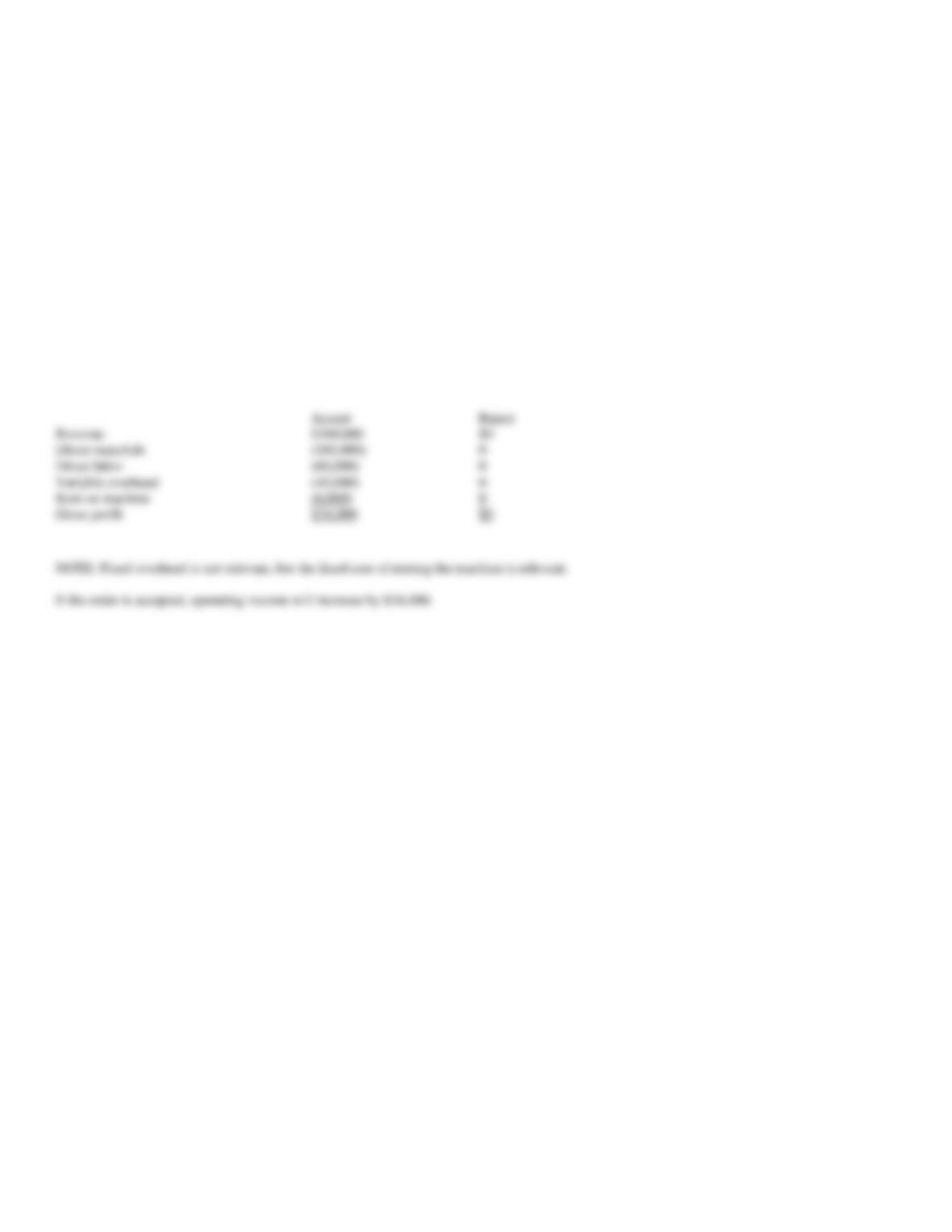
126. Goldwin Company makes lawn and garden equipment. Lawns R Us put in a special order for 20,000 weed
eaters for $15 each. Normally, Goldwin sells the weed eaters for $20 each. In addition, Lawns R Us wants its
own logo on the weed eaters. Cost information is as follows:
Direct materials
$8.00
Direct labor
3.00
Variable overhead
2.00
Fixed overhead
3.50
To affix the Lawns R Us logo, Goldwin will have to lease a special machine for three months (the time it will take to make the order) at a cost of
$2,000 per month. The fixed costs are unavoidable whether the company accepts or rejects the special order.
If Goldwin accepts the special order, what will be the impact on operating income?
Accept
Reject
Revenue
$300,000
Direct materials
(160,000)
0
Direct labor
(60,000)
0
Variable overhead
(40,000)
0
Rent on machine
(6,000)
0
Gross profit
$34,000
127. Island Princess Pineapples purchases pineapples from area farmers and processes them into rings, juice,
and skins. The cost of the pineapples is a joint cost, as is the initial processing in which the fruits are skinned,
cored, and sliced into rings. At the split-off point, Island Princess sells the skins (for fertilizer). Juice and rings
are processed further (further processing costs occurs for cooking and canning). Data for the three products
follows:
Sales
Rings
$2,000
Juice
$1,500
Fertilizer
$400
Further processing costs:
Rings
500
Juice
300
Joint costs
$1,600
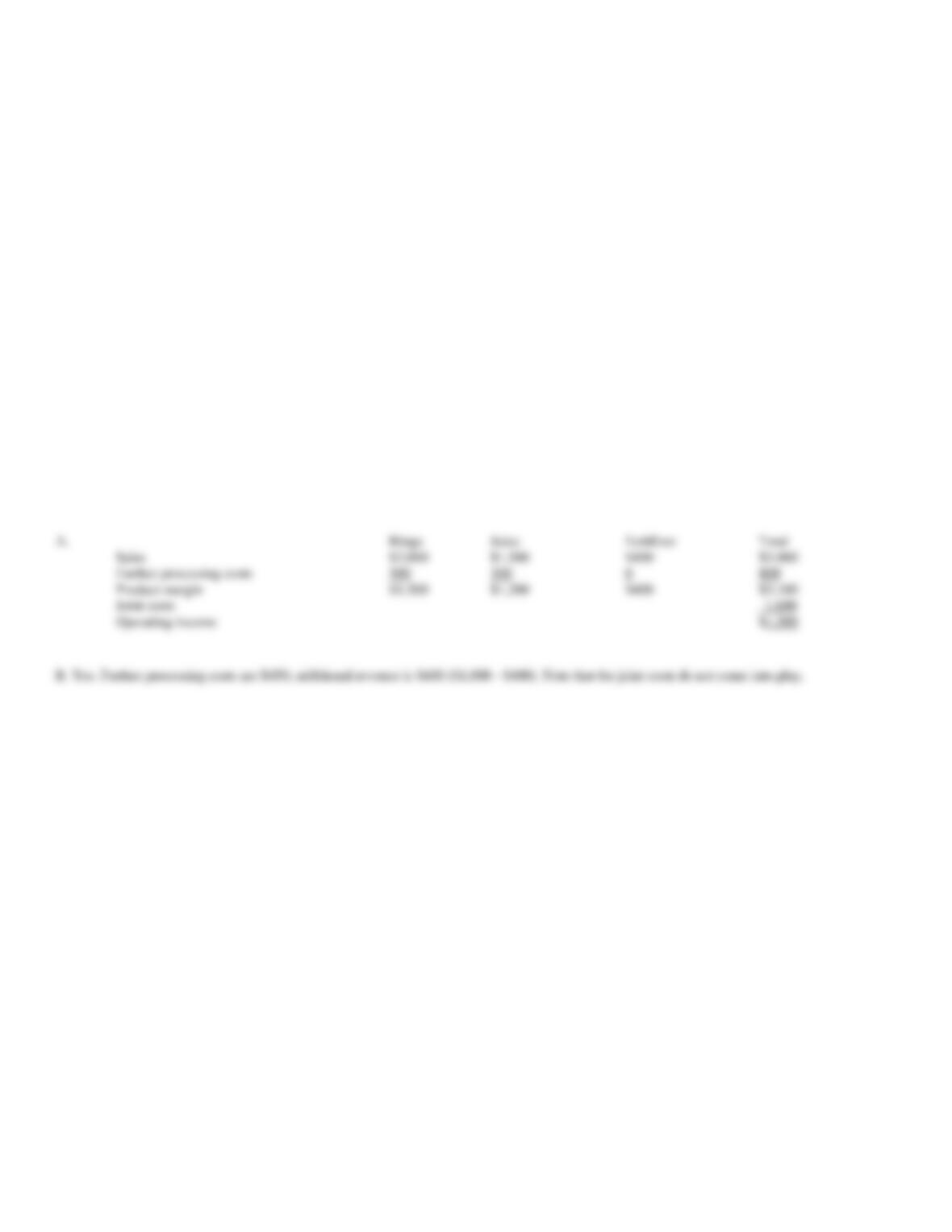
A. Prepare a segmented income statement for Island Princess, showing results for rings, juice, fertilizer, and in total. Do not allocate joint costs
individually.
B. Now suppose that Island Princess is considering the option of processing the skins further into pet food which would sell for $1,000. Additional
costs would be $450. Should this be done?
Rings
Juice
Fertilizer
Total
Sales
$2,000
$1,500
$400
$3,900
Further processing costs
500
300
0
800
Product margin
$1,500
$1,200
$400
$3,100
Joint costs
1,600
Operating income
$1,500