Cost Accounting: A Managerial Emphasis, 6e
Chapter 23 – Transfer Pricing and Multinational Management Control Systems
22) Crush Company makes internal transfers at 180% of full cost. The Soda Refining division purchases
30,000 containers of carbonated water per day, on average, from a local supplier, who delivers the water
for $30 per container via an external shipper. In order to reduce costs the company located an
independent producer in Manitoba who is willing to sell 30,000 containers at $20 each, delivered to Crush
Company’s shipping division in Manitoba. The company’s Shipping Division in Manitoba has excess
capacity and can ship the 30,000 containers at a variable cost of $2.50 per container.
What is the total cost of purchasing the water from the Manitoba supplier and shipping it to the Soda
Division?
A) $600,000
B) $675,000
C) $1,080,000
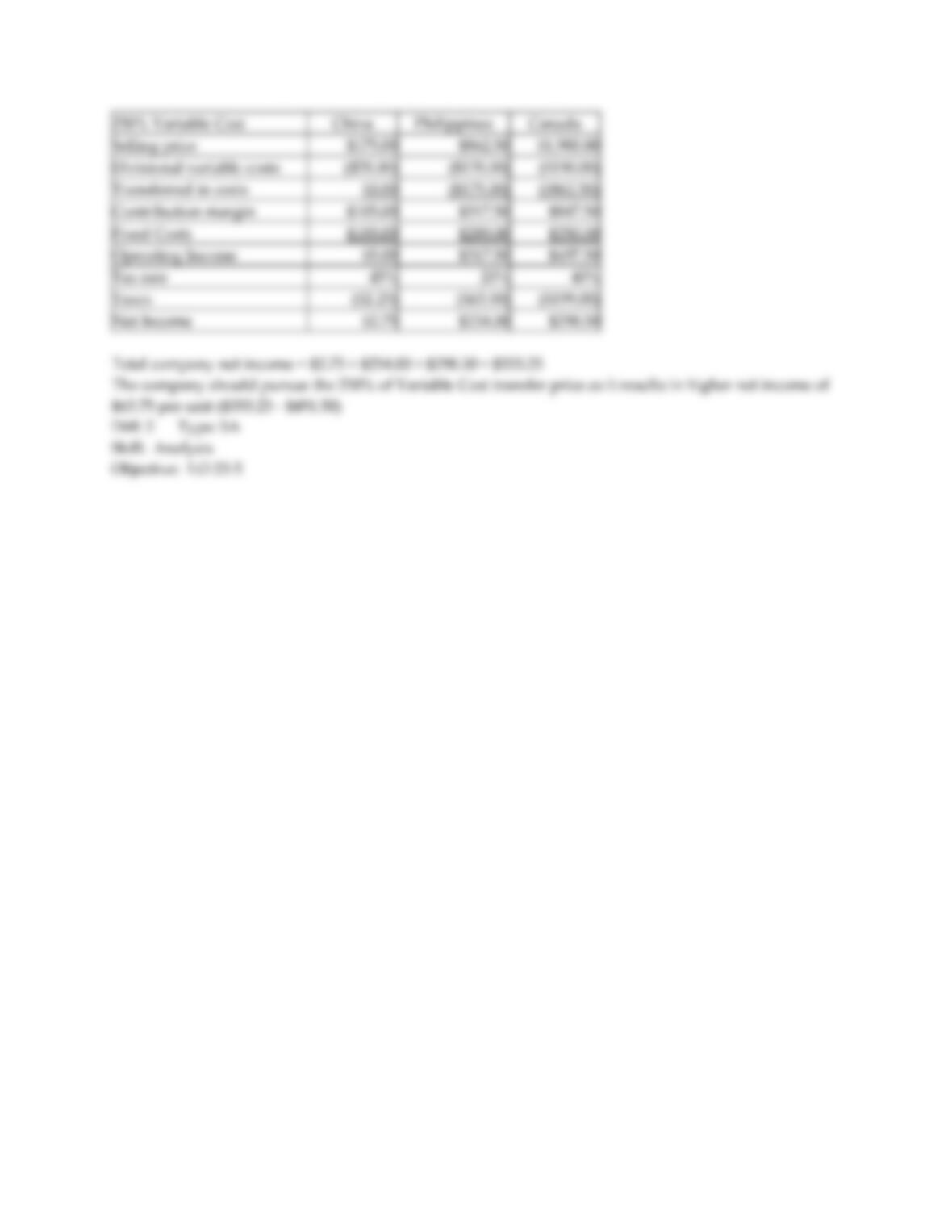
D) $1,215,000
E) $1,815,000
23) One reason companies use full-cost transfer pricing is that it provides
A) relevant costs for long-run decisions even though poor short-run decisions may result.
B) relevant costs for long-run decisions and for short-run decisions.
C) relevant costs for short-run decisions and poor for long-run decisions.
D) relevant costs for short-run decisions at the expense of the company.
E) relevant costs for long-run decisions and for employee staffing decisions.
24) When companies are unable to choose a transfer-pricing method which meets their requirements,
they may use
A) cost pricing.
B) dual pricing.
C) situational pricing.
D) market pricing.
E) pro-rating pricing.
Cost Accounting: A Managerial Emphasis, 6e
Chapter 23 – Transfer Pricing and Multinational Management Control Systems
25) When the vendor division receives full cost plus a mark-up, and the buying division pays the market
price, this is referred to as
A) dual pricing.
B) market pricing.
C) single pricing.
D) prorated transfer pricing.
E) competition pricing.
Use the information below to answer the following question(s).
The Burnaby Division of Columbia Ltd. produces and sells component parts. Its variable costs per unit
are $80 for direct materials, $32 for direct labour and $18 for variable factory overhead. It currently can
sell it components on the outside market at a price of $165/unit. Fixed overhead costs are $22 per unit
based on a denominator volume of 180,000 units.
26) The Surrey Division of Columbia Ltd. has approached the Burnaby Division and requested that it
supply 25,000 units of the component at a transfer price of $150. Assuming Burnaby Division has idle
capacity, what is the minimum transfer price the Burnaby Division should agree to accept?
A) $165
B) $150
C) $152
D) $130
E) $118
Cost Accounting: A Managerial Emphasis, 6e
Chapter 23 – Transfer Pricing and Multinational Management Control Systems
27) The Surrey Division of Columbia Ltd. has approached the Burnaby Division and requested that it
supply 25,000 units of the component at a transfer price of $150. Assuming Burnaby Division has no idle
capacity, what is the minimum transfer price the Burnaby Division should agree to accept?
A) $165
B) $150
C) $152
D) $130
E) $118
28) The Surrey Division of Columbia Ltd. has approached the Burnaby Division and requested that it
supply 25,000 units of the component at a transfer price of $150. The Burnaby Division will save $3 per
unit of direct materials costs for the components manufactured for the Surrey Division. Assuming
Burnaby Division has no idle capacity, what is the minimum transfer price the Burnaby Division should
agree to accept?
A) $165
B) $150
C) $162
D) $130
E) $127
Cost Accounting: A Managerial Emphasis, 6e
Chapter 23 – Transfer Pricing and Multinational Management Control Systems
29) The Surrey Division of Columbia Ltd. has approached the Burnaby Division and requested that it
supply 25,000 units of the component. The Burnaby Division will save $3 per unit of direct materials costs
for the components manufactured for the Surrey Division. Assuming Burnaby Division has idle capacity,
what is the minimum transfer price the Burnaby Division should agree to accept?
A) $165
B) $150
C) $162
D) $130
E) $127
Cost Accounting: A Managerial Emphasis, 6e
Chapter 23 – Transfer Pricing and Multinational Management Control Systems
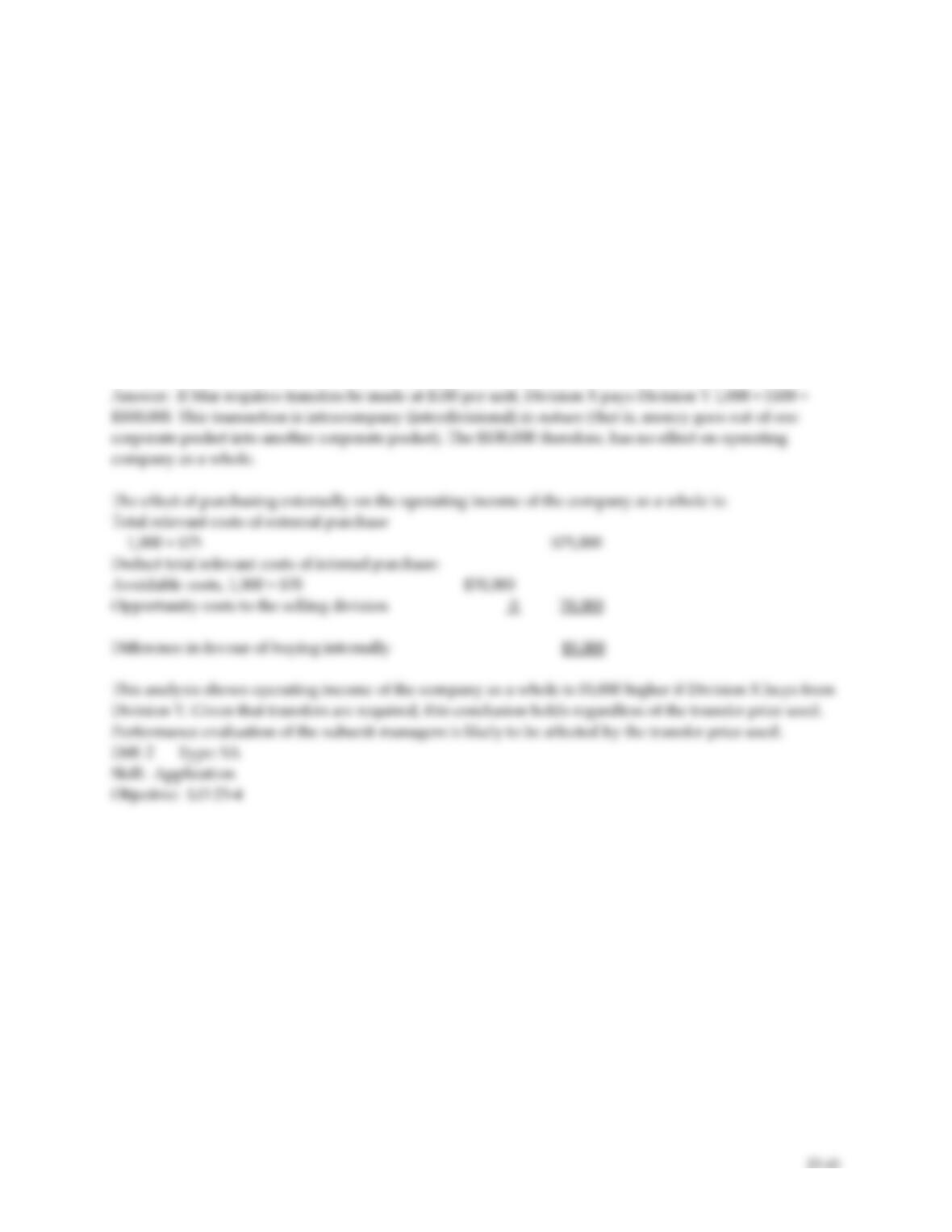
30) Mar Company has two decentralized divisions, X and Y. Division X has been purchasing certain
component parts from Division Y at $75 per unit. Because Division Y plans to raise the price to $100 per
unit, Division X desires to purchase these parts from external suppliers for $75 per unit. The following
information is available:
Division Y variable cost per unit $70
Division Y annual fixed costs $15,000
Division Y annual production
of parts for Division X 1,000 units
If Division X buys from an external supplier, the facilities Division Y uses to manufacture these parts will
be idle. Assuming Division Y’s fixed costs cannot be avoided, what is the result if Mar requires Division X
to buy from Division Y at a transfer price of $100 per unit?
Cost Accounting: A Managerial Emphasis, 6e
Chapter 23 – Transfer Pricing and Multinational Management Control Systems
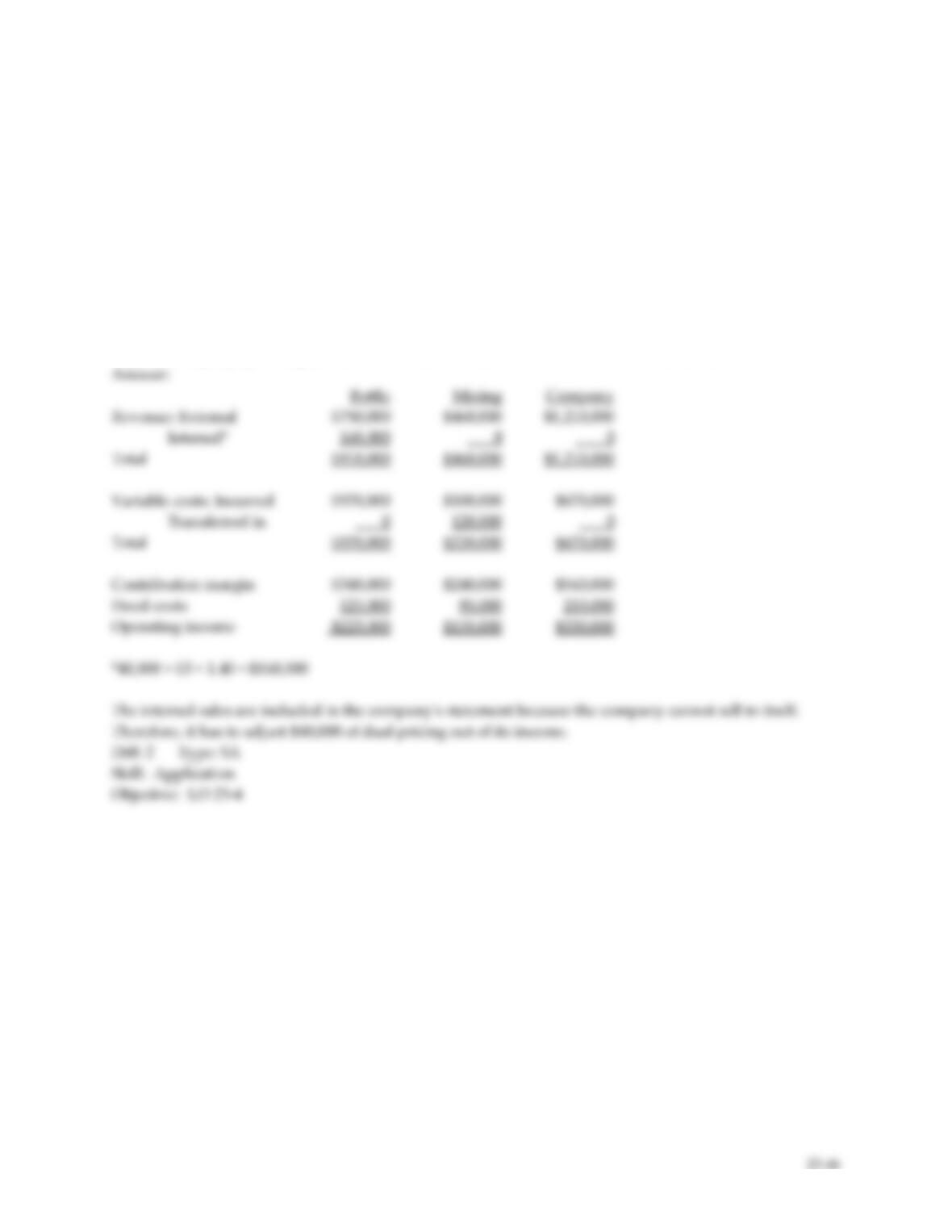
31) A company has two divisions. The Bottle Division produces products that have variable costs of $3
per unit. For the current year, sales were 150,000 to outsiders at $5 per unit and 40,000 units to the Mixing
Division at 140 percent of variable costs. Under a dual transfer pricing system, the Mixing Division pays
only the variable cost per unit. The fixed costs of Bottle Division were $125,000 per year.
Mixing sells its finished products to outside customers for $11.50 per unit. Mixing has variable costs of
$2.50 per unit in addition to the costs from Bottle. The annual fixed costs of Mixing were $85,000. There
were no beginning or ending inventories during the year.
Required:
What are the operating incomes of the two divisions and the company as a whole for the year? Explain
why the company operating income is less than the sum of the two divisions’ total income.
Cost Accounting: A Managerial Emphasis, 6e
Chapter 23 – Transfer Pricing and Multinational Management Control Systems
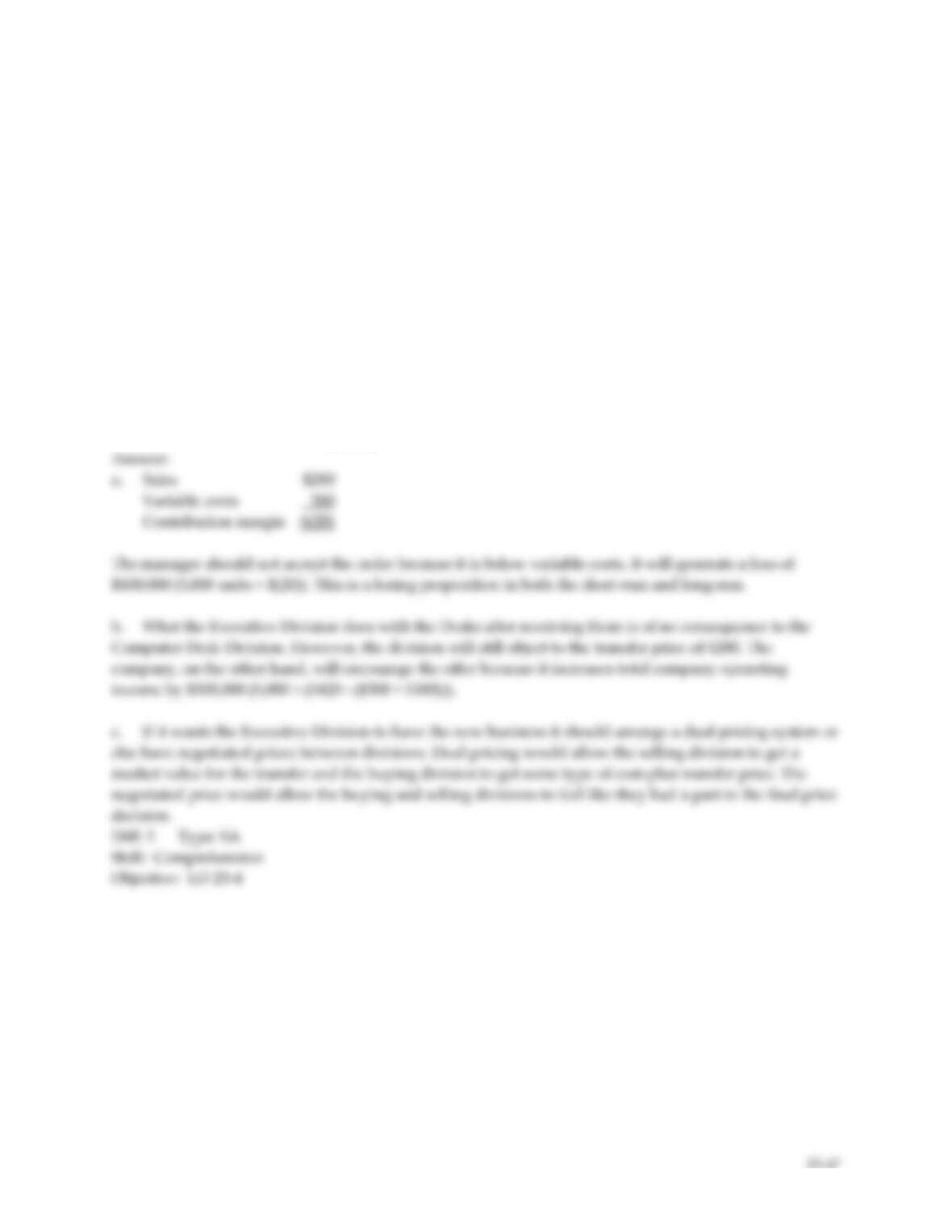
32) The Home Office Company makes all types of office desks. The Computer Desk Division is currently
producing 10,000 desks per year with a capacity of 15,000. The variable costs assigned to each desk are
$300 and annual fixed costs of the division are $900,000. The computer desks sell for $400.
The Executive Division wants to buy 5,000 desks at $280 for its custom office design business. The
Computer Desk manager refuses the order because the price is below variable cost. The Executive
manager argues that the order should be accepted because it will lower the fixed cost per desk from $90
to $60 and will take the division to its capacity, thereby causing operations to be at their most efficient
level.
Required:
a. Should the order from Executive Division be accepted by Computer Desk? Explain why or why not.
b. From the perspective of the Computer Desk Division and the company, should the order be accepted
if the Executive Division plans on selling the chairs in the outside market for $420 after incurring
additional costs of $100 per desk?
c. What action should the company president take?
Cost Accounting: A Managerial Emphasis, 6e
Chapter 23 – Transfer Pricing and Multinational Management Control Systems
23–48
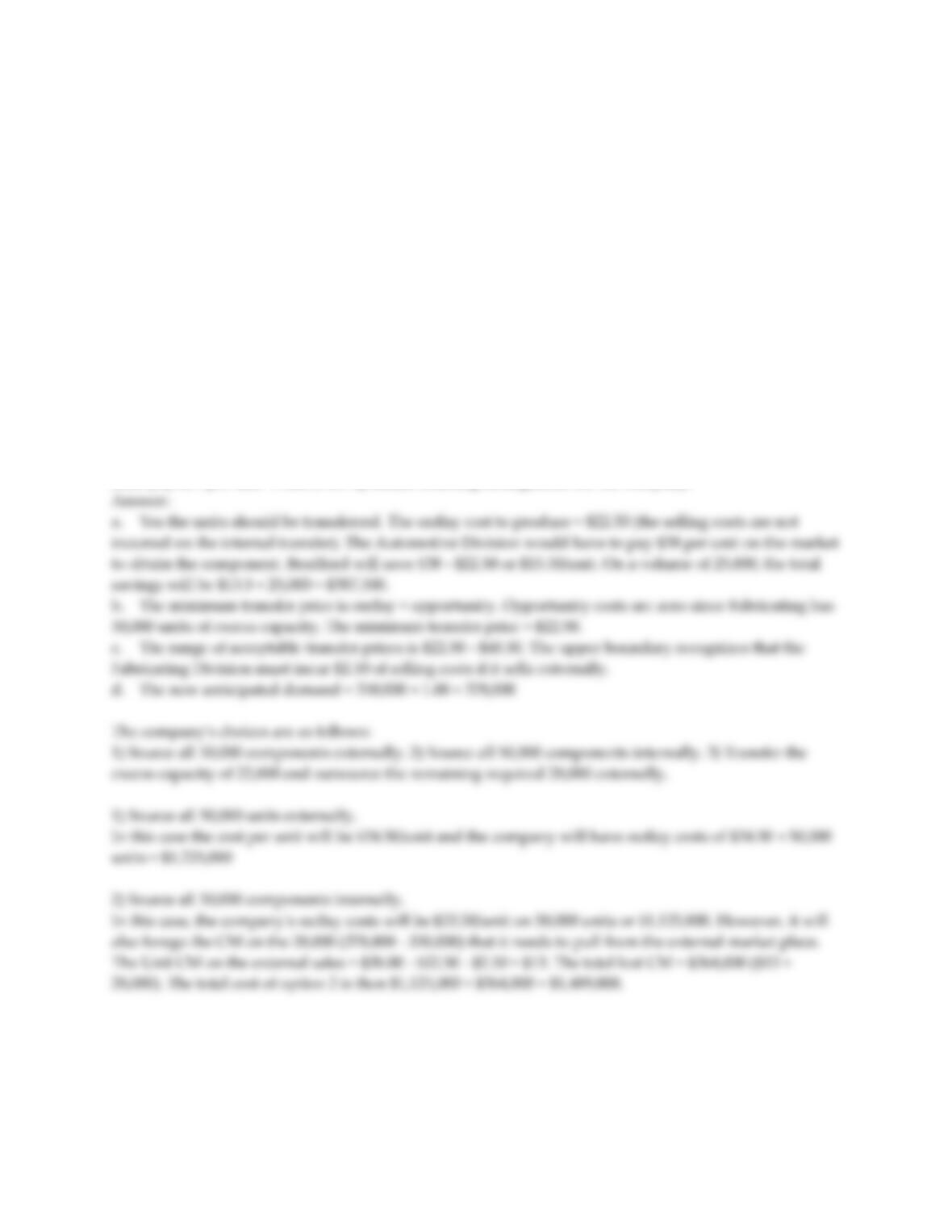
33) Bradford Manufacturing Ltd. manufactures custom metal perforating and fabricating. Its Fabricating
Division can transfer the perforated metal components to Bradford’s Automotive Division or it can sell its
products on the external market. Fabricating currently produces and sells 350,000 units per year to the
external market at an average price of $38 per unit. Variable costs of production average $22.50 and fixed
costs of $6.50/unit. Fabricating incurs $2.50 of variable selling costs on external sales. Fixed costs are
based on the practical capacity of the plant which is 400,000 per year. The Automotive Division is
interested in acquiring up to 50,000 units per year.
Required:
a. From the standpoint of Bradford Manufacturing Ltd., should the units be transferred? Determine the
financial benefit or cost of your recommendation.
b. Using the general guidelines for transfer pricing, what is the minimum transfer price Fabricating
should accept?
c. What is the range of acceptable transfer prices?
d. Now assume that demand in the external market for the components is expected to increase by 8%.
The Automotive Division has negotiated with an external supplier to supply 50,000 units at a price of
$34.50/unit. However, if the Automotive Division reduces its volume below the 50,000 unit volume, it
must pay $39 per unit. What is the optimum sourcing arrangement for the company?
Cost Accounting: A Managerial Emphasis, 6e
Chapter 23 – Transfer Pricing and Multinational Management Control Systems
23–49
34) Walton Industries has two divisions: Machining and Assembly. The Assembly Division is looking to
source 20,000 units annually of specialized component product from Machining Division. The special
components have variable costs of $260 per unit in variable production costs. The Machine Products
Division has a bid from an outside supplier of $445 per unit. However, to meet the requirements of the
Assembly Division, Machining would have to cut back production of an existing product. This product
sells for $565 per unit, and requires $369 per unit in variable production costs. Packaging and shipping
costs of the existing product are $12 per unit, but these would be slashed by 75% for the specialized
component for Assembly. Machining currently sells 120,000 units of the existing product and this volume
would have to be reduced by 25% to meet the Assembly Division’s demand.
Required:
Should the transfer take place, and if so, what would be the range of acceptable transfer prices?
Cost Accounting: A Managerial Emphasis, 6e
Chapter 23 – Transfer Pricing and Multinational Management Control Systems
35) Payne Ltd. has two divisions. The Compound Division makes QZ54, an industrial compound, which
is then transferred to the Processing Division. The Processing Division further processes the QZ54 and
sells the final product to customers at $87/kg Capacity in the Compound Division is 800,000kg QZ54 can
be obtained on the external market at $50/kg Data regarding the costs per kilogram in each division are
presented below:
Compound
Division
Processing
Division
Direct material
$8
$6
Direct labour
$12
$12
Manufacturing overhead*
$28
$18
*In the Compound Division the variable overhead is 80% of the total, and in Processing variable overhead
represents 65% of the total. Fixed overhead rates are based on capacity of 800,000kg in each division.
In addition to the manufacturing costs, the Compound Division would incur $2 per kilogram of selling
costs which would be avoided on internal transfers. Similarly the Processing Division would avoid $3/kg
of ordering costs on internal purchases.
Required:
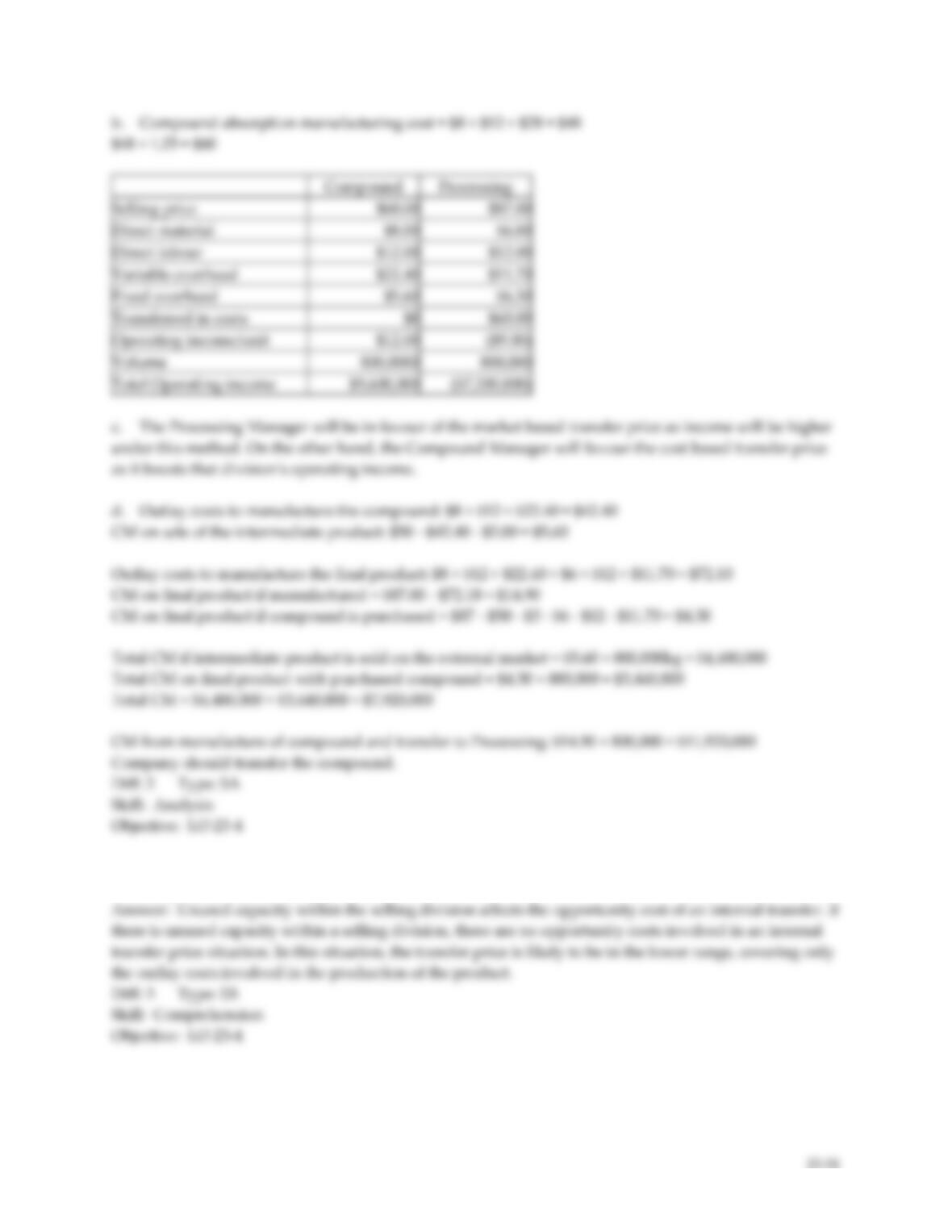
a. Calculate the operating incomes for each division assuming 800,000kg of QZ54 are transferred and
the company uses a market transfer price.
b. Calculate the operating incomes for each division assuming 800,000kg of QZ54 are transferred and
the company uses a transfer pricing policy based on 125% of absorption manufacturing cost.
c. Comment on your calculations in a and b.
d. Should the company transfer its 800,000 kg assuming the Compound Division can sell all of its
output on the external market?
Market based Transfer Price
Selling price
Direct material
Direct labour
Variable overhead
Fixed overhead
Transferred in costs
Operating income/unit
Volume
Total Operating income
Cost Accounting: A Managerial Emphasis, 6e
Chapter 23 – Transfer Pricing and Multinational Management Control Systems
36) What is the role of unused capacity within the selling division in the determination of a negotiated
transfer price to another division?
Cost Accounting: A Managerial Emphasis, 6e
Chapter 23 – Transfer Pricing and Multinational Management Control Systems
23.5 Analyze income tax considerations in multinational transfer pricing.
1) Additional factors that arise in multinational transfer pricing include tariffs and customs duties levied
on imports of products into a country.
2) It is possible to increase the overall after-tax profit of a multinational corporation by adjusting transfer
prices.
3) A Canadian company has subsidiaries in France, England, Canada, and in the USA. The company is
somewhat vertically-integrated in that the Canadian subsidiary sells some of its output to the USA
subsidiary which further processes the material. If the market is fully-competitive, which price is best for
goal congruence?
A) market-based price
B) full cost no markup
C) negotiated price
D) distress price
E) either market-based or full cost
4) A Canadian company has subsidiaries in France, England, Canada, and in the USA. The company is
somewhat vertically-integrated in that the Canadian subsidiary sells some of its output to the USA
subsidiary. Which further processes the material. If the market is fully-competitive, which transfer price
would likely be used, given Canada Revenue Agency‘s published policy on transfer pricing?
A) market-based price
B) full cost plus a markup
C) negotiated price
D) distress price
E) either market-based or full cost
Cost Accounting: A Managerial Emphasis, 6e
Chapter 23 – Transfer Pricing and Multinational Management Control Systems
5) Which of the following plans should be implemented assuming Tails Company wants to maximize the
amount of income received from the division in Bulgaria, a country that places restrictions on the amount
of funds that may be transferred outside its national border?
A) maximize the transfer price of goods transferred out of Bulgaria
B) maximize the transfer price of goods transferred into Bulgaria
C) minimize the transfer price of goods transferred out of Bulgaria
D) minimize the transfer price of goods transferred into Bulgaria
E) minimize the price of goods to external clients
6) Which of the following types of taxes are relevant to transfer pricing?
A) income taxes
B) payroll taxes
C) customs duties
D) value-added taxes
E) income taxes, payroll taxes, customs duties, and value-added taxes
7) Which of the following is FALSE concerning Canada Revenue Agency’s published position on transfer
pricing?
A) The Canadian taxpayer is expected to pay a fair price for goods and services purchased from non–
resident affiliates.
B) The Canadian taxpayer is expected to pay at least a fair price for goods and services purchased from
non-resident affiliates.
C) The Canadian taxpayer is expected to report taxable income based on having paid at least a fair price
for goods and services purchased from non-resident affiliates.
D) The Canadian taxpayer is expected to report taxable income based on having received no more than a
fair price for goods and services sold to non-resident affiliates.
E) The Canadian taxpayer is expected to report taxable income based on having paid no more than a fair
price for goods and services purchased from-resident affiliates.
Cost Accounting: A Managerial Emphasis, 6e
Chapter 23 – Transfer Pricing and Multinational Management Control Systems
8) Full-cost transfer prices will maximize overall corporate income when transferring products from
divisions operating
A) in a low tax area to a high tax area.
B) in a high tax area to a low tax area.
C) between high tax areas.
D) between low tax areas.
E) in a high tax area to another high tax area.
9) A(n) ________ is a binding agreement between a multinational and the United States Internal Revenue
Service to obtain approval for a specific transfer price for a number of years.
A) Tax Treaty
B) Advanced Pricing Agreement
C) Revenue Ruling
D) Dual Price Ruling
E) International Transfer Price
10) Global Giant, a multinational corporation, has a producing subsidiary in a low tax rate country and a
marketing subsidiary in a high tax country. If Global Giant wants to minimize its worldwide tax liability,
we would expect Global Giant to
A) stop producing in the low tax rate country.
B) stop marketing in the high tax rate country.
C) establish a low transfer price when the producing unit sells to the marketing unit.
D) establish a high transfer price when the producing unit sells to the marketing unit.
E) be indifferent as to its transfer pricing policy.
11) A company has a plant in a high tax jurisdiction that produces products for a facility in a low tax
jurisdiction. Suggest a strategy, including transfer prices, which will result in the lowest tax for the
overall corporation.
Cost Accounting: A Managerial Emphasis, 6e
Chapter 23 – Transfer Pricing and Multinational Management Control Systems
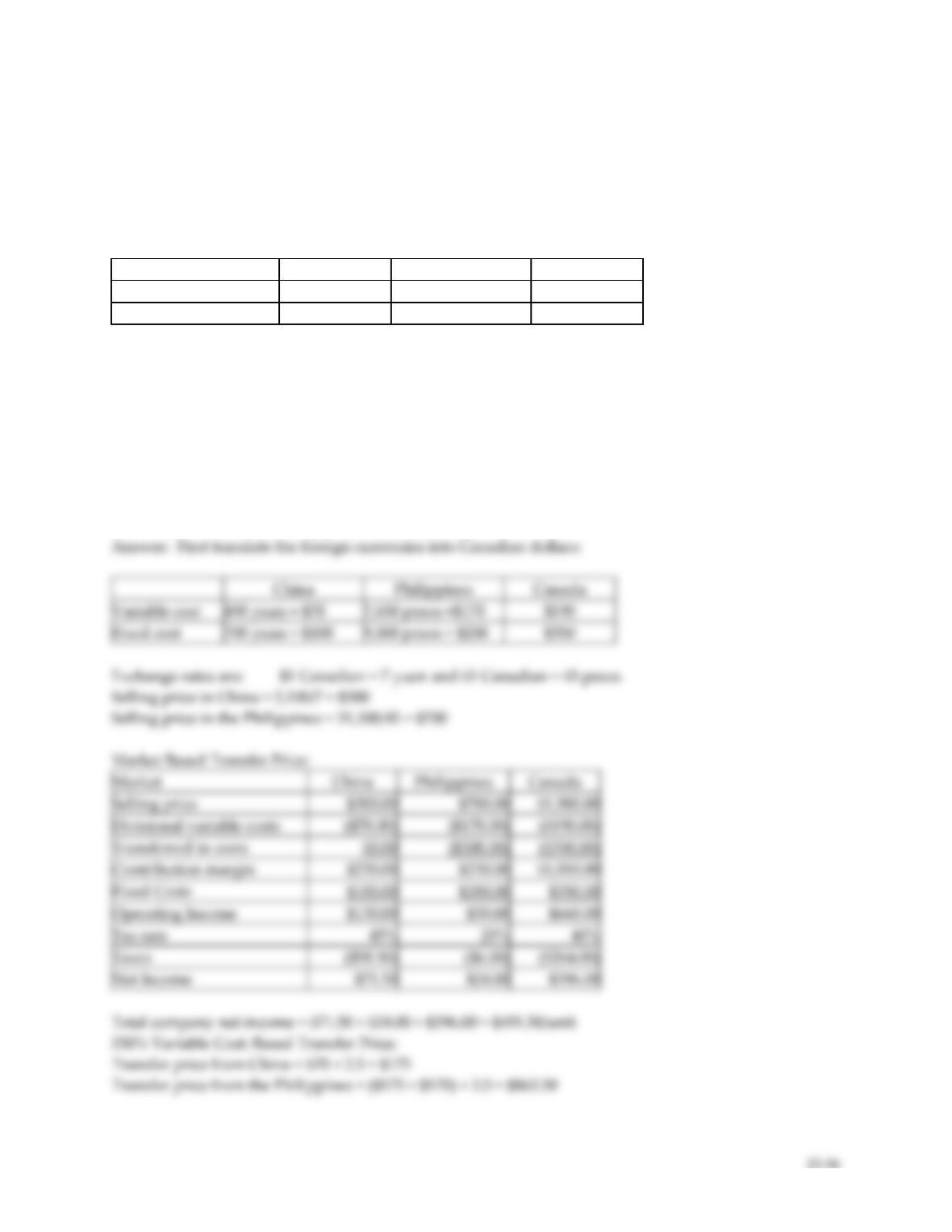
12) Empire Ltd. has two divisions. Division C is located in Canada where the income tax rate is 40%.
Division K is located in Korea where the income tax rate is 30%. Division C produces an intermediate
product at a variable cost of $100 per unit and transfer the product to Division K where it is finished and
sold for $500 per unit. Variable costs in Division K is $80 per unit. Fixed costs are $75,000 per year in
Division C and $90,000 per year in Division K. Assume 1,000 units are transferred annually and the
minimum transfer price allowed by the Canadian tax authorities is the variable cost. Also assume
operating income in each country is equal to taxable income.
Required:
a. What transfer price should be set for Empire to minimize its total income taxes? Show your
calculations.
b. If Empire desires to minimize its total income taxes, calculate the amount of tax liability in each
country.
Cost Accounting: A Managerial Emphasis, 6e
Chapter 23 – Transfer Pricing and Multinational Management Control Systems
13) Hendricks Ltd. of Calgary manufactures and sells computers. The Manufacturing Division is located
in China and transfers 75% of its output to the Assembly Division in the Philippines. The balance of the
product is sold in the local market at 2,100 yuan/unit. The Philippines division sells 20% of its output in
the local market at 31,500 pesos/unit, with the balance shipped to Calgary. The Calgary operation
packages the units and sells the final product at $1,900 Canadian per unit.
The following budget data are available:
China
Philippines
Canada
Variable cost
490 yuan
7,650 pesos
$190
Fixed cost
700 yuan
9,000 pesos
$350
Exchange rates are: $1 Canadian = 7 yuan and $1 Canadian = 45 pesos
Tax rates are 45% in China, 20% in the Philippines and 40% in Canada. Income taxes are not included in
the calculation of cost-based transfer prices. Assume that Hendricks does not pay Canadian tax on
amounts already taxed in foreign jurisdictions. Take each calculation to 2 decimal places.
Required:
The company has determined that it may transfer units at 250% of variable cost or at market and comply
with all existing tax legislation. Which transfer pricing method should the company pursue? Support
your recommendation with appropriate calculations.
Variable cost
490 yuan = $70
7,650 pesos =$170
Fixed cost
700 yuan = $100
9,000 pesos = $200
Market
Selling price
Divisional variable costs
Transferred in costs
($700.00)
Contribution margin
Fixed Costs
Operating Income
Tax rate
Taxes
($264.00)
Net Income
Cost Accounting: A Managerial Emphasis, 6e
Chapter 23 – Transfer Pricing and Multinational Management Control Systems
23–57
Cost Accounting: A Managerial Emphasis, 6e
Chapter 23 – Transfer Pricing and Multinational Management Control Systems
23–58
14) Clark Industries Ltd. manufactures monochromators that are used in a variety of applications. The
Monchromator Division (M Division) sells its monochromators both internally and externally. It is
operating at 80% of its 250,000 unit capacity and internal sales account for approximately 20% of its
current sales volume. Internally the monochromators are transferred into the Aerospace Division (A
Division) at a transfer price of $11,250 each. Variable production costs are the same for internal and
external sales.
The income statement for the M Division is presented below:
Sales
$2,850,000,000
Variable costs
$900,000,000
Contribution Margin
$1,950,000,000
Fixed Costs
$1,360,000,000
Operating Income
$590,000,000
The A Division uses one component in the production of its final product that sells for $75,000/unit. Other
variable costs in the A Division are 40% of sales. and fixed costs per unit at its current capacity of 40,000
units are $17,250.
The Aerospace Division is operating at its full capacity of40,000 units and is evaluating whether it should
invest to increase capacity. The investment would cost $900,000,000 and would have a useful life of 3
years. The equipment could be sold for $800,000 at the end of its useful life. For tax purposes it would be
sold on January 1 of year 4. The machine would be used to manufacture a variation of its current product.
This new product would sell for $68,000 per unit. The variable cost ratio would be higher at 45%. The
additional capacity of the new machine would be 14,000 units. It would qualify for a 30% CCA rate and
the company would continue to have assets in the pool.
Required:
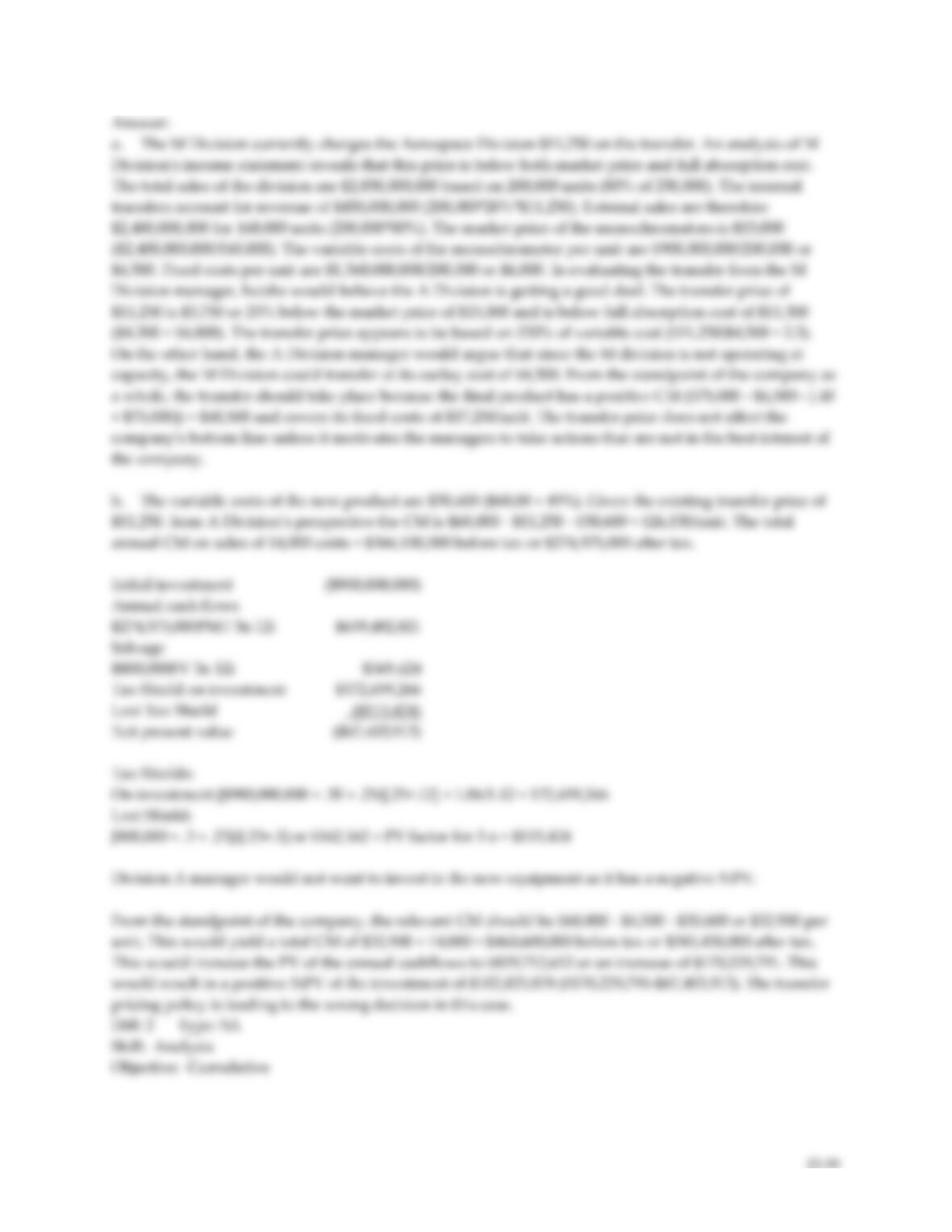
a. Evaluate the current transfer pricing policy from the standpoint of each division manager as well as
the company as a whole.
b. Using net present value (NPV) analysis, would the A Division manager want to invest in the new
equipment if the required rate of return is 12% and the tax rate is 25%?
c. If the investment is evaluated from a corporate perspective using NPV analysis and the 12% discount
rate, does the decision change? Explain.
Cost Accounting: A Managerial Emphasis, 6e
Chapter 23 – Transfer Pricing and Multinational Management Control Systems
Cost Accounting: A Managerial Emphasis, 6e
Chapter 23 – Transfer Pricing and Multinational Management Control Systems
15) What are some of the factors, other than income taxation, that companies should consider when
setting international transfer prices?