
Chapter 23 – Systematics, Phylogenies, and Comparative Biology
Chapter 23
Systematics, Phylogenies, and Comparative Biology
Fill in the Blank Questions
1. The biological specialty that deals with the grouping and naming of organisms is called taxonomy or _________.
2. The biological specialty that deals with the reconstruction and study of phylogenies is
called _________.
3. The behavior of parental care exhibited by dinosaurs is thought to be __________ to this
behavior in crocodiles and birds because phylogeny shows that these three groups share a
common ancestor.

Chapter 23 – Systematics, Phylogenies, and Comparative Biology
4. Saber teeth found in different groups of extinct carnivorous mammals are considered
___________ structures, as the fossil record shows that saber teeth evolved independently
among the groups.
5. Systematists often use DNA sequencing in ______________, the study of the order of
evolutionary events within a group sharing derived characters.
6. A ______________ group consists of the most recent common ancestor and all of its
descendants.
7. A ______________ group consists of the most recent common ancestor and some of its
descendants.

Chapter 23 – Systematics, Phylogenies, and Comparative Biology
8. A ______________ group does not contain the most recent common ancestor.
9. The principle of ______________ favors the hypothesis that requires the fewest
assumptions.
10. A derived character that is shared by all members of a clade is called a ______________
of that clade.
Multiple Choice Questions

Chapter 23 – Systematics, Phylogenies, and Comparative Biology
11. Characteristics between the branch points of a cladogram that are shared by all organisms
above the branch point and are not present in any below it are called
12. Characteristics that have arisen in organisms as a result of common evolutionary descent
are said to be ______________ characteristics.
13. One day after a biology class four of your friends argue about the difference between
phylogeny and systematics. Which friend is right?
Chapter 23 – Systematics, Phylogenies, and Comparative Biology
14. The evolutionary sequence in the development of a complex character can be best
analyzed through
Check All That Apply Questions
15. A phylogenetically-based taxonomy is important not only in creating a logical way to
name organisms, but also in learning about ________ of organisms using information in
related species. Check all that apply.
Multiple Choice Questions
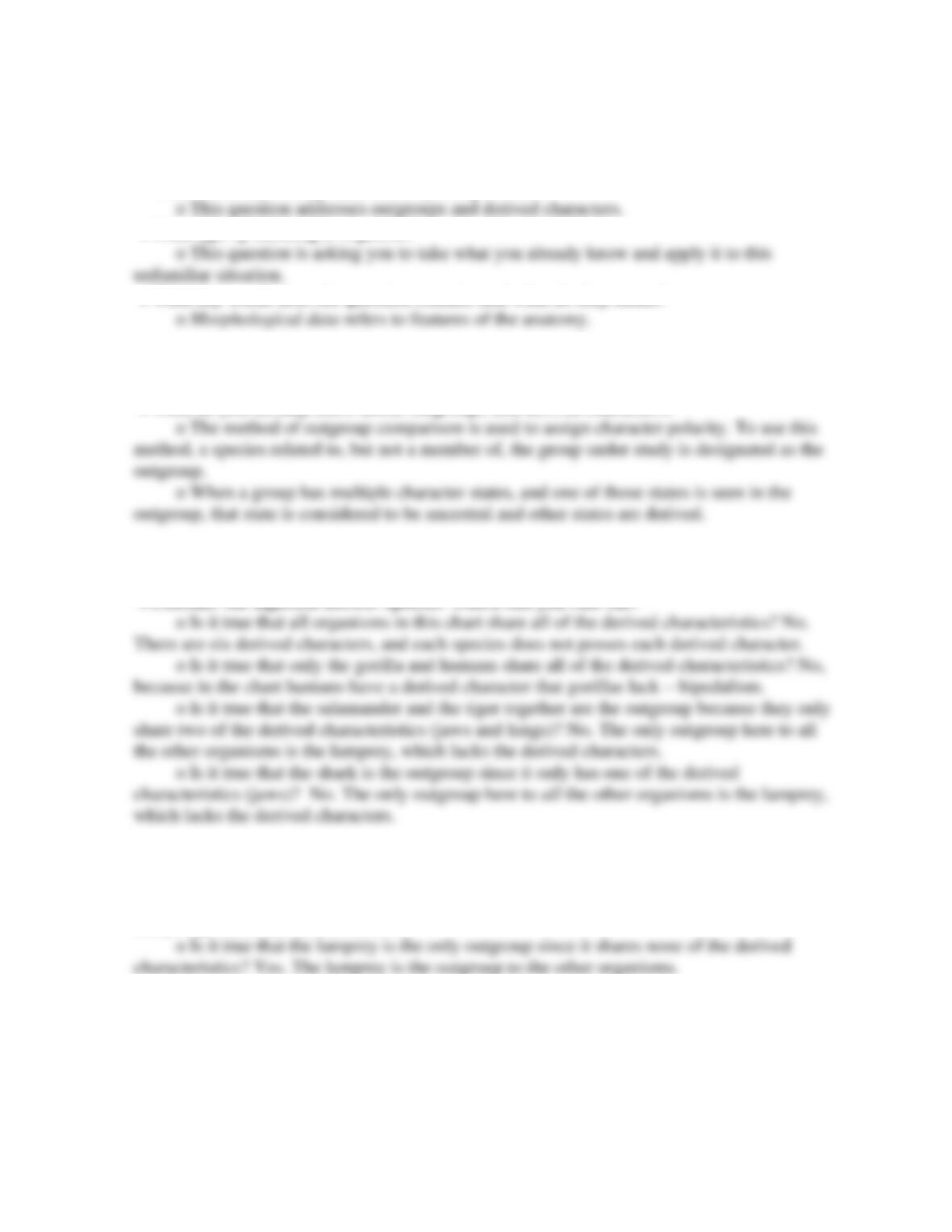
16. Choose the true statement about the morphological data in the chart shown below. The
“1” in the box means the trait is present and the “0” indicates that the trait is absent.(Note: All
of the characteristics across the top of the columns are considered “TRAITS” for purposes of
reading the chart.).
Chapter 23 – Systematics, Phylogenies, and Comparative Biology
Clarify Question
•
What is the key concept addressed by the question?
•
What type of thinking is required?
•
What key words does the question contain and what do they mean?
Gather Content
•
What do you already know about outgroups and derived characters?
Consider Possibilities
•
Consider the different answer options. Which can you rule out?
Choose Answer
•
Given what you now know, what information and/or problem solving approach is most
likely to produce the correct answer?
Reflect on Process
•
Did your problem-solving process lead you to the correct answer? If not, where did the
process break down or lead you astray? How can you revise your approach to produce a
more desirable result?
Chapter 23 – Systematics, Phylogenies, and Comparative Biology
17. The study and reconstruction of phylogenies is

Chapter 23 – Systematics, Phylogenies, and Comparative Biology
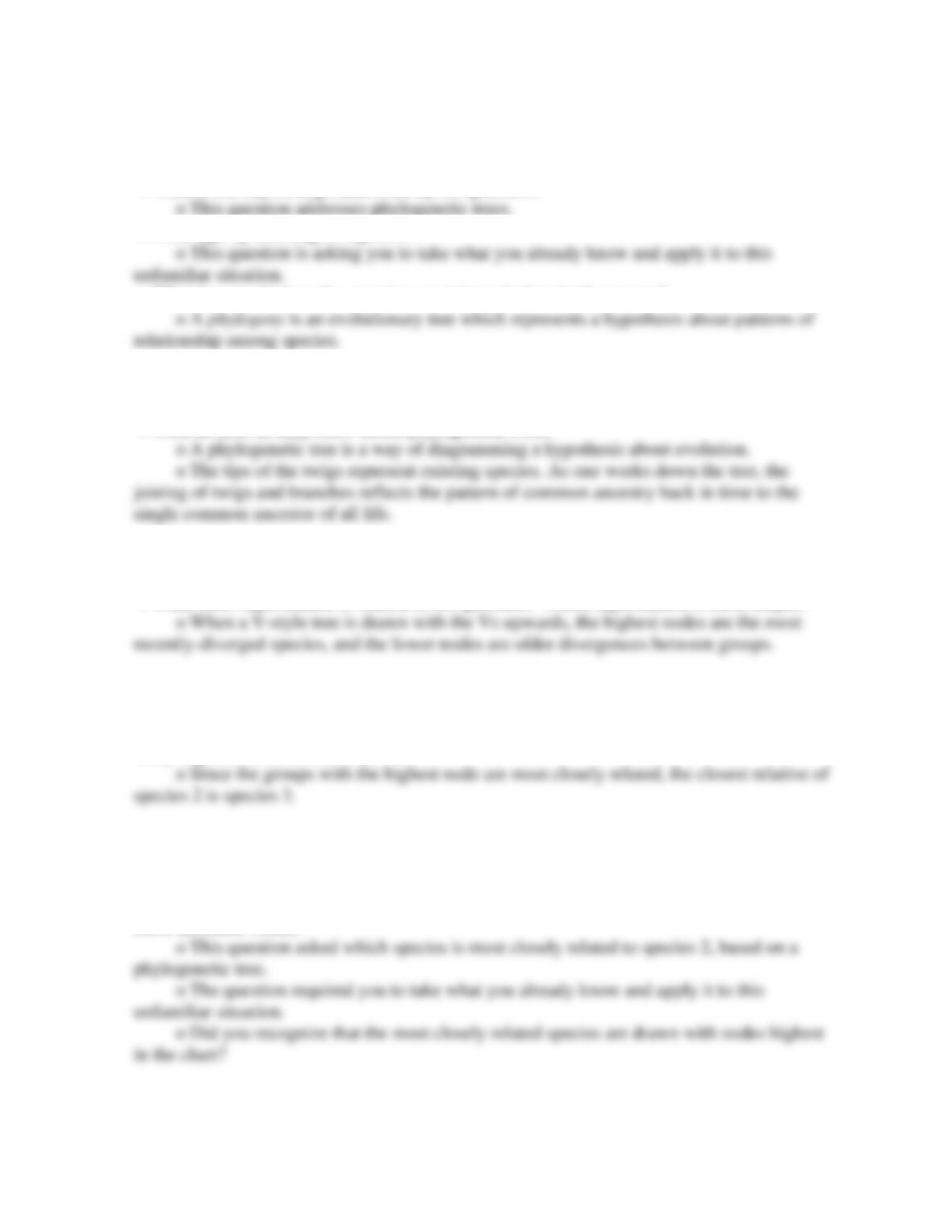
18. Based on the phylogeny shown, we can conclude that species 2 is most closely related to
species
Chapter 23 – Systematics, Phylogenies, and Comparative Biology
Clarify Question
•
What is the key concept addressed by the question?
•
What type of thinking is required?
•
What key words does the question contain and what do they mean?
Gather Content
•
What do you already know about phylogenetic trees?
Consider Possibilities
•
What other information is related to the question? Which information is most useful?
Choose Answer
•
Given what you now know, what information and/or problem solving approach is most
likely to produce the correct answer?
Reflect on Process
•
Did your problem-solving process lead you to the correct answer? If not, where did the
process break down or lead you astray? How can you revise your approach to produce a
more desirable result?

Chapter 23 – Systematics, Phylogenies, and Comparative Biology
19. Based on the phylogeny shown, the outgroup would be species
Chapter 23 – Systematics, Phylogenies, and Comparative Biology
Clarify Question
•
What is the key concept addressed by the question?
•
What type of thinking is required?
•
What key words does the question contain and what do they mean?
Gather Content
•
What do you already know about phylogenetic trees?
Possibilities
•
What other information is related to the question? Which information is most useful?
Choose Answer
•
Given what you now know, what information and/or problem solving approach is most
likely to produce the correct answer?
Reflect on Process
•
Did your problem-solving process lead you to the correct answer? If not, where did the
process break down or lead you astray? How can you revise your approach to produce a
more desirable result?

Chapter 23 – Systematics, Phylogenies, and Comparative Biology
20. Based on the phylogeny shown, the group of species including (2-5) can best be
described as a
Chapter 23 – Systematics, Phylogenies, and Comparative Biology
Clarify Question
•
What is the key concept addressed by the question?
•
What type of thinking is required?
unfamiliar situation.
•
What key words does the question contain and what do they mean?
Gather Content
•
What do you already know about phylogenetic trees?
Consider Possibilities
•
Consider the different answer options. Which can you rule out?
itself.
Choose Answer
•
Given what you now know, what information and/or problem solving approach is most
likely to produce the correct answer?
Reflect on Process
•
Did your problem-solving process lead you to the correct answer? If not, where did the
process break down or lead you astray? How can you revise your approach to produce a
more desirable result?

Chapter 23 – Systematics, Phylogenies, and Comparative Biology
21. Derived character states shared by clade members are called
22. The following are steps used to construct a cladogram that best reflects the evolutionary
relationships of a group of species. Which step involves deciding which tree is most likely to
have occurred, based on the fewest character state changes?
Chapter 23 – Systematics, Phylogenies, and Comparative Biology
Clarify Question
•
What is the key concept addressed by the question?
•
What type of thinking is required?
•
What key words does the question contain and what do they mean?
Gather Content
•
What do you already know about cladograms?
Consider Possibilities
•
Consider the different answer options. Which can you rule out?
Choose Answer
•
Given what you now know, what information and/or problem solving approach is most
likely to produce the correct answer?
Reflect on Process
•
Did your problem-solving process lead you to the correct answer? If not, where did the
process break down or lead you astray? How can you revise your approach to produce a

Chapter 23 – Systematics, Phylogenies, and Comparative Biology
more desirable result?
23. Character states shared by the ancestor or outgroup of a clade are called
Check All That Apply Questions
24. Select all of the following that can result in homoplasies.
Multiple Choice Questions
25. Birds, snakes, lizards, turtles, and crocodiles are all thought to share a common ancestor
and several homologous traits. Assuming that this is true, these groups of animals and their
common ancestor would represent

Chapter 23 – Systematics, Phylogenies, and Comparative Biology
Chapter 23 – Systematics, Phylogenies, and Comparative Biology
Clarify Question
•
What is the key concept addressed by the question?
•
What type of thinking is required?
•
What key words does the question contain and what do they mean?
Gather Content
•
What do you already know about monophyly?
Consider Possibilities
•
Consider the different answer options. Which can you rule out?
Choose Answer
•
Given what you now know, what information and/or problem solving approach is most
likely to produce the correct answer?
Reflect on Process
•
Did your problem-solving process lead you to the correct answer? If not, where did the
process break down or lead you astray? How can you revise your approach to produce a
more desirable result?

Chapter 23 – Systematics, Phylogenies, and Comparative Biology
Check All That Apply Questions
26. Select the true statements describing why cladistics may not always be the best method for
reconstructing phylogenies based on data from the DNA genome.
Multiple Choice Questions
27. Evidence suggests that the crocodiles are more closely related to the birds than the turtles
and snakes. If so, then including crocodiles, but not birds, in the Class Reptilia would make
the Class Reptilia
Chapter 23 – Systematics, Phylogenies, and Comparative Biology
Clarify Question
•
What is the key concept addressed by the question?
•
What type of thinking is required?
•
What key words does the question contain and what do they mean?
Gather Content
•
What do you already know about monophyly?
Consider Possibilities
•
Consider the different answer options. Which can you rule out?
Choose Answer
•
Given what you now know, what information and/or problem solving approach is most
likely to produce the correct answer?
Reflect on Process
•
Did your problem-solving process lead you to the correct answer? If not, where did the
process break down or lead you astray? How can you revise your approach to produce a
more desirable result?