
Chapter 23: Decision Making and Risk – Quiz A Name ________________
Use the following information for problems 1 through 6:
A land owner is considering a community development project in the southeastern U.S.
Even though he realizes that the current market for housing is not very favorable, he
believes that there will be an influx of retirees into the area within the next five years.
He is trying to decide between two alternatives: (1) building detached homes in a
planned retirement community or (2) building a smaller townhouse/condominium
complex. Mortgage interest rates will affect his outcomes and the applicable payoff (in $
millions) table is shown below.
23.3.3 Create and/or use decision trees and payoff tables.
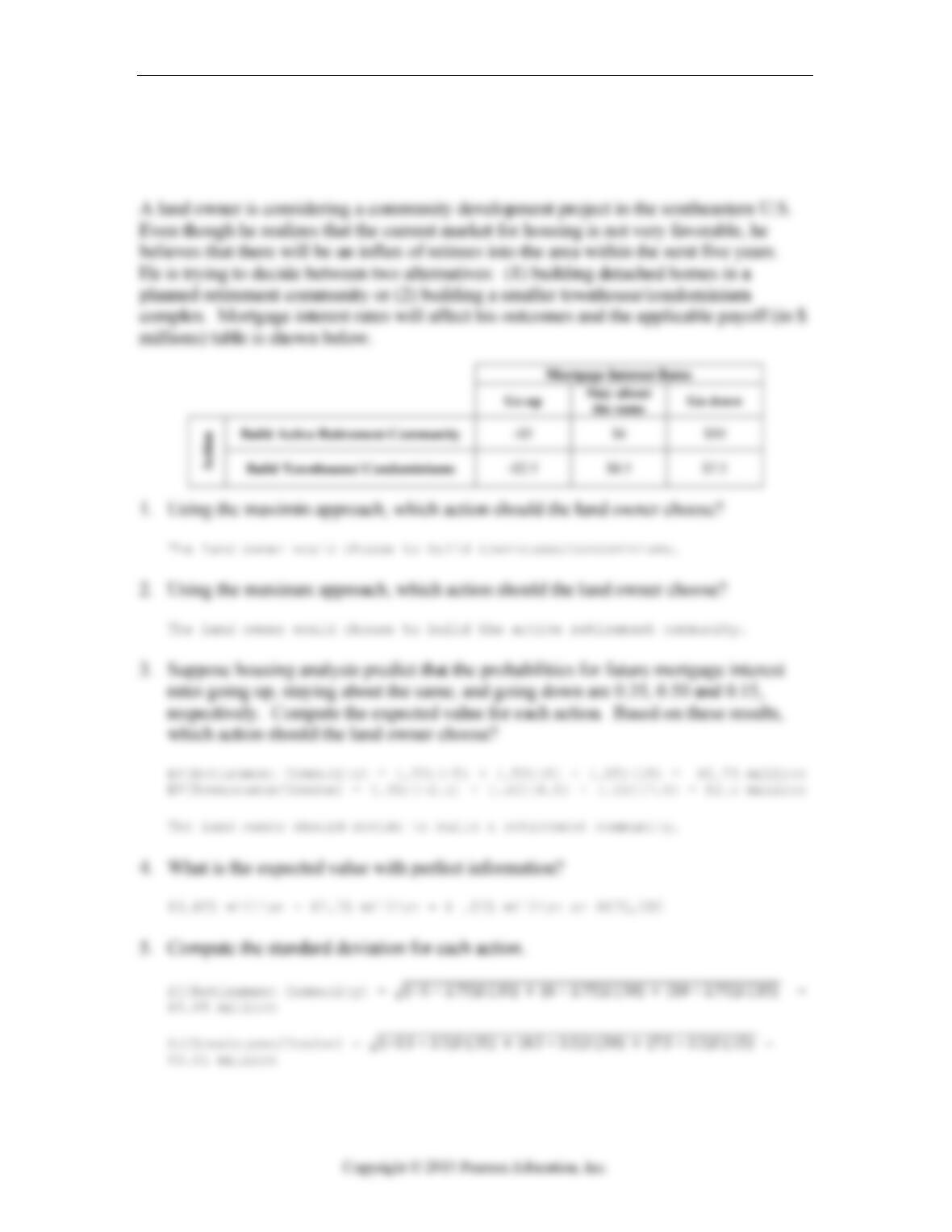
1. Using the maximin approach, which action should the land owner choose?
23.3.3 Create and/or use decision trees and payoff tables.
2. Using the maximax approach, which action should the land owner choose?
23.4.2 Find expected values, standard deviations, coefficients of variation, and/or return
to risk ratios
3. Suppose housing analysts predict that the probabilities for future mortgage interest
rates going up, staying about the same, and going down are 0.35, 0.50 and 0.15,
respectively. Compute the expected value for each action. Based on these results,
which action should the land owner choose?
23.5.2 Find expected values, standard deviations, coefficients of variation, and/or return
to risk ratios
4. What is the expected value with perfect information?
23.7.2 Find expected values, standard deviations, coefficients of variation, and/or return
to risk ratios
5. Compute the standard deviation for each action.
23.7.2 Find expected values, standard deviations, coefficients of variation, and/or return
to risk ratios
6. Compute the Coefficient of Variation for each action. If the land owner is risk
averse, would the CV for each action lead to the same choice as the expected value?
Explain.
Mortgage Interest Rates
Go up Stay about
the same Go down
Action
Build Active Retirement Community -$5 $6 $10
Build Townhouses/ Condominiums -$2.5 $4.5 $7.5
23-2 Chapter 23 Decision Making and Risk
Chapter 23: Decision Making and Risk – Quiz A – Key
Use the following information for problems 1 through 6:
Quiz A 23-3
23-4 Chapter 23 Decision Making and Risk
Chapter 23: Decision Making and Risk – Quiz B Name __________________
Use the following information for questions 1 through 6:
A farm owner in upstate New York who grows summer vegetables must decide whether
to employ additional pickers this season. If he does, he could hire either migrant workers
or local teenagers who need summer employment. The migrant workers are more
experienced, faster, but more expensive. Although the teenagers will work for less, they
are not as experienced and tend to damage plants and produce. His profits, taking into
account losses from unpicked perished or damaged produce, depend on whether there is a
good or bad growing season. The payoffs are shown in the table below.
23.3.3 Create and/or use decision trees and payoff tables.
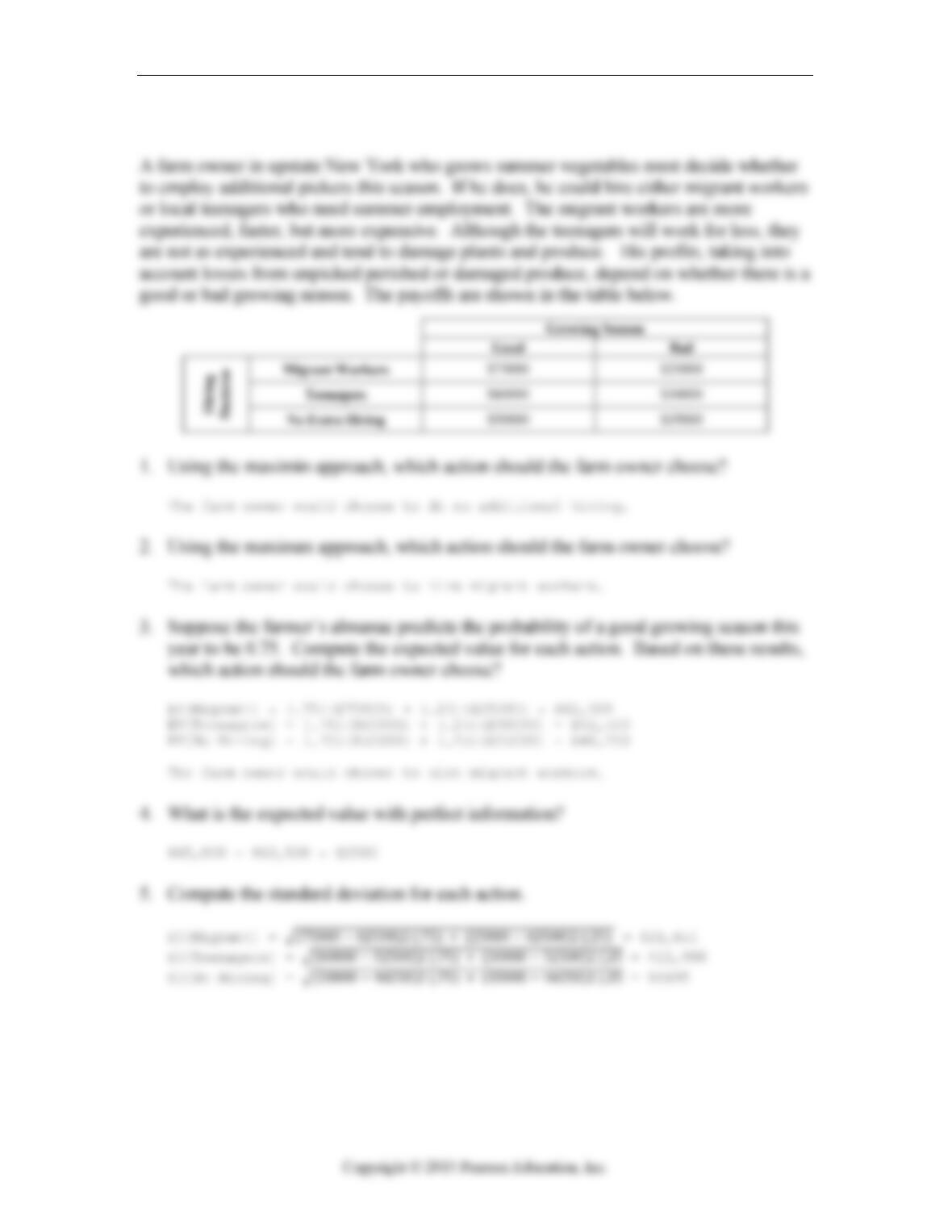
1. Using the maximin approach, which action should the farm owner choose?
23.3.3 Create and/or use decision trees and payoff tables.
2. Using the maximax approach, which action should the farm owner choose?
23.4.2 Find expected values, standard deviations, coefficients of variation, and/or return
to risk ratios
3. Suppose the farmer’s almanac predicts the probability of a good growing season this
year to be 0.75. Compute the expected value for each action. Based on these results,
which action should the farm owner choose?
23.5.2 Find expected values, standard deviations, coefficients of variation, and/or return
to risk ratios
4. What is the expected value with perfect information?
23.7.2 Find expected values, standard deviations, coefficients of variation, and/or return
to risk ratios
5. Compute the standard deviation for each action.
23.7.2 Find expected values, standard deviations, coefficients of variation, and/or return
to risk ratios
6. Compute the Coefficient of Variation for each action. If the farm owner is risk
averse, would the CV for each action lead to the same choice as the expected value?
Explain.
Growing Season
Good Bad
Hiring
Decision
Migrant Workers $75000 $25000
Teenagers $60000 $30000
No Extra Hiring $50000 $35000
Quiz B 23-5
Chapter 23: Decision Making and Risk – Quiz B – Key
23-6 Chapter 23 Decision Making and Risk
Quiz C 23-7
Chapter 23: Decision Making and Risk – Quiz C – Multiple Choice
23.2.3 Create and/or use decision trees and payoff tables.
1. A land owner is considering two actions and mortgage interest rates will affect his
outcomes. The payoff table ($ million) is shown below. According to the maximin
approach, the land owner should build
A. the active retirement community if interest rates go down.
B. the active retirement community.
C. townhouses/condominiums if interest rates go down.
D. townhouses/condominiums.
E. either the active retirement community or townhouses/condominiums.
23.4.2 Find expected values, standard deviations, coefficients of variation, and/or return
to risk ratios
2. Using the payoff table ($ million) is shown below, if the probabilities for future
mortgage interest rates going up, staying about the same, and going down are .35, .50
and .15, respectively, what is the expected value for building an active retirement
community?
A. $2.5 million
B. $3.625 million
C. $2.75 million
D. $875,000
E. None of the above
Mortgage Interest Rates
Go up Stay about
the same Go down
Action
Build Active Retirement Community -$5 $6 $10
Build Townhouses/ Condominiums -$2.5 $4.5 $7.5
Mortgage Interest Rates
Go up Stay about
the same Go down
Action
Build Active Retirement Community -$5 $6 $10
Build Townhouses/ Condominiums -$2.5 $4.5 $7.5
23-8 Chapter 23 Decision Making and Risk
23.4.2 Find expected values, standard deviations, coefficients of variation, and/or return
to risk ratios
3. Using the payoff table ($ million) is shown below for two possible actions, if the
probabilities for future mortgage interest rates going up, staying about the same, and
going down are 0.35, 0.50 and 0.15, respectively, the best decision according to the
expected value approach is to build
A. the active retirement community if interest rates go down.
B. the active retirement community.
C. townhouses/condominiums if interest rates go down.
D. townhouses/condominiums.
E. either the active retirement community or townhouses/condominiums.
23.5.2 Find expected values, standard deviations, coefficients of variation, and/or return
to risk ratios
4. Using the payoff table ($ million) is shown below, if the probabilities for future
mortgage interest rates going up, staying about the same, and going down are 0.35, 0.50
and 0.15, respectively, the expected value with perfect information is
A. $2.5 million
B. $3.625 million
C. $2.75 million
D. $875,000
E. None of the above.
Mortgage Interest Rates
Go up Stay about
the same Go down
Action
Build Active Retirement Community -$5 $6 $10
Build Townhouses/ Condominiums -$2.5 $4.5 $7.5
Mortgage Interest Rates
Go up Stay about
the same Go down
Action
Build Active Retirement Community -$5 $6 $10
Build Townhouses/ Condominiums -$2.5 $4.5 $7.5

Quiz C 23-9
23.7.2 Find expected values, standard deviations, coefficients of variation, and/or return
to risk ratios
5. A land owner is considering a community development project in the southeastern
U.S. He is faced with two alternatives: (1) build detached homes in a planned
retirement community or (2) build a smaller townhouse/condominium complex and
chooses the option with lowest Coefficient of Variation (CV). The owner is said to
be:
A. Risk-averse
B. Risk-neutral
C. Risk-tolerant
D. Both A and C.
E. Both B and C.
23.2.3 Create and/or use decision trees and payoff tables.
6. A company is considering three alternatives (action) to deal with this extra work load
as shown below (in $100,000). Using the minimin approach, the company should
Action Easy Moderately Difficult Extremely Difficult
Outsource 2.5 3.0 3.5
Temporary Staff 1.5 2.6 4.0
Overtime 1.2 2.8 4.2
A. outsource.
B. hire temporary staff.
C. use full time staff in overtime.
D. use full time staff in overtime if the file modifications are easy.
E. hire temporary staff if the file modifications are moderately difficult.
23.4.2 Find expected values, standard deviations, coefficients of variation, and/or return
to risk ratios
7. A company is considering three alternatives to deal with extra work load as shown
below (in $100,000). If the likelihoods of easy, moderately difficult and extremely
difficult are 0.2, 0.4 and 0.4, respectively, the expected cost of hiring temporary staff
is
File Modification
Action Easy Moderately Difficult Extremely Difficult
Outsource 2.5 3.0 3.5
Temporary Staff 1.5 2.6 4.0
Overtime 1.2 2.8 4.2
A. 3.04
B. 2.94
C. 1.99
D. 3.45
E. None of the above
23-10 Chapter 23 Decision Making and Risk
23.7.2 Find expected values, standard deviations, coefficients of variation, and/or return
to risk ratios
8. A company is considering three alternatives to deal with extra work load as shown
below (in $100,000). If the likelihoods of easy, moderately difficult and extremely
difficult are 0.2, 0.4 and 0.4, respectively, the standard deviation in costs associated
with outsourcing is
File Modification
Action Easy Moderately Difficult Extremely Difficult
Outsource 2.5 3.0 3.5
Temporary Staff 1.5 2.6 4.0
Overtime 1.2 2.8 4.2
A. 0.37
B. 0.95
C. 1.11
D. 1.23
E. None of the above
23.5.2 Find expected values, standard deviations, coefficients of variation, and/or return
to risk ratios
9. A company is considering three alternatives to deal with extra work load (in
$100,000) as shown below. If the likelihoods of easy, moderately difficult and
extremely difficult are 0.2, 0.4 and 0.4, respectively, what is the expected value (in
$100,000) with perfect information?
File Modification
Action Easy Moderately Difficult Extremely Difficult
Outsource 2.5 3.0 3.5
Temporary Staff 1.5 2.6 4.0
Overtime 1.2 2.8 4.2
A. 2.68
B. 2.94
C. 0.26
D. 0.16
E. None of the above.

Quiz C 23-11
23.6.3 Create and/or use decision trees and payoff tables.
10. A company believes there is a 20% chance the file modifications will be easy, a 40%
chance that they will be moderately difficult and a 40% that they will be extremely
difficult. Based on old files, modifications will be extensive or minor. Suppose the
probabilities are as follows: P (Minor | Easy) = 0.80, P (Minor | Moderately Difficult)
= 0.50 and P (Minor | Extremely Difficult) = 0.20. What is the probability that the
difficulty of the file modifications and transfer will be extremely difficult given that
the modifications required are minor?
A. 0.56
B. 0.20
C. 0.08
D. 0.44
E. 0.18
23-12 Chapter 23 Decision Making and Risk
Chapter 23: Decision Making and Risk – Quiz C – Key
Quiz D 23-13
Chapter 23: Decision Making and Risk – Quiz D – Multiple Choice
23.3.3 Create and/or use decision trees and payoff tables.
1. A farm owner could hire either migrant workers or local teenagers who need summer
employment. His profits depend on the growing season as shown below. Using the
maximax approach, the farmer would
A. hire migrant workers if the growing season is good.
B. hire teenagers.
C. not do any extra hiring.
D. hire migrant workers.
E. not do any extra hiring if the growing season is good.
23.4.2 Find expected values, standard deviations, coefficients of variation, and/or return
to risk ratios
2. A farm owner has three possible hiring decisions. His profits depend on the growing
season as shown below. If the probability of a good growing season is 0.75. What is
the expected value of hiring teenagers?
A. $62,500
B. $52,500
C. $46,250
D. $12,990
E. None of the above.
Growing Season
Good Bad
Hiring
Decision
Migrant Workers $75000 $25000
Teenagers $60000 $30000
No Extra Hiring $50000 $35000
Growing Season
Good Bad
Hiring
Decision
Migrant Workers $75000 $25000
Teenagers $60000 $30000
No Extra Hiring $50000 $35000
23-14 Chapter 23 Decision Making and Risk
23.4.3 Create and/or use decision trees and payoff tables.
3. A farm owner has three possible hiring decisions. His profits depend on the growing
season as shown below. If the probability of a good growing season is 0.75. Based on
the expected value approach, the farmer should
A. hire migrant workers if the growing season is good.
B. hire teenagers.
C. do not do any extra hiring.
D. hire migrant workers.
E. do not do any extra hiring if the growing season is bad.
23.4.2 Find expected values, standard deviations, coefficients of variation, and/or return
to risk ratios
4. A farm owner has three possible hiring decisions. His profits depend on the growing
season as shown below. If the probability of a good growing season is 0.75. The
standard deviation in payoffs for hiring migrant workers is
A. $21,651
B. $12,990
C. $5495
D. $2500
E. None of the above.
Growing Season
Good Bad
Hiring
Decision
Migrant Workers $75000 $25000
Teenagers $60000 $30000
No Extra Hiring $50000 $35000
Growing Season
Good Bad
Hiring
Decision
Migrant Workers $75000 $25000
Teenagers $60000 $30000
No Extra Hiring $50000 $35000
Quiz D 23-15
23.7.2 Find expected values, standard deviations, coefficients of variation, and/or return
to risk ratios
5. A farm owner has three possible hiring decisions. His profits depend on the growing
season as shown below. If the probability of a good growing season is 0.75. The
return to risk ratio for hiring migrant workers is
A. 8.40
B. 4.05
C. 2.89
D. 0.346
E. None of the above.
23.7.2 Find expected values, standard deviations, coefficients of variation, and/or return
to risk ratios
6. A farm owner has three possible hiring decisions. His profits depend on the growing
season as shown below. If the probability of a good growing season is 0.75. If the
farmer is risk averse, he would
A. hire migrant workers.
B. hire teenagers.
C. do not do any extra hiring.
D. make the same decision as he would using the expected value approach.
E. give up farming.
Growing Season
Good Bad
Hiring
Decision
Migrant Workers $75000 $25000
Teenagers $60000 $30000
No Extra Hiring $50000 $35000
Growing Season
Good Bad
Hiring
Decision
Migrant Workers $75000 $25000
Teenagers $60000 $30000
No Extra Hiring $50000 $35000
23-16 Chapter 23 Decision Making and Risk
23.2.3 Create and/or use decision trees or payoff tables.
7. A company is considering three alternatives (action) to deal with this extra work load
as shown below (in $100,000). Using the minimin approach, the company should
File Modification
Action Easy Moderately Difficult Extremely Difficult
Outsource 2.5 3.0 3.5
Temporary Staff 1.5 2.6 4.0
Overtime 1.2 2.8 4.2
A. outsource.
B. hire temporary staff.
C. use full time staff in overtime.
D. outsource if the file modifications are extremely difficult.
E. use full time staff in overtime if the file modifications are easy.
23.4.2 Find expected values, standard deviations, coefficients of variation, and/or return
to risk ratios
8. A company is considering three alternatives (action) to deal with this extra work load
as shown below (in $100,000). If the likelihoods of easy, moderately difficult and
extremely difficult are 0.2, 0.4 and 0.4, respectively, the best decision according to
the expected value approach is to
File Modification
Action Easy Moderately Difficult Extremely Difficult
Outsource 2.5 3.0 3.5
Temporary Staff 1.5 2.6 4.0
Overtime 1.2 2.8 4.2
A. outsource.
B. hire temporary staff.
C. use full time staff in overtime.
D. outsource if the file modifications are extremely difficult.
E. use full time staff in overtime if the file modifications are easy.

Quiz D 23-17
23.6.3 Create and/or use decision trees and payoff tables.
9. A company believes there is a 20% chance the file modifications will be easy, a 40%
chance that they will be moderately difficult and a 40% that they will be extremely
difficult. Based on old files, modifications will be extensive or minor. Suppose the
probabilities are as follows: P (Minor | Easy) = 0.80, P (Minor | Moderately Difficult)
= 0.50 and P (Minor | Extremely Difficult) = 0.20. What is the probability that the
difficulty of the file modifications and transfer will be extremely difficult given that
the consultant believes the modifications required are extensive?
A. 0.57
B. 0.20
C. 0.32
D. 0.44
E. 0.90
23.6.3 Create and/or use decision trees and payoff tables.
10. A company believes there is a 20% chance the file modifications will be easy, a 40%
chance that they will be moderately difficult and a 40% that they will be extremely
difficult. Based on old files, modifications will be extensive or minor. Suppose the
probabilities are as follows: P (Minor | Easy) = 0.80, P (Minor | Moderately Difficult)
= 0.50 and P (Minor | Extremely Difficult) = 0.20. What is the probability that the
difficulty of the file modifications and transfer will be extremely difficult given that
the modifications required are minor?
A. 0.57
B. 0.20
C. 0.32
D. 0.44
E. 0.90
23-18 Chapter 23 Decision Making and Risk
Chapter 23: Decision Making and Risk – Quiz D – Key