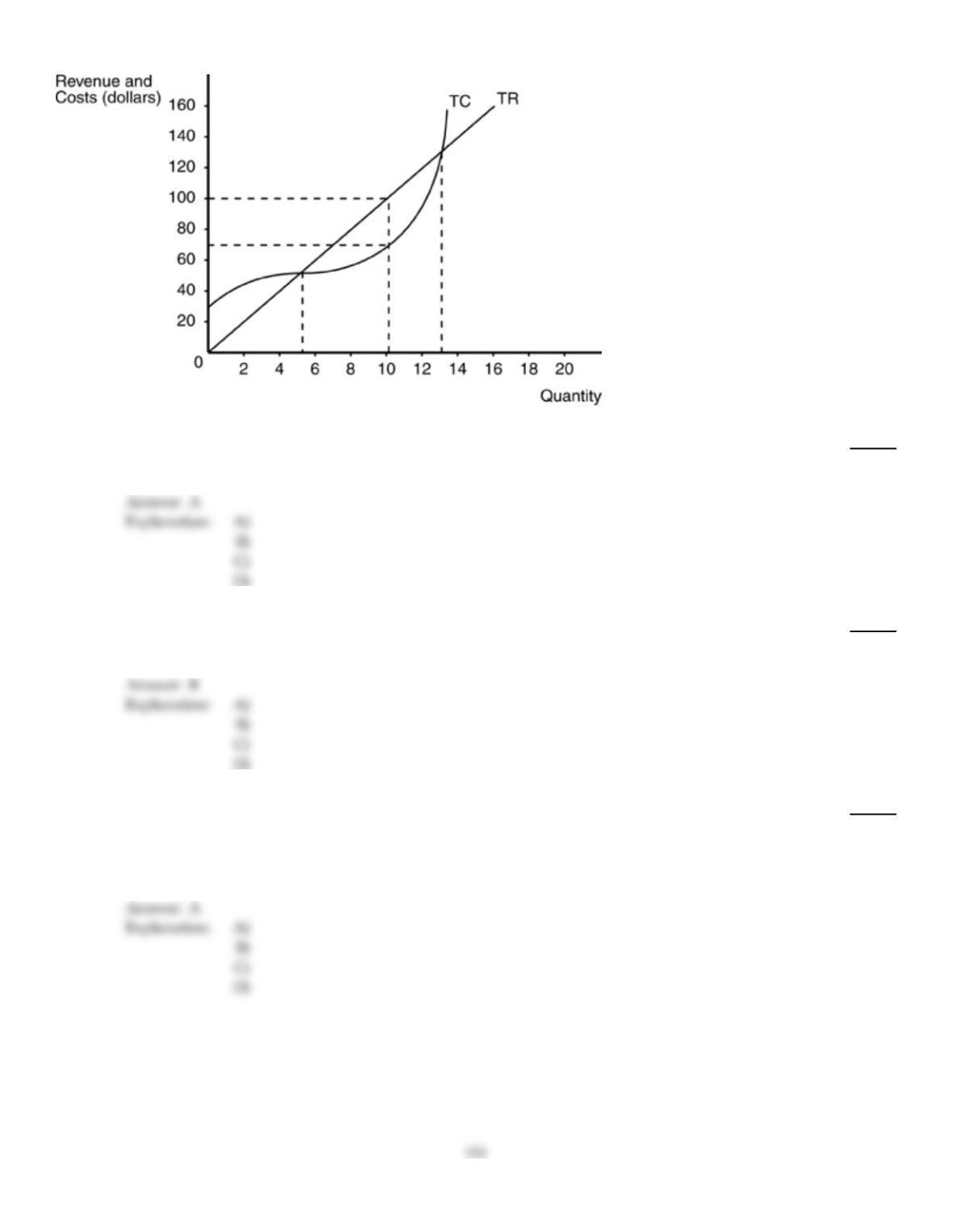
339)
In the above figure, at the profit–maximizing rate of production for the perfectly competitive firm
total cost is
339)
A)
$70.
B)
$30.
C)
$100.
D)
$130.
340)
The demand curve faced by a perfectly competitive industry
340)
A)
is perfectly inelastic.
B)
slopes downward.
C)
has no slope.
D)
slopes upward.
341)
Competitive pricing is efficient because
341)
A)
the price that consumers pay reflects the opportunity cost to society of producing the good.
B)
firms make positive economic profits in long–run equilibrium.
C)
firms produce above the minimum efficient scale.
D)
average revenue equals average cost.
342)
Which of the following is NOT a characteristic of a perfectly competitive industry?
342)
A)
Each firm produces the same homogeneous product.
B)
There is free entry and exit in the long run.
C)
The industry demand curve is downward sloping.
D)
Economic profits must be positive in the short run.
343)
An industry in which an increase in output leads to a reduction in long–run per–unit costs is a(n)
343)
A)
increasing–cost industry.
B)
constant–cost industry.
C)
break–even cost industry.
D)
decreasing–cost industry.
D
344)
If marginal revenue is greater than marginal cost, the firm should
344)
A)
increase its rate of output.
B)
raise marginal revenue.
C)
raise price.
D)
decrease its rate of output.
A
345)
Which of the following is closest to a perfectly competitive market?
345)
A)
the market for corn
B)
the market for automobiles
C)
the market for breakfast cereal
D)
the pizza market
A
346)
The perfectly competitive firm’s demand curve has
346)
A)
a negative slope.
B)
an undefined slope.
C)
a positive slope.
D)
a slope of 0.
D
D
347)
Consider an industry that is in long–run equilibrium. An increase in demand leads to no change in
the price of the good. We know that this is
347)
A)
a decreasing cost industry.
B)
a constant cost industry.
C)
an increasing cost industry.
D)
not a competitive industry.
348)
When demand is perfectly elastic, marginal revenue is
348)
A)
equal to price.
B)
declining.
C)
zero.
D)
increasing.
Total
Output Costs
100 $400
101 402
102 405
103 409
104 414
105 420
106 427
107 435
349)
Refer to the above table. If the price is $3, the perfectly competitive firm should produce
349)
A)
104 units.
B)
103 units.
C)
102 units.
D)
105 units.
350)
Each firm in a perfectly competitive industry is
350)
A)
relatively large.
B)
a price setter.
C)
a price taker.
D)
producing a unique product.
351)
A constant–cost industry is one in which
351)
A)
there is no change in long–run per–unit costs, even as output varies.
B)
each firm has a horizontal long–run average cost curve.
C)
the marginal product of labor is constant.
D)
output increases lead to productivity gains.
352)
Which of the following equals the ratio of the change in total revenues over the change in output?
352)
A)
marginal revenue
B)
average revenue
C)
demand
D)
total cost
353)
If a constant–cost, perfectly competitive industry experiences an increase in the demand for its
product, we would expect
353)
A)
decreases in the market price, but increases in quantity supplied.
B)
both the market price and quantity supplied to increase.
C)
only the market price of the good to increase.
D)
only the quantity supplied of the product to increase.
354)
An industry whose total output can be increased without a change in long–run per–unit costs is
a(n)
354)
A)
increasing–cost industry.
B)
constant–cost industry.
C)
break–even cost industry.
D)
decreasing–cost industry.
355)
A firm will continue to produce in the short run even though economic profits are negative as long
as
355)
A)
the amount of the loss is no greater than the amount of fixed cost.
B)
it has fixed obligations to pay.
C)
it earned positive economic profits last year.
D)
MC = MR.
356)
Suppose a perfectly competitive industry is in long–run equilibrium. If a decrease in demand leads
to a higher long–run price, we know that
356)
A)
after further adjustments, price will fall to its original level.
B)
this is a decreasing–cost industry.
C)
some firms will be losing money in the long run.
D)
this is an increasing–cost industry.
357)
At the short–run break–even point, the perfectly competitive firm is
357)
A)
earning positive economic profits.
B)
earning negative economic profits.
C)
just covering its total variable costs.
D)
earning zero economic profits.
358)
When marginal cost pricing occurs
358)
A)
price equals average variable cost but exceeds average total cost.
B)
price equals the additional cost society incurs in producing the next unit of an item.
C)
the firm can only break even if it does not set price to marginal cost.
D)
the firm is at the shutdown point.
359)
In a perfectly competitive industry, any restrictions that prevent new firms from entering
359)
A)
hinder economic efficiency.
B)
lead to negative profits.
C)
guarantee that all existing firms will earn exactly a zero profit.
D)
reduce the average cost of production.
360)
A firm in a perfectly competitive industry faces the following cost and revenue conditions: ATC =
$6; AVC = $3; MR = MC = $5. The firm is
360)
A)
experiencing zero profits.
B)
experiencing economic losses.
C)
earning economic profits.
D)
in a position in which it should shut down.
361)
The equation TR/Q is used to compute
361)
A)
average revenue.
B)
marginal revenue.
C)
demand.
D)
total cost.
362)
If a firm in a perfectly competitive market raises its price
362)
A)
its sales will remain unchanged.
B)
it will sell more products.
C)
it will sell nothing.
D)
it will sell fewer products.
363)
The short–run shutdown price for a perfectly competitive firm is where price equals
363)
A)
minimum ATC.
B)
AR.
C)
minimum AVC.
D)
MR.
364)
Under perfect competition, a firm that sets its price slightly above the market price would
364)
A)
earn higher profits as long as the other firms continued to charge the market price.
B)
make a normal rate of return, but on reduced revenues.
C)
lose all of its customers.
D)
make lower profits than the other firms, but the amount would depend on the elasticity of
demand.
365)
All of the following are characteristics of perfect competition EXCEPT
365)
A)
product differentiation.
B)
homogeneous products.
C)
a lack of barriers.
D)
each firm is a price taker.
366)
When MR < MC for a firm, the firm should
366)
A)
stop producing.
B)
reduce its level of output.
C)
stay at the same level of output.
D)
increase output, unless P < AVC.
367)
In a perfectly competitive market structure both buyers and sellers have equal access to
information. This implies
367)
A)
firms will move labor and capital in pursuit of profit–making opportunities to whatever
business venture gives them the highest return on their investment.
B)
no one buyer or seller has any influence on price.
C)
consumers are able to find out about lower prices charged by other firms.
D)
the products sold will be alike.

368)
If price is below average variable costs at all rates of output, the quantity supplied by a perfectly
competitive firm will equal
368)
A)
the rate of output where marginal revenue equals average fixed costs.
B)
zero.
C)
the rate of output where price equals marginal cost.
D)
the rate of output associated with the break–even point.
Total Total Total Total
Output Costs Output Costs
100 $500 106 $528
101 501 107 540
102 503 108 555
103 506 109 580
104 510 110 615
105 518 111 660
369)
Refer to the above table. This firm operates in a perfectly competitive market in which the market
price is $10 per unit. What is its profit–maximizing rate of production?
369)
A)
106 units
B)
104 units
C)
110 units
D)
108 units
A
370)
A decreasing–cost industry will have
370)
A)
a perfectly elastic long–run supply curve.
B)
an upward sloping demand curve in the long run.
C)
a perfectly inelastic long–run supply curve.
D)
a downward sloping supply curve in the long run.
D
371)
Which of the following is NOT correct concerning perfectly competitive firms in the long run?
371)
A)
Entrepreneurs earn the opportunity cost of their investment.
B)
Price equals minimum long–run average cost.
C)
Long–run economic profits are zero.
D)
The opportunity cost of capital is zero.
D
B
372)
Marginal revenue equals
372)
A)
price times quantity, divided by average revenue.
B)
total revenue divided by output.
C)
total revenue divided by average revenue.
D)
the change in total revenue from selling one more unit.
373)
A company finds that at its present level of production, MR = MC at $14, MC = AVC at $15, and
MC = ATC at $20. Your advice to the firm regarding its short–run operations is
373)
A)
to continue production, as it is earning an economic profit of $1 per unit.
B)
to shut down.
C)
to continue production, as it is earning an economic profit of $6 per unit.
D)
to continue production at a loss.
374)
All of the following are characteristics of a perfectly competitive industry EXCEPT
374)
A)
firms in the industry are price takers.
B)
there are a large number of buyers and sellers with only a few being able to influence the
market price.
C)
the product sold is homogeneous.
D)
buyers and sellers have equal access to information.
375)
Suppose a perfectly competitive ukulele factory can produce 35 ukuleles at an output at which
marginal cost equals marginal revenue. The price per ukulele is $1300 and the average total cost is
$1500. What is the profit or loss that this furniture factory is earning?
375)
A)
$700.00
B)
–$1,050.00
C)
–$450.00
D)
–$7,000.00

376)
In the long run, the price for a perfectly competitive firm
376)
A)
will be determined by the firm’s supply and demand curves.
B)
will equal marginal cost where marginal cost is at a minimum.
C)
will equal the minimum average total cost.
D)
will allow for positive economic profits.
Total Total Total Total
Output Costs Output Costs
100 $500 106 $528
101 501 107 540
102 503 108 555
103 506 109 580
104 510 110 615
105 518 111 660
377)
Refer to the above table. This firm operates in a perfectly competitive market in which the market
price is $10/unit. What is TRUE when the firm produces 103 units?
377)
A)
Total costs exceed total revenue by $403.
B)
Its total profit is $524.
C)
Marginal revenue is less than marginal cost.
D)
Total revenue equals $5,060.
378)
Suppose a perfectly competitive firm faces the following cost and revenue conditions: ATC =
$25.50; AVC = $20.50; MC = $25.50; MR = $28.50. The firm should
378)
A)
continue to produce its current output.
B)
decrease output.
C)
shut down.
D)
increase output.
379)
Which of the following is NOT true for a perfectly competitive firm?
379)
A)
P = AR
B)
AR = MR
C)
MR = TR
D)
P = MR
380)
With marginal cost pricing
380)
A)
all opportunity costs will be covered in the short run.
B)
there cannot be any short–run economic profit.
C)
the price charged is equal to the opportunity cost to society of producing one more unit of the
good.
D)
marginal benefits are usually less than marginal cost.
381)
Suppose the perfectly competitive equilibrium occurs such that too many units of the good are
produced. This is an example of
381)
A)
greedy business people behaving in an inappropriate manner.
B)
market failure.
C)
marginal cost pricing.
D)
firms have not yet exited the industry.
B
382)
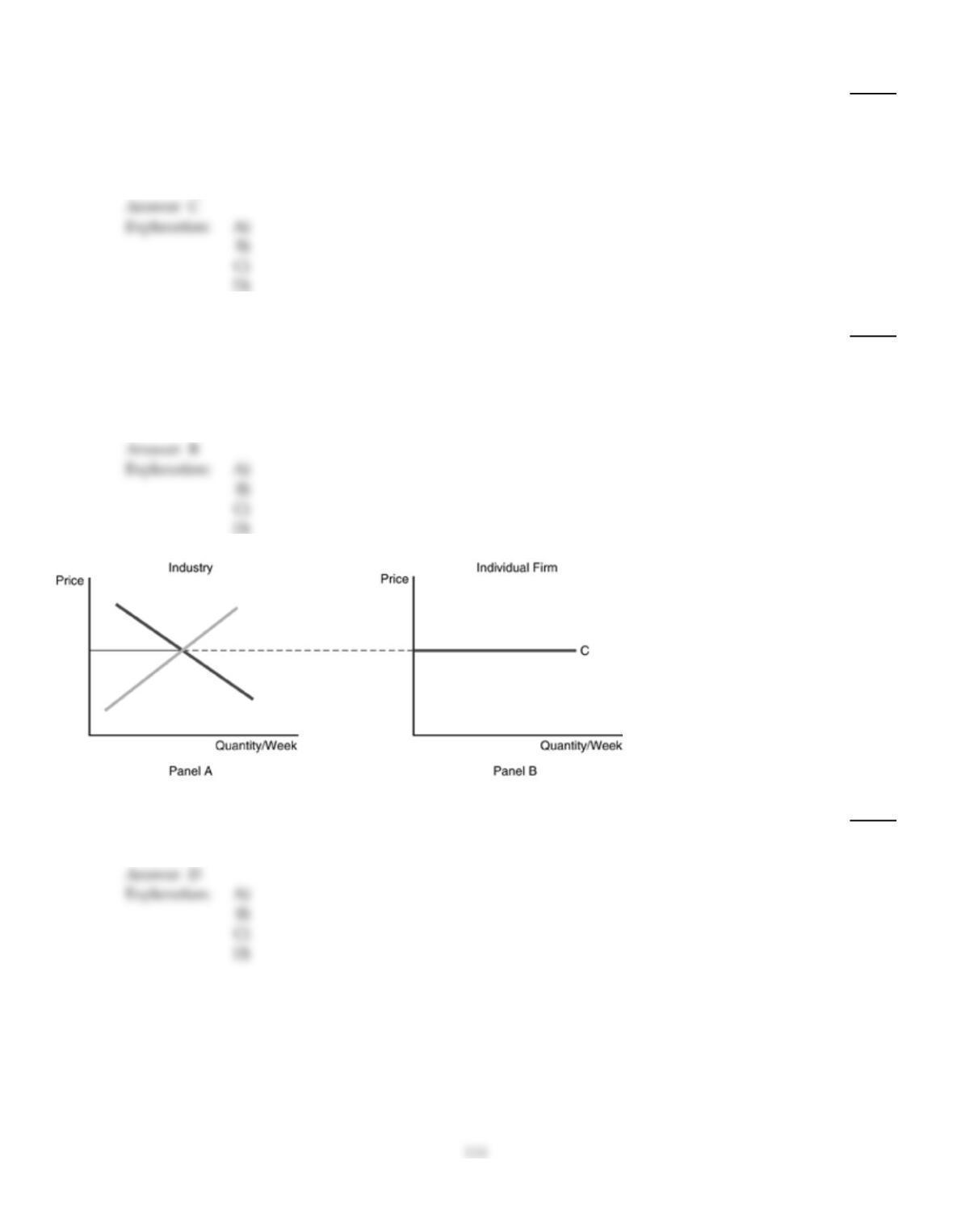
Refer to the above figure. Line C in Panel B does NOT represent
382)
A)
the equilibrium price.
B)
marginal revenue.
C)
average revenue.
D)
total revenue.
D
C
383)
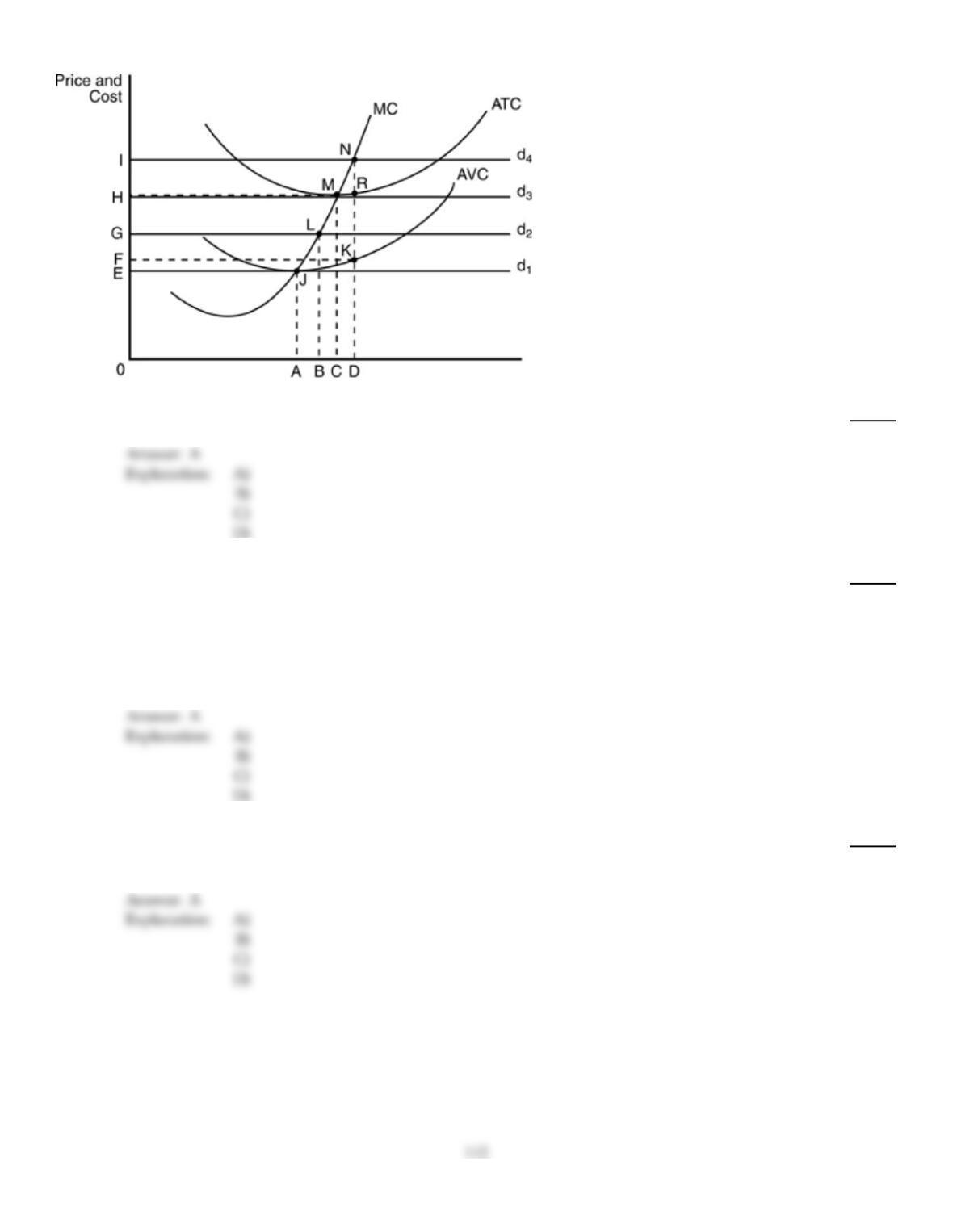
In the above figure, the firm will shut down if quantity falls below
383)
A)
A.
B)
B.
C)
C.
D)
D.
384)
What does it mean when the products sold by the firms in an industry are homogeneous?
384)
A)
The product sold by one firm is a perfect substitute of the product sold by another firm in the
same industry.
B)
The product sold by one firm is a perfect complement of the product sold by another firm in
the same industry.
C)
Firms in the industry can produce the same product with different inputs.
D)
All firms in the industry are identical in size.
385)
Market signals
385)
A)
are ways of conveying information.
B)
do not involve economic losses.
C)
are best ignored by investors.
D)
do not involve economic profits.
386)
The short–run break–even price is
386)
A)
the point at which the firm’s total costs are maximized.
B)
the point at which the firm‘s implicit costs are maximized.
C)
the price at which a firm’s total revenues exceed total costs.
D)
the price at which a firm’s total revenues equal its total costs.
387)
Total revenue divided by quantity is
387)
A)
price revenue.
B)
quantity revenue.
C)
marginal revenue.
D)
average revenue.
388)
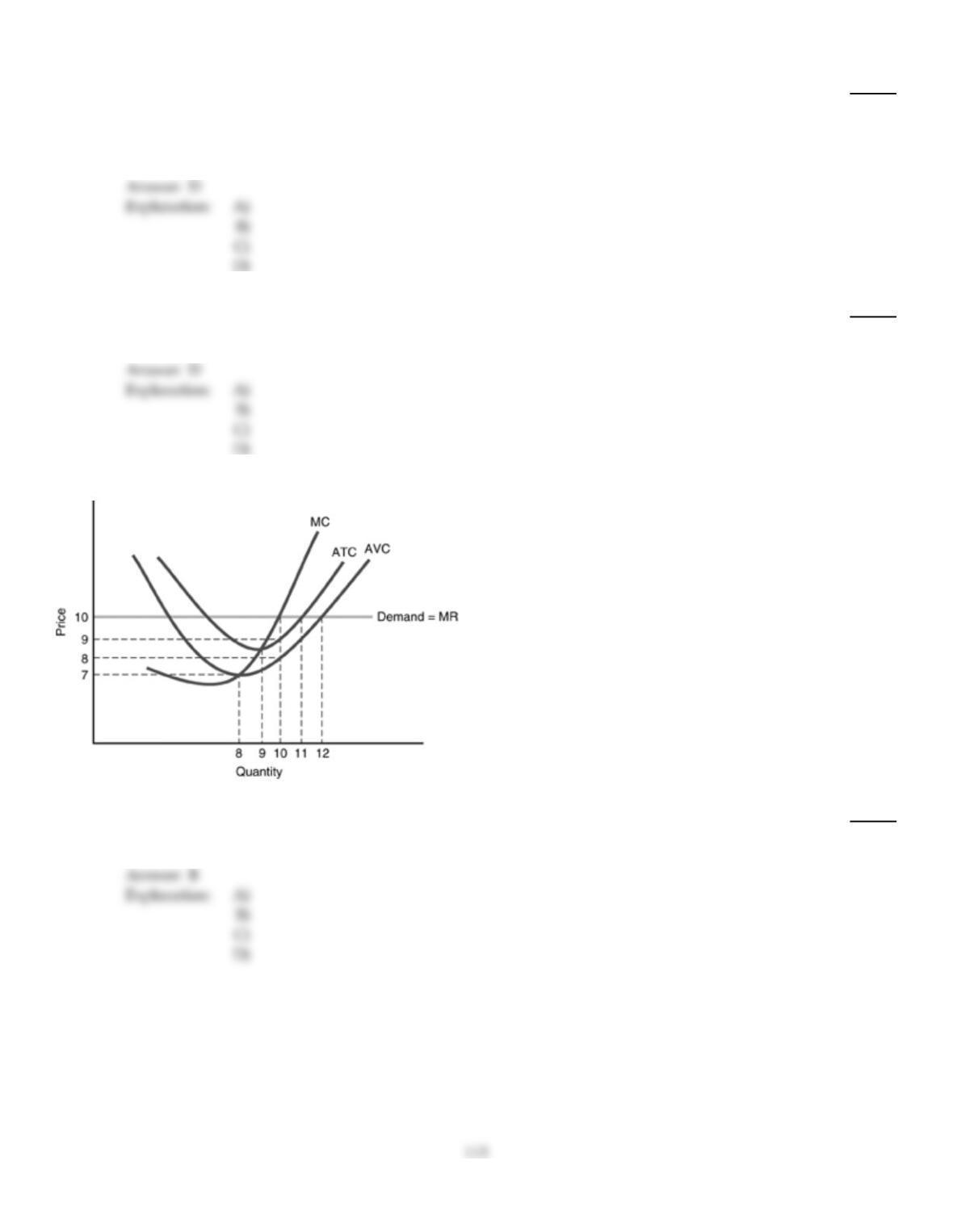
In the above figure, if the market price is less than $7, the firm
388)
A)
produces 11 units.
B)
produces 0 units.
C)
produces 10 units.
D)
produces 8 units.
389)
When price is greater than both marginal cost and average variable cost, the perfectly competitive
firm
389)
A)
should increase its level of output.
B)
should stop production.
C)
is maximizing economic profit.
D)
should reduce its level of output.
390)
In the long run when a perfectly competitive firm experiences positive economic profits,
390)
A)
firms enter the industry, the market supply curve shifts rightward, and the market price rises.
B)
firms exit the industry, the market supply curve shifts rightward, and the market price falls.
C)
firms enter the industry, the market supply curve shifts rightward, and the market price falls.
D)
firms exit the industry, the market supply curve shifts leftward, and the market price rises.
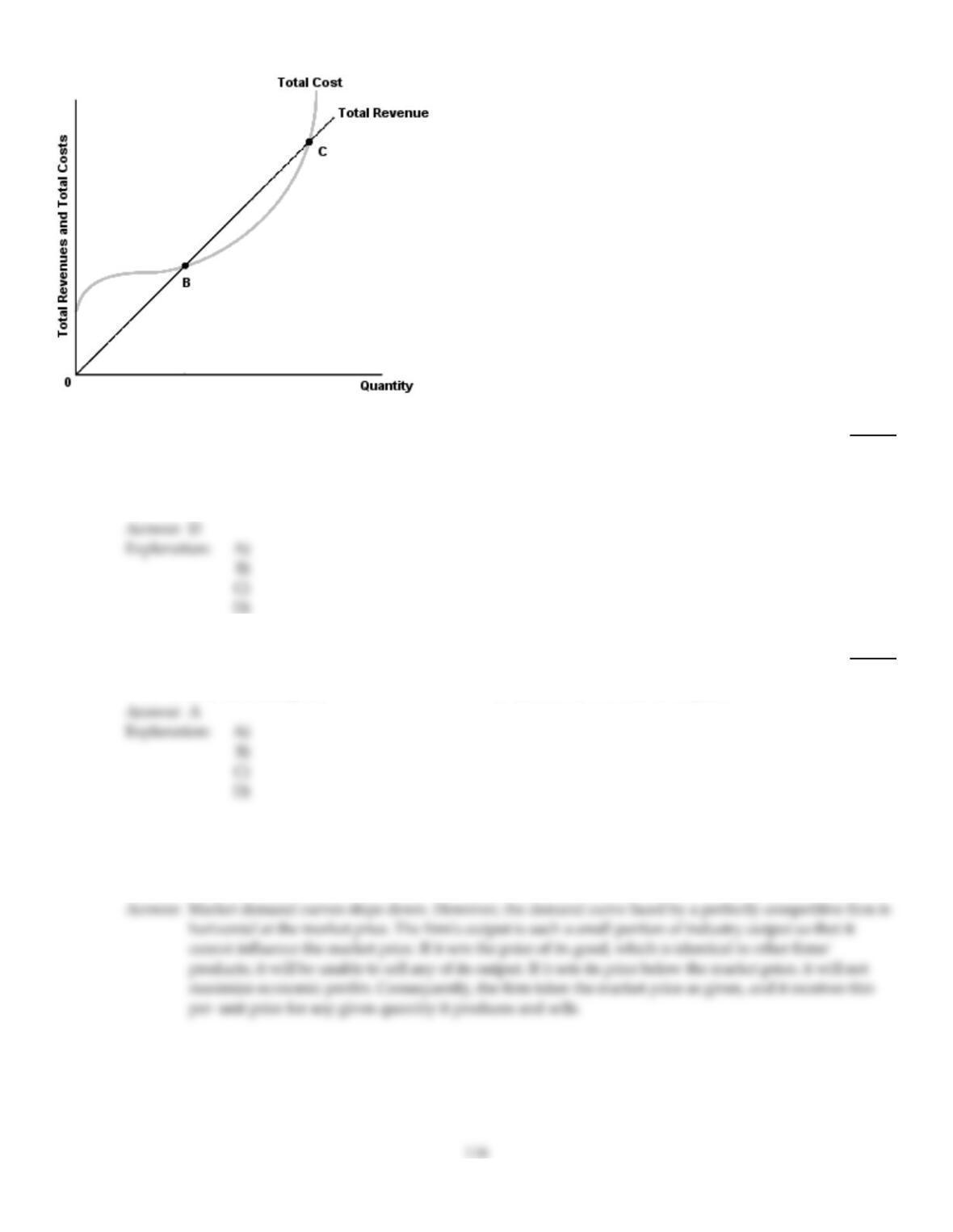
391)
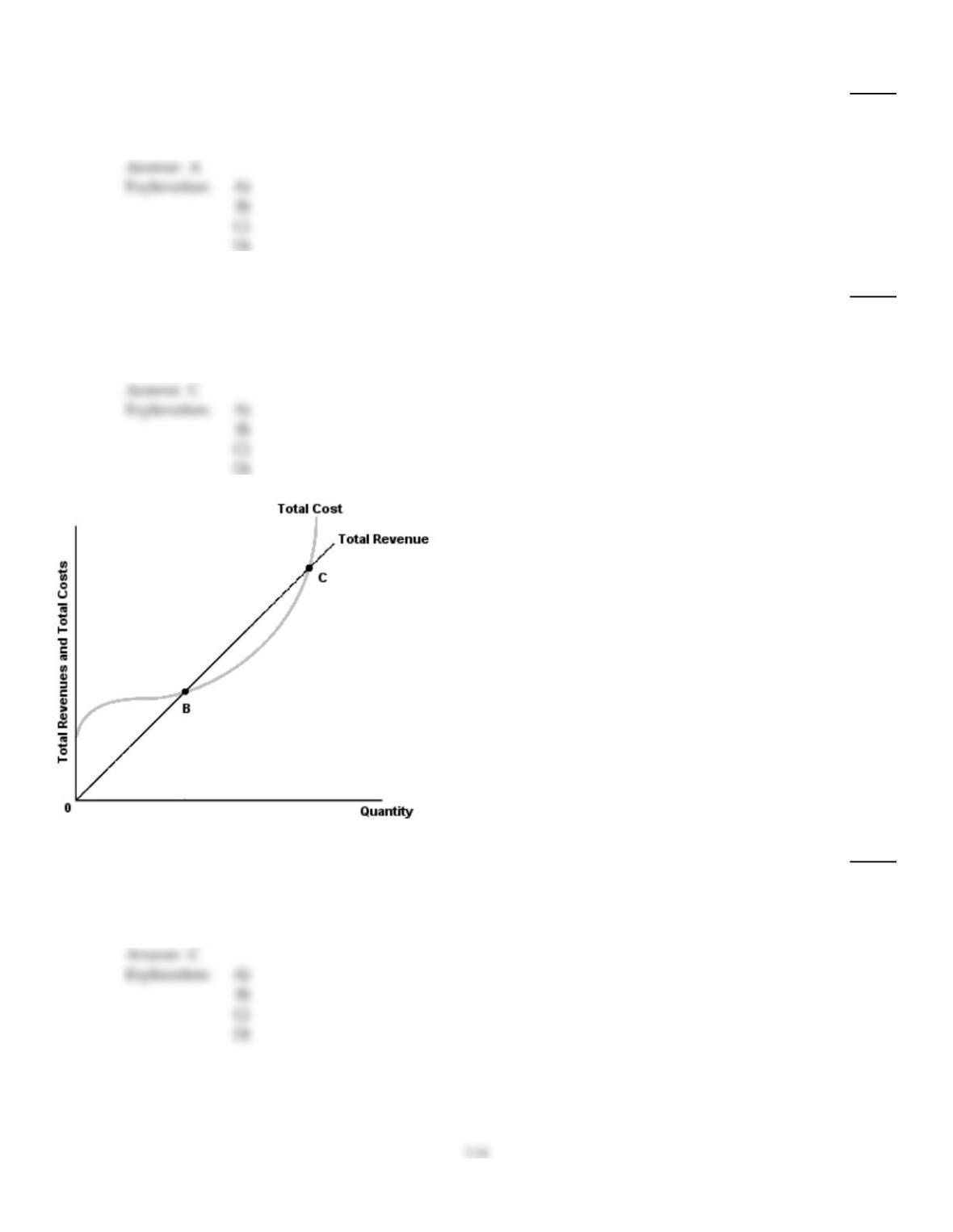
Refer to the above figure. Profits for this firm are equal to zero
391)
A)
for points between B and C.
B)
only for all points less than B.
C)
only at points B and C.
D)
for all points less than B and greater than C.
Total
Output Costs
0 $8
1 13
2 16
3 21
4 30
5 45
392)
Refer to the above table. The table represents information on the costs for Ajax Corporation. Ajax
operates in a perfectly competitive market and the price of the product is $10. What does profit
equal when quantity equals 4?
392)
A)
$4
B)
$40
C)
$10
D)
$8
393)
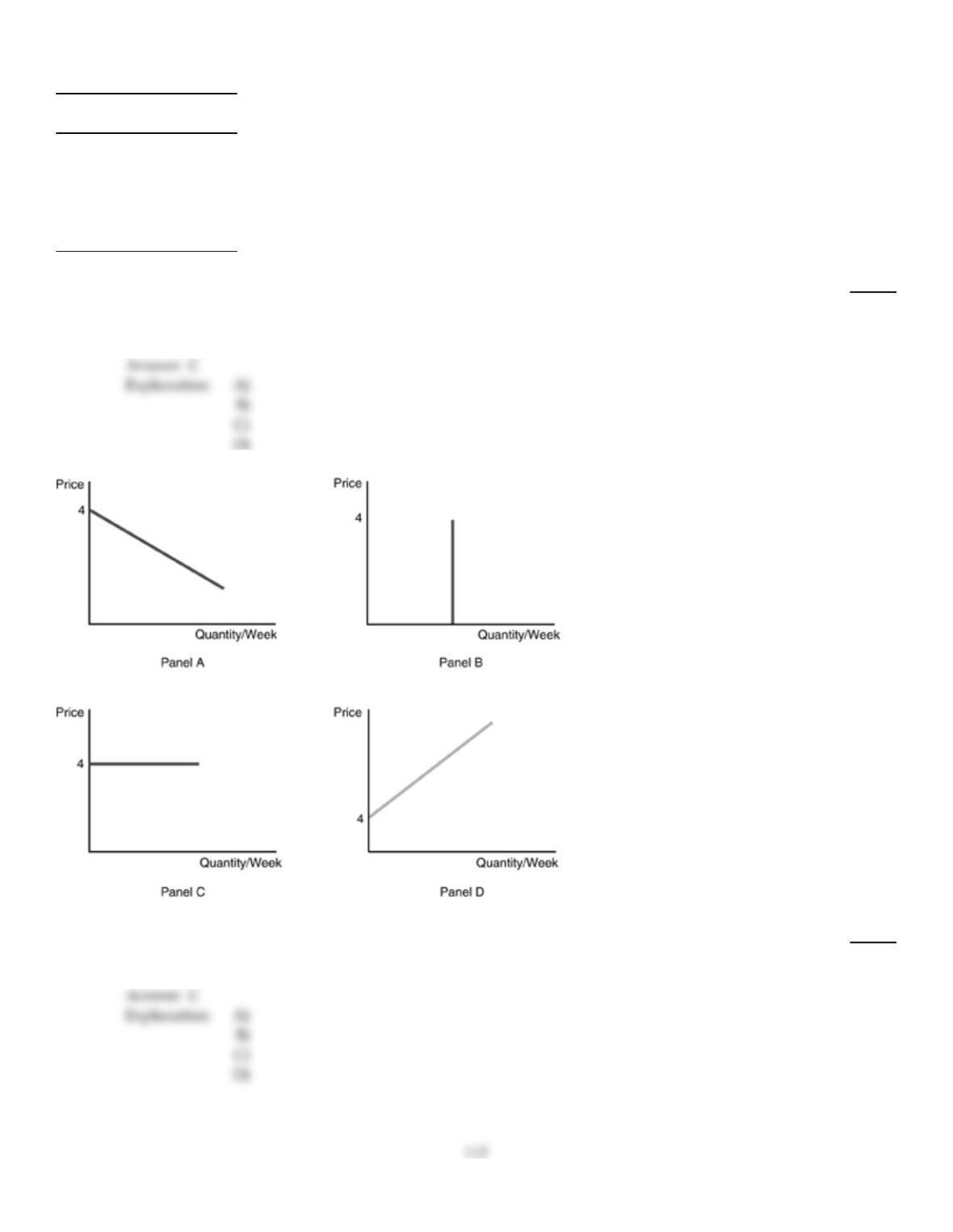
Refer to the above figure. The market supply and demand curves in a perfectly competitive market
intersect at $4. Which of the graphs represent the situation for an individual firm?
393)
A)
Panel A
B)
Panel B
C)
Panel C
D)
Panel D
394)
Refer to the above figure. Profits for this firm are positive
394)
A)
for all points less than B and greater than C.
B)
only at points B and C.
C)
only for all points less than B.
D)
for points between B and C.
395)
In the long run, the perfectly competitive firm
395)
A)
earns only a normal profit.
B)
may produce even if it suffers a loss.
C)
earns an economic profit.
D)
does not have a shut down price.
ESSAY. Write your answer in the space provided or on a separate sheet of paper.
396)
“Demand curves slope down, so the demand curve faced by a perfectly competitive firm must also be
downward sloping.” Do you agree or disagree? Why?
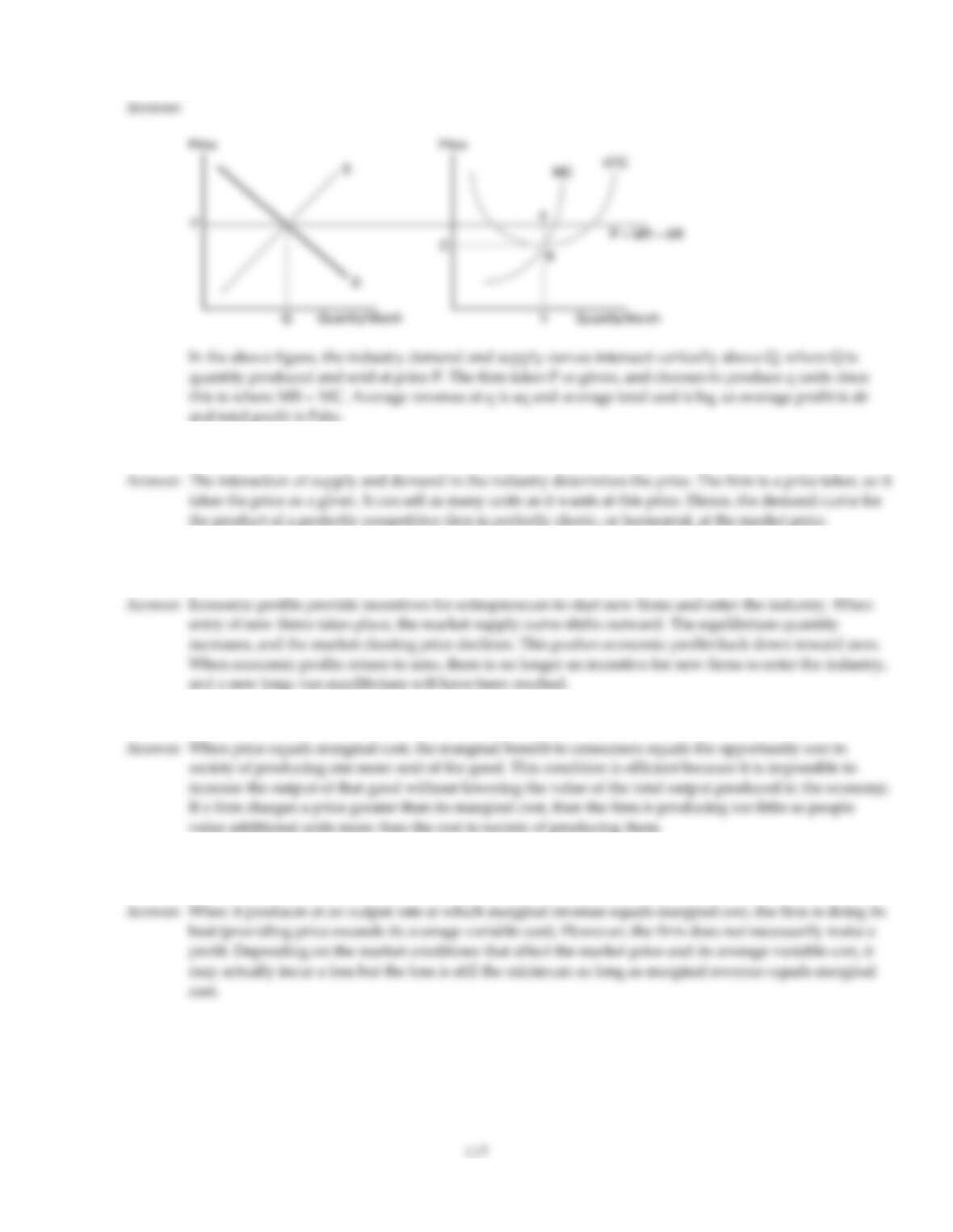
397)
Using a graph, show a short–run equilibrium for the industry and the firm. Explain the graph.
398)
Describe and explain how a perfectly competitive firm’s demand curve is found.
399)
If firms in a perfectly competitive industry are earning positive economic profits, then what will happen in the
long run?
400)
Why would it be economically inefficient for a firm to charge the price of a good greater than its marginal cost?
401)
“By producing at an output rate at which marginal revenue equals marginal cost, a firm is definitely making
positive economic profits.” Do you agree or disagree? Why?