272)
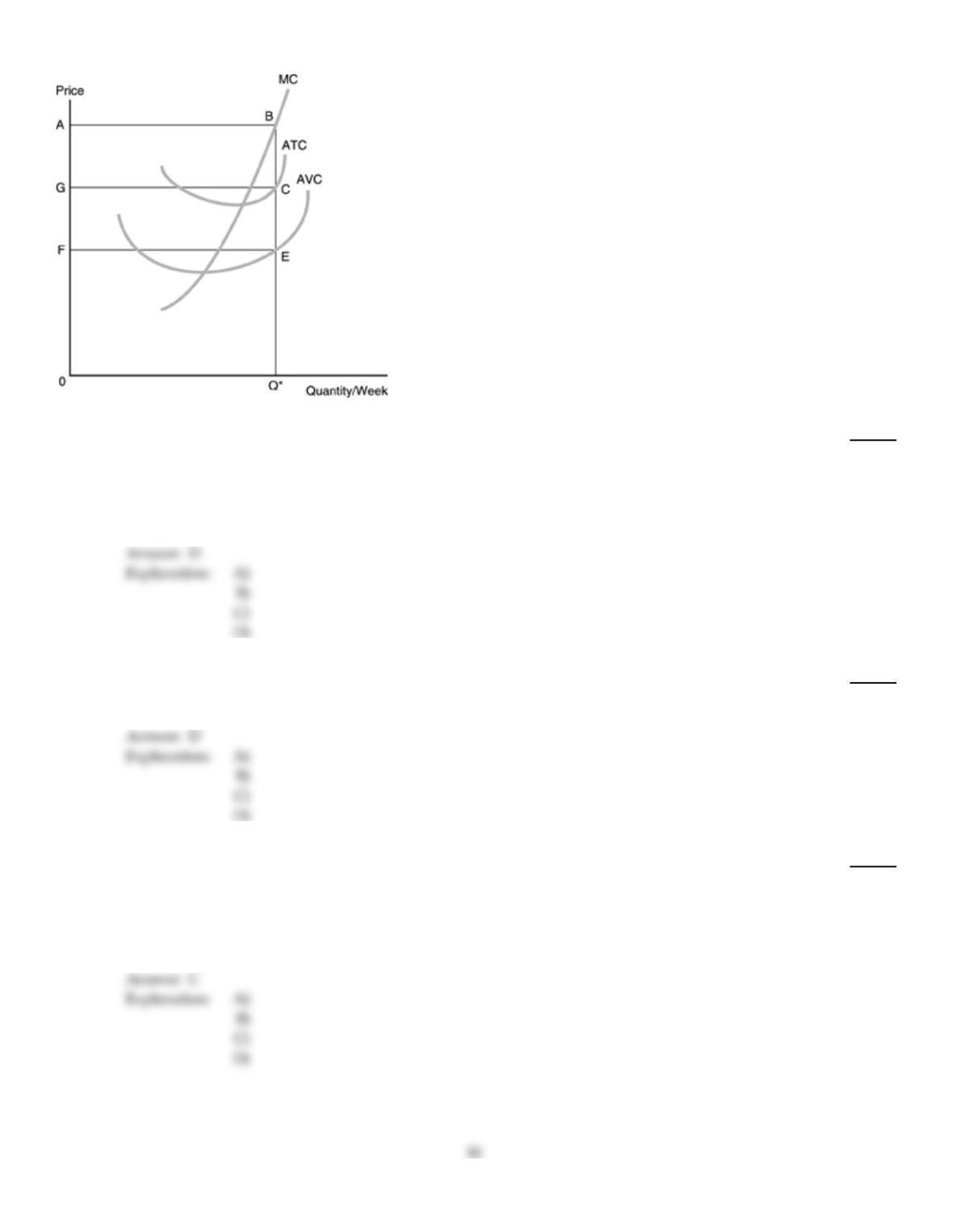
Refer to the above figure. If the market price is equal to A, which statement can be made about
economic profits?
272)
A)
Economic profits are negative and equal to GCEF.
B)
Economic profits are positive and equal to ABEF.
C)
Economic profits are negative and equal to ABQ0.
D)
Economic profits are positive and equal to ABCG.
273)
Which of the following is NOT correct for a perfectly competitive firm in long–run equilibrium?
273)
A)
MR = P = AR
B)
SAC = LAC
C)
LAC = P
D)
MC = MR > LAC
274)
A firm in a competitive industry faces the following short–run cost and revenue conditions: ATC =
$16; AVC = $8; and MR = MC = $12. This firm should
274)
A)
decrease production and raise its price.
B)
shut down.
C)
continue to operate at the same price and output level in the short run.
D)
expand production and keep price constant.
275)
Accounting profits at a firm’s break–even point are
275)
A)
indeterminate since we need to know what demand is.
B)
positive.
C)
negative.
D)
zero.
276)
Signals are
276)
A)
used by economic decision–makers to inform others about their plans.
B)
the method by which government planners inform economic decision–makers about the types
of decisions they should make.
C)
compact ways of conveying to economic decision makers information needed to identify
industries where more resources are needed.
D)
the method by which firms determine their profit maximizing quantity.
277)
What is always TRUE about the short–run equilibrium position for a firm in perfect competition?
277)
A)
MC = ATC
B)
MR = MC = P = AR
C)
MR = MC = P = ATC = AR
D)
TR = TC
278)
A constant–cost industry will have
278)
A)
an upward sloping demand curve in the long run.
B)
an upward sloping supply curve in the long run.
C)
a perfectly inelastic long–run supply curve.
D)
a perfectly elastic long–run supply curve.

279)
In a perfectly competitive market, if P > ATC in the short run, there is apt to be
279)
A)
entry of new firms into the market.
B)
an accounting loss for existing firms.
C)
an upward pressure on price.
D)
an inward shift in the industry supply curve.
280)
Suppose a perfectly competitive firm can produce 20,000 bushels of corn a year at an output at
which marginal cost equals marginal revenue. The market price of corn per bushel is $2.00. The
firm’s total costs per year are $50,000 and fixed costs per year are $25,000. In the short run, this firm
should
280)
A)
continue producing until the price of corn increases.
B)
produce 40,000 bushels to try to increase economic profit.
C)
shut down.
D)
produce 20,000 bushels of corn because, although they are losing money, they are losing less
than if they shut down.
Total
Output Costs
0 $8
1 13
2 16
3 21
4 30
5 45
281)
Refer to the above table. The table represents information on the costs for Ajax Corporation. Ajax
operates in a perfectly competitive market and the price of the product is $7. What will be the value
of total revenue when quantity sold equals 2?
281)
A)
$21
B)
$14
C)
$16
D)
$7
282)
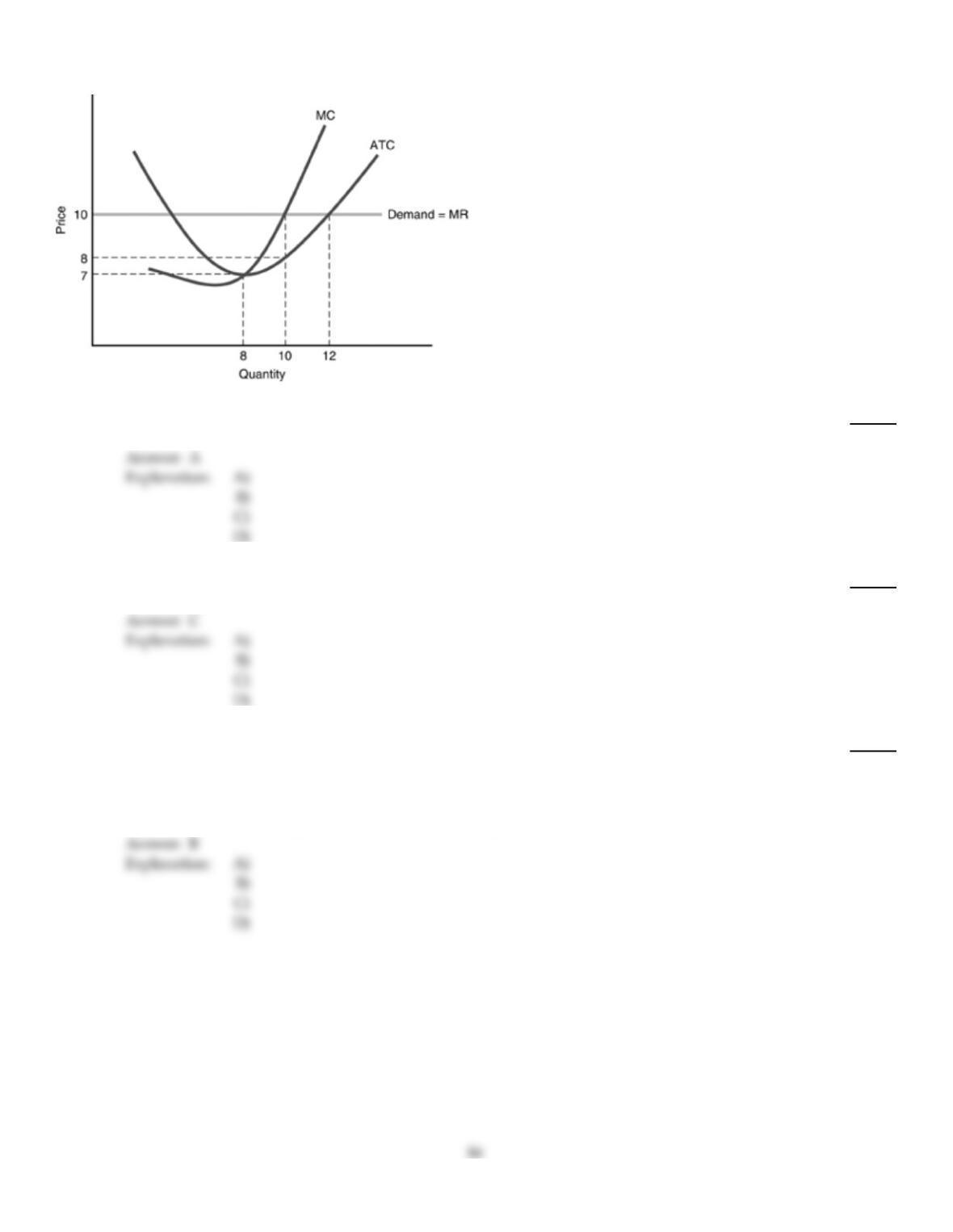
In the above figure, what is the profit at the profit–maximizing output level?
282)
A)
$20
B)
$2
C)
$10
D)
$70
283)
In the short run, a firm should shut down when
283)
A)
MR > MC.
B)
MR = ATC.
C)
P < AVC.
D)
P > MC.
284)
A perfectly competitive industry’s short–run supply curve is best described as
284)
A)
horizontal.
B)
the horizontal summation of the individual firms’ supply curves.
C)
perfectly inelastic.
D)
the upward sloping portion of the industry’s marginal cost curve.

285)
All of the following are characteristics of a perfectly competitive market EXCEPT
285)
A)
homogeneous products.
B)
high barriers to entry and exit.
C)
large number of buyers and sellers.
D)
buyers and seller have equal access to information.
286)
In a perfectly competitive market, the average revenue curve of a firm is
286)
A)
the difference between its total revenue curve and its marginal revenue curve.
B)
the same its economic profits.
C)
the same as its demand curve.
D)
the same as its total revenue curve.
287)
A constant–cost industry
287)
A)
is one in which an increase in demand is matched by a proportional increases in long–run
supply.
B)
generates increasing profits whenever demand increases because the new long–run
equilibrium price is above the old price even though average costs have not changed.
C)
has a downward sloping long–run supply curve.
D)
has a horizontal long–run supply curve.

Total
Output Costs
0 $8
1 13
2 16
3 21
4 30
5 45
288)
Refer to the above table. The table represents information on the costs for Ajax Corporation. Ajax
operates in a perfectly competitive market and the price of the product is $8. What will be the value
of total revenue when quantity sold equals 3?
288)
A)
$24
B)
$3
C)
$27
D)
$9
289)
Suppose a perfectly competitive firm faces the following short–run cost and revenue conditions:
ATC = $12; AVC = $10; MC = $15; MR = $13. The firm should
289)
A)
increase price.
B)
increase output.
C)
change nothing.
D)
decrease output.
290)
When there are large numbers of buyers and sellers, then
290)
A)
consumers are able to find out about lower prices charged by other firms.
B)
the products sold must look identical.
C)
no one buyer or seller has any influence on price.
D)
firms will move labor and capital in pursuit of profit–making opportunities to whatever
business venture gives them the highest return on their investment.
291)
A firm in a perfectly competitive industry is a
291)
A)
price taker.
B)
quality maker.
C)
price maker.
D)
quantity taker.

292)
The total amount received from the sale of output is
292)
A)
price revenue.
B)
marginal revenue.
C)
total revenue.
D)
average revenue.
293)
The demand curve for the product of a perfectly competitive firm is
293)
A)
elastic at high prices and inelastic at low prices.
B)
perfectly inelastic.
C)
perfectly elastic.
D)
identical to the elasticity of demand on the market demand curve.
294)
If there is no output for which product price is sufficient to cover variable costs
294)
A)
the firm earns economic profits by staying open.
B)
the firm should increase production.
C)
the firm should shut down in the short run.
D)
the firm should stay open in the short–run.
295)
Economic efficiency means
295)
A)
that it is impossible to increase the output of any good without lowering the total value of the
output of the economy.
B)
that high–tech methods of production are the most efficient.
C)
the same as technical efficiency.
D)
that all firms within a single competitive industry are producing at the same level of output.
296)
For a firm in a perfectly competitive market, average revenue equals
296)
A)
average cost.
B)
the market price.
C)
the change in total revenue.
D)
price divided by quantity.
297)
The difference between price and average total cost is
297)
A)
an irrelevant quantity.
B)
marginal costs.
C)
average profit.
D)
total costs.
298)
Which of the following best describes a situation of economic efficiency?
298)
A)
A firm produces to the point at which MR = AFC, with P = AVC.
B)
A firm produces to the point at which P = AVC, with MR < MC.
C)
A firm produces to the point at which MR = MC, with P = MC.
D)
A firm produces to the point at which P = ATC, with MC < MR.
299)
A perfectly competitive firm faces a market clearing price of $150 per unit. Average total costs are
at the minimum value of $120 per unit at an output rate of 70 units. Marginal cost equals $150 per
unit at an output rate of 75 units. It can be concluded that the short–run profit–maximizing output
rate is
299)
A)
75 units, at which the firm earns positive economic profits per unit sold.
B)
70 units, because price is less than average total costs.
C)
75 units, at which the firm earns zero economic profits per unit sold.
D)
75 units, at which the firm earns negative economic profits per unit sold.
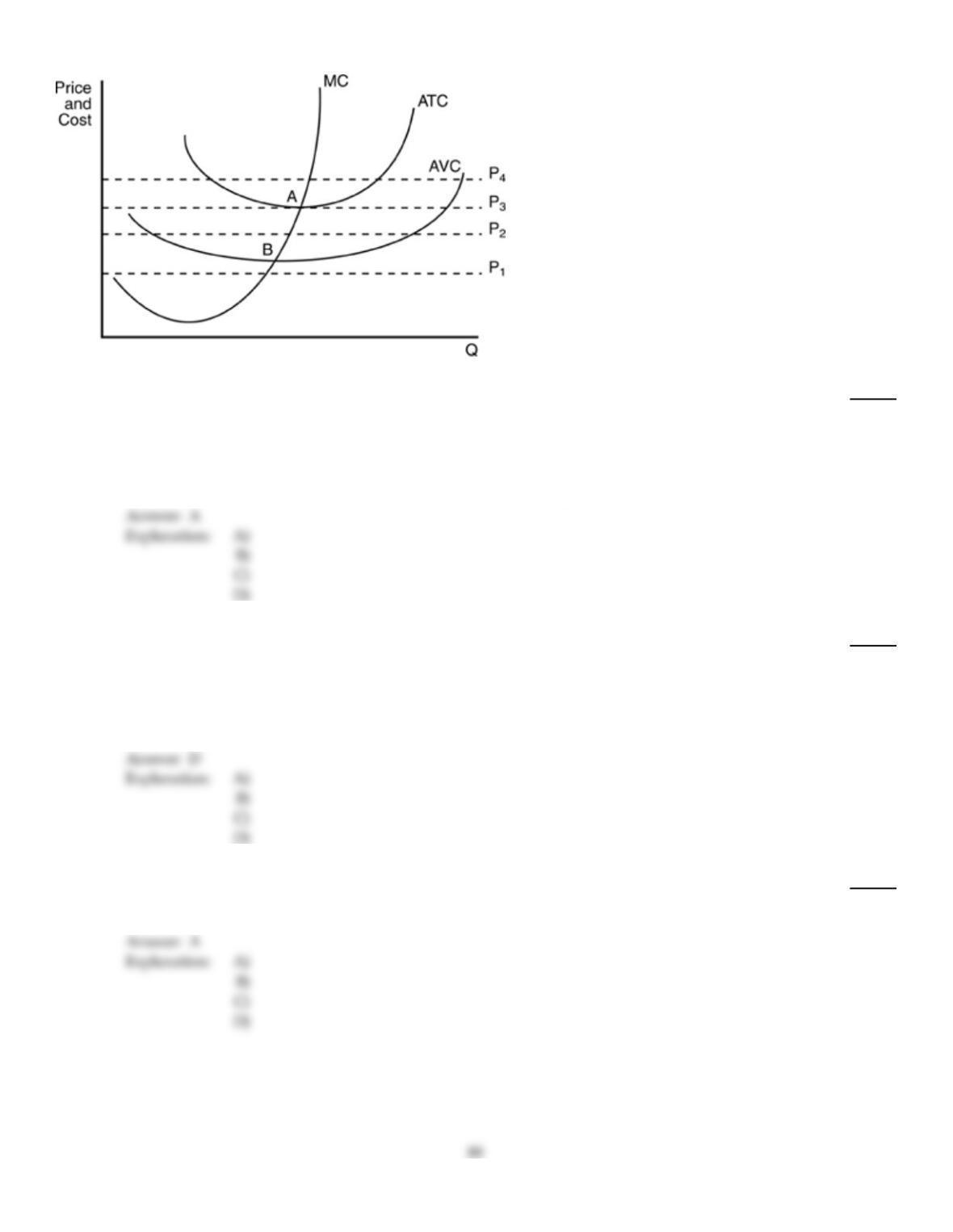
300)
In the above figure, what happens to the firm’s optimal level of output if the price it receives for its
product increases from P2 to P3?
300)
A)
Output increases.
B)
Output decreases.
C)
Output stays the same.
D)
There is not enough information provided to know what happens to output.
301)
The perfectly competitive, profit–maximizing rate of production
301)
A)
occurs at the point at which the difference between marginal revenue and marginal cost is
maximized.
B)
ignores the relation of total revenues and total costs.
C)
is not measurable for a perfectly competitive firm.
D)
occurs at the point at which marginal revenue is equal to marginal cost.
302)
Under the perfectly competitive market structure, the demand curve of an individual firm is
302)
A)
perfectly elastic.
B)
downward sloping.
C)
relatively inelastic.
D)
perfectly inelastic.
303)
If the wage rate increases and firms in a perfectly competitive industry are hiring labor, then
303)
A)
the firms will quit using labor.
B)
market price will decrease.
C)
market supply will decrease.
D)
profits will increase.
304)
The change in total revenues resulting from a change in output of one unit is
304)
A)
quantity revenue.
B)
marginal revenue.
C)
average revenue.
D)
price revenue.
305)
The short–run supply curve of a perfect competitor is
305)
A)
its average variable cost curve.
B)
its marginal cost curve equal to or above the minimum point on its average variable cost
curve.
C)
its marginal revenue curve.
D)
its entire marginal cost curve.
306)
In a decreasing–cost industry, an increase in output will lead to
306)
A)
an upward shift in the ATC curve.
B)
an increase in long–run per–unit costs.
C)
an upward shift in the MC curve.
D)
a reduction in long–run per–unit costs.
307)
The opportunity cost to society of producing one more unit of the good is
307)
A)
average cost.
B)
efficiency costing.
C)
the optimal cost.
D)
marginal cost.
308)
Economists generally assume that firms attempt to maximize
308)
A)
marginal revenue.
B)
total economic profits.
C)
total revenue.
D)
sales.
309)
In the above figure, when price is below E, this firm should
309)
A)
lower prices.
B)
continue to operate as–is.
C)
shut down.
D)
attempt to lower ATC and to raise AVC.
C
310)
Which of the following is NOT a characteristic of perfect competition?
310)
A)
Any firm can easily enter or leave the industry.
B)
Both buyers and sellers have equally good information.
C)
There are large numbers of buyers and sellers.
D)
The firms in an industry produce goods that are different from each other.
D
B
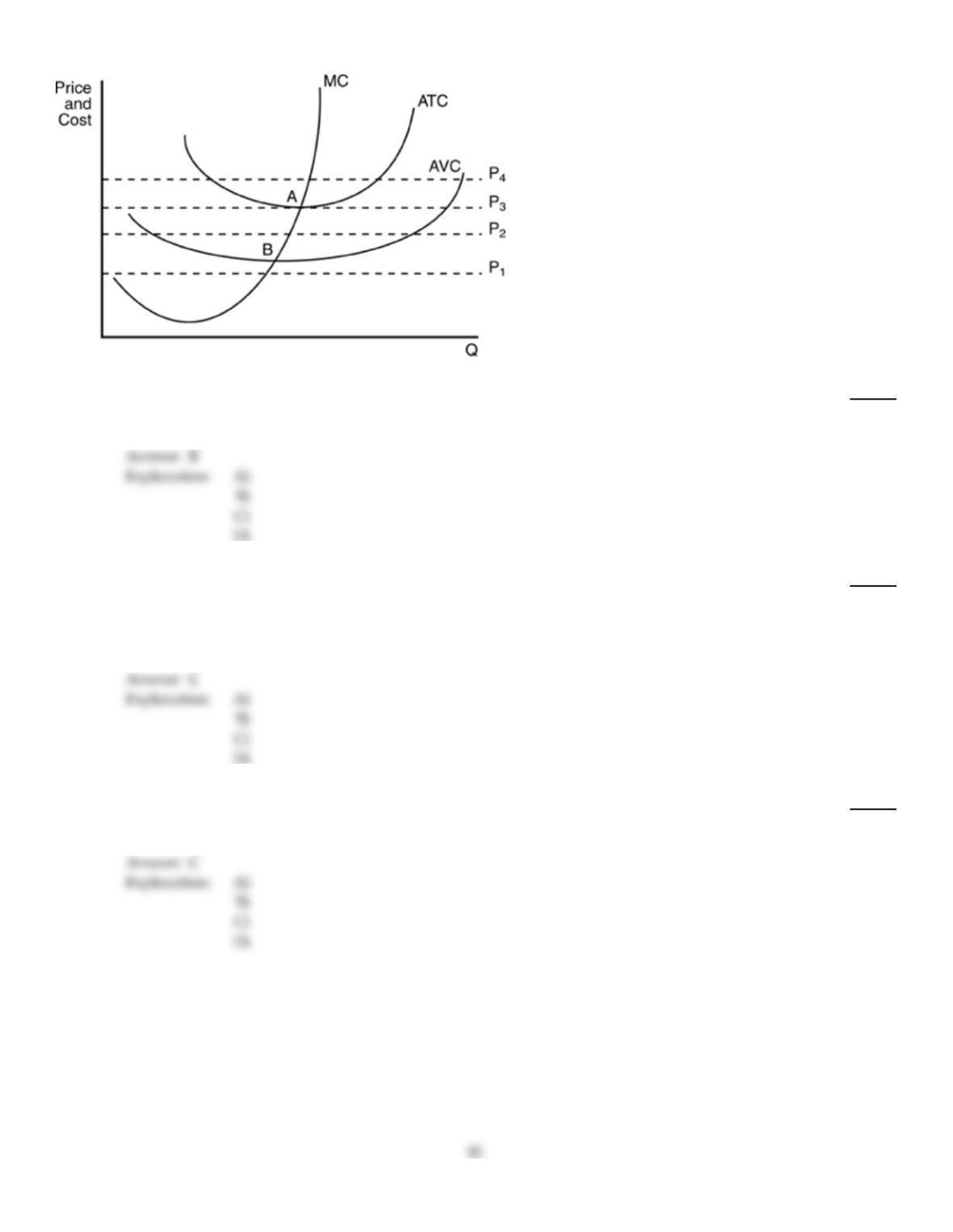
311)
In the above figure, if price is equal to P4, the firm will
311)
A)
earn zero economic profits.
B)
earn positive economic profits.
C)
incur an economic loss.
D)
shut down.
312)
Total revenues
312)
A)
are defined as the quantity sold divided by price.
B)
equal gross revenues minus all expenses of the firm.
C)
equal the price per unit times the total quantity sold.
D)
are not the same as total receipts from the sale of output.
313)
For a perfectly competitive firm, any price below its minimum AVC is a
313)
A)
market price.
B)
negative price.
C)
shutdown price.
D)
profit maximizing price.
314)
The rising portion of a perfectly competitive firm’s marginal cost curve, above the intersection with
AVC, is its
314)
A)
demand curve.
B)
supply curve.
C)
economic profit.
D)
accounting profit.
315)
Which of the following statements is correct?
315)
A)
The market demand curve of perfect competition is inelastic because the individual
consumers are buying a homogeneous product.
B)
The demand curve of the perfectly competitive industry is elastic as are the demand curves
facing the individual firms.
C)
The market demand curve of the perfectly competitive industry is downward sloping while
the demand curve of an individual firm is horizontal with a height equal to the product price.
D)
The market demand curve of the perfectly competitive industry is downward sloping, so the
demand curves of the individual firms are also downward sloping.
316)
The rate of production that maximizes the positive difference between total revenues and total
costs is the
316)
A)
rate of production at which marginal revenue equals average revenue.
B)
profit–maximizing rate of production.
C)
rate of production at which marginal revenue equals marginal product.
D)
rate of production at which average revenue equals average total cost.
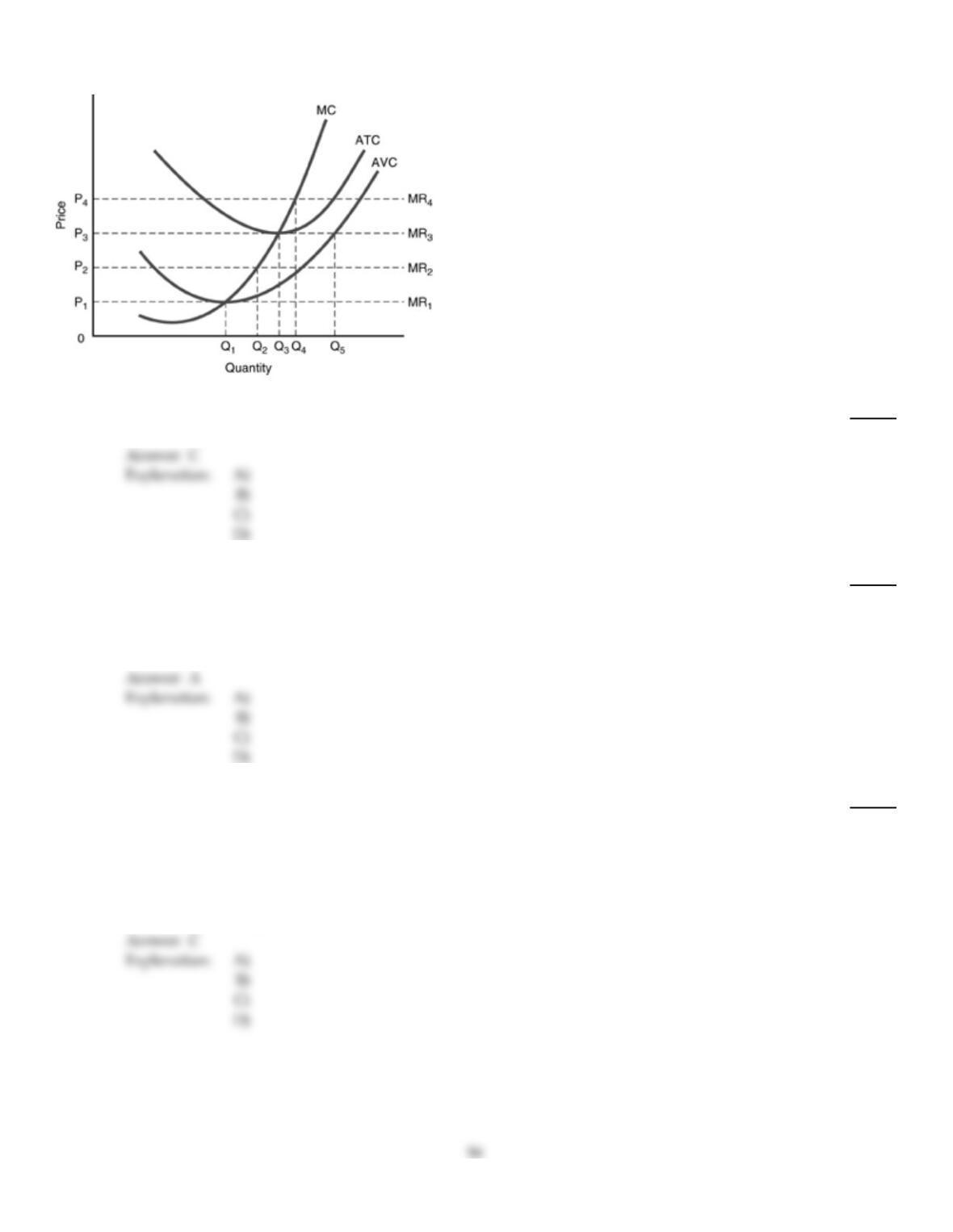
317)
Using the above figure, the price facing the perfectly competitive firm in the long run will be
317)
A)
P1.
B)
P2.
C)
P3.
D)
P4.
318)
At a perfectly competitive firm’s short–run break–even price
318)
A)
P = ATC.
B)
TR is more than TC.
C)
P > AVC, but P < AFC.
D)
the average cost is below the total revenue line.
319)
Malfeasance at Enron, a Houston–based energy firm, led to overstatement of revenues by almost
$92 billion. As Enron closed its operations, U.S. energy prices remained stable. This may have been
evidence that
319)
A)
there was lack of any competition, so Enron was the winner.
B)
Enron could charge whatever price it wanted to for energy.
C)
there is a competitive market in energy distribution in the United States.
D)
the accounting profession needs to review its policies quickly.
320)
The demand curve for a perfectly competitive industry is
320)
A)
vertical.
B)
downward sloping.
C)
horizontal.
D)
indeterminate without more information.
321)
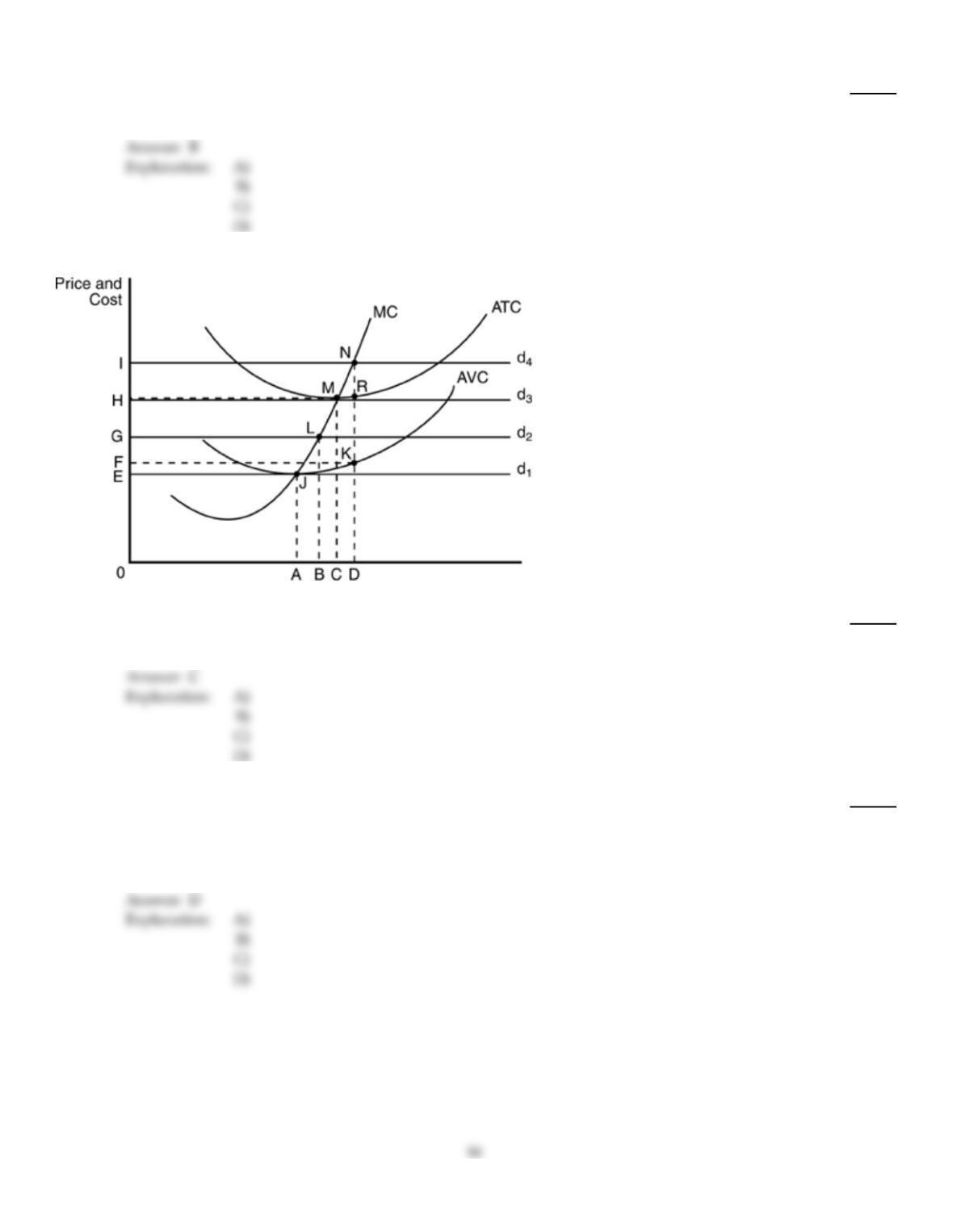
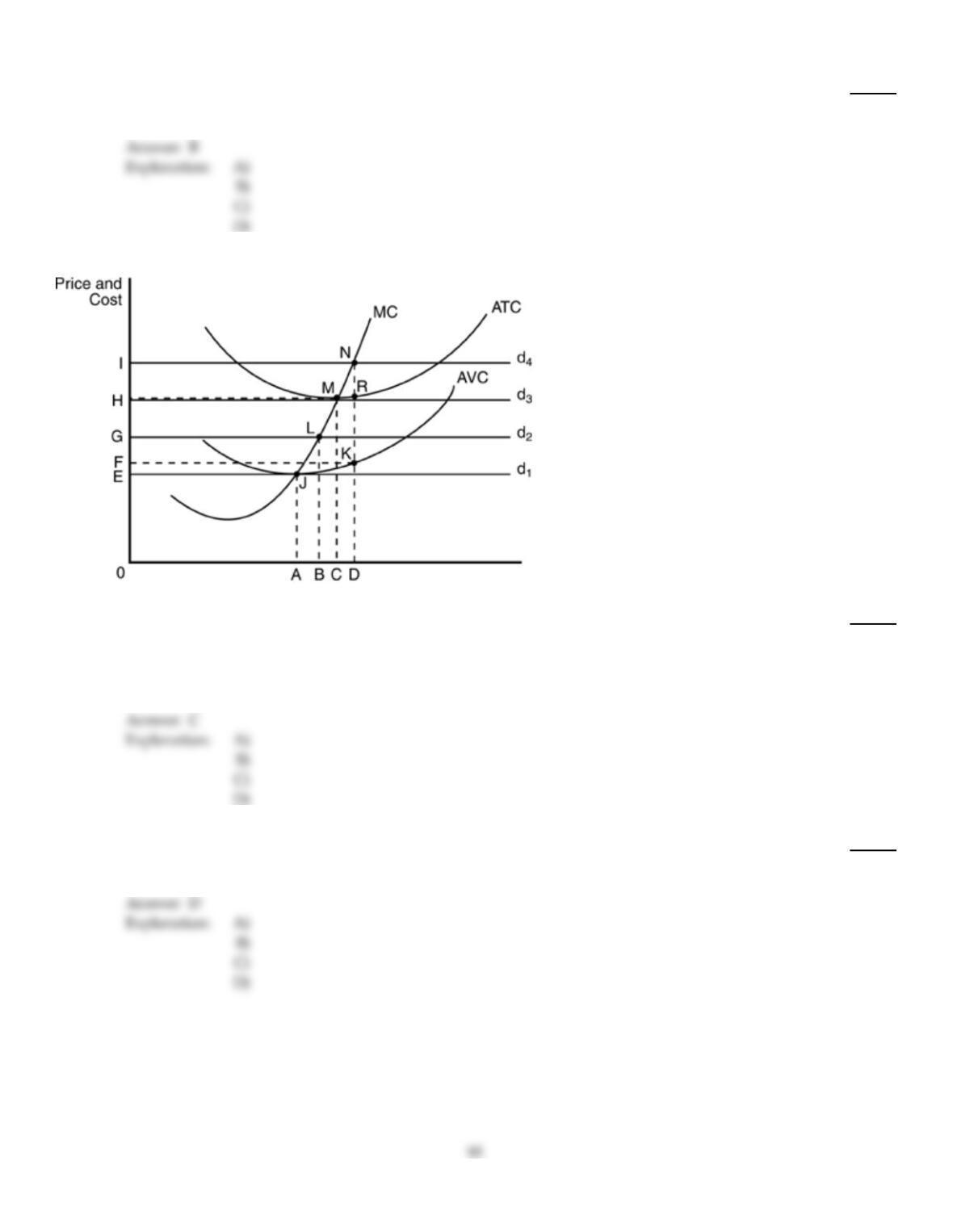
In the above figure, assume d3 is the demand curve faced by this firm. Which is TRUE?
321)
A)
This firm is experiencing an economic loss.
B)
This firm is earning an economic profit.
C)
This firm is breaking even.
D)
This firm’s total revenues equal HRD0.
C
322)
The perfectly competitive firm‘s total revenue curve
322)
A)
has a positive slope.
B)
is linear and upward sloping.
C)
has a constant slope.
D)
all of the above.
D
B
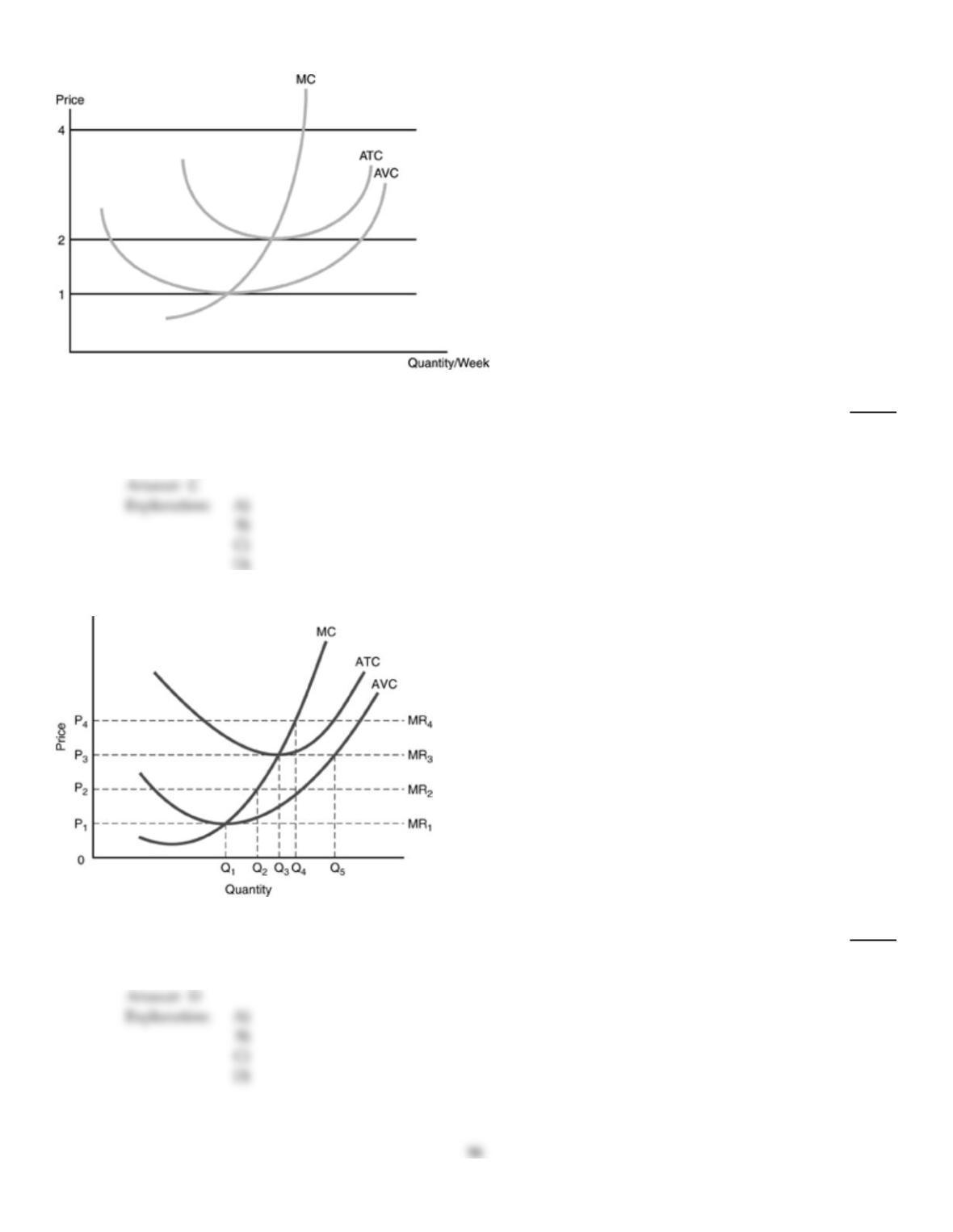
323)
Refer to the above figure. The firm will just be covering all of its variable cost but none of its fixed
cost
323)
A)
when the price equals $2.
B)
when the price equals $4.
C)
when the price equals $1.
D)
at prices between $1 and $2.
324)
Using the above figure, the perfectly competitive firm in the diagram will earn an economic profit
if the market price is
324)
A)
P1.
B)
P2.
C)
P3.
D)
P4.
325)
Perfect competition is a market structure
325)
A)
in which individual buyers and sellers have no effect on the market price.
B)
resulting from individual firms selling highly differentiated products.
C)
where there is significant regulation and markets are always efficient.
D)
in which any firm would have serious impediments to entry or exit.
326)
For a perfectly competitive firm, the short–run break–even point occurs at the level of output
where
326)
A)
MR < P = MC.
B)
P > MR = MC.
C)
P = MC = ATC.
D)
MR = P > MC.
327)
When a firm is at its short–run break–even point
327)
A)
economic profits are negative but the firm should continue to produce because accounting
profits are positive.
B)
economic profits are positive.
C)
economic profits equal zero and the firm should shut down.
D)
economic profits equal zero and the firm is earning a nominal rate of return on investment.
328)
The firm will shut down in the short run if
328)
A)
P = MC.
B)
P = ATC at its minimum.
C)
the market price rises unexpectedly.
D)
the price falls below its minimum AVC.
329)
If a firm is producing an output rate at which marginal cost is equal price, the firm
329)
A)
should increase its output level.
B)
should reduce its output level.
C)
is maximizing profits.
D)
will not be covering its fixed cost.
330)
In the long run, a perfect competitor
330)
A)
earns zero economic profits.
B)
earns positive economic profits.
C)
produces at its shutdown point.
D)
earns positive profits but will not make losses.
331)
A perfectly competitive firm is selling 300 units of output at $4 each. At this output level, total fixed
cost is $100 and total variable cost is $500. The firm
331)
A)
is earning a profit, but not necessarily the maximum profit.
B)
should shut down.
C)
is experiencing an economic loss.
D)
is maximizing its profit.
332)
The goal of the perfectly competitive firm is to
332)
A)
maximize total revenue.
B)
maximize total profits.
C)
minimize ATC.
D)
minimize AFC.
333)
We assume that firms, when they are deciding the best rate of output at which to produce
333)
A)
try to get the highest price possible.
B)
want to minimize costs.
C)
want to maximize sales.
D)
want to maximize profits.
334)
Which of the following statements is correct about the demand curve of the perfectly competitive
industry?
334)
A)
The market demand curve of the perfectly competitive industry is downward sloping while
the demand curve facing an individual firm is horizontal.
B)
The demand curve of the perfectly competitive industry is horizontal as are the demand
curves facing the individual firms.
C)
The market demand curve of the perfectly competitive industry is downward sloping, so the
demand curves of the individual firms are also downward sloping.
D)
The market demand curve of perfect competition is vertical because the individual consumers
are buying a homogeneous product.
335)
The loss–minimizing output for the perfectly competitive firm occurs at the point at which
335)
A)
TR – MR = minimum.
B)
TR – TC = maximum.
C)
TC – ATC = maximum.
D)
MR = MC.
336)
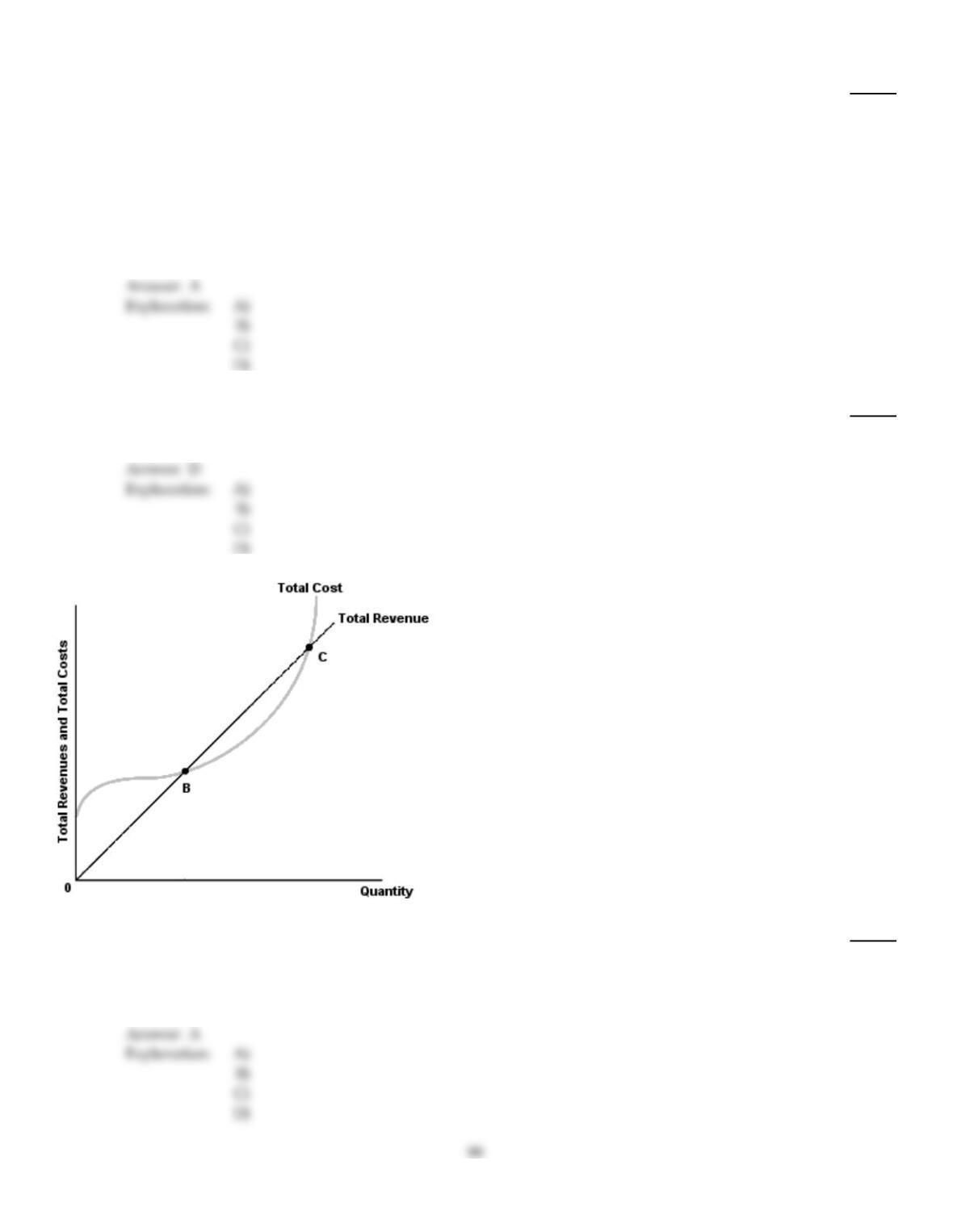
Refer to the above figure. Profits for this firm are negative
336)
A)
for all points less than B and greater than C.
B)
only at points B and C.
C)
only for all points less than B.
D)
for points between B and C.
337)
Suppose that at the current level of output, price = $12, MC = $4, AVC = $7, and ATC = $11. Which
of the following is TRUE?
337)
A)
The firm should maintain the current level of output.
B)
The firm should increase output.
C)
The firm should shut down.
D)
The firm should decrease output.
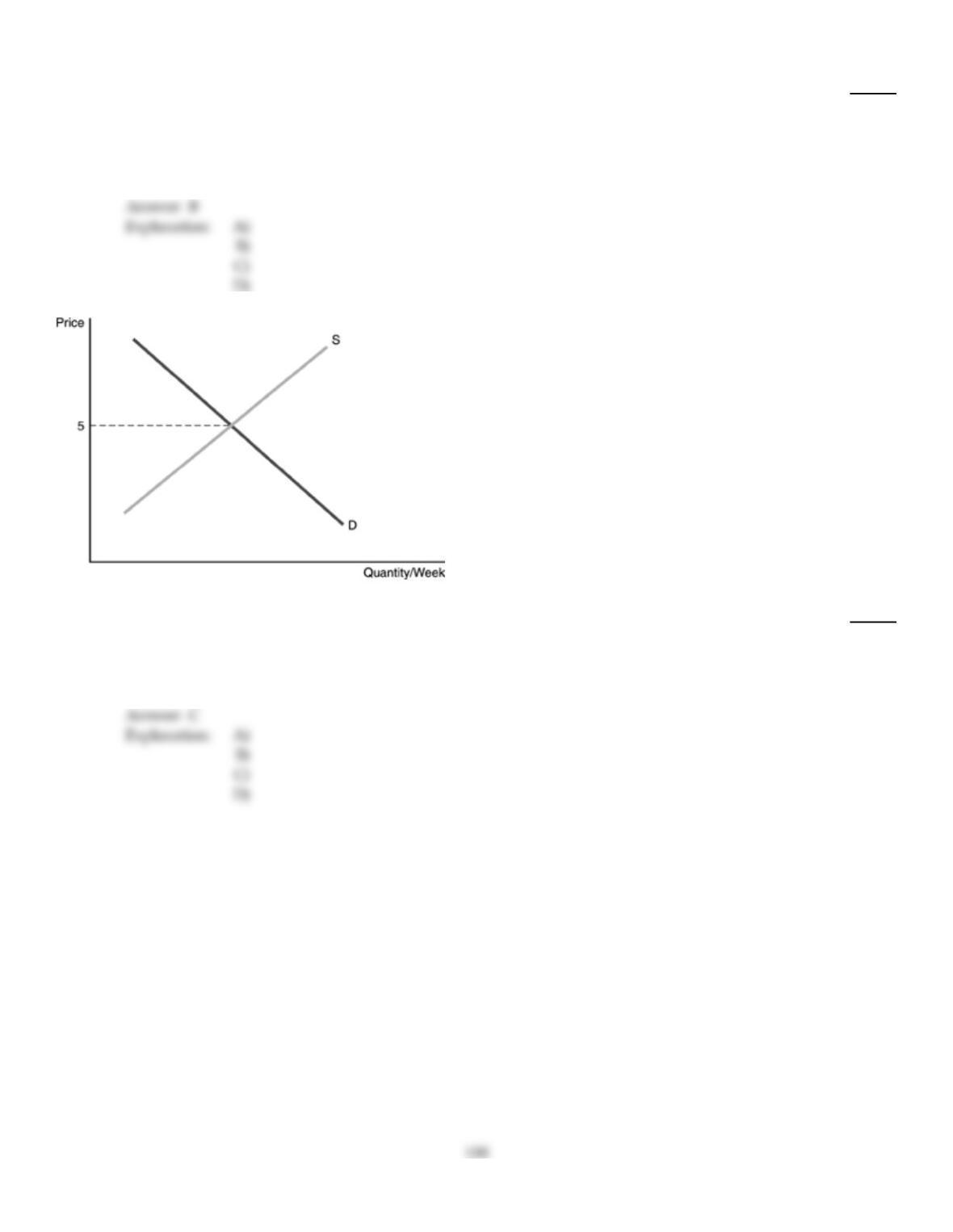
338)
Refer to the above figure. If an individual firm wants to maximize economic profits, it should
338)
A)
charge more than $5 for its product since increasing the price will increase revenues.
B)
charge less than $5 for its product since a lower price will attract more customers.
C)
charge $5 for its product.
D)
withdraw its product from the market forcing the market price up.