201)
If a perfectly competitive firm is producing at an output at which marginal cost exceeds marginal
revenue
201)
A)
the firm should expand production.
B)
the firm should reduce production.
C)
price will be at the profit maximizing level.
D)
sales will be at the profit maximizing level.
202)
When a firm has economic profits equal to zero
202)
A)
the firm should shut down.
B)
the firm is not earning a normal rate of return on investment.
C)
the firm is earning a normal rate of return on investment.
D)
the firm’s accounting profits are also zero.
203)
If the long–run supply curve slopes downward, we know that this is
203)
A)
a decreasing–cost industry.
B)
a constant–cost industry.
C)
an increasing–cost industry.
D)
a situation in which no input prices change as firms enter and exit the industry.
204)
A firm is currently producing at the point where MC = MR. The situation for the firm at this point
is P = $5, Q = 100, ATC = $6, AVC = $5.50. What do you recommend this firm do?
204)
A)
Increase production above the current output rate, because MC = MR at this rate of output.
B)
Continue to produce the current output rate, because P > AVC.
C)
Shut down, because ATC > P.
D)
Shut down, because AVC > P.
205)
Perfect competition is characterized by
205)
A)
high barriers to entry.
B)
differentiated products of firms in the industry.
C)
a small number of firms.
D)
many buyers and sellers.
206)
Which of the following is NOT a characteristic of a perfectly competitive long–run equilibrium?
206)
A)
Firms are producing on the downward sloping portions of their short–run average cost
curves.
B)
Price equals long–run minimum average cost.
C)
Price equals marginal cost.
D)
Firms are earning zero profits.
Explanation:
207)
In a perfectly competitive market in which all firms are maximizing their economic profits, the
demand and supply curves intersect at a price of $8. From this we know that each
207)
A)
firm’s average total cost of producing the good is $8.
B)
firm is earning positive economic profits at a price of $8 or more.
C)
firm’s average variable cost of producing the good is $8.
D)
firm’s marginal cost of producing the good is $8.
Explanation:
208)
The demand curve for the product of a perfectly competitive firm‘s demand curve indicates that if
the firm
208)
A)
raises its price, sales will fall to zero.
B)
accepts the market–set price, the number of units the firm can sell is limited.
C)
lowers its price, it can sell more.
D)
changes its price, the quantity demanded will change in the opposite direction.
Explanation:
Explanation:
209)
Perfectly competitive markets are efficient because
209)
A)
they always reach equilibrium.
B)
the long run equilibrium assures that the prices of resources will not increase.
C)
the cost to society for producing the goods is exactly equal to the value that society places on
the good.
D)
firms in the market are price takers.
210)
In the model of perfect competition, the market demand curve is found by
210)
A)
taking the demand curve of a “representative consumer” and expanding it by the number of
consumers of the good.
B)
horizontally summing the supply curves of individual firms.
C)
horizontally summing the demand curves of individual consumers.
D)
a marketing analysis.
Total
Output Costs
0 $8
1 13
2 16
3 21
4 30
5 45
211)
Refer to the above table. The table represents information on the costs for Ajax Corporation. Ajax
operates in a perfectly competitive market and the price of the product is $7. What does profit
equal when quantity equals 2?
211)
A)
$2
B)
–$2
C)
$14
D)
$16
212)
Marginal revenue
212)
A)
is the change in total revenues resulting from a change in output.
B)
cannot be used to determine the profit–maximizing rate of production.
C)
cannot be effectively utilized when analyzing the perfect competitor.
D)
is a change in revenue that is immeasurable and non–quantifiable.
213)
Which of the following is always TRUE in the short run for a perfectly competitive firm that is
maximizing economic profits?
213)
A)
P = d = MR = MC
B)
P = d = MR = MC = AVC
C)
P = d = MR = Q
D)
MR = MC = Q
214)
Profit per unit is the difference between
214)
A)
average revenue and average total cost.
B)
average revenue and marginal cost.
C)
total revenue and total cost.
D)
marginal revenue and marginal cost.
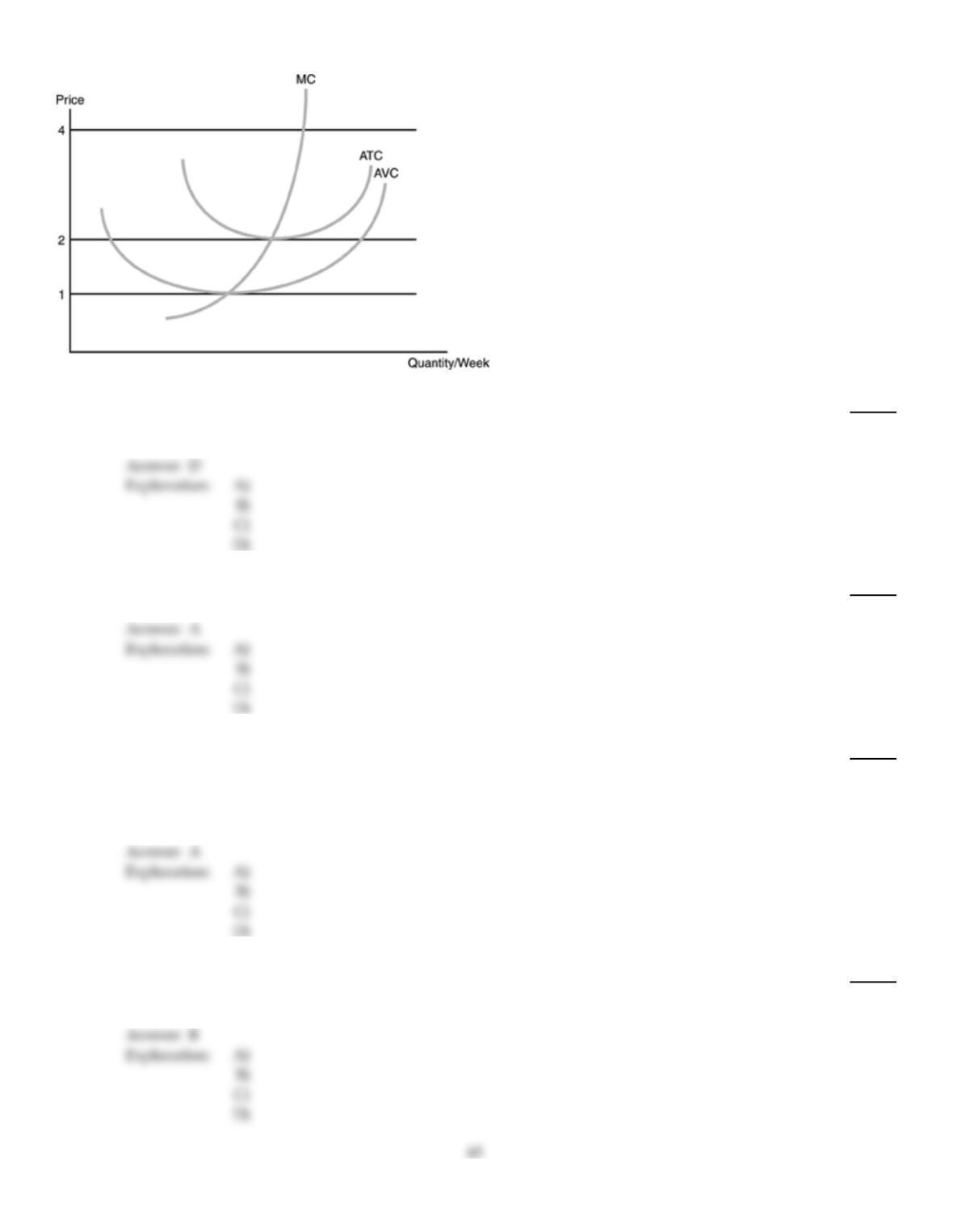
215)
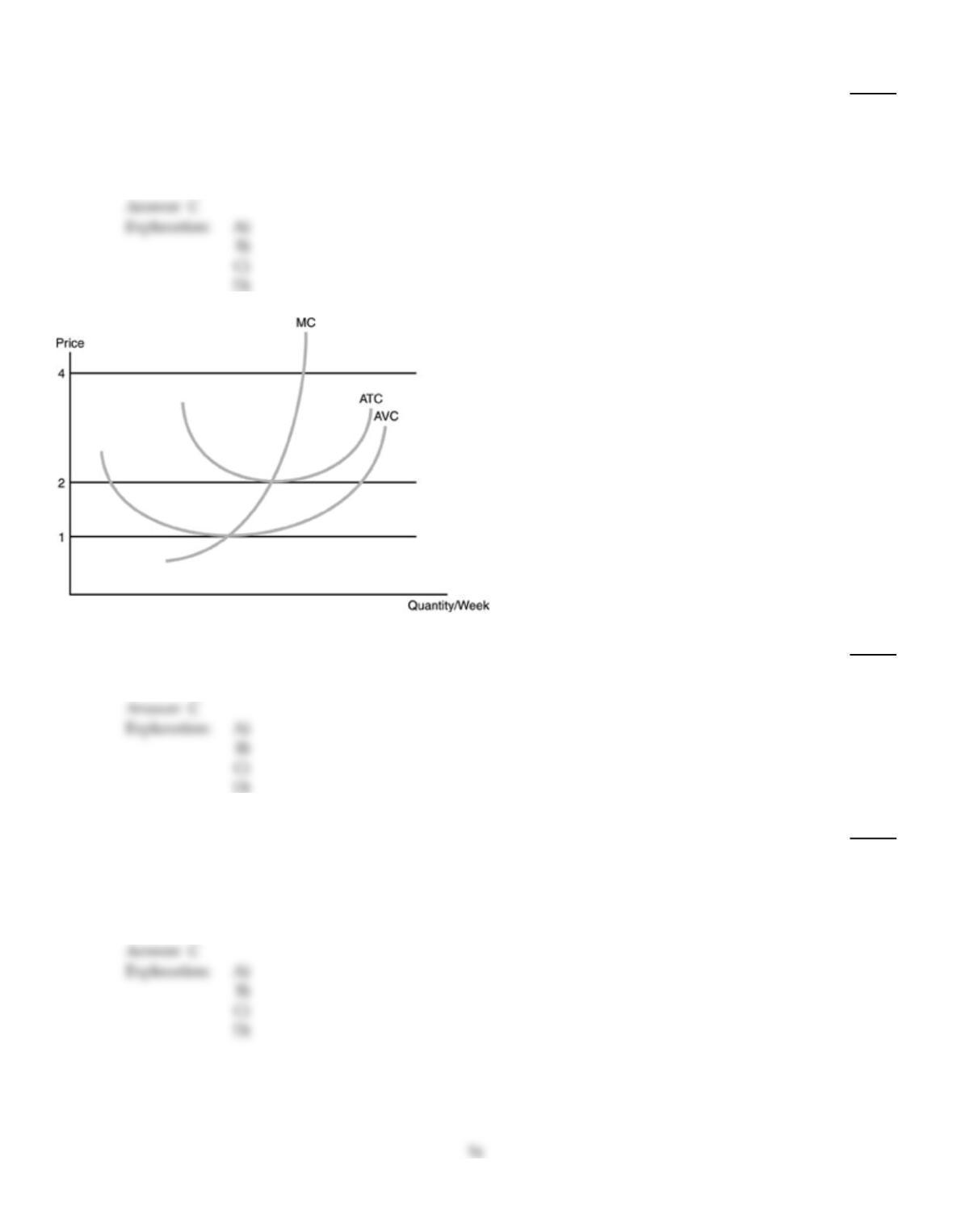
Refer to the above figure. Profits will be negative
215)
A)
when the price equals $2.
B)
when the price is above $2.
C)
only when the price equals $1.
D)
when the price is below $2.
216)
A firm should never produce any output if
216)
A)
P < AVC.
B)
AR < ATC.
C)
MR < MC.
D)
P < ATC.
A
217)
If a perfectly competitive firm has economic profits greater than zero, then we know that
217)
A)
the firm’s industry is not in long–run equilibrium.
B)
the firm is producing at the bottom of the average total cost curve.
C)
the firm’s industry is in long–run equilibrium.
D)
the firm will reduce output.
A
218)
A situation in which the price charged is greater than society’s opportunity cost would lead to
218)
A)
marginal cost pricing.
B)
too little being produced.
C)
too much being produced.
D)
an efficient amount being produced.
B
D

219)
An industry in which an increase in industry output is accompanied by an increase in long–run
per–unit costs is a(n)
219)
A)
increasing–cost industry.
B)
constant–cost industry.
C)
break–even cost industry.
D)
decreasing–cost industry.
Total
Output Costs
100 $400
101 402
102 405
103 409
104 414
105 420
106 427
107 435
220)
Refer to the above table. If the price is $5, the maximum economic profits this firm could earn is
220)
A)
$420.
B)
$520.
C)
$414.
D)
$106.
221)
Which of the following is always TRUE for a perfectly competitive firm?
221)
A)
P = d = AVC
B)
MC = MR = AVC
C)
AVC = ATC = P
D)
P = d = MR
222)
The short–run shutdown price occurs where price equals
222)
A)
AVC at the minimum point.
B)
AVC at any point.
C)
AFC at the minimum point.
D)
MC.
223)
Under perfect competition, the demand curve facing the firm is determined by
223)
A)
utility maximizing behavior on the part of consumers.
B)
the tastes and preferences of consumers.
C)
the intersection of the industry demand and supply curves.
D)
the willingness of the firm to supply the good.
224)
Which of the following statements about the perfect competitor is INCORRECT?
224)
A)
The perfectly competitive firm is always a price taker.
B)
If an individual firm raises price, it will lose business.
C)
The perfect competitor sells a homogeneous commodity.
D)
The products made by a perfectly competitive firm have no close substitutes.
225)
In an increasing–cost industry, an increase in output will lead to
225)
A)
a reduction in long–run per–unit costs.
B)
an increase in long–run per–unit costs.
C)
an downward shift in the ATC curve.
D)
an downward shift in the MC curve.
226)
Suppose that at the current level of output, price = $100, MC = $100, AVC = $80, and ATC = $90.
Which of the following is TRUE?
226)
A)
The firm should decrease output.
B)
The firm should maintain the current level of output.
C)
The firm should shut down.
D)
The firm should increase output.
227)
A perfectly competitive firm faces a horizontal demand curve because it is
227)
A)
a large firm in a small industry.
B)
one of few firms in the market.
C)
a price maker.
D)
a price taker.
228)
What is the shape of the long–run supply curve in a decreasing–cost industry?
228)
A)
upward sloping
B)
horizontal
C)
increasing
D)
downward sloping
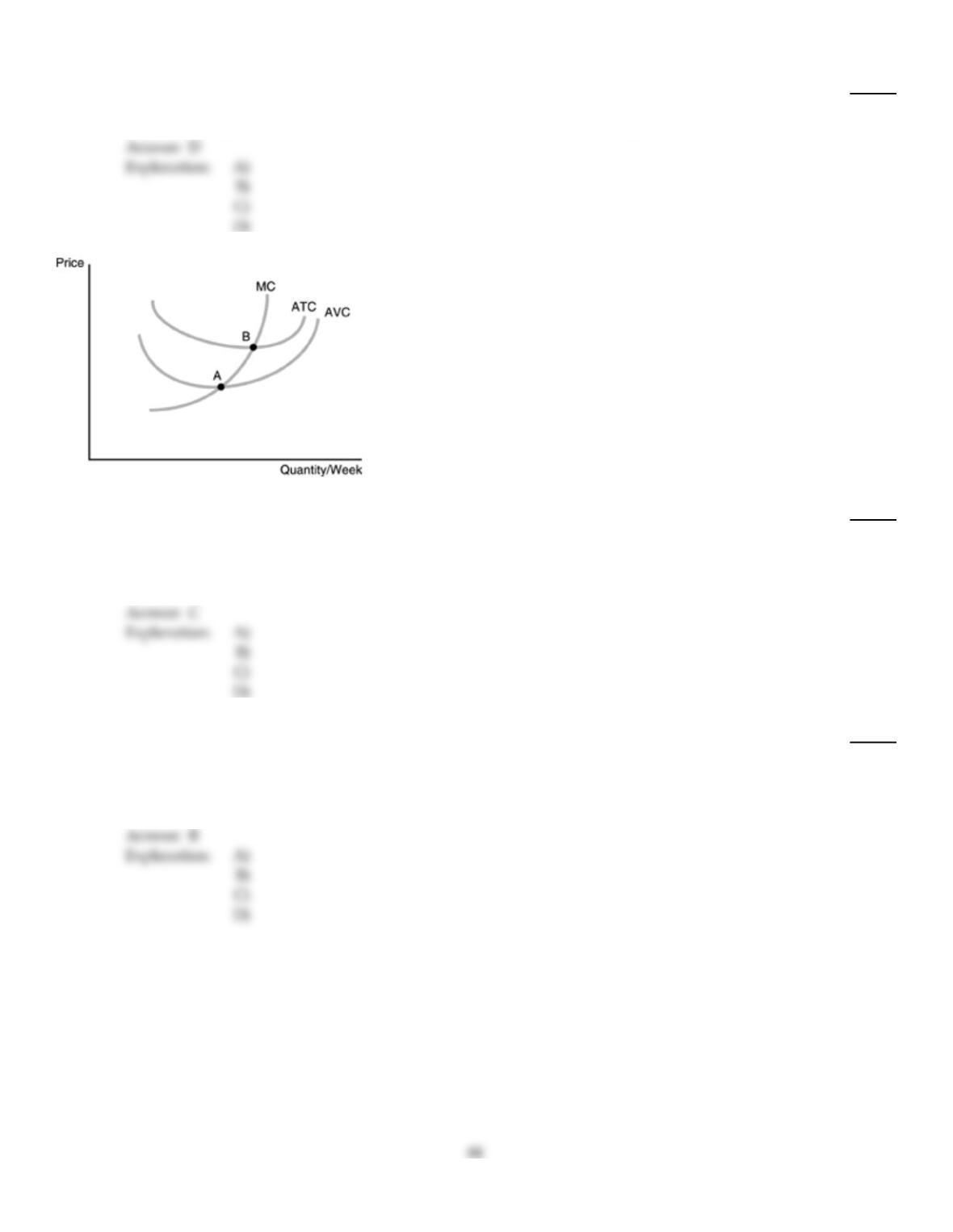
229)
Refer to the above figure. The competitive firm’s short run supply curve
229)
A)
starts at B and goes along the ATC curve as quantity increases.
B)
starts at B and goes along the MC curve as quantity increases.
C)
starts at A and goes along the MC curve as quantity increases.
D)
starts at A and goes along the AVC curve as quantity increases.
230)
For a perfectly competitive firm, when MC is less than MR
230)
A)
the producer has no incentive to change production.
B)
the producer has an incentive to expand output.
C)
the producer has an incentive to decrease output.
D)
economic profits must be positive.
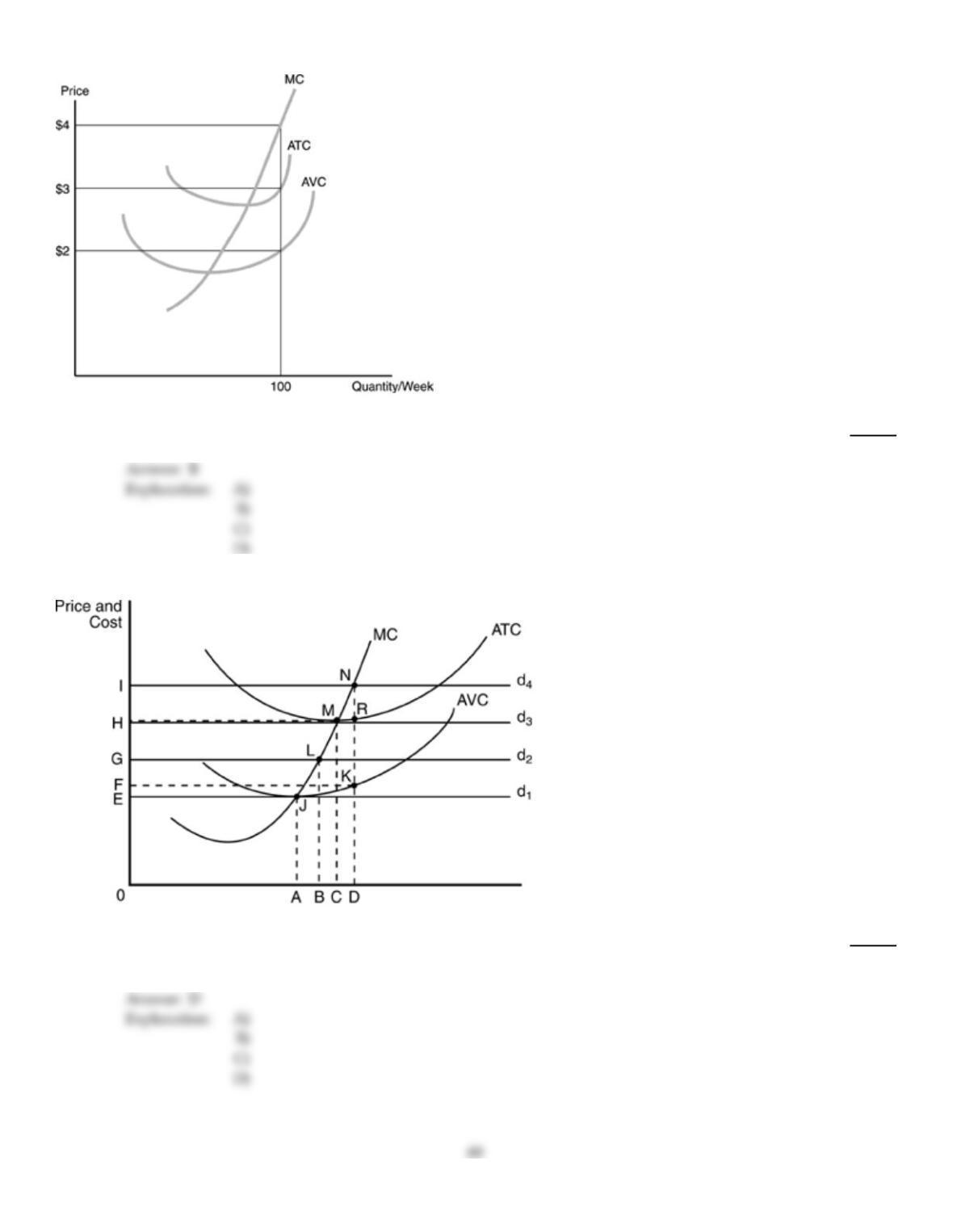
231)
Refer to the above figure. When the price in the market is $4, economic profits will equal
231)
A)
$400.
B)
$100.
C)
$300.
D)
$200.
232)
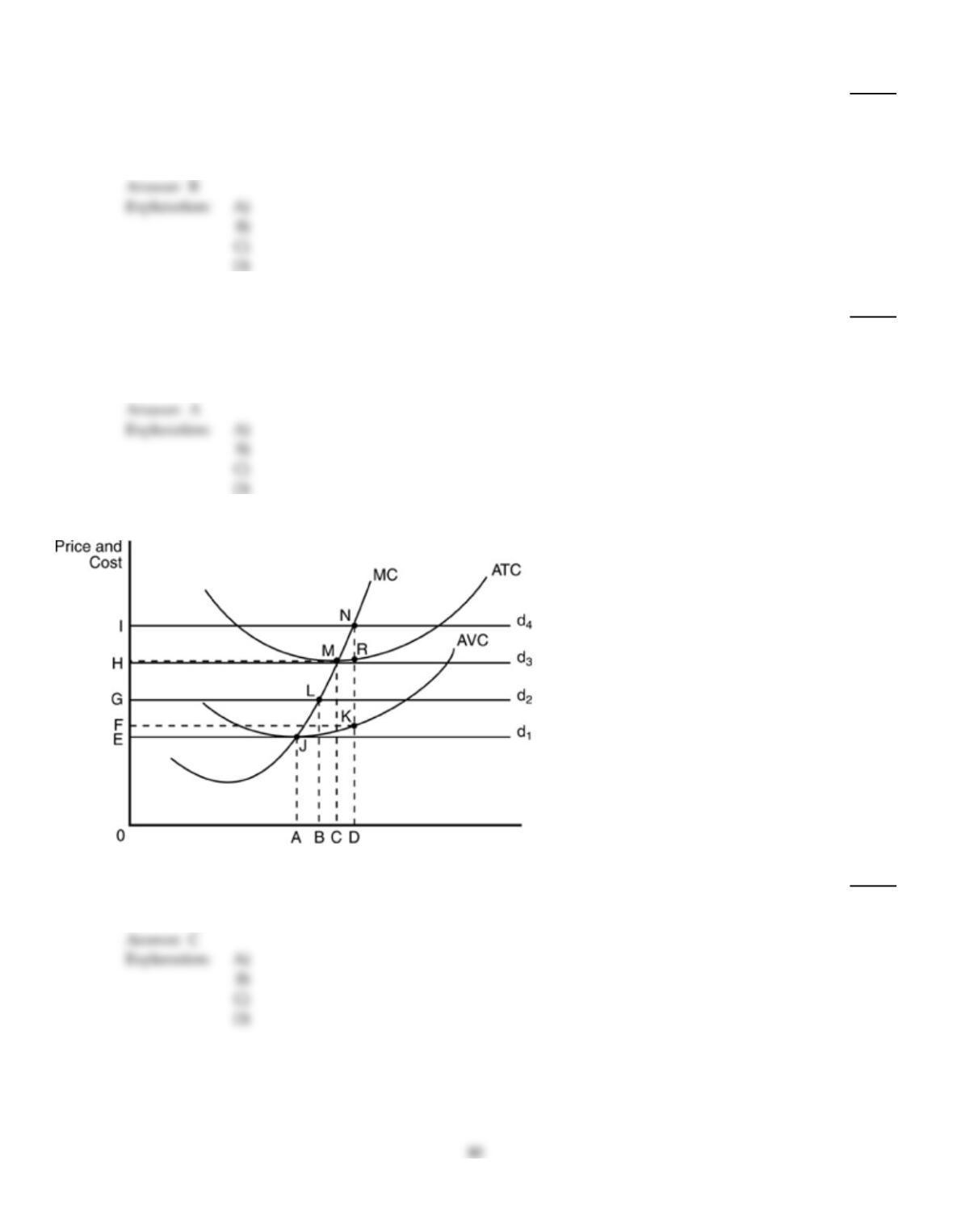
In the above figure, if d4 is the relevant demand curve for this firm, then which level of output will
maximize this firm’s profits or minimize its losses?
232)
A)
A
B)
B
C)
C
D)
D
233)
At the short–run break–even price, the firm
233)
A)
is earning negative economic profits.
B)
is making a normal rate of return on its capital investment.
C)
may be earning a positive or negative profit economic depending upon costs.
D)
is earning positive economic profits.
234)
If a firm is producing an output rate at which marginal cost is greater than price, the firm
234)
A)
should increase its output level.
B)
is sustaining economic loss.
C)
will not be covering its fixed cost.
D)
should reduce its output level.
235)
The break–even price for a perfectly competitive firm is the price that is equal to
235)
A)
AVC.
B)
MC.
C)
MR
D)
ATC.
236)
The marginal revenue curve of a perfectly competitive firm
236)
A)
is also the demand curve faced by the firm.
B)
lies below the demand curve and above the average revenue curve.
C)
has a vertical intercept equal to exactly one–half of the vertical intercept for the demand
curve.
D)
intersects the average revenue curve from above at the maximum point of the average
revenue curve.
237)
When price equals marginal cost
237)
A)
firms make positive profits.
B)
the marginal benefits of consuming an extra unit of the good exactly equals the marginal cost
to society of producing the good.
C)
the industry is in long–run equilibrium.
D)
firms make zero profits.
238)
If the long–run supply curve slopes upward, we know that this is
238)
A)
a decreasing–cost industry.
B)
a constant–cost industry.
C)
an increasing–cost industry.
D)
a situation in which no input prices change as firms enter and exit the industry.
239)
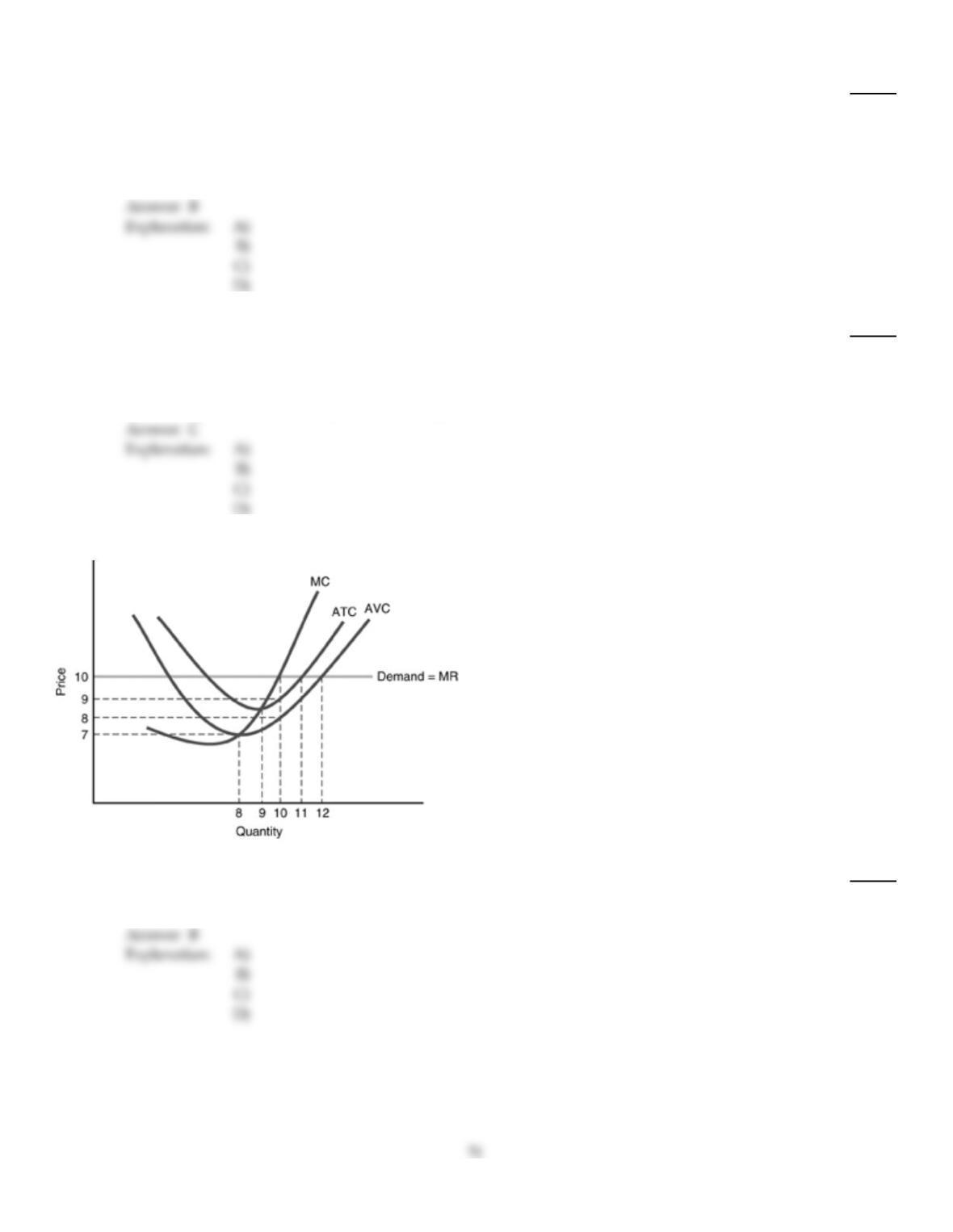
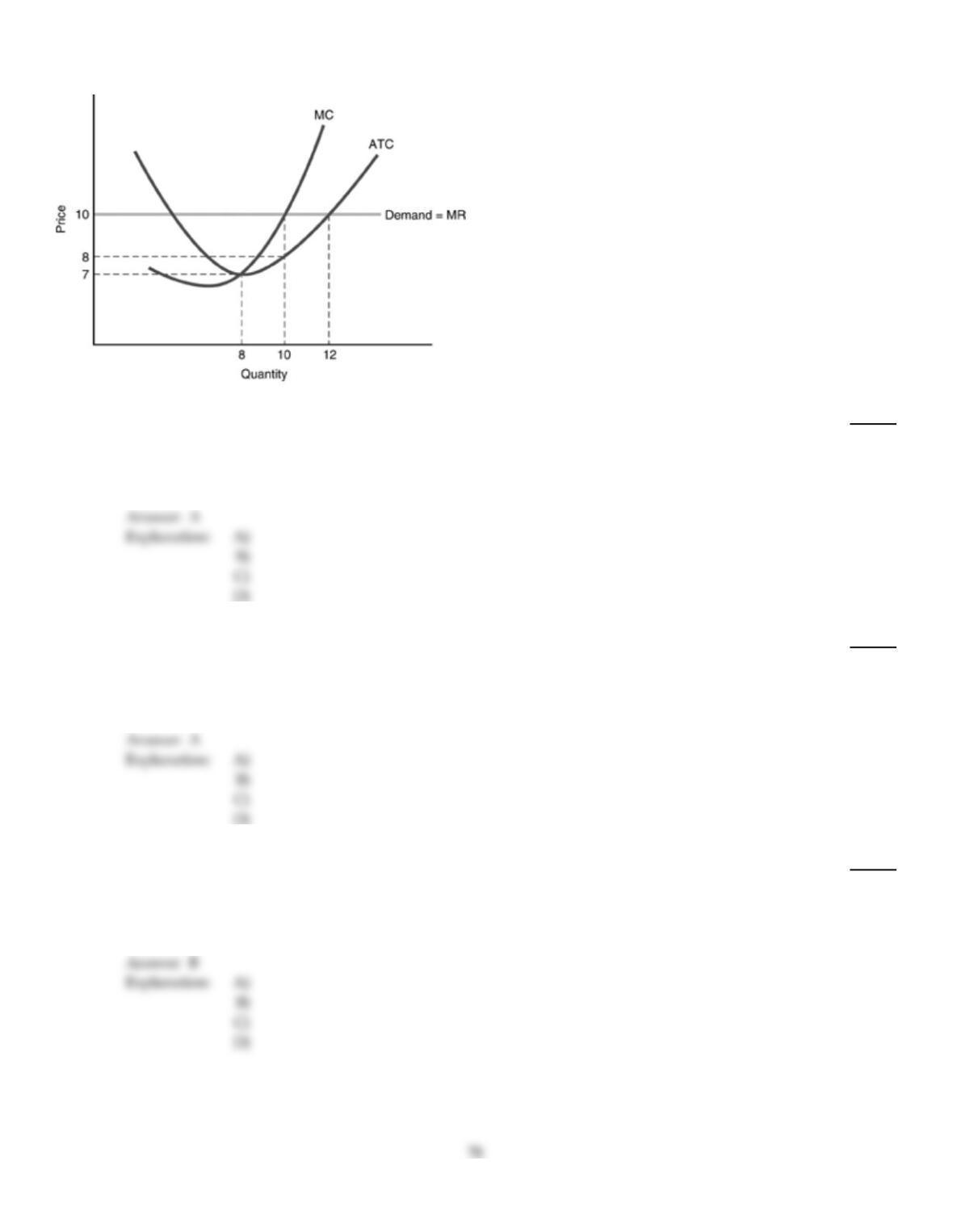
In the above figure, if the market price is $10, the firm
239)
A)
produces 12 units.
B)
produces 10 units.
C)
produces 11 units.
D)
shuts down operations.
240)
When economic profits in a perfectly competitive industry are positive
240)
A)
new firms will be attracted to the industry, and economic profits will decline to zero.
B)
firms will increase output to earn even higher profits.
C)
the industry is in equilibrium.
D)
firms will increase prices while they have the opportunity.
241)
Under what condition are profits maximized?
241)
A)
at the output rate where marginal cost is greater than marginal revenue
B)
at the point at which the difference between price and quantity demanded is greatest
C)
at the point at which the difference between total revenues and total costs is negative
D)
at the rate of output at which marginal revenue equals marginal cost
242)
For a firm in a perfectly competitive industry, the demand curve for its own product is
242)
A)
downward sloping.
B)
horizontal.
C)
vertical.
D)
upward sloping.
243)
Which of the following conditions is TRUE for a profit–maximizing firm in a perfectly competitive
industry?
243)
A)
MR = TC
B)
MC = AVC
C)
ATC = AFC
D)
MR = MC
244)
When a perfectly competitive firm experiences zero economic profits
244)
A)
the high barriers to entry prevent further competition.
B)
existing firms exit the industry.
C)
additional firms enter the industry.
D)
firms have no incentive to exit or enter the industry.
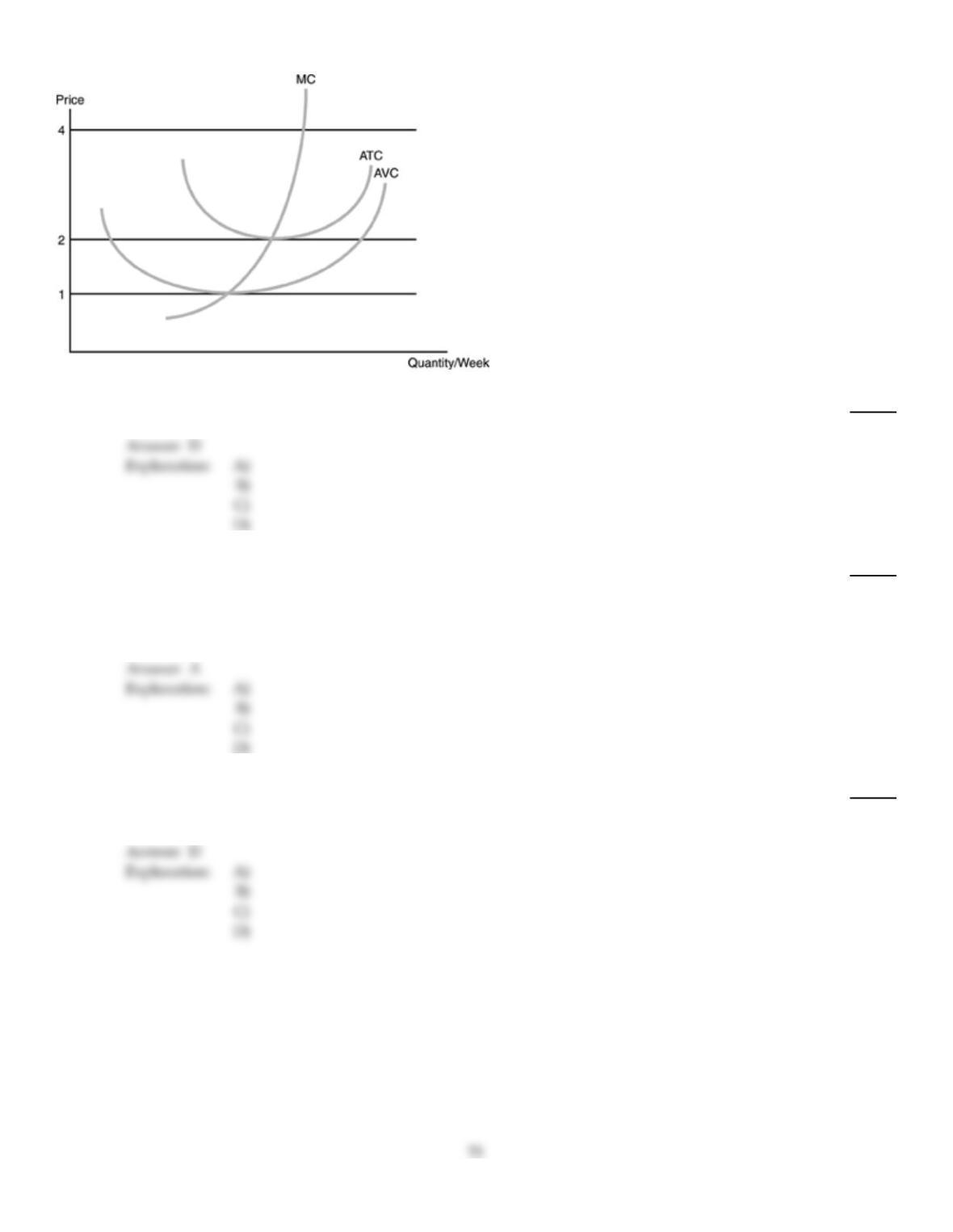
245)
Refer to the above figure. The firm’s short–run shutdown price is
245)
A)
at $4.
B)
at $2.
C)
above $4.
D)
at $1.
246)
Which of the following is NOT a characteristic of perfect competition?
246)
A)
There are substantial barriers to entry into the industry.
B)
All firms sell identical products.
C)
There are many buyers and sellers.
D)
Firms are “price takers.”
A
247)
Which of the following would tell us that resources are not flowing to their highest valued uses?
247)
A)
Some firms are just breaking even.
B)
short–run economic profits
C)
short–run economic losses
D)
song–run economic profits
D
D
248)
A firm is currently producing an output at which price equals the minimum point on the average
variable cost curve. If wage rates increase, the firm will
248)
A)
decrease its rate of output to offset the higher variable costs.
B)
increase its rate of output to make up for the higher variable costs.
C)
shut down since it would no longer be covering its variable costs.
D)
not make any changes since its current rate of output is still minimizing its losses.
249)
Refer to the above figure. Profits will be positive
249)
A)
at prices between $1 and $2.
B)
when the price equals $2.
C)
when the price is above $2.
D)
when the price equals $1.
250)
A perfectly competitive firm is maximizing profits in the short run. This implies that the firm is
earning the most economic profits possible, which
250)
A)
must be positive.
B)
exist at the point at which price equals total cost.
C)
can be positive, negative, or zero.
D)
must be either zero or positive.
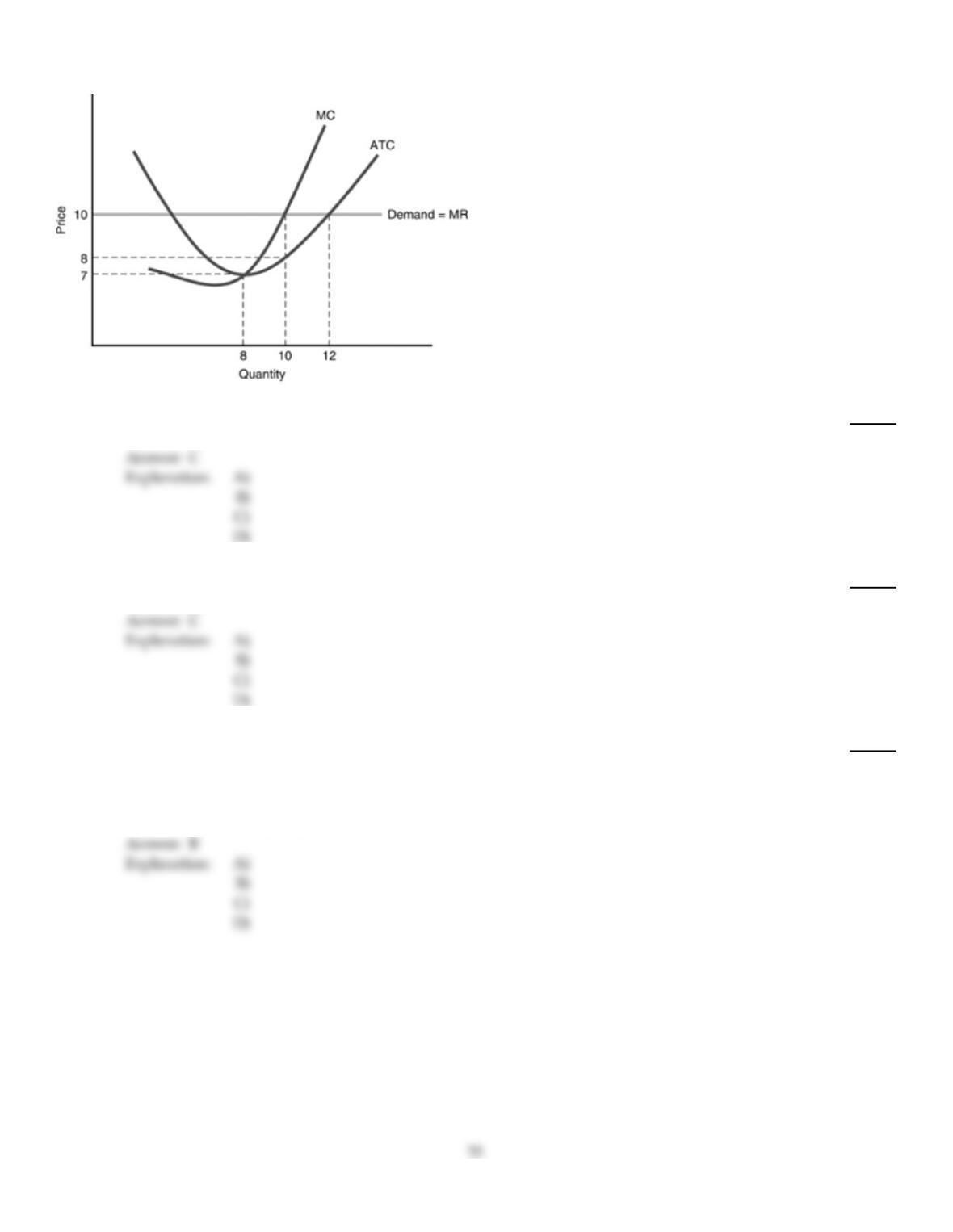
251)
In the above figure, what is the price the firm receives if the output is 8?
251)
A)
$2
B)
$8
C)
$10
D)
$7
252)
For a firm in a perfectly competitive industry, which of the following is TRUE?
252)
A)
MR < P
B)
AVC = ATC
C)
MR = P
D)
MR > P
253)
If the long–run supply curve is upward sloping, we know that
253)
A)
entrepreneurs are earning higher profits as output expands.
B)
some input prices are increasing as the industry expands.
C)
the law of diminishing marginal returns has set in.
D)
firms are getting larger as the industry contracts.
254)
Suppose a perfectly competitive firm faces the following short–run cost and revenue conditions:
ATC = $700; AVC = $500; MC = $600; MR = $600. The firm should
254)
A)
shut down.
B)
increase output.
C)
continue to produce its current output.
D)
decrease output.
255)
If a perfectly competitive industry is in long–run equilibrium, then
255)
A)
all firms earn the same accounting profits.
B)
price equals average cost.
C)
marginal cost is less than average cost.
D)
price is greater than average cost and equal to marginal cost.
B
256)
Consider an industry that is in long–run equilibrium. An increase in demand leads to a decrease in
the price of the good. We know that this is
256)
A)
a decreasing cost industry.
B)
a constant cost industry.
C)
an increasing cost industry.
D)
not a competitive industry.
A
257)
All firms in a perfect competition industry
257)
A)
produce identical products.
B)
lose money.
C)
are price makers.
D)
produce differentiated products.
A
258)
For a perfect competitor, price equals
258)
A)
both average revenue and marginal revenue.
B)
marginal revenue only.
C)
neither marginal revenue nor average revenue.
D)
average revenue only.
A
C
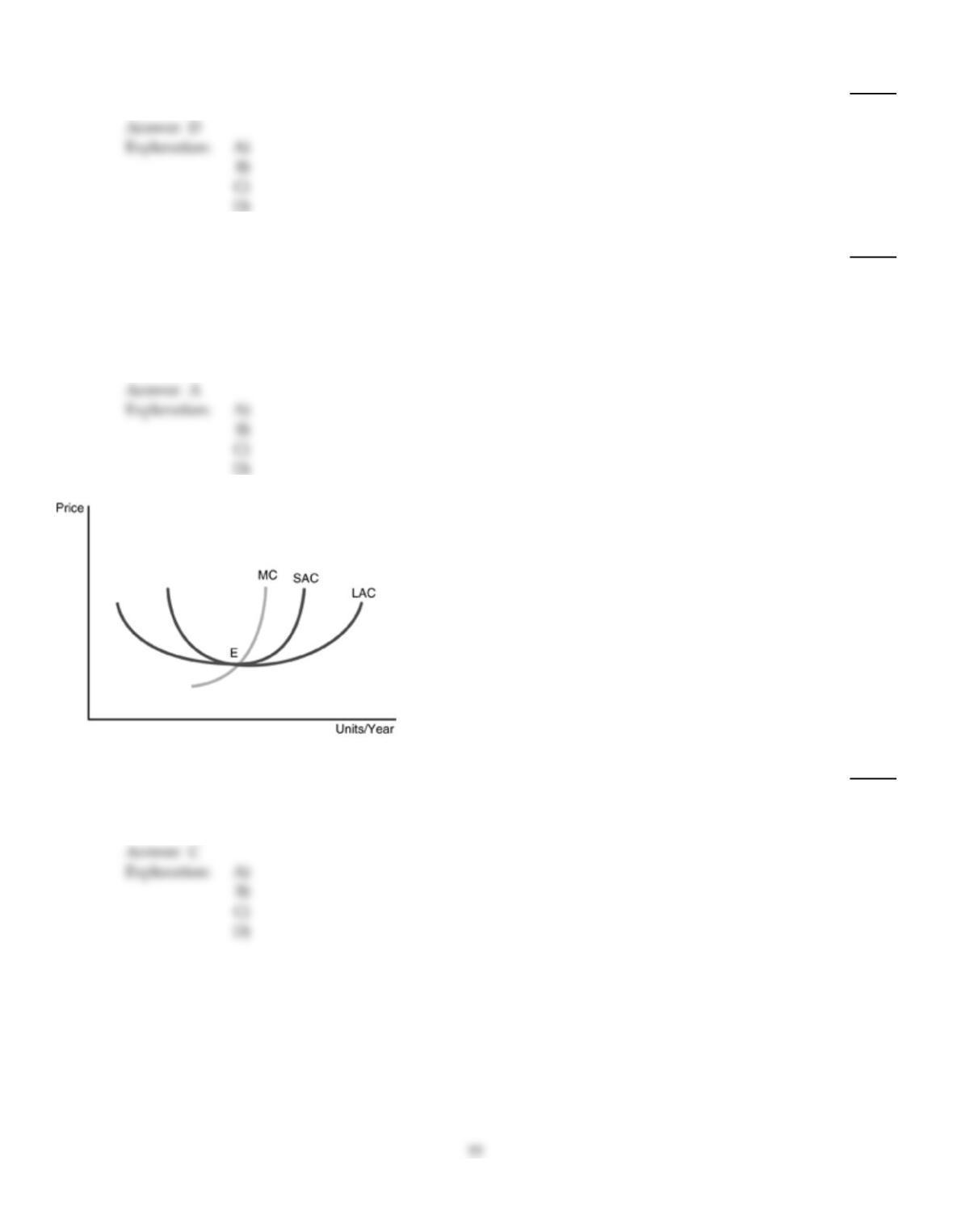
259)
Economic efficiency is indicated by
259)
A)
P = MR.
B)
P = AVC.
C)
MR = MC.
D)
P = MC.
260)
The owner of a perfectly competitive firm is currently earning an economic profit of zero. This
owner
260)
A)
is covering all of his fixed costs.
B)
should raise the price of the product to increase profits.
C)
will continue producing in the short–run but will shut down in the long run if profits do not
increase.
D)
should shut down since profits of zero are not good.
261)
Refer to the above figure. A perfectly competitive firm that is in long–run equilibrium will be
operating
261)
A)
at a quantity less than point E.
B)
with positive economic profits.
C)
at point E.
D)
at a quantity greater than point E.
262)
If a firm is earning short–run economic profits shown in the above figure, in the long run
262)
A)
firms enter the industry, the market supply curve shifts rightward, and the market price falls.
B)
firms enter the industry, the market supply curve shifts rightward, and the market price rises.
C)
firms exit the industry, the market supply curve shifts leftward, and the market price falls.
D)
firms exit the industry, the market supply curve shifts rightward, and the market price falls.
263)
The demand curve for a perfectly competitive firm is
263)
A)
perfectly elastic.
B)
elastic at relatively high prices and inelastic at relatively low prices.
C)
unitary elastic.
D)
perfectly inelastic.
264)
For a firm in a perfectly competitive industry, the demand curve for its own product is
264)
A)
always above the marginal revenue curve.
B)
the same as the marginal revenue curve.
C)
downward sloping.
D)
vertical.
265)
In a decreasing–cost industry, an increase in industry output will
265)
A)
lead to a lower market price.
B)
shift each firm’s short run supply curve up.
C)
lead to a higher market price.
D)
shift each firm‘s average fixed cost curve up.
266)
A situation in which the price charged is less than society’s opportunity cost would lead to
266)
A)
an efficient amount being produced.
B)
too little being produced.
C)
too much being produced.
D)
marginal cost pricing.
C
267)
When a perfectly competitive firm is in long–run equilibrium, economic profits
267)
A)
may be positive, zero or negative depending upon costs.
B)
are zero.
C)
are positive.
D)
are negative.
B
268)
In a perfectly competitive market, a firm in long–run equilibrium will be operating
268)
A)
at the minimum of the long–run average cost curve.
B)
to the left of the minimum of the long–run average cost curve.
C)
to the right of the minimum of the long–run average cost curve.
D)
at the minimum of the marginal cost curve.
A
A
269)
The short–run industry supply curve slopes up because
269)
A)
wages increase as the industry increases output.
B)
the law of diminishing marginal product applies in the short run.
C)
the firms eventually experience diseconomies of scale.
D)
the higher price is needed to get more firms to enter the industry.
270)
In the long run, all firms in a perfectly competitive industry
270)
A)
break even.
B)
sell differentiated products to earn economic profits.
C)
suffer economic losses.
D)
earn economic profits.
271)
In the above figure, if d3 is the relevant demand curve for this firm, then which level of output will
maximize this firm’s profits or minimize its losses?
271)
A)
A
B)
B
C)
C
D)
D