131)
In a perfectly competitive market structure any firm can enter or leave the industry without serious
impediments. This implies
131)
A)
consumers are able to find out about lower prices charged by other firms.
B)
the products sold will be alike.
C)
firms will move labor and capital in pursuit of profit–making opportunities to whatever
business venture gives them the highest return on their investment.
D)
no one buyer or seller has any influence on price.
132)
Along a perfectly competitive industry’s long–run supply curve
132)
A)
economic profits are positive.
B)
entrepreneurs earn an above–average rate of return.
C)
the number of firms is constant.
D)
economic profits are zero.
D
133)
In a perfectly competitive industry, the firm’s marginal revenue curve is
133)
A)
downward sloping.
B)
vertical.
C)
horizontal.
D)
upward sloping.
C
134)
When a perfectly competitive firm experiences positive economic profits
134)
A)
the high barriers to entry prevent further competition.
B)
existing firms exit the industry.
C)
additional firms enter the industry.
D)
firms have no incentive to exit or enter the industry.
C
C
135)
If marginal revenue is less than marginal cost, the firm should
135)
A)
raise price.
B)
increase its rate of output.
C)
raise marginal revenue.
D)
decrease its rate of output.
136)
A firm that shuts down in the short run experiences losses equal to
136)
A)
total variable costs.
B)
zero.
C)
total fixed costs.
D)
total marginal costs.
137)
A situation in which the price charged is greater than society’s opportunity cost would lead to
137)
A)
market failure.
B)
marginal cost pricing.
C)
marginal profits.
D)
marginal monopoly pricing.
138)
Which of the following is NOT a characteristic of a perfectly competitive industry?
138)
A)
Sellers have better information about the product than consumers.
B)
The firms in the industry produce a homogeneous product.
C)
There are large numbers of buyers and sellers.
D)
Any firm can enter or leave the industry without serious impediments.
139)
Economic profits are maximized at the point at which
139)
A)
accounting profits are equal to zero.
B)
total revenues are greater than total costs.
C)
marginal revenues equal marginal costs.
D)
accounting profit exceeds economic profit.
140)
Suppose a perfectly competitive firm faces the following short–run cost and revenue conditions:
ATC = $8.00; AVC = $5.00; MC = $8.00; MR = $9.00. The firm should
140)
A)
continue to produce its current output.
B)
increase output.
C)
decrease output.
D)
increase price.
141)
Which of the following is a characteristic of perfect competition?
141)
A)
few firms
B)
differentiated products
C)
easy entry and exit
D)
none of the above
C
142)
The motive that drives firms to enter or exit an industry is
142)
A)
utility.
B)
accounting costs.
C)
governmental.
D)
economic profit.
D
143)
Which of the following is NOT a characteristic of perfect competition?
143)
A)
Each firm determines the market price of its product.
B)
Products are homogeneous.
C)
There are many buyers and sellers.
D)
Buyers and sellers have equal access to information.
A
144)
The short–run supply curve for the perfectly competitive firm is the portion of its
144)
A)
MC curve above the AVC curve.
B)
MC curve above the ATC curve.
C)
MC curve above the AFC curve.
D)
MC curve above the MR curve.
A
B
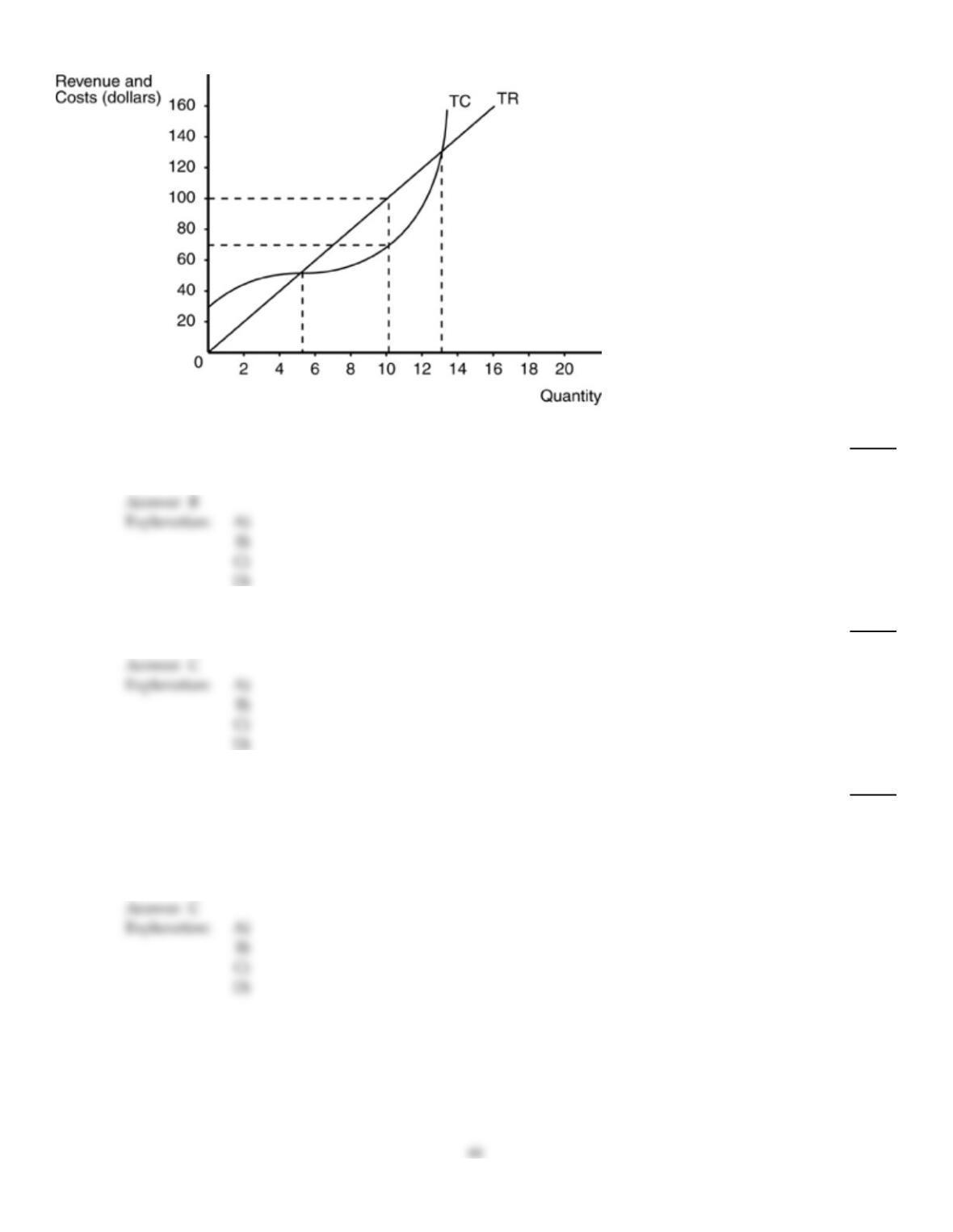
145)
In the above figure, at the profit–maximizing rate of production for the perfectly competitive firm
total revenue is
145)
A)
$130.
B)
$100.
C)
$70.
D)
$30.
146)
In the above figure, at which output level is this firm earning negative economic profits?
146)
A)
12
B)
10
C)
2
D)
5
C
147)
The owner of a perfectly competitive firm that is earning economic losses in the short run
147)
A)
should alter the rate of output in order to increase profitability.
B)
should cut his own salary in order to reach the break–even point.
C)
is earning less than he would if he worked for someone else.
D)
is actually losing more than he thinks because not all of the implicit costs have been
considered.
C
B
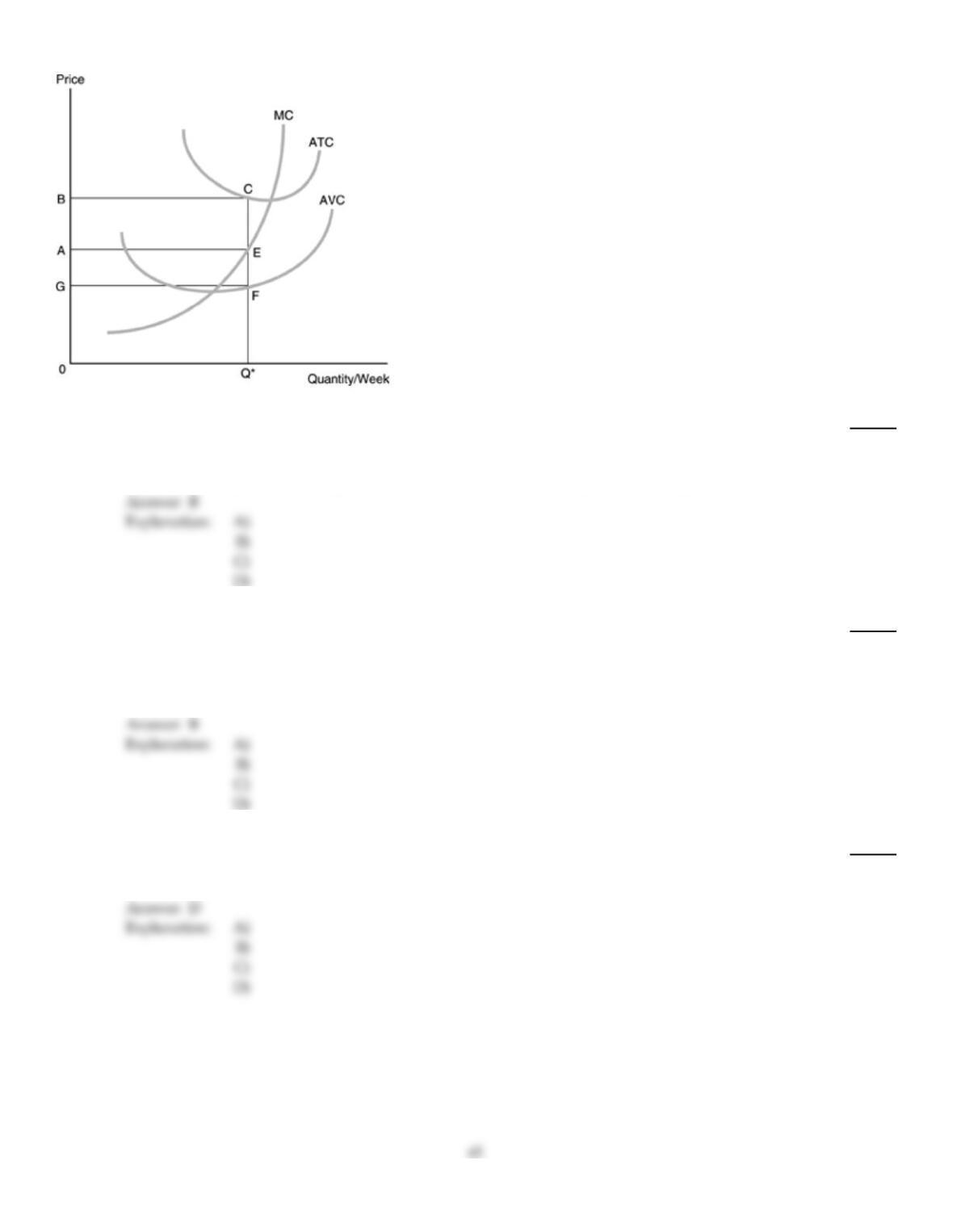
148)
Refer to the above figure. If the market price is equal to A, which statement can be made about
profits?
148)
A)
Profits are negative and equal to GFQ0.
B)
Profits are negative and equal to BCEA.
C)
Profits are positive and equal to BCFG.
D)
Profits are positive and equal to BCEA.
149)
In long–run equilibrium, the perfectly competitive firm will
149)
A)
go out of business.
B)
produce to the point at which marginal cost equals average total cost.
C)
produce to the point at which marginal cost is at its minimum.
D)
produce on the upward sloping portion of its ATC curve.
150)
The demand curve for a perfectly competitive industry is
150)
A)
unit elastic.
B)
perfectly inelastic.
C)
perfectly elastic.
D)
downward sloping.
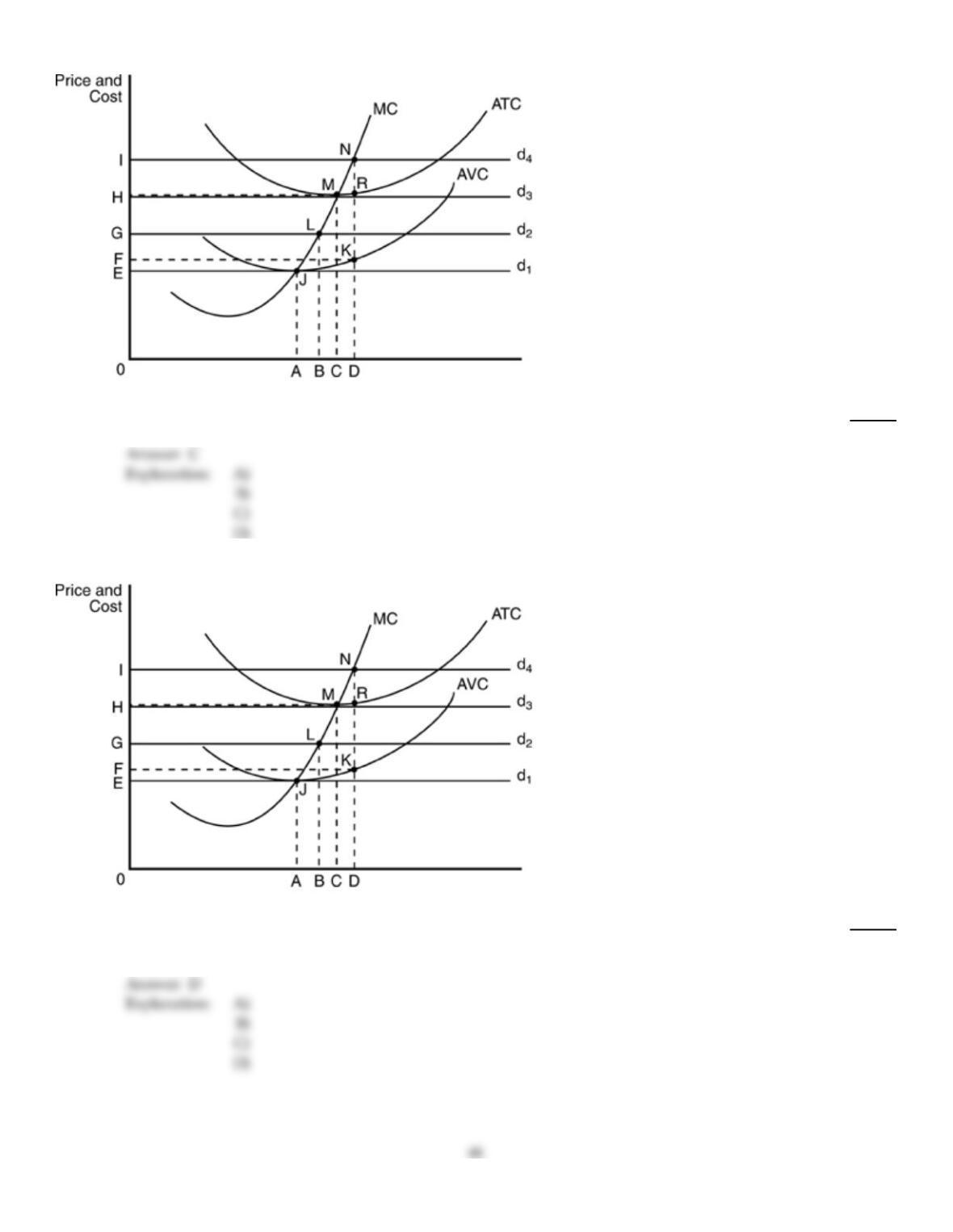
151)
The firm in the above figure breaks even when quantity is
151)
A)
A.
B)
B.
C)
C.
D)
D.
152)
If the firm in the above figure produces output level D, it incurs an average fixed cost of production
equal to the distance
152)
A)
DK.
B)
JL.
C)
RN.
D)
KR.
153)
A company finds that at the output level at which marginal cost equals marginal revenue, TC =
$500, TVC = $400, and TR = $450. Your advice to the firm is
153)
A)
continue to produce because loss is less than TFC.
B)
reduce output to reduce the cost of production.
C)
shut down, as TC > TR.
D)
increase output to reduce the per unit cost of production.
154)
A firm that has positive economic profits has accounting profits that are
154)
A)
zero.
B)
positive.
C)
negative.
D)
indeterminate without more information.
155)
If a firm is a perfect competitor, then
155)
A)
it is impossible for the firm to earn short–run economic profits.
B)
its marginal cost will exceed marginal revenue at the optimal level of output.
C)
the demand curve for its product is perfectly elastic.
D)
it can independently set the price of the product it sells without regard to what other firms in
the market are doing.
156)
If the costs of production do not change as output increases in the long run in a perfectly
competitive industry, then this is a
156)
A)
constant–competitive industry.
B)
constant–return–to–scale industry.
C)
constant–price industry.
D)
constant–cost industry.
157)
A perfectly competitive industry’s market price is found by
157)
A)
identifying the price at which each firm realizes its largest economic profit.
B)
the horizontal summation of all the industry firms’ individual supply curves.
C)
locating the intersection of the market demand and market supply curves.
D)
finding the point on the market demand curve where the largest number of units will be
purchased.
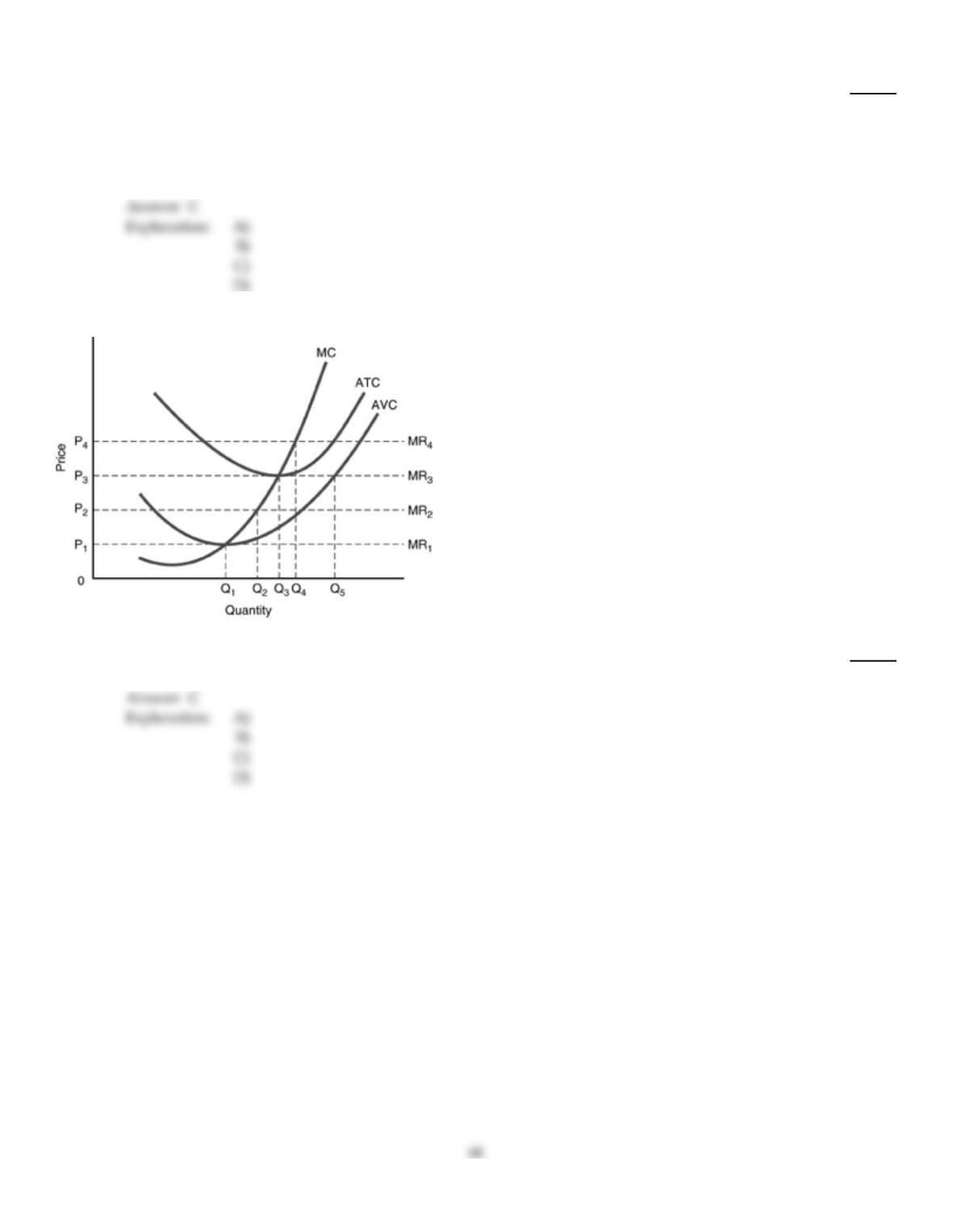
158)
Using the above figure, the short–run break–even price for the perfectly competitive firm will be
158)
A)
P1.
B)
P2.
C)
P3.
D)
P4.

Total
Output Costs
100 $400
101 402
102 405
103 409
104 414
105 420
106 427
107 435
159)
Refer to the above table. If the price is $6, the perfectly competitive firm should produce
159)
A)
104 units.
B)
107 units.
C)
105 units.
D)
106 units.
160)
For a perfect competitor, the marginal revenue curve will be
160)
A)
negatively sloped.
B)
vertical.
C)
horizontal.
D)
positively sloped.
161)
If an industry has constant marginal and average costs, any shift in demand will eventually
161)
A)
be met by an equal change in quantity supplied, and equilibrium price will not change.
B)
result in a higher equilibrium price.
C)
make economic profits zero in the short run.
D)
be met by a smaller change in quantity supplied.
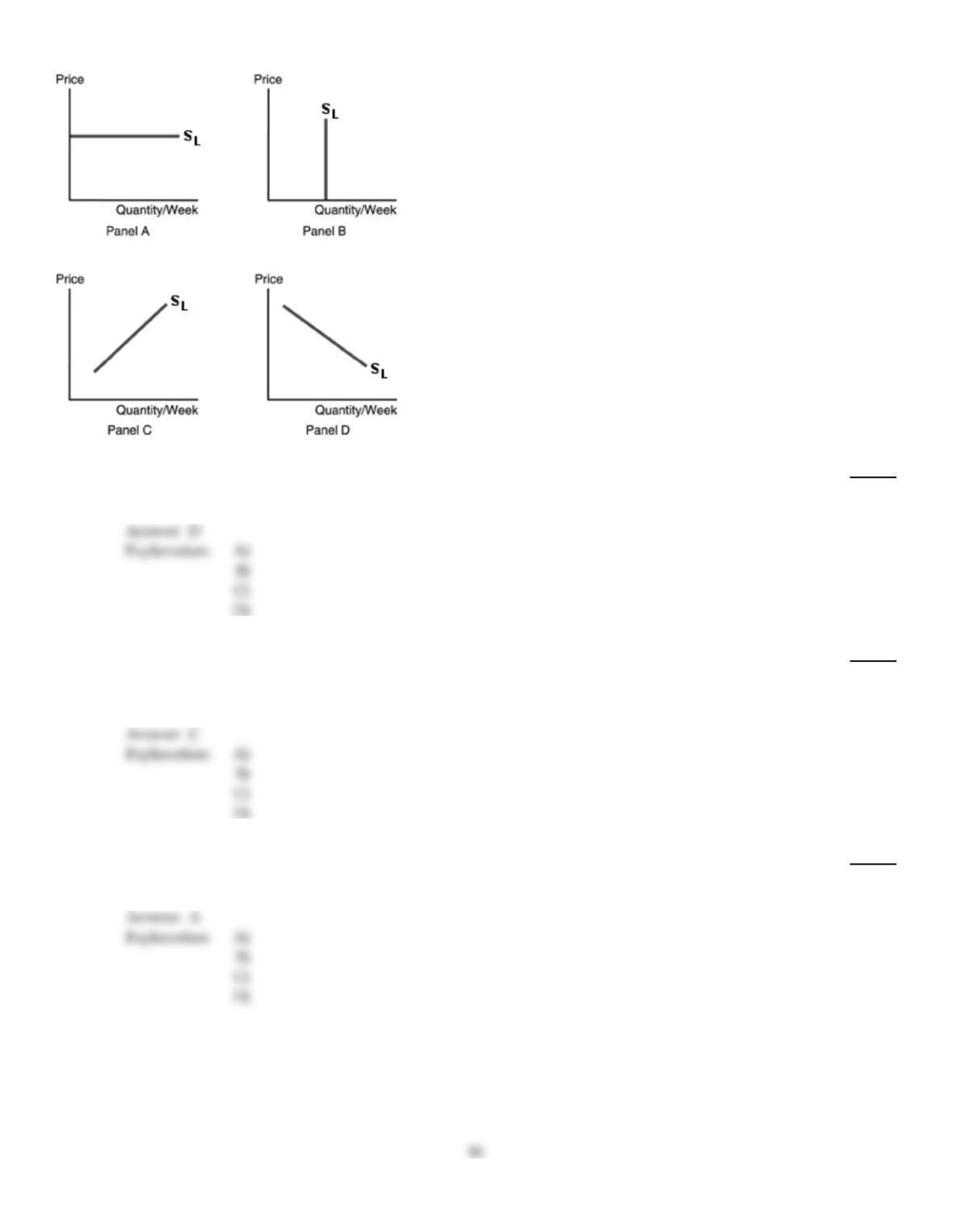
162)
Refer to the above figure. Which panel represents the long–run supply curve for a decreasing cost
industry?
162)
A)
Panel A
B)
Panel B
C)
Panel C
D)
Panel D
163)
Suppose a perfectly competitive firm faces the following short–run cost and revenue conditions:
ATC = $6.00; AVC = $4.00; MC = $3.50; MR = $3.50. The firm should
163)
A)
remain at the same position.
B)
increase output.
C)
shut down.
D)
increase price.
164)
The shutdown rule for a firm in a perfectly competitive industry is that the firm should cease
production if
164)
A)
P < AVC.
B)
P < AFC.
C)
P < ATC.
D)
P < MC.
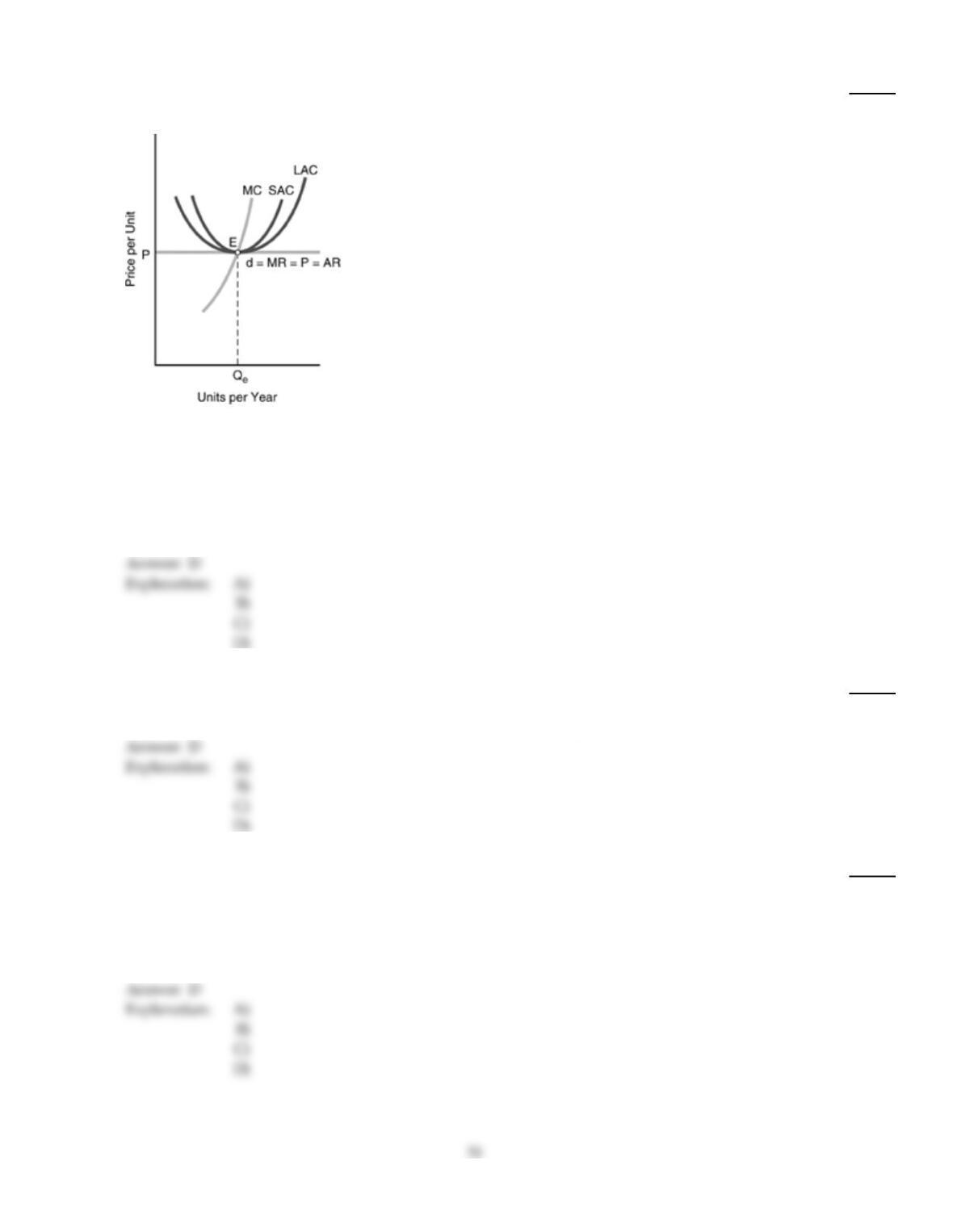
165)
In reference to the long–run firm competitive equilibrium diagram, which of the following
statements is INCORRECT?
165)
A)
In the long run, the firm operates where price, marginal revenue, marginal cost, short–run
minimum average cost, and long–run minimum average cost all are equal.
B)
In the long run, the firm has no incentive to alter its scale of operations.
C)
Because profits must be zero in the long run, the firm’s short–run average costs (SAC) must
equal P at Qe, which occurs at minimum SAC.
D)
In the long run, this firm must be part of a constant–cost industry, because its marginal
revenue curve is perfectly elastic.
166)
As long as price exceeds AVC, the firm is better off
166)
A)
cutting price.
B)
closing.
C)
raising its price.
D)
continuing production.
167)
A perfectly competitive firm is producing zero units of output in the short run. We know that price
is
167)
A)
between the minimum points of its average total cost curve.
B)
below the minimum point of its average total cost curve.
C)
below the minimum point of its average fixed cost curve.
D)
below the minimum point of its average variable cost curve.
168)
A firm‘s long–run position under perfect competition is often said to be efficient because
168)
A)
P = AR > MC = AVC.
B)
P = MR = AVC = AFC.
C)
P = AR > MR = MC.
D)
P = MR = MC = ATC.
169)
In a perfectly competitive market, positive economic profits act to
169)
A)
drive potential competitors away from the industry.
B)
prevent reinvestment on the part of firms within the industry.
C)
attract new entrants into the industry.
D)
signal resource owners elsewhere not to invest their capital in this industry.
170)
The short–run break–even price is the point at which
170)
A)
price is less than marginal cost.
B)
average variable cost is at a minimum.
C)
marginal cost, average total cost and marginal revenue are all equal.
D)
marginal cost, price and average variable cost are all equal.
171)
In a long–run equilibrium, a perfectly competitive firm’s average total cost is
171)
A)
equal to average fixed cost.
B)
zero.
C)
maximized.
D)
minimized.
172)
For a perfectly competitive firm
172)
A)
price is less than marginal revenue.
B)
there is no relationship between price and marginal revenue.
C)
price equals marginal revenue.
D)
price is greater than marginal revenue.
173)
A perfectly competitive firm’s short–run break–even output occurs
173)
A)
at the minimum point of its average total cost curve.
B)
at the minimum point of its marginal cost curve.
C)
at the intersection of its total cost curve and its marginal revenue curve.
D)
at the minimum point of its average variable cost curve.
174)
An increasing–cost industry will have
174)
A)
an upward sloping supply curve in the long run.
B)
a perfectly inelastic long–run supply curve.
C)
a perfectly elastic long–run supply curve.
D)
an upward sloping demand curve in the long run.
175)
Economic profits and losses are true market signals because they
175)
A)
convey information in an asymmetrical fashion.
B)
convey information about rewards people should anticipate experiencing by shifting
resources from one activity to another.
C)
cause people to move into careers in both undesirable and desirable industries with equal
ease.
D)
convey information to public officials about where to encourage people to invest and what
skills people should develop.
176)
Profits and losses are true signals because they
176)
A)
convey information about where to place resources and reward people who act on the
information.
B)
convey information about true long–run profits.
C)
cannot be misinterpreted by entrepreneurs.
D)
reward people who make profits with even more profits and punish those who make losses
with even more losses.
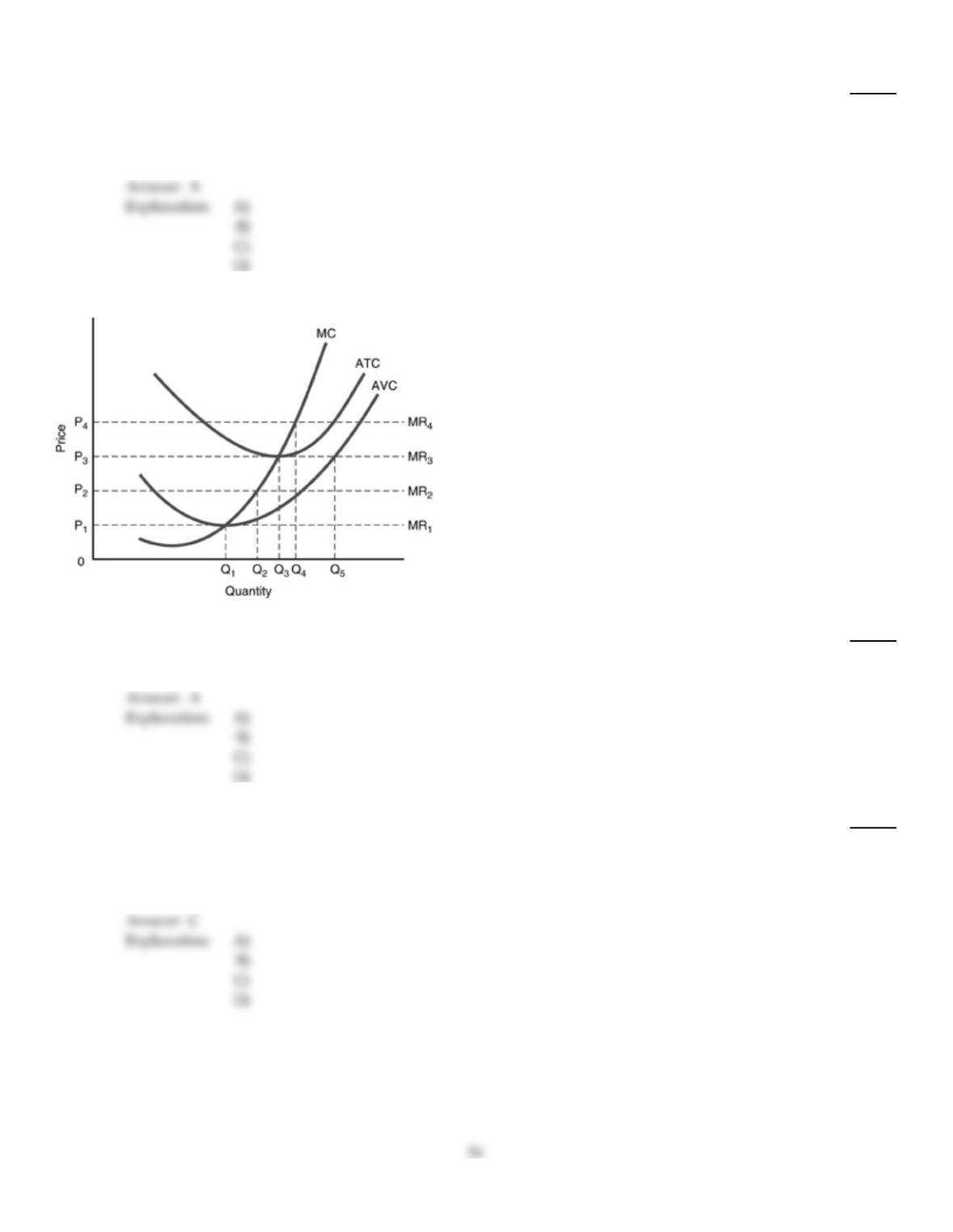
177)
The demand curve for a perfectly competitive firm is horizontal because
177)
A)
its production decisions cannot influence the market price.
B)
its product is easy for consumers to differentiate from those of other firms.
C)
the firm profits from setting its price higher than the market price.
D)
consumers are willing to pay any price to obtain its product.
178)
Using the above figure, the perfectly competitive firm should shut down if the market price is
below
178)
A)
P1.
B)
P2.
C)
P3.
D)
P4.
179)
For a perfectly competitive firm, which of the following is NOT true?
179)
A)
The average revenue curve, the demand and the marginal revenue curves are identical.
B)
The slope of the total revenue curve is equal to the product price.
C)
The total revenue curve is horizontal.
D)
The total revenue curve begins at the origin and slopes upward as output increases.

180)
A perfectly competitive firm will not earn an economic profit in the long run, because
180)
A)
it faces a perfectly inelastic demand curve.
B)
it is a “price–maker.”
C)
there are no barriers to entry into the industry.
D)
it produces differentiated products.
Total
Output Costs
0 $8
1 13
2 16
3 21
4 30
5 45
181)
Refer to the above table. The table represents information on the costs for Ajax Corporation. Ajax
operates in a perfectly competitive market and the price of the product is $10. What does total
revenue equal when quantity equals 4?
181)
A)
$36
B)
$4
C)
$6
D)
$40
182)
Firms in a perfectly competitive industry are producing goods efficiently in the long run if each is
producing at the minimum point of the
182)
A)
AFC curve.
B)
MC curve.
C)
LAC curve.
D)
AVC curve.
183)
The perfectly competitive seller’s short–run supply curve is
183)
A)
its marginal revenue curve.
B)
the part of its marginal cost curve above the average variable cost curve.
C)
the part of its marginal cost curve above the average total cost curve.
D)
its entire marginal cost curve.
184)
For a perfectly competitive firm at its long–run equilibrium
184)
A)
there are no opportunity costs to be concerned with.
B)
accounting profit must be zero.
C)
P = MR = MC = AC.
D)
P = MR > MC.
185)
If the long–run supply curve is horizontal, we know that this is
185)
A)
a decreasing–cost industry.
B)
a constant–cost industry.
C)
an increasing–cost industry.
D)
a situation in which some input prices change as firms enter and exit the industry.
B
186)
A perfectly elastic demand function
186)
A)
is characteristic of an individual firm operating in a perfectly competitive market.
B)
has a marginal revenue that is always decreasing.
C)
shows that the individual firm can increase sales by lowering the price of output.
D)
shows that a consumer is willing to pay any amount for the product.
A
187)
Which of the following is the best example of a decreasing–cost industry?
187)
A)
the college–education industry
B)
the personal computer industry
C)
the health care industry
D)
the oil industry
B
C
188)
In a perfectly competitive industry
188)
A)
no buyer or seller can influence the market price.
B)
firms can never make an economic profit.
C)
there is apt to be a shortage of sellers of output.
D)
each firm is a price maker.
189)
A perfectly competitive market has
189)
A)
high barriers to entry or exit.
B)
homogeneous products.
C)
few firms.
D)
to do a lot of advertising to attract buyers.
190)
When a firm has an accounting profit that is negative, it
190)
A)
will never produce output, even in the short run.
B)
may still have economic profit.
C)
cannot be producing where price equals marginal cost.
D)
has total revenue that is less than total cost.
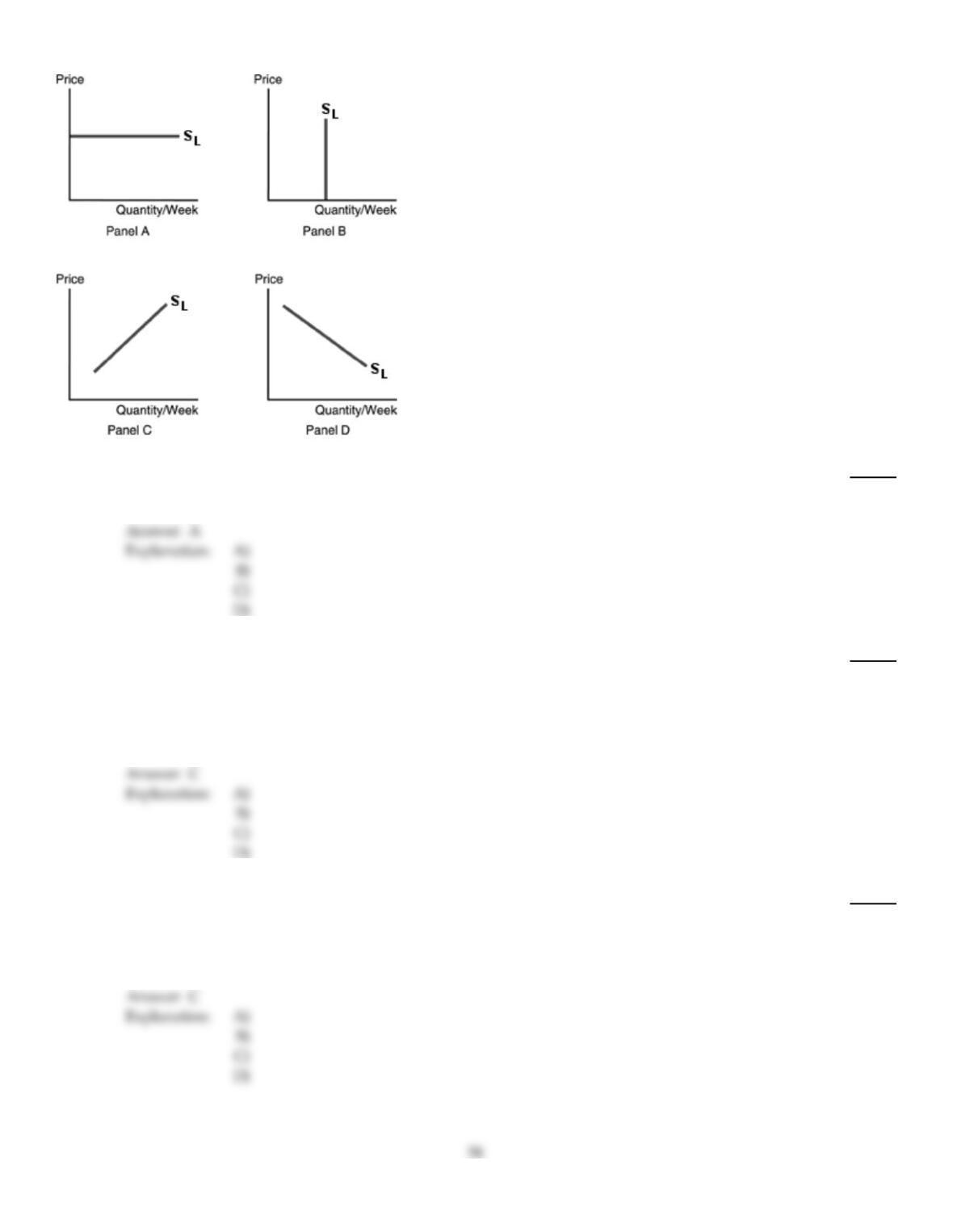
191)
Refer to the above figure. Which panel represents the long–run supply curve for a constant cost
industry?
191)
A)
Panel A
B)
Panel B
C)
Panel C
D)
Panel D
192)
In a perfectly competitive market, a firm’s short–run supply curve is
192)
A)
its total cost curve between the shutdown point and the break–even point.
B)
its total cost curve.
C)
its marginal cost curve equal to or above the point of intersection with its average variable
cost curve.
D)
its average variable cost curve below the point of intersection with its total cost curve.
193)
If price is above average total costs, the firm
193)
A)
is making a normal rate of return on its capital investment.
B)
is earning negative profits.
C)
is earning positive profits.
D)
may be earning a positive or negative profit depending upon costs.
194)
When a firm is earning zero economic profits
194)
A)
P is greater than ATC.
B)
P = ATC.
C)
accounting profit is zero.
D)
total revenue is greater than total cost.
195)
A firm is currently producing at the rate of output at which total revenues just cover its total
variable costs. If demand falls, the firm should
195)
A)
increase its rate of output to make up for the lower price.
B)
shut down.
C)
lower both price and its rate of output.
D)
not change its rate of output because it is still covering its variable costs.
196)
A perfectly competitive industry‘s market or “going” price is established by
196)
A)
the forces of supply and demand.
B)
the largest purchaser of this industry’s output.
C)
each individual producing firm and reflects that firm’s costs.
D)
the largest firm in the industry.
197)
The exiting of firms from a perfectly competitive industry occurs when
197)
A)
P = ATC.
B)
MR equals MC.
C)
opportunity costs cannot be covered.
D)
accounting profit is less than economic profit.
198)
In a perfectly competitive industry, the industry demand curve
198)
A)
must be horizontal.
B)
is downward sloping.
C)
is upward sloping.
D)
must be vertical.
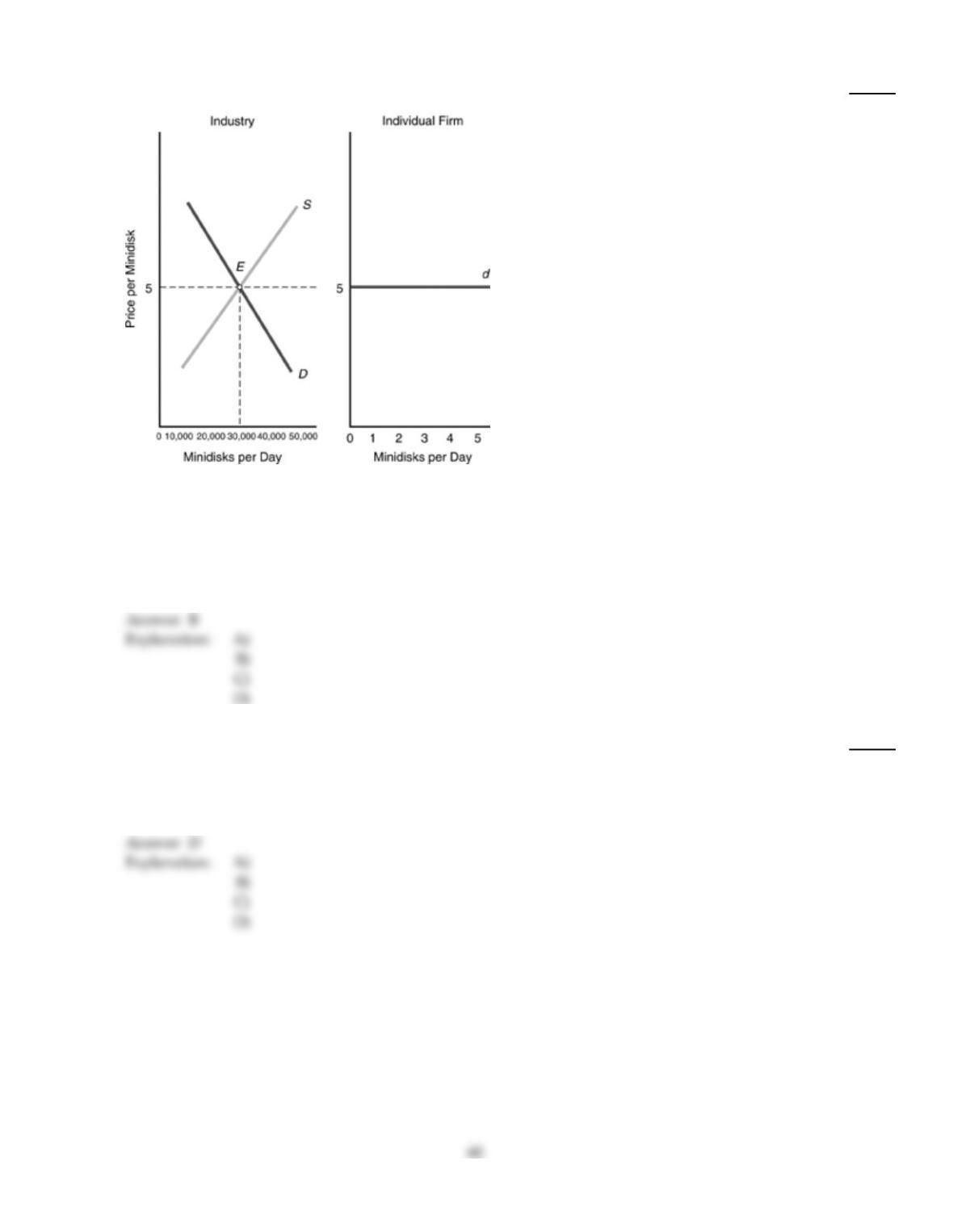
199)
Referring to the diagram, which of the following statements is INCORRECT?
199)
A)
The individual firm takes as given the market price along the perfectly elastic demand curve
“d.”
B)
If the individual firm raises its price, it will capture all sales in the market.
C)
The equilibrium market price is $5, at which the industry demand and supply curves
intersect.
D)
The individual firm faces the going market price as determined by the industry.
200)
If an industry’s long–run per–unit costs increase as its output increases then
200)
A)
the firm is most likely a constant–cost industry.
B)
the firm’s long–run economic profits must be greater than zero.
C)
the firm is most likely a decreasing–cost industry.
D)
the firm is most likely an increasing–cost industry.