Use the information for the question(s) below.
You founded your own firm three years ago. You initially contributed $200,000 of your own money and in return you
received 2 million shares of stock. Since then, you have sold an additional 1 million shares of stock to angel investors. You
are now considering raising capital from a venture capital firm. This venture capital firm would invest $5 million and
would receive 2 million newly issued shares in return.
25)
The post–money valuation of your firm is closest to:
25)
A)
$5.2 million
B)
$12.5 million
C)
$10.0 million
D)
$5.0 million
26)
Which of the following statements is false?
26)
A)
If the company runs into financial difficulties, the preferred stockholders have a senior claim
on the assets of the firm relative to any common stockholders.
B)
The preferred stock issued by young companies typically does not pay regular cash
dividends.
C)
Preferred stock issued by mature companies such as banks usually has a preferential
dividend and seniority in any liquidation and sometimes special voting rights.
D)
The preferred stock issued by young companies usually gives the owner an option to convert
it into common stock on some future date, so it is often called callable preferred stock.

27)
Which of the following statements is false?
27)
A)
Institutional investors such as pension funds, insurance companies, endowments, and
foundations manage large quantities of money.
B)
The general partners work for the venture capital firm and run the venture capital firm; they
are called venture capitalists.
C)
An important consideration for investors in private companies is their exit strategy–how they
will eventually realize the return from their investment.
D)
When a company founder decides to sell equity to outside investors for the first time, it is
common practice for private companies to issue common stock rather than preferred stock to
raise capital.
Use the information for the question(s) below.
You founded your own firm three years ago. You initially contributed $200,000 of your own money and in return you
received 2 million shares of stock. Since then, you have sold an additional 1 million shares of stock to angel investors. You
are now considering raising capital from a venture capital firm. This venture capital firm would invest $5 million and
would receive 2 million newly issued shares in return.
28)
Assuming that this is the venture capitalist’s first investment in your firm, what percentage of the
firm will the venture capitalist own?
28)
A)
33%
B)
40%
C)
50%
D)
25%
29)
Which of the following statements is false?
29)
A)
In most cases, the preexisting shareholders are subject to a 180–day lockup; they cannot sell
their shares for 180 days after the IPO. Once the lockup period expires, they are free to sell
their shares.
B)
Underwriters appear to use the information they acquire during the book–building stage to
intentionally under price the IPO, thereby reducing their exposure to losses.
C)
The lead underwriter usually makes a market in the stock and assigns an analyst to cover it.
D)
The blue tooth option allows the underwriter to issue more stock, amounting to 15% of the
original offer size, at the IPO offer price.
Use the information for the question(s) below.
You founded your own firm three years ago. You initially contributed $200,000 of your own money and in return you
received 2 million shares of stock. Since then, you have sold an additional 1 million shares of stock to angel investors. You
are now considering raising capital from a venture capital firm. This venture capital firm would invest $5 million and
would receive 2 million newly issued shares in return.
30)
Assuming that this is the venture capitalist’s first investment in your firm, the post–money
valuation of your shares are closest to:
30)
A)
$2.5 million
B)
$12.5 million
C)
$5.0 million
D)
$4.0 million
ESSAY. Write your answer in the space provided or on a separate sheet of paper.
31)
Describe the four characteristics of IPOs that puzzle financial economists.

Use the information for the question(s) below.
During the most recent fiscal year, KT Industries had revenues of $400 million and earnings of $30 million. KD has filed a
registration statement with the SEC for its IPO. Before it is offered, KD‘s investment bankers would like to estimate the value
of the company using comparable companies. The investment bankers have assembled the following information based on
data for other companies in the same industry that have recently gone public. In each case the ratios are based upon the IPO
price.
Comparable Company Price/Earnings Price/Revenues
Eenie 12.4 1.6
Meenie 14.6 1.4
Minie 16.2 1.2
Moe 20.4 0.8
32)
Based upon the price/revenue ratio, what would be a reasonable value for KD?
Use the information for the question(s) below.
Luther Industries sold 10 million shares of stock in an SEO. The market price of Luther at the time was $25 per share. Of the
10 million shares sold, 6 million shares were primary shares being sold by the company, and the remaining 4 million shares
were being sold by venture capitalists. Luther’s underwriters charges 5% of the gross proceeds as an underwriting fee.
33)
How much money did the venture capitalists receive?

Use the information for the question(s) below.
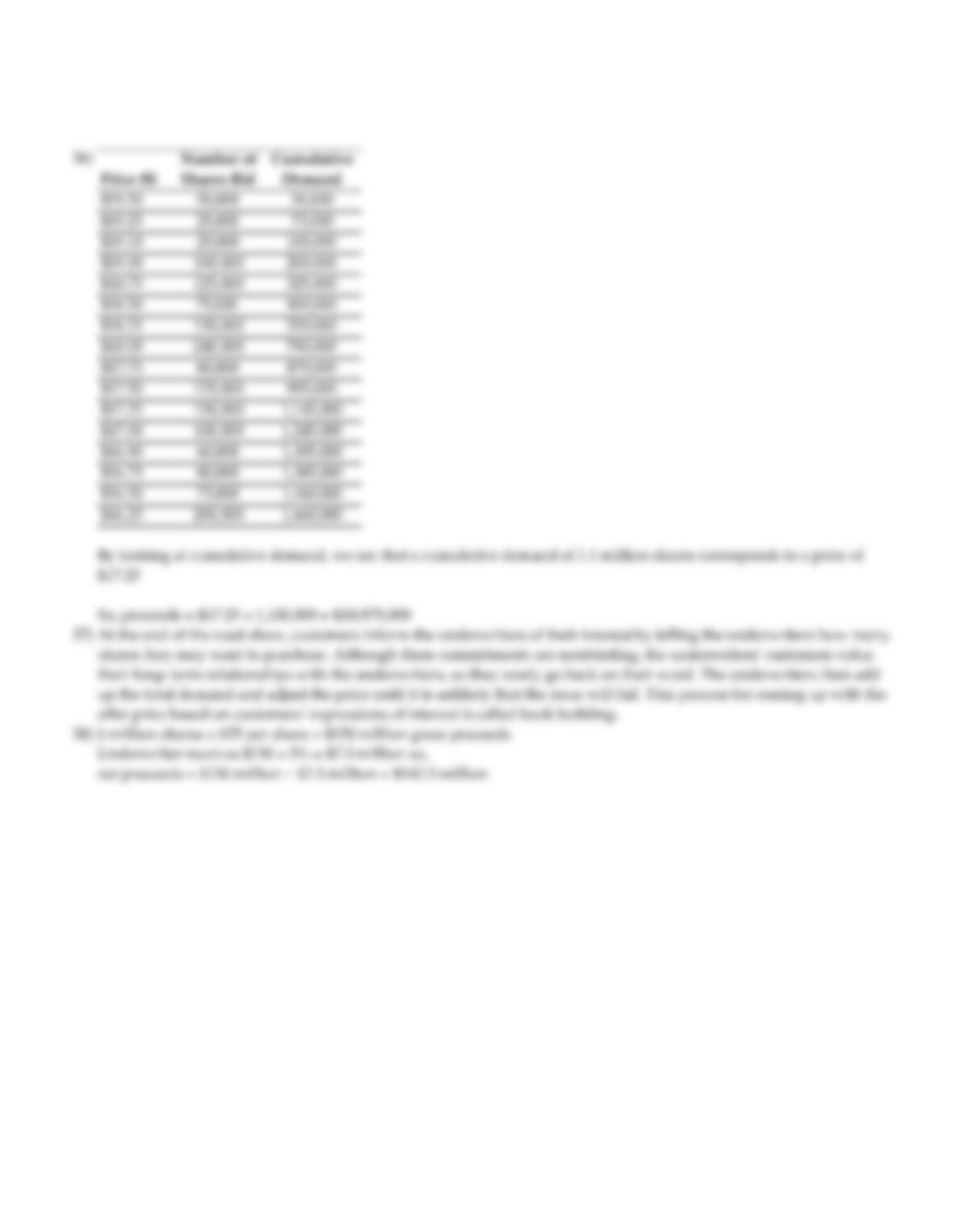
Luther Industries is in the process of selling shares of stock in an auction IPO. At the end of the bidding period, Luther’s
investment bank has received the following bids:
Price ($)
Number of
Shares Bid
$19.50 50,000
$19.25 25,000
$19.10 25,000
$19.00 100,000
$18.75 125,000
$18.50 75,000
$18.25 150,000
$18.00 240,000
$17.75 80,000
$17.50 125,000
$17.25 150,000
$17.00 100,000
$16.90 60,000
$16.75 80,000
$16.50 75,000
$16.25 200,000
34)
What will the offer price of these shares be if Luther is selling 800,000 shares?

Use the information for the question(s) below.
During the most recent fiscal year, KT Industries had revenues of $400 million and earnings of $30 million. KD has filed a
registration statement with the SEC for its IPO. Before it is offered, KD‘s investment bankers would like to estimate the value
of the company using comparable companies. The investment bankers have assembled the following information based on
data for other companies in the same industry that have recently gone public. In each case the ratios are based upon the IPO
price.
Comparable Company Price/Earnings Price/Revenues
Eenie 12.4 1.6
Meenie 14.6 1.4
Minie 16.2 1.2
Moe 20.4 0.8
35)
Based upon the price/earnings ratio, what would be a reasonable value for KD?

Use the information for the question(s) below.
Luther Industries is in the process of selling shares of stock in an auction IPO. At the end of the bidding period, Luther’s
investment bank has received the following bids:
Price ($)
Number of
Shares Bid
$19.50 50,000
$19.25 25,000
$19.10 25,000
$19.00 100,000
$18.75 125,000
$18.50 75,000
$18.25 150,000
$18.00 240,000
$17.75 80,000
$17.50 125,000
$17.25 150,000
$17.00 100,000
$16.90 60,000
$16.75 80,000
$16.50 75,000
$16.25 200,000
36)
What will the proceeds from the IPO be if Luther is selling 1.1 million shares ?

37)
When referring to IPOs, what is book building?
Use the information for the question(s) below.
Luther Industries sold 10 million shares of stock in an SEO. The market price of Luther at the time was $25 per share. Of the
10 million shares sold, 6 million shares were primary shares being sold by the company, and the remaining 4 million shares
were being sold by venture capitalists. Luther’s underwriters charges 5% of the gross proceeds as an underwriting fee.
38)
How much money did Luther raise?
Answer Key
Testname: C23
20
Answer Key
Testname: C23
21
Answer Key
Testname: C23
22