57) How many carbons are found in a molecule that contains the prefix but-?
A) 2
B) 4
C) 3
D) 7
58) “Wood alcohol” is the common name for
A) methanol.
B) ethanol.
C) 2-propanol.
D) 1, 2-ethanediol.
59) The term “carbohydrates” refers to a large class of polyhydroxylated
A) alcohols and carboxylic acids.
B) aldehydes and ketones.
C) amines and amides.
D) ethers and esters.
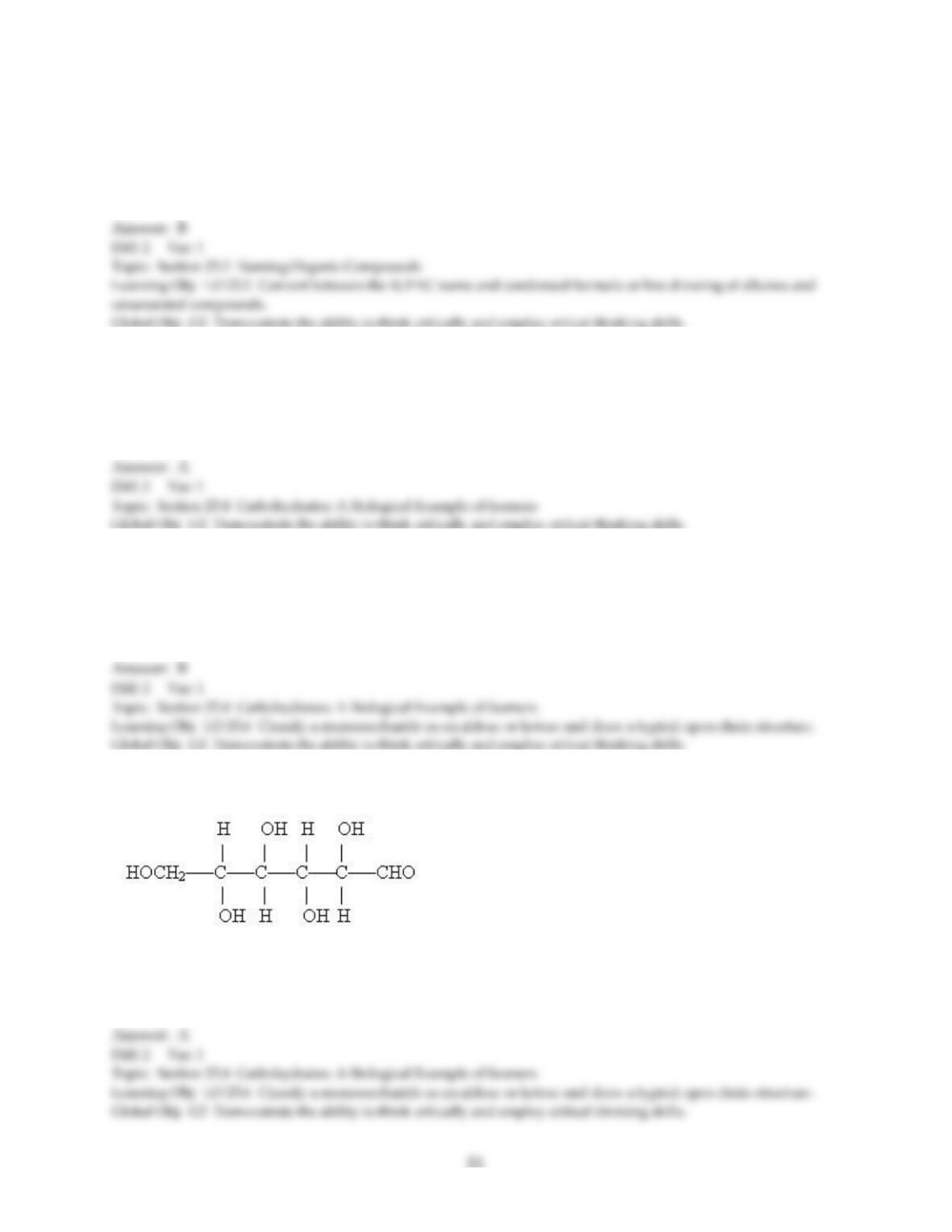
60) The monosaccharide shown below is a(n)
A) aldohexose.
B) aldopentose.
C) ketohexose.
D) ketopentose.
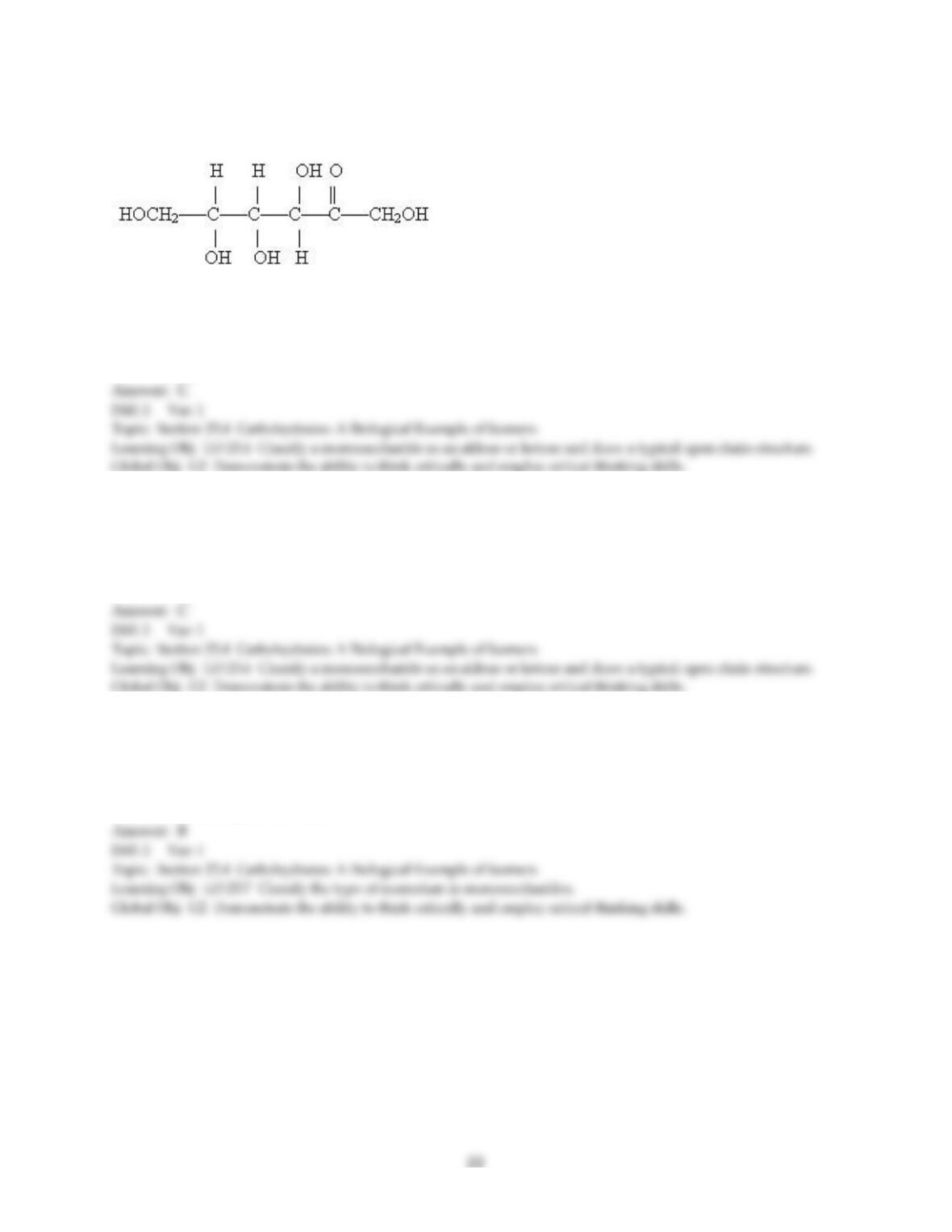
61) The monosaccharide shown below is a(n)
A) aldohexose.
B) aldopentose.
C) ketohexose.
D) ketopentose.
62) What class of compounds are cyclic?
A) amino acids
B) lipids
C) monosaccharides
D) proteins
63) In water, which form of glucose predominates?
A) cyclic α
B) cyclic β
C) open chain
D) All three are equal in solution.
64) When crystallized, which form of glucose predominates?
A) cyclic α
B) cyclic β
C) open chain
D) All three are equal in crystals.
65) Sucrose, common table sugar, when hydrolyzed will form
A) amylose and glycogen.
B) cellulose and starch.
C) glucose and fructose.
D) lactose and maltose.
66) Starch is a polymer consisting of thousands of
A) α-glucose molecules.
B) β-glucose molecules.
C) long chain fatty acids.
D) amino acids.
67) Cellulose is a polymer consisting of thousands of
A) α-glucose molecules.
B) β-glucose molecules.
C) long chain fatty acids.
D) amino acids.
68) Which substance is a monosaccharide?
A) cellulose
B) glucose
C) glycogen
D) starch
69) Which of the following statements about cis–trans isomers is not correct?
A) Conversion between cis– and trans-isomers occurs easily by rotation around the double bond.
B) In the trans– isomer, the groups of interest are on opposite sides across the double bond.
C) In the cis– isomer, the groups of interest are on the same side of the double bond.
D) There are no cis-trans isomers in alkynes.
70) Which compound will have the largest dipole moment?
A) cis-1, 2-dichloroethylene
B) trans-1, 2-dichloroethylene
C) tetrabromoethylene
D) tetrachloroethylene
71) Which compound will exhibit cis-trans isomerism?
A) 1, 2-dichloroethane
B) 1, 2-dichloroethene
C) dichloroethyne
D) ethylene
72) How many distinct isomers can be drawn for a molecule of C4H8?
A) 1
B) 2
C) 3
D) 4
73) Hydrogenation of vegetable oils converts them into what type of molecule?
A) esters
B) ethers
C) polymers
D) saturated fats
74) “Glycerol” is the common name for
A) ethanol.
B) 2-propanol.
C) 1, 2-ethanediol.
D) 1, 2, 3-propanetriol.
75) Lipids are characterized by what property?
A) chemical reactivity
B) chemical structure
C) refractive index
D) solubility
76) Which statement below regarding fatty acids is not correct? Fatty acids
A) are always liquids.
B) are long chain carboxylic acids.
C) are usually unbranched chains.
D) usually have an even number of carbon atoms.
77) All of the fatty acids below contain eighteen carbons and range from saturated to three double bonds.
Which has the highest melting point?
A) stearic acid (saturated)
B) oleic acid (one double bond)
C) linoleic acid (two double bonds)
D) linolenic acid (three double bonds)
78) What functional group is commonly found in fats?
A) —NH2
B) —OH
C) —C—O—C
D) O
—O—C—C—
79) Which of the following statements best describes the difference between vegetable oils and animal
fats?
A) Animals fats have more carboxylic acid groups.
B) Vegetable oils have carbon chains with more unsaturated bonds.
C) Vegetable oils have more alcohol groups.
D) Animal fats have more unsaturated bonds.
80) In addition to an amine, which functional group do all amino acids contain?
A) an alcohol
B) an amide
C) a carboxylic acid
D) an oxyacid
81) What does the term “alpha” amino acid mean?
A) The amino group attaches to the carbon in the carboxyl group.
B) The amino group attaches to the carbon next to the carboxylic acid group.
C) The amino acid contains only one carbon atom.
D) The amino acid contains only one carboxylic acid group.
82) What does the term “essential” mean when referring to amino acids? These are the amino acids which
A) are necessary for digestion.
B) are necessary for respiration.
C) are synthesized in our bodies.
D) we must obtain from our diet.
83) Which is an amino acid nonpolar neutral side chain?
A) –CH3
B) –CH2OH
C) –CH2CO2H
D) –CH2CH2CH2CH2NH2
84) Which is an amino acid polar neutral side chain?
A) –CH3
B) –CH2OH
C) –CH2CO2H
D) –CH2CH2CH2CH2NH2
85) Which is an amino acid basic side chain?
A) –CH3
B) –CH2OH
C) –CH2CO2H
D) –CH2CH2CH2CH2NH2
86) Which is an amino acid acidic side chain?
A) –CH3
B) –CH2OH
C) –CH2CO2H
D) –CH2CH2CH2CH2NH2
87) What does the term “hydrophobic” mean?
A) water reactive
B) water repelling
C) water soluble
D) none of these
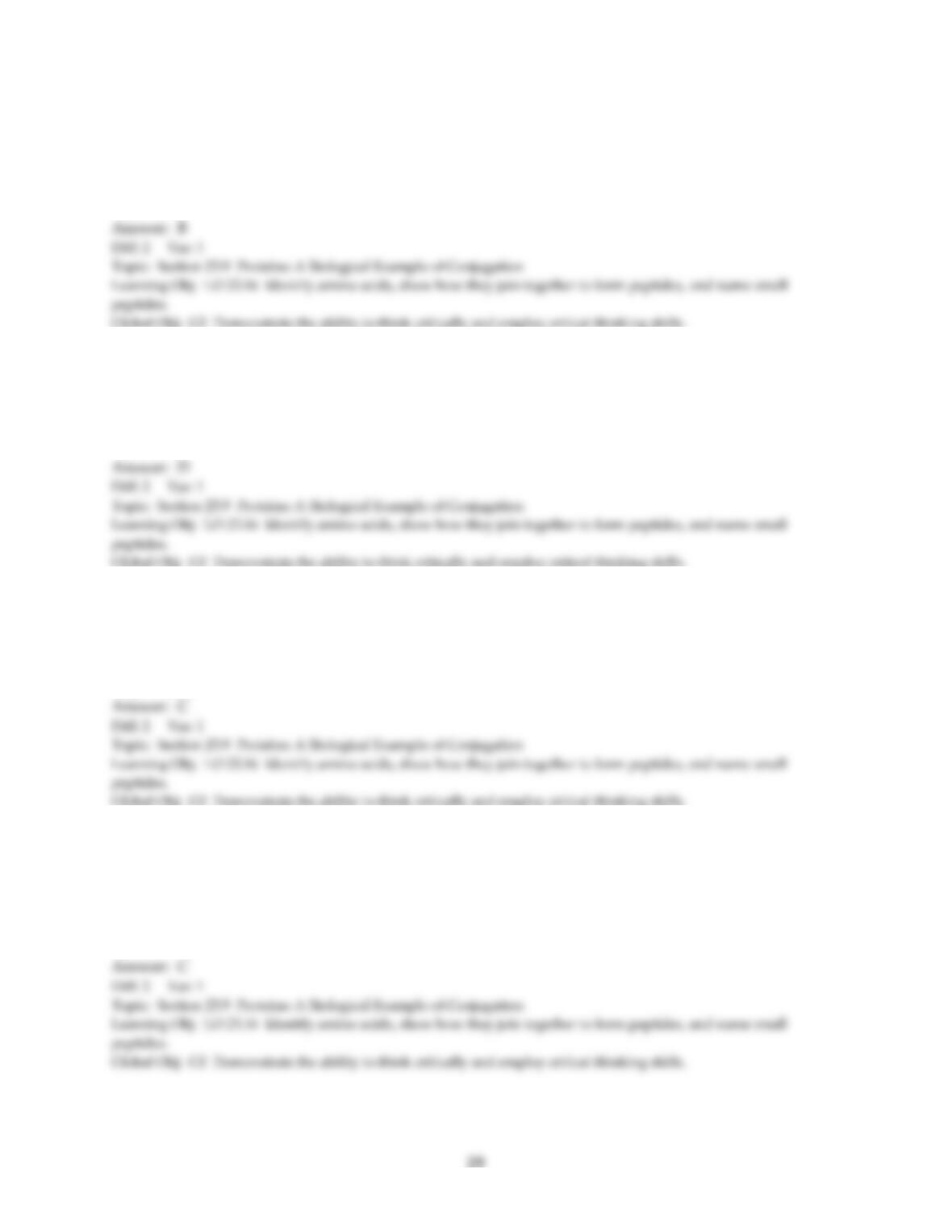
88) Peptide bonds that link amino acids together in proteins contain the ________ functional group.
A) amine
B) amide
C) ester
D) ketone
89) In the protein, Val-Tyr-His-Pro, which amino acid contains the N-terminal group?
A) histidine
B) proline
C) tyrosine
D) valine
90) In the protein, Asn-Phe-Cys-Lys, which amino acid contains the C-terminal group?
A) asparagine
B) cysteine
C) lysine
D) phenylalanine
91) How many possible tripeptides can be made with the amino acids: tyrosine, histidine, and cysteine,
each used only once?
A) 3
B) 4
C) 6
D) 9
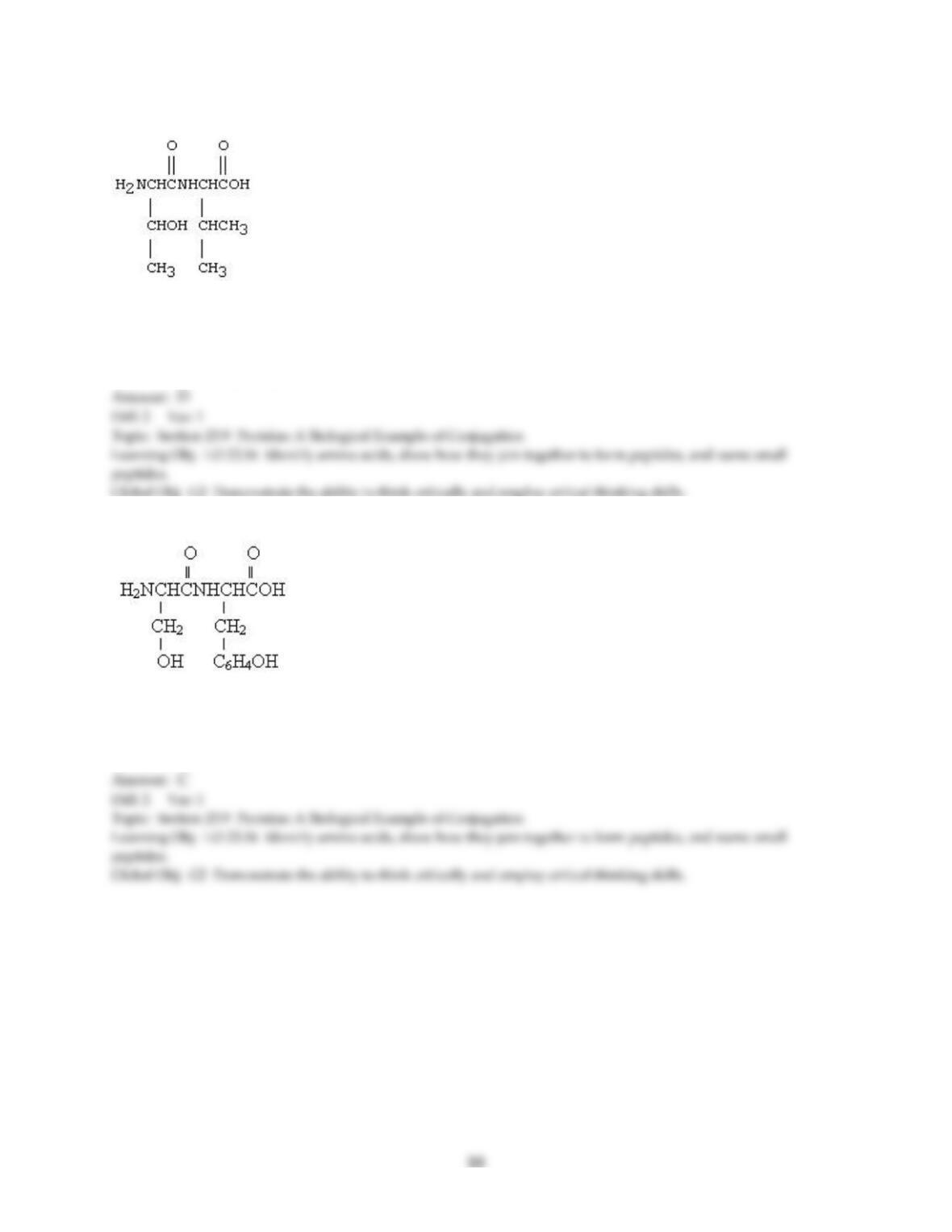
92) Which two amino acids form the dipeptide below?
A) asparagine and proline
B) glycine and cysteine
C) serine and alanine
D) threonine and valine
93) Which of the following notations represents the dipeptide shown below?
A) Phe-Thr
B) Thr-Phe
C) Ser-Tyr
D) Tyr-Ser
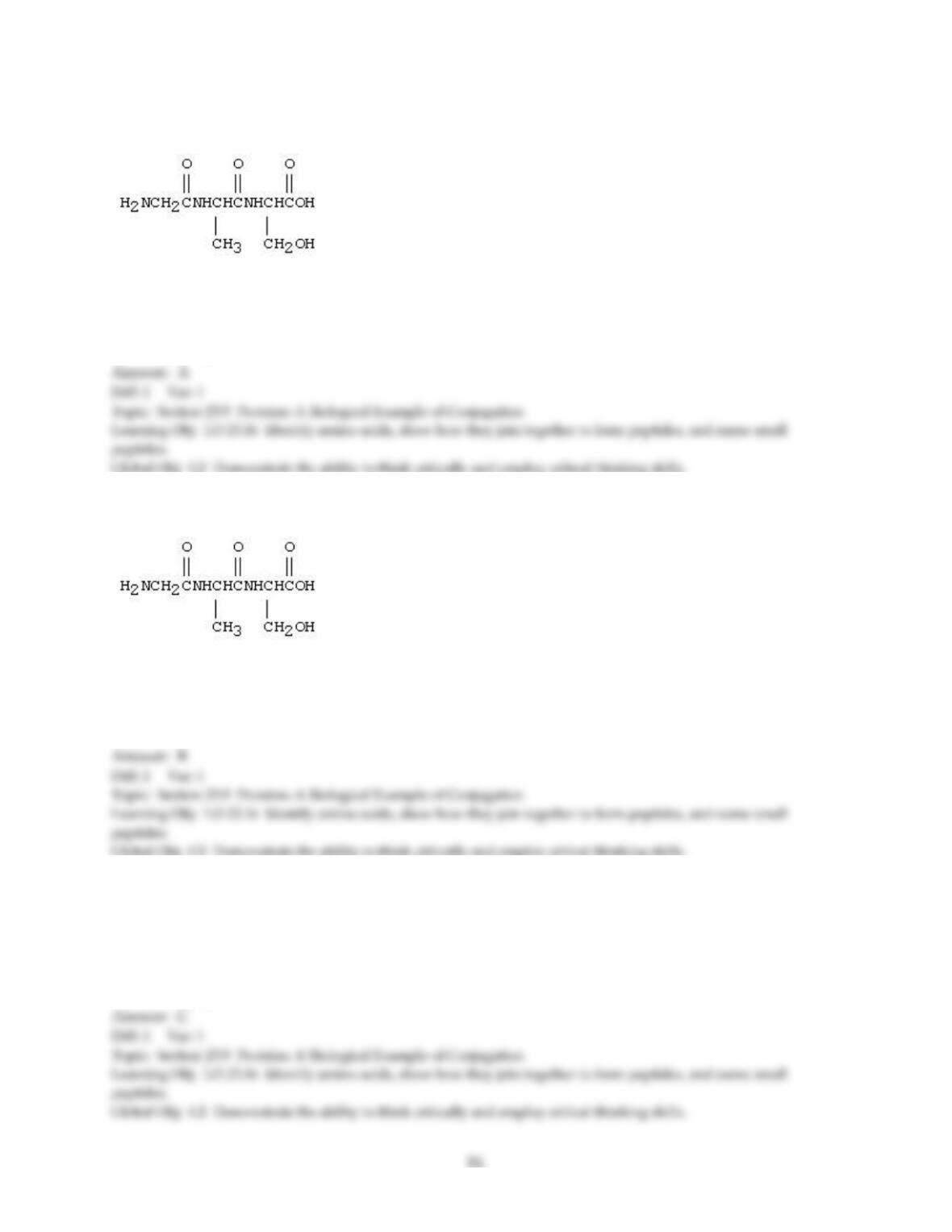
94) Which of the following notations represents the polypeptide shown below?
A) Gly-Ala-Ser
B) Gly-Val-Thr
C) Ser-Ala-Gly
D) Thr-Val-Gly
95) How many peptide bonds are present in the polypeptide shown below?
A) one
B) two
C) three
D) four
96) A partial hydrolysis of a protein yielded the following fragments: Ser-Gly, Gly-Ala, Gly-Ala-Val, Val-
Leu, Ala-Val. What is the sequence of amino acids in the polypeptide?
A) Gly-Leu-Ser-Ala-Val
B) Leu-Ala-Gly-Val-Ser
C) Ser-Gly-Ala-Val-Leu
D) Val-Ala-Gly-Ser-Leu
97) Hemoglobin is a protein molecule which contains 4 iron atoms. If the mass percent of iron is 0.342%,
what is the molar mass of hemoglobin?
A) 1020 g/mol
B) 16,300 g/mol
C) 65,300 g/mol
D) none of these
98) Which of the following statements about benzene is true? Benzene
A) contains 3 long bonds and 3 short bonds.
B) is a puckered, six-membered ring.
C) is unusually stable because of delocalized pi electrons.
D) readily undergoes addition reactions.
99) What type of hybridization does a carbon atom have in a six-membered aromatic ring?
A) sp
B) sp2
C) sp3
D) sp3d
100) Which reaction is not characteristic of aromatic compounds?
A) aromatic ring has 4n pi electrons
B) aromatic ring is planar
C) aromatic ring has 4n + 2 pi electrons
D) aromatic ring has p orbitals that overlap
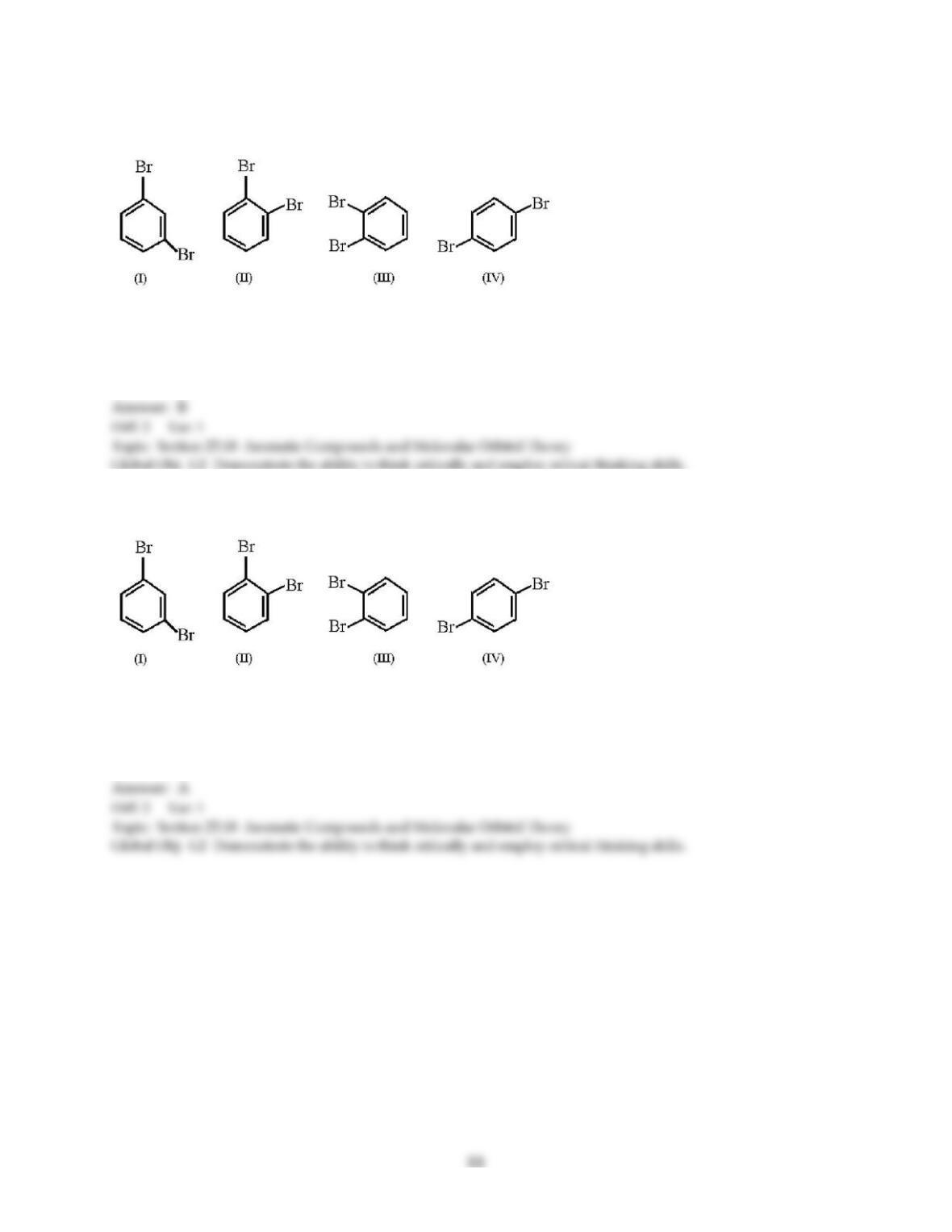
101) Which structures represent the same dibromobenzene compound?
A) I and IV
B) II and III
C) I, II, and III
D) All structures are identical.
102) Which structure is 1,2-dibromobenzene?
A) structure I
B) structure II
C) structure III
D) structure IV
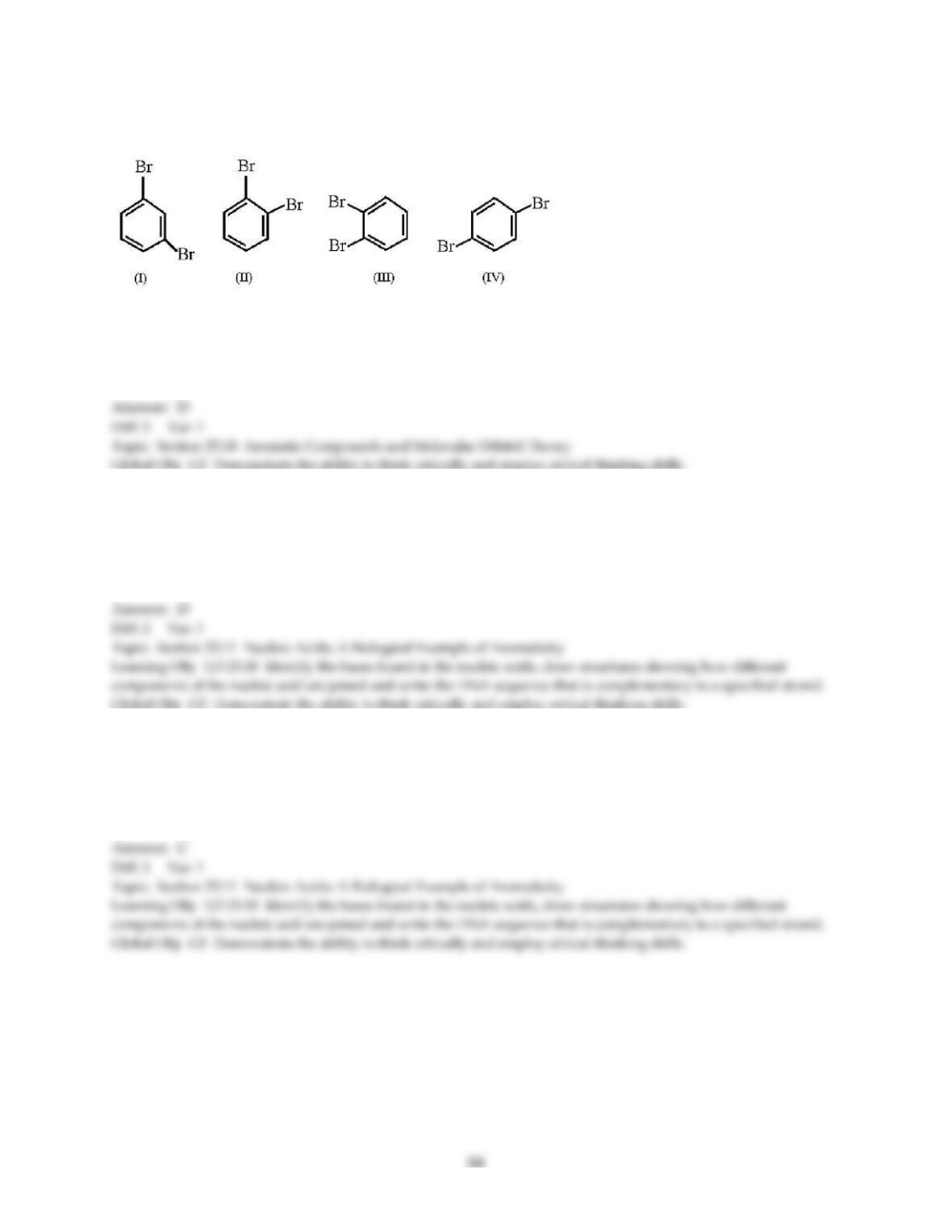
103) Which structure is 1,4-dibromobenzene?
A) structure I
B) structure II
C) structure III
D) structure IV
104) Which one of the following amine bases does not appear in DNA?
A) adenine
B) cytosine
C) guanine
D) uracil
105) The one cyclic amine base that occurs in DNA but not in RNA is
A) cystine.
B) guanine.
C) thymine.
D) uracil.
106) Which of the following is not part of a nucleotide?
A) cyclic amine base
B) fatty acid
C) phosphoric acid
D) a sugar
107) The attractive force between the cylic amine bases in DNA is
A) disulfide bridges.
B) hydrogen bonding.
C) hydrophobic stacking.
D) ionic interactions of salt bridges.
108) What is the sugar component in RNA called?
A) fructose
B) galactose
C) glucose
D) ribose
109) What is the backbone of the nucleic acid constructed of?
A) alternating sugar phosphate groups
B) amine bases
C) glucose polymers
D) polyamides
110) The nucleotide sequence, T-A-G, stands for
A) threonine-alanine-glutamine.
B) thymine-adenine-guanine.
C) tyrosine-asparagine-glutamic acid.
D) None of these.
111) Which of the following bases pairs with adenine in DNA?
A) cytosine
B) guanine
C) thymine
D) uracil
112) What is the complementary DNA sequence to ATATGGTC?
A) CGCGTTGA
B) GCGCAACT
C) TATACCAG
D) TUTUCCAG
113) What is the complementary mRNA sequence to GCTATACCGT?
A) ATCGCGTTAC
B) CGAUAUGGCA
C) TUGCGCUUTG
D) UTCGCGTTUC
114) The base sequences in mRNA that code for particular amino acids are Trp: UGG, Phe: UUU, and
Glu: GAA. What is the peptide that is produced from the DNA sequence: CTTACCAAA?
A) Glu-Phe-Trp
B) Glu-Trp-Phe
C) Phe-Trp-Glu
D) Trp-Glu-Phe
115) DNA has a shape of a
A) tetrahedral molecule.
B) single helix.
C) double helix.
D) linear molecule.
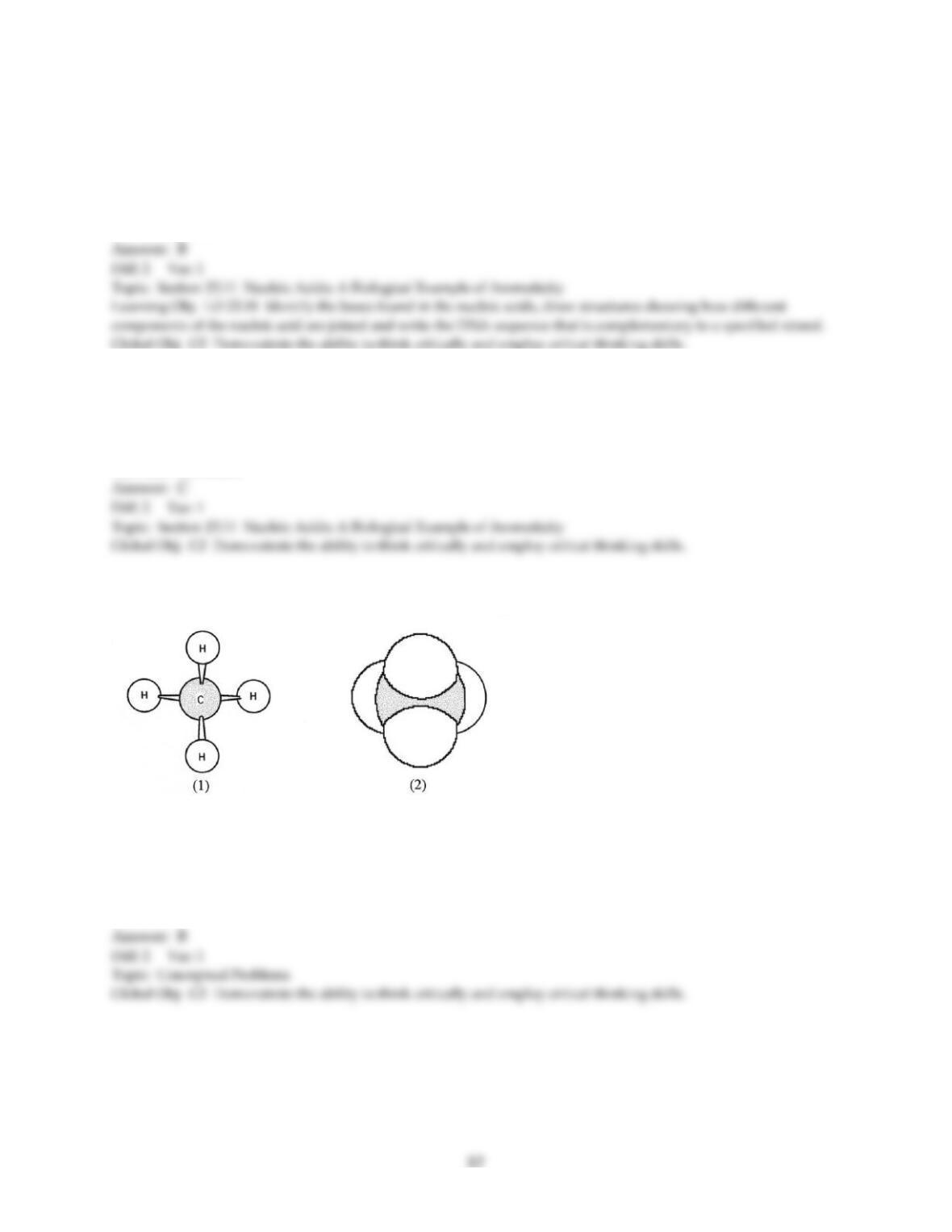
Shown are ball-and-stick (1) and space-filling (2) models of methane.
116) What is the H-C-H bond angle?
A) 90°
B) 109.5°
C) 120°
D) 180°
117) What hybrid orbitals are used by carbon to form covalent bonds with hydrogen?
A) sp
B) sp2
C) sp3
D) sp3d
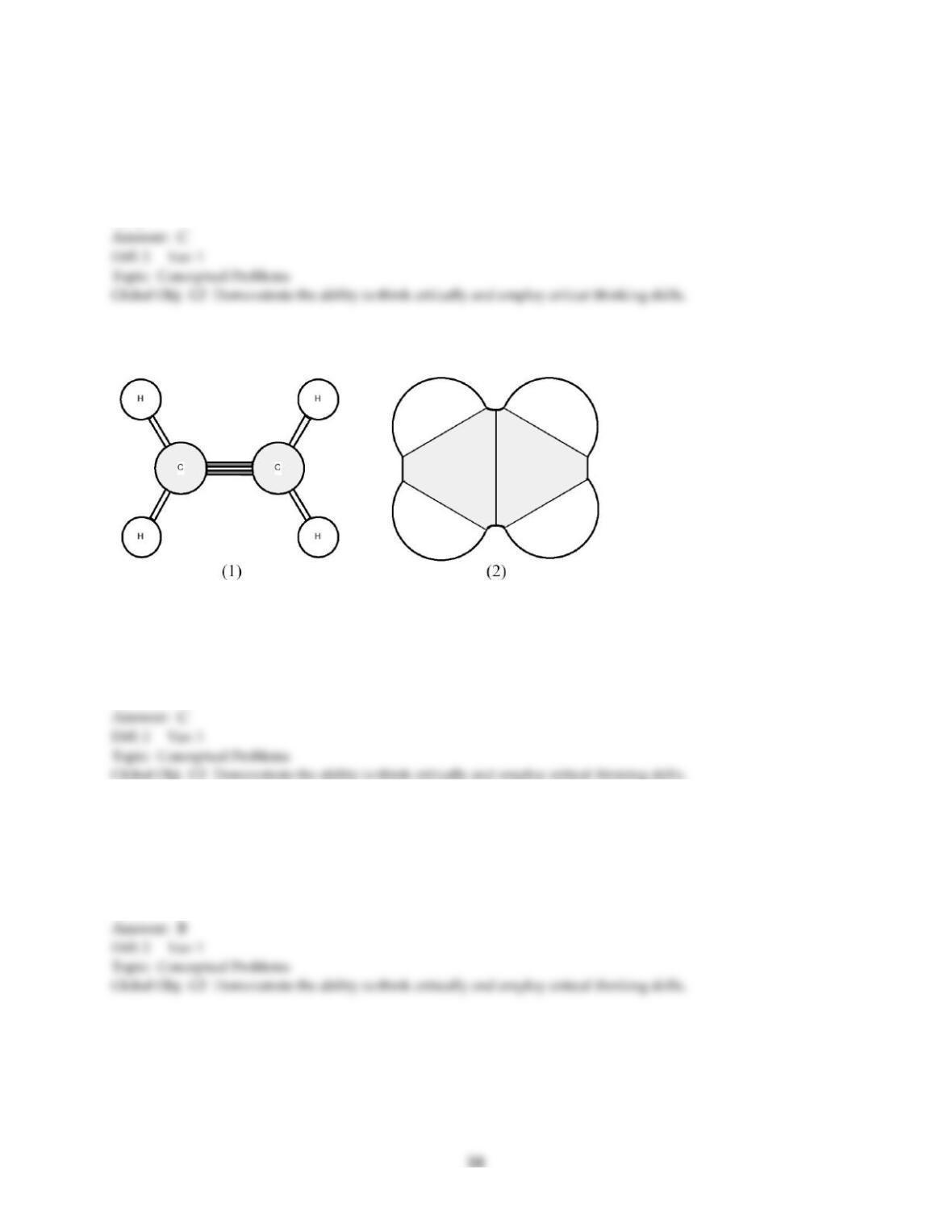
Shown are ball-and-stick (1) and space-filling (2) models of ethylene.
118) What is the H-C-H bond angle?
A) 90°
B) 109.5°
C) 120°
D) 180°
119) What hybrid orbitals are used by carbon to form covalent bonds with hydrogen?
A) sp
B) sp2
C) sp3
D) sp3d
39
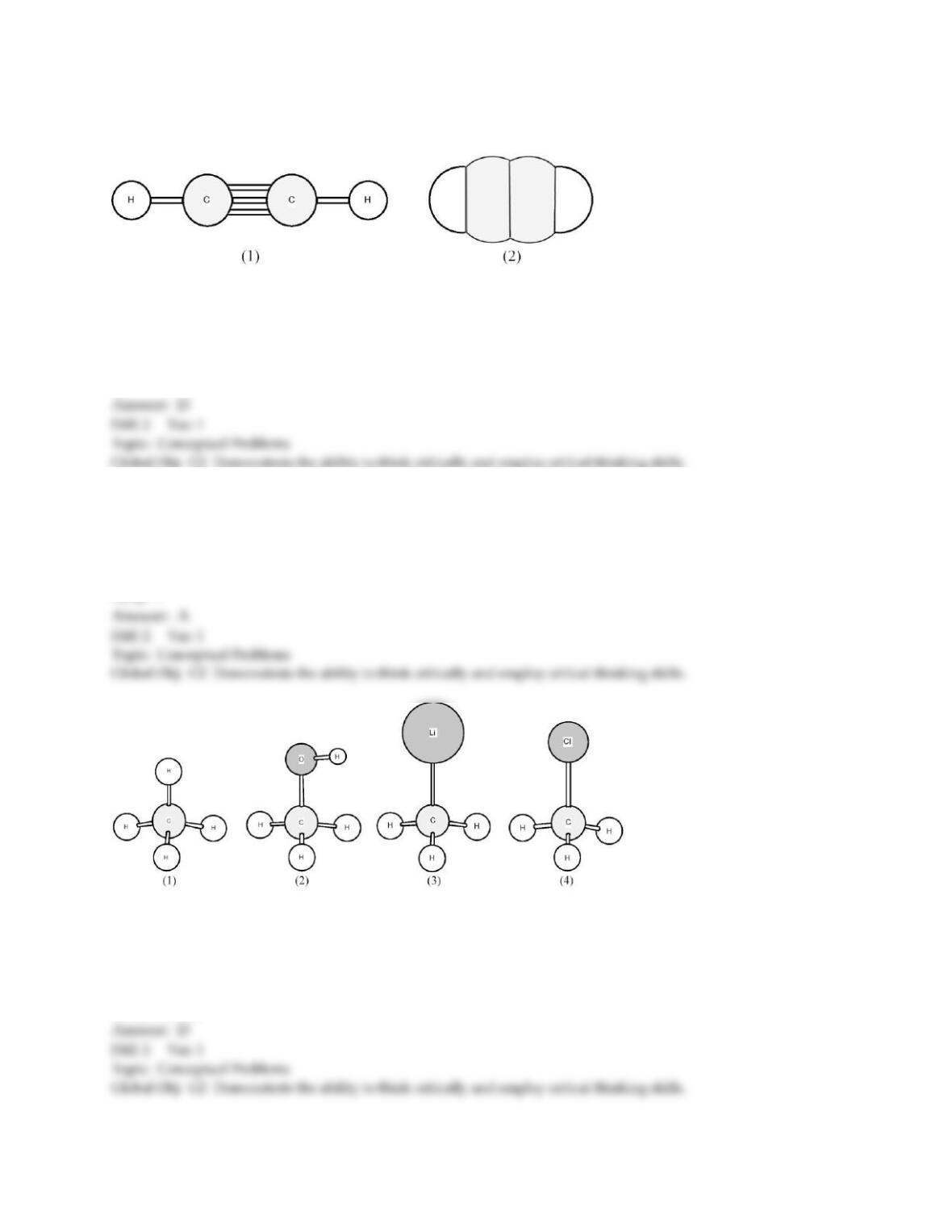
Shown are ball-and-stick (1) and space-filling (2) models of acetylene.
120) What is the H-C-C bond angle?
A) 90°
B) 109.5°
C) 120°
D) 180°
121) What hybrid orbitals are used by carbon to form covalent bonds with hydrogen?
A) sp
B) sp2
C) sp3
D) sp3d
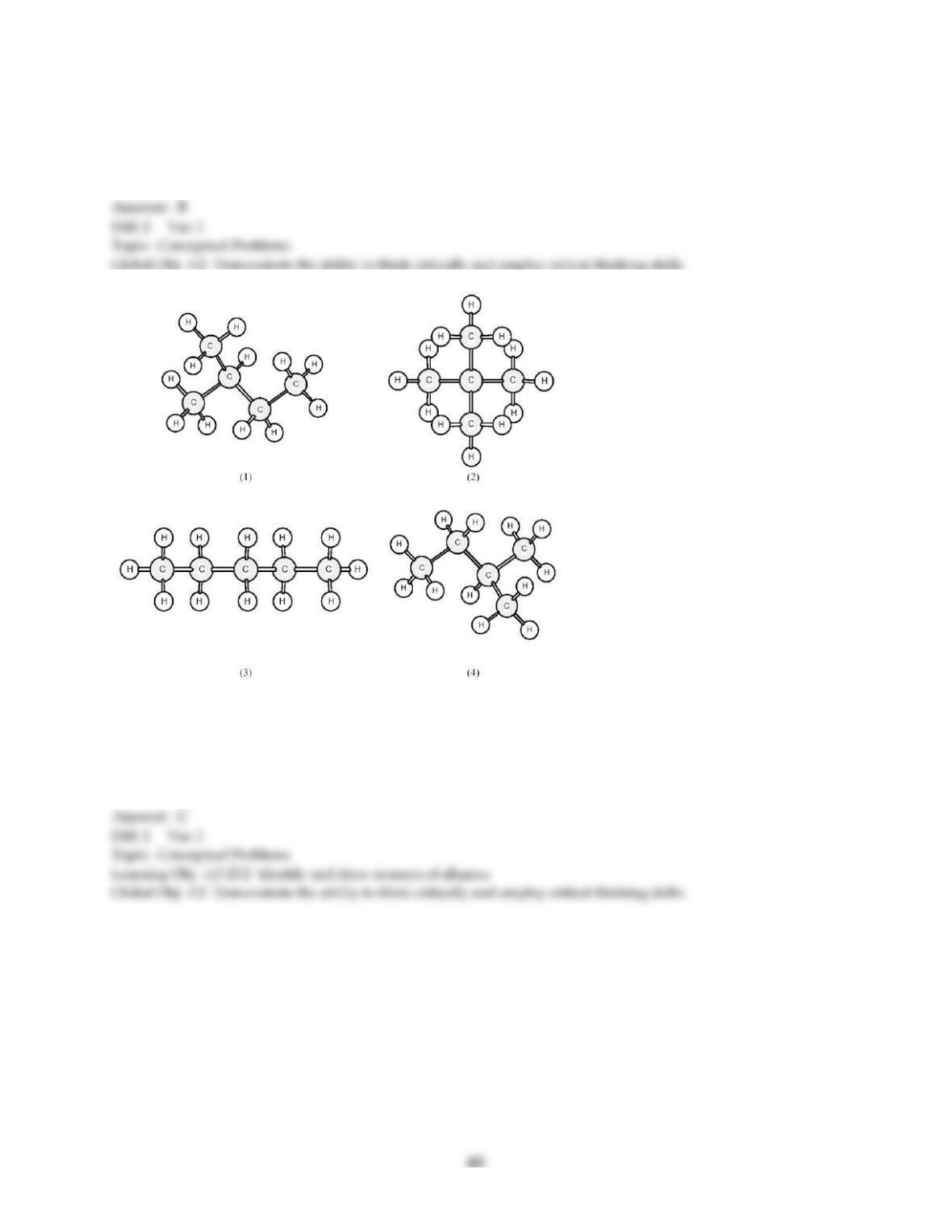
122) Which of these molecules above have a partial positive charge (δ+) on the carbon atom?
A) only (1)
B) only (3)
C) (1) and (3)
D) (2) and (4)
123) Which of these molecules above have a large partial negative charge (δ-) on the carbon atom?
A) only (1)
B) only (3)
C) (1) and (3)
D) (2) and (4)
124) In the figure above, which structures are identical?
A) All are identical.
B) None are identical.
C) only (1) and (4)
D) only (1), (3), and (4)