52)
Economic efficiency means
52)
A)
that it is impossible to increase the output of any good without lowering the total value of the
output of the economy.
B)
the same as technical efficiency.
C)
that high–tech methods of production are the most efficient.
D)
that all firms within a single competitive industry are producing at the same level of output.
53)
If a perfectly competitive industry is in long–run equilibrium, then
53)
A)
price equals average cost.
B)
marginal cost is less than average cost.
C)
all firms earn the same accounting profits.
D)
price is greater than average cost and equal to marginal cost.
A
54)
Which of the following is not true for a perfectly competitive firm?
54)
A)
AR = MR
B)
P = AR
C)
P = MR
D)
MR = TR
D
55)
Your local farmer has many competitors and exists in a market structure known as perfect
competition. This means that price is determined outside of the individual farmer’s ability to charge
a price higher than the going market for a bushel of wheat, hence the farmer is
55)
A)
a price taker and cannot affect the market price of wheat.
B)
never able to determine any prices he charges for anything, such as soybeans.
C)
always able to price produce above the competition and earn a larger profit.
D)
a price maker and can therefore charge different customers different prices.
A
A
56)
Which is always true at a firm’s profit–maximizing rate of production?
56)
A)
Marginal Revenue = Marginal Cost
B)
The total revenue curve lies below the total cost curve.
C)
Total Revenue = Total Costs
D)
Marginal Revenue > Marginal Cost
57)
A firm that has negative economic profits has accounting profits that are
57)
A)
zero.
B)
positive.
C)
negative.
D)
indeterminate without more information.
58)
An industry whose total output can be increased without a change in long–run per–unit costs is
a(n)
58)
A)
increasing–cost industry.
B)
constant–cost industry.
C)
break–even cost industry.
D)
decreasing–cost industry.
59)
Which of the following is closest to a perfectly competitive market?
59)
A)
the market for broccoli
B)
the market for athletic shoes
C)
the market for handmade guitars
D)
the computer software market
60)
In a perfectly competitive industry, which of the following is a market signal to resource owners?
60)
A)
Quality of goods
B)
The level of subsidies the industry receives
C)
The level of exports in the country
D)
Economic profits
61)
In a perfectly competitive industry, any restrictions that prevent new firms from entering
61)
A)
lead to negative profits.
B)
guarantee that all existing firms will earn exactly a zero profit.
C)
reduce the average cost of production.
D)
hinder economic efficiency.
62)
If an industry’s long–run per–unit costs increase as its output increases then
62)
A)
the firm is most likely a decreasing–cost industry.
B)
the firm’s long–run economic profits must be greater than zero.
C)
the firm is most likely a constant–cost industry.
D)
the firm is most likely an increasing–cost industry.
63)
Suppose a perfectly competitive industry is in long–run equilibrium. If a decrease in demand leads
to a higher long–run price, we know that
63)
A)
this is a decreasing–cost industry.
B)
after further adjustments, price will fall to its original level.
C)
this is an increasing–cost industry.
D)
some firms will be losing money in the long run.
64)
When a perfectly competitive firm experiences zero economic profits,
64)
A)
additional firms enter the industry.
B)
existing firms exit the industry.
C)
the high barriers to entry prevent further competition.
D)
firms have no incentive to exit or enter the industry.
65)
A firm’s total explicit costs are $1,000. Its total implicit costs are $500, and it has a total revenue of
$2000. This firm receives
65)
A)
an accounting profit only.
B)
both an economic profit and an accounting profit.
C)
an economic profit only.
D)
neither an economic profit nor an accounting profit.
66)
Which of the following is NOT a characteristic of perfect competition?
66)
A)
easy entry and exit into the market
B)
differentiated products
C)
large number of buyers and sellers
D)
price taking by each firm
B
67)
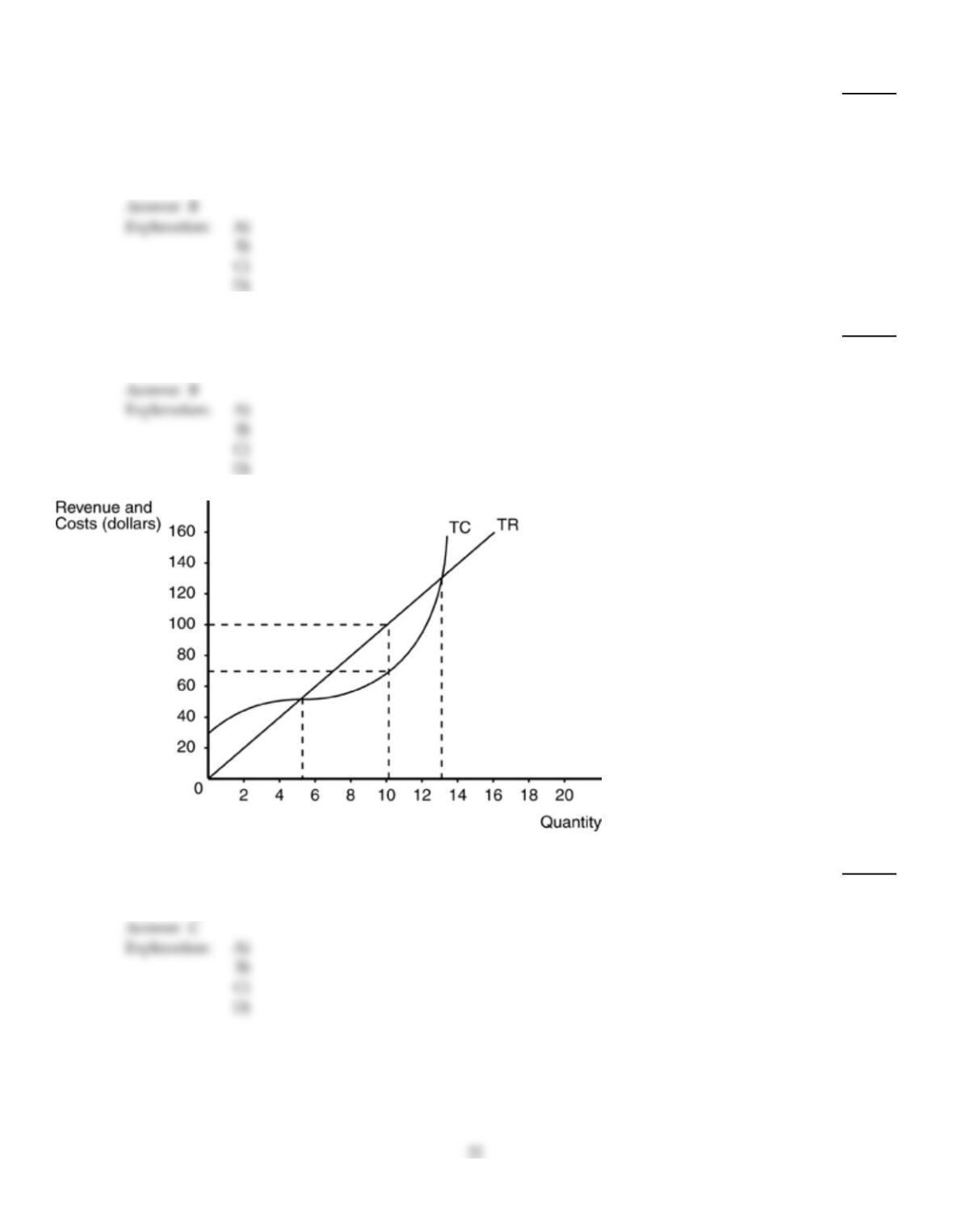
In the above figure, the profit–maximizing rate of production for the perfectly competitive firm is
67)
A)
5.
B)
13.
C)
10.
D)
none of the above.
C
B
68)
Which of the following is NOT a characteristic of a perfectly competitive industry?
68)
A)
The firms in the industry produce a homogeneous product.
B)
Sellers have better information about the product than consumers.
C)
There are large numbers of buyers and sellers.
D)
Any firm can enter or leave the industry without serious impediments.
69)
The opportunity cost to society of producing one more unit of the good is
69)
A)
the optimal cost.
B)
average cost.
C)
marginal cost.
D)
efficiency costing.
70)
For a perfectly competitive firm, any price below its minimum AVC is a
70)
A)
profit maximizing price.
B)
shutdown price.
C)
negative price.
D)
market price.
71)
For a perfectly competitive firm,
71)
A)
there is no relationship between price and marginal revenue.
B)
price is greater than marginal revenue.
C)
price equals marginal revenue.
D)
price is less than marginal revenue.
72)
If markets are perfectly competitive, then the production of goods
72)
A)
will always lead to business failures.
B)
will occur at an average total cost value that is above the minimum.
C)
will use the least costly combination of resources.
D)
will require government intervention.
73)
When a perfectly competitive firm is in long–run equilibrium, economic profits
73)
A)
may be positive, zero or negative depending upon costs.
B)
are negative.
C)
are positive.
D)
are zero.
74)
For a perfectly competitive firm, the short–run break–even point occurs at the level of output
where
74)
A)
MR < P = MC.
B)
P > MR = MC.
C)
P = MC = ATC.
D)
MR = P > MC.
75)
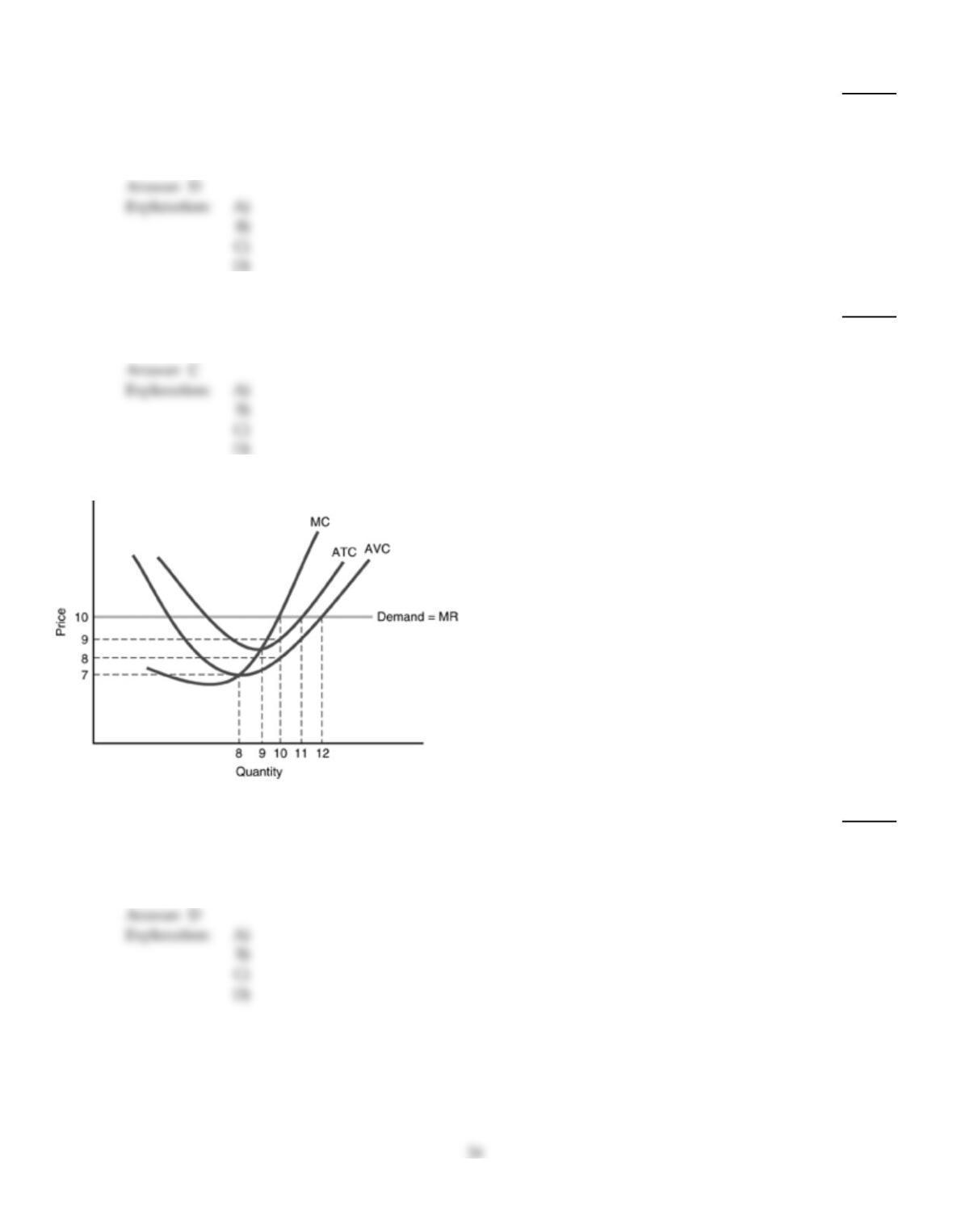
In the above figure, if the market price is $8, the firm
75)
A)
continues to produce but at an economic profit.
B)
shuts down operations.
C)
produces 10 units.
D)
continues to produce but at an economic loss.
76)
The long–run industry supply curve in a decreasing–cost, perfectly competitive industry is
76)
A)
negatively sloped.
B)
perfectly elastic.
C)
perfectly inelastic.
D)
positively sloped.
77)
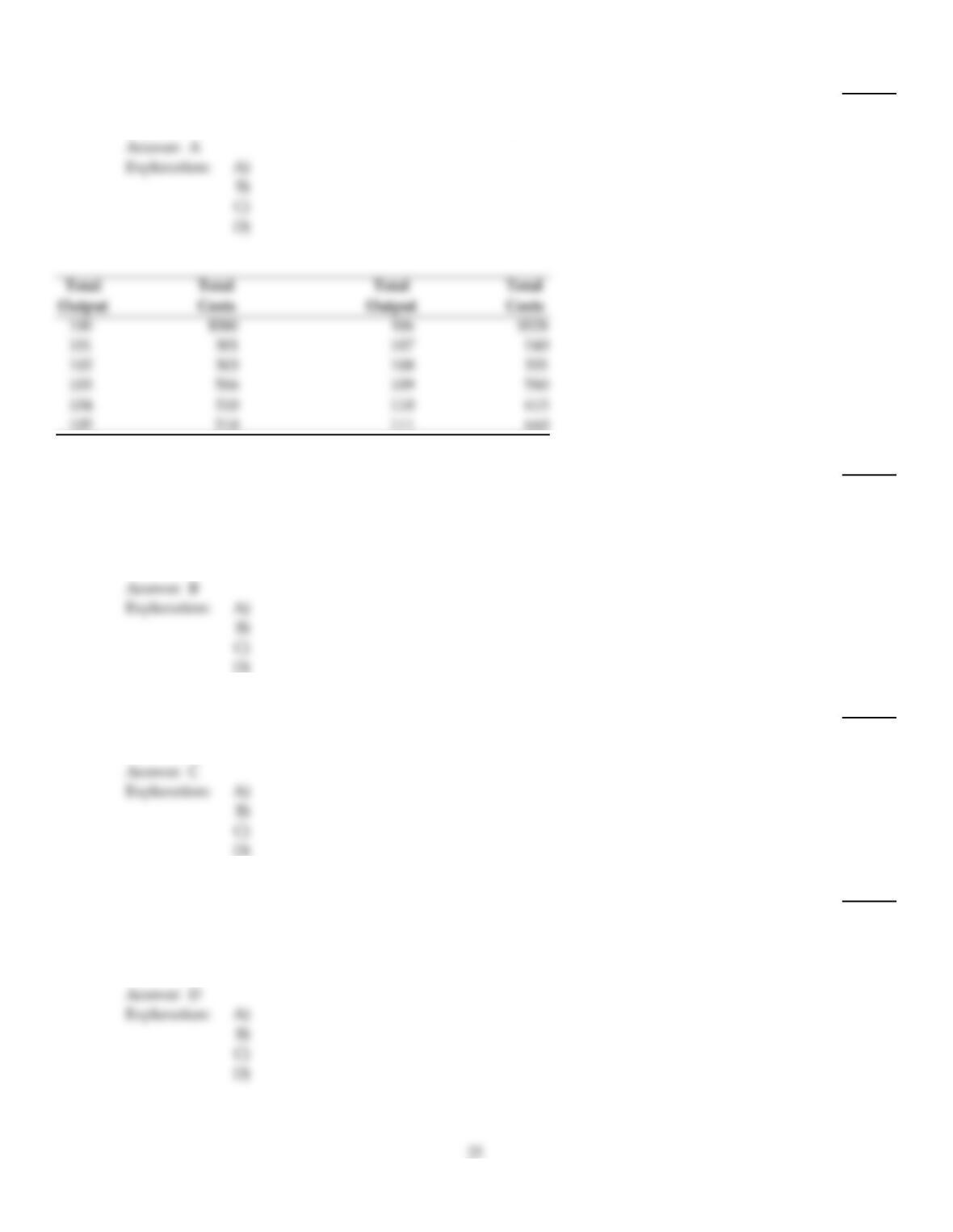
Refer to the above table. This firm operates in a perfectly competitive market in which the market
price is $10/unit. What is true when the firm produces 103 units?
77)
A)
Marginal revenue is less than marginal cost.
B)
Its total profit is $524.
C)
Total costs exceed total revenue by $403.
D)
Total revenue equals $5,060.
78)
As long as price exceeds AVC, the firm is better off
78)
A)
raising its price.
B)
cutting price.
C)
continuing production.
D)
closing.
79)
Marginal revenue
79)
A)
cannot be used to determine the profit–maximizing rate of production.
B)
is a change in revenue that is immeasurable and non–quantifiable.
C)
cannot be effectively utilized when analyzing the perfect competitor.
D)
is the change in total revenues resulting from a change in output.
80)
The demand curve for a perfectly competitive firm is
80)
A)
unitary elastic.
B)
perfectly elastic.
C)
perfectly inelastic.
D)
elastic at relatively high prices and inelastic at relatively low prices.
81)
In a perfectly competitive market structure any firm can enter or leave the industry without serious
impediments. This implies
81)
A)
firms will move labor and capital in pursuit of profit–making opportunities to whatever
business venture gives them the highest return on their investment.
B)
no one buyer or seller has any influence on price.
C)
consumers are able to find out about lower prices charged by other firms.
D)
the products sold will be alike.
82)
In the short run, which of the following is FALSE about the shutdown point?
82)
A)
Total revenue is equal to total variable cost.
B)
Product price is equal to the minimum average variable cost.
C)
Price multiplied by quantity must be equal to minimum average variable cost multiplied by
quantity.
D)
Total revenue is equal to total fixed cost.
83)
For a perfectly competitive firm, profit maximization occurs when
83)
A)
marginal cost is equal to average total cost.
B)
marginal revenue equals marginal cost.
C)
average total cost is at its minimum.
D)
marginal revenue equals average total cost.
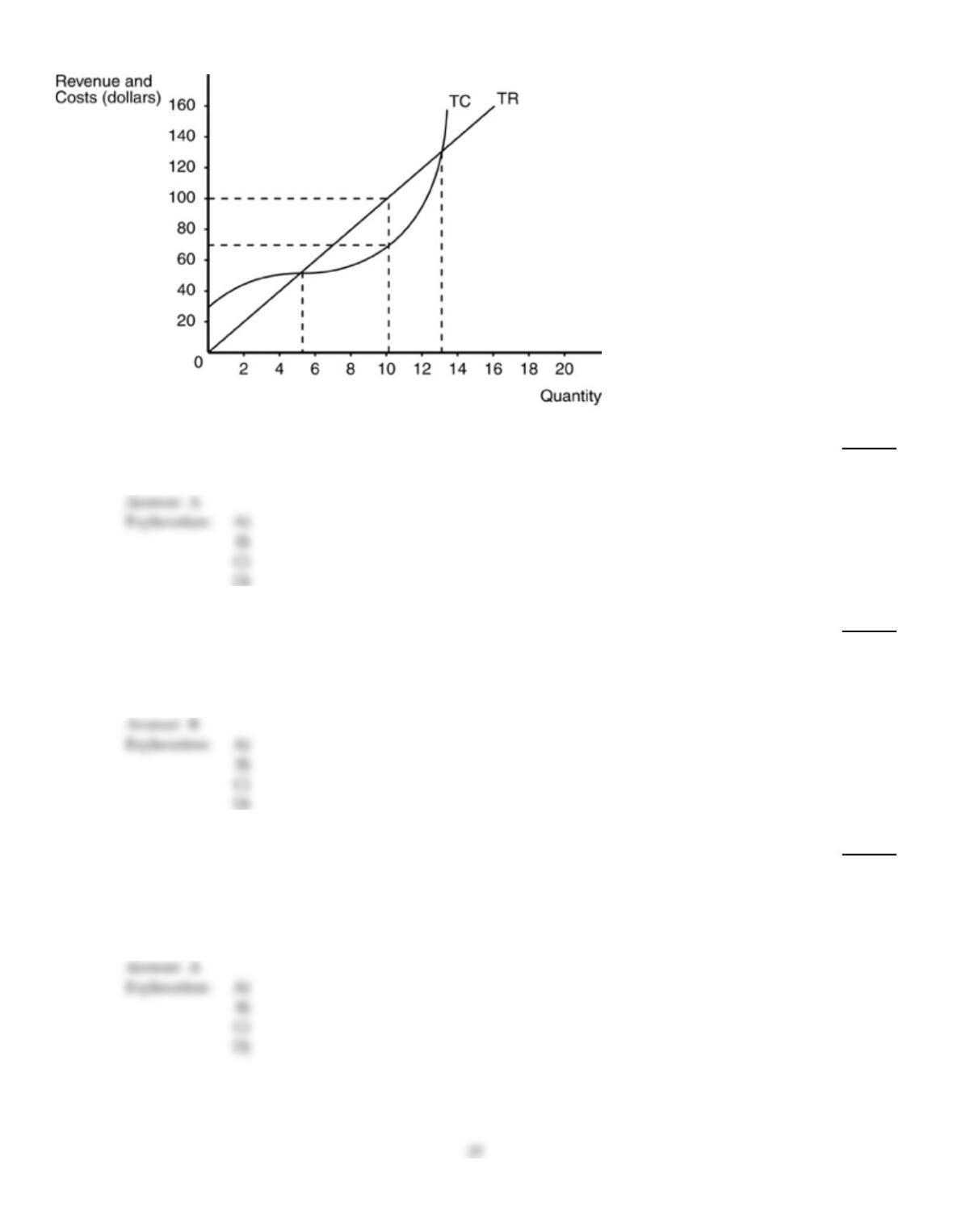
84)
In the above figure, at the profit–maximizing rate of production for the perfectly competitive firm
total revenue is
84)
A)
$100.
B)
$30.
C)
$130.
D)
$70.
85)
A perfectly elastic long–run supply curve indicates
85)
A)
that some input prices change as firms enter and exit the industry.
B)
a constant–cost industry.
C)
an increasing–cost industry.
D)
a decreasing–cost industry.
86)
The value of total output decreases when labor leaves one industry and goes to another and capital
leaves the second industry and goes to the first. This indicates that
86)
A)
it would be efficient to return to the first situation.
B)
price is greater than marginal cost.
C)
the first situation was not efficient.
D)
the second situation is efficient.
87)
Which of the following is a characteristic of perfect competition?
87)
A)
Differentiated products
B)
Few firms
C)
Easy entry and exit
D)
None of the above
88)
If price is below average variable costs at all rates of output, the quantity supplied by a perfectly
competitive firm will equal
88)
A)
the rate of output where price equals marginal cost.
B)
the rate of output where marginal revenue equals average fixed costs.
C)
zero.
D)
the rate of output associated with the break–even point.
C
89)
Marginal revenue equals
89)
A)
price times quantity, divided by average revenue.
B)
total revenue divided by average revenue.
C)
total revenue divided by output.
D)
the change in total revenue from selling one more unit.
D
90)
In the short run, the price at which a firm’s total revenues equal its total costs is
90)
A)
a point of positive profits.
B)
the short–run shutdown point.
C)
the short–run break–even point.
D)
a no return price.
C
91)
The demand curve for the product of a perfectly competitive firm is
91)
A)
perfectly elastic.
B)
downward sloping.
C)
upward sloping.
D)
perfectly inelastic.
A
C
92)
Total revenue divided by quantity is
92)
A)
average revenue.
B)
quantity revenue.
C)
marginal revenue.
D)
price revenue.
93)
A perfectly competitive market has
93)
A)
high barriers to entry or exit.
B)
few firms.
C)
to do a lot of advertising to attract buyers.
D)
homogeneous products.
94)
Consider an industry that is in long–run equilibrium. An increase in demand leads to no change in
the price of the good. We know that this is
94)
A)
a constant cost industry.
B)
not a competitive industry.
C)
an increasing cost industry.
D)
a decreasing cost industry.
95)
Suppose a perfectly competitive firm faces the following short–run cost and revenue conditions:
ATC = $8.00; AVC = $5.00; MC = $8.00; MR = $9.00. The firm should
95)
A)
increase output.
B)
continue to produce its current output.
C)
increase price.
D)
decrease output.
96)
In the model of perfect competition, the market demand curve is found by
96)
A)
taking the demand curve of a “representative consumer” and expanding it by the number of
consumers of the good.
B)
horizontally summing the supply curves of individual firms.
C)
horizontally summing the demand curves of individual consumers.
D)
a marketing analysis.
97)
A firm’s total explicit costs are $1,000. Its total implicit costs are $500, and it has a total revenue of
$1500. This firm receives
97)
A)
an economic profit only.
B)
an accounting profit only.
C)
both an economic profit and an accounting profit.
D)
neither an economic profit nor an accounting profit.
98)
A situation in which the price charged is less than society’s opportunity cost would lead to
98)
A)
too little being produced.
B)
marginal cost pricing.
C)
an efficient amount being produced.
D)
too much being produced.
D
99)
When economic profits in a perfectly competitive industry are positive,
99)
A)
firms will increase output to earn even higher profits.
B)
the industry is in equilibrium.
C)
firms will increase prices while they have the opportunity.
D)
new firms will be attracted to the industry, and economic profits will decline to zero.
D
100)
Under perfect competition, the demand curve facing the firm is determined by
100)
A)
utility maximizing behavior on the part of consumers.
B)
the willingness of the firm to supply the good.
C)
the intersection of the industry demand and supply curves.
D)
the tastes and preferences of consumers.
C
B
SHORT ANSWER. Write the word or phrase that best completes each statement or answers the question.
101)
If firms in a perfectly competitive industry are earning positive economic profits, then
what will happen in the long run?
101)
102)
What is marginal cost pricing? Why is marginal cost pricing important?
102)
103)
“A firm should shut down immediately when it earns zero economic profits.” Do you
agree or disagree? Explain your answer.
103)
104)
“An industry‘s short–run supply curve is constructed by adding horizontally all the
average variable cost curves of firms in that industry.” Do you agree or disagree? Why?
104)
105)
When should a firm shut down? When should a firm go out of business?
105)
106)
“A market is said to be perfectly competitive when consumers can tell that some products
are of better quality than others.” Do you agree or disagree? Why?
106)
107)
What are signals? How do profits function as signals?
107)
108)
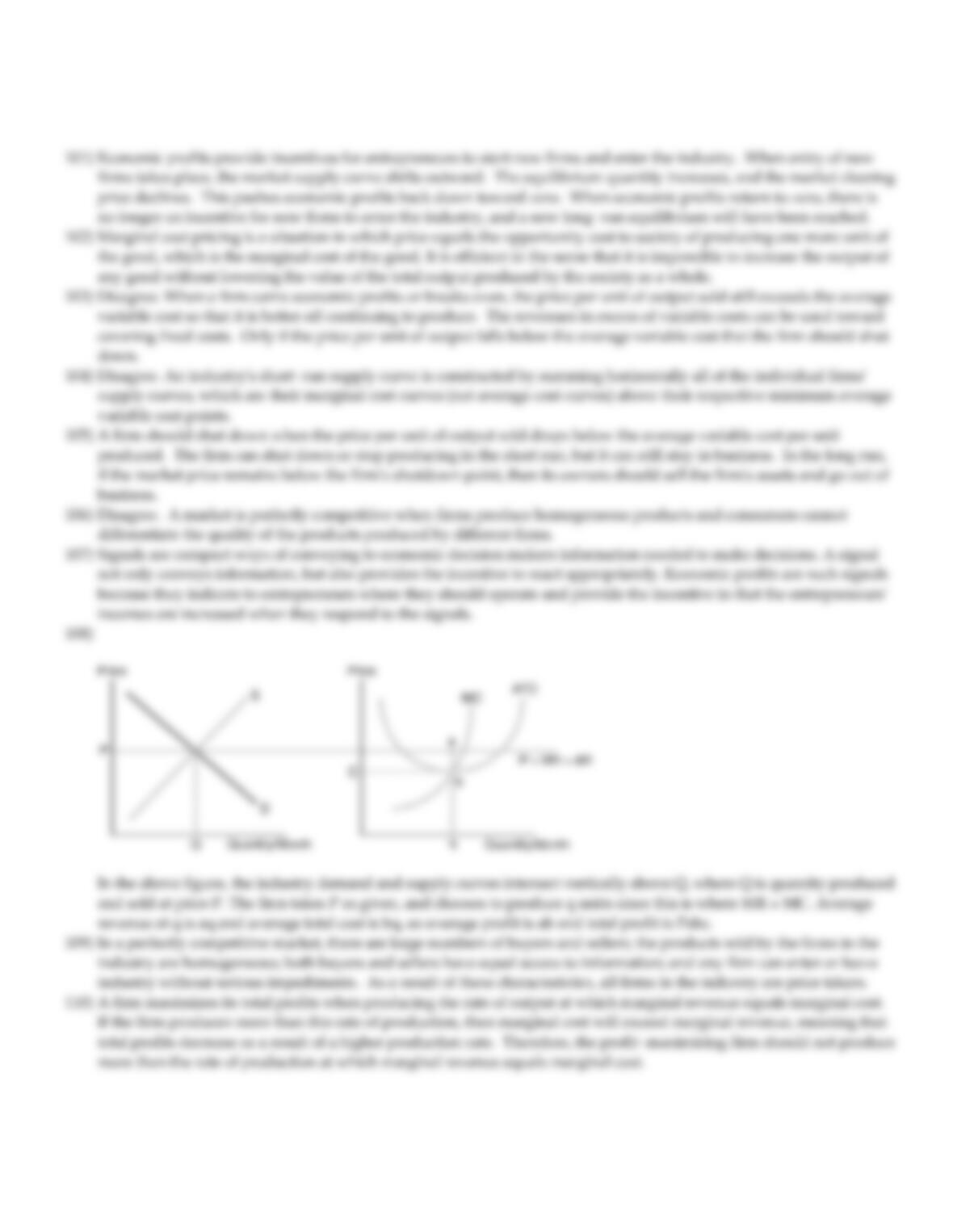
Using a graph, show a short–run equilibrium for the industry and the firm. Explain the
graph.
108)
109)
What are the main characteristics of a perfectly competitive market?
109)
110)
Why should a firm not produce more than the rate of output at which marginal revenue
equals marginal cost?
110)
Answer Key
Testname: C23
Answer Key
Testname: C23
Answer Key
Testname: C23
35