65)
Marginal revenue is
65)
A)
change in total revenue/change in output.
B)
total revenue/change in output.
C)
change in total revenue/output.
D)
total revenue/output.
66)
For the perfectly competitive firm, price
66)
A)
equals average total cost.
B)
depends on the fixed cost for the firm.
C)
equals average revenue and marginal revenue.
D)
changes as output changes.
67)
Which of the following statements is NOT true for a perfectly competitive firm?
67)
A)
The market demand and supply curves determine the market price.
B)
The firm can influence its demand curve by advertising its product.
C)
The firm’s demand curve is perfectly elastic.
D)
A firm‘s demand curve is horizontal.
68)
Suppose that at the current level of output, price = $12, MC = $14, AVC = $7, and ATC = $9. Which
of the following is TRUE?
68)
A)
The firm should decrease output.
B)
The firm should increase output.
C)
The firm should maintain the current level of output.
D)
The firm should shut down.
69)
In the long run when a perfectly competitive firm experiences negative economic profits,
69)
A)
firms exit the industry, the market supply curve shifts leftward, and the market price rises.
B)
firms enter the industry, the market supply curve shifts rightward, and the market price rises.
C)
firms enter the industry, the market supply curve shifts rightward, and the market price falls.
D)
firms exit the industry, the market supply curve shifts rightward, and the market price falls.
70)
A firm should continue producing until
70)
A)
the cost of increasing output by one more unit equals the revenues obtainable from selling the
extra unit.
B)
average costs are at a minimum.
C)
the average cost when another unit is produced equals the average revenue obtainable from
selling the extra unit.
D)
the cost of producing the output equals the revenues obtainable from selling the output.
71)
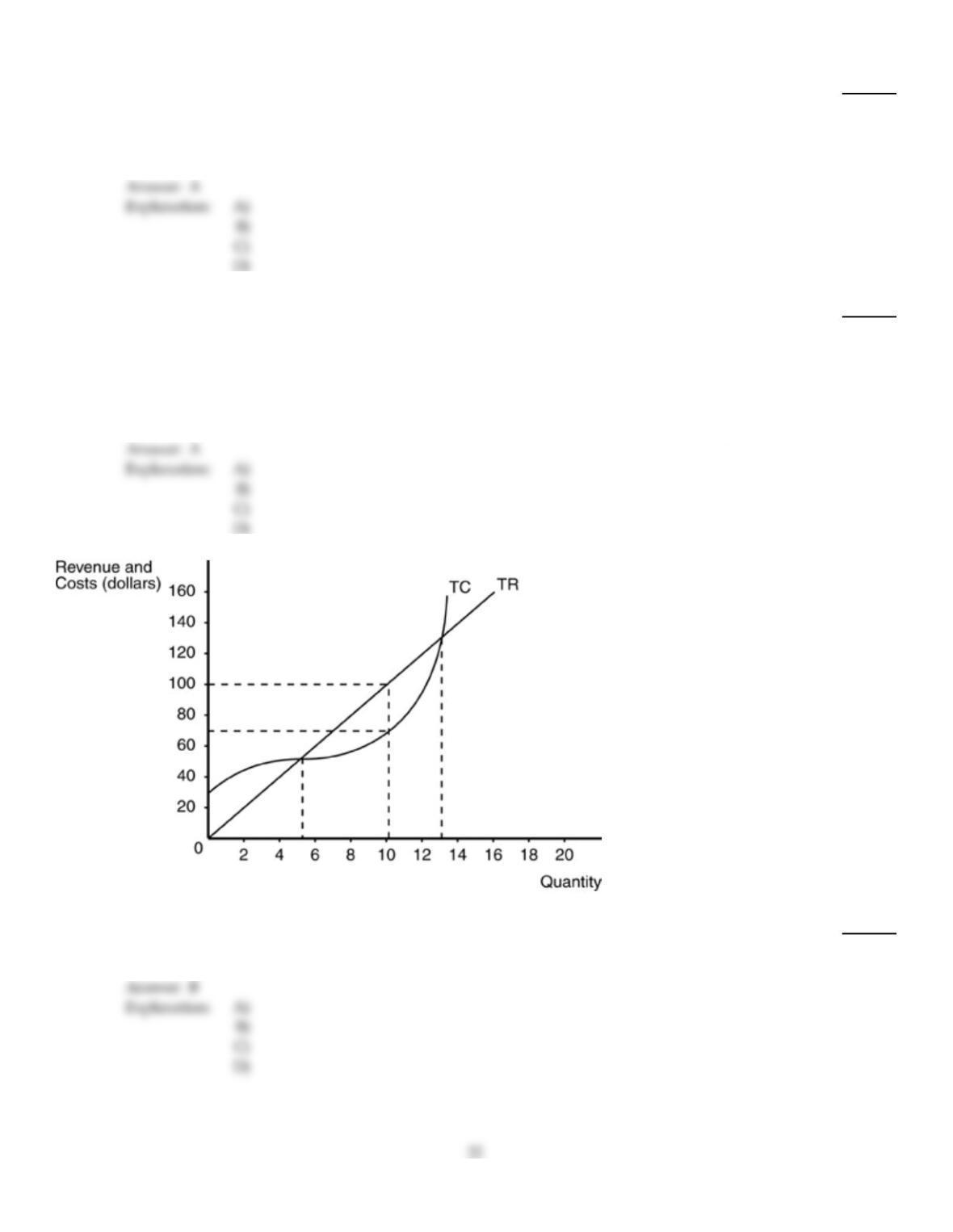
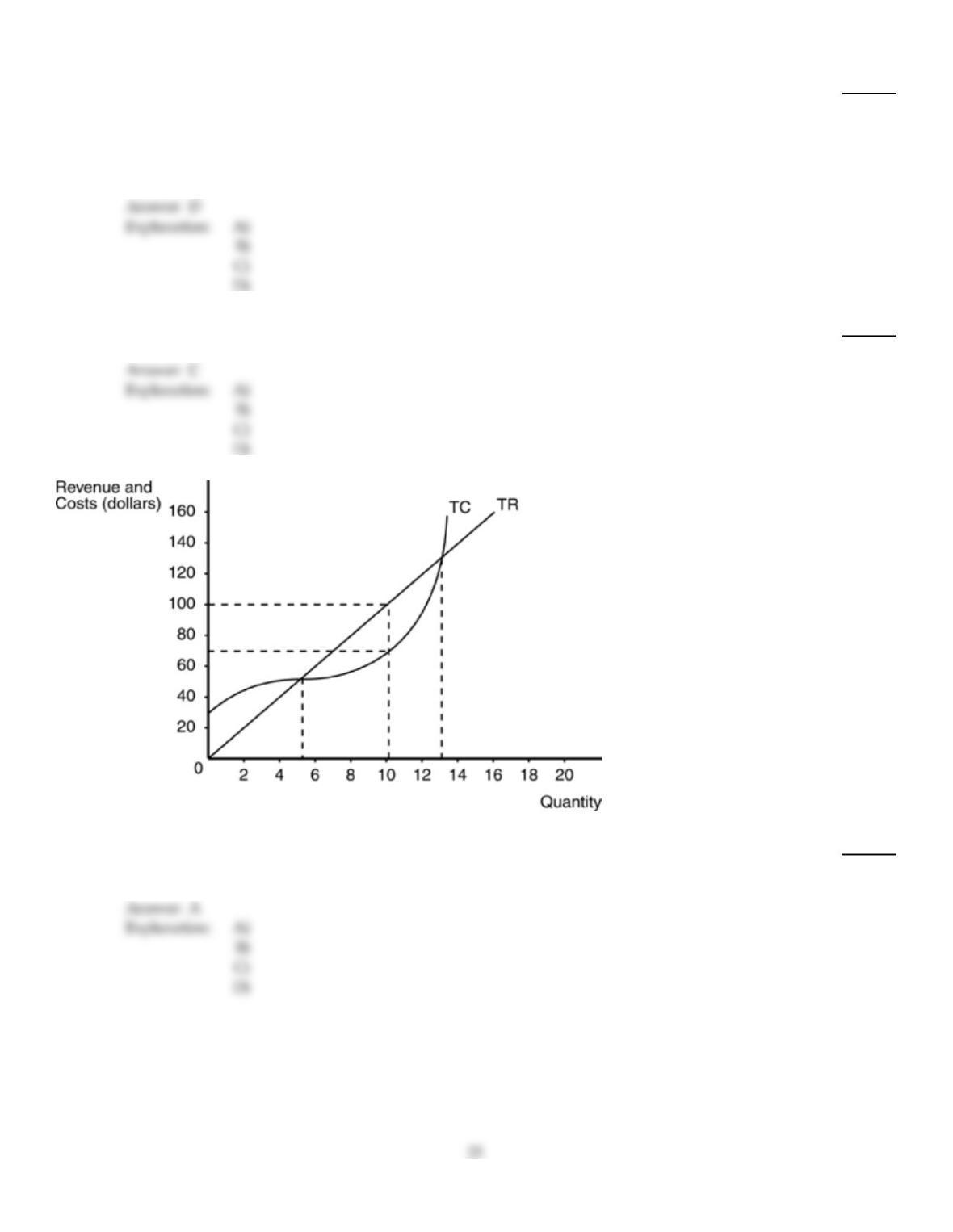
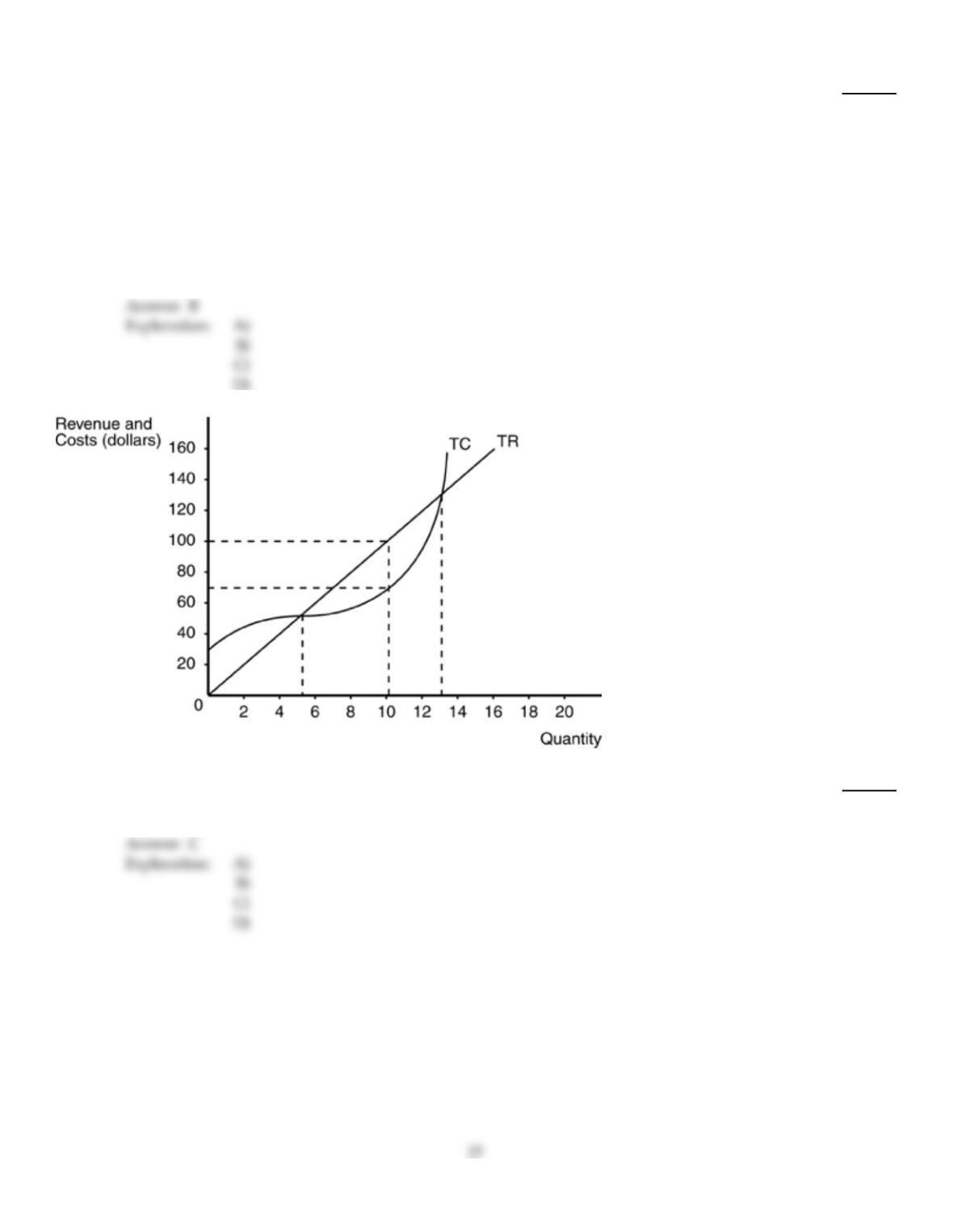
In the above figure, at output levels between 5 units and 13 units
71)
A)
total revenue equals total costs.
B)
the firm’s economic profits are positive.
C)
the firm is breaking even.
D)
the firm’s accounting profits are negative.
Total
Output Costs
100 $400
101 402
102 405
103 409
104 414
105 420
106 427
107 435
72)
Refer to the above table. If the price is $6 the maximum profit this firm could earn is
72)
A)
$414.
B)
$630.
C)
$420.
D)
$210.
73)
The demand curve for the product of a perfectly competitive firm is
73)
A)
downward sloping.
B)
perfectly elastic.
C)
perfectly inelastic.
D)
upward sloping.
74)
The perfectly competitive firm maximizes profits when
74)
A)
it produces and sells the quantity at which the difference between price and average cost is
the greatest.
B)
it produces and sells the quantity at which the difference between average revenue and
average cost is the greatest.
C)
it produces and sells the quantity at which marginal revenue and marginal cost are equal.
D)
it produces and sells the quantity at which the difference between marginal revenue and
marginal cost is the greatest.
75)
A firm that shuts down in the short run experiences losses equal to its
75)
A)
total fixed costs.
B)
average variable costs.
C)
total variable costs minus its total fixed costs.
D)
total variable costs.
76)
In the above figure, the market price charged by this profit–maximizing, perfectly competitive firm
is
76)
A)
$5 per unit of output.
B)
$14 per unit of output.
C)
$10 per unit of output.
D)
$8 per unit of output.
77)
In the short run, which of the following is FALSE about the shutdown point?
77)
A)
Total revenue is equal to total variable cost.
B)
Price multiplied by quantity must be equal to minimum average variable cost multiplied by
quantity.
C)
Product price is equal to the minimum average variable cost.
D)
Total revenue is equal to total fixed cost.
78)
A company finds that at its present level of production, MC = AVC at $15, MC = ATC at $20, and
MC = MR at $17. Your advice to the firm regarding its short–run operations is
78)
A)
to continue production, as it is earning an economic profit of $2 per unit.
B)
to shut down.
C)
to continue production, as it is earning an economic profit of $3 per unit.
D)
to continue production at a loss.
79)
In the short run, the perfectly competitive firm will always earn an economic profit when
79)
A)
P > AVC.
B)
P = ATC.
C)
P > ATC.
D)
P = MC.
80)
In the above figure, at the profit–maximizing rate of production for the perfectly competitive firm
profit is
80)
A)
$30.
B)
$100.
C)
$70.
D)
$130.
81)
If an industry’s long–run supply curve slopes downward, then the industry is
81)
A)
a decreasing–cost industry.
B)
a fixed–cost industry.
C)
a constant–cost industry.
D)
an increasing–cost industry.
82)
A firm that has negative economic profits has accounting profits that are
82)
A)
zero.
B)
positive.
C)
negative.
D)
indeterminate without more information.
83)
A true signal must
83)
A)
convey information and direct the resource owners to act appropriately.
B)
convey information only.
C)
explain in detail why something should be done.
D)
convey information about the long–run future.
84)
In the long run when a perfectly competitive firm experiences negative economic profits
84)
A)
the high barriers to entry prevent further competition.
B)
existing firms exit the industry.
C)
additional firms enter the industry.
D)
firms have no incentive to exit or enter the industry.
85)
In a perfectly competitive market, if P > MC, then
85)
A)
the firm is paying a price for resources that is too high.
B)
production is efficient, as the firm is earning profits.
C)
too much output is being produced.
D)
too little output is being produced.
86)
Clothing retailers have faced greater competition in recent years as more firms have entered the
clothing market. Some of the competition has come from foreign competitors, but much of it is
domestic competition. As a result there is much competition in markets for many types of clothing
and
86)
A)
firms have a great degree of flexibility in pricing their products because these products can be
sold at a high profit level.
B)
individual buyers and sellers cannot affect the market price because it is determined by the
market forces of demand and supply.
C)
there are no other implications.
D)
there are relatively few buyers and sellers in the market, and one individual firm can
determine the market price.
87)
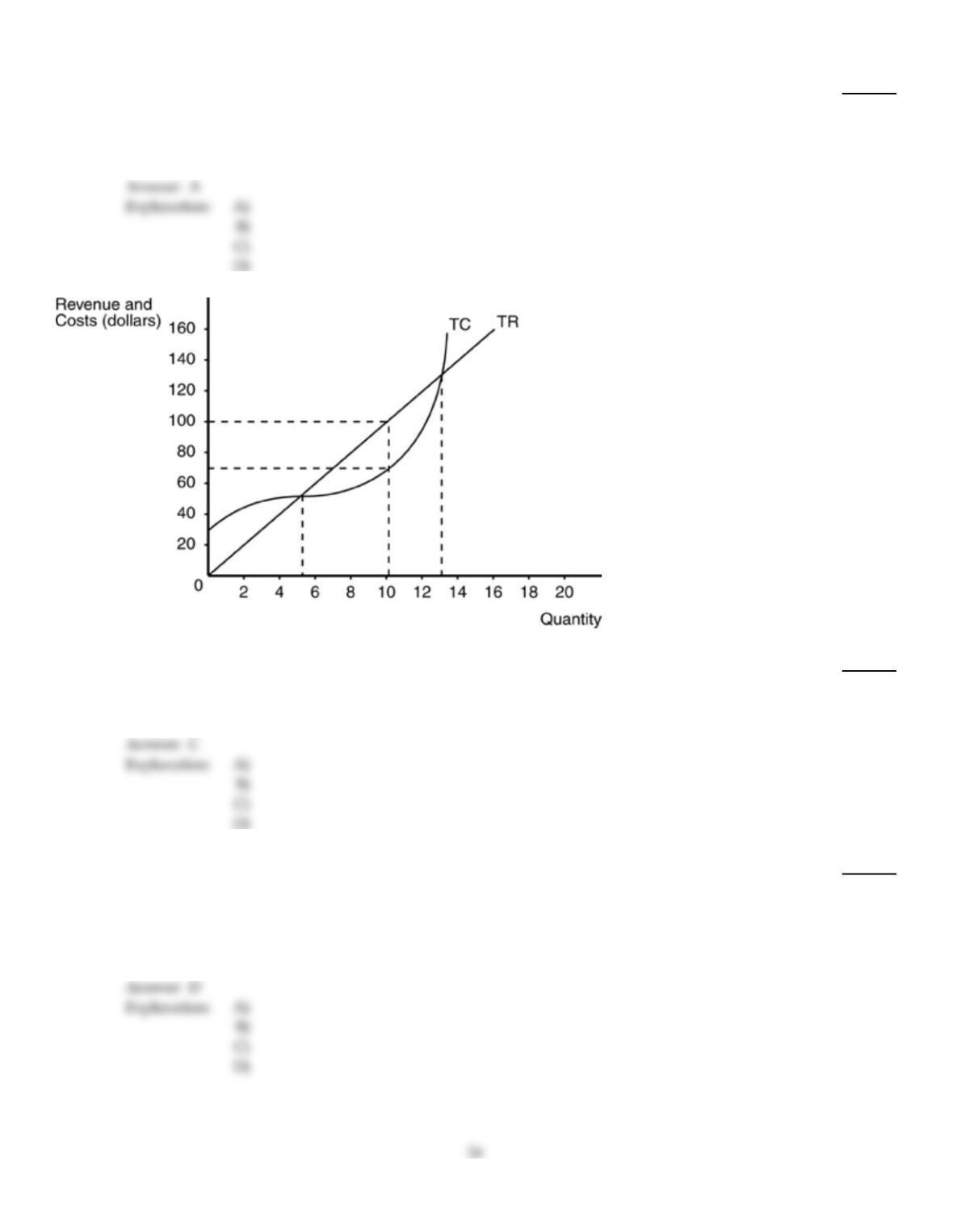
In the above figure, the profit–maximizing rate of production for the perfectly competitive firm is
87)
A)
5.
B)
13.
C)
10.
D)
none of the above.
C
B
88)
The rate of production at which marginal revenue equals marginal cost is
88)
A)
the point where profits are maximized.
B)
the firm’s shutdown point.
C)
what determines the equilibrium price in the market.
D)
a point of negative profits for the firm.
89)
A firm earning economic losses should operate in the short run as long as
89)
A)
the price per unit sold is greater than the average fixed cost per unit produced.
B)
marginal revenue is at least the price per unit sold.
C)
the price per unit sold is greater than the average variable cost per unit produced.
D)
the price per unit sold is equal to or greater than the marginal cost of production.
C
90)
Which of the following is NOT true for a perfectly competitive firm in the long run?
90)
A)
MR = MC
B)
SAC = LAC
C)
Price = MC
D)
MC > LAC
D
91)
Your local farmer has many competitors and exists in a market structure known as perfect
competition. This means that price is determined outside of the individual farmer’s ability to charge
a price higher than the going market for a bushel of wheat, hence the farmer is
91)
A)
always able to price produce above the competition and earn a larger profit.
B)
a price maker and can therefore charge different customers different prices.
C)
never able to determine any prices he charges for anything, such as soybeans.
D)
a price taker and cannot affect the market price of wheat.
D
92)
Which of the following is closest to a perfectly competitive market?
92)
A)
the computer software market
B)
the market for broccoli
C)
the market for handmade guitars
D)
the market for athletic shoes
B
A
93)
When a firm is operating at an output rate at which total revenue equal total costs, this is called
93)
A)
its shutdown point.
B)
a short–run profit.
C)
a loss.
D)
its breakeven point.
94)
For a perfectly competitive firm at its long–run competitive equilibrium point
94)
A)
P = AR = MR = LATC = SATC = MC.
B)
P > MR > AR > MC > LATC > SATC.
C)
P = AR = MR = LATC > SATC = MC.
D)
P = AR = MR = MC = LATC = AVC.
A
95)
A perfectly competitive firm faces a market clearing price of $150 per unit. Average variable costs
are at the minimum value of $200 per unit at an output rate of 100 units. Marginal cost equals $150
per unit at an output rate of 75 units. It can be concluded that the short–run profit–maximizing
output rate is
95)
A)
75 units, at which the firm earns zero economic profits per unit sold.
B)
75 units, at which the firm earns $50 in economic profits per unit sold.
C)
0 units, because price is less than average variable costs.
D)
100 units, because marginal cost equals average variable costs.
C
96)
The market demand curve in perfect competition is found by
96)
A)
utility maximizing behavior of the “representative consumer.”
B)
the interaction of supply and demand at the individual firm and consumer levels.
C)
horizontally summing the supply curves of the individual firms in the industry.
D)
horizontally summing the demand curves of the individual consumers.
D
D
97)
A firm will shut down in the short run when
97)
A)
price is below average variable costs at all possible rates of output.
B)
price is below average total costs at all possible rates of output.
C)
price is below marginal cost at all possible rates of output.
D)
it is making a loss.
98)
Suppose a perfectly competitive firm can produce 20,000 bushels of corn a year at an output at
which marginal cost equals marginal revenue. The market price of corn per bushel is $1.00. The
firm’s total costs per year are $50,000 and fixed costs per year are $25,000. In the short run, this firm
should
98)
A)
produce 40,000 bushels to try to increase economic profit.
B)
shut down.
C)
continue producing until the price of corn increases.
D)
produce 20,000 bushels of corn because, although they are losing money, they are losing less
than if they shut down.
99)
The value of total output decreases when labor leaves one industry and goes to another and capital
leaves the second industry and goes to the first. This indicates that
99)
A)
the second situation is efficient.
B)
the first situation was not efficient.
C)
price is greater than marginal cost.
D)
it would be efficient to return to the first situation.
100)
A price taker is a firm that
100)
A)
cannot influence the market price.
B)
searches for the best price and then takes the highest profits possible.
C)
buys inputs for firms.
D)
seeks to maximize revenue rather than profit.
101)
An increase in the productivity of labor causes
101)
A)
quantity supplied by each firm in a competitive industry to decrease.
B)
the firm’s supply curve to shift but has no effect on the industry supply curve.
C)
the market price to increase in a competitive industry.
D)
supply in a competitive industry to increase.
102)
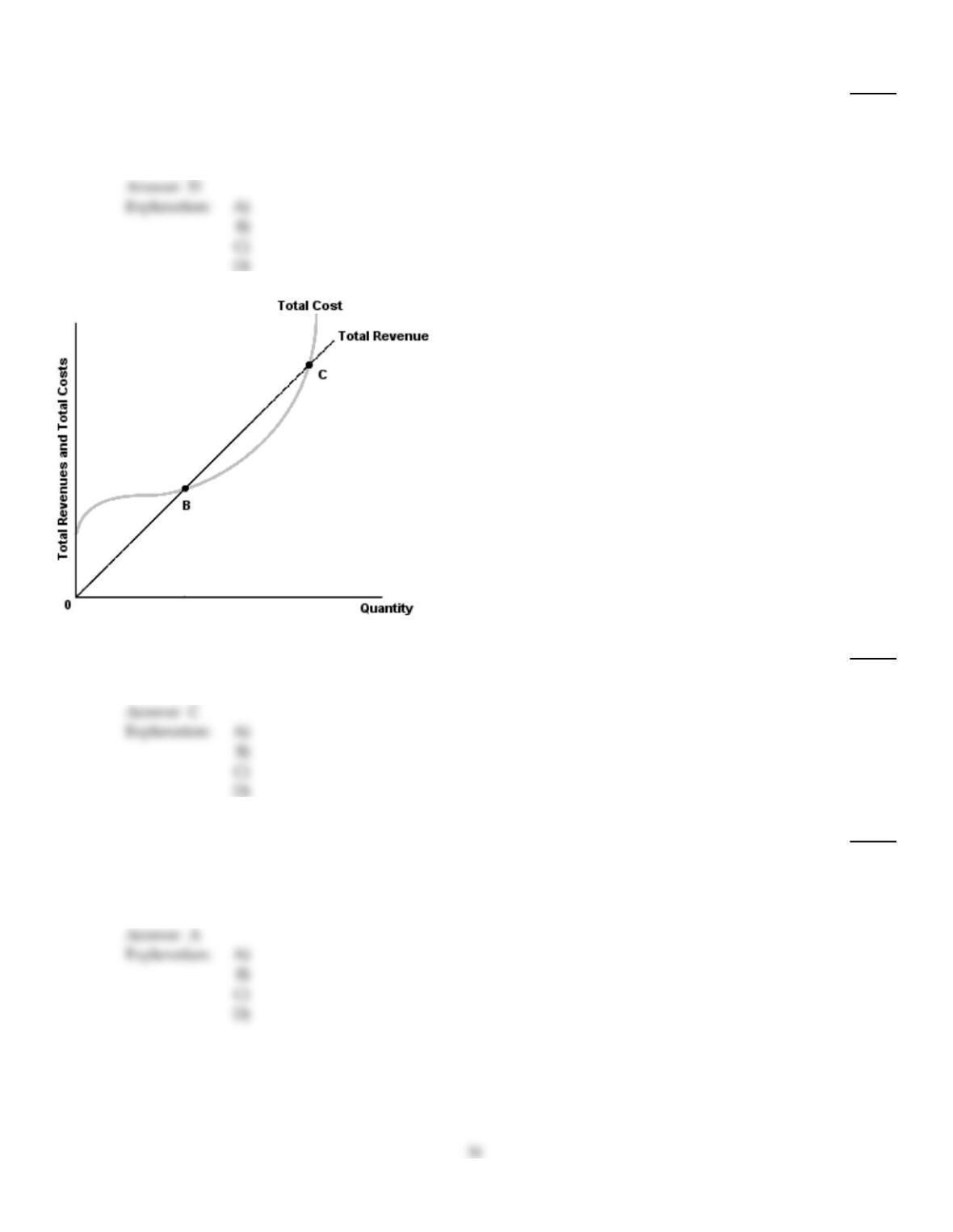
Refer to the above figure. Profits for this firm will be maximized at
102)
A)
point C.
B)
point B.
C)
a quantity between points B and C.
D)
a quantity greater than point C.
C
103)
The total revenue of a perfectly competitive firm is calculated by
103)
A)
multiplying price by quantity.
B)
multiplying quantity by average total cost.
C)
dividing price by quantity.
D)
multiplying average revenue by price.
A
D
104)
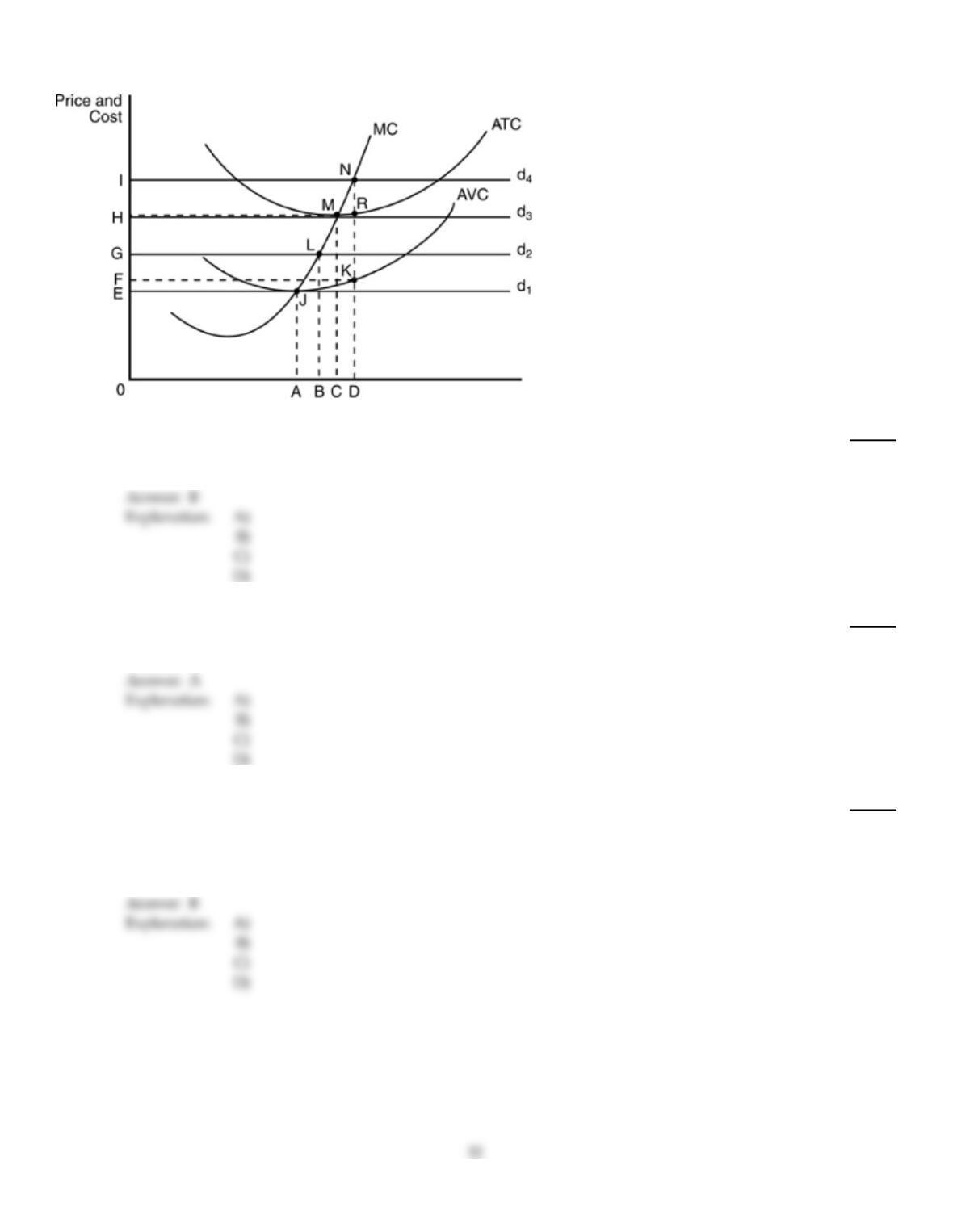
In the above figure, if the firm is facing demand curve d2, then to maximize profits it will produce
at output level
104)
A)
A.
B)
B.
C)
C.
D)
D.
105)
A perfectly competitive producer faces a demand curve for its own product that is
105)
A)
horizontal.
B)
downward sloping.
C)
vertical.
D)
upward sloping.
106)
Below the short–run shutdown price, the firm
106)
A)
is earning positive economic profits.
B)
is earning negative economic profits.
C)
may be earning a positive or negative economic profits depending upon costs.
D)
is making a normal rate of return on its capital investment.
107)
In a perfectly competitive industry, which of the following is a market signal to resource owners?
107)
A)
economic profits
B)
the level of subsidies the industry receives
C)
the level of exports in the country
D)
quality of goods
108)
If price is $5, marginal cost is $5, average total cost is $3, and the quantity produced is 150 units,
then the perfectly competitive firm is
108)
A)
earning $300 in economic profits and is maximizing economic profits.
B)
earning $2 in economic profits and is maximizing economic profits.
C)
not maximizing economic profit.
D)
earning $150 in economic profits and is not maximizing economic profits.
109)
Which is always TRUE at a firm’s profit–maximizing rate of production?
109)
A)
Marginal Revenue > Marginal Cost
B)
The total revenue curve lies below the total cost curve.
C)
Total Revenue = Total Costs
D)
Marginal Revenue = Marginal Cost
110)
The profit–maximizing level of output for a firm occurs at the point at which
110)
A)
MR = MC.
B)
P = ATC.
C)
MR = ATC.
D)
P = AVC.
111)
A law that restricts plant closings will
111)
A)
make the economy more efficient by reducing poor decisions on the part of entrepreneurs.
B)
prevent resources from flowing to their highest–valued uses.
C)
allow profits and losses to provide a signaling function.
D)
make the economy more efficient by slowing down the movement of resources to a more
optimal rate.
112)
A firm seeking to maximize economic profits should produce at the output at which
112)
A)
marginal revenue equals marginal cost.
B)
marginal revenue equals average revenue.
C)
average revenue equals average cost.
D)
total revenue equals total cost.
113)
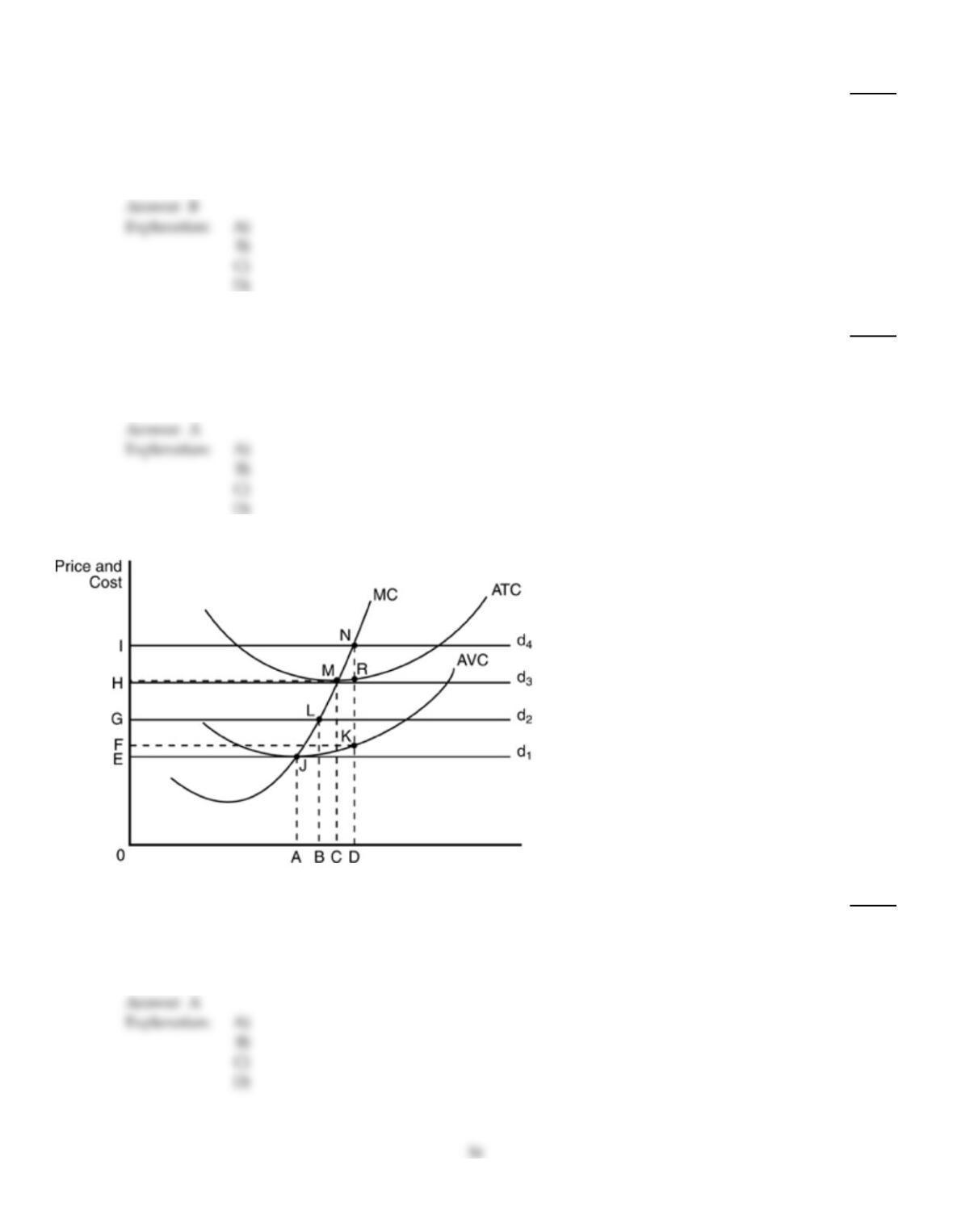
In the above figure, assume d1 is the demand curve faced by this firm. Which is TRUE?
113)
A)
This firm is experiencing an economic loss.
B)
This firm’s total costs equal EJA0.
C)
This firm is breaking even.
D)
This firm is earning an economic profit.
114)
If AVC is $10 when P = MC, a firm
114)
A)
should shut down if price is less than $10.
B)
is experiencing economies of scale.
C)
is producing too little output.
D)
will have positive economic profits if price is greater than $10.
115)
Price equals the minimum of long–run average cost
115)
A)
in a long–run equilibrium.
B)
along a horizontal long–run supply curve, but not along an upward sloping long–run supply
curve.
C)
in a short–run equilibrium as well as in a long–run equilibrium.
D)
whenever average revenue equals marginal cost.
116)
Economic profits at the short–run break–even point are
116)
A)
positive.
B)
equal to zero.
C)
indeterminate since they also depend on the size of the fixed costs.
D)
negative.
117)
Suppose that in a perfectly competitive market, the market price is $10. A firm in that market has
marginal cost of $10, average total cost of $12, and it is producing 100 units. The firm is
117)
A)
earning zero total economic profits and is not maximizing economic profits.
B)
earning $200 in total economic profits and is maximizing economic profits.
C)
incurring $200 in total economic losses and is minimizing economic losses.
D)
earning $1,000 in total economic profits and is maximizing economic profits.
118)
When price and marginal cost are equal for a perfectly competitive firm, the firm is
118)
A)
maximizing economic profit.
B)
earning negative economic profit.
C)
maximizing total revenue.
D)
minimizing average total cost.
119)
All of the following are true regarding perfectly competitive price determination EXCEPT
119)
A)
the market price is determined by the interactions among all buyers (households) and firms.
B)
the individual firm is known as a market price maker.
C)
the individual firm takes the market price as given.
D)
the individual firm‘s marginal revenue curve is horizontal at the market price.
120)
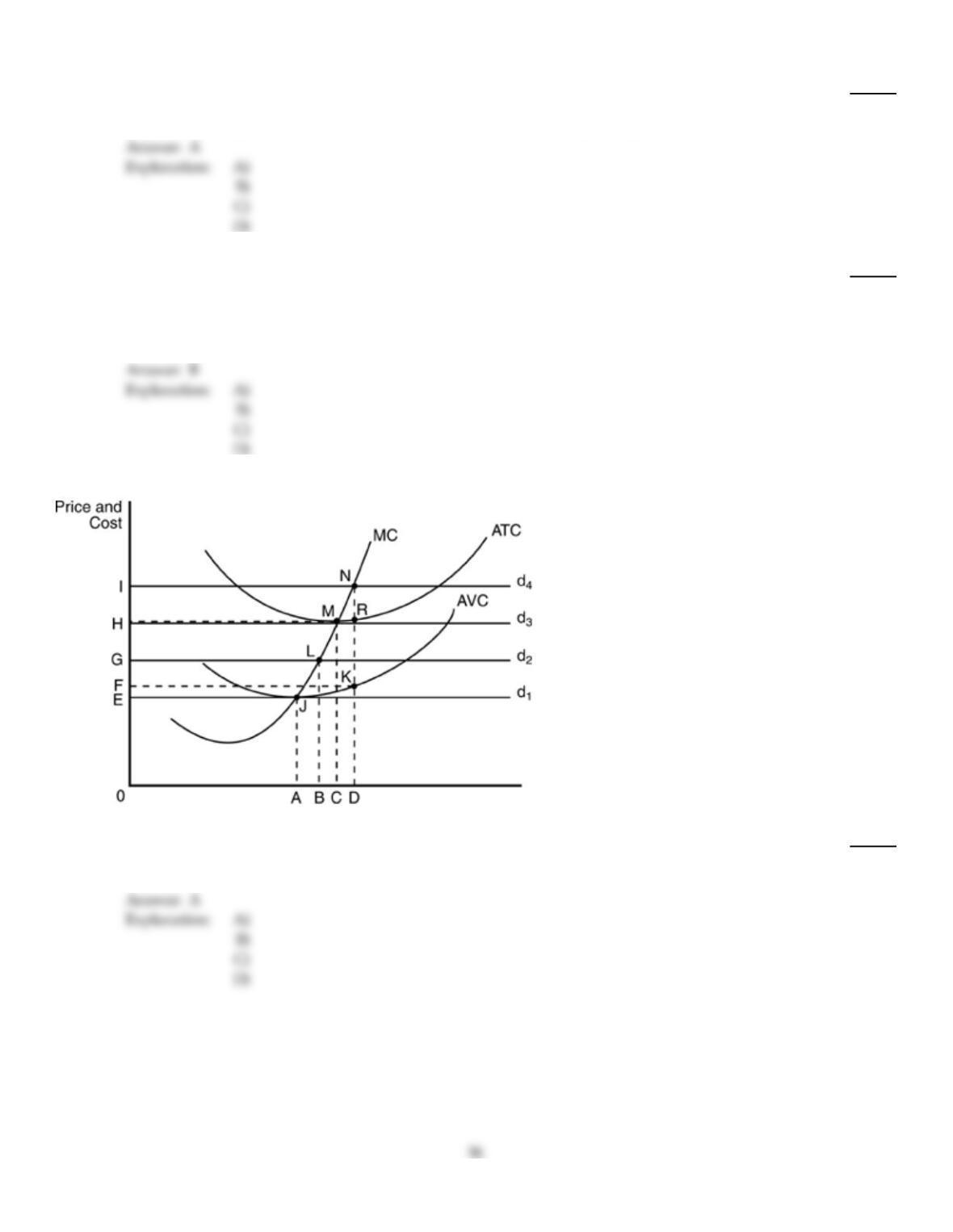
In the above figure, if d1 is the relevant demand curve for this firm, then which level of output will
maximize this firm’s profits or minimize its losses?
120)
A)
A
B)
B
C)
C
D)
D
121)
The short–run industry supply curve is found by
121)
A)
horizontally summing the average total cost curve of all firms in the industry.
B)
taking the inverse of the industry demand curve.
C)
adding up the quantities supplied at each price by each firm in the industry.
D)
adding up the quantities supplied at each price by each of the firms in the industry that are
making a profit.
122)
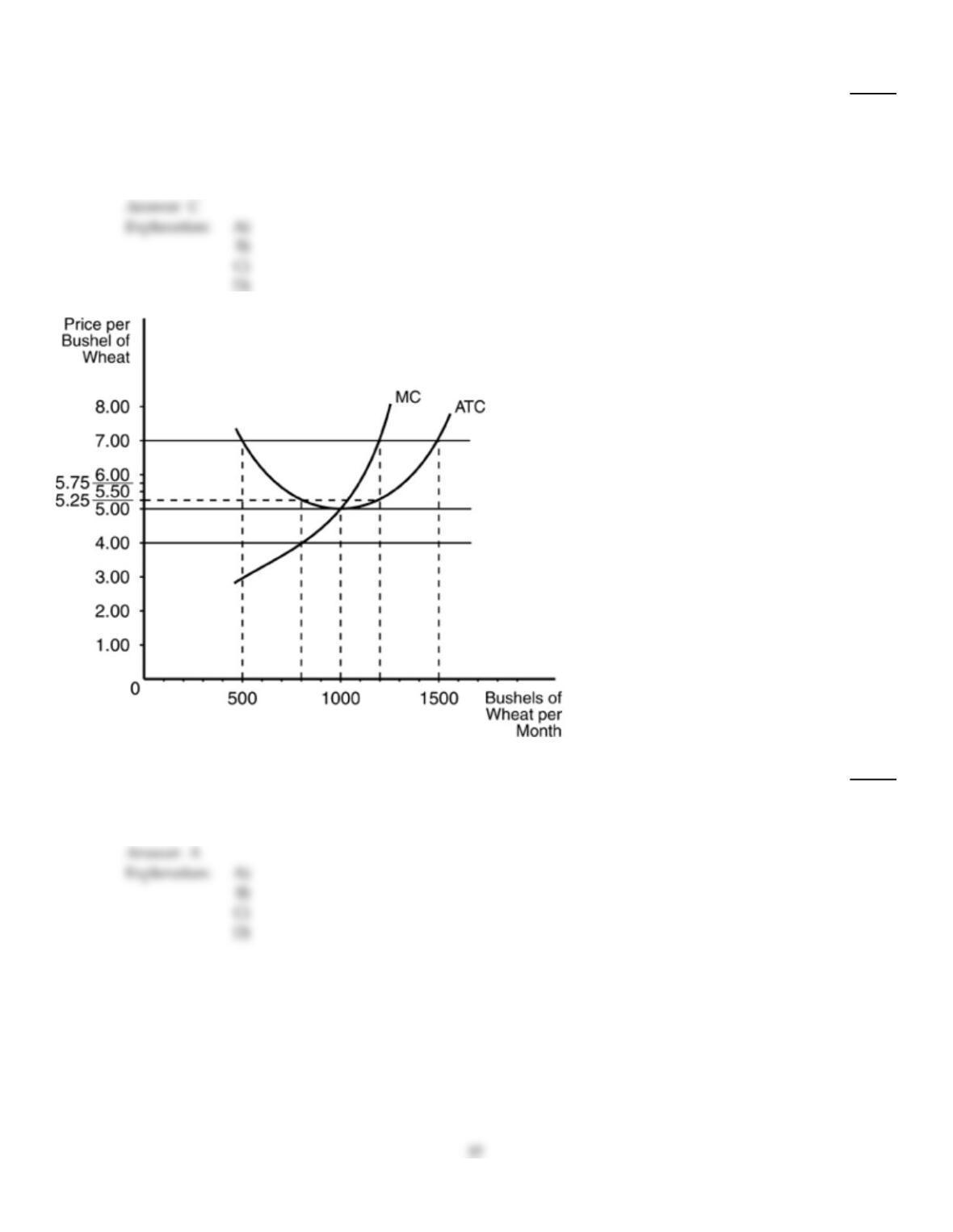
According to the above figure, if the firm is earning zero economic profits, what quantity is the firm
selling and at what price?
122)
A)
Q = 1,000; P = $5
B)
Q = 1,200; P = $7
C)
Q = 200; P = $4
D)
Q = 800; P = $4
123)
Under perfect competition, the firm must decide
123)
A)
the best rate of output it should produce.
B)
the optimal level of advertising to engage in.
C)
the optimal level of quality and the packaging that will maximize profits.
D)
the best price to charge for its product.
124)
The price per unit times the total quantity sold is
124)
A)
price revenue.
B)
total revenue.
C)
marginal revenue.
D)
average revenue.
B
125)
A market structure in which the decisions of individual buyers and sellers have no effect on market
price is
125)
A)
oligopoly.
B)
perfect competition.
C)
monopolistic competition.
D)
monopoly.
B
A
126)
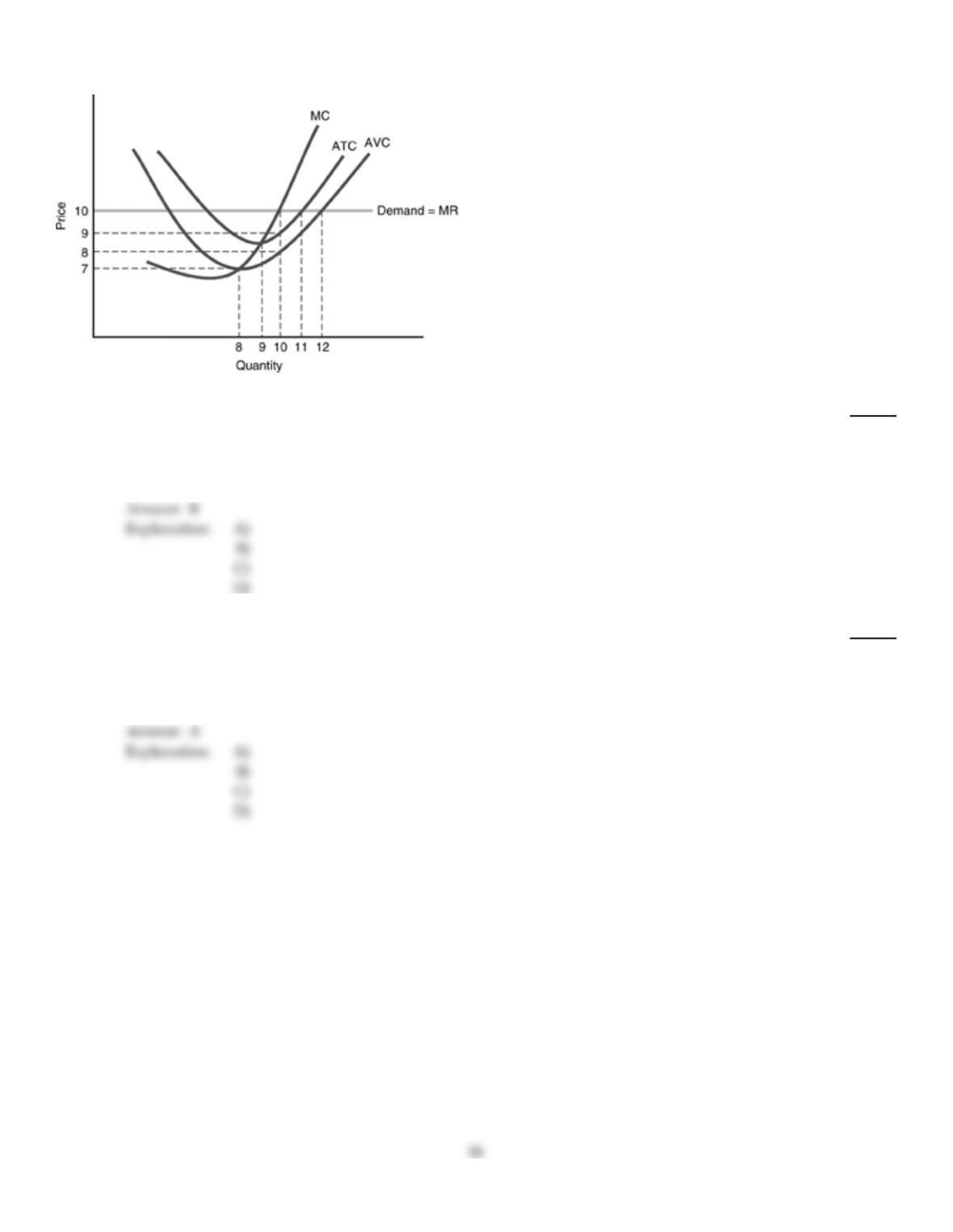
In the above figure, if the market price is $8, the firm
126)
A)
continues to produce but at an economic profit.
B)
continues to produce but at an economic loss.
C)
shuts down operations.
D)
produces 10 units.
127)
A perfectly competitive firm will maximize profits when
127)
A)
marginal cost is equal to marginal revenue.
B)
marginal cost is greater than marginal revenue.
C)
average cost is equal to average revenue.
D)
average cost is greater than marginal revenue.
128)
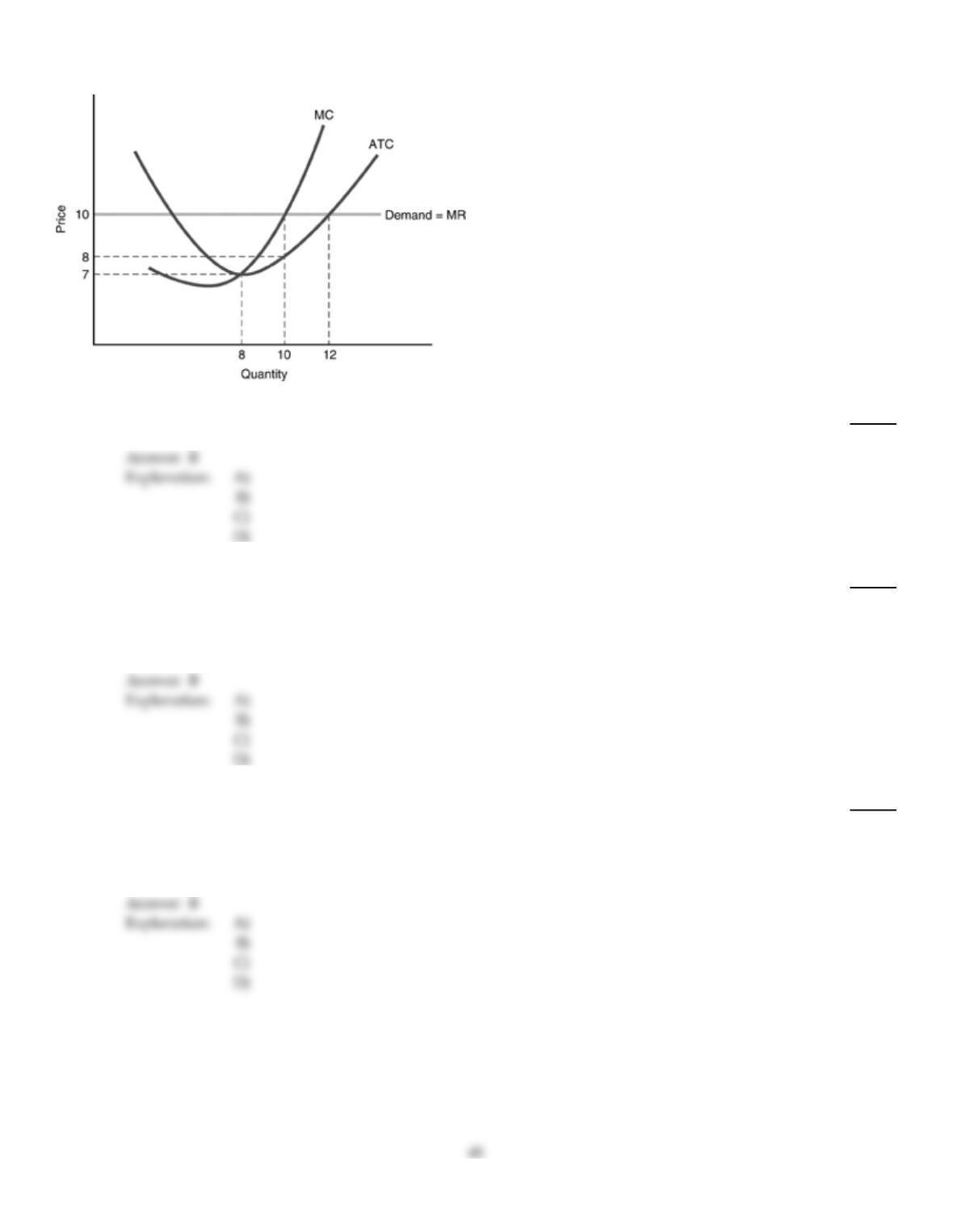
In the above figure, the long–run equilibrium price and output are
128)
A)
$8 and 10.
B)
$7 and 8.
C)
$10 and 10.
D)
$10 and 12.
129)
The perfectly competitive firm cannot influence the market price because
129)
A)
it has market power.
B)
its production is too small to affect the market.
C)
its costs are too high.
D)
it is a price maker.
130)
If an industry’s long–run per–unit costs are constant as its output increases then
130)
A)
the firm’s long–run economic profits must be greater than zero.
B)
the firm is most likely a constant–cost industry.
C)
the firm is most likely an increasing–cost industry.
D)
the firm is most likely a decreasing–cost industry.