Chemistry, 6e (McMurry/Fay)
Chapter 23 Organic and Biological Chemistry
23.1 Multiple-Choice Questions
1) The most important characteristic of carbon atoms for forming organic molecules is
A) ability to bond together to form long chains.
B) ability to form multiple covalent bonds.
C) use of hybrid orbitals.
D) A and B
2) Which of the following statements about properties of organic compounds is not correct?
A) Most organic compounds are not soluble in water.
B) Most organic compounds do not conduct electricity.
C) Organic compounds have higher melting and boiling points than ionic compounds.
D) Organic compounds have weak intermolecular forces.
3) Which class of hydrocarbons has the general formula CnH2n+2?
A) alkanes
B) alkenes
C) alkynes
D) cylcloalkanes
4) Another term for alkanes is
A) alkenes.
B) alkynes.
C) saturated hydrocarbons.
D) unsaturated hydrocarbons.
5) Which compound is a saturated hydrocarbon?
A) benzene
B) cyclohexene
C) 2-methylpentane
D) propylene
6) Compounds that have the same formula but different molecular structures are called
A) isoelectronic.
B) isomers.
C) isotones.
D) isotopes.
7) Which of the following statements about isomers is false?
A) All alkanes have branched chain isomers.
B) As the number of carbon atoms increase in a compound, so do the number of possible isomers.
C) Isomers have different physical properties.
D) Isomers have the same formula but different molecular structures.
8) How many isomers are there for C5H12?
A) 3
B) 4
C) 5
D) 6
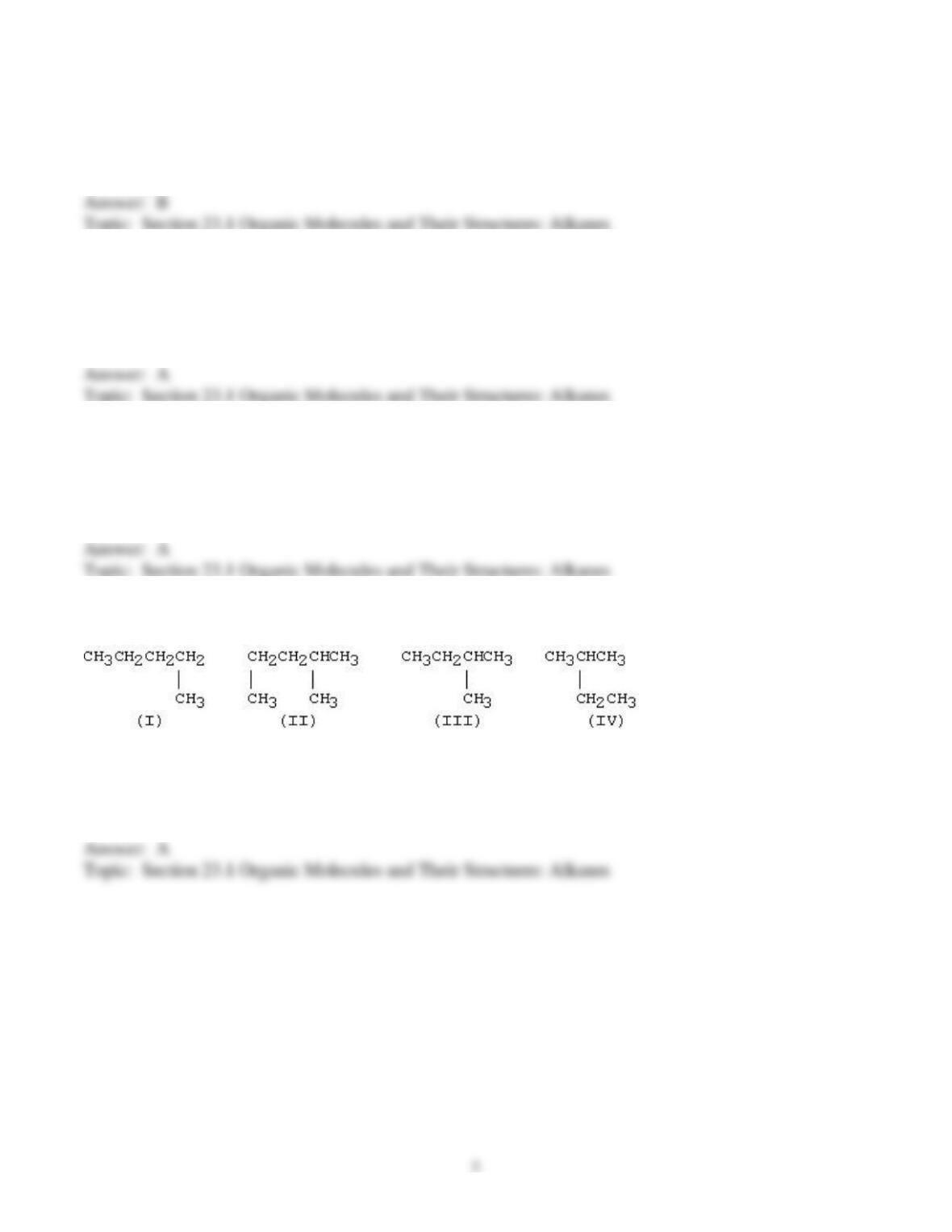
9) Which is the condensed structure of a straight-chain hydrocarbon?
A) I
B) II
C) III
D) IV
10) Which condensed structure below representing an alkane is not correct?
A) CH3CH2CH3
B)
C) CH3CH2CH2CH3
D)
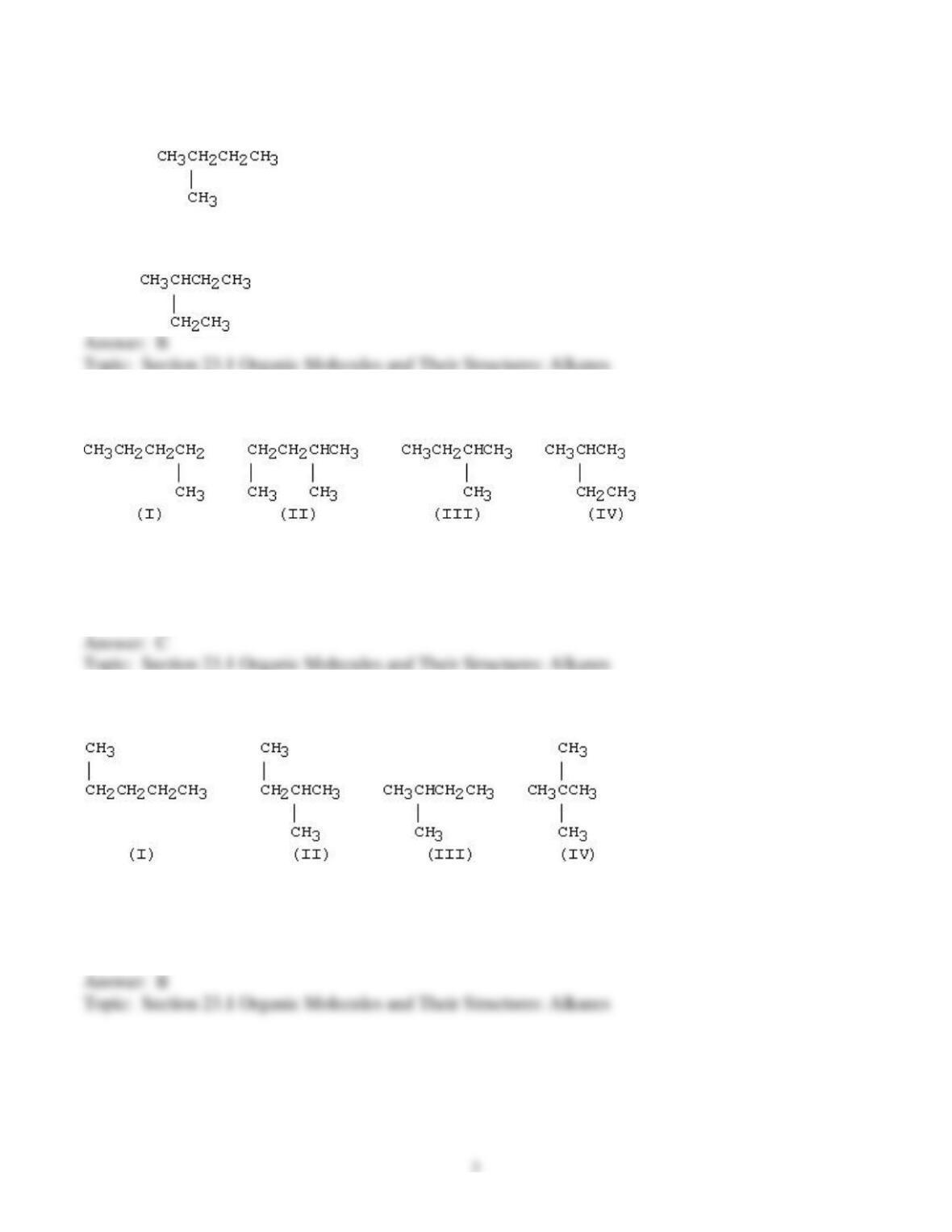
11) Which of the following condensed structures represent the same molecule?
A) I and II
B) II and IV
C) III and IV
D) II and III
12) Which of the structures below are identical?
A) I and II
B) II and III
C) III and IV
D) I and IV
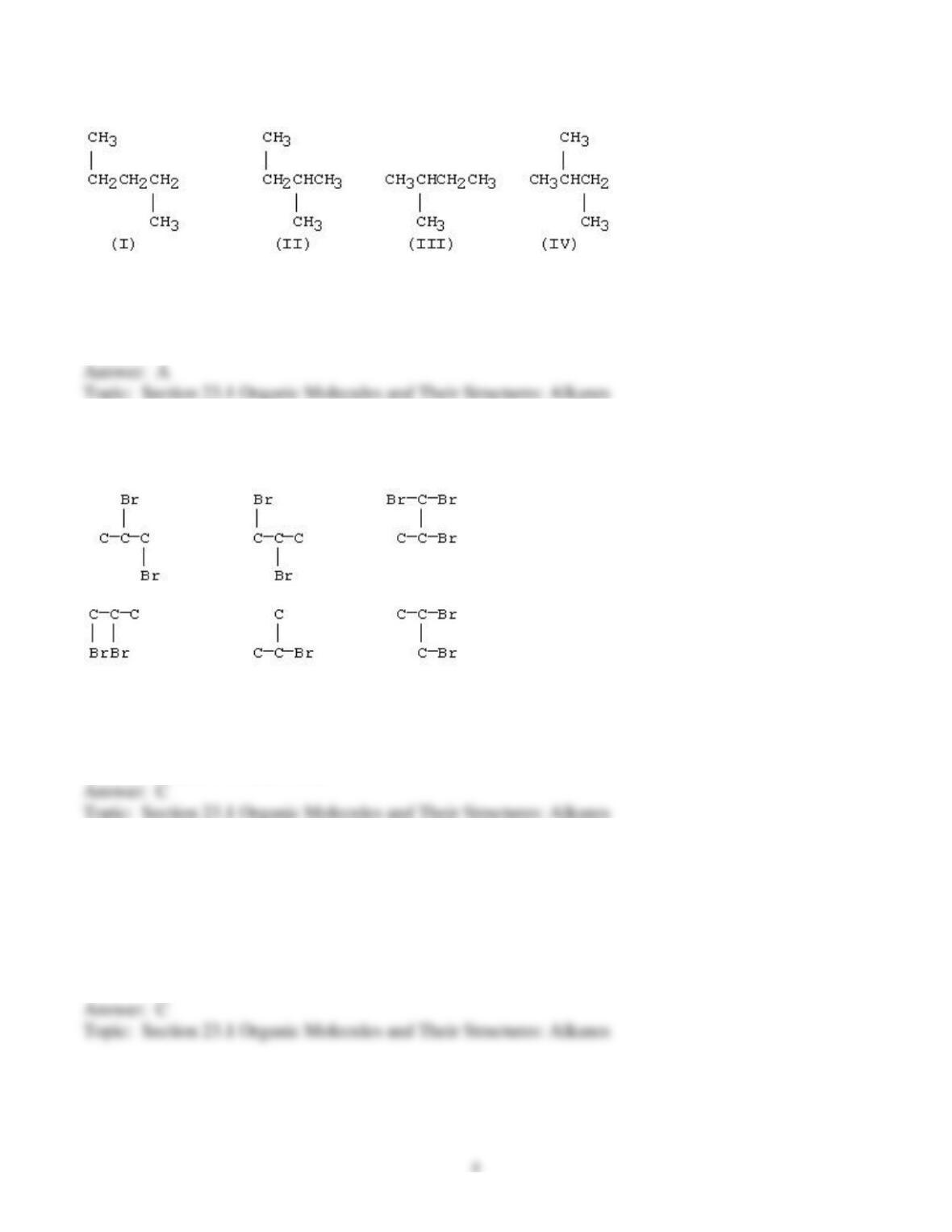
13) Which one of the structures below is different from the other three?
A) I
B) II
C) III
D) IV
14) Some of the products from reaction of bromine and propane are shown below. (The hydrogen atoms
are not shown in the structures.) How many are identical structures?
A) 2
B) 3
C) 4
D) All are isomers of each other.
15) When alkanes react with chlorine in the presence of ultraviolet light, chlorine atoms substitute for
one or more alkane hydrogen atoms. What is the number of different chloroalkane compounds that can
be formed by the reaction of C2H6 with chlorine?
A) 3
B) 6
C) 9
D) 12
16) Which of the following statements is false regarding functional groups?
A) The chemical properties of the functional group dictate the chemistry of the larger molecule.
B) Each functional group has a characteristic chemical behavior.
C) A functional group consists of an atom or a group of atoms that is part of a larger molecule.
D) A functional group consists of only carbon and hydrogen atoms.
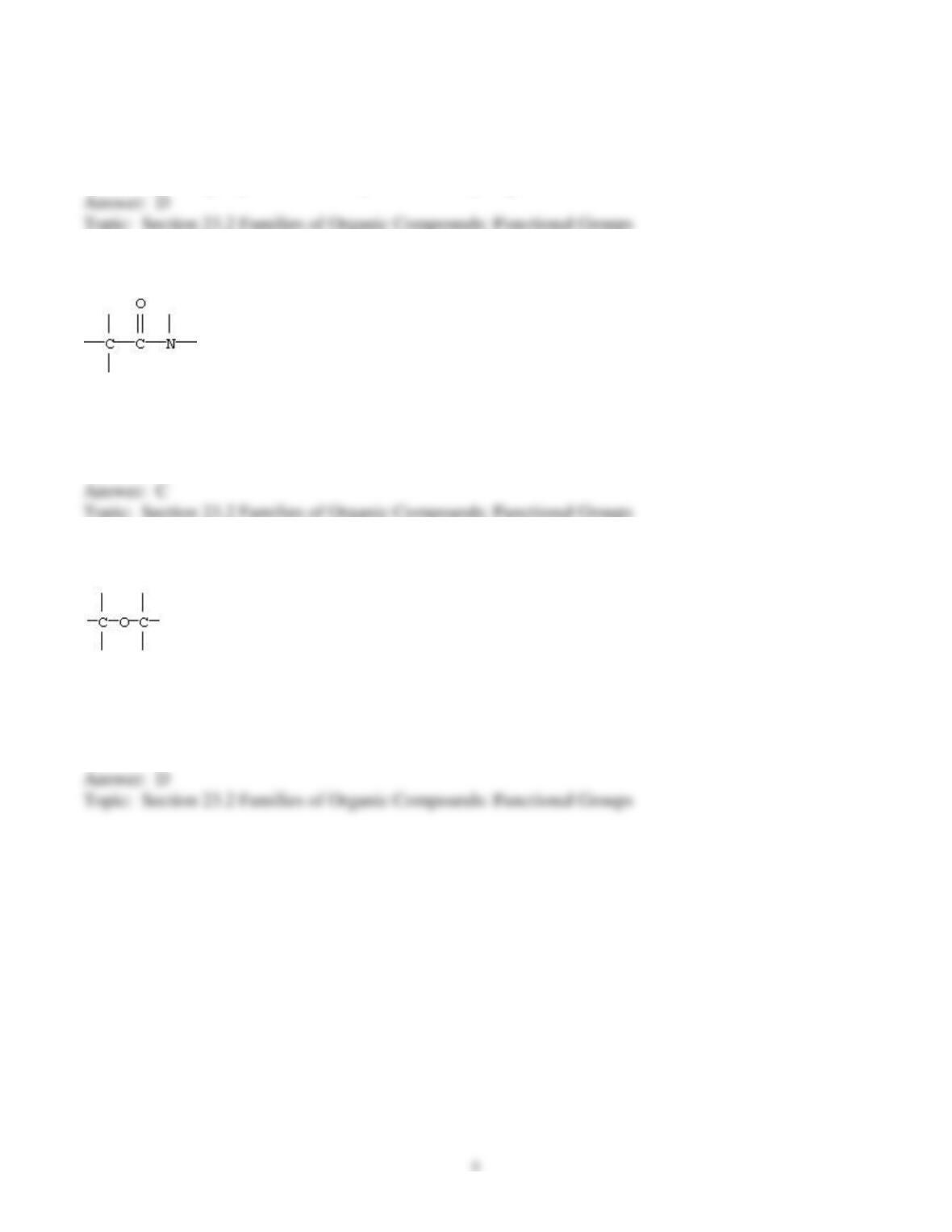
17) Identify the functional group:
A) alcohol
B) amine
C) amide
D) ester
18) Identify the functional group:
A) aldehyde
B) ketone
C) ester
D) ether
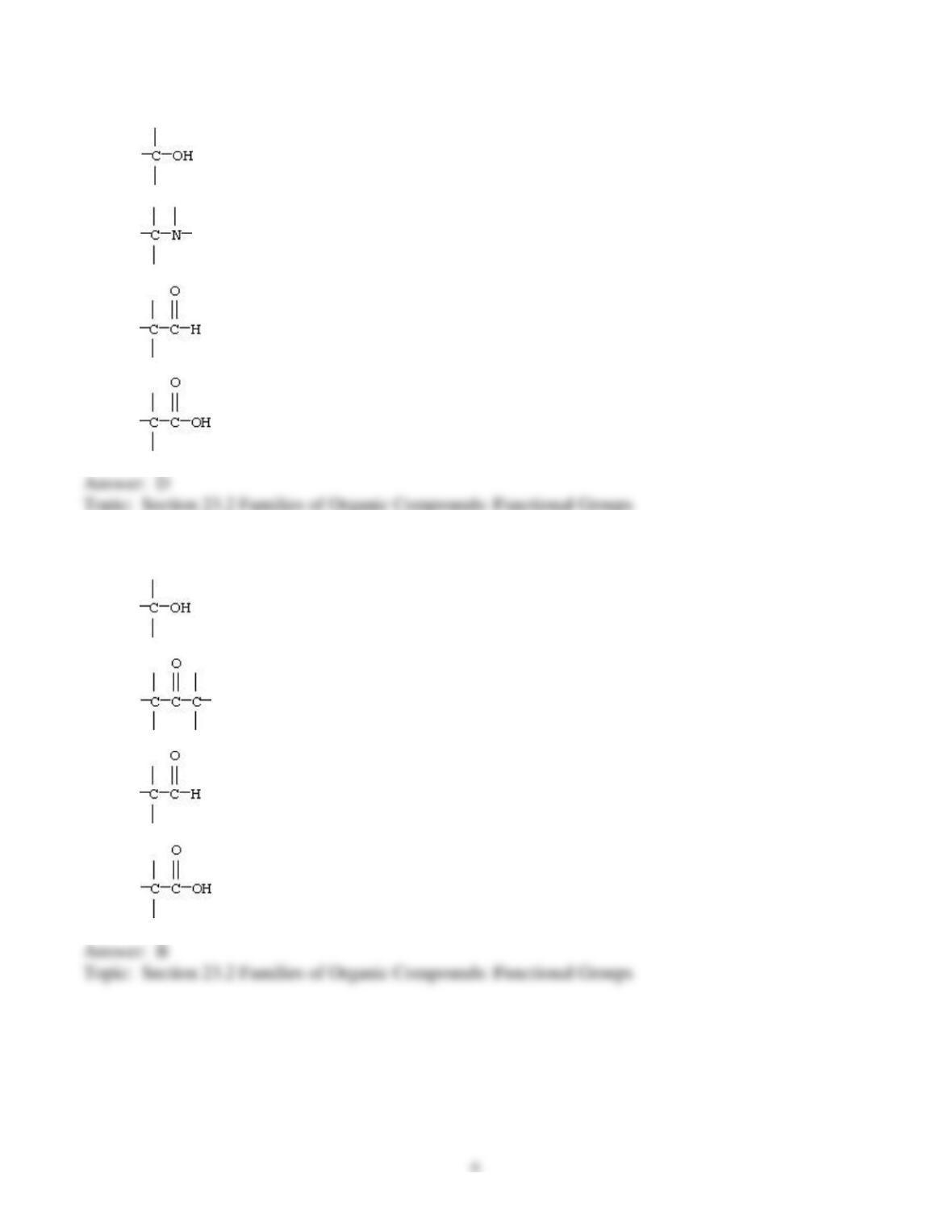
19) Which functional group below represents a carboxylic acid?
A)
B)
C)
D)
20) Which functional group below represents a ketone?
A)
B)
C)
D)
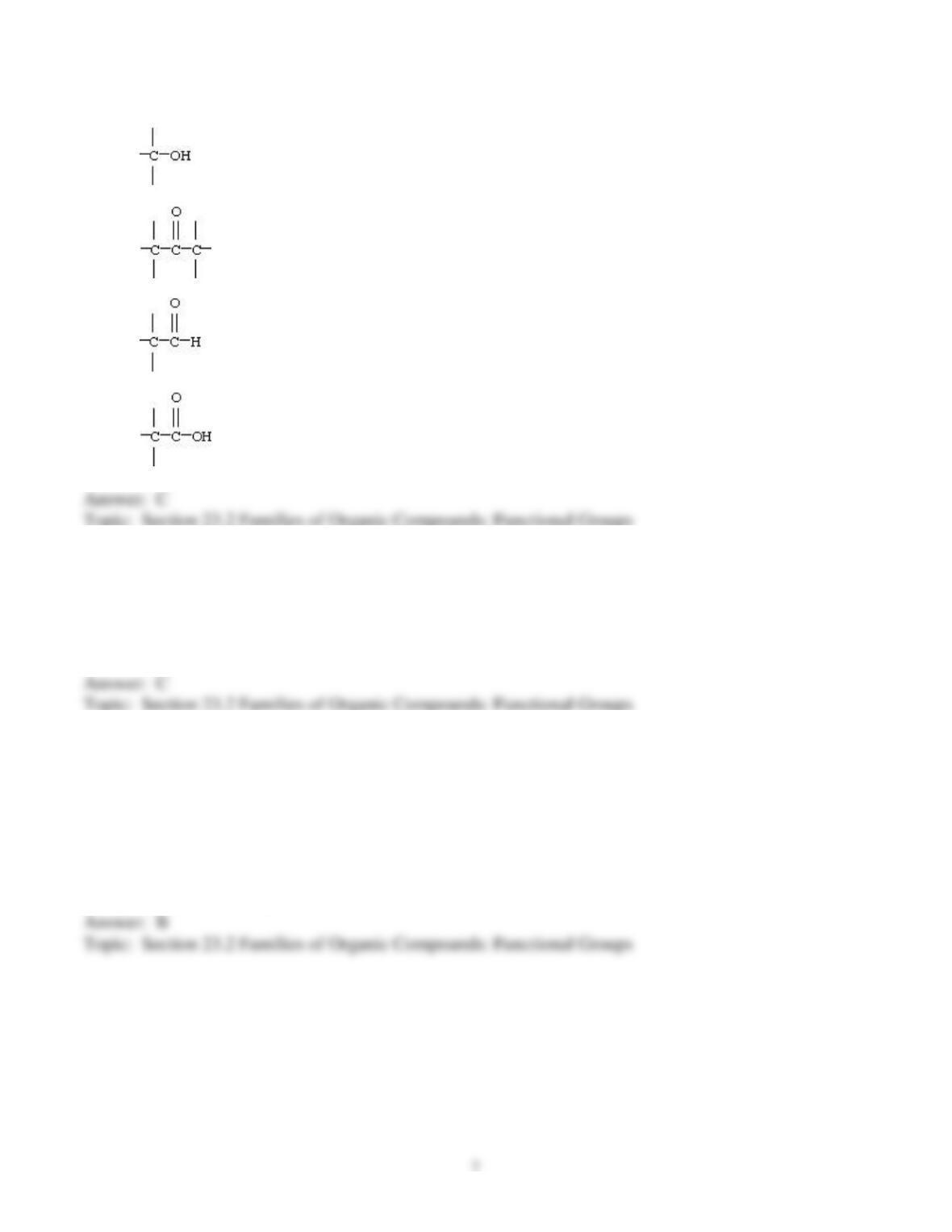
21) Which functional group below represents an aldehyde?
A)
B)
C)
D)
22) Which one of the following compounds is an alcohol?
A) CH3OCH3
B) CH3COCH3
C) (CH3)2CHOH
D) CH3CO2H
23) The functional groups in the molecule below are
H2NCH2CO2H
A) alkane, amide, and carboxylic acid.
B) alkane, amine, and carboxylic acid.
C) alkane, amide, ketone, and alcohol.
D) alkane, amine, ketone, and alcohol.
24) The functional groups in the molecule below are
O O
HCCH2COCH3
A) alkane, aldehyde, and ester.
B) alkane, aldehyde, ketone, and ether.
C) alkane, carboxylic acid, and ester.
D) alkane, ketone, and ester.
25) Which statement below is false concerning nomenclature rules for alkanes?
A) Carbon atoms are numbered starting with the atom farthest from the branching point.
B) Each branching group is assigned a number referring to its point of attachment in the parent chain.
C) The name of the alkane is written as a single word.
D) The parent name is taken from the longest continuous chain of carbon atoms.
26) An alkyl group is named for the part of the alkane group that remains after a ________ is removed.
A) C atom
B) CH3 group
C) CH2 group
D) H atom
27) If the point of attachment to an alkane is by the middle carbon in a propyl group, the group is called
A) isopropyl.
B) n-propyl.
C) sec-propyl.
D) tert-propyl.
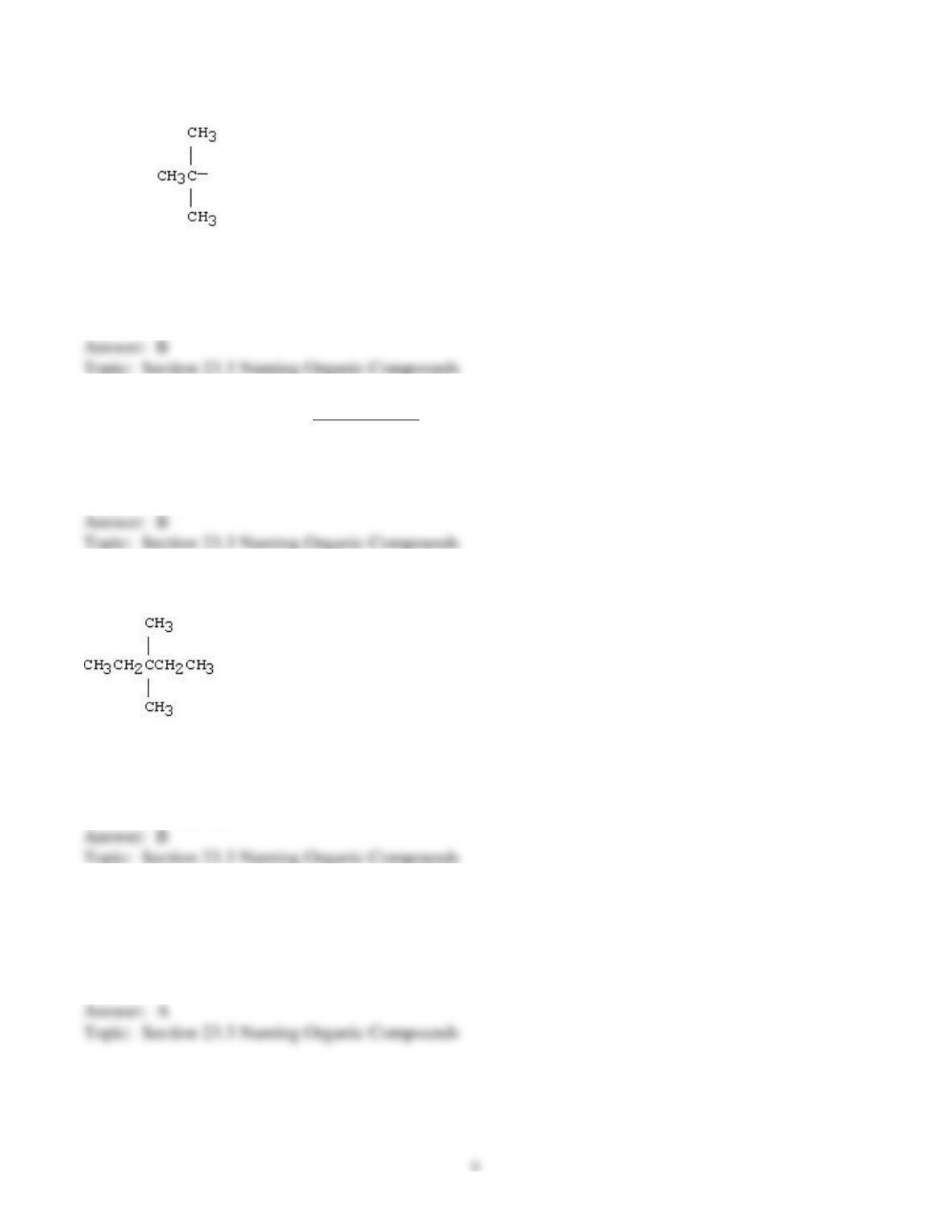
28) What is the name for the alkyl group:
A) isobutyl
B) tert-butyl
C) tributyl
D) trimethyl
29) (CH3)2CH— represents a butyl group.
A) normal
B) secondary
C) tertiary
D) quaternary
30) What is the IUPAC name for the following compound?
A) heptane
B) 3, 3-dimethylpentane
C) 2, 2-dimethyl-2-ethylpropane
D) 2, 2-diethylpropane
31) What is the IUPAC name for the continuous carbon chain of C10H22?
A) decane
B) dipentane
C) tenalkane
D) tenane
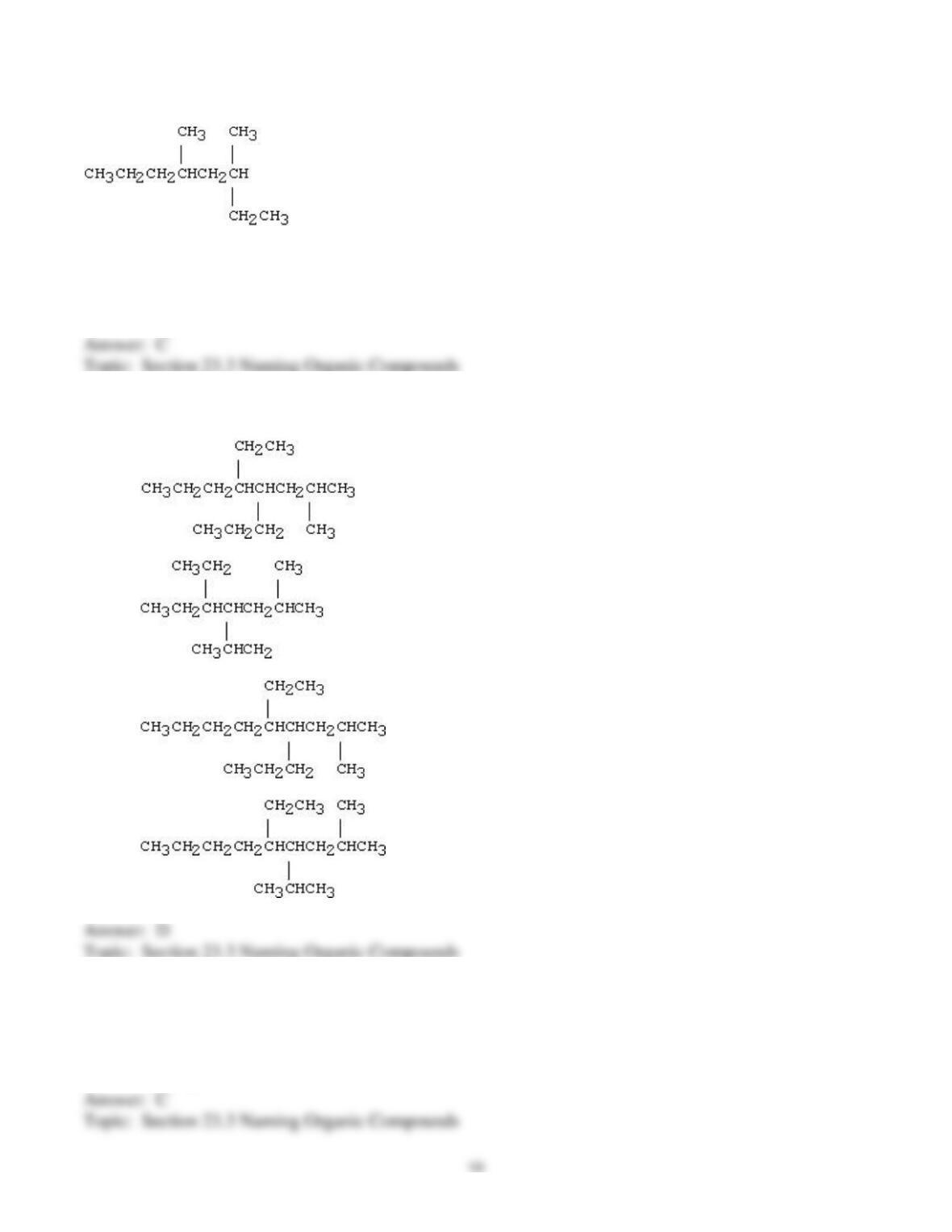
32) What is the IUPAC name for the following compound?
A) 1, 3-dimethyl-1-ethylhexane
B) 4, 6-dimethyl-6-ethylhexane
C) 3, 5-dimethyloctane
D) sec-hexylbutane
33) Which of the following compounds is 5-ethyl-4-isopropyl-2-methylnonane?
A)
B)
C)
D)
34) Which name is not correct?
A) 1, 2-dichloropentane
B) 2, 3-dimethylbutane
C) 2-ethylbutane
D) 4-propylheptane
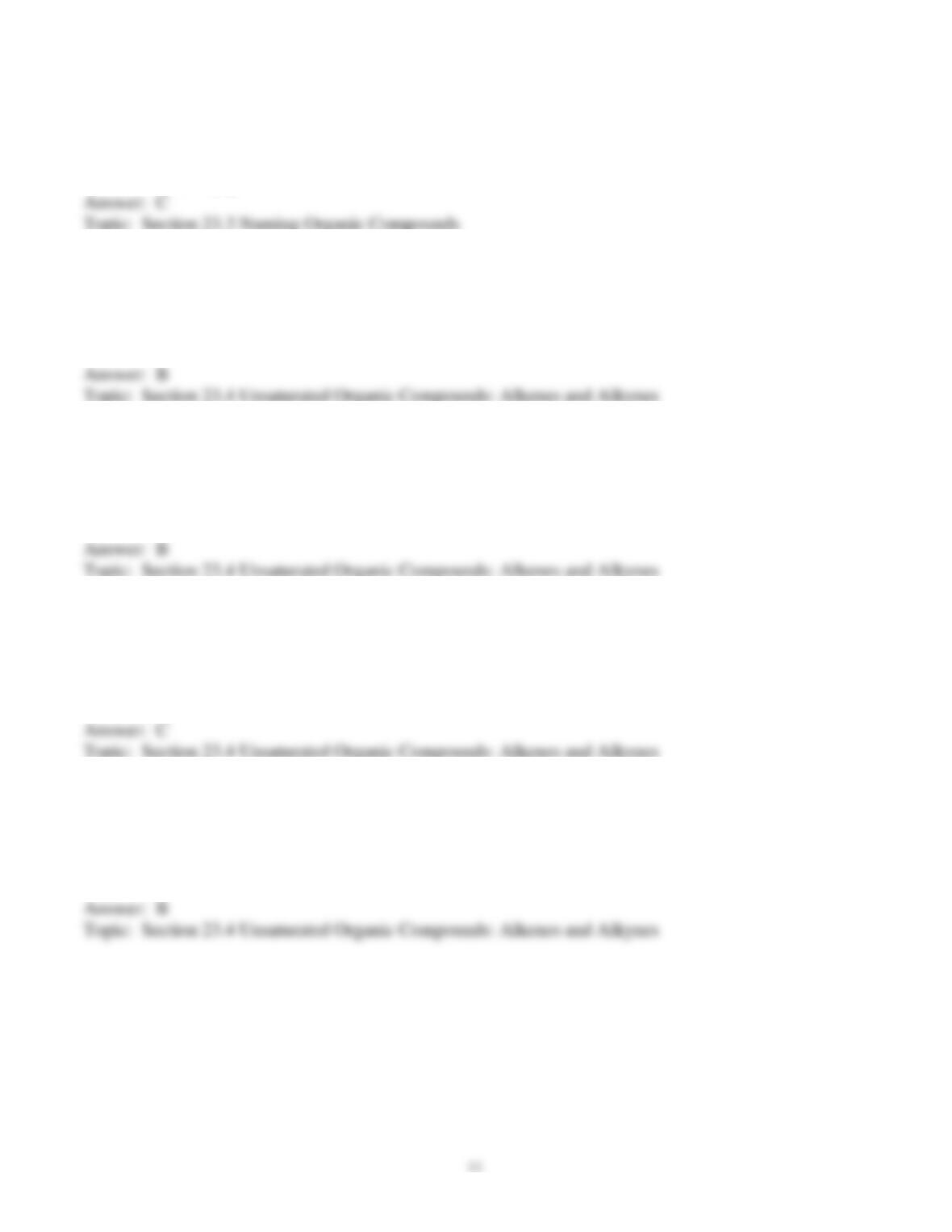
35) Which name is not correct?
A) 2, 2-dimethylbutane
B) 2, 3-dimethylpentane
C) 2, 3, 3-trimethylbutane
D) 2, 3, 3-trimethylpentane
36) The names of compounds with carbon-carbon double bonds contain the suffix ________.
A) -ane
B) -ene
C) -yne
D) -one
37) What class of hydrocarbons has the general formula CnH2n?
A) alkanes
B) alkenes and cycloalkanes
C) alkynes
D) aromatics
38) None of the listed compounds contains a ring. Which has at least one doubly-bonded carbon atom?
A) C2H6
B) C3H4
C) C4H8
D) All of these
39) None of the listed compounds contains a ring. Which has at least one triply-bonded carbon atom?
A) C2H6
B) C3H4
C) C4H8
D) All of these
40) None of the listed compounds contains a ring. Which has at least one singly-bonded carbon atom?
A) C2H6
B) C3H4
C) C4H8
D) All of these
41) What is the hybridization of the carbon in (CH3)2C=CHC N indicated by the asterisk (*)?
A) sp
B) sp2
C) sp3
D) dsp3
42) What is the molecular geometry around the carbon in (CH3)2C=CHC N indicated by the
asterisk (*)?
A) linear
B) trigonal planar
C) trigonal pyramidal
D) tetrahedral
43) Which of the molecules shown below are unsaturated?
(1) CH3CH2CH2CH(CH3)2
(2) CH3CH=CHCH(CH3)2
(3) HC CCH2CH(CH3)2
A) All are unsaturated.
B) Only (2) and (3) are unsaturated.
C) Only (2) is unsaturated.
D) Only (3) is unsaturated.
44) Which of the following statements about cis–trans isomers is not correct?
A) Conversion between cis– and trans-isomers occurs easily by rotation around the double bond.
B) In the trans– isomer, the groups of interest are on opposite sides across the double bond.
C) In the cis– isomer, the groups of interest are on the same side of the double bond.
D) There are no cis-trans isomers in alkynes.
45) Which one of the following molecules can rotate freely around its carbon-carbon bond?
A) acetylene
B) cyclopropane
C) ethane
D) ethylene
46) How many geometrical and structural isomers are there of butene?
A) 3
B) 4
C) 5
D) 6
47) Which compound will have the largest dipole moment?
A) cis-1, 2-dichloroethylene
B) trans-1, 2-dichloroethylene
C) tetrabromoethylene
D) tetrachloroethylene
48) Which of the following is not a geometric (cis-trans) isomer?
A) 1, 1-dichloro-1-butene
B) 1, 2-dichloro-1-butene
C) 2-butene
D) 2-chloro-2-butene
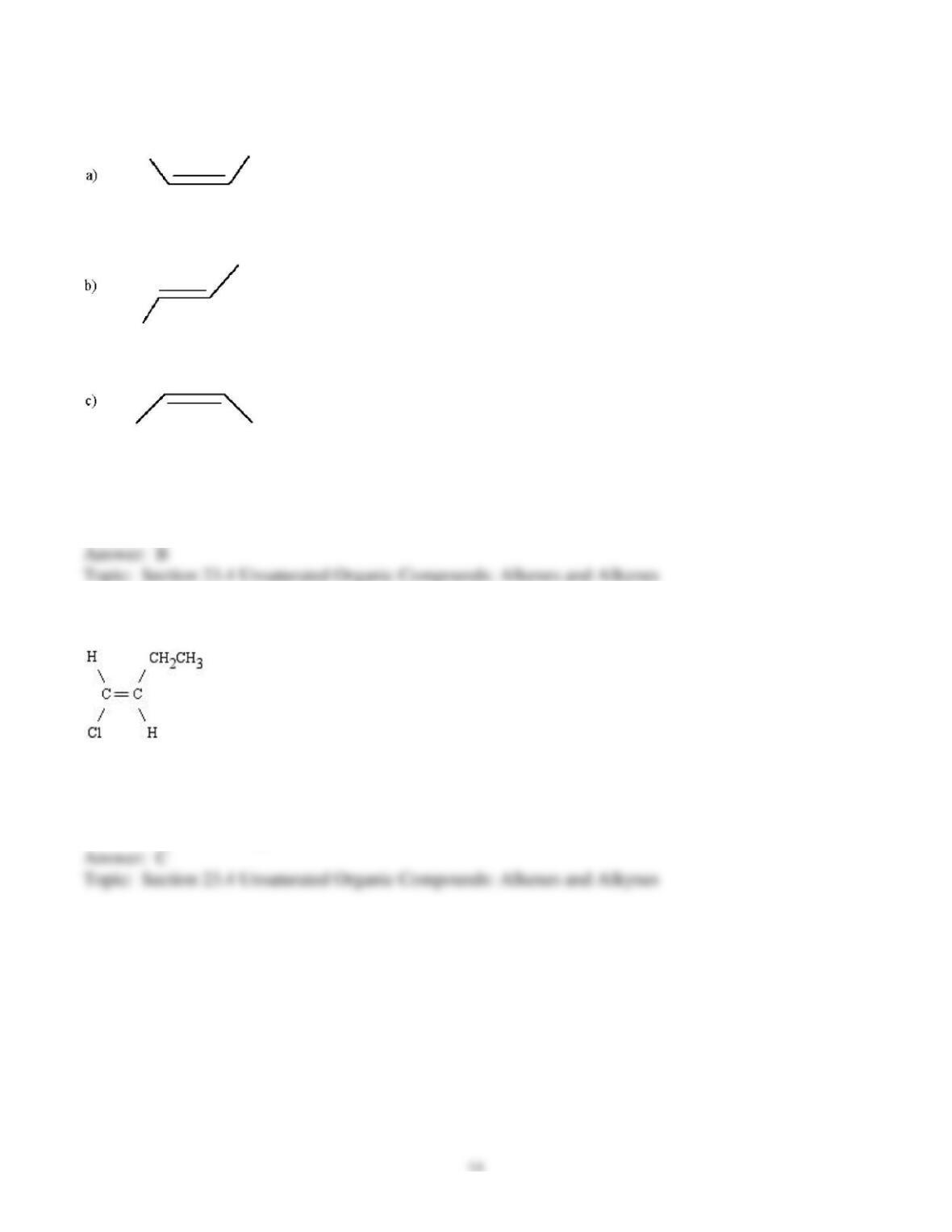
49) Which of the following is trans-2-butene? (Only bonds are shown in the skeletal structures below;
the carbon and hydrogen atoms are deleted.)
A) structure a
B) structure b
C) structure c
D) none of these
50) What is the name of the following structure?
A) cis-1-ethyl-2-chloroethane
B) cis-1-chloro-1-butene
C) trans-1-chloro-1-butene
D) trans-1-chloro-2-ethylethane
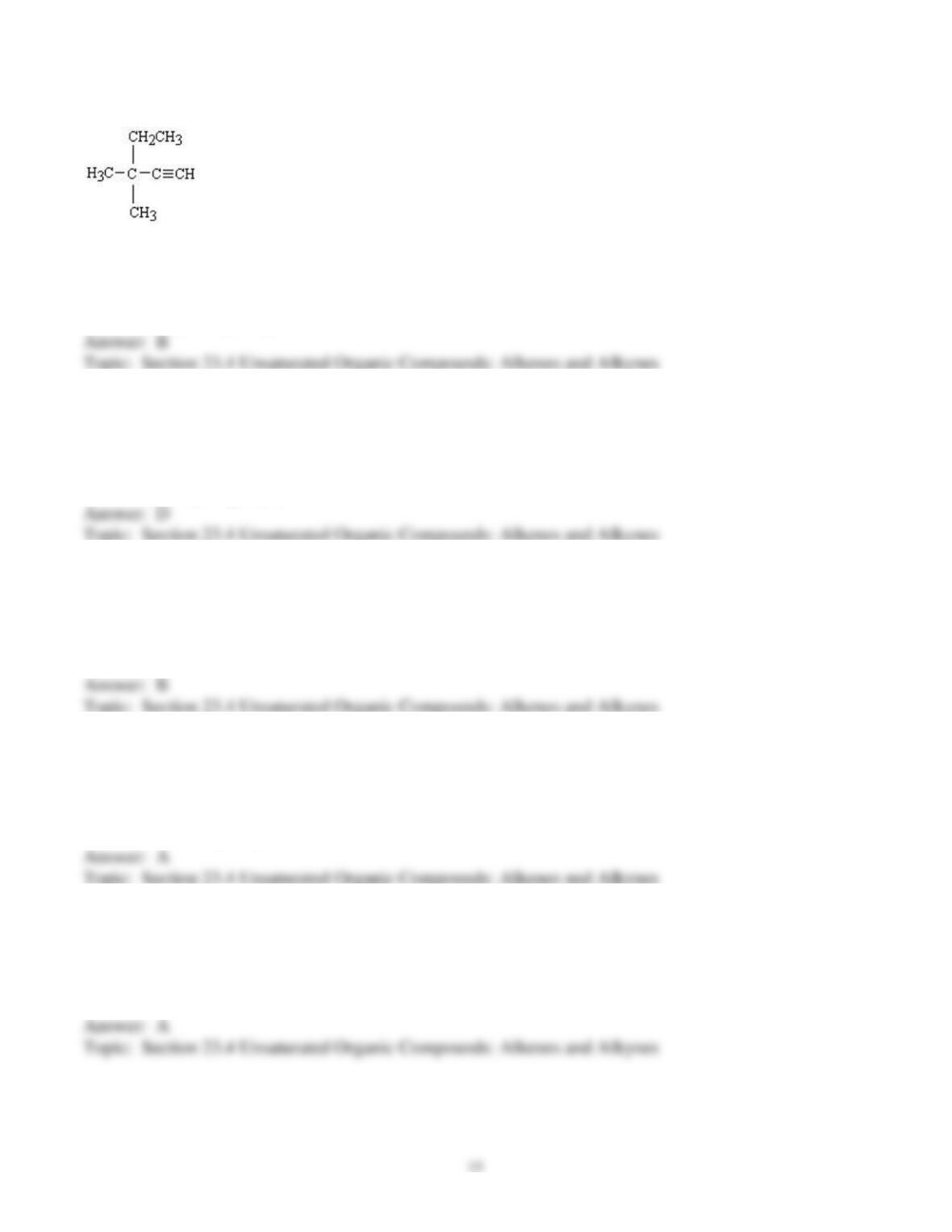
51) What is the name of the following structure?
A) tert-butylethyne
B) 3, 3-dimethyl-1-pentyne
C) 3-ethyl-3-methyl-1-butyne
D) trans-ethylmethylbutyne
52) Which of the following is a correct name for an alkyne?
A) 3-methyl-2-pentyne
B) 5-methyl-3-pentyne
C) 2, 2-dimethyl-4-pentyne
D) 3, 3-dimethyl-1-pentyne
53) Which compound will exhibit cis-trans isomerism?
A) 1, 2-dichloroethane
B) 1, 2-dichloroethene
C) dichloroethyne
D) ethylene
54) The most important synthetic chemical reactions that alkenes and alkynes undergo are called
A) addition reactions.
B) combustion reactions.
C) photochemical halogenation reactions.
D) substitution reactions.
55) Name the product of hydrogenation of trans-2-pentene.
A) pentane
B) cis-2-pentene
C) trans-2-pentane
D) none of these
56) Hydrogenation of vegetable oils converts them into what type of molecule?
A) esters
B) ethers
C) polymers
D) saturated fats
57) Name the product obtained from the addition of bromine to 3-methyl-1-butene.
A) 1, 1-dibromobutane
B) 1, 2-dibromo-3-methylbutane
C) 1, 2-dibromopentane
D) trans-1, 2-dibromobutene
58) What is the product when pure water and ethene are mixed?
A) an alcohol
B) a carboxylic acid
C) an ether
D) no reaction occurs
59) In the addition reaction of water and propene in an acidic solution, the product is ________.
A) an alcohol
B) a carboxylic acid
C) an ether
D) a ketone
60) Which of the following statements about cycloalkanes is true?
A) The bonds in cyclopropane and cyclobutane are weaker than other cycloalkanes.
B) Cycloalkanes are also called “acyclic” compounds.
C) Cyclopropane has 109° bond angles.
D) Most cycloalkanes are planar molecules.
61) The cycloalkane represented by a square is called ________ and has the molecular formula
________.
A) cyclopropane, C3H6
B) cyclopropane, C3H8
C) cyclobutane, C4H4
D) cyclobutane, C4H8
17
62) What are the C–C–C bond angles in cyclopropane and cyclohexane?
A) 60° in both molecules
B) 60° in cyclopropane and 109.5° in cyclohexane
C) 60° in cyclopropane and 120° in cyclohexane
D) 109.5° in both molecules
63) Which name is not correct?
A) 1, 1 dimethylcyclobutane
B) 1, 2-dimethylcyclobutane
C) 1, 3-dimethylcyclohexane
D) 1, 4-dimethylcyclopentane
64) Which compound is not an isomer of the other three?
A) cyclohexane
B) 1, 2-dimethylcyclobutane
C) 1, 2-dimethylcyclopropane
D) methylcyclopentane
65) Which of the following statements about benzene is true? Benzene
A) contains 3 long bonds and 3 short bonds.
B) is a puckered, six-membered ring.
C) is unusually stable because of delocalized pi electrons.
D) readily undergoes addition reactions.
66) What type of hybridization does a carbon atom have in a six-membered aromatic ring?
A) sp
B) sp2
C) sp3
D) sp3d
67) Which reaction is not characteristic of aromatic compounds?
A) addition
B) halogenation
C) nitration
D) sulfonation
68) Which structures represent the same dibromobenzene compound?
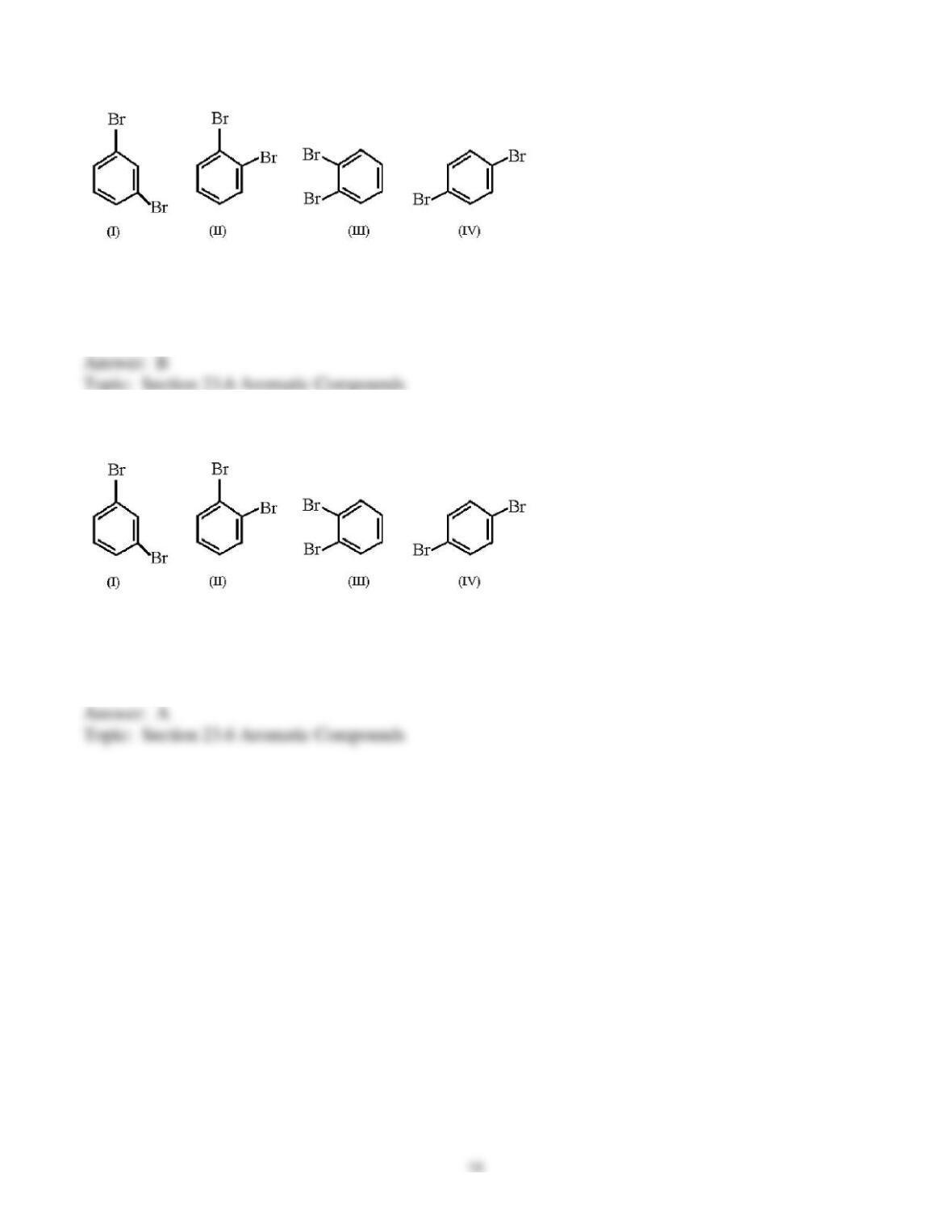
A) I and IV
B) II and III
C) I, II, and III
D) All structures are identical.
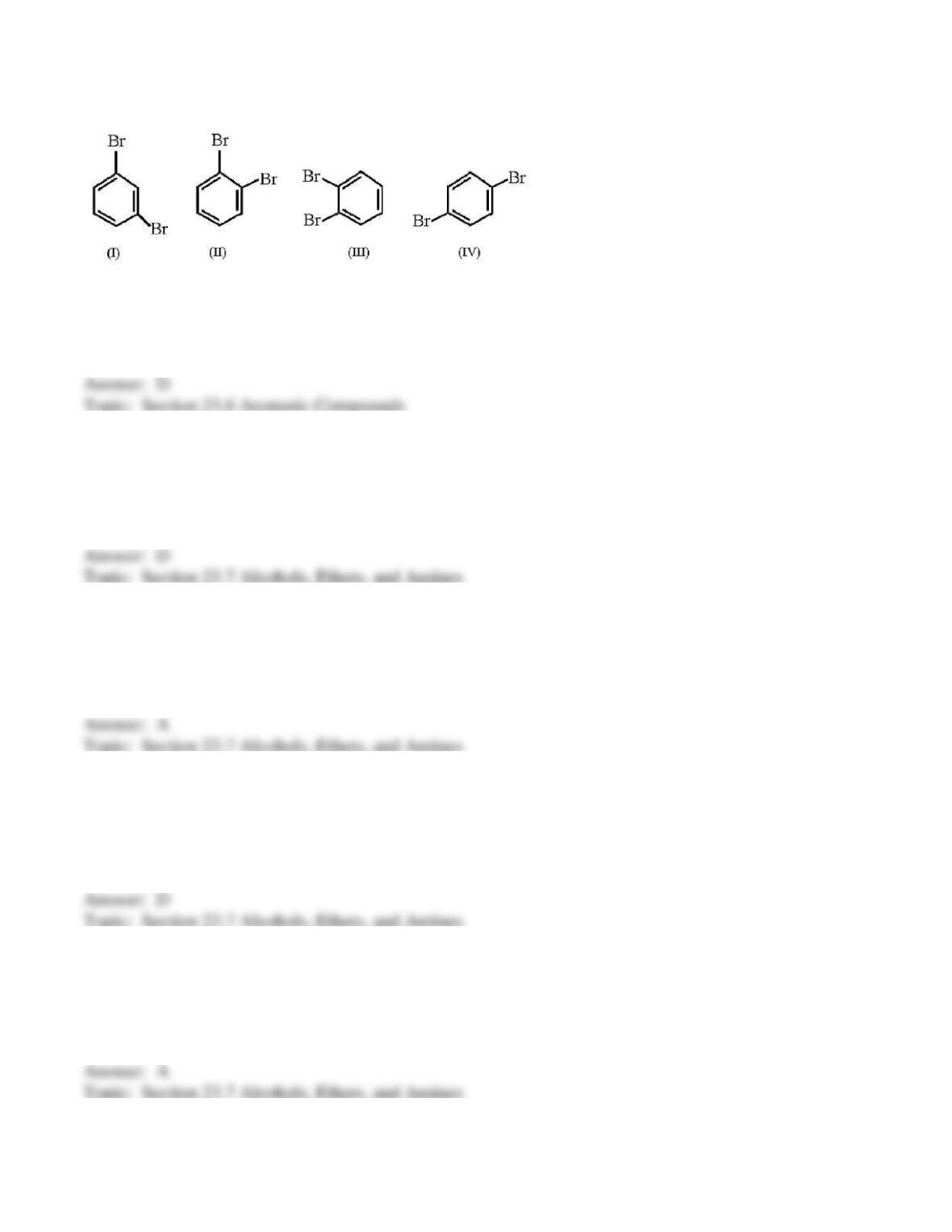
69) Which structure is meta-dibromobenzene?
A) structure I
B) structure II
C) structure III
D) structure IV
19
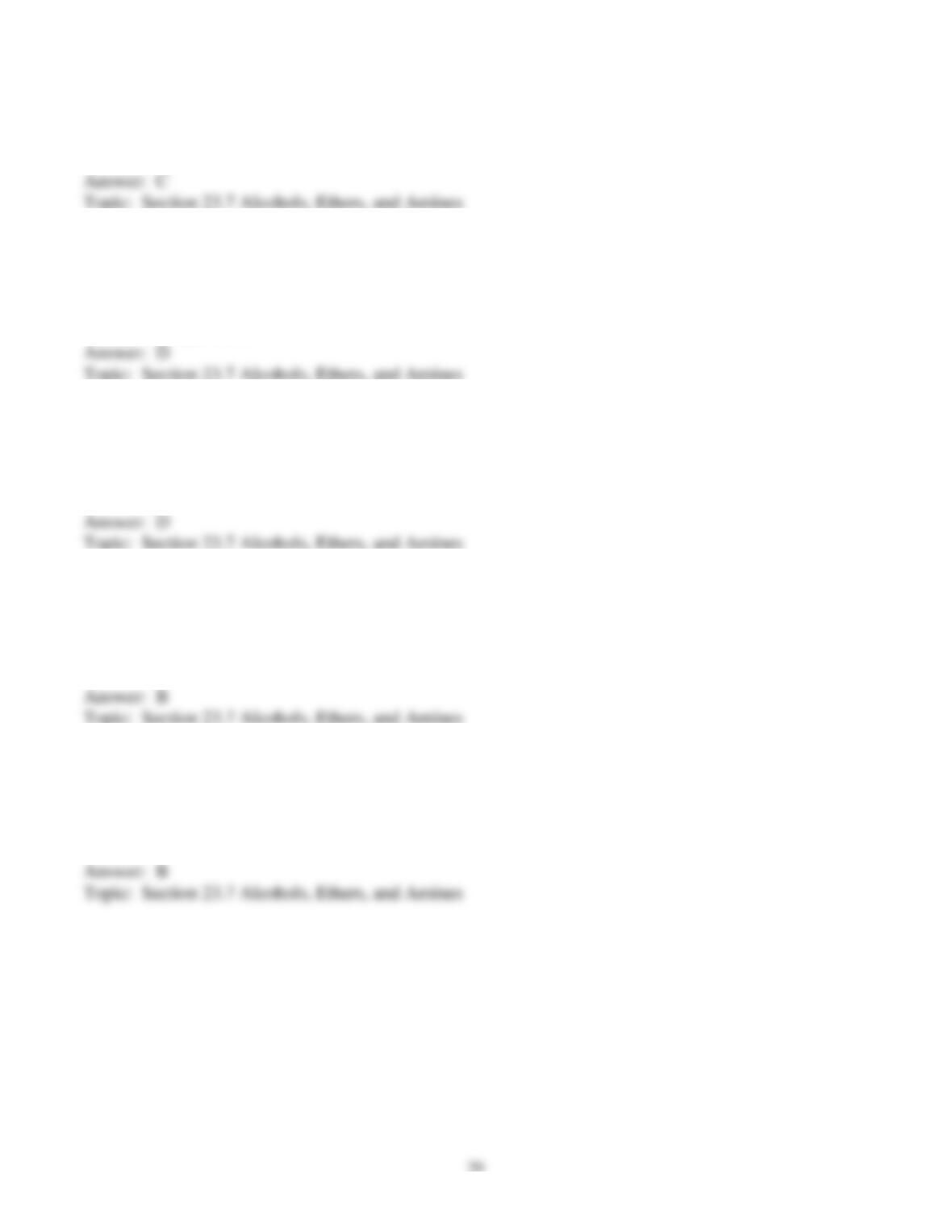
70) Which structure is para-dibromobenzene?
A) structure I
B) structure II
C) structure III
D) structure IV
71) Which of the following statements about amines is not correct? Amines are
A) bases (proton acceptors).
B) converted to ammonium salts by reaction with HCl.
C) organic derivatives of ammonia.
D) very water soluble.
72) The boiling point of 1-propanol should be ________ than the boiling point of methyl ethyl ether.
A) higher than
B) lower than
C) the same as
D) cannot be determined
73) What is the proper name for (CH3)2CHCH(OH)CH3?
A) isopropanol
B) isopentanol
C) 2-methylpentanol
D) 3-methyl-2-butanol
74) “Wood alcohol” is the common name for
A) methanol.
B) ethanol.
C) 2-propanol.
D) 1, 2-ethanediol.
75) “Rubbing alcohol” is the common name for
A) methanol.
B) ethanol.
C) 2-propanol.
D) 1, 2-ethanediol.
76) “Glycerol” is the common name for
A) ethanol.
B) 2-propanol.
C) 1, 2-ethanediol.
D) 1, 2, 3-propanetriol.
77) Which of the following compounds is most soluble in water?
A) decanol
B) dimethyl ether
C) ethane
D) ethanol
78) How many ether isomers have the formula C4H10O?
A) 2
B) 3
C) 4
D) 5
79) What type of compound contains the –NH2 functional group?
A) alcohol
B) amine
C) carboxylic acid
D) ether