Environment: Science Behind the Stories, 2e Cdn. Ed. (Withgott)
Chapter 23 Strategies for Sustainability
23.1 Graph and Figure Interpretation Questions
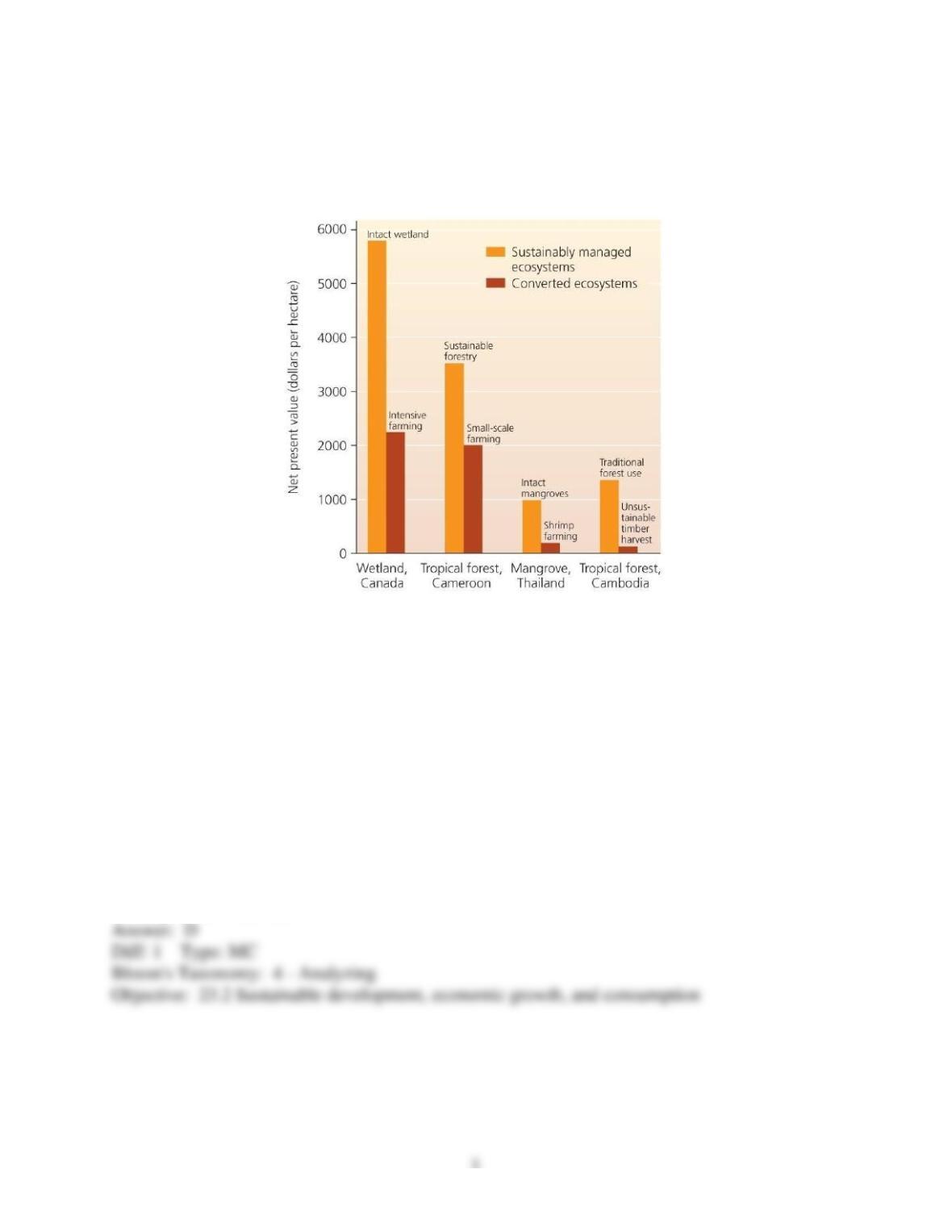
Figure 23.1
Use Figure 23.1 to answer the following questions.
Scientists with the Millennium Ecosystem Assessment analyzed sustainably managed
ecosystems. In this graph, the sustainably managed ecosystems and the ecosystems that have
been converted to private use are compared. Shown are land values calculated by researchers in
four such comparisons from sites around the world.
1) Refer to Figure 23.1. Which ecosystem has the greatest value?
A) Tropical forest, Cameroon
B) Mangrove, Thailand
C) Mangrove, Thailand plus tropical forest, Cambodia
D) Wetland, Canada
E) Tropical forest, Cambodia

2) Refer to Figure 23.1. Which ecosystem lost the most value (in dollars per hectare) on its
conversion to private use?
A) Tropical forest, Cameroon
B) Wetland, Canada
C) Mangrove, Thailand plus Tropical forest, Cambodia
D) Tropical forest, Cambodia
E) Mangrove, Thailand
3) Refer to Figure 23.1. Which of the conversions had the worst “rate of return” (i.e., which
ecosystem lost the highest percentage of its original value as a result of the conversion)?
A) Tropical forest, Cambodia
B) Wetland, Canada
C) Tropical forest, Cameroon
D) Mangrove, Thailand
E) None of the graphs show a particularly bad rate of return.

3
23.2 Matching Questions
Match the following.
A) “cradle to grave” analysis
B) external
C) RecycleMania
D) acquisition fever
E) environmental bottleneck
F) environmental logjam
G) biodegradable masonry
H) affluenza
I) Talloires Declaration
J) internalized
K) “triple bottom line” analysis
L) high energy efficiency
1) Wealthy people in developed countries often have this
2) An effect of unsustainable societal practices
3) University leaders pursuing sustainability
4) Characteristic considered by sustainable, energy–efficient universities when they build green
buildings
5) Sustainable accounting practices include these costs
6) A proper analysis of all environmental impacts of a given product or practice

4
23.3 Short Answer Questions
1) What is the Talloires Declaration?
2) At what level(s) do we have to make efforts to achieve a sustainable world civilization?
3) Give examples of “voting for environmental issues with wallets” on campus.
4) What is the definition of true progress for our entire planet?
5) What are two of the simplest and most common campus sustainability efforts?
6) What is the first step toward a sustainable campus?
7) Some progressive industries are making their processes more sustainable by mimicking
________ by transforming linear pathways into closed cycles in which waste is recovered,

recycled, and reused.
8) Populations may grow exponentially for a time, but they eventually run up against limiting
factors and level off at a ________.
9) The labelling of products produced through sustainable methods is called ________.
10) ________ is meant to sustain human civilization in a happy, healthy state.
11) The success of the Summerhill Group in dealing with corporations was achieved thanks to
________.

23.4 Multiple-Choice Questions
1) The Environmental Performance Index uses data on 10 environmental indicators divided into
two categories: ________ and ________.
A) ecosystem health; ecosystem vitality
B) ecosystem health; climate change
C) air pollution; ecosystem vitality
D) ecosystem health; biodiversity and habitat
E) ecosystem vitality; biodiversity and habitat
2) Working to achieve sustainability on college and university campuses ________.
A) will have long–term benefits to society when students graduate
B) increases costs to students
C) is not a vital part of university curricula
D) is opposed by most universities
E) will have no impact on society after students graduate
3) Student sustainability movements are more successful when administration is shown how a
policy of sustainable practices ________.
A) increases the prestige of the college/university
B) recruits more top–notch faculty
C) attracts a more diverse student body
D) saves money
E) wins more awards

4) Colleges and universities can advocate for sustainability with a focus on local biodiversity by
________.
A) choosing to build new buildings using “green” materials, designs, and technology
B) conducting an audit of operations to determine ecological footprint
C) ignoring recommendations from an audit of operations
D) having procedures and technology to use energy and water efficiently
E) using native plants in landscaping
5) Sustainability is about ________.
A) sustaining resource use at current or higher levels
B) keeping the natural environment and human society in a happy, healthy, and functional state
C) holding or increasing the current quality of human life
D) always focusing on fulfilling short–term needs
E) opposing change from current policies
6) The current use of fossil fuels versus the need to develop new renewable energy sources is an
example of ________.
A) how short–term needs are in opposition to long–term sustainability
B) two different goals that are not in opposition
C) governmental vision competing with economic practicalities
D) two unrelated and independent but positive environmental goals
E) an issue that will never be resolved
7) The highest scores of the Environmental Performance Index are in ________.
A) northern Europe
B) developing countries
C) developed countries
D) North America
E) Africa

8
8) Our consumptive lifestyles are ________.
A) a new phenomenon on Earth
B) sustainable if we use technology properly
C) consistent with the lifestyles of previous generations
D) not affecting the environment on account of environmental regulations
E) not likely to affect the ability of developing countries to obtain natural resources
9) Sustainable development involves ________.
A) reducing consumption, increasing efficiency, and using renewable energies
B) larger buildings using stronger design and materials
C) developing better transportation by building more roads
D) using all resources at maximum rates
E) sustaining growth by increasing economically recoverable reserves
10) A reason for the “economy against environment” mindset is ________.
A) the difference in salary between environmental watchdogs and corporate CEOs
B) CEOs are usually Conservatives and environmental advocates are Liberals
C) industrialization and urbanization have broken the connections among ourselves, our
economies, and our natural environment
D) typical of environmentalists who would stifle the economy to protect species most people
have not heard about
E) command–and–control environmental policy may be too costly for industry and infringe on
private owners’ rights
11) The lowest scores of the Environmental Performance Index are in ________.
A) Africa and Southeast Asia
B) developing countries
C) developed countries
D) North America
E) northern Europe
12) Reconnecting ourselves with nature ________.

A) is possible only after economic development, because only then we can afford it
B) requires considering the origin of what we use, so we can see our interdependence with the
environment
C) is something society cannot afford in the long run
D) requires curbing human population growth
E) is something good only for modern-day “hippies”
13) Producing responsible and constructive technology that can achieve sustainable solutions
requires ________.
A) funding for scientific research and elimination of damaging and inefficient technology
B) an increase of the technology developed by the free market
C) having citizens be cognizant of the need for politicians to work with “big business”
D) public pressure to limit infringement of intellectual property rights
E) importing inferior technology to developing countries while developed countries invest in
green technology
14) Ecological economists suggest that we can gain a better understanding of economics and
human interactions with the environment if we view human economies as ________.
A) consumer driven
B) preservation driven
C) entities that are integrated within natural systems
D) entities that are devoid of ecosystem characteristics
E) consumption driven

15) Which of the following will lead to sustainability?
A) increasing energy production from renewable sources
B) reducing consumption and halting population growth
C) increasing population growth, because with the growth there will be more people to support
our social safety net
D) sustaining a high consumer growth rate
E) creating industrial systems that are linear in design and operation
16) We could, in theory, make all of our industrial processes sustainable if we could ________.
A) transform cyclic processes into linear ones
B) transform linear processes into circular ones
C) speed up the disposal of wastes by deep-well injection
D) develop more draconian policies to regulate manufacturing
E) reduce the use of biodegradable plastics
17) Many proponents of sustainability believe that encouraging local self–sufficiency is
important for building sustainable societies because ________.
A) it eliminates governmental influence on local practices
B) it forces citizens to look more closely at the global community
C) when people are tied more closely to the area they live in, they are more aware of their link
with the environment
D) more and more people are growing gardens
E) This is not correct; proponents of sustainability believe that the solution is finding more
effective ways of using our resources through the opposite tendency: globalization.
18) Some argue that globalization will have a negative impact because ________.
A) it entails multinational corporations attaining greater and greater power over global trade
B) it entails weakened central power as a result of homogenization
C) the United Nations will gain more power over national governments
D) citizens will gain more power
E) it will decentralize control of power to many stakeholders

11
19) If Earth’s 4.6-billion-year history was compressed into 12 hours, the first life would have
appeared at 2:52, and modern humans (Homo sapiens) would have appeared around ________.
A) 9:50
B) 10:54
C) 11:59:45
D) 11:59:55
E) 11:59:59
20) There is ample reason to hope that, because of human ________, we may achieve
sustainability before doing too much damage to our planet and our own prospects.
A) consumption patterns
B) ingenuity and determination
C) rationalization
D) “affluenza”
E) procrastination
21) The lesson of Easter Island was that ________.
A) economics is an important facilitator of sustainable societies
B) conservation of resources is necessary for sustainable societies
C) we never comprehend resource issues until the resources are gone
D) grassroots organizations must be involved to ensure sustainable societies
E) political and governmental support are required to ensure sustainable societies
22) Our global society has a greater potential to address concerns of sustainability today
compared to previous societies because ________.
A) politicians have to address the long-term sustainability to be elected again
B) we have a democracy
C) we have many thousands of scientists who study Earth’s processes and resources closely
D) of the Charter of Rights and Freedoms
E) we value goods
23) To encourage corporations to adopt green technologies in a capitalist economy, citizens can

________.
A) choose products from companies that adopt sustainable practices
B) visibly protest companies that are destructive to the environment
C) choose products with the lowest price
D) write letters to all companies encouraging them to adopt green technologies
E) attend meetings with other people who desire green technologies
24) An important way to alter the perception that protecting the environment is incompatible
with economic progress is through ________.
A) education and collaboration
B) consumerism and competition
C) top–down governmental regulations
D) articles in newspapers
E) picketing and paying for newspaper ads
25) It is imperative that developed countries assist developing countries in economic
advancement for sustainability because ________.
A) there is a direct connection between poverty and those who suffer the most from
environmental degradation
B) it is less expensive for developing countries to manufacture the consumer goods needed by
developed countries
C) it is easier and less expensive to exploit resources in developing countries
D) it is easier and less expensive to create physical and governmental infrastructure to support
heavy industry in developing countries
E) all people in developing countries welcome the influx of foreign corporations for economic
assistance