
College Physics: A Strategic Approach, 3e (Knight)
Chapter 23 Circuits
23.1 Conceptual Questions
1) When two or more different capacitors are connected in series across a potential source, which
of the following statements must be true? (There could be more than one correct choice.)
A) The total voltage across the combination is the algebraic sum of the voltages across the
individual capacitors.
B) Each capacitor carries the same amount of charge.
C) The equivalent capacitance of the combination is less than the capacitance of any of the
capacitors.
D) The potential difference across each capacitor is the same.
E) The capacitor with the largest capacitance has the most charge.
2) Three identical capacitors are connected in series across a potential source (battery). If a
charge of Q flows into this combination of capacitors, how much charge does each capacitor
carry?
A) 3Q
B) Q
C) Q/3
D) Q/9
3) Three identical capacitors are connected in parallel to a potential source (battery). If a charge
of Q flows into this combination, how much charge does each capacitor carry?
A) 3Q
B) Q
C) Q/3
D) Q/9
4) When two or more different capacitors are connected in parallel across a potential source
(battery), which of the following statements must be true? (There could be more than one
correct choice.)
A) The potential difference across each capacitor is the same.
B) Each capacitor carries the same amount of charge.
C) The equivalent capacitance of the combination is less than the capacitance of any one of the
capacitors.
D) The capacitor with the largest capacitance has the largest potential difference across it.
E) The capacitor with the largest capacitance has the most charge.
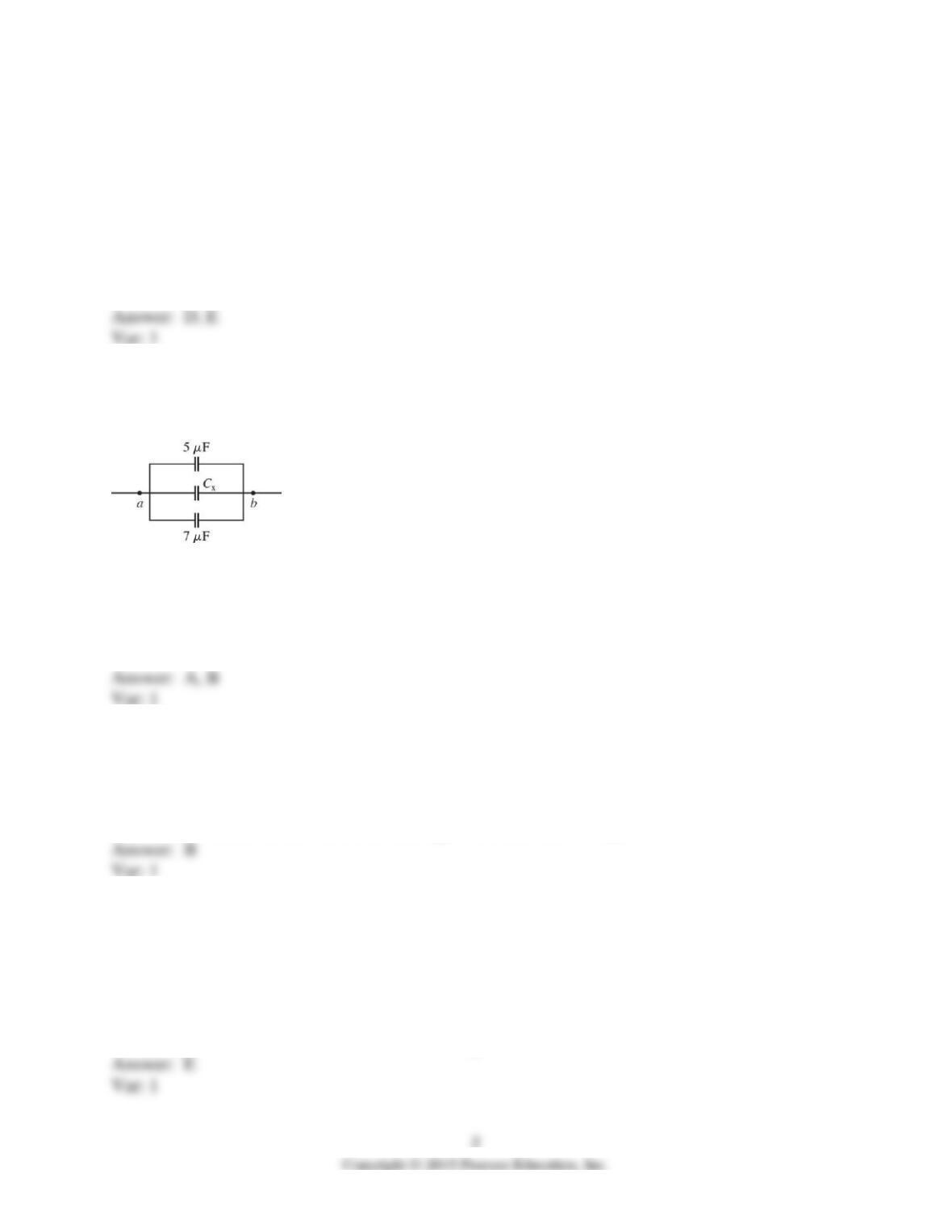
5) A 5-µF, a 7-µF, and an unknown capacitor CX are connected in series between points a and b.
What do you know about the equivalent capacitance Cab between a and b? (There could be more
than one correct choice.)
A) Cab > 12 µF
B) 5 µF < Cab < 7 µF
C) 5 µF < Cab < 12 µF
D) Cab < 5 µF
E) Cab < CX
6) A 5-µF, a 7-µF, and an unknown capacitor CX are connected in parallel between points a and
b as shown in the figure. What do you know about the equivalent capacitance Cab between a and
b? (There could be more than one correct choice.)
A) Cab > 12 µF
B) Cab > CX
C) 5 µF < Cab < 12 µF
D) Cab < 5 µF
E) Cab < CX
7) Suppose you have two capacitors and want to use them to store the maximum amount of
energy by connecting them across a voltage source. You should connect them
A) in series across the source.
B) in parallel across the source.
C) It doesn’t matter because the stored energy is the same either way.
8) Four unequal resistors are connected in series with each other. Which one of the following
statements is correct about this combination?
A) The equivalent resistance is equal to that of any one of the resistors.
B) The equivalent resistance is equal to average of the four resistances.
C) The equivalent resistance is less than that of the smallest resistor.
D) The equivalent resistance is less than that of the largest resistor.
E) The equivalent resistance is more than the largest resistance.
9) Four unequal resistors are connected in a parallel with each other. Which one of the following
statements is correct about this combination?
A) The equivalent resistance is less than that of the smallest resistor.
B) The equivalent resistance is equal to the average of the four resistances.
C) The equivalent resistance is midway between the largest and smallest resistance.
D) The equivalent resistance is more than the largest resistance.
E) None of the other choices is correct.
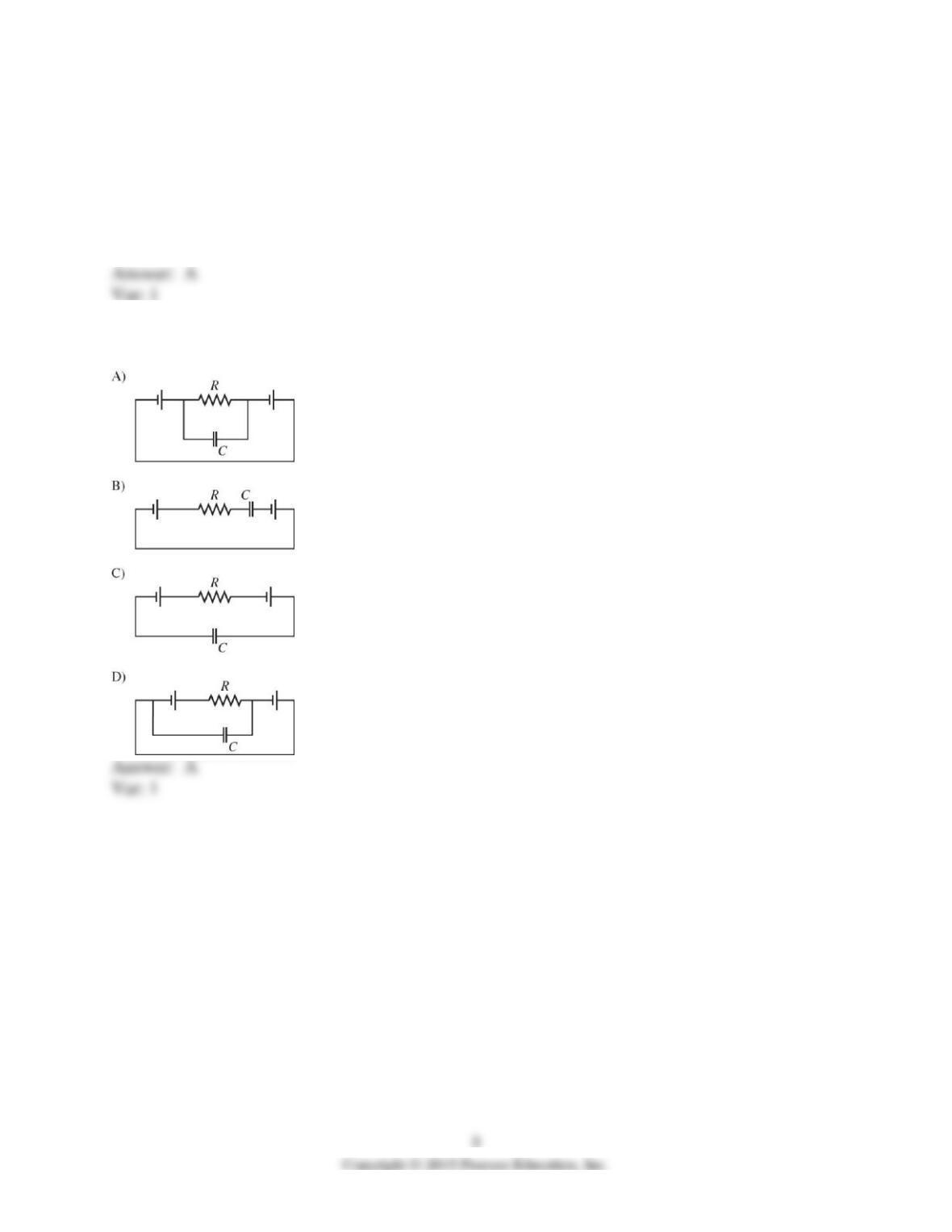
10) Draw a circuit with two batteries, a resistor between them, and a capacitor in parallel with
the resistor. The batteries are connected negative pole to positive pole.
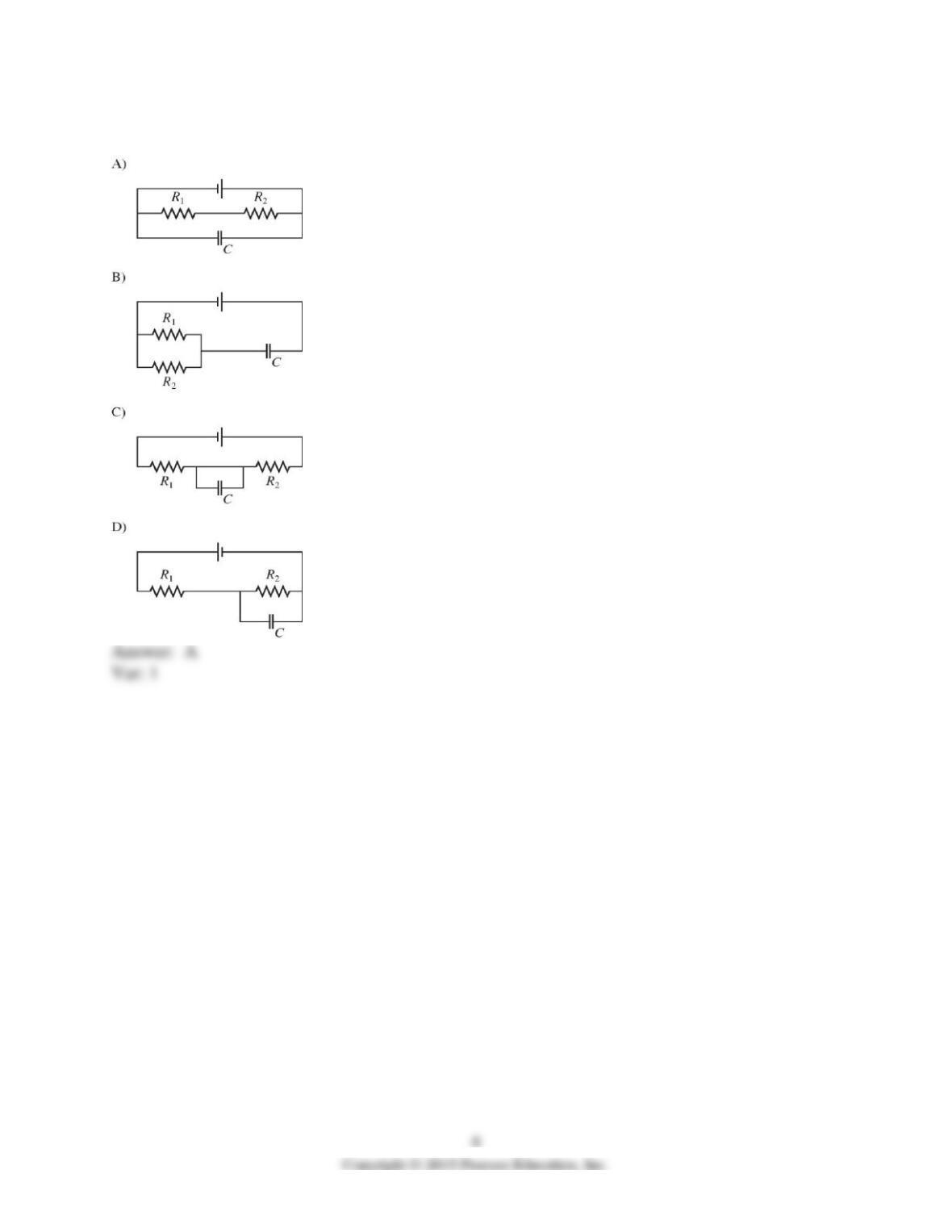
11) Draw a circuit consisting of a battery connected to two resistors, R1 and R2, in series with
each other and a capacitor C connected across the resistors.
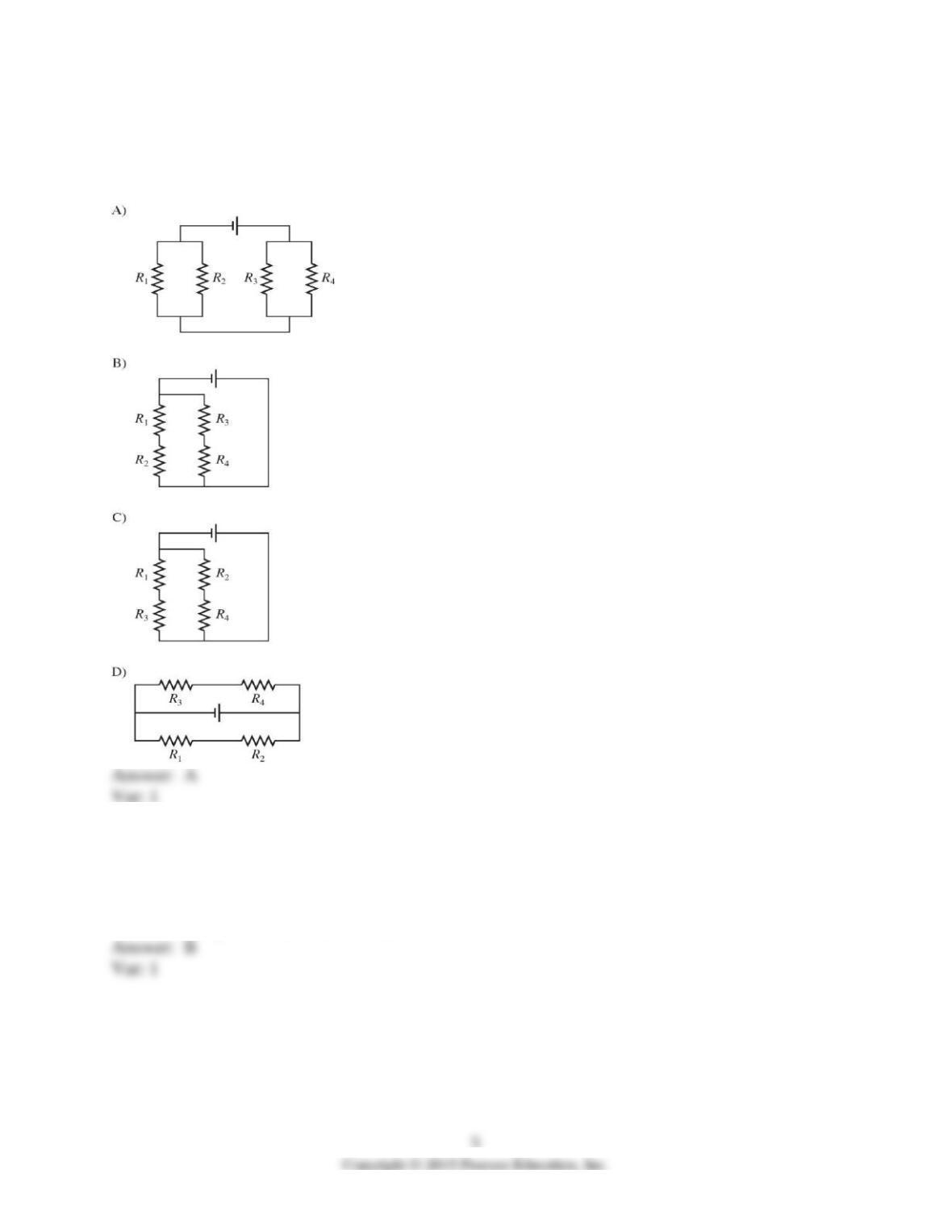
12) Draw a circuit with a battery connected to four resistors, R1, R2, R3, and R4, as follows.
Resistors R1 and R2 are connected in parallel with each other, resistors R3 and R4 are connected
in parallel with each other, and both parallel sets of resistors are connected in series with each
other across the battery.
13) When unequal resistors are connected in parallel in a circuit,
A) the same current always runs through each resistor.
B) the potential drop is always the same across each resistor.
C) the largest resistance has the largest current through it.
D) the power generated in each resistor is the same.

14) When unequal resistors are connected in series across an ideal battery,
A) the same power is dissipated in each one.
B) the potential difference across each is the same.
C) the current flowing in each is the same.
D) the equivalent resistance of the circuit is less than that of the smallest resistor.
E) the equivalent resistance of the circuit is equal to the average of all the resistances.
15) You obtain a 100-W light bulb and a 50-W light bulb. Instead of connecting them in the
normal way, you devise a circuit that places them in series across normal household voltage. If
each one is an incandescent bulb of fixed resistance, which statement about these bulbs is
correct?
A) Both bulbs glow with the same brightness, but less than their normal brightness.
B) Both bulbs glow with the same brightness, but more than their normal brightness.
C) The 100-W bulb glows brighter than the 50-W bulb.
D) The 50-W bulb glows more brightly than the 100-W bulb.
16) As more resistors are added in series to a constant voltage source, the power supplied by the
source
A) increases.
B) decreases.
C) does not change.
D) increases for a time and then starts to decrease.
17) As more resistors are added in parallel across a constant voltage source, the power supplied
by the source
A) increases.
B) decreases.
C) does not change.
D) increases for a time and then starts to decrease.
18) When different resistors are connected in parallel across an ideal battery, we can be certain
that
A) the same current flows in each one.
B) the potential difference across each is the same.
C) the power dissipated in each is the same.
D) their equivalent resistance is greater than the resistance of any one of the individual
resistances.
E) their equivalent resistance is equal to the average of the individual resistances.
19) The lamps in a string of decorative lights are connected in parallel across a constant-voltage
power source. What happens if one lamp burns out? (Assume negligible resistance in the wires
leading to the lamps.)
A) The brightness of the lamps will not change appreciably.
B) The other lamps get brighter equally.
C) The other lamps get brighter, but some get brighter than others.
D) The other lamps get dimmer equally.
E) The other lamps get dimmer, but some get dimmer than others.
20) A 9-V battery is hooked up to two resistors in series using wires of negligible resistance. One
has a resistance of 5 Ω, and the other has a resistance of 10 Ω. Several locations along the circuit
are marked with letters, as shown in the figure. Which statements about this circuit are true?
(There could be more than one correct choice.)
A) The current is exactly the same at points A, B, C, and D.
B) The current at A is greater than the current at B, which is equal to the current at C, which is
greater than the current at D.
C) The current at A is greater than the current at B, which is greater than the current at C, which
is greater than the current at D.
D) The potential at B is equal to the potential at C.
E) The potential at D is equal to the potential at C.
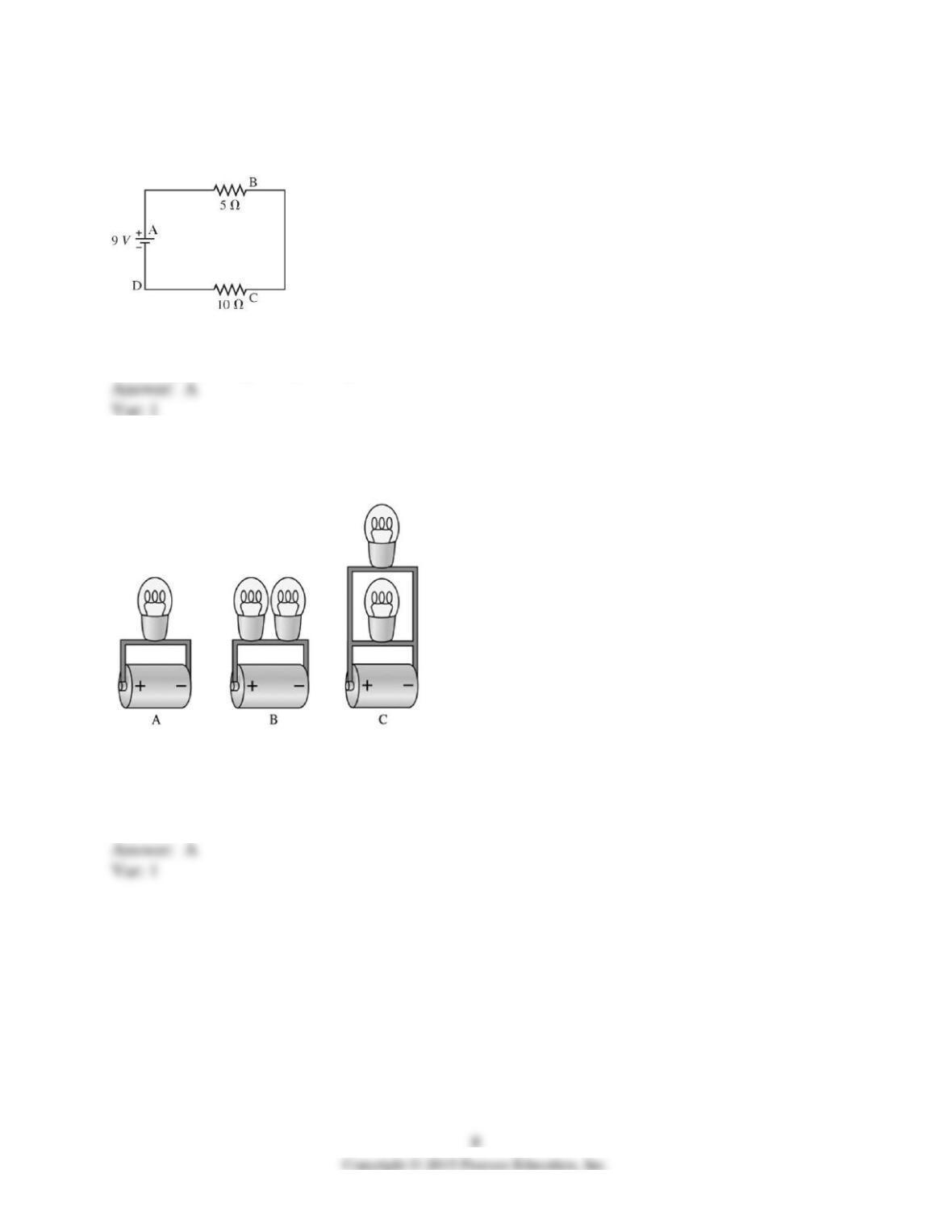
21) A 9-V battery is hooked up to two resistors in series. One has a resistance of 5 Ω, and the
other has a resistance of 10 Ω. Several locations along the circuit are marked with letters, as
shown in the figure. Through which resistor is energy being dissipated at the higher rate?
A) the 10-Ω resistor
B) the 5-Ω resistor
C) Energy is being dissipated by both resistors at the same rate.
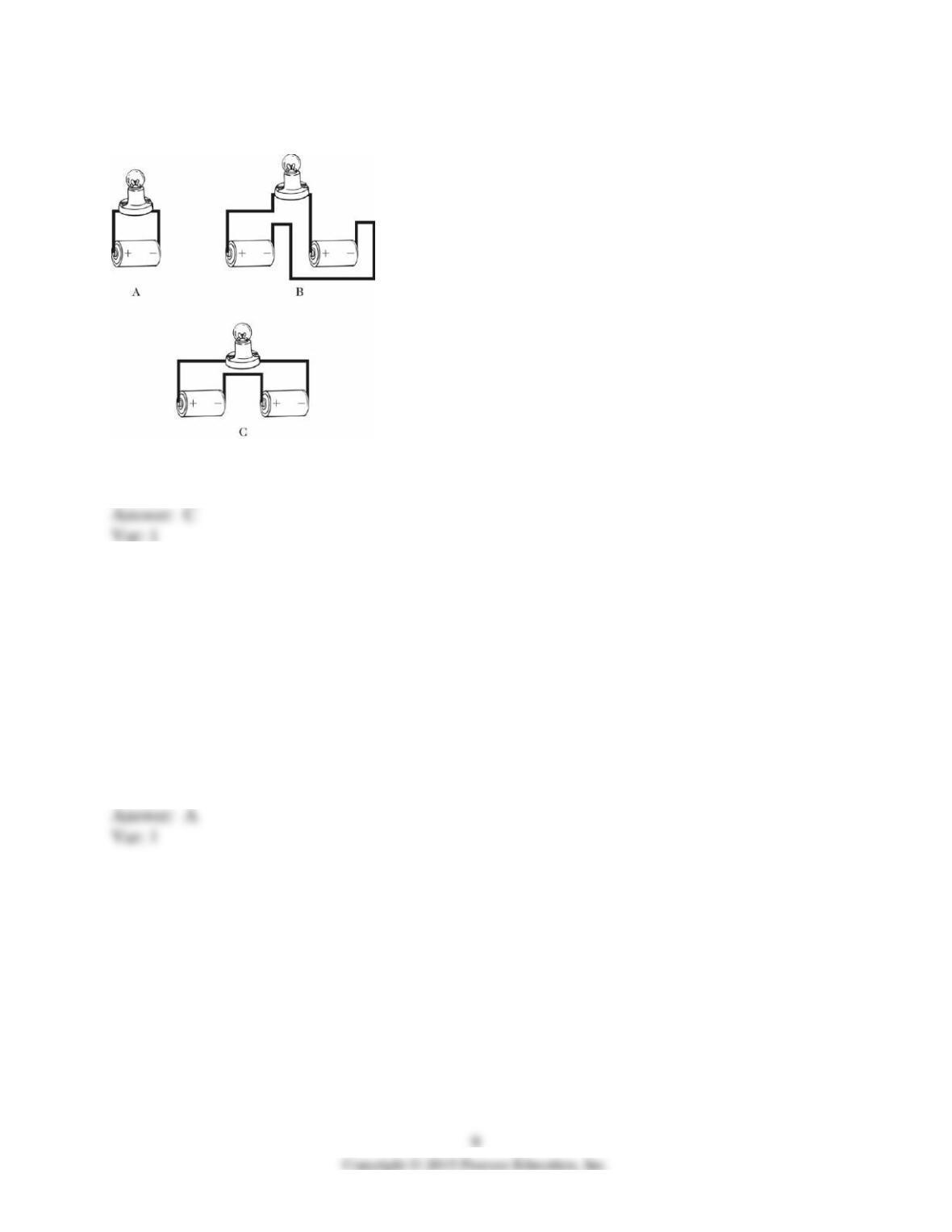
22) Identical light bulbs can be attached to identical ideal batteries in three different ways (A, B,
or C), as shown in the figure. The ranking (from lowest to highest) of the total power produced
by the battery is
A) B, A, C
B) A, B, C
C) C, B, A
D) A, C, B
E) C, A, B
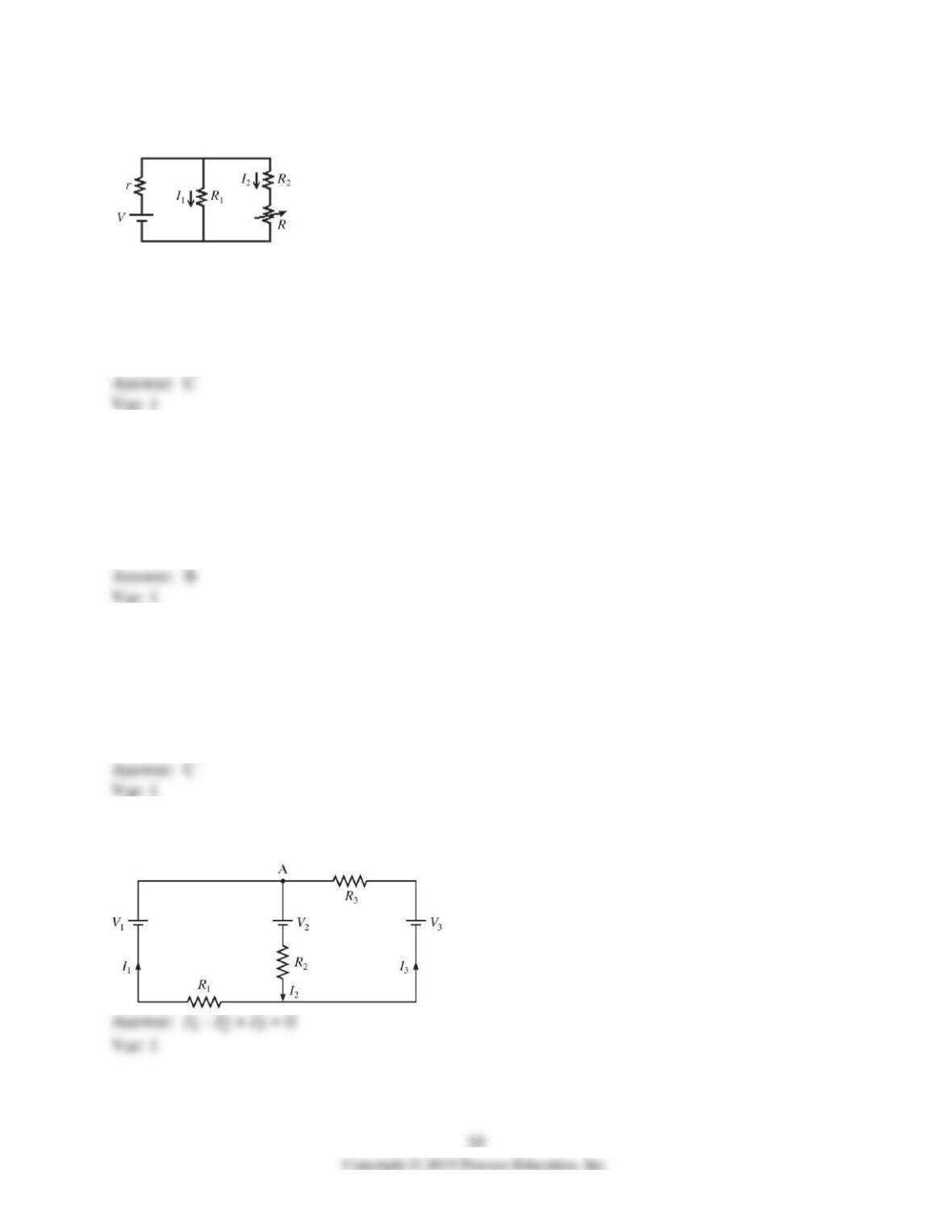
23) Identical ideal batteries are connected in different arrangements to the same light bulb, as
shown in the figure. For which arrangement will the bulb shine the brightest?
A) A
B) B
C) C
24) A resistor is made out of a wire having a length L. When the ends of the wire are attached
across the terminals of an ideal battery having a constant voltage V0 across its terminals, a
current I flows through the wire. If the wire were cut in half, making two wires of length L/2, and
both wires were attached across the terminals of the battery (the right ends of both wires attached
to one terminal, and the left ends attached to the other terminal), how much current would the
battery put out?
A) 4I
B) 2I
C) I
D) I/2
E) I/4
25) In the circuit shown in the figure, the resistor R has a variable resistance. As R is decreased,
what happens to the currents?
A) I1 remains unchanged and I2 increases.
B) I1 decreases and I2 decreases.
C) I1 decreases and I2 increases.
D) I1 increases and I2 decreases.
E) I1 increases and I2 increases.
26) Kirchhoff’s junction rule is a statement of
A) the law of conservation of momentum.
B) the law of conservation of charge.
C) the law of conservation of energy.
D) the law of conservation of angular momentum.
E) Newton’s second law.
27) Kirchhoff’s loop rule is a statement of
A) the law of conservation of momentum.
B) the law of conservation of charge.
C) the law of conservation of energy.
D) the law of conservation of angular momentum.
E) Newton’s second law.
28) For the circuit shown in the figure, write the Kirchhoff current equation for the node labeled
A. Notice the directions of the currents!
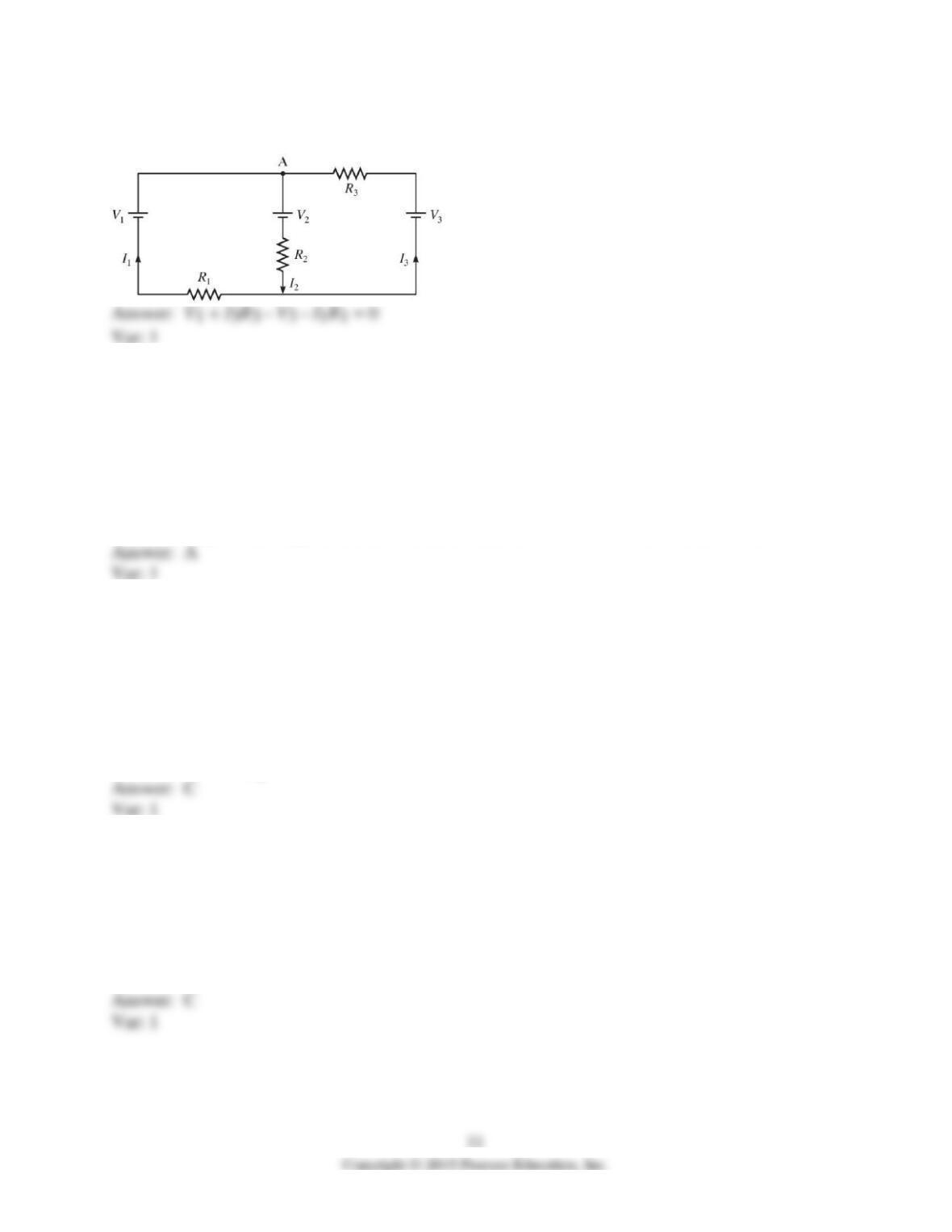
29) For the circuit shown in the figure, write the Kirchhoff loop equation for the entire outside
loop. Notice the directions of the currents!
30) A resistor, an uncharged capacitor, a dc voltage source, and an open switch are all connected
in series. The switch is closed at time t = 0 s. Which one of the following is a correct statement
about this circuit?
A) The charge on the capacitor after four time constants is about 98% of the maximum value.
B) The charge on the capacitor after one time constant is 50% of its maximum value.
C) The charge on the capacitor after one time constant is 1/e of its maximum value.
D) The voltage on the capacitor after one time constant is 1/e of the maximum value.
E) The voltage on this capacitor after one time constant is 100% of its maximum value.
31) A capacitor C is connected in series with a resistor R across a battery and an open switch. If a
second capacitor of capacitance 2C is connected in parallel with the first one, the time constant
of the new RC circuit will be
A) the same as before.
B) twice as large as before.
C) three times a large as before.
D) one-half as large as before.
E) one-fourth as large as before.
32) A capacitor C is connected in series with a resistor R across a battery and an open switch. If a
second capacitor of capacitance 2C is connected in series with the first one, the time constant of
the new RC circuit will be
A) the same as before.
B) larger than before.
C) smaller than before.
D) variable.
33) A resistor, an uncharged capacitor, a dc voltage source, and an open switch are all connected
in series. The switch is closed at time t = 0 s. Which one of the following is a correct statement
about the circuit?
A) The capacitor charges to its maximum value in one time constant.
B) The capacitor charges to its maximum value in two time constants.
C) The potential difference across the resistor is always equal to the potential difference across
the capacitor.
D) Current flows through the circuit even after the capacitor is essentially fully charged.
E) Once the capacitor is essentially fully charged, there is no current in the circuit.
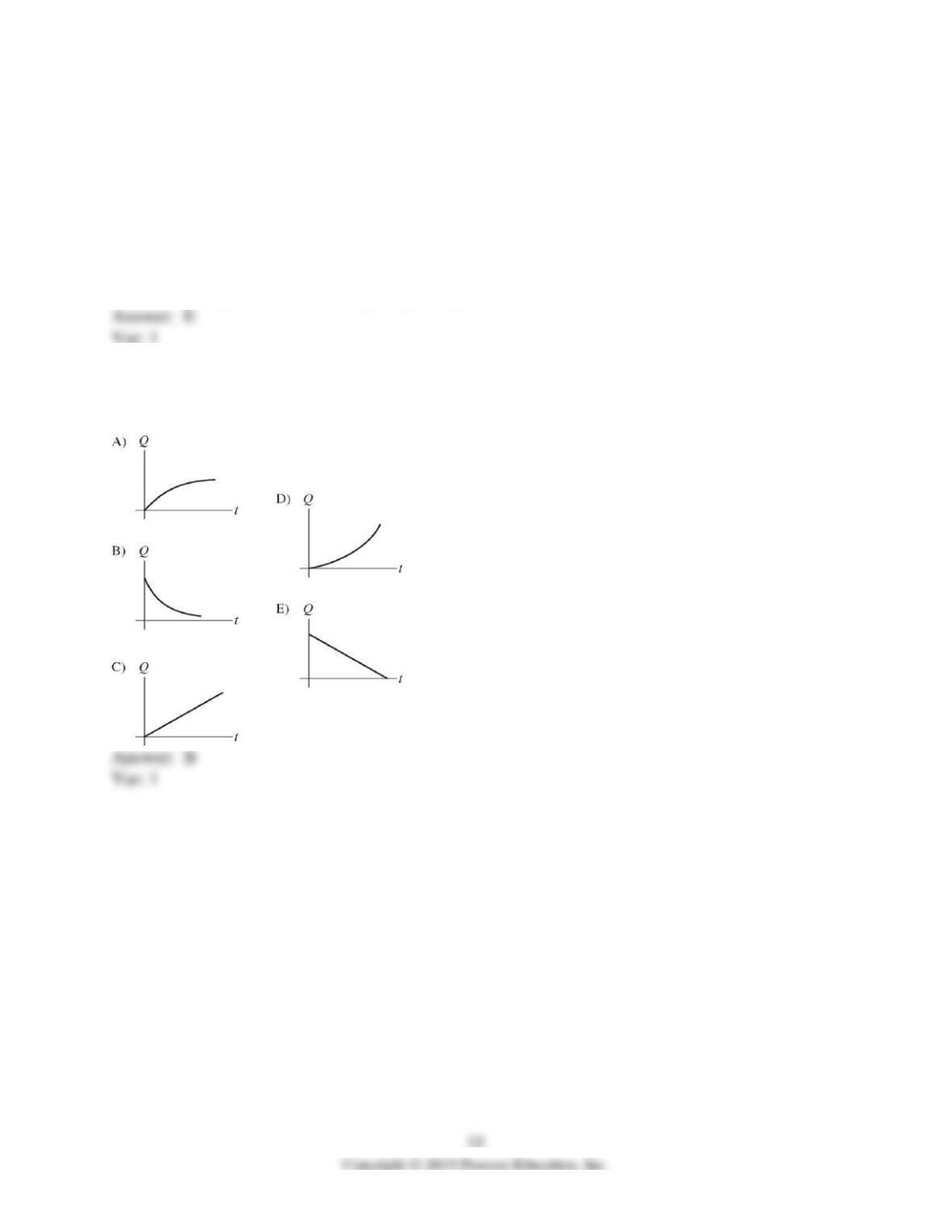
34) A charged capacitor is connected in series with a resistor and an open switch. At time t = 0 s,
the switch is closed. Which of the graphs below best describes the charge Q on the capacitor as a
function of time t?
35) An uncharged capacitor is connected in series with a resistor, a dc battery, and an open
switch. At time t = 0 s, the switch is closed. Which of the graphs below best describes the charge
Q on the capacitor as a function of time t?
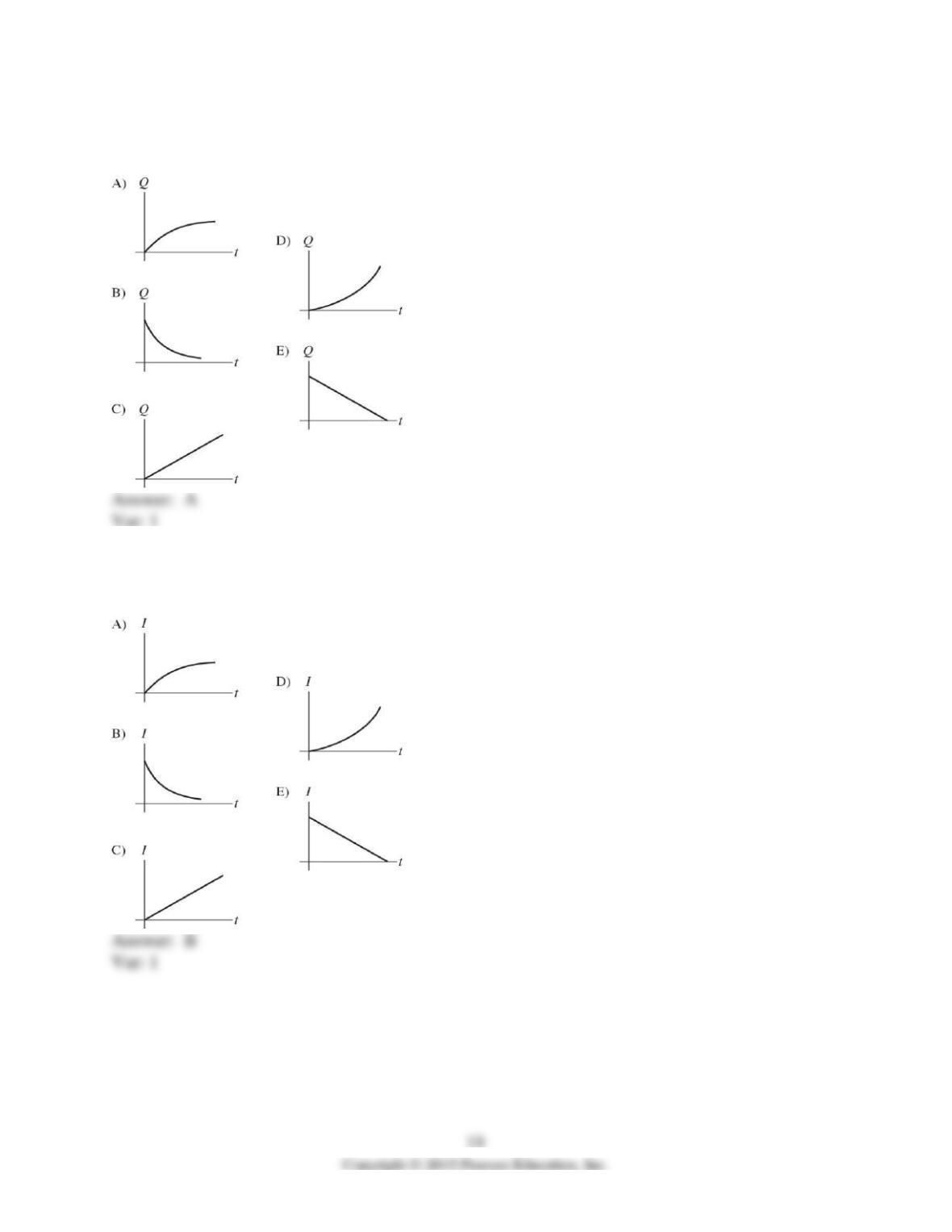
36) A charged capacitor is connected in series with a resistor and an open switch. At time t = 0 s,
the switch is closed. Which of the graphs below best describes the current I through the resistor
as a function of time t?
37) An uncharged capacitor is connected in series with a resistor, a dc battery, and an open
switch. At time t = 0 s, the switch is closed. Which of the graphs below best describes the current
I through the resistor as a function of time t?
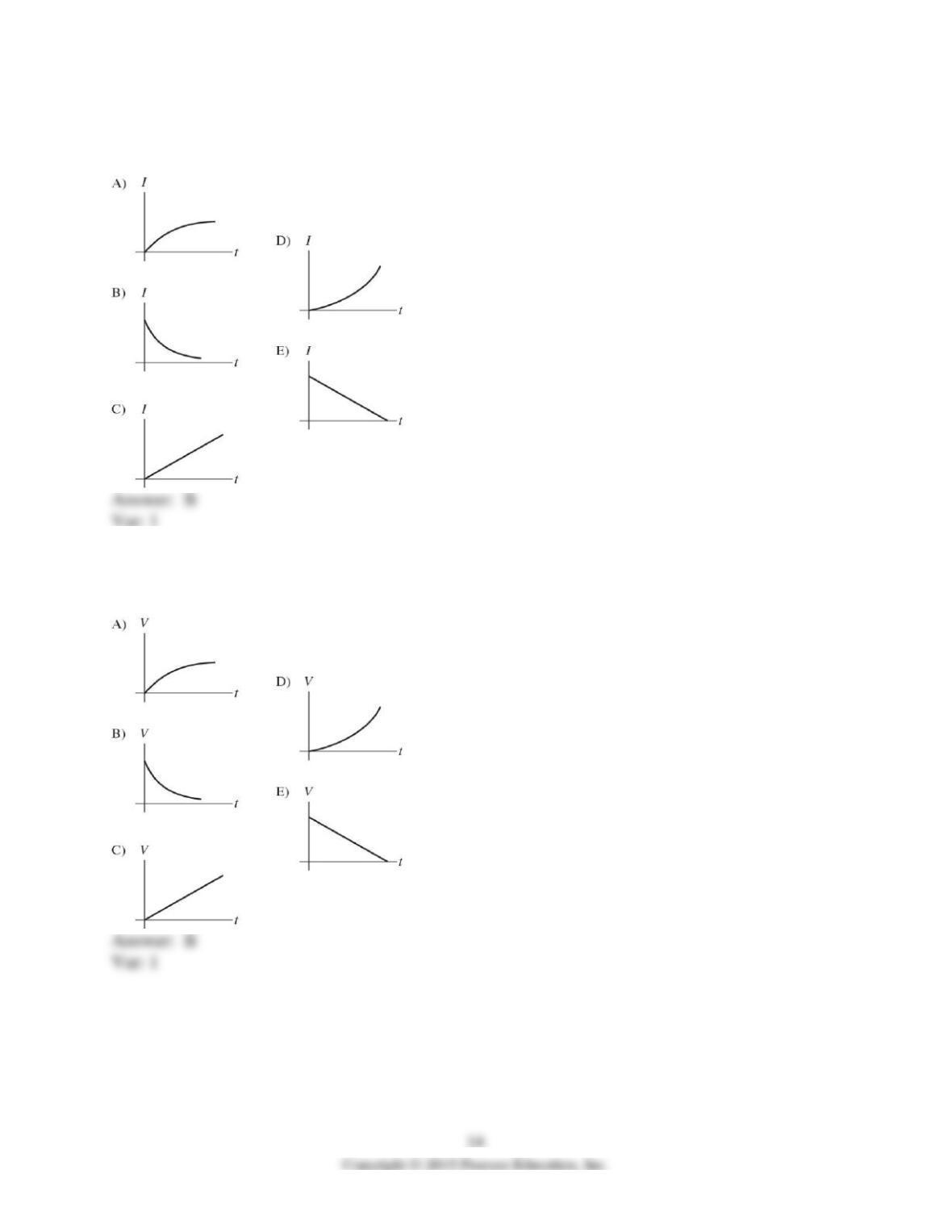
38) A charged capacitor is connected in series with a resistor and an open switch. At time t = 0 s,
the switch is closed. Which of the graphs below best describes the potential difference V across
the resistor as a function of time t?
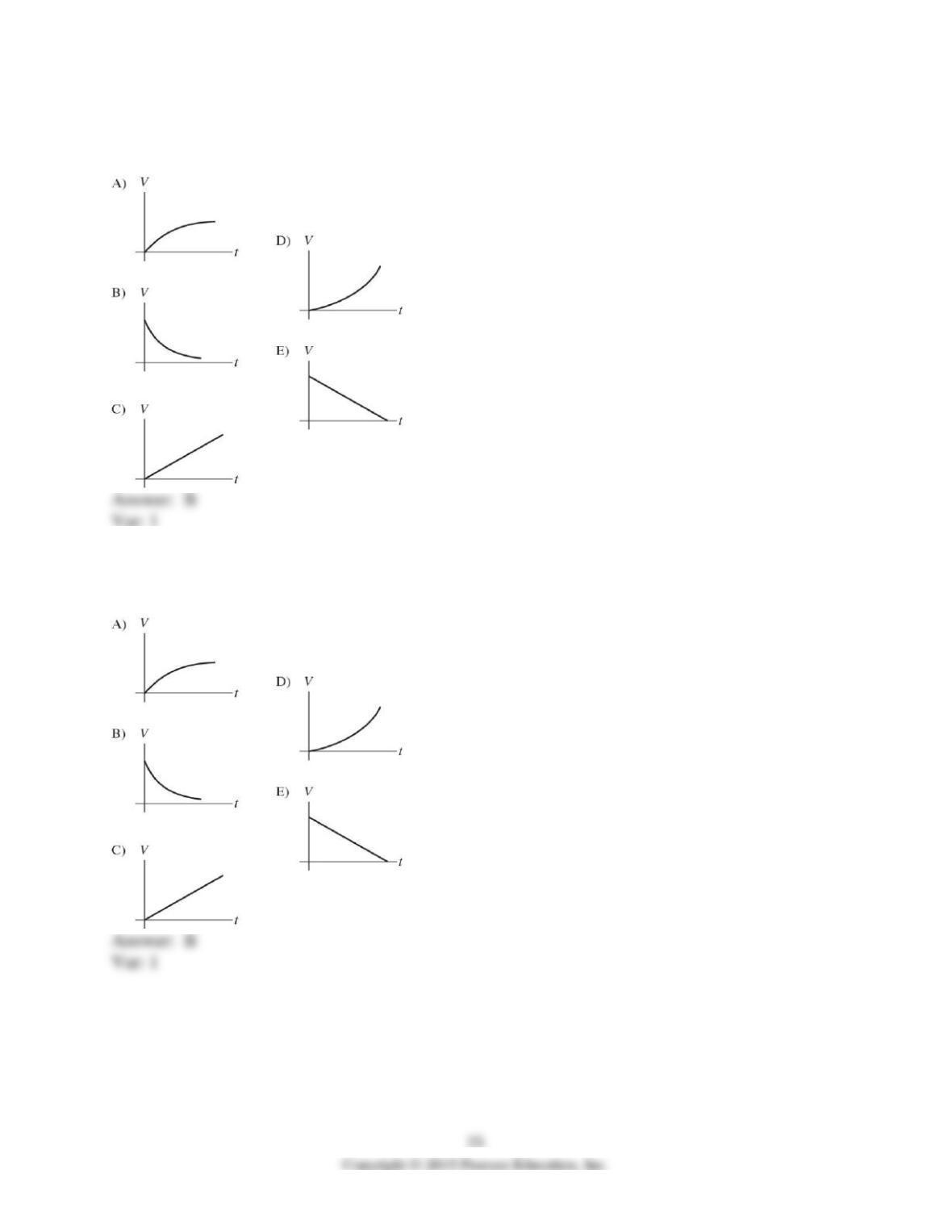
39) An uncharged capacitor is connected in series with a resistor, a dc battery, and an open
switch. At time t = 0 s, the switch is closed. Which of the graphs below best describes the
potential difference V across the resistor as a function of time t?
40) A charged capacitor is connected in series with a resistor and an open switch. At time t = 0 s,
the switch is closed. Which of the graphs below best describes the potential difference V across
the capacitor as a function of time t?
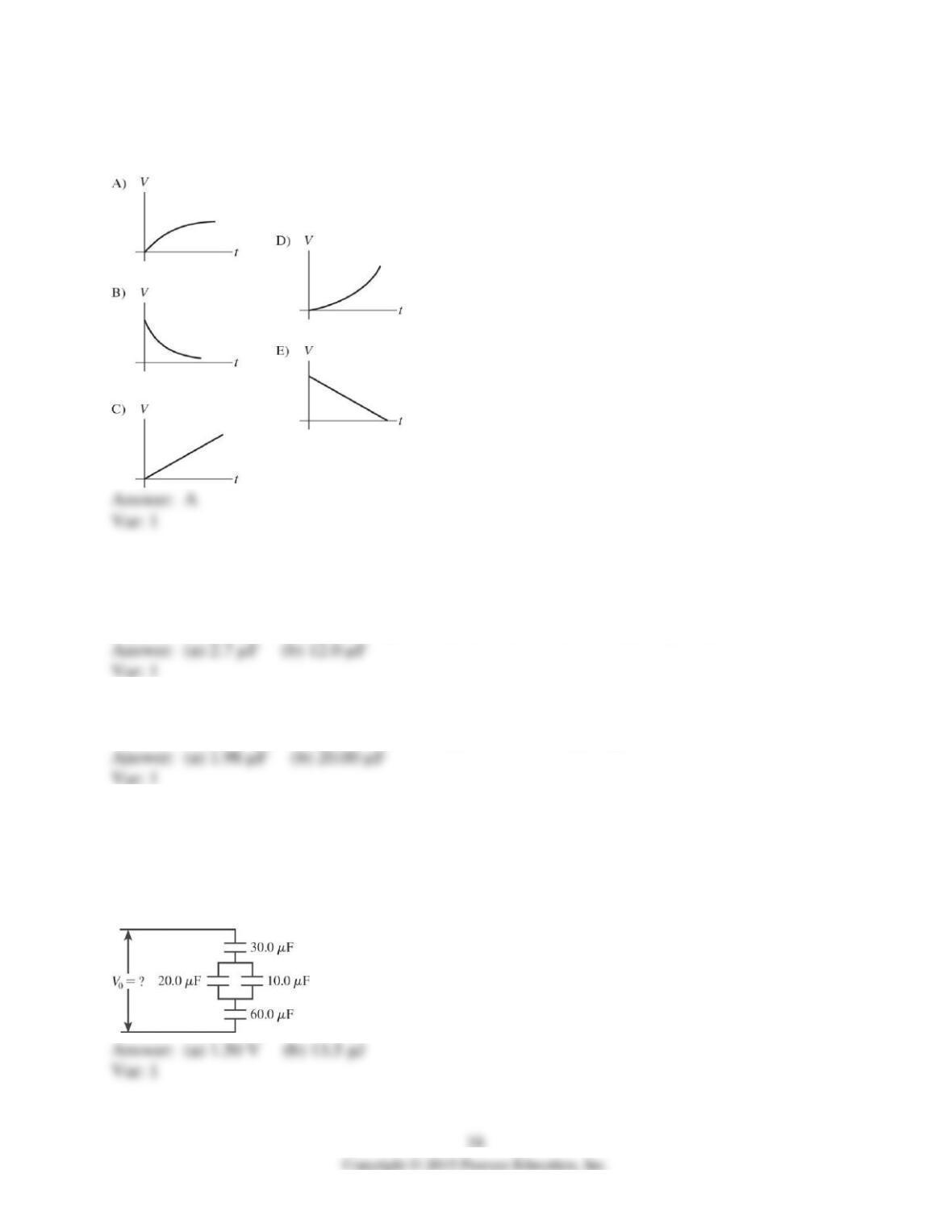
41) An uncharged capacitor is connected in series with a resistor, a dc battery, and an open
switch. At time t = 0 s, the switch is closed. Which of the graphs below best describes the
potential difference V across the capacitor as a function of time t?
23.2 Problems
1) A 4.0-µF capacitor and an 8.0-µF capacitor are connected together. What is the equivalent
capacitance of the combination if they are connected (a) in series or (b) in parallel?
2) You have three capacitors with capacitances of 4.00 μF, 7.00 μF, and 9.00 μF. What is the
equivalent capacitance if they are connected (a) in series and (b) in parallel?
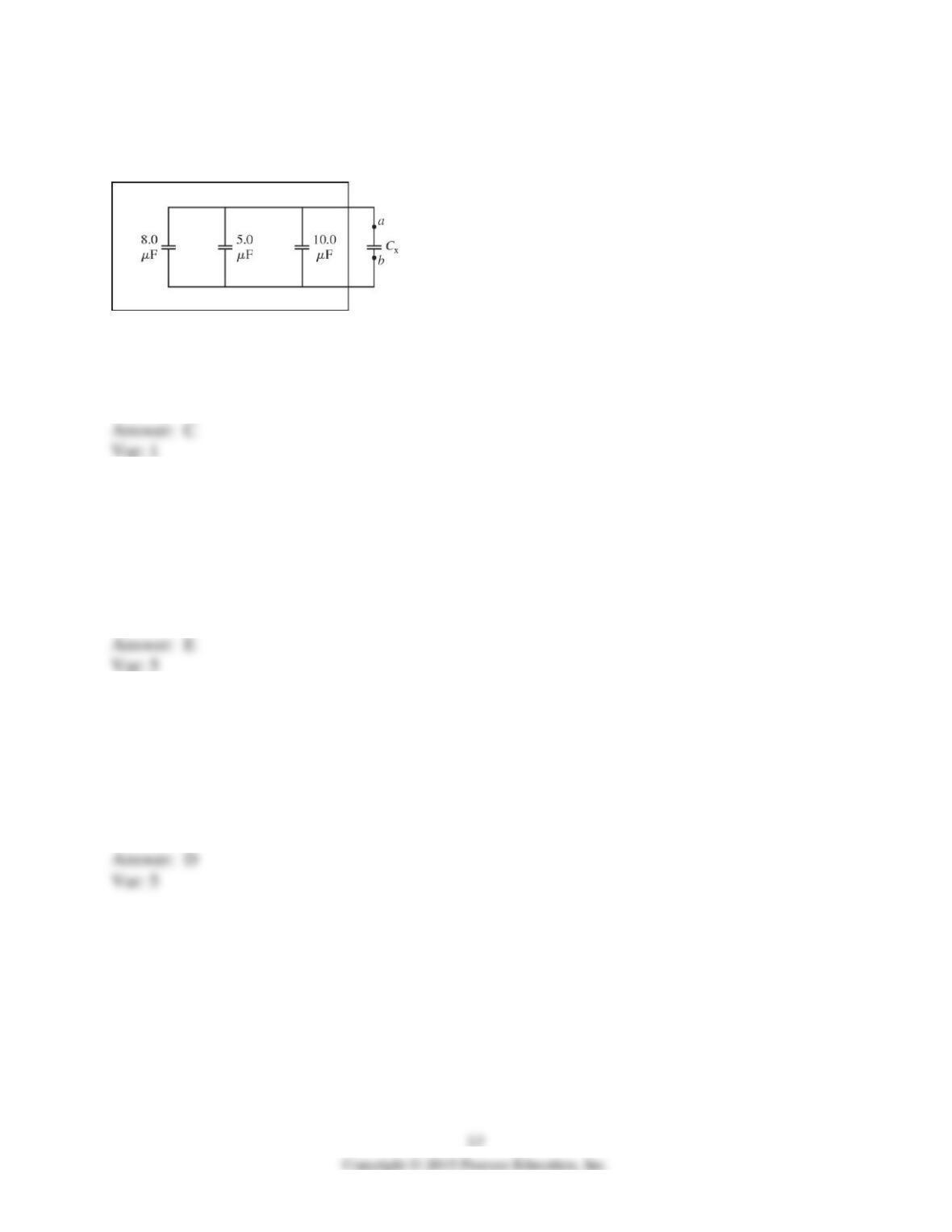
3) A network of capacitors is connected across a potential difference V0 as shown in the figure.
(a) What should V0 be so that the 60.0-µF capacitor will have 18.0 µC of charge on each of its
plates?
(b) Under the conditions of part (a), how much total energy is stored in this network of
capacitors?
4) A network of capacitors is mostly inside a sealed box, but one capacitor CX is sticking out, as
shown in the figure. When you connect a multimeter across points a and b, it reads 27.0 µF.
What is CX?
A) 27.0 µF
B) 23.0 µF
C) 4.0 µF
D) 2.4 µF
E) 2.2 µF
5) A 5.0-μF capacitor and a 7.0–μF capacitor are connected in series across an 8.0-V potential
source. What is the potential difference across the 5.0-μF capacitor?
A) 0 V
B) 8.0 V
C) 2.7 V
D) 3.6 V
E) 4.7 V
6) A 2.0-μF capacitor and a 4.0–μF capacitor are connected in series across an 8.0-V potential
source. What is the charge on the 2.0-μF capacitor?
A) 2.0 μC
B) 4.0 μC
C) 12 μC
D) 11 μC
E) 25 μC
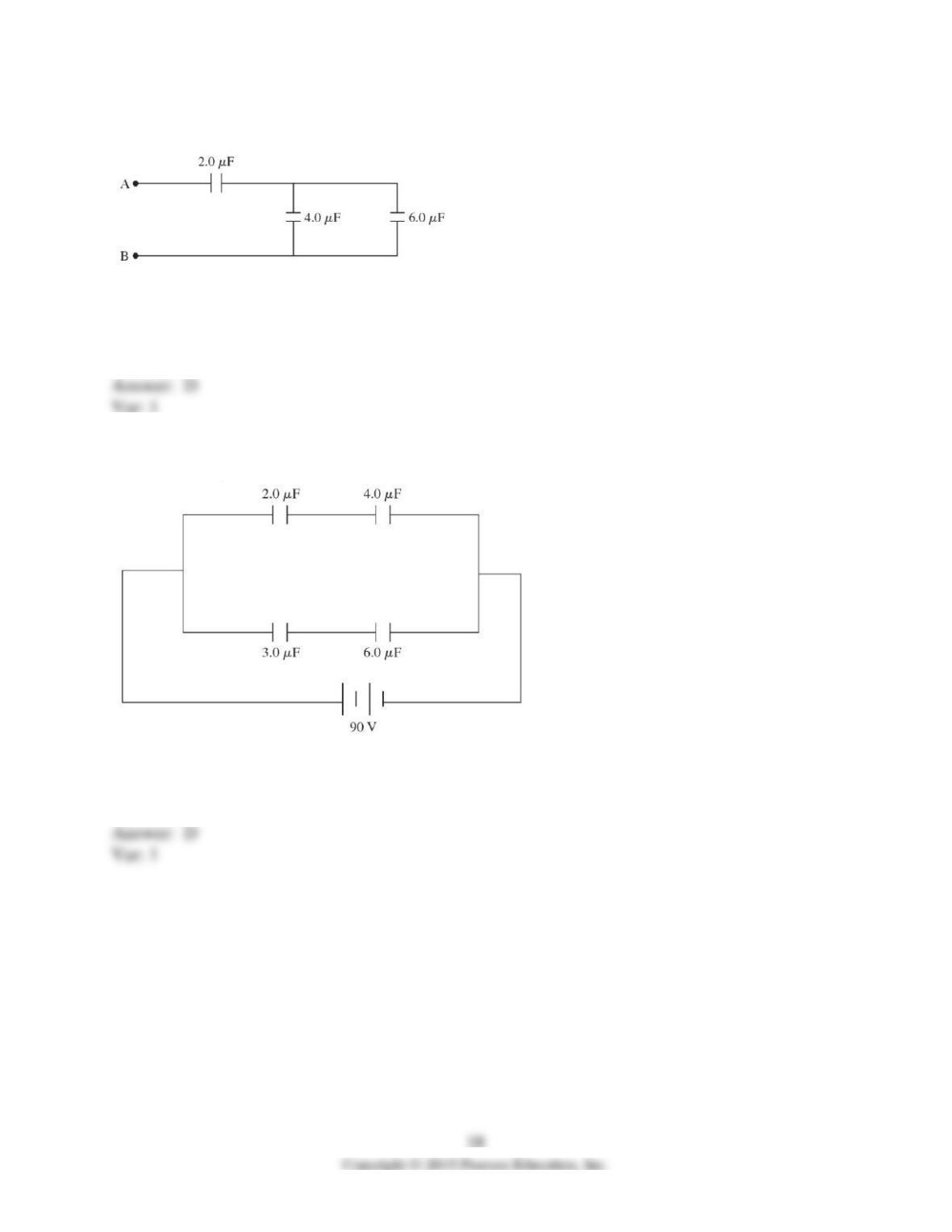
7) Three capacitors are connected as shown in the figure. What is the equivalent capacitance
between points A and B?
A) 12 μF
B) 4.0 μC
C) 7.1 μF
D) 1.7 μF
E) 8.0 μF
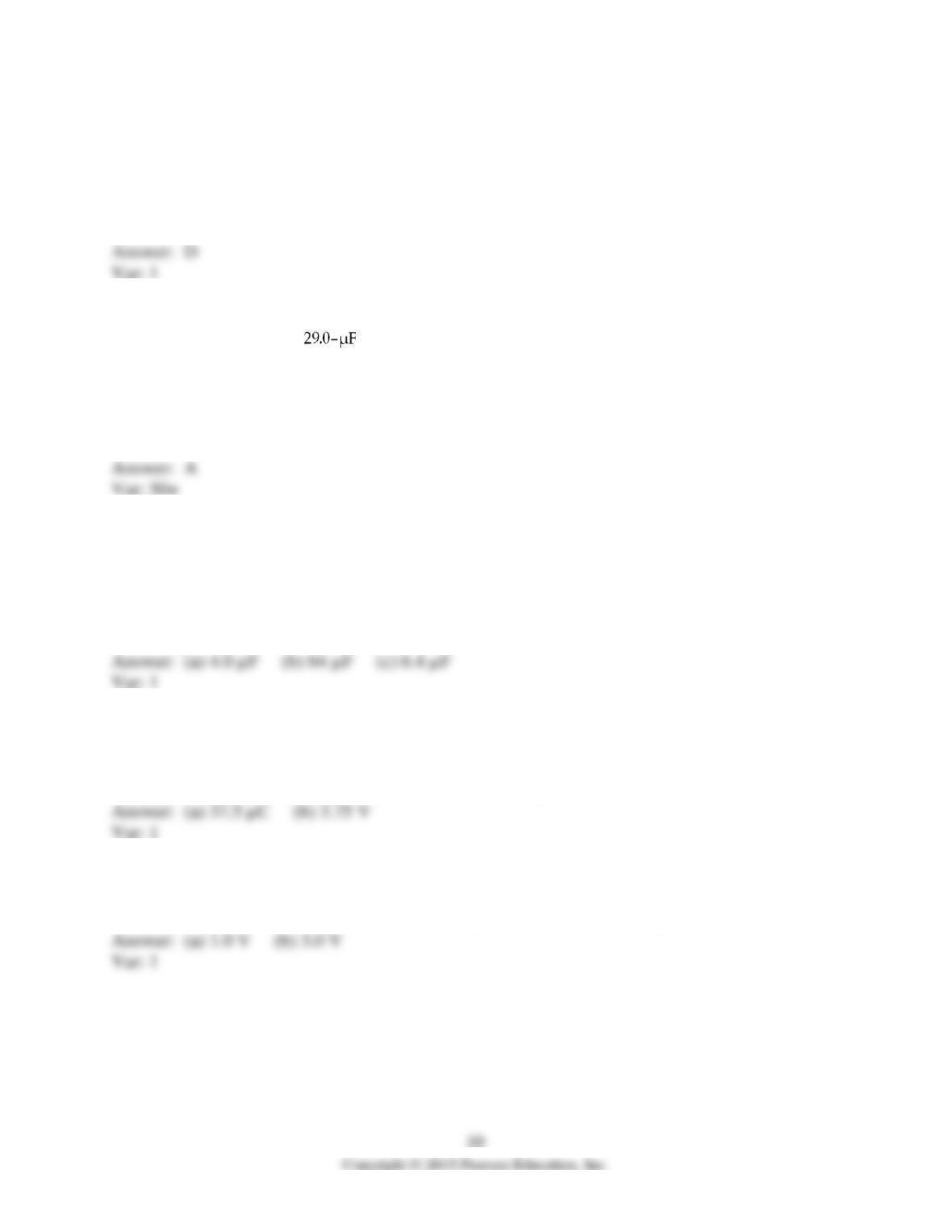
8) A system of four capacitors is connected across a 90-V voltage source as shown in the figure.
What is the equivalent capacitance of this system?
A) 1.5 μF
B) 15 μF
C) 3.6 μF
D) 3.3 μF
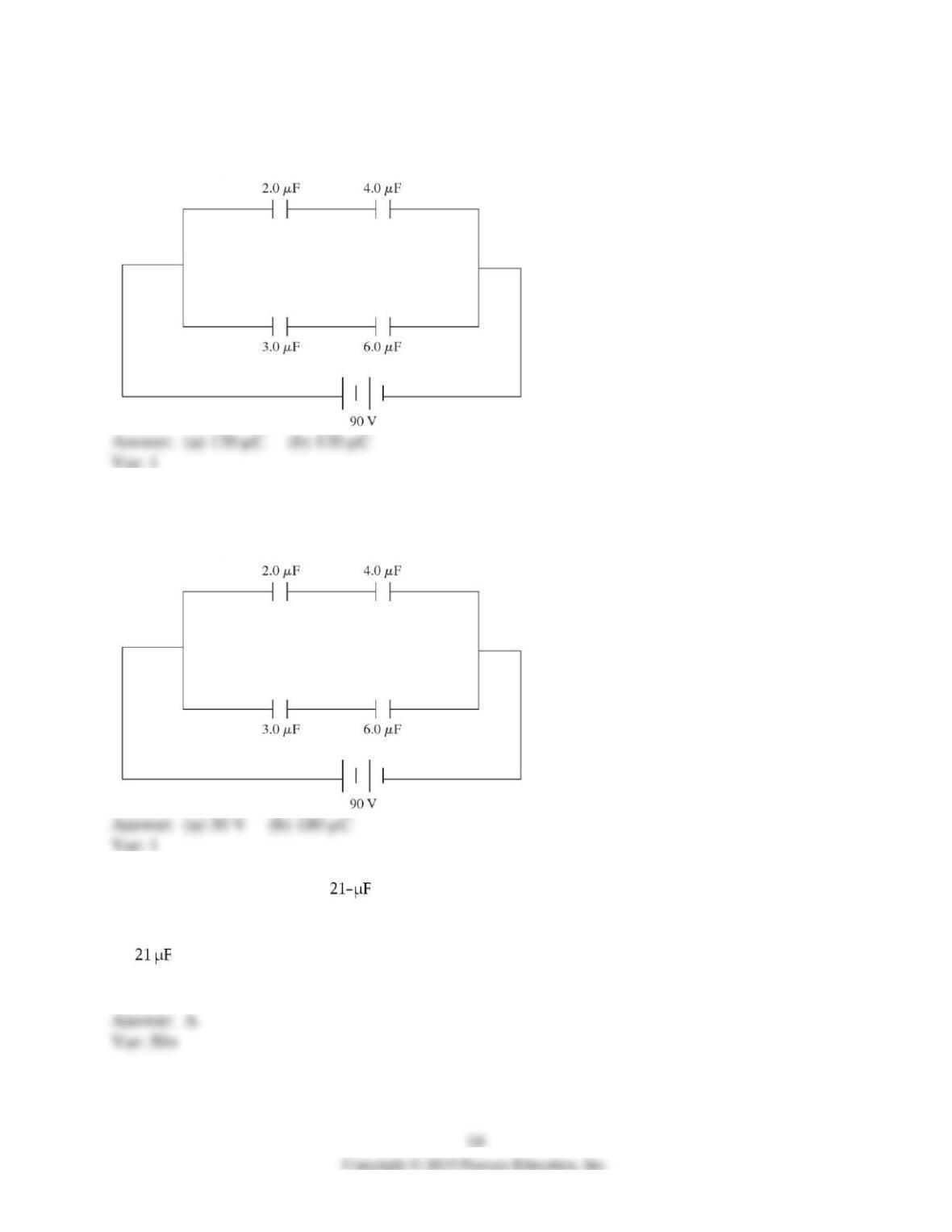
9) A system of four capacitors is connected across a 90-V voltage source as shown in the figure.
(a) What is the charge on the 4.0-µF capacitor?
(b) What is the charge on the 2.0-µF capacitor?
10) A system of four capacitors is connected across a 90-V voltage source as shown in the figure.
(a) What is the potential difference across the plates of the 6.0-µF capacitor?
(b) What is the charge on the 3.0-µF capacitor?
11) A 5.0-μF, a 14–μF, and a capacitor are connected in parallel. How much capacitance
would a single capacitor need to have to replace the three capacitors?
A) 40 μF
B)
C) 5.0 μF
D) 14 μF
12) A 5.0-μF, a 14–μF, and a 21–μF capacitor are connected in series. How much capacitance
would a single capacitor need to have to replace the three capacitors?
A) 40 μF
B) 3.6 μF
C) 2.0 μF
D) 3.1 μF
13) A 5.0-μF and a 12.0–μF capacitor are connected in series, and the series arrangement is
connected in parallel to a capacitor. How much capacitance would a single capacitor
need to replace this combination of three capacitors?
A) 33 μF
B) 13 μF
C) 16 μF
D) 38 μF
14) Four 16-μF capacitors are connected in combination. What is the equivalent capacitance of
this combination if they are connected
(a) in series?
(b) in parallel?
(c) such that two of them are in parallel with each other and that combination is in series with the
remaining two capacitors?
15) Three capacitors of capacitance 5.00 μF, 10.0 μF, and 50.0 μF are connected in series across
a 12.0-V potential difference (a battery).
(a) How much charge is stored in the 5.00-μF capacitor?
(b) What is the potential difference across the 10.0-µF capacitor?
16) A 1.0-µF capacitor and a 2.0-µF capacitor are connected together, and then that combination
is connected across a 3.0-V potential source (a battery). What is the potential difference across
the 2.0-µF capacitor if the capacitors are connected (a) in series or (b) in parallel?