
Exam
Name___________________________________
MULTIPLE CHOICE. Choose the one alternative that best completes the statement or answers the question.
Total
Output Costs
0 $8
1 13
2 16
3 21
4 30
5 45
1)
Refer to the above table. The table represents information on the costs for Ajax Corporation. Ajax
operates in a perfectly competitive market and the price of the product is $9. What does profit
equal when quantity equals 3?
1)
A)
$2
B)
$6
C)
$13
D)
$10
2)
Which of the following is NOT a characteristic of a perfectly competitive market?
2)
A)
It is difficult for a firm to enter or leave the market.
B)
Each firm is a price taker.
C)
There are many buyers and sellers in the market.
D)
The products sold by the firms in the market are homogeneous.
3)
Which of the following could generate economic profits for perfectly competitive firms in the short
run, if they initially earn zero economic profits?
3)
A)
a unit tax on output
B)
an increase in total fixed costs
C)
a fall in demand
D)
a decrease in input prices
4)
When considering perfect competition the absence of entry barriers implies that
4)
A)
all firms will earn economic profit.
B)
no firm can enter the industry.
C)
firms can enter and leave the industry without serious impediments.
D)
firms can enter but cannot get out of the industry easily.
5)
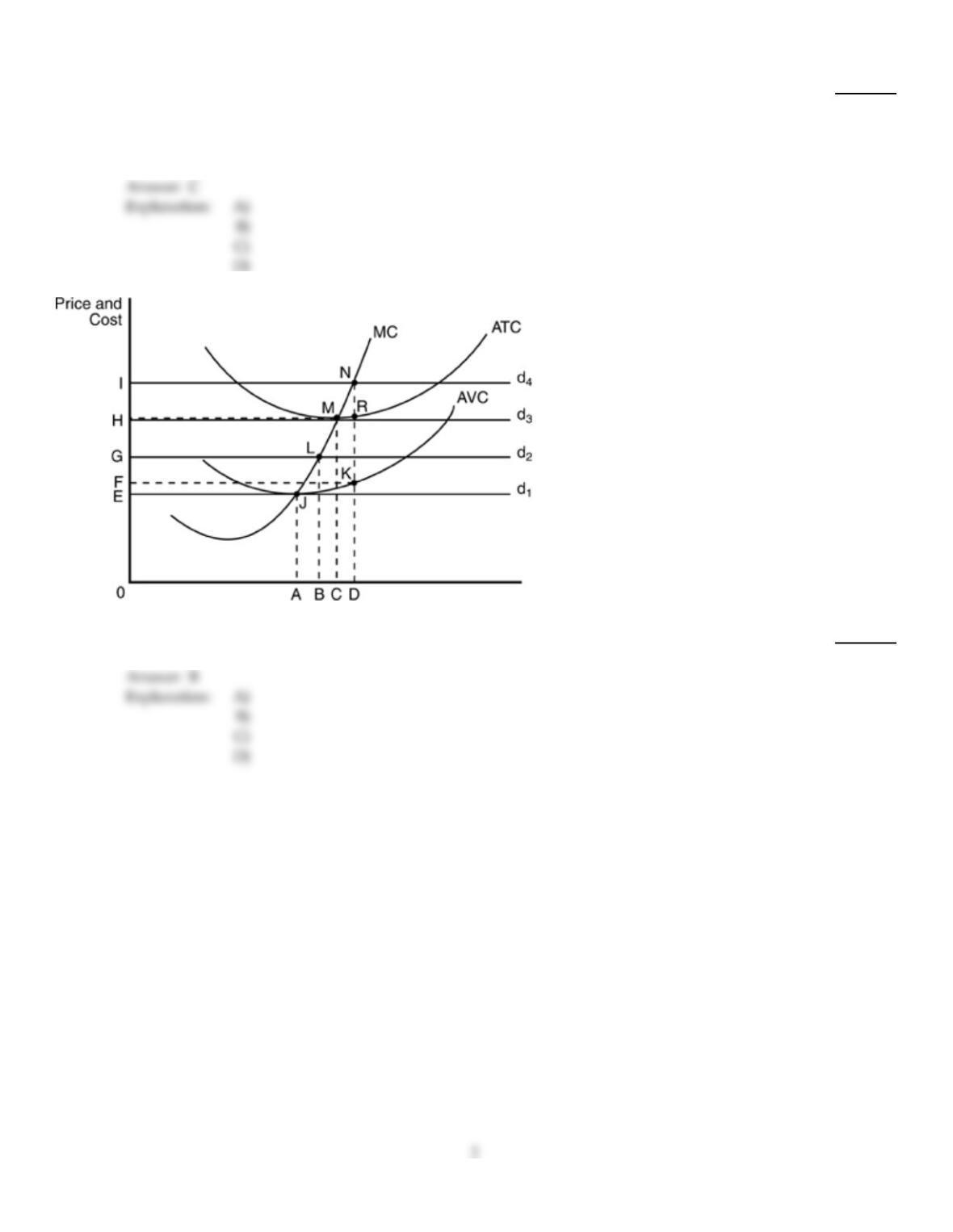
The firm in the above figure breaks even when market price is
5)
A)
G.
B)
H.
C)
I.
D)
E.
B
C
6)
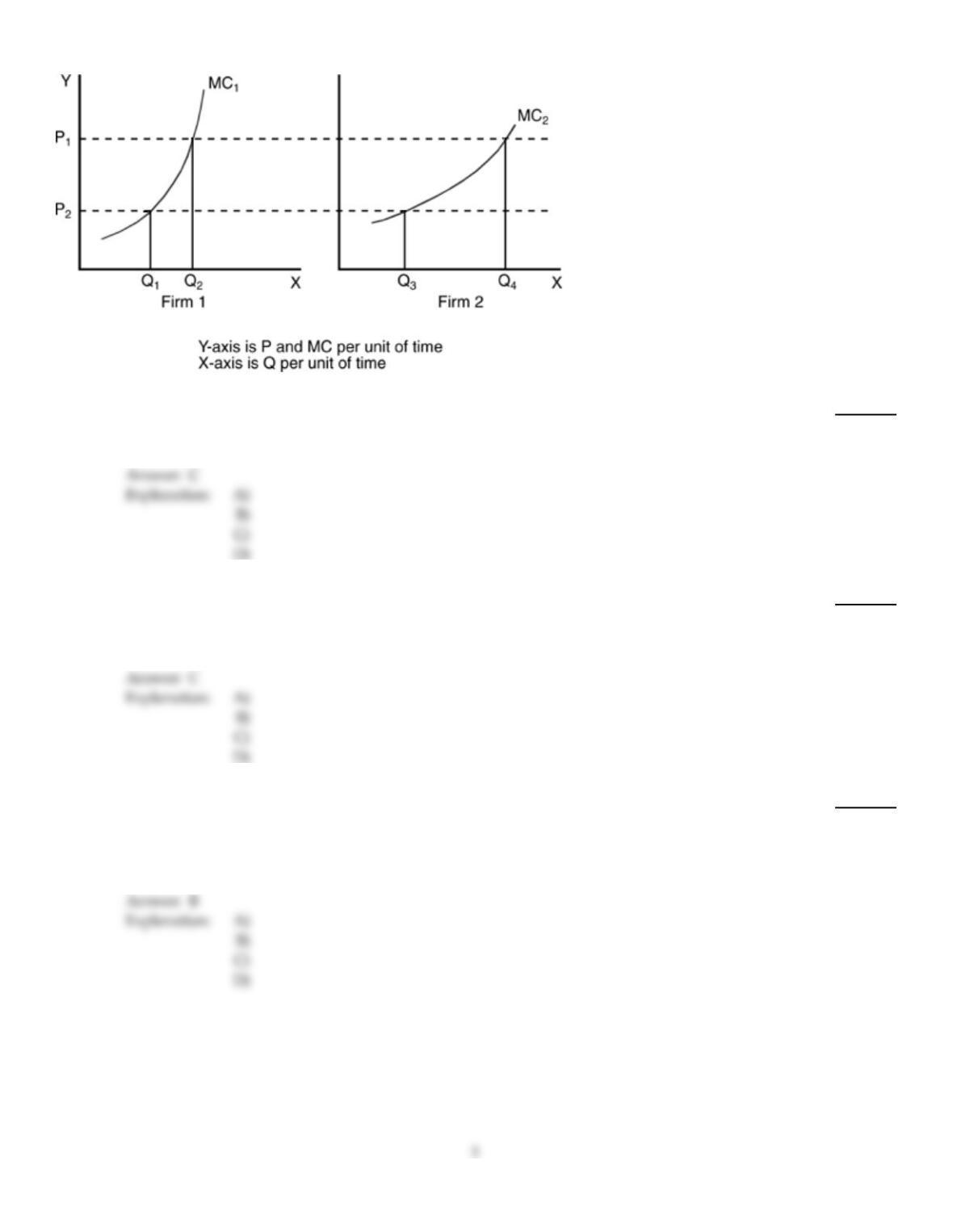
In the above figure, assuming Firm 1 and Firm 2 are the sole producers in the industry, the industry
quantity supplied at price P1 is equal to
6)
A)
Q1+ Q2.
B)
Q4– Q2.
C)
Q2+ Q4.
D)
Q1+ Q3.
7)
Consider an industry that is in long–run equilibrium. An increase in demand leads to an increase in
the price of the good. We know that this is
7)
A)
a decreasing cost industry.
B)
a constant cost industry.
C)
an increasing cost industry.
D)
not a competitive industry.
8)
If markets are perfectly competitive, then the production of goods
8)
A)
will occur at an average total cost value that is above the minimum.
B)
will use the least costly combination of resources.
C)
will always lead to business failures.
D)
will require government intervention.
9)
For a perfectly competitive firm, profit maximization occurs when
9)
A)
marginal revenue equals average total cost.
B)
marginal cost is equal to average total cost.
C)
average total cost is at its minimum.
D)
marginal revenue equals marginal cost.
10)
Which of the following is TRUE for the perfectly competitive firm?
10)
A)
Price elasticity of demand is equal to 1.
B)
AR is less than price.
C)
Price and MR are always equal.
D)
AR is more than price.
11)
If a firm shuts down in the short run
11)
A)
it will lose its operating costs.
B)
it will incur only its explicit costs.
C)
it will incur its fixed costs.
D)
its losses will be equal to zero.
12)
A market failure is a situation in which
12)
A)
the market equilibrium leads to either too many or too few resources going towards
producing the good or service.
B)
the government must take actions to correct the failures of the market in a particular industry.
C)
there is no free entry or exit into an industry.
D)
resources are being efficiently allocated, but some companies are forced to shut down.
Total
Output Costs
100 $400
101 402
102 405
103 409
104 414
105 420
106 427
107 435
13)
Refer to the above table. If the price is $3 the maximum profit this firm could earn is
13)
A)
$306.
B)
$99.
C)
–$100.
D)
–$99.
14)
The firm in a perfectly competitive industry is a
14)
A)
price maker.
B)
price taker.
C)
price seeker.
D)
price dealer.
15)
In the short run, in a perfectly competitive market, a firm will shut down if
15)
A)
ATC > P > AVC for all levels of output.
B)
P > AFC for all levels of output.
C)
P < AVC for all levels of output.
D)
P < ATC for all levels of output.
16)
If a perfect competitor faces P = ATC in the long run, the firm will
16)
A)
earn economic profits.
B)
leave the industry.
C)
earn economic losses.
D)
remain in the industry.
17)
A firm in a perfectly competitive market maximizes profits when it finds
17)
A)
the quantity at which total revenue minus total cost is the greatest.
B)
the quantity at which total revenue is maximized.
C)
the quantity at which total revenue equals total cost.
D)
the price at which total revenue minus total cost is the greatest.
18)
For a firm in a perfectly competitive industry
18)
A)
marginal revenue and product price are equal at every level of output.
B)
more output can be sold only if the firm unilaterally lowers its product price.
C)
the price elasticity of demand is zero.
D)
the demand curve is unitary elastic throughout.
Explanation:
19)
In a long–run perfectly competitive equilibrium
19)
A)
P > MR > MC = ATC.
B)
P = MR = MC = ATC.
C)
P = MR > MC = ATC.
D)
P = MR = MC > ATC.
Explanation:
20)
The long–run industry supply curve in a decreasing–cost, perfectly competitive industry is
20)
A)
perfectly inelastic.
B)
negatively sloped.
C)
positively sloped.
D)
perfectly elastic.
Explanation:
21)
Factors that cause the short–run supply curve to change are factors that affect
21)
A)
demand.
B)
the market but not the individual firm.
C)
variable costs.
D)
fixed costs.
Explanation:
Explanation:
22)
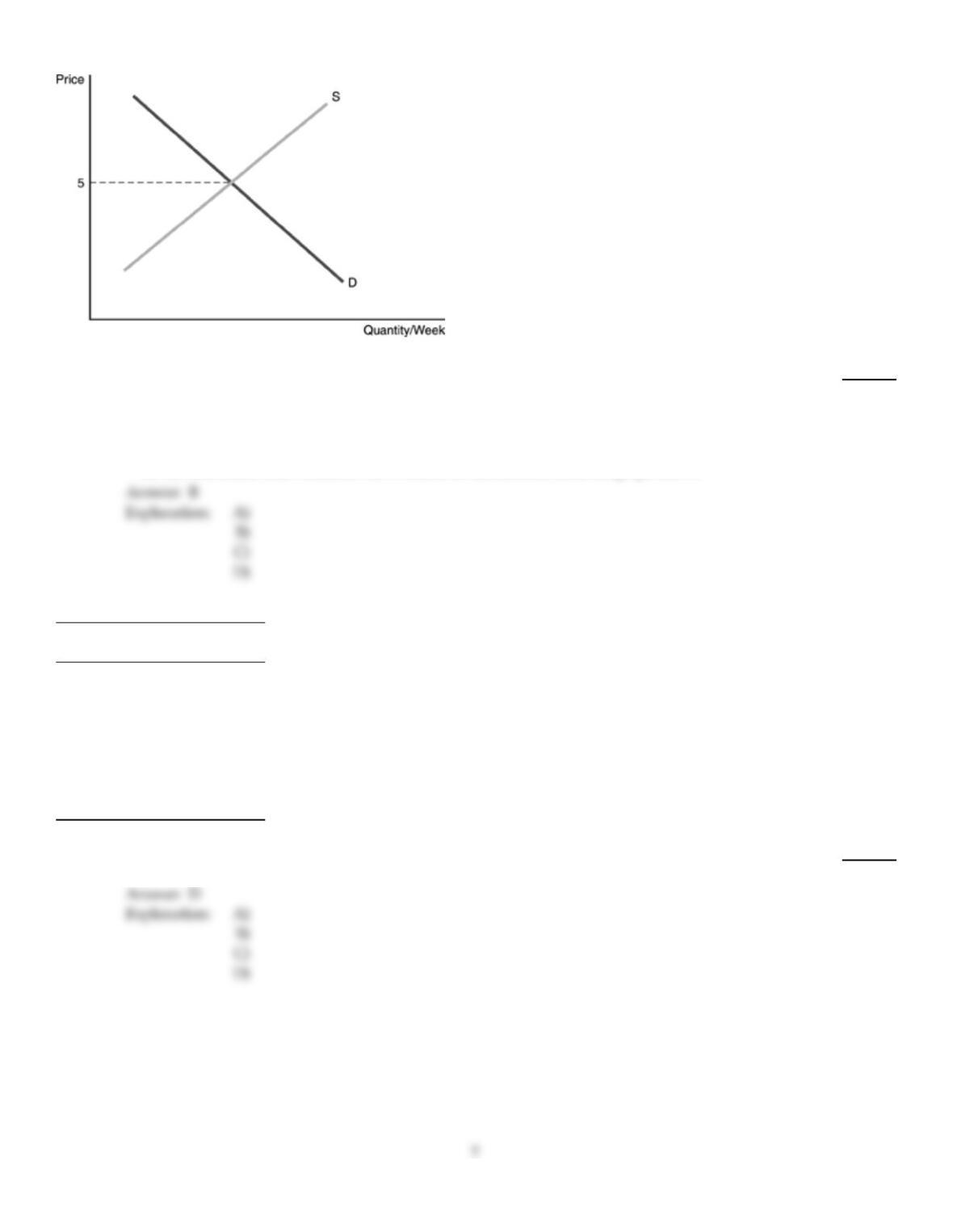
Refer to the above figure. The figure represents the market demand and supply curves for widgets.
What statement can be made about the demand curve for an individual firm in this market?
22)
A)
An individual firm’s demand curve will be a smaller version of the market demand curve.
B)
An individual firm’s demand curve will be horizontal at $5.
C)
An individual firm’s demand curve will be horizontal at a price below $5.
D)
An individual firm’s demand curve cannot be determined from the graph above.
Total
Output Costs
100 $400
101 402
102 405
103 409
104 414
105 420
106 427
107 435
23)
Refer to the above table. If the price is $5, the perfectly competitive firm should produce
23)
A)
106 units.
B)
105 units.
C)
107 units.
D)
104 units.
24)
A perfectly elastic long–run supply curve indicates
24)
A)
an increasing–cost industry.
B)
that some input prices change as firms enter and exit the industry.
C)
a decreasing–cost industry.
D)
a constant–cost industry.
25)
At the short–run break–even point, the firm is
25)
A)
earning zero economic profit.
B)
ready to shutdown.
C)
earning zero accounting profit.
D)
losing money.
Explanation:
26)
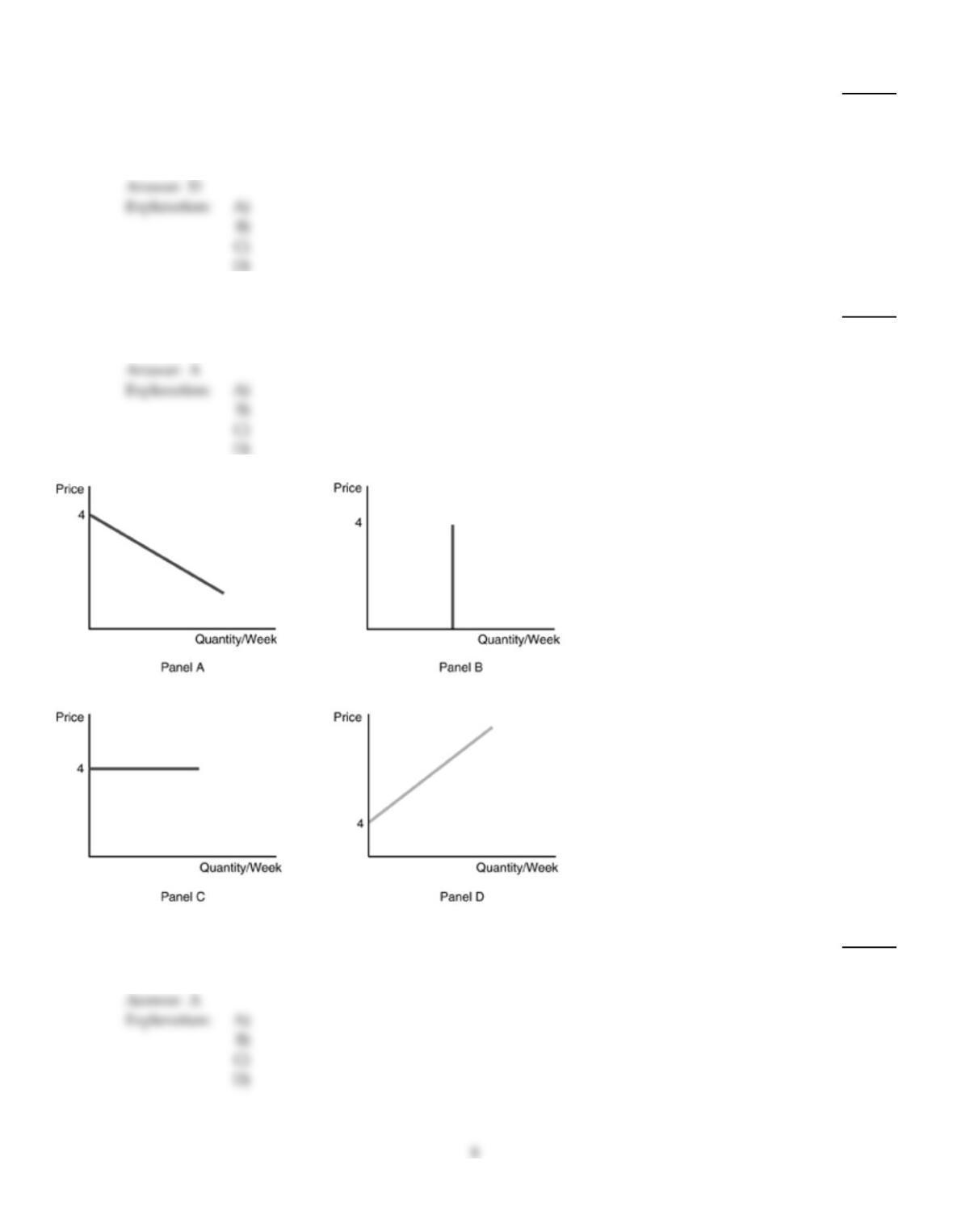
Refer to the above figure. Which of the graphs represent the situation for a perfectly competitive
industry?
26)
A)
Panel A
B)
Panel B
C)
Panel C
D)
Panel D
Explanation:
Explanation:
27)
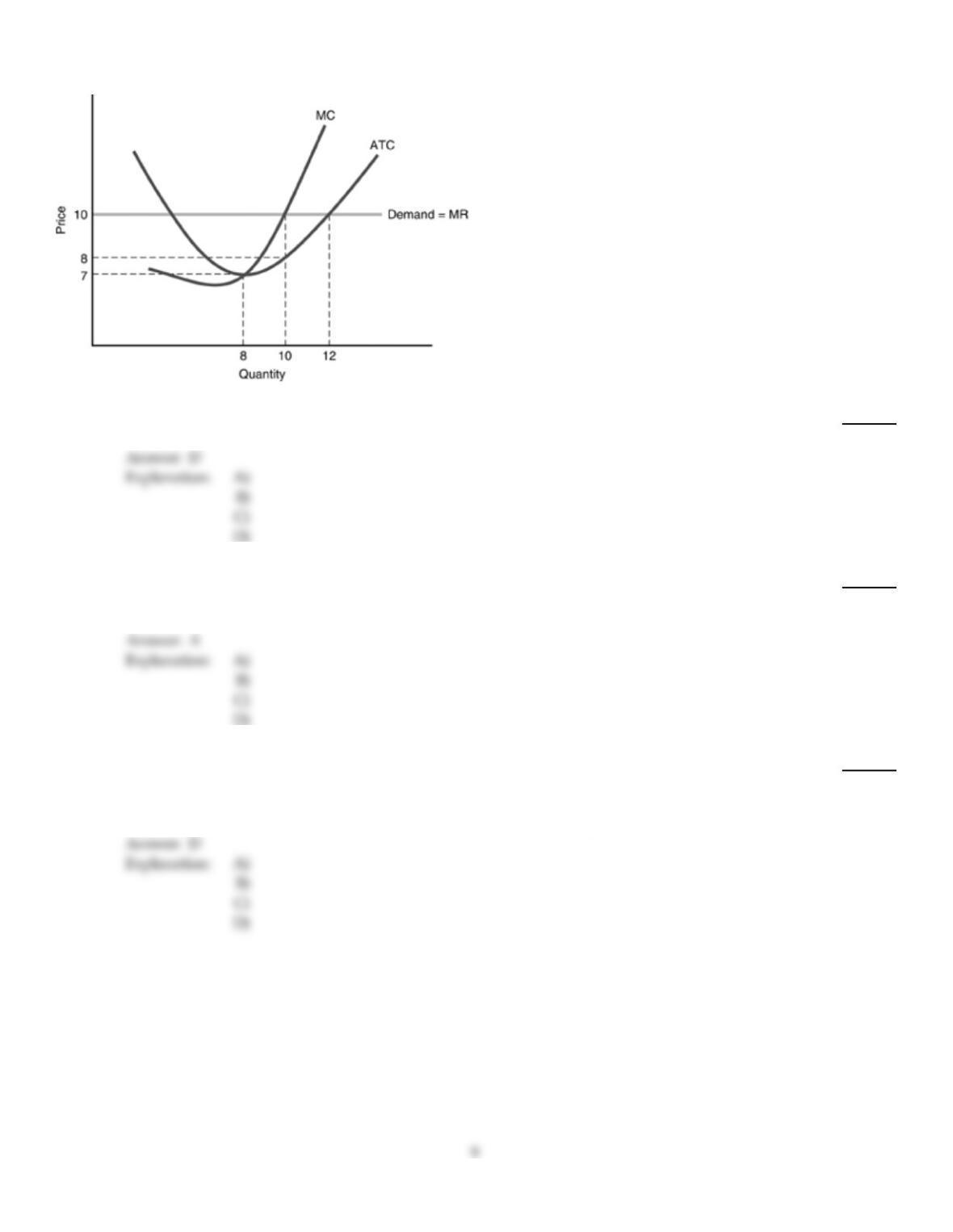
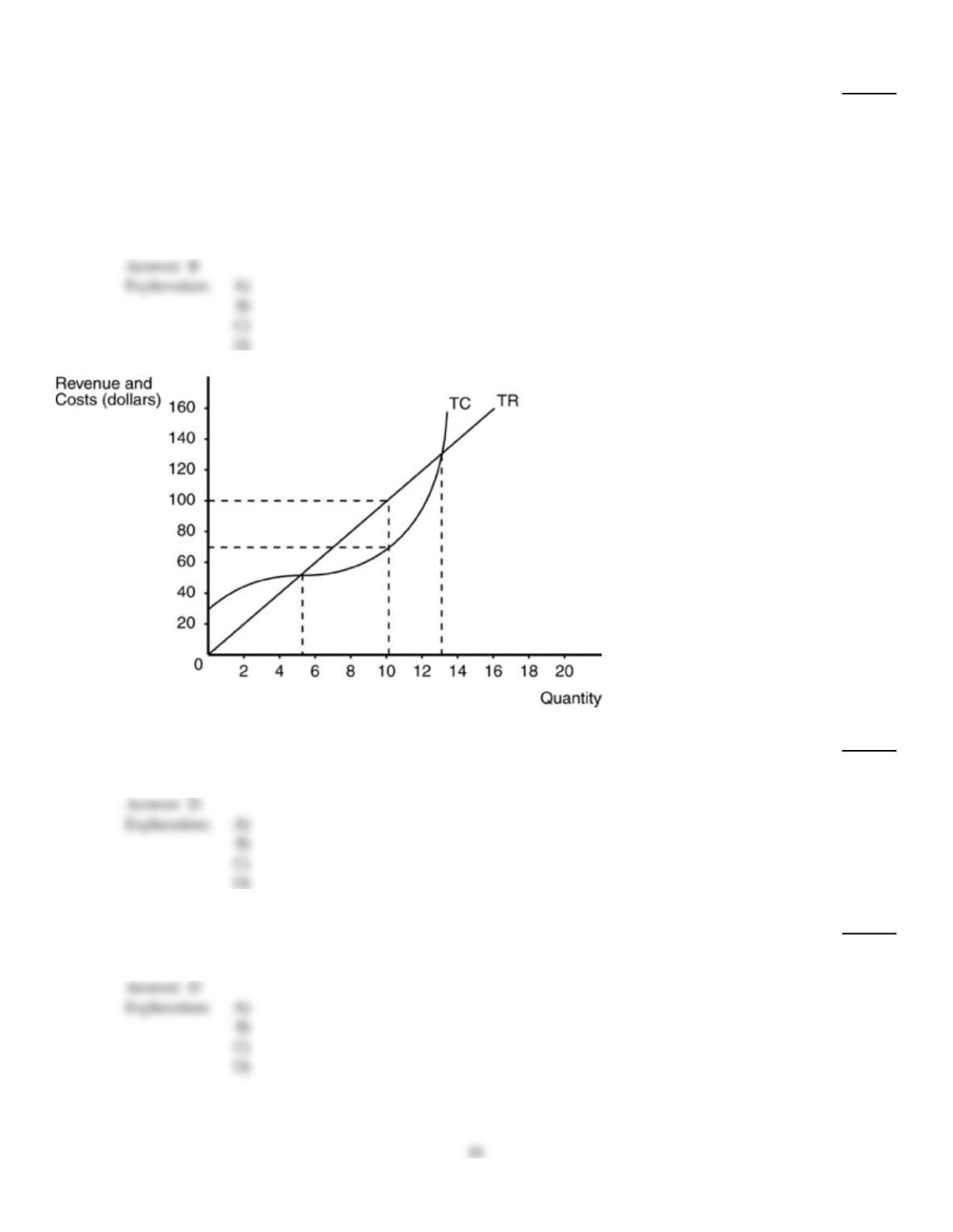
In the above figure, what is the profit–maximizing output and price?
27)
A)
10, $8
B)
12, $10
C)
8, $7
D)
10, $10
28)
For a perfectly competitive firm facing the short–run break–even price
28)
A)
it has an economic profit of zero.
B)
it should expand production.
C)
it should shut down.
D)
it has a negative accounting profit.
29)
A market structure in which the decisions of individual buyers and sellers have no effect on market
price is
29)
A)
a market supply industry.
B)
a short–run industry.
C)
a long–run industry.
D)
perfect competition.
30)
A perfectly competitive firm faces a market clearing price of $150 per unit. Average total costs are
at the minimum value of $200 per unit at an output rate of 100 units. Average variable costs are at
the minimum value of $100 per unit at an output rate of 50 units. Marginal cost equals $150 per
unit at an output rate of 75 units. It can be concluded that the short–run profit–maximizing output
rate is
30)
A)
50 units, because price is less than average variable costs.
B)
75 units, at which the firm earns negative economic profits per unit sold.
C)
75 units, at which the firm earns zero economic profits per unit sold.
D)
75 units, at which the firm earns positive economic profits per unit sold.
31)
In the above figure, at the profit–maximizing rate of production for the perfectly competitive firm
average total cost is
31)
A)
$10.
B)
$3.
C)
$70.
D)
$7.
32)
The perfectly competitive firm faces
32)
A)
a horizontal supply function.
B)
a downward sloping demand curve.
C)
constant marginal costs.
D)
perfectly elastic demand.
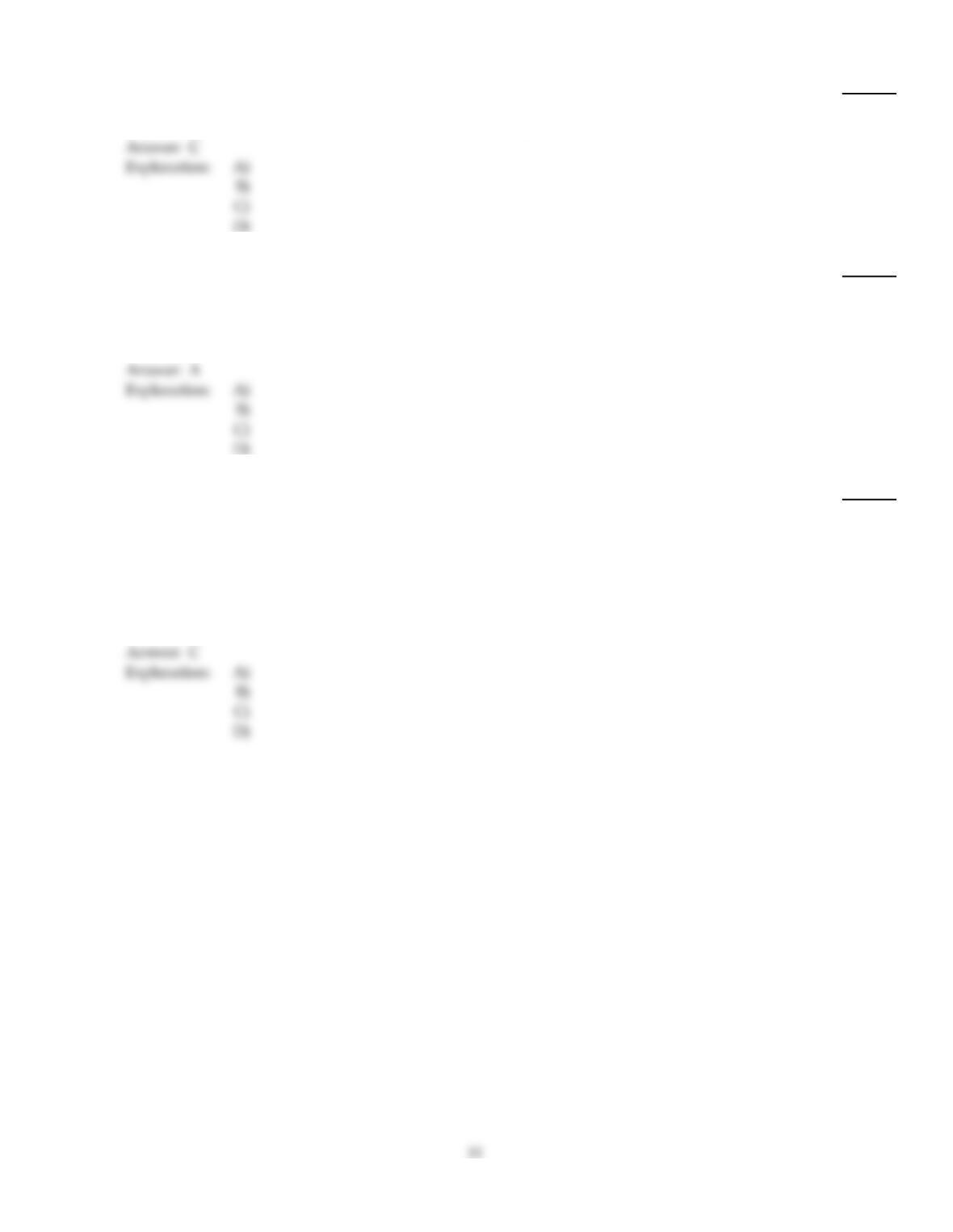
33)
In the short run, the price at which a firm’s total revenues equal its total costs is
33)
A)
a no return price.
B)
the short–run shutdown point.
C)
the short–run break–even point.
D)
a point of positive profits.
34)
In the long run in a perfectly competitive industry
34)
A)
economic profits will be zero.
B)
some firms will be experiencing economic losses.
C)
opportunity costs are negligible.
D)
only entrepreneurs will earn more than their opportunity costs.
A
Explanation:
35)
Suppose the price of an item in a perfectly competitive market is $3. For a firm in this market, MC =
MR at an output of 100 units. The average total cost at this output level is $4 per unit, and TVC is
$80. We may conclude that
35)
A)
the firm should shut down because TC > TR.
B)
the firm should shut down because other firms will enter the industry as the market is
perfectly competitive.
C)
the firm should continue to produce because P>AVC.
D)
the firm should shut down because its TFC is $320 and its TC is $400.
C
Explanation:
C
Explanation:
36)
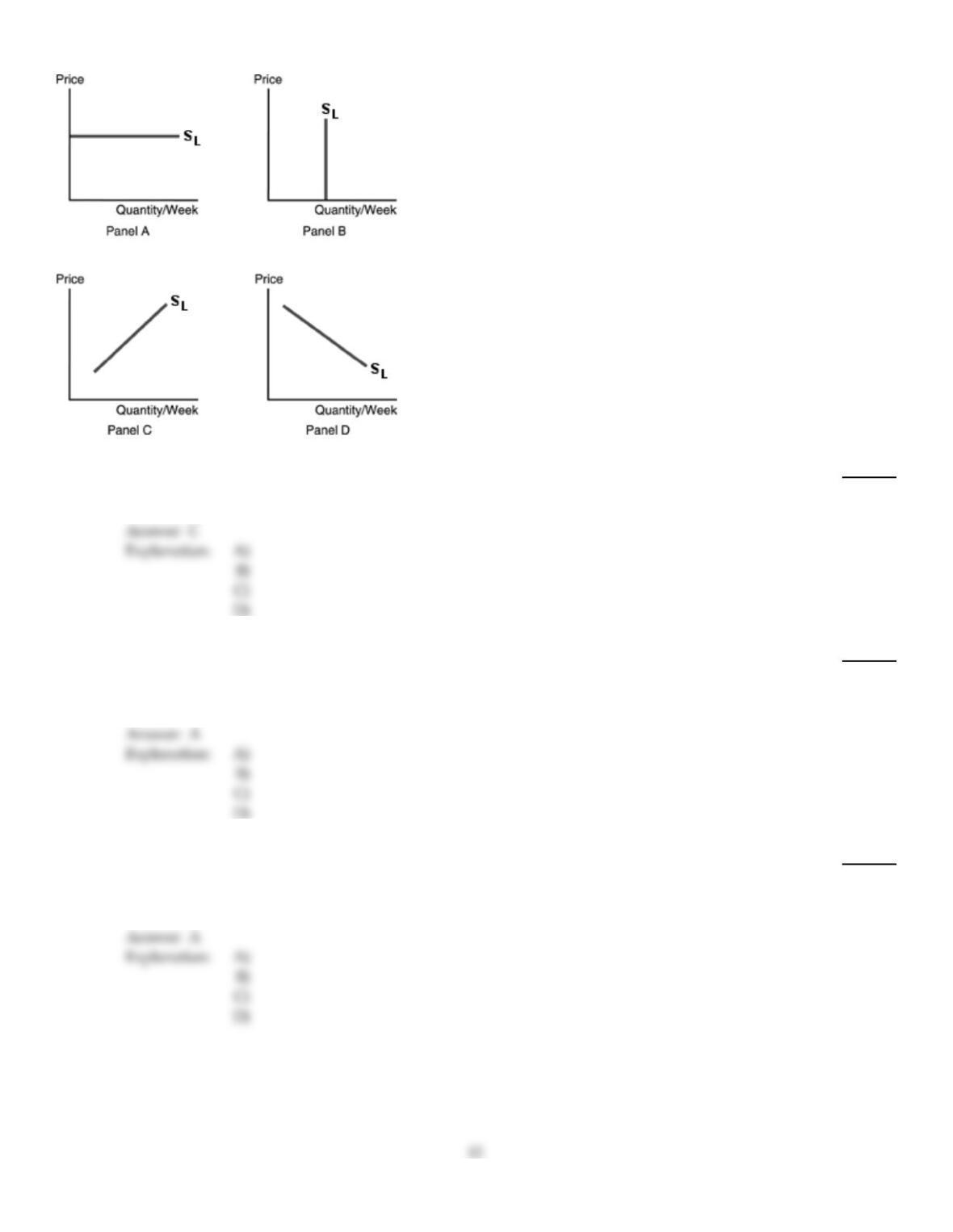
Refer to the above figure. Which panel represents the long–run supply curve for an increasing cost
industry?
36)
A)
Panel A
B)
Panel B
C)
Panel C
D)
Panel D
37)
Suppose a perfectly competitive cotton farmer can produce 10 containers of cotton at an output at
which marginal cost equals marginal revenue. The price per container of cotton is $100 and the
average total cost is $75. What is the profit or loss that this cotton farmer is earning?
37)
A)
$250
B)
$750
C)
–$25
D)
$150
38)
In a perfectly competitive market, which of the following is the main factor that affects consumers’
decisions on which firm to purchase a good from?
38)
A)
price
B)
quality
C)
reputation
D)
customer service
39)
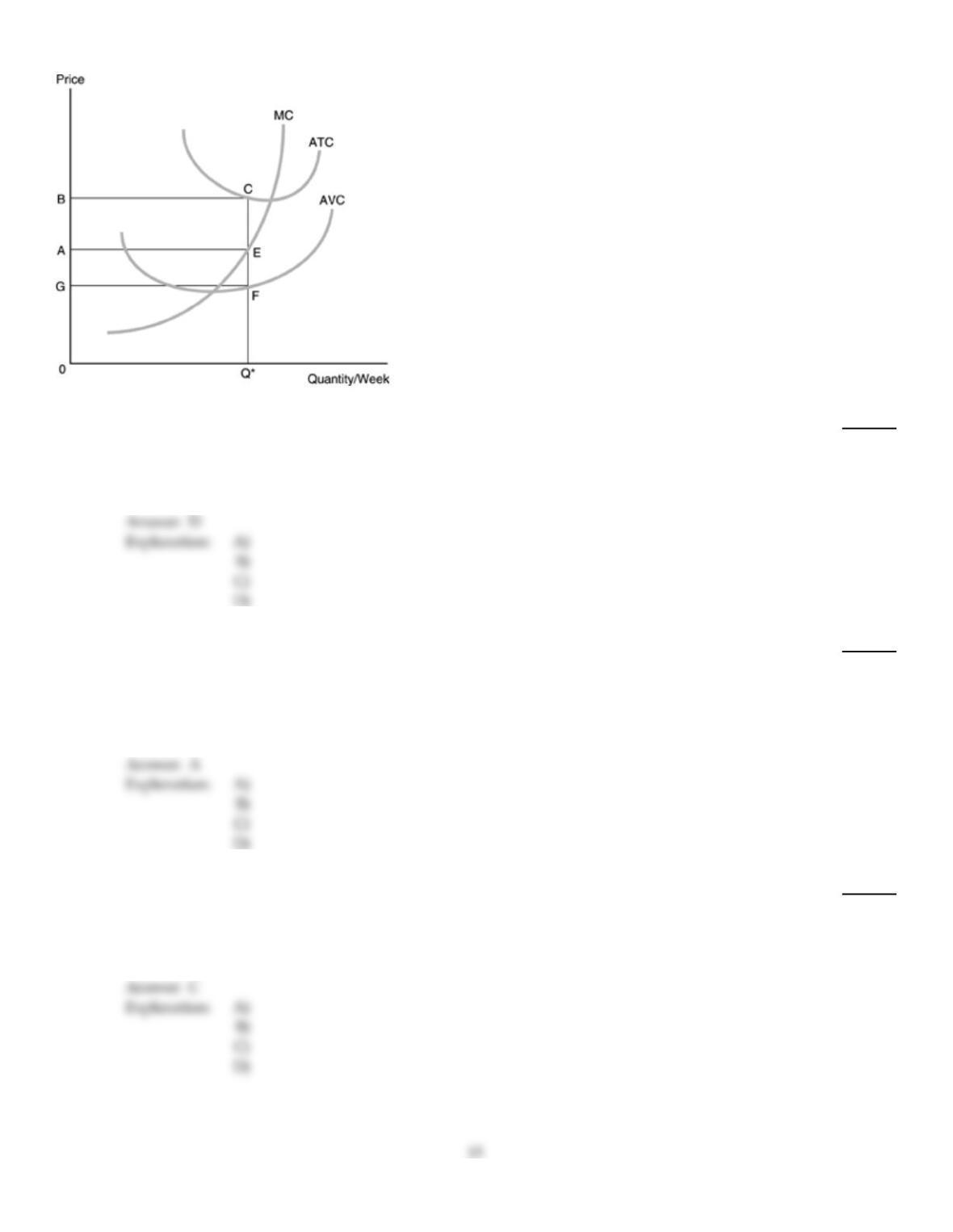
Refer to the above figure. In order to stay open in the short run, this firm must
39)
A)
recover its fixed cost.
B)
receive a price exactly equal to its average total cost.
C)
earn a positive profit.
D)
receive a price equal to or greater than the minimum of its average variable cost.
40)
Suppose the market price is $5, marginal cost is $4, and average total cost is $2. The perfectly
competitive firm in that market is
40)
A)
earning $3 in economic profits per unit of output and is not maximizing profits.
B)
earning $1 in economic profits per unit of output and is not maximizing profits.
C)
earning $2 in economic profits per unit of output and is maximizing profits.
D)
none of the above: Insufficient information is given.
A
41)
In a perfectly competitive market, if P < MC, then
41)
A)
too little output is being produced.
B)
production is efficient, as the firm is earning profits.
C)
too much output is being produced.
D)
the firm is paying a price for resources that is too high.
C
D
42)
For a firm in a perfectly competitive industry
42)
A)
short–run and long–run economic profits must be zero.
B)
short–run economic profits must be zero.
C)
short–run economic profits may be positive, but long–run economic profits must be zero.
D)
both short–run and long–run economic profits may be negative.
43)
Which of the following is closest to a perfectly competitive market?
43)
A)
the market for fast food
B)
the soda pop market
C)
the market for sugar
D)
the market for bread
44)
A firm is currently producing at the point where MC = MR. The situation for the firm at this point
is P = $5, Q = 100, ATC = $6, AVC = $4.50. What do you recommend this firm do?
44)
A)
Shut down, because ATC > P.
B)
Shut down, because AVC > P.
C)
Continue to produce the current output rate, because P > AVC.
D)
Increase production above the current output rate, because MC = MR at this rate of output.
45)
Firms in a perfectly competitive industry are earning economic losses. This is
45)
A)
a signal that the entrepreneurs are doing a poor job and should become workers for someone
else.
B)
a signal to entrepreneurs that some of the firms in the industry should exit and the resources
of these firms should move into production of other goods.
C)
a signal to entrepreneurs that additional resources should be brought into this industry in
order to make it profitable.
D)
a signal to government officials that a subsidy is needed for the firms in the industry.
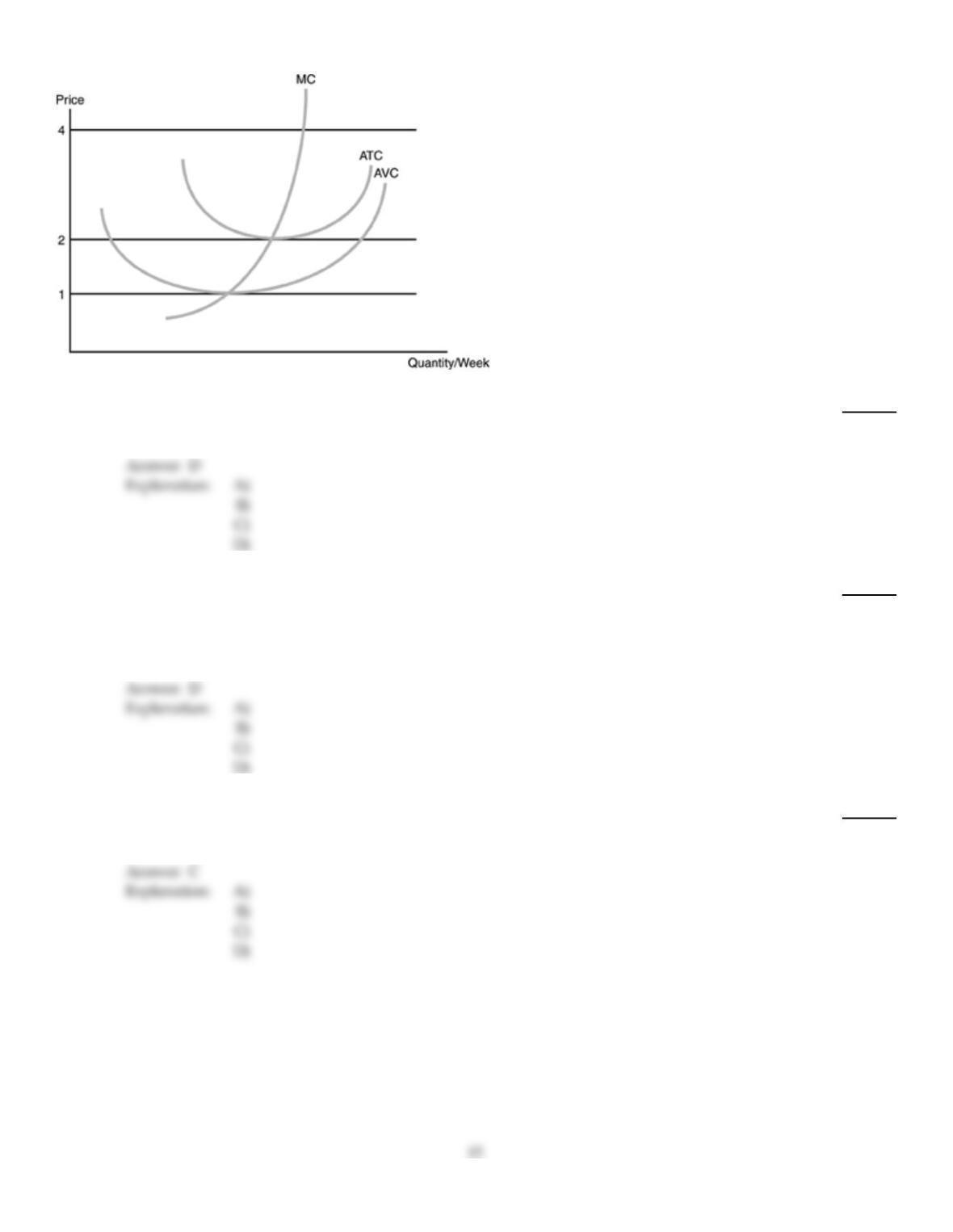
46)
Refer to the above figure. Profits will equal zero
46)
A)
at prices between $1 and $2.
B)
when the price equals $4.
C)
when the price equals $1.
D)
when the price equals $2.
47)
Being a price taker essentially means
47)
A)
the firm cannot legally set its price above the market price.
B)
the firm cannot legally set its price below the market price.
C)
a firm can influence the market price.
D)
a firm cannot influence the market price.
D
48)
A situation in which the price charged is equal to society’s opportunity cost is known as
48)
A)
marginal monopoly pricing.
B)
marginal profits.
C)
marginal cost pricing.
D)
market failure.
C
D
49)
If an industry’s long–run per–unit costs decrease as its output increases then
49)
A)
the firm is most likely a constant–cost industry.
B)
the firm’s long–run economic profits must be less than zero.
C)
the firm is most likely a decreasing–cost industry.
D)
the firm is most likely an increasing–cost industry.
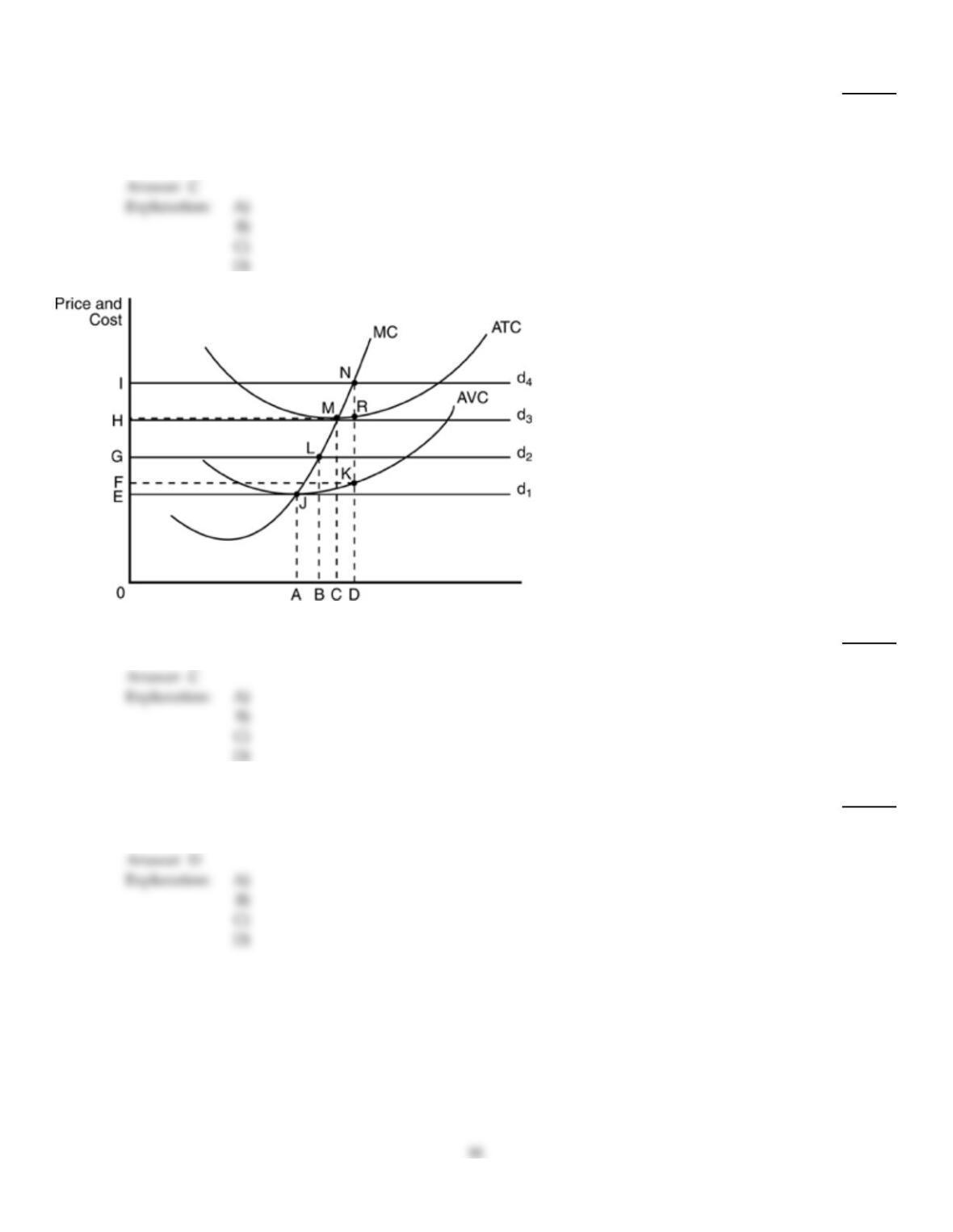
50)
In the above figure, the firm will shut down if price falls below
50)
A)
I.
B)
H.
C)
E.
D)
F.
51)
Which of the following is TRUE in perfect competition at long–run equilibrium?
51)
A)
Economic profit is $0.
B)
ATC is minimized.
C)
P = ATC = MC = MR
D)
all of the above
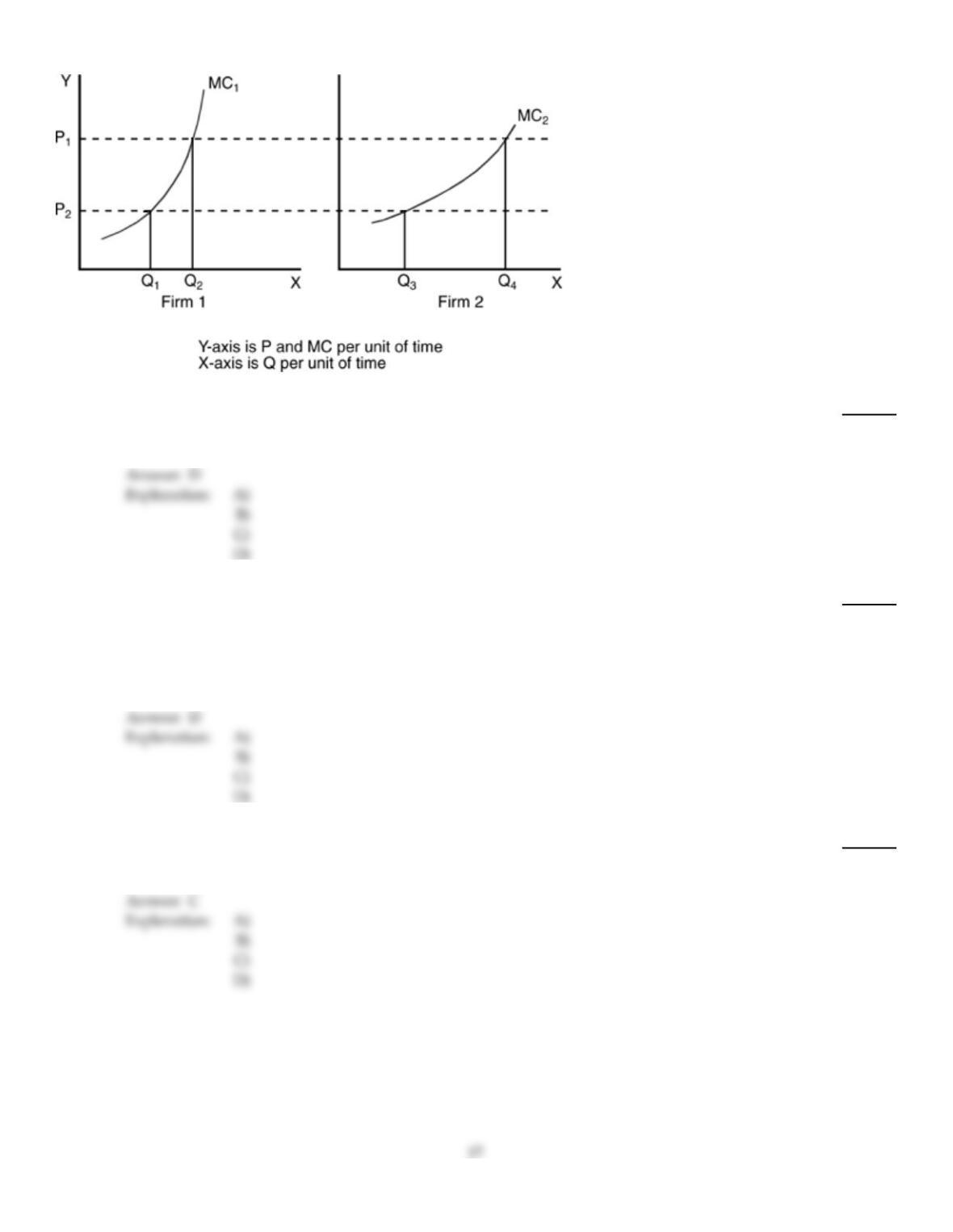
52)
In the above figure, assuming Firm 1 and Firm 2 are the sole producers in the industry, the industry
quantity supplied at price P2 is equal to
52)
A)
Q2+ Q4.
B)
Q1+ Q2.
C)
Q4– Q2.
D)
Q1+ Q3.
53)
Suppose a perfectly competitive industry is in long–run equilibrium. If a decrease in demand leads
to a lower long–run price, we know that
53)
A)
some firms will be losing money in the long run.
B)
after further adjustments, price will rise to its original level.
C)
this is a decreasing–cost industry.
D)
this is an increasing–cost industry.
54)
The short–run supply curve for a perfectly competitive firm is the portion of its
54)
A)
ATC curve below the MC curve.
B)
MC curve above the ATC curve.
C)
MC curve above its AVC curve.
D)
ATC curve above the MC curve.
55)
For a perfect competitor, marginal revenue equals
55)
A)
the slope of the demand curve.
B)
average revenue divided by price.
C)
the market price.
D)
price divided by average revenue.
56)
Assuming fixed factor prices, the short–run industry supply curve for a perfectly competitive
industry is equal to the sum of the
56)
A)
MC curves above minimum ATC.
B)
ATC curves above minimum ATC.
C)
MC curves above minimum AVC.
D)
AVC curves above minimum AVC.
C
Total Total Total Total
Output Costs Output Costs
100 $500 106 $528
101 501 107 540
102 503 108 555
103 506 109 580
104 510 110 615
105 518 111 660
57)
Refer to the above table. This firm operates in a perfectly competitive market in which the market
price is $5/unit. What is TRUE when the firm produces 110 units?
57)
A)
Total costs exceed total revenue by $65.
B)
Total revenue equals $3,075.
C)
Its total profit is $65.
D)
Marginal revenue is more than marginal cost.
A
58)
The vertical distance between the horizontal axis and any point on a perfect competitor‘s demand
curve measures
58)
A)
total revenues.
B)
supply curve for the product.
C)
product price, marginal revenue, and average revenue.
D)
total cost.
C
C
59)
The long–run supply curve in a constant–cost, perfectly competitive industry is
59)
A)
upward sloping.
B)
perfectly elastic.
C)
downward sloping.
D)
perfectly inelastic.
60)
The short–run break–even price
60)
A)
is the price at which the firm’s current liabilities are paid off.
B)
occurs at the output at which the firm yields a below normal rate of return.
C)
is the price at which a firm’s total revenues equal total costs.
D)
occurs at the output at which the firm yields a positive economic profit.
Explanation:
61)
In an increasing–cost industry, an increase in industry output will
61)
A)
lead to a higher market price.
B)
shift each firm’s short run supply curve down.
C)
lead to a lower market price.
D)
shift each firm’s average fixed cost curve down.
Explanation:
Explanation:
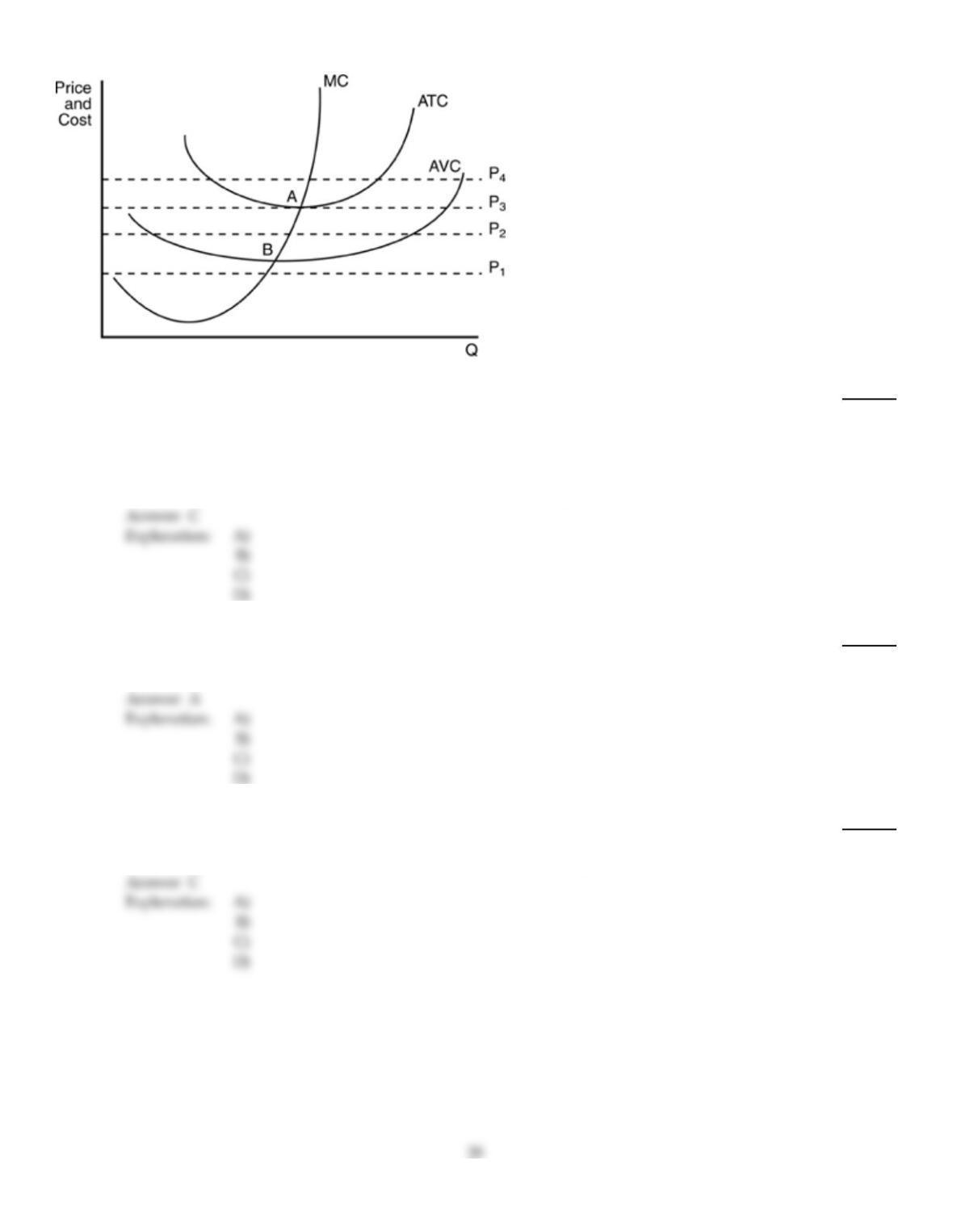
62)
In the above figure, what happens to the firm’s optimal level of output if the price it receives for its
product decreases from P4 to P3?
62)
A)
Output stays the same.
B)
Output increases.
C)
Output decreases.
D)
There is not enough information provided to know what happens to output.
63)
The profit–maximizing output for the perfectly competitive firm occurs at the point at which
63)
A)
MR = MC.
B)
TR – TC is at a minimum.
C)
TR – MR is at a maximum.
D)
TR – ATC is at a maximum.
64)
Which of the following is NOT a characteristic of perfect competition?
64)
A)
easy entry and exit into the market
B)
large number of buyers and sellers
C)
differentiated products
D)
price taking by each firm