Chapter 23—Performance Evaluation Using Variances from
Standard Costs Key
1. A variable cost system is an accounting system where standards are set for each manufacturing cost element.
2. One reason not to depend solely on historical records to set standards is that there may be inefficiencies
contained in past costs.
3. Standard costs serve as a device for measuring efficiency.
4. The standard cost is how much a product should cost to manufacture.
5. Standard costs can be used with both the process cost and job order cost systems.
6. Cost systems using detailed estimates of each element of manufacturing cost entering into the finished
product are called standard cost systems.
7. Cost systems using detailed estimates of each element of manufacturing cost entering into the finished
product are called budgeted cost systems.
8. Normally standard costs should be revised when labor rates change to incorporate new union contracts.
9. Standard costs should always be revised when they differ from actual costs.
10. Financial reporting systems that are guided by the principle of exceptions concept focus attention on
variances from standard costs.
11. In most businesses, cost standards are established principally by accountants.
12. It is correct to rely exclusively on past cost data when establishing standards.
13. Ideal standards are developed under conditions that assume no idle time, no machine breakdowns, and no
materials spoilage.
14. Currently attainable standards do not allow for reasonable production difficulties.
15. If employees are given bonuses for exceeding normal standards, the standards may be very effective in
motivating employees.
16. The fact that workers are unable to meet a properly determined direct labor standard is sufficient cause to
change the standard.
17. Changes in technology, machinery, or production methods may make past cost data irrelevant when setting
standards.
18. The difference between the standard cost of a product and its actual cost is called a variance.
19. Standards are performance goals used to evaluate and control operations.
20. Standards are set for only direct labor and direct materials.
21. Principle of exceptions allows managers to focus on correcting variances between standard costs and actual
costs.
22. Because accountants have financial expertise, they are the only ones that are able to set standard costs for
the production area.
23. While setting standards, the managers should never allow for spoilage or machine breakdowns in their
calculations.
24. A budget performance report compares actual results with the budgeted amounts and reports differences for
possible investigation.
25. A favorable cost variance occurs when actual cost is less than budgeted cost at actual volumes.
26. An unfavorable cost variance occurs when budgeted cost at actual volumes exceeds actual cost.
27. Standards are designed to evaluate price and quantity variances separately.
28. If the standard to produce a given amount of product is 2,000 units of direct materials at $12 and the actual
was 1,600 units at $13, the direct materials quantity variance was $5,200 favorable.
29. If the standard to produce a given amount of product is 1,000 units of direct materials at $11 and the actual
was 800 units at $12, the direct materials quantity variance was $2,200 unfavorable.
30. If the standard to produce a given amount of product is 1,000 units of direct materials at $11 and the actual
was 800 units at $12, the direct materials price variance was $800 unfavorable.
31. If the standard to produce a given amount of product is 1,000 units of direct materials at $11 and the actual
was 800 units at $12, the direct materials price variance was $800 favorable.
32. If the standard to produce a given amount of product is 1,000 units of direct materials at $11 and the actual
was 800 units at $12, the direct materials quantity variance was $1,000 unfavorable.
33. If the standard to produce a given amount of product is 600 direct labor hours at $17 and the actual was 500
hours at $15, the time variance was $1,500 unfavorable.
34. If the standard to produce a given amount of product is 600 direct labor hours at $15 and the actual was 500
hours at $17, the time variance was $1,700 unfavorable.
35. If the standard to produce a given amount of product is 600 direct labor hours at $15 and the actual was 600
hours at $17, the rate variance was $1,200 unfavorable.
36. If the standard to produce a given amount of product is 500 direct labor hours at $15 and the actual was 600
hours at $17, the rate variance was $1,200 favorable.
37. Standard costs are determined by multiplying expected price by expected quantity.
38. The direct labor time variance measures the efficiency of the direct labor force.
39. The variance from standard for factory overhead cost resulting from operating at a level above or below
100% of normal capacity is termed volume variance.
40. The variance from standard for factory overhead resulting from incurring a total amount of factory overhead
cost that is greater or less than the amount budgeted for the level of operations achieved is termed controllable
variance.
41. The most effective means of presenting standard factory overhead cost variance data is through a factory
overhead cost variance report.
42. Since the controllable variance measures the efficiency of using variable overhead resources, if budgeted
variable overhead exceeds actual results, the variance is favorable.
43. An unfavorable volume variance may be due to a failure of supervisors to maintain an even flow of work.
44. Favorable volume variances are never harmful, since achieving them encourages managers to run the
factory above normal capacity.
45. Volume variance measures fixed factory overhead.
46. Though favorable volume variances are usually good news, if inventory levels are too high, additional
production could be harmful.
47. Standard costs are a useful management tool that can be used solely as a statistical device apart from the
ledger or they can be incorporated in the accounts.
48. At the end of the fiscal year, the variances from standard are usually transferred to the finished goods
account.
49. Standard cost variances are usually not reported in reports to stockholders.
50. Standards are more widely used for nonmanufacturing expenses than for manufacturing costs.
51. Non-financial measures are often lined to the inputs or outputs of an activity or process.
52. A company must choice either a standard system or nonfinancial performance measures to evaluate the
performance of a company.
53. Nonfinancial performance output measures are used to improve the input measures.
54. An example of a nonfinancial measure is the number of customer complaints.
55. A company should only use nonfinancial performance measures when financial measures cannot be
calculated.
56. Which of the following conditions normally would not indicate that standard costs should be revised?
57. Standards that represent levels of operation that can be attained with reasonable effort are called:
58. Standard costs are used in companies for a variety of reasons. Which of the following is not one of the
benefits for using standard costs?
59. The principle of exceptions allows managers to
60. Periodic comparisons between planned objectives and actual performance are reported in:
61. The standard price and quantity of direct materials are separated because:
62. Standard costs are divided into which of the following components?
63. A favorable cost variance occurs when
64. The total manufacturing cost variance consists of:
65. Which of the following is not a reason standard costs are separated in two components?
66. The standard costs and actual costs for direct materials for the manufacture of 3,000 actual units of product
are as follows:
Standard Costs
Direct materials (per completed unit)
1.04 kilograms @$8.75
Actual Costs
Direct materials
2,500 kilograms @ $8
The amount of direct materials price variance is:
67. The standard costs and actual costs for direct materials for the manufacture of 2,500 actual units of product
are as follows:
Standard Costs
Direct materials
2,500 kilograms @ $8
Actual Costs
Direct materials
2,600 kilograms @ $8.75
The amount of the direct materials quantity variance is:
68. The following data relate to direct materials costs for November:
Actual costs
4,700 pounds at $5.40
Standard costs
4,500 pounds at $6.20
What is the direct materials price variance?
69. The following data relate to direct materials costs for November:
Actual costs
4,700 pounds at $5.40
Standard costs
4,500 pounds at $6.20
What is the direct materials quantity variance?
70. If the actual quantity of direct materials used in producing a commodity differs from the standard quantity,
the variance is termed a:
71. If the price paid per unit differs from the standard price per unit for direct materials, the variance is termed
a:

72. The following data is given for the Stringer Company:
Budgeted production
26,000 units
Actual production
27,500 units
Materials:
Standard price per ounce
$6.50
Standard ounces per completed unit
8
Actual ounces purchased and used in production
228,000
Actual price paid for materials
$1,504,800
Labor:
Standard hourly labor rate
$22 per hour
Standard hours allowed per completed unit
6.6
Actual labor hours worked
183,000
Actual total labor costs
$4,020,000
Overhead:
Actual and budgeted fixed overhead
$1,029,600
Standard variable overhead rate
$24.50 per standard labor hour
Actual variable overhead costs
$4,520,000
Overhead is applied on standard labor hours.
The direct material price variance is:
73. The following data is given for the Stringer Company:
Budgeted production
26,000 units
Actual production
27,500 units
Materials:
Standard price per ounce
$6.50
Standard ounces per completed unit
8
Actual ounces purchased and used in production
228,000
Actual price paid for materials
$1,504,800
Labor:
Standard hourly labor rate
$22 per hour
Standard hours allowed per completed unit
6.6
Actual labor hours worked
183,000
Actual total labor costs
$4,020,000
Overhead:
Actual and budgeted fixed overhead
$1,029,600
Standard variable overhead rate
$24.50 per standard labor hour
Actual variable overhead costs
$4,520,000
Overhead is applied on standard labor hours.
The direct material quantity variance is:
74. The Lucy Corporation purchased and used 129,000 board feet of lumber in production, at a total cost of
$1,548,000. Original production had been budgeted for 22,000 units with a standard material quantity of 5.7
board feet per unit and a standard price of $12 per board foot. Actual production was 23,500 units.
Compute the material price variance.
75. The Lucy Corporation purchased and used 129,000 board feet of lumber in production, at a total cost of
$1,548,000. Original production had been budgeted for 22,000 units with a standard material quantity of 5.7
board feet per unit and a standard price of $12 per board foot. Actual production was 23,500 units.
Compute the material quantity variance.
76. If the wage rate paid per hour differs from the standard wage rate per hour for direct labor, the variance is
termed a:
77. If the actual direct labor hours spent producing a commodity differs from the standard hours, the variance is
termed a:
78. The following data relate to direct labor costs for the current period:
Standard costs
7,500 hours at $11.40
Actual costs
6,000 hours at $12.00
What is the direct labor time variance?
79. The following data relate to direct labor costs for the current period:
Standard costs
6,000 hours at $12.00
Actual costs
7,500 hours at $11.40
What is the direct labor rate variance?
80. The following data relate to direct labor costs for the current period:
Standard costs
9,000 hours at $5.50
Actual costs
8,500 hours at $5.75
What is the direct labor rate variance?
81. The following data relate to direct labor costs for the current period:
Standard costs
36,000 hours at $22.00
Actual costs
35,000 hours at $23.00
What is the direct labor time variance?
82. The standard costs and actual costs for direct labor for the manufacture of 2,500 actual units of product are
as follows:
Standard
Costs
Direct labor
7,500 hours @ $11.80
Actual
Costs
Direct labor
7,400 hours @ $11.40
The amount of the direct labor rate variance is:
83. The standard costs and actual costs for direct materials, direct labor, and factory overhead for the
manufacture of 2,500 units of product are as follows:
Standard
Costs
Direct labor
7,500 hours @ $11.80
Actual
Costs
Direct labor
7,400 hours @ $11.40
The amount of the direct labor time variance is:
84. The following data relate to direct labor costs for February:
Actual costs
7,700 hours at $14.00
Standard costs
7,000 hours at $16.00
What is the direct labor time variance?
85. The following data relate to direct labor costs for February:
Actual costs
7,700 hours at $14.00
Standard costs
7,000 hours at $16.00
What is the direct labor rate variance?
86. The following data is given for the Harry Company:
Budgeted production
26,000 units
Actual production
27,500 units
Materials:
Standard price per ounce
$6.50
Standard ounces per completed unit
8
Actual ounces purchased and used in production
228,000
Actual price paid for materials
$1,504,800
Labor:
Standard hourly labor rate
$22 per hour
Standard hours allowed per completed unit
6.6
Actual labor hours worked
183,000
Actual total labor costs
$4,020,000
Overhead:
Actual and budgeted fixed overhead
$1,029,600
Standard variable overhead rate
$24.50 per standard labor hour
Actual variable overhead costs
$4,520,000
Overhead is applied on standard labor hours.
The direct labor rate variance is:

87. The following data is given for the Harry Company:
Budgeted production
26,000 units
Actual production
27,500 units
Materials:
Standard price per ounce
$6.50
Standard ounces per completed unit
8
Actual ounces purchased and used in production
228,000
Actual price paid for materials
$1,504,800
Labor:
Standard hourly labor rate
$22 per hour
Standard hours allowed per completed unit
6.6
Actual labor hours worked
183,000
Actual total labor costs
$4,020,000
Overhead:
Actual and budgeted fixed overhead
$1,029,600
Standard variable overhead rate
$24.50 per standard labor hour
Actual variable overhead costs
$4,520,000
Overhead is applied on standard labor hours.
The direct labor time variance is:
88. The Flapjack Corporation had 8,200 actual direct labor hours at an actual rate of $12.40 per hour. Original
production had been budgeted for 1,100 units, but only 1,000 units were actually produced. Labor standards
were 7.6 hours per completed unit at a standard rate of $13.00 per hour.
Compute the labor rate variance.
89. The Flapjack Corporation had 8,200 actual direct labor hours at an actual rate of $12.40 per hour. Original
production had been budgeted for 1,100 units, but only 1,000 units were actually produced. Labor standards
were 7.6 hours per completed unit at a standard rate of $13.00 per hour.
Compute the labor time variance.
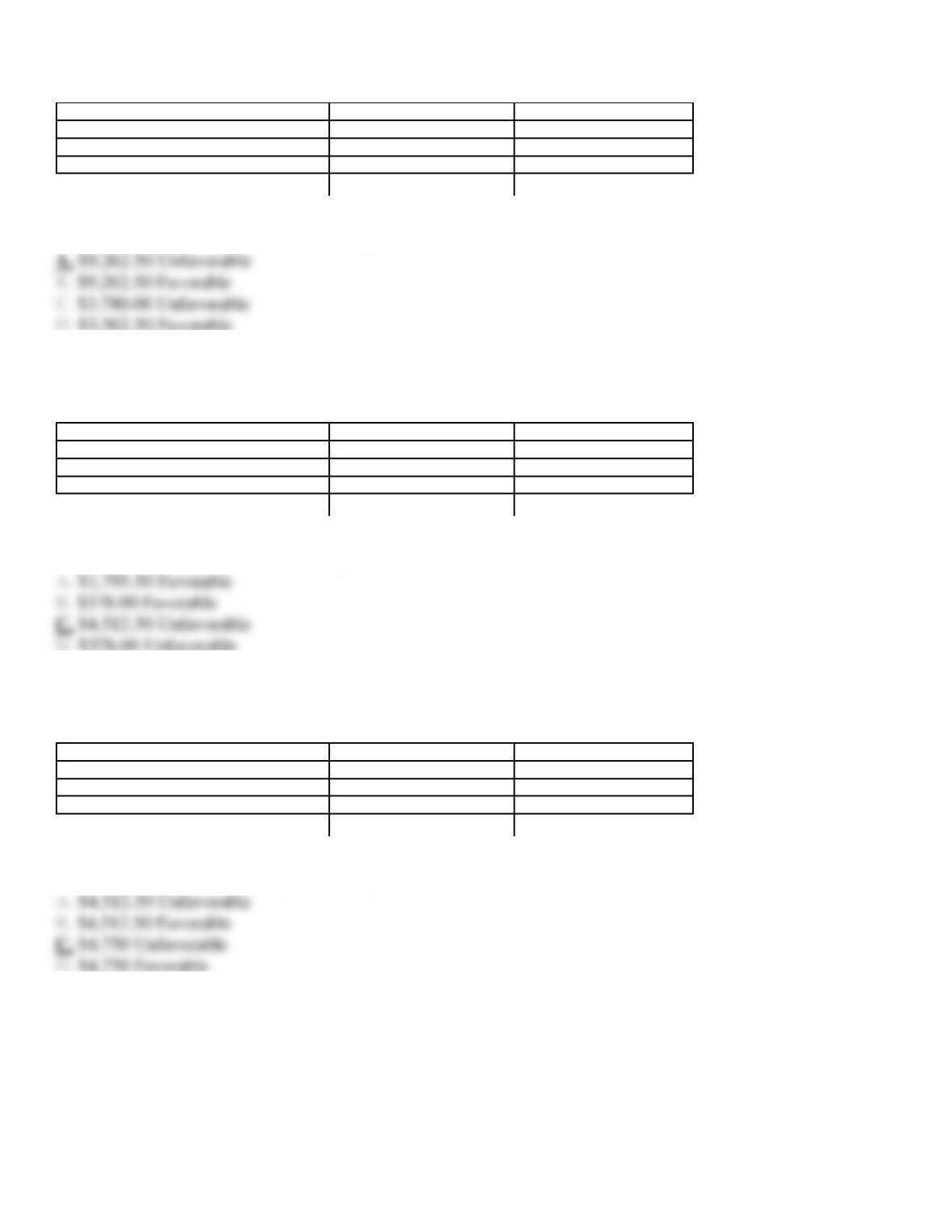
90.
Standard
Actual
Material Cost Per Yard
$2.00
$2.10
Standard Yards per Unit
4.5 yards
4.75 yards
Units of Production
9,500
Calculate the Total Direct Materials cost variance using the above information:
91.
Standard
Actual
Material Cost Per Yard
$2.00
$2.10
Standard Yards per Unit
4.5 yards
4.75 yards
Units of Production
9,500
Calculate the Direct Materials Price variance using the above information:
92.
Standard
Actual
Material Cost Per Yard
$2.00
$2.10
Standard Yards per Unit
4.5 yards
4.75 yards
Units of Production
9,500
Calculate the Direct Materials Quantity variance using the above information:
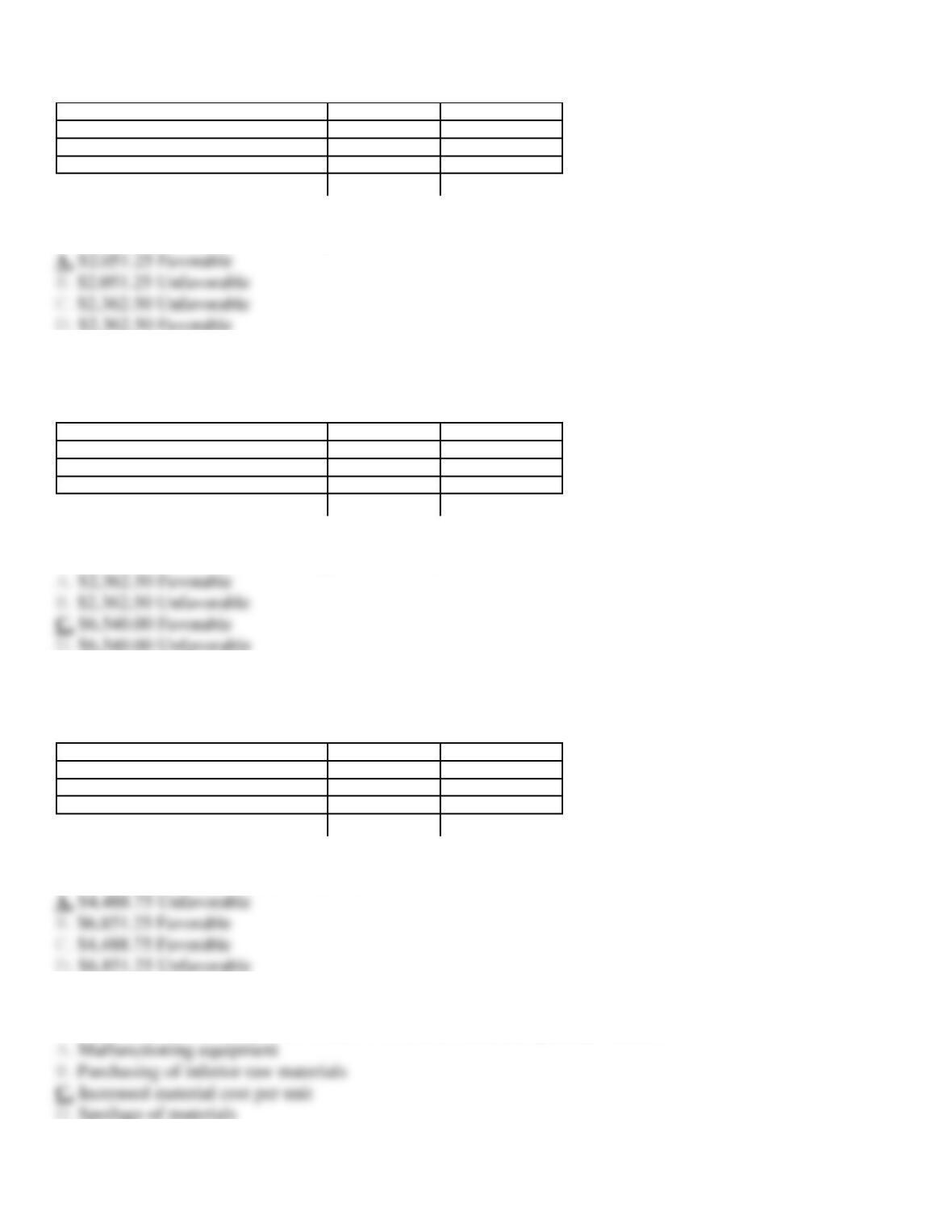
93.
Standard
Actual
Rate
$12.00
$12.25
Hours
18,500
17,955
Units of Production
9,450
Calculate the Total Direct Labor Variance using the above information
94.
Standard
Actual
Rate
$12.00
$12.25
Hours
18,500
17,955
Units of Production
9,450
Calculate the Direct Labor Time Variance using the above information
95.
Standard
Actual
Rate
$12.00
$12.25
Hours
18,500
17,955
Units of Production
9,450
Calculate the Direct Labor Rate Variance using the above information
96. Which of the following is not a reason for a direct materials quantity variance?
97. The formula to compute direct labor rate variance is to calculate the difference between
98. The formula to compute direct labor time variance is to calculate the difference between
99. The formula to compute direct materials price variance is to calculate the difference between
100. The formula to compute direct material quantity variance is to calculate the difference between
101. Which of the following would not lend itself to applying direct labor variances?
102. The standard costs and actual costs for factory overhead for the manufacture of 2,500 units of actual
production are as follows:
Standard
Costs
Fixed overhead (based on 10,000 hours)
3 hours @ $.80 per hour
Variable overhead
3 hours @ $2.00 per hour
Actual Costs
Total variable cost, $18,000
Total fixed cost, $8,000
The amount of the factory overhead volume variance is:
103. The standard costs and actual costs for factory overhead for the manufacture of 2,500 units of actual
production are as follows:
Standard
Costs
Fixed overhead (based on 10,000 hours)
3 hours @ $.80 per hour
Variable overhead
3 hours @ $2.00 per hour
Actual Costs
Total variable cost, $18,000
Total fixed cost, $8,000
The amount of the total factory overhead cost variance is: