Cost Accounting: A Managerial Emphasis, 6e
Chapter 22 – Capital Budgeting: A Closer Look
Chapter 22 Capital Budgeting: A Closer Look
22.1 Analyze the impact of income taxes on operating and capital cash flows.
1) After-tax savings from an operating cash outflow are calculated by multiplying the cash flow by (1 – t),
where t = the tax rate.
2) The Income Tax Act does not permit a company to deduct depreciation in the calculation of taxable
income.
3) Capital cost allowance is the income tax version of financial reporting depreciation.
4) A Canadian corporation can deduct a full year’s worth of CCA on any asset acquired in the year.
5) The half-year rule assumes that all net additions are purchased in the middle of the year, and thus only
one-half of the stated CCA rate is allowed in the first year.
6) Capital Cost Allowance (CCA) is a cash flow.
Cost Accounting: A Managerial Emphasis, 6e
Chapter 22 – Capital Budgeting: A Closer Look
7) CCA reduces taxable income, and therefore reduces tax payments and increases the firm’s cash flow.
8) The Income Tax Act classifies every amortizable asset into one of several classes.
9) The acquisition cost of the assets in a class, minus the CCA claimed to date for that class, is referred to
as the UCC of a particular class.
10) In case of a sale or trade of a capital asset for another capital asset, the net tax book value of the asset
can be ignored for capital budgeting purposes.
11) Depreciation tax deductions result in tax savings that partially offset the cost of acquiring the capital
asset.
12) The use of an accelerated method of depreciation for tax purposes would usually increase the present
value of the investment.
13) In the net present value (NPV) method, after-tax cash flows should be used instead of pre–tax cash
flows when taxes are a consideration.
Cost Accounting: A Managerial Emphasis, 6e
Chapter 22 – Capital Budgeting: A Closer Look
14) A decrease in the tax rate will decrease the net present value (NPV) for a given capital budgeting
project.
15) The tax effects are significant in capital budgeting decisions.
16) Businesses may opt not to claim the full amount of available capital cost allowance.
17) The disposal of a machine (or any depreciable asset) results in a lost tax shield.
18) After-tax cash-operating flows are equal to
A) (one minus the tax rate) times (net income).
B) (one minus the tax rate) times (operating income) plus CCA.
C) (one minus the tax rate) times (sales less costs excluding CCA).
D) sales less (one minus the tax rate) times (cash costs).
E) (one minus the tax rate) times (sales less costs including CCA).
Cost Accounting: A Managerial Emphasis, 6e
Chapter 22 – Capital Budgeting: A Closer Look
19) When considering the net cash inflows resulting from a capital-budgeting decision, taxes will
A) reduce the amount of the cash savings by the tax rate.
B) increase the amount of the cash savings by the tax rate.
C) increase the amount of the cash savings by (1 – tax rate).
D) reduce the amount of the cash savings by (1 – tax rate).
E) increase the amount of the cash savings by (1 + tax rate).
20) A capital proposal is projected to result in annual savings of $25,000. What is the after-tax cash flow if
the tax rate is 35%?
A) $25,000
B) $16,250
C) $8,750
D) $7,500
E) $5,000
21) Canada, like most taxing authorities, uses different methods for calculating depreciation for tax
purposes. The Income Tax Act uses which of the following methods?
A) accelerated amortization
B) straight-line and accelerated amortization
C) straight-line, double declining balance, and accelerated amortization
D) straight-line and declining balance
E) double declining balance and accelerated amortization only
22) Wilf Company acquired an additional Class 10 (30% declining balance) asset for $60,000. The UCC at
the beginning of the year was $100,000. CCA in the current year is
A) $48,000.
B) $24,000.
C) $45,000.
D) $37,500.
E) $39,000.
Cost Accounting: A Managerial Emphasis, 6e
Chapter 22 – Capital Budgeting: A Closer Look
For Years 1 through 6 Better Products Ltd. had annual net income of $20,000, CCA of $40,000 each year, a
40 percent tax rate, a discount rate of 10 percent and annual cash sales of $200,000. The depreciable assets
of Better Products belong in several different classes under the Income tax Act, have a salvage value of
zero at the end of six years, and were all bought new at the beginning of Year 1. The present value factors,
in simplified form, for 10 percent are:
Year
PV of $1
PV of annuity of $1
1
0.91
0.91
2
0.83
1.74
3
0.75
2.49
4
0.68
3.17
5
0.62
3.79
6
0.56
4.35
23) What is the annual expense deduction for CCA?
A) $16,000
B) $24,000
C) $36,000
D) $40,000
E) $42,500
24) What is the tax saving from CCA in each year?
A) $16,000
B) $24,000
C) $36,000
D) $54,000
E) $14,400
Cost Accounting: A Managerial Emphasis, 6e
Chapter 22 – Capital Budgeting: A Closer Look
25) If the appropriate tax rate is 35%, the after-tax effect of a single CCA deduction of $60,000 is
A) $39,000 net after-tax cash outflow.
B) $39,000 net after-tax cash inflow.
C) $21,000 net after-tax cash outflow.
D) $21,000 net after-tax cash inflow.
E) $24,000 net after-tax cash inflow.
26) Biermann Equipment is a publicly held corporation required to pay income taxes. For the current year
it had revenues of $5,000,000 and cash expenses of $3,000,000, and claimed CCA of $200,000. The
company has a 30 percent tax rate.
What would be the net cash flow for the current year if all revenues were received in cash?
A) $600,000
B) $1,260,000
C) $1,460,000
D) $1,800,000
E) $2,000,000
Cost Accounting: A Managerial Emphasis, 6e
Chapter 22 – Capital Budgeting: A Closer Look
27) The three factors that generally influence depreciation for tax purposes are: amount allowable for
depreciation, allowable life of asset, and allowable methods of depreciation. In Canada, for tax purposes,
A) the amount allowable for CCA is the cost of the asset, and, the allowable life of asset and the amount
of salvage value are determined by its Class under the Income Tax Act.
B) the amount allowable for CCA is the cost of the asset; the tax-based depreciation rate is determined by
the Class of the asset under the Income Tax Act, and neither the estimated life of asset nor the amount of
estimated salvage value are relevant in calculating the CCA claim.
C) the allowable depreciation for tax purposes (CCA) is increased for the first year only.
D) depreciable assets are placed in various classes by the Income Tax Act, based on their estimated
salvage value.
E) in the year of acquisition of new assets into an existing pool the allowable CCA claim is based on 50%
of all the assets in the pool.
28) Which of the following statements is true?
A) The accounting book value for all assets in a class equals the UCC for that class.
B) The CCA claimed does not affect cash outflows.
C) The total CCA available over the life of the asset depends on the method of depreciation used.
D) Since CCA does not involve a cash expenditure, it can be ignored in capital-budgeting decisions.
E) The depreciation method used does not affect cash inflows from operations.
29) A company purchased a class 8 asset (there were no disposals). If the asset cost $20,000, had an
estimated salvage value of $5,000, using the declining balance method with an allowable rate of 20%, the
allowable CCA in the first and second years would be, respectively,
A) $1,500 and $2,700.
B) $2,000 and $3,600.
C) $3,000 and $2,400.
D) $3,000 and $1,200.
E) $4,000 and $3,200.
Cost Accounting: A Managerial Emphasis, 6e
Chapter 22 – Capital Budgeting: A Closer Look
30) When calculating the lost tax shield concerning the terminal disposition of an asset four years from
now,
A) the amount calculated by the Tax Shield formula must also be discounted for the four years by the
relevant discount factor.
B) the discount is already included in the formula.
C) we discount the Lost Tax Shield amount by the tax rate.
D) we discount the Lost Tax Shield amount by (1 – tax rate).
E) we discount the Lost Tax Shield amount by (1 + tax rate).
Creston Ltd. purchased a piece of equipment for $100,000 (list price). The equipment was added to the
$350,000 of opening UCC for Class 8 (20%), and the company traded-in old class 8 equipment, paying
$80,000 difference. The company uses straight-line depreciation, estimates a 20 year useful life but no
salvage value for the new equipment. The tax rate is 35%, and Creston has a required rate of return of
9.0%.
31) What is the balance in the Class 8 pool after the addition of the new equipment?
A) $350,000
B) $410,000
C) $450,000
D) $430,000
E) $460,000
32) What is the CCA claim in year 1?
A) $3,500
B) $7,000
C) $8,000
D) $16,000
E) $18,400
Cost Accounting: A Managerial Emphasis, 6e
Chapter 22 – Capital Budgeting: A Closer Look
33) What are the tax savings in year 2 from the investment?
A) $3,500
B) $7,000
C) $8,000
D) $5,040
E) $18,400
34) Based on the above data only, what are the tax savings from the CCA of class 8 for year 2?
A) $45,760
B) $70,400
C) $75,000
D) $24,640
E) $86,000
Cost Accounting: A Managerial Emphasis, 6e
Chapter 22 – Capital Budgeting: A Closer Look
35) A company purchased computer equipment that is Class 10 for Income Tax purposes (Class 10 is
declining balance, but with a 30% rate). The company made the following two journal entries:
Cash
1,500
Accumulated Depreciation
1,100
Loss
300
Computer # 4
2,800
(disposal of old computer)
Computer # 7
5,000
Cash
5,000
How is the $300 loss treated in discounted cash flow analysis?
A) It reduces the net additions to class 10 for calculating CCA.
B) The loss times the tax rate is an after–tax cash flow.
C) The loss plus the accumulated amortization are disposals for class 10.
D) It reduces the net additions to class 10 for calculating CCA, and (the loss) times (the tax rate) is an
after-tax cash flow.
E) It is ignored.
36) The income tax depreciation method referred to as CCA
A) allows a corporation some flexibility in choosing the class an asset is assigned to.
B) ignores estimated salvage value.
C) only applies to businesses organized as corporations.
D) provides an organization some flexibility in choosing a method of amortization.
E) allows amortization over the asset’s useful life as determined by management.
37) A project’s net present value is increased if
A) the CCA rate is decreased.
B) the discount rate is increased.
C) the CCA rate is increased.
D) the company’s net income is negative during the life of the project.
E) the rate of inflation rises.
Cost Accounting: A Managerial Emphasis, 6e
Chapter 22 – Capital Budgeting: A Closer Look
38) Which of the following are not considered in capital-budgeting?
A) initial machine investment
B) depreciation
C) cash flow from current disposal of old machine
D) cash flow from terminal disposal of new machine
E) recurring after-tax operating flows
39) Which of the following is not a relevant cash flow in capital budgeting?
A) after-tax cash flow from current disposal of old asset
B) after-tax cash flow from future disposal of asset at life’s end
C) after-tax cash flow from accumulated depreciation
D) initial asset investment of the replacement machine
E) after-tax annual cash flows relating to the new asset
40) A new machine will cost $500,000. It is in a CCA class pool that uses a declining balance rate of 30%.
The company’s tax rate is 40% and it requires a 15% rate of return on investments. Calculate the cash
savings from the tax shield the first year assuming the savings occur at year end.
A) $126,998.42
B) $78,214.34
C) $132,445.53
D) $119,765.22
E) $26,086.96
Cost Accounting: A Managerial Emphasis, 6e
Chapter 22 – Capital Budgeting: A Closer Look
41) A new machine will cost $720,000. It is in a CCA class pool that uses a declining balance rate of 20%.
The company’s tax rate is 42% and it requires a 12% rate of return on investments. Calculate the cash
savings from the tax shield the first year assuming the savings occur at year end.
A) $60,480.00
B) $54,000.00
C) $27,000.00
D) $30,240.00
E) $37,285.71
42) A new machine will cost $1,800,000. It is in a CCA class pool that uses a declining balance rate of 30%.
The company’s tax rate is 38% and it requires a 9% rate of return on investments. Calculate the cash
savings from the tax shield the first year assuming the savings occur at year end.
A) $153,577.98
B) $188,256.88
C) $167,400.00
D) $94,128.44
E) $102,600.00
43) What is the balance in the Class 10 pool after the addition of the new equipment?
A) $780,000
B) $940,000
C) $1,040,000
D) $430,000
E) $1,200,000
Cost Accounting: A Managerial Emphasis, 6e
Chapter 22 – Capital Budgeting: A Closer Look
44) What are the tax savings in year 1 from the investment?
A) $31,500
B) $39,900
C) $23,940
D) $11,970
E) $105,000
45) What is the CCA claim in year 2 from the investment?
A) $20,349
B) $44,100
C) $66,300
D) $53,550
E) $21,000
Cost Accounting: A Managerial Emphasis, 6e
Chapter 22 – Capital Budgeting: A Closer Look
46) Based on the above data only, what are the tax savings from the CCA of class 10 for year 2?
A) $78,603
B) $239,700
C) $91,086
D) $128,247
E) $206,850
Cost Accounting: A Managerial Emphasis, 6e
Chapter 22 – Capital Budgeting: A Closer Look
47) Clock Manufacturing Company purchased a new piece of equipment at a cost of $60,000 at the
beginning of the year. For tax purposes the machine is a Class 8 asset (20% declining balance). The
company has a 34 percent income tax rate. Assume that the company has no other Class 8 assets during
the period.
Required:
a. Compute the amount of tax savings from CCA for the first three years.
b. Compute the amount of tax savings from CCA for the first three years using a required rate of return
of 12 percent.
Cost Accounting: A Managerial Emphasis, 6e
Chapter 22 – Capital Budgeting: A Closer Look
48) Tex Corporation trades in a Class 10 (30%) asset during the current year. The opening UCC balance in
the Class 10 pool is $420,000. Tex trades in an asset for $25,000, which is deducted from the $125,000 price
of the new machine (also Class 10). The appropriate tax rate is 35% and the nominal after-tax rate of
return is 10%.
Required: Calculate the UCC at the end of the year for class 10.
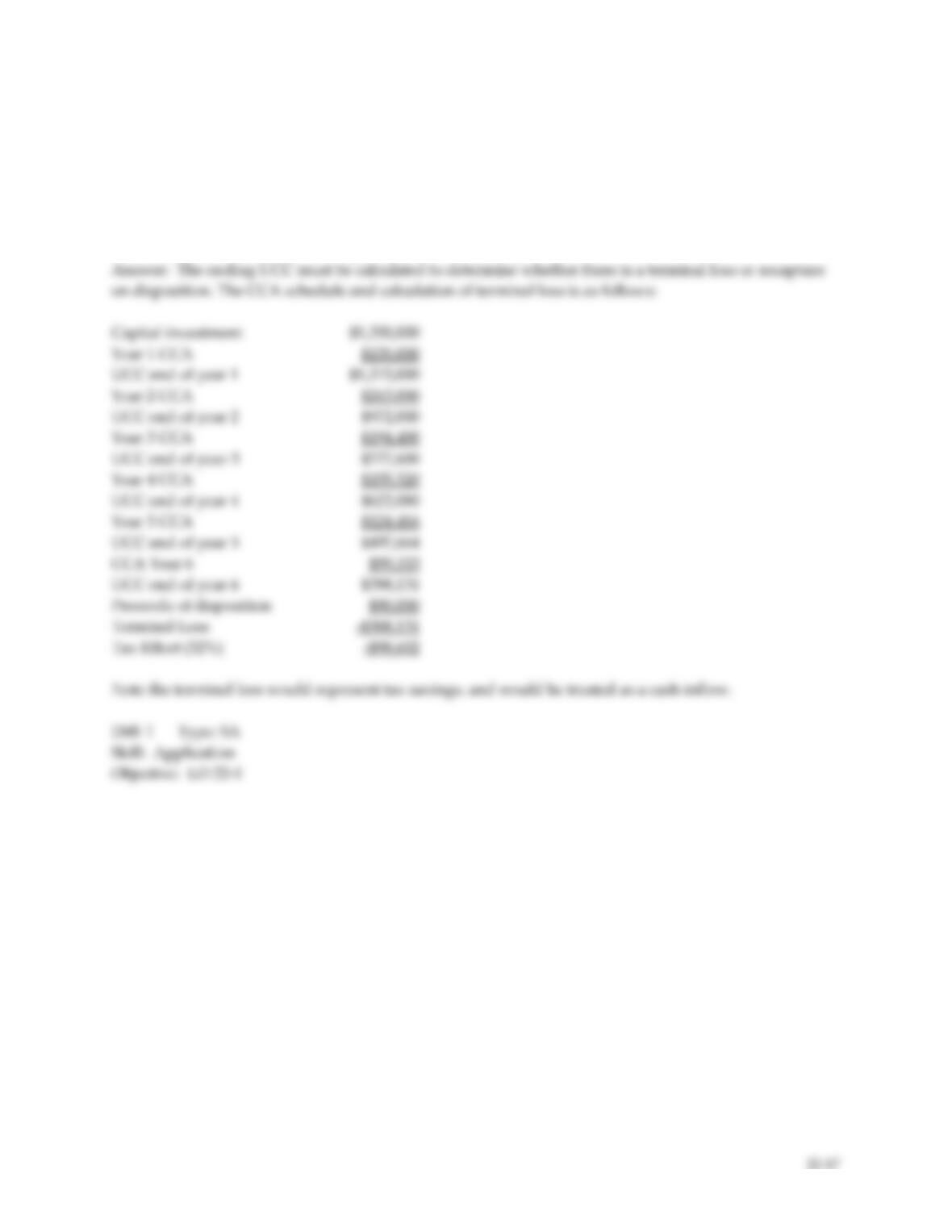
49) Headwaters Ltd. is considering purchasing a new asset. It has a cost of $1,350,000, an expected 6 year
life and a salvage value of $90,000. The equipment would qualify as a class 8 (20% CCA) asset and
Headwaters has a required rate of return of 11% and an effective tax rate of 32%.
Required:
Calculate the tax shields that are generated from the purchase of this asset. Assume the asset will be
placed in a pool and the pool will continue upon disposition. For tax purposes the disposition will occur
on day 1 of Year 7. What is the net tax effect of the asset acquisition?
Cost Accounting: A Managerial Emphasis, 6e
Chapter 22 – Capital Budgeting: A Closer Look
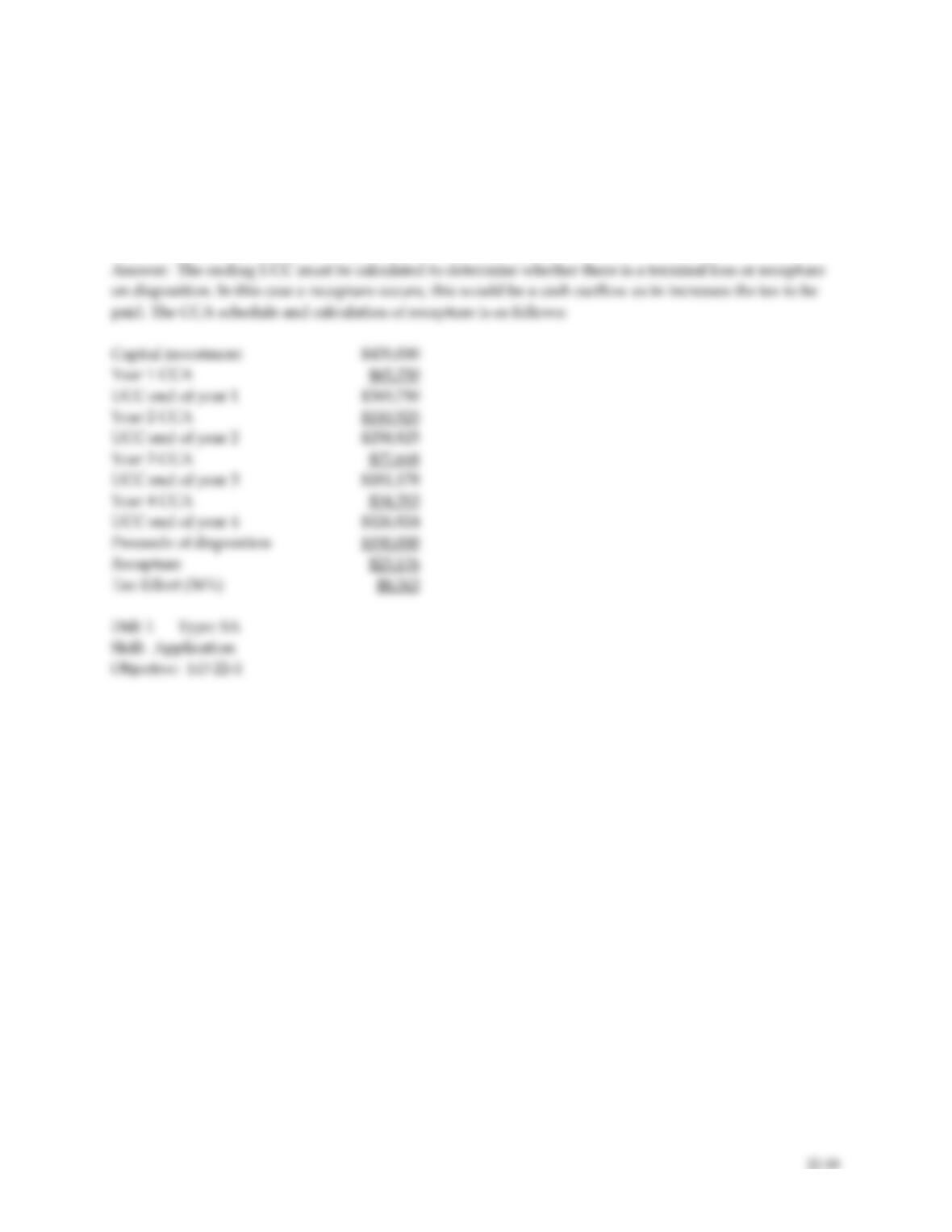
50) Headwaters Ltd. is considering purchasing a new asset. It has a cost of $1,350,000, an expected 6 year
life and a salvage value of $90,000. The equipment would qualify as a class 8 (20% CCA) asset and
Headwaters has a required rate of return of 11% and an effective tax rate of 32%.
Required:
Assume that this asset is the only asset in the pool. Assuming the asset is disposed of at its estimated
salvage value, what is the tax effect on the disposition of the asset? Assume the asset will be disposed of
on day 1 of year 7 so the asset is eligible for CCA claims in year 6.
Cost Accounting: A Managerial Emphasis, 6e
Chapter 22 – Capital Budgeting: A Closer Look
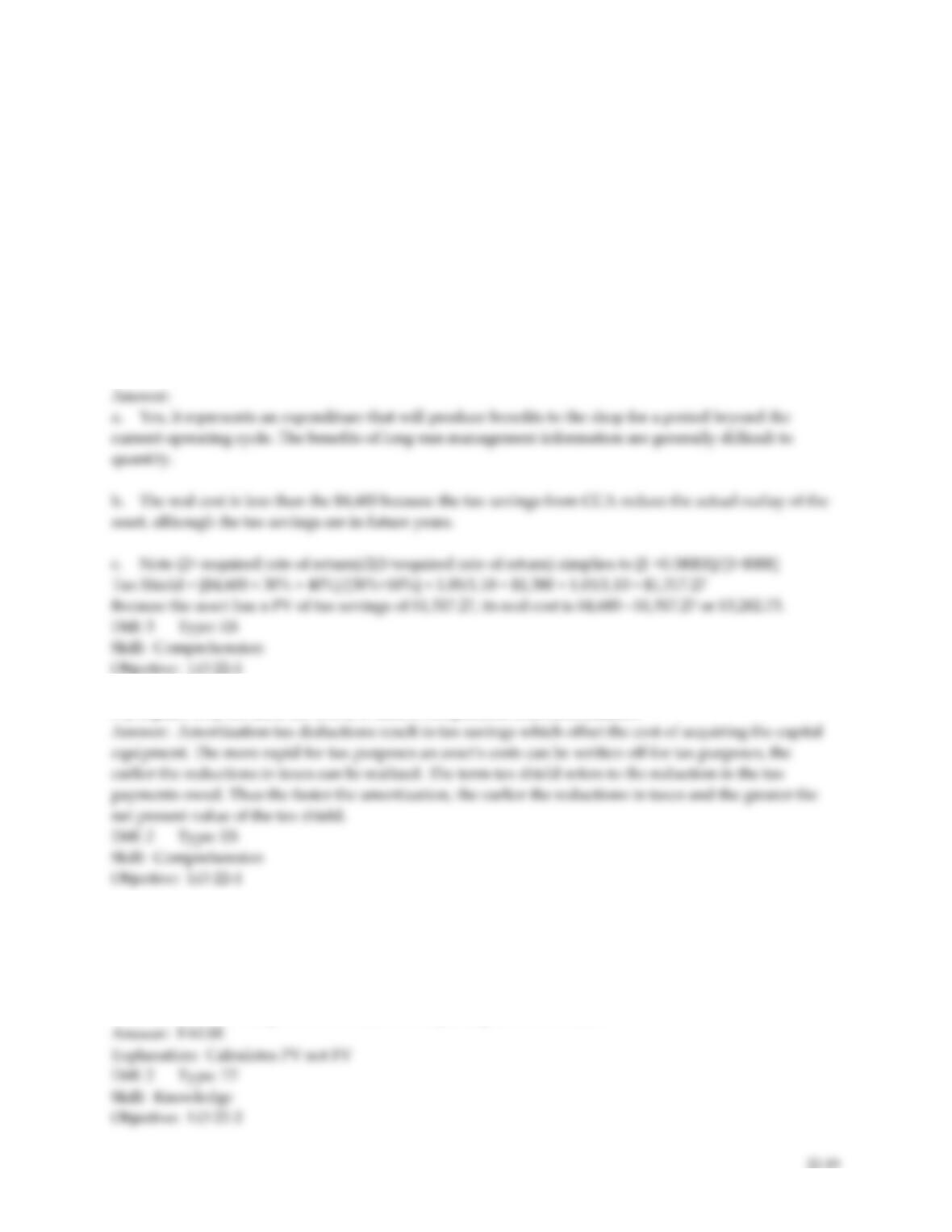
51) Allan Ltd. is considering purchasing a new asset. It has a cost of $435,000, an expected 4 year life and
a salvage value of $150,000. The equipment would qualify as a class 10 (30% CCA) asset and Allan has a
required rate of return of 13% and an effective tax rate of 36%.
Required:
Assume that this asset is the only asset in the pool. Assuming the asset is disposed of at its estimated
salvage value, what is the tax effect on the disposition of the asset? Assume the asset will be disposed of
on day 1 of year 5 so the asset is eligible for CCA claims in year 4.
Cost Accounting: A Managerial Emphasis, 6e
Chapter 22 – Capital Budgeting: A Closer Look
52) Johnson’s Mini Mart is considering the purchase of a new electronic bar code scanner that will keep
detailed records of every sale transaction. The scanner is likely to have little effect on operating revenues
and expenses. Its acquisition is primarily for increasing management information about sales. The
scanner costs $4,600 and would be included in Class 10 for tax purposes. Johnson’s accountant has stated
that due to the fast write-off of Class 10 assets (30% CCA rate), its real cost is less than $4,600.
Due to technological obsolescence, it would have zero salvage value.
Required:
a. Since the bar code scanner cannot produce a profit or even show short run savings, should it even be
evaluated as a capital budgeting expenditure? Explain.
b. Explain whether or not the real cost is less than $4,600.
c. If the company has a 40 percent tax rate and a 10% discount rate, compute the real cost of the bar
code scanner. Assume there would be other assets in the class.
53) Explain why the term tax shield is used in conjunction with amortization.
22.2 Apply the total-project approach and the differential approach appropriately to
different capital budgeting decisions.
1) The total project approach calculates the future value of cash outflows and inflows that differ between
the alternatives of using the old machine and replacing the old machine.
Cost Accounting: A Managerial Emphasis, 6e
Chapter 22 – Capital Budgeting: A Closer Look
2) The differential approach calculates the present value of all cash inflows and outflows under each
alternative.
3) The differential approach is based on the concept of relevance.
4) A company is considering the purchase of some equipment that in the second year of operation should
cause an increase in sales of $200,000, an increase in cash expenses of $120,000, and CCA of $60,000. If the
appropriate tax rate is 40%, what will be the after-tax effect on net income in year two?
A) no effect
B) net after-tax inflows of $72,000
C) net after-tax inflows of $12,000
D) net after-tax inflows of $20,000
E) net after-tax inflows of $50,000
5) The total project approach to capital budgeting
A) calculates the present value of all cash inflows and outflows under each alternative separately.
B) calculates the net present value for the incremental cash flows.
C) calculates the net present value of cash flows which differ between alternatives.
D) uses gross cash flows to determine net present values.
E) produces the same answer as the IRR method.