Chapter 22—Cash Conversion, Inventory, and Receivables Management
MULTIPLE CHOICE
1. Cold Chiller Corporation (CCC) has annual sales of $s million, cost of goods sold of cogs percent,
average age of inventory of aai days, average collection period of acp days, average payment period of
app days, and purchases that are pur percent of cost of goods sold. How much does CCC have invested
in its cash conversion cycle assuming a 365-day year?
a.
$ans9
b.
$ans8
c.
$ans7
d.
$ans6
e.
$ans5
2. In order to achieve the goal of shortening the cash conversion cycle for her firm, Cheri should suggest
__________ inventory turnover, __________ the collection period on accounts receivable, and
__________ the amount of time taken to pay outstanding accounts.
a.
decreasing; decreasing; increasing
b.
decreasing; decreasing; decreasing
c.
decreasing; increasing; decreasing
d.
increasing; decreasing; increasing
e.
increasing; decreasing; decreasing
3. Decreasing the balances of a firm’s operating assets (cash and marketable securities, accounts
receivable, and inventory) would result in:
a.
decreasing illiquidity and solvency costs
b.
decreasing order and setup costs associated with replenishment and production of finished
goods
c.
increasing costs of investment in accounts receivable and bad debts
d.
increasing opportunity costs of lost sales due to too restrictive credit policy and/or terms
e.
increasing opportunity cost of funds
4. Brianna must decide if her firm should relax its credit standards. The proposed change would increase
sales by si units. The cost of the increased investment in accounts receivable would be $cii, with a cost
of increased bad debts of $cibd. Brianna’s company sells its product for $p per unit, with variable costs
per unit of $vc, fixed costs of $fc per year, and a required return of rr percent on investments of equal
risk. Brianna’s firm should:
a.
relax its credit standards because the change would provide $ans1 net profit
b.
relax its credit standards because the change would provide $ans2 net profit
c.
maintain its current credit standards because the change does not meet the rr percent
required rate of return
d.
maintain its current credit standards because the change would cost $ans3
e.
maintain its current credit standards because the change would cost $ans4
5. Neat-O-Widgets (NOW) must decide whether changing its credit policy from net n to disk / time net n
would be beneficial. The cash discount should increase sales from s1 to s2 units per year, and d
percent of NOW’s customers will likely take the discount. The bad debt percentage will not be altered.
NOW sells each unit for $p, with a variable cost per unit of $vc. NOW has calculated the cost savings
from reduced investment in accounts receivable from the proposed discount to be $sav. NOW should:
a.
offer the discount as it results in a net profit of $ans1
b.
offer the discount as it results in a net profit of $ans2
c.
not offer the discount as it results in a net cost of $ans3
d.
not offer the discount as it results in a net cost of $pfc
e.
not offer the discount as it results in a net cost of $ans5
6. Effectively managing the credit and accounts receivable process involves cooperation between the
finance staff and __________.
a.
sales staff
b.
customer service staff
c.
accounting staffs
d.
all of the above
e.
none of the above
7. The first, and most important, aspect of accounts receivable management is __________.
a.
the operating cycle
b.
the float
c.
setting credit terms
d.
the credit scoring
e.
setting credit standards
8. The purpose of credit scoring is to make an informed credit decision quickly and inexpensively,
recognizing that the cost of a single bad scoring decision is __________.
a.
small
b.
large
c.
not important
d.
short-term
e.
none of the above
9. A firm’s operating cycle:
a.
is the months over which a firm prepares its annual report of operations, which may not
necessarily be January to December
b.
is the length of time necessary for a firm to operate equipment to produce a product
c.
is the time that elapses from the firm’s receipt of raw materials to begin production to its
collection of cash from the sale of the finished product
d.
is the number of days a firm’s plant operates during a year
e.
is the amount of time that suppliers are willing to extend credit for operations
10. Which is not among “The 5 C’s of Credit”?
a.
Character
b.
Capacity
c.
Conditions
d.
Classification
e.
Capital
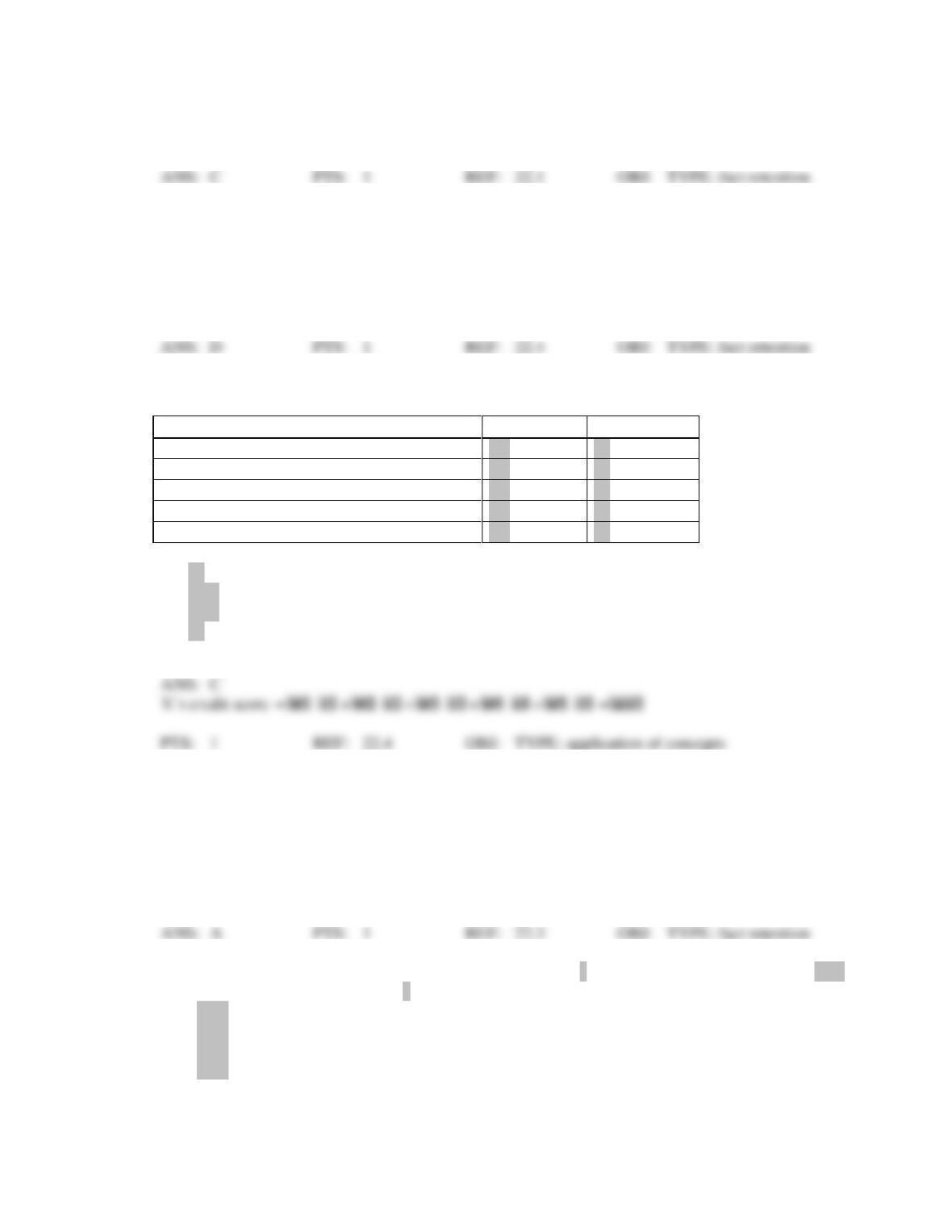
11. Claire Crisaac Corp uses credit scoring to make credit decisions. Following are the criteria and
weights, along with scores of customer X:
Characteristics
Weight
Customer X
Timely payment of bills
w1
c1
Amount of money currently owed
w2
c2
Length of credit history
w3
c3
Years on job
w4
c4
home ownership
w5
c5
What is customer X’s credit score?
a.
c1
b.
ans2
c.
ans3
d.
c3
e.
none of the above
12. Although inventory management is a task for __________, the financial manager should monitor the
activity.
a.
productions/operations management
b.
the marketers
c.
the board of directors
d.
accountants
e.
the legal affairs department
13. This past year, Falstaff’s Fine Furniture had annual sales of $s million, a gross profit margin of gpm%,
and an average age of inventory of n days. What was Falstaff’s average investment in inventory?
a.
$ans1
b.
$ans2
c.
$ans3
d.
$ans4
e.
none of the above
14. This year, Company K had average investment in inventory $ii million, turned its inventory over n
times per year, and had cost of goods sold equal to ps% of sales. What were Company K’s sales this
year?
a.
$cogs million
b.
$ans2 million
c.
$ans3 million
d.
$ans4 million
e.
$ans5 million
15. Perpetual Paints, Inc. (PRP) has an opportunity to install an inventory control system. With or without
the system, sales will be $s million. Gross profit margin will be unaffected at gpm%. The new system
will allow PRP’s average age of inventory to drop from aai1 days to aai2 days. The appropriate
discount rate is r%, and assume a 365 day year. Neglecting the cost of the system, what is the annual
benefit associated with using it?
a.
$ans1
b.
$ans2
c.
$ans3
d.
$ans4
e.
$ans5
16. Barneycle’s Boat Shop sells s of its glow-in-the-dark boats each year and has fixed order costs of $fc
per order. Carrying cost per boat is $cc per year. What is the optimal order quantity for these boats?
a.
ans1
b.
ans2
c.
ans3
d.
ans4
e.
ans5
17. There is an inventory management system that uses a complex computer system and integrates data
from many departments and allows generation of a production plan, management reports, forecasts,
and financial statements. This sort of system is referred to as
a.
material requirements planning
b.
manufacturing resource planning II
c.
just-in-time
d.
optimal order quantity
e.
none of the above
18. Bellingham Banners currently has average collection period of acp1 days, annual sales of s1 units at
selling price $p a piece, and contribution margin $cm. It is considering a tightening of credit policy
that would reduce average collection period to acp2 days and reduce sales to s2 units. There are no bad
debts, and BB has required return of r%. What is the net profit from tightening the credit policy?
a.
– $ans1
b.
– $ans2
c.
–$ans3
d.
–$ans4
e.
$ans5
19. La Forks of Destiny, Inc., has had an average A/R balance the past t days of $ar. Revenues the last t
days have totaled $s on sales of u units, each with $cm contribution margin. The average collection
period for La Forks is __________.
a.
ans1 days
b.
ans2 days
c.
ans3 days
d.
ans4 days
e.
ans5 days
20. A method that involves a company recording customer invoices in the A/R journal and matching
received payments to the invoices to clear them is known by what name?
a.
aging of accounts receivables
b.
payment-pattern monitoring
c.
match booking
d.
open item
e.
none of the above
21. The balance forward cash application method is typically used when
a.
the only remittance information needed is customer account number, amount of payment,
and date received
b.
customers have become less prompt in payment than they were previously
c.
it is important to know which invoices for a given customer have been closed out
d.
short term interest rates are high and recording costs are low
e.
none of the above
22. Novafadtrend Corp. offers credit terms d/t net net. This means that a customer paying pay days from
the beginning of the credit period
a.
receives a d% discount
b.
pays (d%) * (pay/360) interest
c.
pays a net% surcharge
d.
pays 0.d% interest
e.
none of the above
23. Pomegranate Computer Corp. is considering a substantial strategic initiative that will increase the
payable period by pp days, increase inventory turnover from t1 times per year to t2 times, and lengthen
the average collection period from cp1 days to cp2 days. What will be the impact on Pomegranate’s
cash conversion cycle? (There are 365 days in a year)
a.
reduction of ans1 days
b.
reduction of ans2 days
c.
reduction of ans3 days
d.
increase of ans4 days
e.
increase of ans5 days
24. Burnt Amber Corp. (BAC) forecasts monthly sales as follows:
Month
Sales (in millions)
April
$s1
May
$s2
June
$s3
July
$s4
pc% of receivables are collected, with pw% written off as bad debts. BAC’s historical collection
pattern, which is expected to continue in the future, is to collect p1% of sales in the month of sale, p2%
in the month following the sale, and p3% in the second month following the sale. What is a predicted
amount for the total dollar collections in June?
a.
$a1 million
b.
$a2 million
c.
$a3 million
d.
$a4 million
e.
$a5 million
25. Especially when a firm employs a(n) __________ inventory system, unexpected events like 9/11 can
cause problems.
a.
MRP
b.
MRP II
c.
ABC
d.
JIT
e.
safety stock
26. Given the following information, calculate the firm’s annual cost of resources in accounts receivable:
ACP = acp days
Annual Sales = $as
Variable cost ratio of vc%
Required return = rr%
a.
$ans1
b.
$ans0
c.
$ans3
d.
$ans4
e.
$ans5
27. Which of the does not shorten the cash conversion cycle?
a.
Turn over inventory as quickly as possible
b.
Collect accounts receivable as quickly as possible
c.
Pay accounts payable as quickly as possible
d.
Reduce mail processing and clearing time when collecting from customers
28. Currently your firm has an average collection period of acp1 days and your have been asked to analyze
offering a d/t net net discount to expedite collections. You expect a decrease in the ACP of dacp days
(the new ACP would be acp2 days). cd% of the customers are expected to take the discount. The
current accounts receivable balance is arb million. Sales levels and bad debt expenses are expected to
remain constant. Using a 365 day year for your calculations, if the required rate of return on
receivables is r%, what is the expected change in pretax profit?
a.
A loss of more than $ans1
b.
A loss of about $ans2
c.
A gain of about $ans2
d.
A gain of more than $ans1
29. Your firm wants to analyze using relaxed credit periods to increase sales. Current credit sales are c1
million a year. The current credit term is net n1 and the proposed credit term is net n2. The current
ACP is acp1 and the expected ACP is acp2. Credit sales are expected to increase to c2 million. Bad
debt expense is currently bd1 percent of credit sales and is expected to increase to bd2%. The
variable cost ratio is vc%. The required rate of return on receivables is r%. Using a 365 day year,
what is the expected change in profit if the plan is implemented?
a.
About $ans1
b.
About $ans2
c.
About $ans3
d.
About $ans4
30. Investment in accounts receivable is most like an investment in
a.
Inventory
b.
Accounts payable
c.
Average collection period
d.
Aging receivables
31. Consider the discount a/b net c; the supplying firm is in fact offering a form of financing in the amount
of a% over a period of _______ days
a.
a days
b.
b days
c.
d days
d.
c days
MATCHING
Match the term with the correct description:
a.
Conditions
b.
Character
c.
Collateral
d.
Capacity
e.
Capital
1. a credit applicant’s record of meeting past credit obligations
2. current general and industry-specific economic situations
3. a credit applicant’s ability to repay requested credit
4. the financial strength of a credit applicant as reflected by its capital structure
5. the assets of a credit applicant available for securing credit
SHORT ANSWER
1. What should the financial manager do to allow the firm to operate effectively with minimum cash
investment?
2. What are the key areas of concern for effectively managing the credit and accounts receivable process?
3. What is credit scoring?
4. How do companies handle delinquent accounts?
5. Discuss the average collection period and payment pattern monitoring when dealing with cyclical or
growing firms.
6. Rich Corporation’s Financial Statements
Rich Corporation Balance Sheets ($000)
Assets
2004
2003
Current assets
Cash
$ c1.00
$ c2.00
Marketable securities
$ ms1.00
$ ms2.00
Accounts receivable
$ar1.00
$ ar2.00
Inventory
$ inv1.00
$ inv2.00
Other
$ other1.00
$ other2.00
Total current assets
$2,325.00
$1,510.00
Fixed Assets
Gross Property, plant, and equipment
$ 7,900.00
$ 7,000.00
Less: accumulated depreciation
$(2,725.00)
$(2,225.00)
Net property, plant, and equipment
$ 5,175.00
$ 4,775.00
Intangible assets
$ 250.00
$ 150.00
Net fixed assets
$ 5,425.00
$ 4,925.00
Total Assets
$ 7,750.00
$ 6,435.00
Liabilities and Stockholders’ Equity
Current liabilities
Accounts payable
$ ap1.00
$ ap2.00
Notes payable
$ np1.00
$ np2.00
Accrued expenses
$ ae1.00
$ ae2.00
Total current liabilities
$1,730.00
$1,325.00
Long-term liabilities
Deferred taxes
$ 650.00
$ 425.00
Long-term debt
$1,387.00
$ 950.00
Total long-term liabilities
$2,037.00
$1,375.00
Total liabilities
$3,767.00
$2,700.00
Stockholders’ equity
Preferred stock
$ 20.00
$ 20.00
Common stock ($1 par value)*
$ 665.00
$ 652.00
Paid-in capital in excess of par
$ 585.00
$ 575.00
Retained earnings
$3,113.00
$2,688.00
Less: treasury stock
$ (400.00)
$ (200.00)
Total stockholders’ equity
$3,983.00
$3,735.00
Total liabilities and stockholders’ equity
$7,750.00
$6,435.00
* 665,000 shares of common stock outstanding in 2004 and 652,000 shares of common stock
outstanding in 2003
Rich Corporation Income Statements ($000)
2004
2003
Sales revenue
$s1.00
$s2.00
Less: Cost of goods sold (COGS)*
$ cogs1.00
$cogs2.00
Gross profit
$ gp1.00
$gp2.00
Less: Operating expenses
$ opex1.00
$opex2.00
Less: Selling, general, & administrative expenses
$ 555.00
$ 530.00
Less: Depreciation
$ 500.00
$ 475.00
Operating profit
$ 1,338.00
$ 748.00
Plus: Other income
$ 120.00
$ 90.00
EBIT
$ 1,458.00
$ 838.00
Less: Interest expense
$ 160.00
$ 125.00
Pretax income
$ 1,298.00
$ 713.00
Less: Taxes
Current
$ 325.00
$ 178.00
Deferred
$ 180.00
$ 90.00
Total taxes
$ 505.00
$ 268.00
Net income after tax
$ 793.00
$ 445.00
Less: Preferred stock dividends
$ 3.00
$ 3.00
Earnings available for common stockholders
$ 790.00
$ 442.00
Less: Dividends
$ 365.00
$ 190.00
Total retained earnings**
$ 425.00
$ 252.00
* Rich’s annual credit purchases represent about cpp% of COGS. Using this relationship, its
credit purchases in 2004 were $cp1 and in 2003 were $cp2.
** The price per share of stock at the end of 2004 was $14.25 and in 2003 it was $6.10.
Refer to Rich Corporation’s Financial Statements. Answer a. through d. Assume a 365-day year.
a.
Calculate the cash conversion cycle (CCC) for Rich Corporation for 2003 and 2004.
b.
What can you conclude about Rich’s CCC?
c.
What is the average amount of resources that Rich Corporation has invested in its cash
conversion cycle for 2003 and 2004?
d.
If Rich Corporation could reduce the amount of time it takes to receive, process, and collect
payments after they are mailed by the firm’s customers by d days, and assuming all sales are
credit sales, how much would it reduce the resources in the CCC in 2003 and 2004?
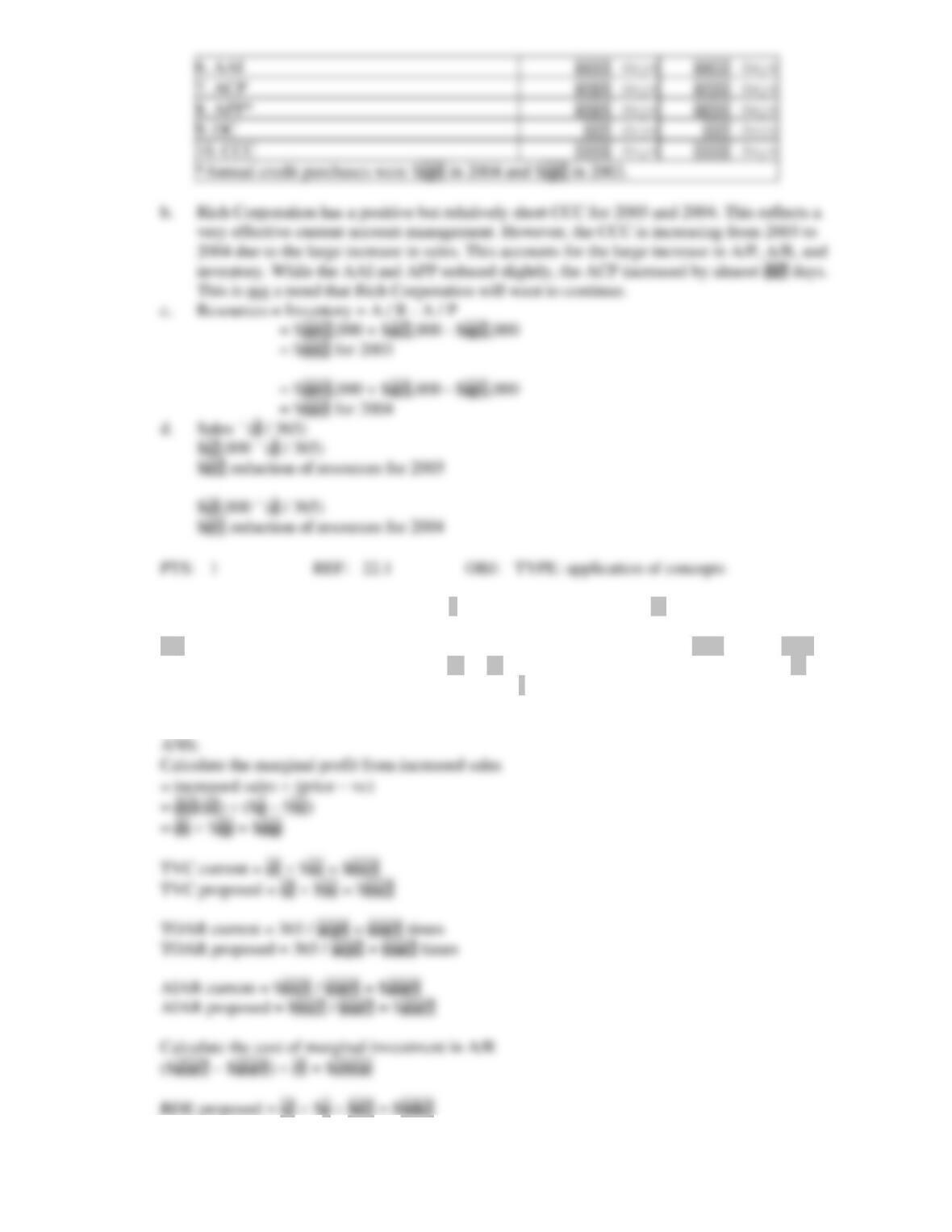
Using the equation 22.1 and the following format from Table 22.2:
1. Sales
2. Cost of sales
3. A/P
4. A/R
5. Inventory
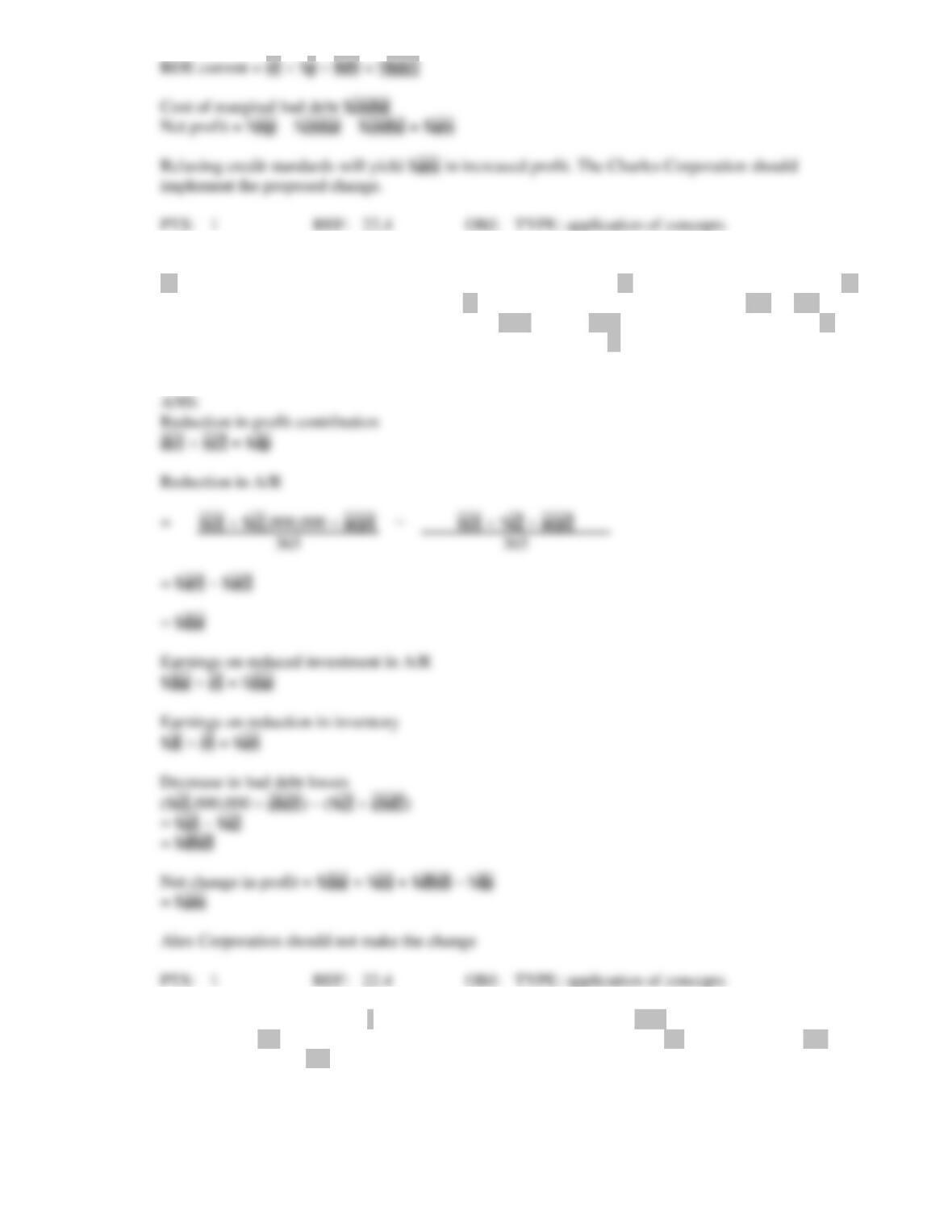
7. Charles Corporation sells its product for $p/unit with variable costs at $vc/unit. Its fixed costs are
$750,000 a year. If Charles Corporation relaxes its credit standards it expects the following effects: a
ds1% increase in unit sales, an increase in the average collection period from acp1 days to acp2 days,
and an increase in bad debt expense from d1 to d2% of sales. If the company currently sells s1 units all
on credit and has a required return on investment of r%, should the company relax its credit standards?
Assume a 365-day year.
8. Alex Corporation is considering whether to discontinue offering credit to customers that are more than
n1 days overdue on their payments. Current 2004 credit sales are $s1 million on credit terms of net n2.
The change assumes a reduction in sales by ds%, a reduction in bad-debt losses from bd1 to bd2%, and
a reduction in the average collection period from acp1 days to acp2 days. Alex’s variable cost is vc%
with a required rate of return of 15%. If inventory decreased by $di, should Alex Corporation make the
change? Assume a 365-day year.
9. Your firm has annual sales of s million. Cost of goods sold represent cogs percent of this value and
purchases are pur percent of cost of goods sold. Your firm has an AAI of aai days, an APP of app
days, and an ACP of acp days.
a.
What is your firm’s operating cycle?
b.
What is your firm’s cash conversion cycle?
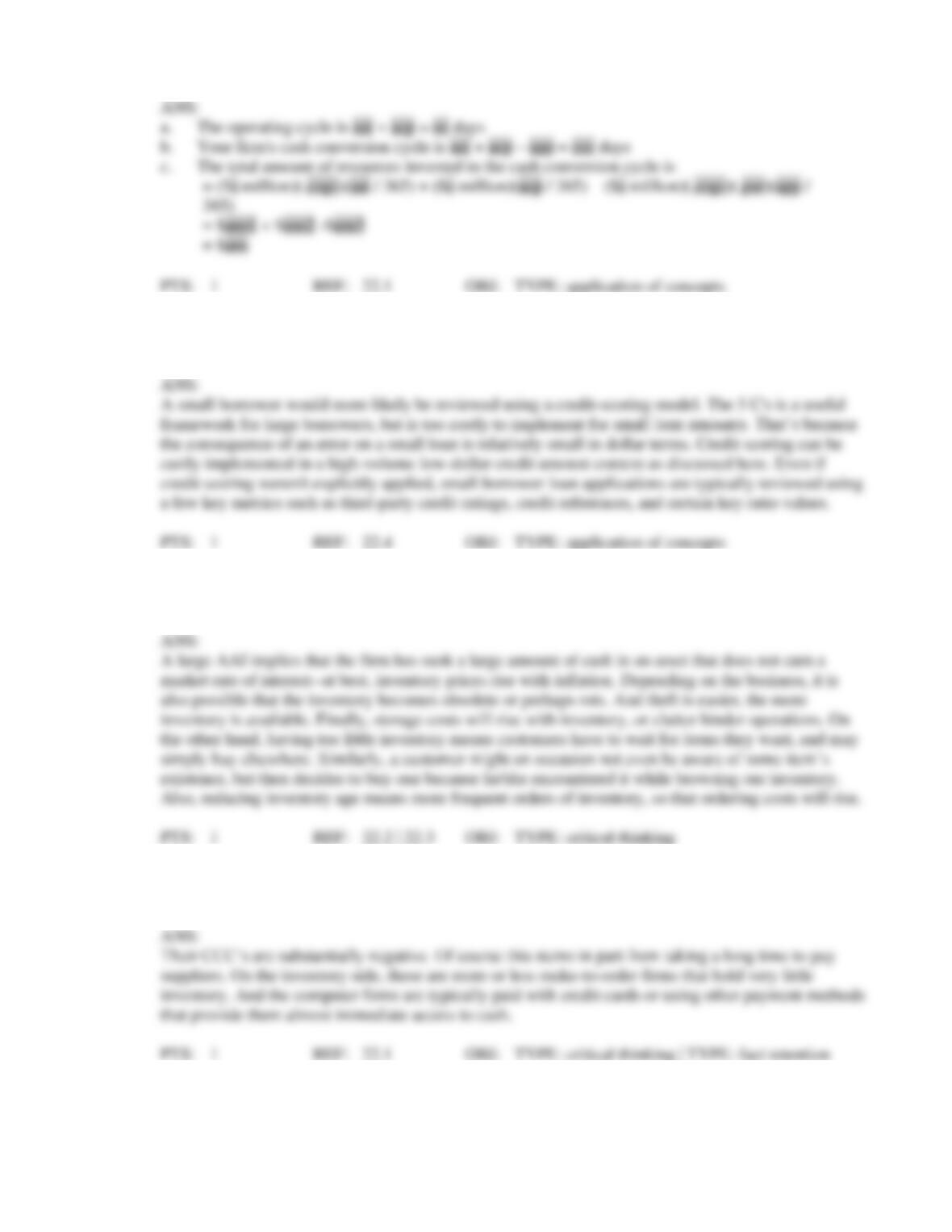
c.
What total amount of resources has your firm invested in its cash conversion cycle?
10. Would a small borrower’s loan application be more likely to be reviewed according to the five Cs of
credit or by using a credit-scoring model? (Fully explain why.)
11. Why would a firm want to minimize its Average Age of Inventory? What considerations act to oppose
a very small AAI?
12. What is distinctive about the CCC for computer firms like Dell, Gateway, and Apple, and why do they
have such CCC’s?
b.
Your firm’s cash conversion cycle is aai + acp – app = ccc days
c.
The total amount of resources invested in the cash conversion cycle is
365)
= $ans
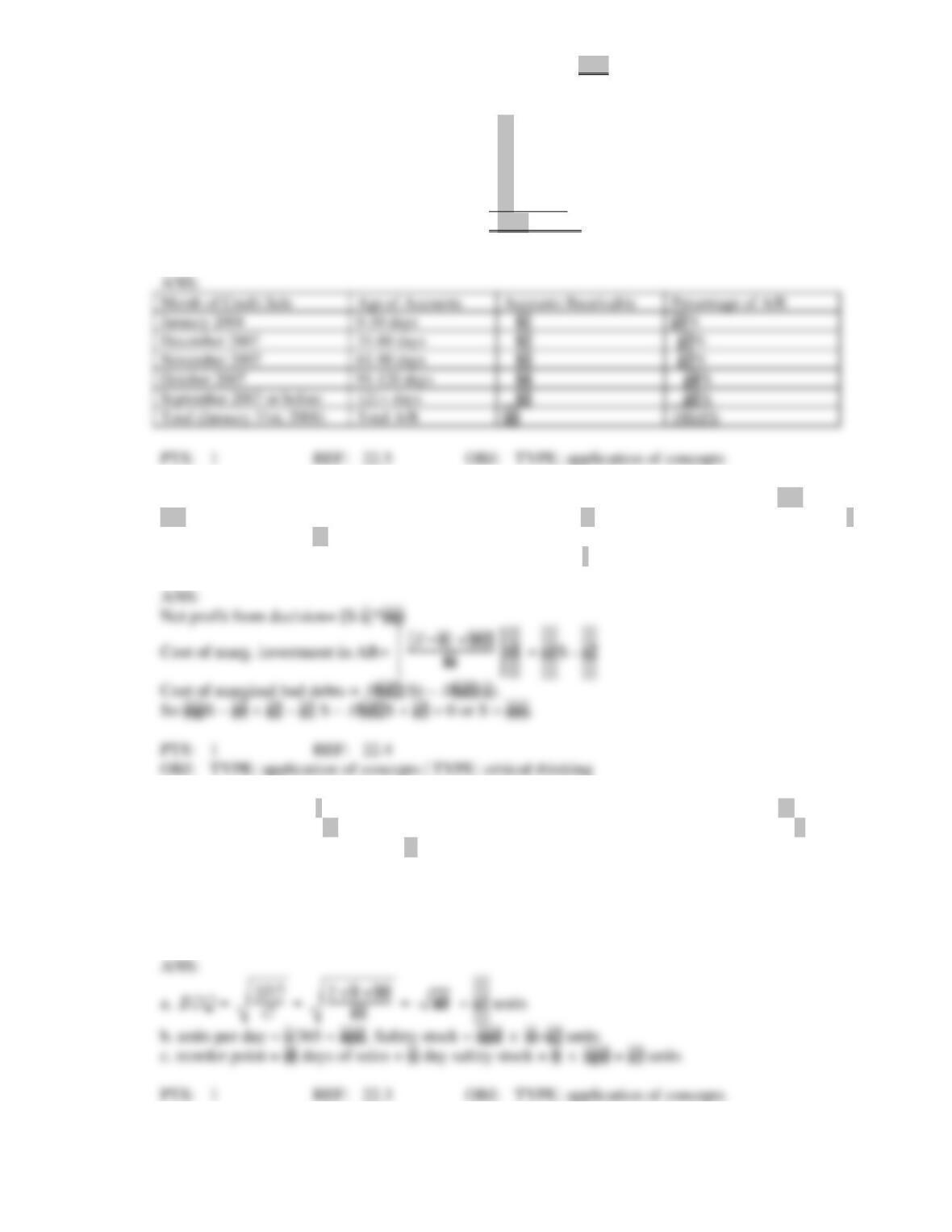
13. As of January 31st, 2008, a firm has accounts receivable of $total million. The following figures
indicate the months of sales that contribute to the current A/R balance:
Month of Credit Sale
Accounts Receivable
January 2008
$a1 million
December 2007
$a2 million
November 2007
$a3 million
October 2007
$a4 million
September 2007 or before
$a5 million
Total (January 31st, 2008)
$total million
Prepare an aging schedule for the January 31st, 2008 accounts receivable balance.
14. EFG Corp is considering a change in credit policy that will increase bad debt % rate from bd1% to
bd2%. The change will leave accounts receivable turnover at to times/year. Current annual sales is $s
and variable costs are vc% of sales. What new annual sales figure would result in this change having
zero net profit effect on EFG with a required rate of return of r%?
15. Tamminga Corp. uses s units of an inventory item each year. The inventory order cost is $oc per order
and carrying costs are $cc per item per year. Tamminga wishes to maintain a safety stock of st days of
inventory and it takes the company dt days to receive an order once it is placed. Assume a 365-day
year.
a. Calculate the economic order quantity for Tamminga’s inventory item.
b. How large a safety stock (in units) of inventory should Tamminga maintain?
c. What is the reorder point for this item?
16. Suchy Stablegear buys s units of an inventory item each year. It faces a $oc order cost, and the
carrying cost per item is $cc. Assume a 365-day year.
a. What is Suchy’s economic order quantity?
b. Assuming there is no safety stock, what is Suchy’s total cost at the EOQ?
c. Suppose Suchy can either 1) reduce both its order cost and its carrying cost by p1%
or 2) reduce its carrying cost by p2%
Which would result in the lowest total cost at the resultant new EOQ?
17. In an ABC inventory system, what do the different inventory classifications mean? Briefly, how are
the different types of inventory treated?
18. Relate what is distinctive about the just-in–time inventory system, mentioning the benefits that such a
system can bring about as well as the potential for problems.
19. Treacly Foodstuffs Corp. (TREF) is considering renting an inventory control system that would cost $c
per year. It would result in TREF’s average age of inventory dropping from aai1 days to aai2 days.
Sales will remain unchanged at $s million, with gross profit margin remaining at pm%. TREF’s has an
r% required return on investments with this level of risk. Assume a 365-day year.
Should TREF rent the inventory control system?
20. Interurban Irrigators is considering changing its location. If it does, it will spend a net of $c on
property purchase and setup, after selling the old property. As a result of the move, sales will rise from
$s1 to $s2. Gross profit margin will remain at pm%, and variable costs will remain at vc% of sales.
Inventory turnover will rise from t1 times to t2 times per year. Average age of accounts receivable will
rise from aar1 to aar2 days, and bad debts will rise from bd1% to bd2%. The appropriate discount rate
for these cash flow impacts is r%. Assume a 365-day year. Is the move worthwhile?
21. Longshort Corp. is considering a change in credit policy that will increase sales from $s1 per year to
$s2. Variable costs will remain vc% of sales. Accounts receivable turnover will drop from art1 times
to art2 times. Assuming a 365-day year, what will be the change in Longshort’s cash cycle, and what
will be the change in its average investment in accounts receivable?
ESSAY
1. How should a firm monitor its accounts receivable?
2. Produce a clear graph demonstrating how holding costs of operating assets increase with quantity held
and also how other costs may decrease as the quantity of operating assets increases. Discuss how the
firm should consider all these costs in determining the appropriate balance of operating assets.
3. The five Cs of credit are often used to help assist in the decision-making process when considering
credit requests. Discuss the five Cs of credit and explain the main purpose for using this framework.
4. Explain the method for computing the cash conversion cycle, the components of that computation, and
the economic meaning of the computed figure.
5. Describe the method for analyzing whether a firm should change its credit standards and the economic
logic underlying the method.