Exam
Name___________________________________
MULTIPLE CHOICE. Choose the one alternative that best completes the statement or answers the question.
1) This period is known as the conglomerate wave because firms typically acquired firms in unrelated
businesses:
A) 1960s
B) 1970s
C) 1980s
D) 1990s
2) This period is known for hostile, “bust–up” takeovers, in which the acquirer purchased a poorly performing
conglomerate and sold off its individual business units for more than the purchase price:
A) 1960s
B) 1970s
C) 1980s
D) 1990s
3) This period is known for known for “strategic” or “global” deals that were more likely to be friendly and to
involve companies in related businesses; these mergers often were designed to create strong firms on a scale
that would allow them to compete globally:
A) 1960s
B) 1970s
C) 1980s
D) 1990s
4) Which of the following statements is false?
A) There are two primary mechanisms by which ownership and control of a public corporation can
change: Either another corporation or group of individuals can acquire the target firm, or the target
firm can merge with another firm.
B) Merger activity is greater during economic contractions than during expansions.
C) Mergers and acquisitions are part of what is often referred to as “the market for corporate control.”
D) The takeover market is also characterized by merger waves–peaks of heavy activity followed by quiet
troughs of few transactions.
5) Which of the following statements is false?
A) In practice, most acquirers pay a substantial acquisition premium, which is the percentage difference
between the acquisition price and the premerger price of the target firm.
B) When a bid is announced, the target shareholders enjoy a gain of 15% on average in their stock price.
C) In most U.S. states, the law requires that when existing shareholders of a target firm are forced to sell
their shares, they receive the market price for their shares. In most cases, this concept is interpreted as
the value inclusive of any value that arises because of the merger itself.
D) A bidder is unlikely to acquire a target company for less than its current market value.
TRUE/FALSE. Write ‘T’ if the statement is true and ‘F’ if the statement is false.
6) On average, when a bid is announced, the stock price of the target drops.

7) Most acquirers pay an acquisition premium for a target. Upon announcement of the bid, the target’s stock
price increases, on average, so that the stock price is the same as the price bid by the acquirer.
8) The synergies of a merger add so much value to the combined firm that, upon announcement of a merger,
the stock prices of both the target and the acquirer increase substantially.
MULTIPLE CHOICE. Choose the one alternative that best completes the statement or answers the question.
9) The fact that a large company can enjoy savings from producing goods in high volume that are not available
to a small company is called
A) economies of scale.
B) horizontal integration.
C) vertical integration.
D) economies of scope.
10) Savings that come from combining the marketing and distribution of different types of related products are
called
A) horizontal integration.
B) vertical integration.
C) economies of scale.
D) economies of scope.
11) The merger of two companies in the same industry that make products required at different stages of the
production cycle is called
A) economies of scope.
B) vertical integration.
C) economies of scale.
D) horizontal integration.
12) The justification for the benefits of diversification from mergers include all of the following except
A) tax loss benefits.
B) lower cost of debt or increased debt capacity.
C) direct risk reduction.
D) liquidity enhancement.
13) Which of the following statements is false?
A) Chief among the costs associated with size is that larger firms are more difficult to manage.
B) For most investors an investment in the stock market is a zero–NPV investment.
C) Diversification benefits are by far the most common justification that bidders give for the premium they
pay for a target.
D) An acquirer might be able to add economic value, as a result of an acquisition, that an individual
investor cannot add.
14) Which of the following statements is false?
A) Cost–reduction synergies are hard to predict and achieve.
B) Because the CEOs of small firms receive information so quickly, small firms are often able to react in
timely way to changes in the economic environment.
C) Synergies usually fall into two categories: cost reductions and revenue enhancements.
D) There may also be costs associated with size.
15) Which of the following statements regarding vertical integration is false?
A) Vertically integrated companies may be large, but unlike other large corporations, since they remain
focused in one industry they are easy to run.
B) A company might not be happy with how its products are being distributed, so it might decide to take
control of its distribution channels.
C) A company might conclude that it can enhance its product if it has direct control of the inputs required
to make the product.
D) The principal benefit of vertical integration is coordination. By putting two companies under central
control, management can ensure that both companies work toward a common goal.
16) Which of the following statements regarding monopoly mergers is false?
A) It is often argued that merging with or acquiring a major rival enables a firm to substantially reduce
competition within the industry and thereby increase profits.
B) Financial researchers have found that the share prices of other firms in the same industry did not
significantly increase following the announcement of a merger within the industry.
C) While only the merging company benefits when competition is reduced, all companies in an industry
pay the associated costs.
D) Society as a whole bears the cost of monopoly strategies, so most countries have antitrust laws that
limit such activity.
17) Which of the following statements regarding efficiency gains is false?
A) Takeovers relying on the improvement of target management are difficult to complete, and
post–takeover resistance to change can be great. Thus not all inefficiently run organizations are
necessarily more efficient following a takeover.
B) Although identifying poorly performing corporations is relatively easy, fixing them is another matter
entirely.
C) A justification that acquirers cite for paying a premium for a target is efficiency gains, which are often
achieved through an elimination of duplication.
D) A chief executive of an inefficiently run corporation can be ousted by current shareholders voting to
replace the board of directors, and in fact a large number of ineffective managers are replaced in this
way.
18) Which of the following statements regarding mergers and taxes is false?
A) Carryback and carryforward provisions essentially deliver the benefits of conglomeration to a small
firm with volatile earnings.
B) It might appear that a conglomerate has a tax advantage over a single–product firm simply because
losses in one division can offset profits in another division.
C) Companies with current–year losses can also use them to offset earnings (carryback) for the twenty
prior years.
D) The IRS will disallow a tax break if it can show that the principal reason for a takeover is tax avoidance,
so it is unlikely that the tax advantage could, by itself, be a valid reason to acquire another firm.
19) Which of the following statements regarding mergers and diversification is false?
A) Because it may be easier to measure performance accurately in a conglomerate, agency costs may be
reduced and resources may be more efficiently allocated.
B) Because these employees are obligated to hold idiosyncratic risk, they benefit when the firm reduces
that risk by conglomerating.
C) Like a large portfolio, large firms bear less idiosyncratic risk, so often mergers are justified on the basis
that the combined firm is less risky.
D) Because most stockholders will already be holding a well–diversified portfolio, they get no further
benefit from the firm diversifying through acquisition.
20) Which of the following statements is false?
A) All else being equal, larger firms, because they are more diversified, have an increased probability of
bankruptcy.
B) To justify a takeover based on operating losses, management would have to argue that the tax savings
are over and above what the firm would save using carryback and carryforward provisions.
C) It is possible to combine two companies with the result that the earnings per share of the merged
company exceed the premerger earnings per share of either company, even when the merger itself
creates no economic value.
D) When an acquirer buys a private target, it provides the target’s owners with a way to reduce their risk
exposure by cashing out their investment in the private target and reinvesting in a diversified portfolio.
21) Consider two firms, Thither and Yon. Both companies will either make $30 million or lose $10 million every
year with equal probability. The companies’ profits are perfectly negatively correlated. What are the
expected after–tax profits of Thither in any year, assuming a corporate tax rate of 35% and no tax loss carry
back or carry forward?
A) $19.5 million
B) $6.5 million
C) $4.75 million
D) $–6.5 million
22) Consider two firms, Thither and Yon. Both companies will either make $30 million or lose $10 million every
year with equal probability. The companies’ profits are perfectly negatively correlated. What are the
expected after–tax profits of the combined company (Thither and Yon) in any year, assuming a corporate tax
rate of 35% and no tax loss carry back or carry forward?
A) $19.5 million
B) $6.5 million
C) $4.75 million
D) $–6.5 million
23) Consider two firms, Bob Company and Cat Enterprises, both with earnings of $10 per share and 5 million
shares outstanding. Cat is a mature company with few growth opportunities and a stock price of $25 per
share. Bob is a new firm with much higher growth opportunities and a stock price of $40 per share.
Assume Bob acquires Cat using its own stock and the takeover adds no value. In a perfect capital market,
how many shares must Bob offer Cat’s shareholders in exchange for their shares?
A) 1 share of BobCat for each share of Cat Enterprises.
B) 0.625 shares of BobCat company for each share of Cat Enterprises.
C) 1.6 shares of BobCat company for each share of Cat Enterprises.
D) 0.3846 shares of BobCat company for each share of Cat Enterprises.
ESSAY. Write your answer in the space provided or on a separate sheet of paper.
Use the information for the question(s) below.
Martin Manufacturing has earnings per share (EPS) of $3.00, 5 million shares outstanding, and a share price of $32.
Martin is considering buying Luther Industries, which has earnings per share of $2.50, 2 million shares outstanding, and a
share price of $20. Martin will pay for Luther by issuing new shares. There are no expected synergies from the
transaction.
24) If Martin pays no premium to acquire Luther, what will the earnings per share be after the merger?
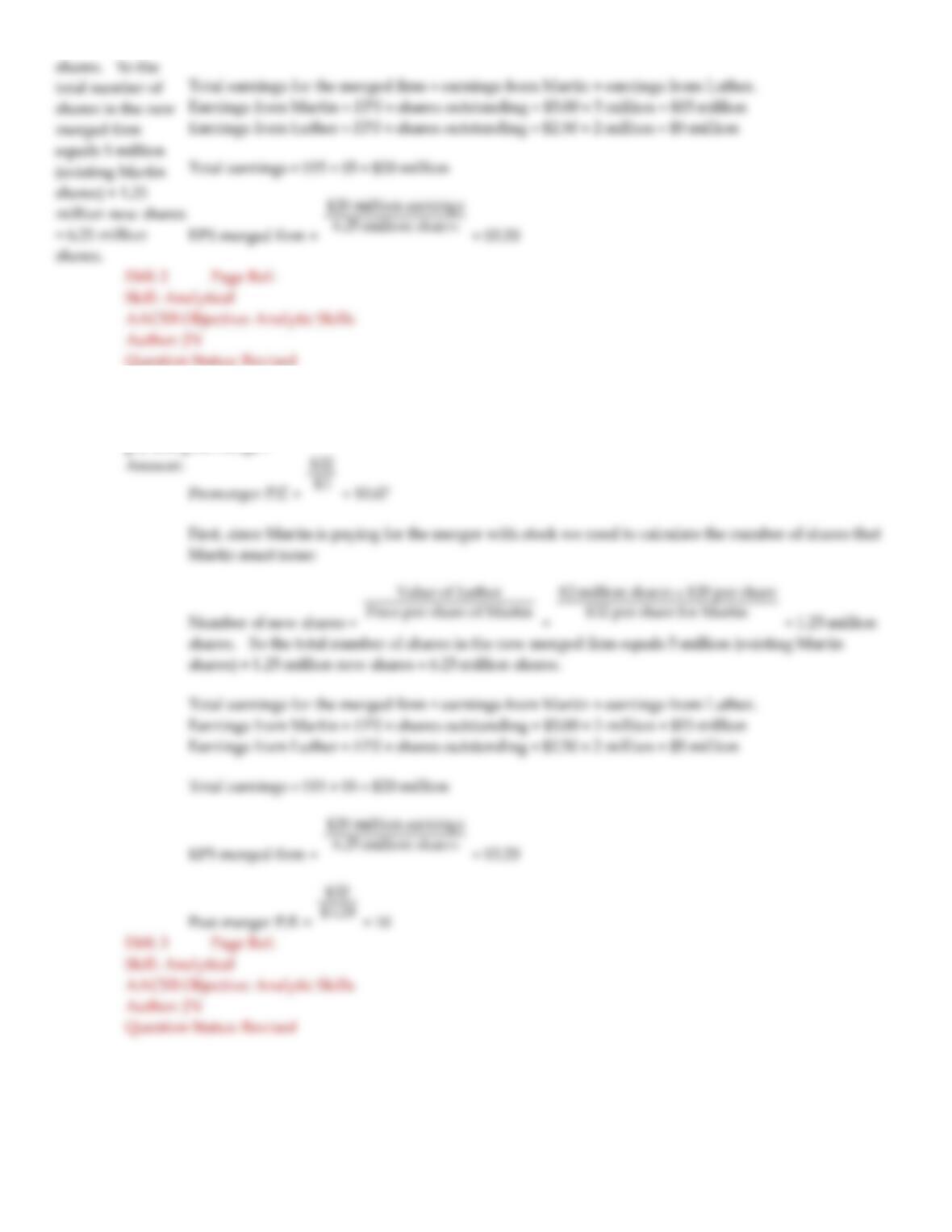
25) Assume that Martin pays no premium to acquire Luther. Calculate Martin’s price–earnings (P/E) ratio both
pre and post merger.
MULTIPLE CHOICE. Choose the one alternative that best completes the statement or answers the question.
26) Consider the following equation:

<
The term A in this equation refers to
A) the premerger, or standalone, value of the acquirer.
B) new shares to pay for the target.
C) the value of the synergies created by the merger.
D) the premerger (standalone) value of the target.
27) Consider the following equation:
<
The term S in this equation refers to
A) the premerger (standalone) value of the target.
B) the premerger, or standalone, value of the acquirer.
C) the value of the synergies created by the merger.
D) new shares to pay for the target.
28) Consider the following equation:
<
The term x in this equation refers to
A) the value of the synergies created by the merger.
B) the premerger, or standalone, value of the acquirer.
C) new shares to pay for the target.
D) the premerger (standalone) value of the target.