Cost Accounting: A Managerial Emphasis, 6e
Chapter 22 – Capital Budgeting: A Closer Look
22–21
6) The differential approach is often considered superior to the total project approach to capital budgeting
A) because it is easier to select the components for the model.
B) because it uses only net cash flows instead of gross cash flows.
C) for all large investment decisions.
D) because it is faster if analyzing fewer than three alternatives.
E) because it can more easily accommodate multiple investment opportunities.
7) Both the total-project approach and the differential approach present a net present value that
A) will always be the same amount.
B) will rarely be the same amount.
C) will only be the same when net present value is positive.
D) will only be the same when net present value is negative.
E) will only be the same when nominal cash flows are considered.
Answer the following question(s) using the information below.
Jonesville Hospital has been considering the purchase of a new x-ray machine. The existing machine is
operable for five more years and will have a zero disposal price. If the machine is disposed now, it may
be sold for $45,000. The new machine will cost $325,000 and an additional cash investment in working
capital of $10,000 will be required. The new machine will reduce the average amount of time required to
take the x-rays and will allow an additional amount of business to be done at the hospital. The
investment is expected to net $30,000 in additional cash inflows during the year of acquisition and
$115,000 each additional year of use. The new machine has a five-year life, and zero disposal value. These
cash flows will generally occur throughout the year and are recognized at the end of each year. Jonesville
Hospital is not subject to tax. The working capital investment will not be recovered at the end of the
asset’s life.
Cost Accounting: A Managerial Emphasis, 6e
Chapter 22 – Capital Budgeting: A Closer Look
8) What is the net present value of the investment, assuming the required rate of return is 12%? Would
the hospital want to purchase the new machine?
A) $(48,670); no
B) $25,715; no
C) $48,670; yes
D) $83,415; yes
E) $3,670; yes
9) What is the net present value of the investment, assuming the required rate of return is 20%? Would
the hospital want to purchase the new machine?
A) $6,955; yes
B) $(16,955); no
C) $(16,955); yes
D) $25,350; yes
E) $3,045; yes
Cost Accounting: A Managerial Emphasis, 6e
Chapter 22 – Capital Budgeting: A Closer Look
Answer the following question(s) using the information below.
Miller Ltd. has been considering the purchase of a new machine. The existing machine is operable for
three more years and will have a zero disposal price. If the machine is disposed now, it may be sold for
$35,000. The new machine will cost $180,000 and an additional cash investment in working capital of
$25,000 will be required. The new machine will reduce the average amount of time required on the
production line and will decrease labour costs. The investment is expected to net $80,000 in additional
cash inflows during the year of acquisition and $120,000 each additional year of use. The new machine
has a three-year life, and zero disposal value. These cash flows will generally occur throughout the year
and are recognized at the end of each year. The working capital investment will not be recovered at the
end of the asset’s life. The equipment would qualify as a class 8 asset and the company will continue to
have assets in the pool. Miller’s tax rate is 28%.
10) What is the net present value of the investment assuming a discount rate of 13%?
A) $31,707
B) $48,288
C) $35,706
D) $52,287
E) $101,131
Cost Accounting: A Managerial Emphasis, 6e
Chapter 22 – Capital Budgeting: A Closer Look
11) What is the net present value of the investment, assuming the required rate of return is 24%? Would
the company want to purchase the new machine?
A) $52,167
B) $55,041
C) ($5,372)
D) $18,989
E) ($2,948)
Cost Accounting: A Managerial Emphasis, 6e
Chapter 22 – Capital Budgeting: A Closer Look
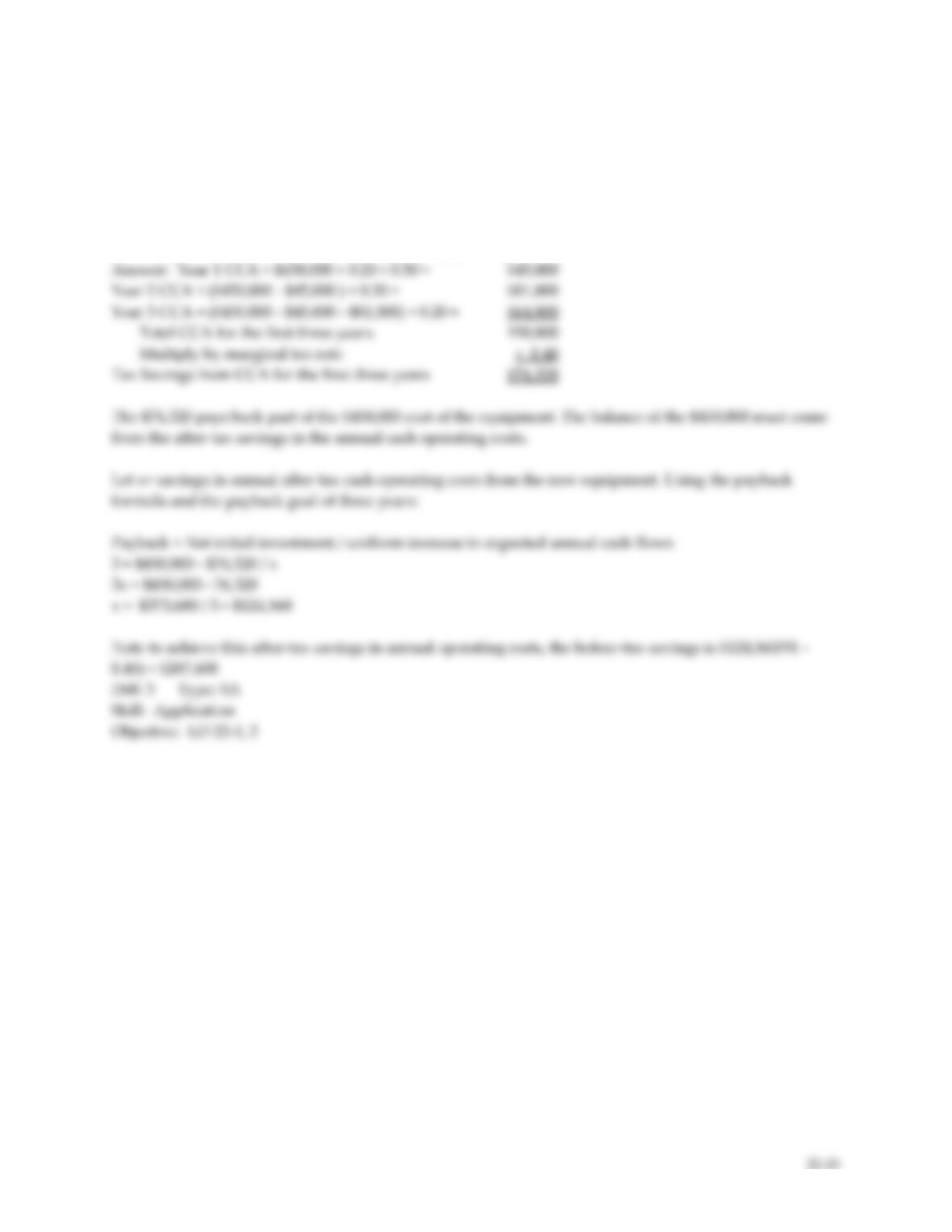
12) Jasper Company Ltd. has a payback goal of three years on new equipment acquisitions. Jasper is
evaluating new equipment that costs $450,000, will have a CCA rate of 20%, an estimated useful life of 8
years, and a zero terminal disposal price. The company’s marginal tax rate is 40%.
Required:
Calculate the amount of after-tax savings in annual cash operating costs that must be generated by the
new equipment in order to meet the company’s payback goal.
Cost Accounting: A Managerial Emphasis, 6e
Chapter 22 – Capital Budgeting: A Closer Look
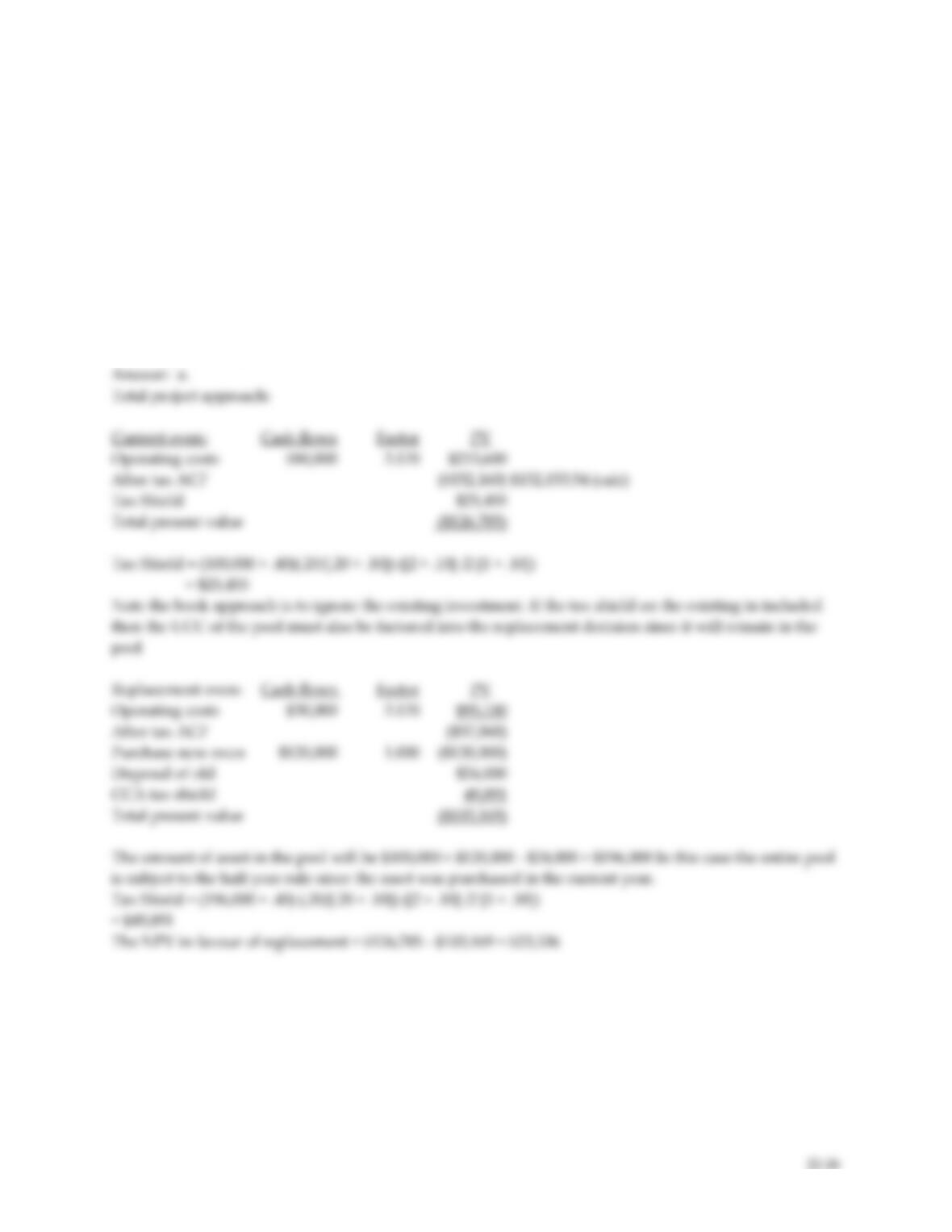
13) Good Bread Bakery installed an oven costing $100,000 on January 1 of the current year. Due to
unexpected advances in technology, the equipment’s value was reduced to $24,000 in only one week. The
equipment is class 8 which has a CCA rate of 20% for tax purposes. The incremental costs of operating the
oven over four years is $80,000 annually, excluding depreciation. A new replacement machine with all
the new advances can be purchased now for $120,000. It also has a useful life of four years and can be
operated for $30,000 a year, excluding depreciation. The company’s tax rate is 40 percent. Neither oven
has a salvage value at the end of the four years. Assume that the company will replace the oven
(whichever one it chooses) after the four years.
Required:
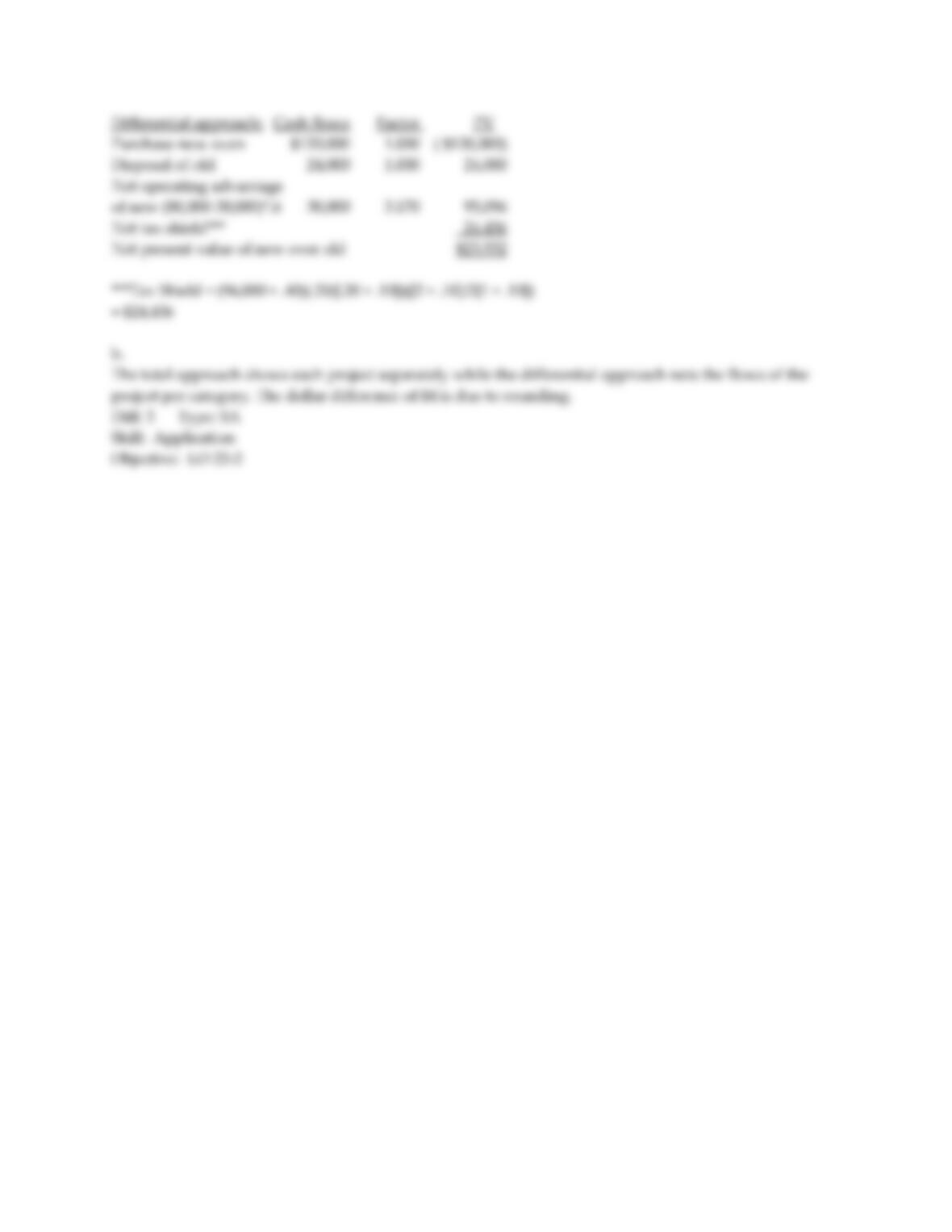
a. Calculate the relevant cash flows using both a total project approach and a differential approach if
the company’s required rate of return is 10 percent.
b. What is the difference between the two methods?
Cost Accounting: A Managerial Emphasis, 6e
Chapter 22 – Capital Budgeting: A Closer Look
22–27
Cost Accounting: A Managerial Emphasis, 6e
Chapter 22 – Capital Budgeting: A Closer Look
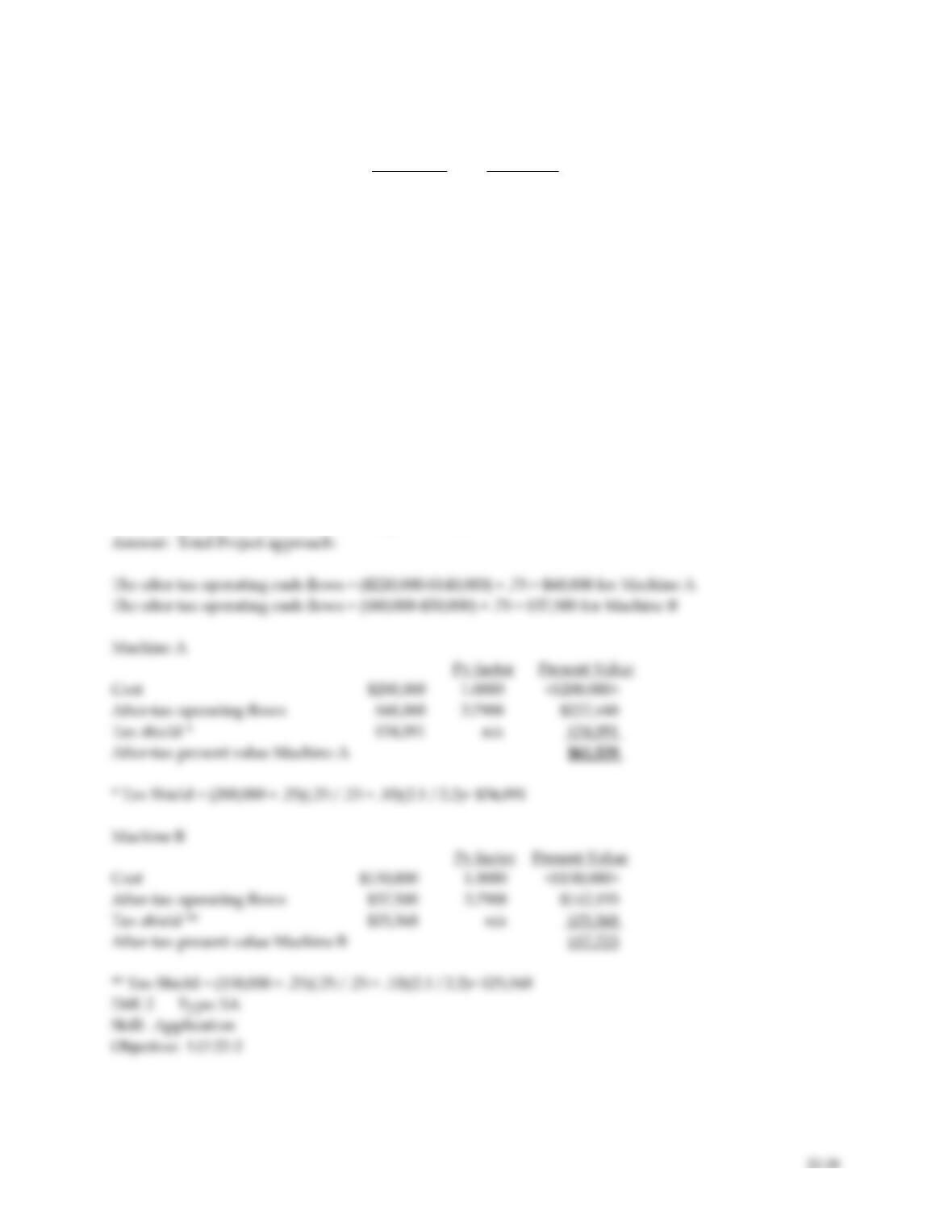
14) Avilas Corp. has a marginal tax rate of 25%, and is considering the following two capital projects:
Machine A Machine B
Cost $200,000 $150,000
Additional annual revenue $220,000 $80,000
Additional annual cash expense $140,000 $30,000
Terminal salvage value $0 $0
Required after-tax rate of return 10% 10%
Useful life of machine 5 yrs. 5 yrs.
CCA class 9 25% 25%
Additional data (for interest rate of 10%, 5 periods):
Present value of $1 0.6209
Future value of $1 1.6105
Present value of annuity of $1 3.7908
Future value of annuity of $1 6.1051
Required:
Which project has a higher net after-tax present value?
Cost Accounting: A Managerial Emphasis, 6e
Chapter 22 – Capital Budgeting: A Closer Look
15) Bacon Jewelers are interested in buying a new stone-polishing machine for $25,000. The new machine
will reduce stone polishing time substantially and annual operating costs are expected to be only $5,000.
The current machine, with a fair market value of $10,000 and a book value of $15,000, has annual
operating costs of $12,500. The current machine can be updated for a cost of $17,500. Because of
advancing technology, neither the new machine nor the remodelled old machine is expected to last
longer than four years. The new machine will have a salvage value after taxes of $500 but the remodelled
machine will have a salvage value of zero. The company has a tax rate of 30 percent. For tax purposes, the
equipment is class 8, which has a CCA rate of 20% .
Required:
Several categories of cash flows are common in capital budgeting analysis. Place as much information
from this problem as possible into each one of the cash flow categories.
Cost Accounting: A Managerial Emphasis, 6e
Chapter 22 – Capital Budgeting: A Closer Look
16) Exar Construction Ltd is contemplating the purchase of new equipment. The equipment would cost
$40,000, have an expected life of 8 years, and a zero terminal salvage value. The equipment would be
Class 8 (20% CCA rate), and would generate $125,000 additional revenue annually, and Exar would incur
additional annual expenses of $115,000 for labour and material. The company’s marginal tax rate is 20%,
and the required after-tax rate of return is 14%.
Additional data (for interest rate of 14%, 8 periods):
Present value of $1 0.3506
Future value of $1 2.8526
Present value of annuity of $1 4.6389
Future value of annuity of $1 13.2328
Required:
Calculate the net after-tax present value, and determine whether Exar should purchase the equipment.
Cost Accounting: A Managerial Emphasis, 6e
Chapter 22 – Capital Budgeting: A Closer Look
17) Morrison Limited has an opportunity to purchase new, more efficient production equipment to
replace existing machinery. The new machine will cost $850,000 and has an expected 8 year life and a
salvage value of $125,000.
The existing machine can be sold for $255,000. It is estimated that 8 years from now the salvage value of
the old equipment will be zero.
Annual cash flows to be generated by the new machine through productivity improvements are
estimated at $198,000 per year (before tax).
The equipment is in Class 8 and Morrison’s tax rate is 40%. Morrison uses a cost of capital of 15%.
Required:
Using NPV analysis, should the new equipment be purchased? Assume the asset will be disposed of on
January 1 of year 9 for tax purposes and there will be assets remaining in the pool.
Cost Accounting: A Managerial Emphasis, 6e
Chapter 22 – Capital Budgeting: A Closer Look
18) The Toronto Deli & Cafeteria adjoins a large university and receives mostly student customers. It
recently purchased a new electronic scanner for student debit card purchases at a cost of $20,000.
Amortization has been recorded for one year with six more years remaining. The cafeteria owner has just
returned from a trade show where several new scanners were on display. One of the new models, which
would be appropriate for the cafeteria, has a cost of $30,000. It has a useful life of 10 years. The
manufacturer of the new model predicts that it will result in annual savings of 20 percent over the current
operating costs.
Required:
a. Since the current machine is only one year old, should the owner even consider replacing it with the
new model? Explain.
b. What are the relevant items to be considered from a capital budgeting perspective in replacing the
old machine with the new one?
c. Which of the relevant items have related tax effects?
Cost Accounting: A Managerial Emphasis, 6e
Chapter 22 – Capital Budgeting: A Closer Look
19) Melvin, Otto, and Clapman consulting firm is considering the purchase of a new telephone system for
$10,000. It is believed that the new equipment will save $750 a year over current costs. Telephone
equipment is included in Class 3 for tax purposes. Class 3 CCA rate is 5%. The new equipment has an
estimated life of five years. Its salvage value is estimated at $400 at the end of five years.
Required:
What items must be considered in the analysis of the purchase?
22.3 Apply the concepts of real and nominal ROR to account for inflation in capital
budgeting.
1) The nominal rate of return is the rate of return demanded to cover investment risk.
2) The real rate of return is the rate of return which deals with the inflation element.
3) It is an error when accounting for inflation in capital budgeting to state cash inflows and outflows in
real terms and using a nominal discount rate.
4) The nominal rate of return considers inflation.
Cost Accounting: A Managerial Emphasis, 6e
Chapter 22 – Capital Budgeting: A Closer Look
5) The nominal approach to incorporating inflation into the net present value method predicts cash
inflows in real monetary units and uses a real rate as the required rate of return.
6) Declines in the general purchasing power of the dollar will inflate future cash flows above what they
would have been without inflation.
Cost Accounting: A Managerial Emphasis, 6e
Chapter 22 – Capital Budgeting: A Closer Look
7) The Columbian Coffee Company is planning on purchasing a special coffee grinding machine that
costs $30,000 and is in a CCA class with a 20% rate. The company has decided to use its traditional real
rate of return of 10 percent as the required rate of return. It is anticipated the equipment will generate net
savings in nominal before-tax dollars as follows:
Year 1
$15,000
Year 2
15,000
Year 3
10,000
The anticipated salvage value of the equipment at the end of three years is $5,000 and is not taxable. The
income tax rate of Columbian Coffee is 40 percent.
What is the after-tax net present value of the investment?
A) $(12,220)
B) $(1,941)
C) $(5,700)
D) $(14,080)
E) $(14,000)
Cost Accounting: A Managerial Emphasis, 6e
Chapter 22 – Capital Budgeting: A Closer Look
8) The rate of return earned in the market is called the
A) real rate.
B) investment risk rate.
C) nominal rate.
D) inflation rate.
E) marginal rate.
9) When making capital-budgeting decisions, the inflation rate
A) should be ignored since it’s impossible to know what future inflation rates will be.
B) is automatically considered because it equals the market rate.
C) is important, but it‘s impossible to estimate the effect on capital-budgeting decisions.
D) reduces the minimum desired rate of return on projects.
E) increases the minimum desired rate of return on projects.
10) The nominal rate of return would be .38 if
A) the real rate was .20, and the inflation rate was .18.
B) the real rate was .18, and the inflation rate was .20.
C) the real rate was .20, and the inflation rate was .15.
D) the real rate was .20, and the required rate was .15.
E) the real rate was .18 and the inflation rate was .15.