Corporate Finance, 3e (Berk/DeMarzo)
Chapter 22 Real Options
22.1 Real Versus Financial Options
1) Which of the following statements is FALSE?
A) In particular, because real options allow a decision maker to choose the most attractive
alternative after new information has been learned, the presence of real options adds value to an
investment opportunity.
B) To make an investment decision correctly, the value of embedded real options must be
included in the decision-making process.
C) A key distinction between a real option and a financial option is that real options, and the
underlying assets on which they are based, are often traded in competitive markets.
D) We can compute the value of the real option by comparing the expected profit without the
real option to the value with the option.
2) Which of the following is NOT a real option?
A) A stock option
B) An abandonment option
C) An investment timing option
D) An expansion option
22.2 Decision Tree Analysis
1) Which of the following statements is FALSE?
A) Decision nodes are nodes in which uncertainty is involved that is out of the control of the
decision maker.
B) Most investment projects allow for the possibility of reevaluating the decision to invest at a
later point in time.
C) A decision tree is a graphical representation of future decisions and uncertainty resolution.
D) With binomial trees the uncertainty is not under the control of the decision maker.
2) The two different types of node on a decision tree are:
A) information and decision nodes.
B) information and uncertainty nodes.
C) uncertainty and decision nodes.
D) go to meet and stay home nodes.
1) Which of the following statements is FALSE?
A) One way to see why you sometimes choose not to invest in a positive-NPV project is to think
about the decision of when to invest as a choice between two mutually exclusive projects: (1)
invest today or (2) wait.
B) You invest today only when the NPV of investing today exceeds the value of the option of
waiting, which from option pricing theory we know to be always positive.
C) When you do not have the option to wait, it is optimal to invest in any positive-NPV project.
D) When you have the option of deciding when to invest, it is usually optimal to invest only
when the NPV is positive but close to zero.
2) Which of the following statements is FALSE?
A) If there is a lot of uncertainty, the benefit of waiting is diminished.
B) In the real option context, the dividends correspond to any value from the investment that we
give up by waiting.
C) By delaying an investment, we can base our decision on additional information.
D) Given the option to wait, an investment that currently has a negative NPV can have a positive
value.
3) Which of the following statements is FALSE?
A) Aside from the current NPV of the investment, other factors affect the value of an investment
and the decision to wait.
B) The option to wait is most valuable when there is a great deal of uncertainty regarding what
the value of the investment will be in the future.
C) The smaller the cost of waiting, the less attractive the option to delay becomes.
D) It is always better to wait to invest unless there is a cost to doing so.
Use the information for the question(s) below.
Kinston Industries has come up with a new mountain bike prototype and is ready to go ahead
with pilot production and test marketing. The pilot production and test marketing phase will last
for one year and cost $500,000. Your management team believes that there is a 50% chance that
the test marketing will be successful and that there will be sufficient demand for the new
mountain bike. If the test-marketing phase is successful, then Kinston Industries will invest $3
million in year one to build a plant that will generate expected annual after tax cash flows of
$400,000 in perpetuity beginning in year two. If the test marketing is not successful, Kinston
can still go ahead and build the new plant, but the expected annual after tax cash flows would be
only $200,000 in perpetuity beginning in year two. Kinston has the option to stop the project at
any time and sell the prototype mountain bike to an overseas competitor for $300,000. Kinston’s
cost of capital is 10%.
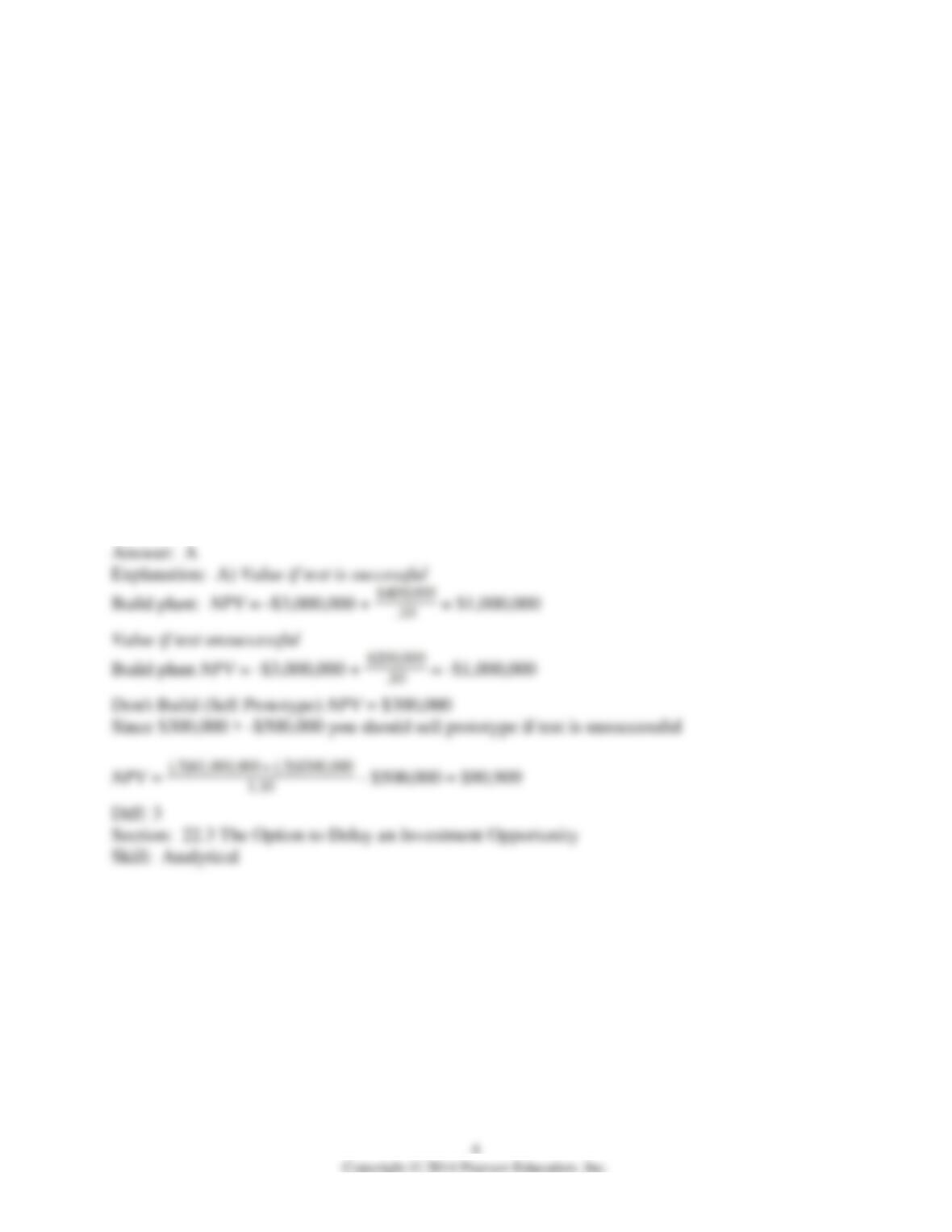
4) Assuming that Kinston has the ability to sell the prototype in year one for $300,000, the NPV
of the Kinston Industries Mountain Bike Project is closest to:
A) $90,000
B) $590,000
C) $455,000
D) -$45,000
5) Assuming that Kinston does not have the ability to sell the prototype in year one for $300,000,
the NPV of the Kinston Industries Mountain Bike Project is closest to:
A) -$45,000
B) $455,000
C) $590,000
D) $90,000
6) Assume that Kinston has the ability to ignore the pilot production and test marketing and to go
ahead and build their manufacturing plant immediately. Assuming that the probability of high or
low demand is still 50%, the NPV of the Kinston Industries Mountain Bike Project is closest to:
A) $0
B) $90,000
C) -$45,000
D) $1,000,000
7) Assume that Kinston has the ability to ignore the pilot production and test marketing and to go
ahead and build their manufacturing plant immediately and that the probability of high or low
demand would still be 50%. What is the value of the the option to do pilot production and test
marketing?
8) Assuming that Kinston has the ability to sell the prototype in year one for $300,000, draw a
decision tree detailing the Kinston Industries Mountain Bike Project.
9) Assuming that Kinston does not have the ability to sell the prototype in year one for $300,000,
draw a decision tree detailing the Kinston Industries Mountain Bike Project.
10) Assume that Kinston has the ability to ignore the pilot production and test marketing and to
go ahead and build their manufacturing plant immediately. Further assume that the probability
of high or low demand is still 50%. Draw a decision tree that details Kinston Industries Mountain
Bike project if Kinston goes ahead and builds the plant immediately.
11) Describe the two factors that affect the value of an investment timing option?
12) Luther Industries is considering launching a new toy just in time for the Christmas season.
They estimate that if Luther launches the new toy this year it will have an NPV of $25 million.
Luther has the option to wait one year until the next Christmas season to launch the toy,
however, the demand next year will depend upon what new toys Luther’s competitors introduce
and therefore greater uncertainty about next years demand. Launching the new today will
involve a total capital expenditure of $100 million. If the risk-free rate is 5%, N(d1) is .62 and
N(d2) is .65, then what is the value of the option to wait until next year to launch the new toy?
22.4 Growth and Abandonment Options
1) Which of the following statements is FALSE?
A) It is tempting to use the Black-Scholes formula to value future growth options, but often there
are good reasons why this formula might not price these options correctly.
B) When a firm has a real option to invest in the future it is known as a growth option.
C) Because growth options have value, they contribute to the value of any firm that has future
possible investment opportunities.
D) Future growth opportunities can be thought of as a collection of real put options on potential
projects.
2) Which of the following statements is FALSE?
A) An alternative to using the Black-Scholes formula is to compute the value of growth options
using risk neutral probabilities.
B) Future growth options are not only important to firm value, but can also be important in the
value of an individual project.
C) While the Black-Scholes formula values American options, most growth options cannot be
exercised at any time.
D) Out-of-the-money calls are riskier than in-the-money calls, and because most growth options
are likely to be out-of-the-money, the growth component of firm value is likely to be riskier than
the ongoing assets of the firm.
3) Which of the following statements is FALSE?
A) Abandonment options can add value to a project because a firm can drop a project if it turns
out to be unsuccessful.
B) Corporate bonds often contain embedded abandonment options: The issuing firm sometimes
has the option to convert the bond—that is, to repay it.
C) An abandonment option is the option to walk away.
D) An important abandonment option that most people encounter at some point in their lives is
the option to abandon their mortgage.
4) Which of the following statements is FALSE?
A) Often, the decision to abandon a project entails costs, which may be either positive or
negative.
B) Mortgage interest rates are higher than Treasury rates because mortgages have an
abandonment option that Treasuries do not have: You can prepay your mortgage at any time,
while the U.S. government can repay its debt only according to the schedule outlined in the bond
contract.
C) A popular option gives holders of the bond the option to convert the bond into equity. These
kinds of bonds are termed callable bonds.
D) More often than not, there is an opportunity cost of abandoning a project: If you shut down
the project and later decide to start it up again, you have to pay the costs of restarting the project.
5) The idea that once a manager makes a large investment, he should not abandon the project is
known as the:
A) negative NPV fallacy.
B) abandonment fallacy.
C) sunk cost fallacy.
D) dependence fallacy.
Use the information for the question(s) below.
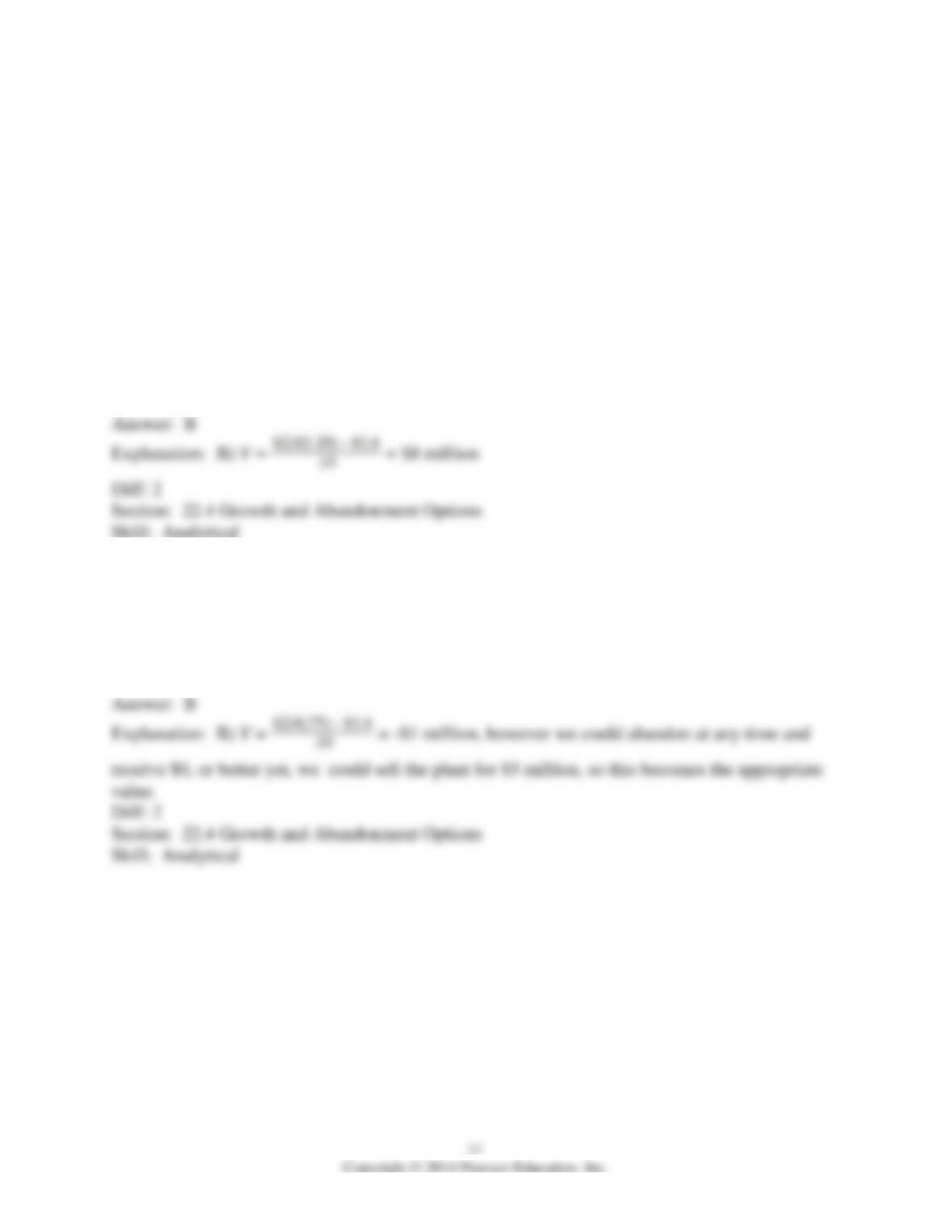
You own a small manufacturing plant that currently generates revenues of $2 million per year.
Next year, based upon a decision on a long-term government contract, your revenues will either
increase by 20% or decrease by 25%, with equal probability, and stay at that level as long as you
operate the plant. Other costs run $1.6 million dollars per year. You can sell the plant at any
time to a large conglomerate for $5 million and your cost of capital is 10%.
6) If you are awarded the government contract and your sales increase by 20%, then the value of
your plant will be closest to:
A) $5 million
B) $8 million
C) $0
D) $4 million
7) If you are not awarded the government contract and your sales decrease by 25%, then the
value of your plant will be closest to:
A) -$1 million
B) $5 million
C) $8 million
D) $0
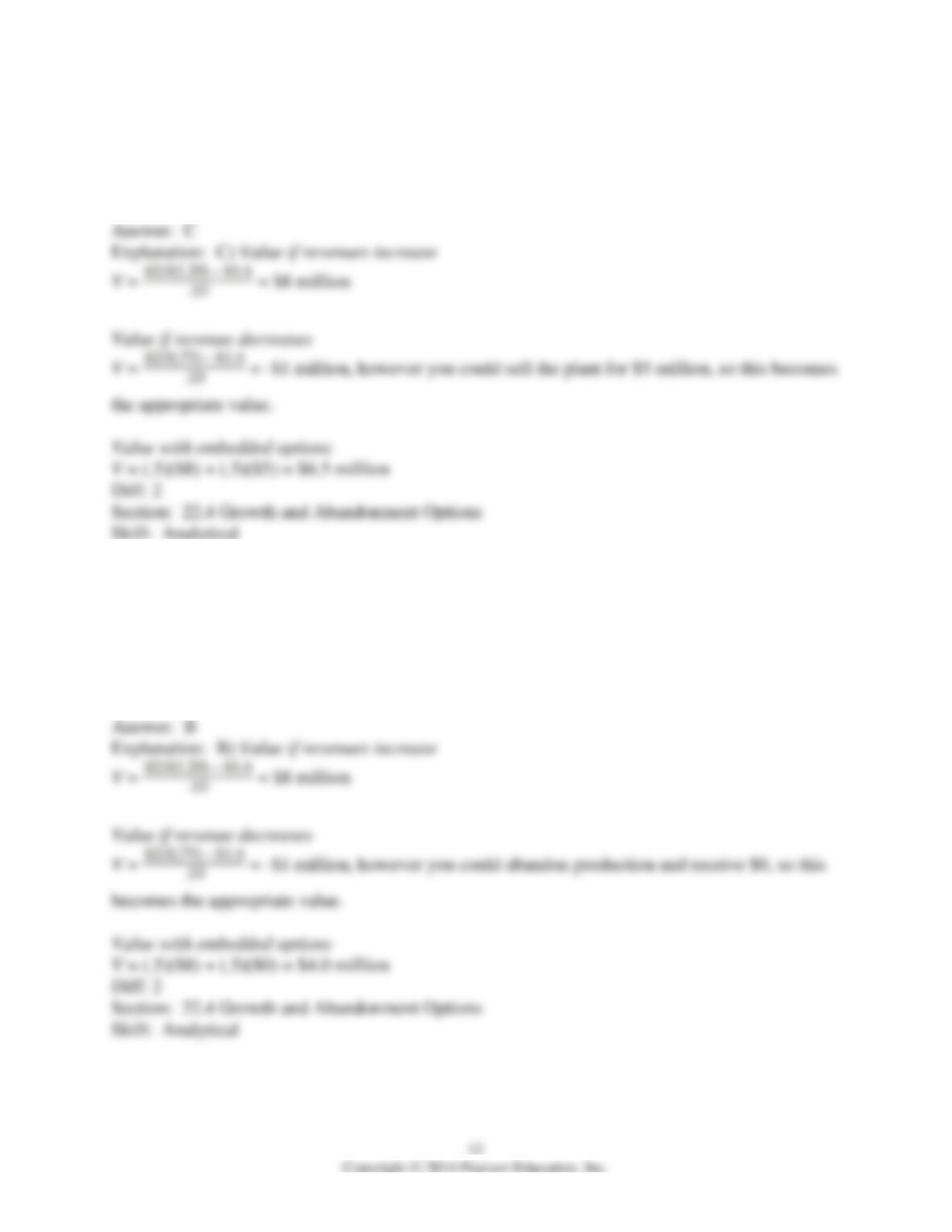
8) Given the embedded option to sell the plant, the value of your plant will be closest to:
A) $5.0 million
B) $4.0 million
C) $6.5 million
D) $8.0 million
9) Assume that you are not able to sell the plant, but you are able to shut down the plant at no
cost at any time. Given the embedded option to abandon production the value of your plant will
be closest to:
A) $8.0 million
B) $4.0 million
C) $5.0 million
D) $6.5 million
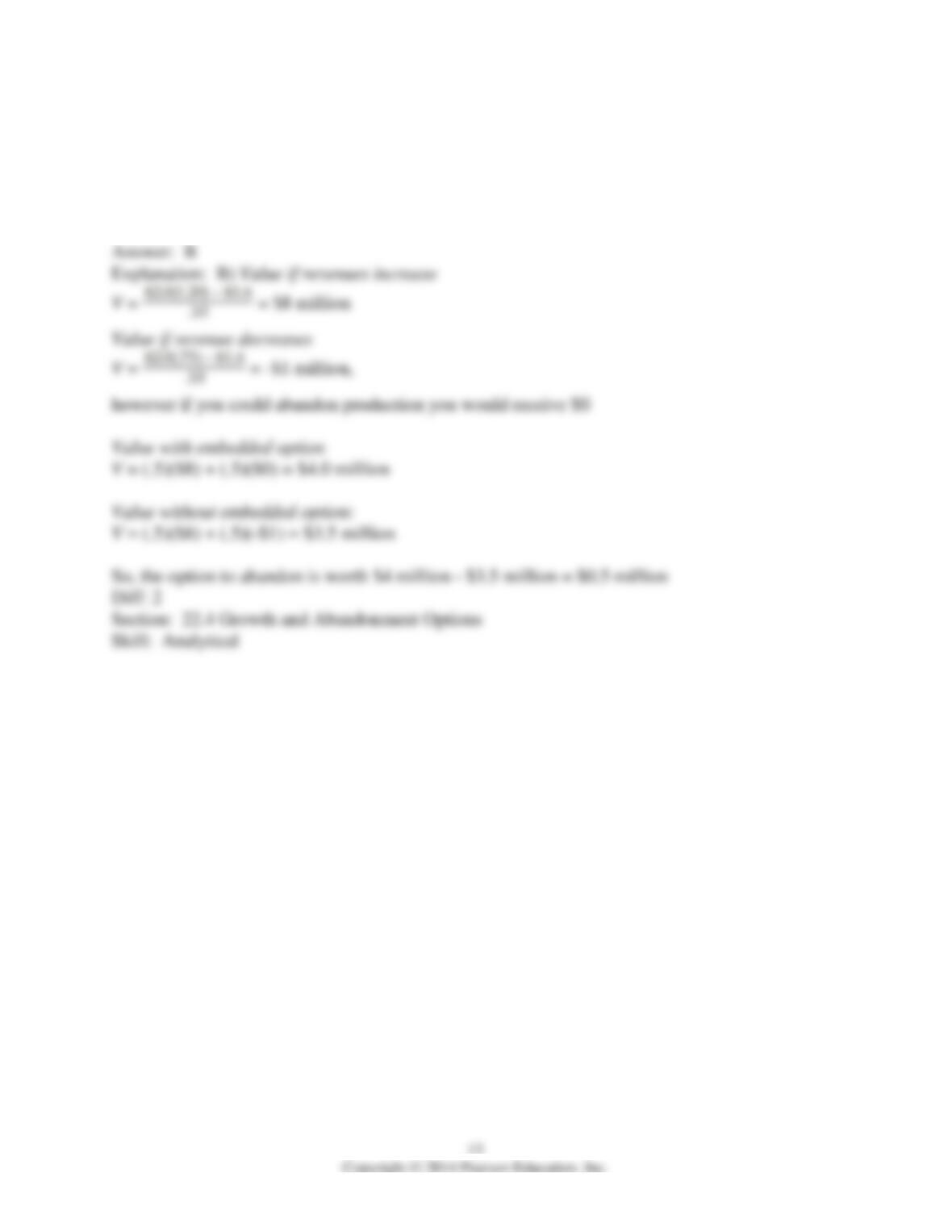
10) Assume that you are not able to sell the plant, but you are able to shut down the plant at no
cost at any time. The value of the option to abandon production will be closest to:
A) $1.0 million
B) $0.5 million
C) -$1.0 million
D) $3.0 million
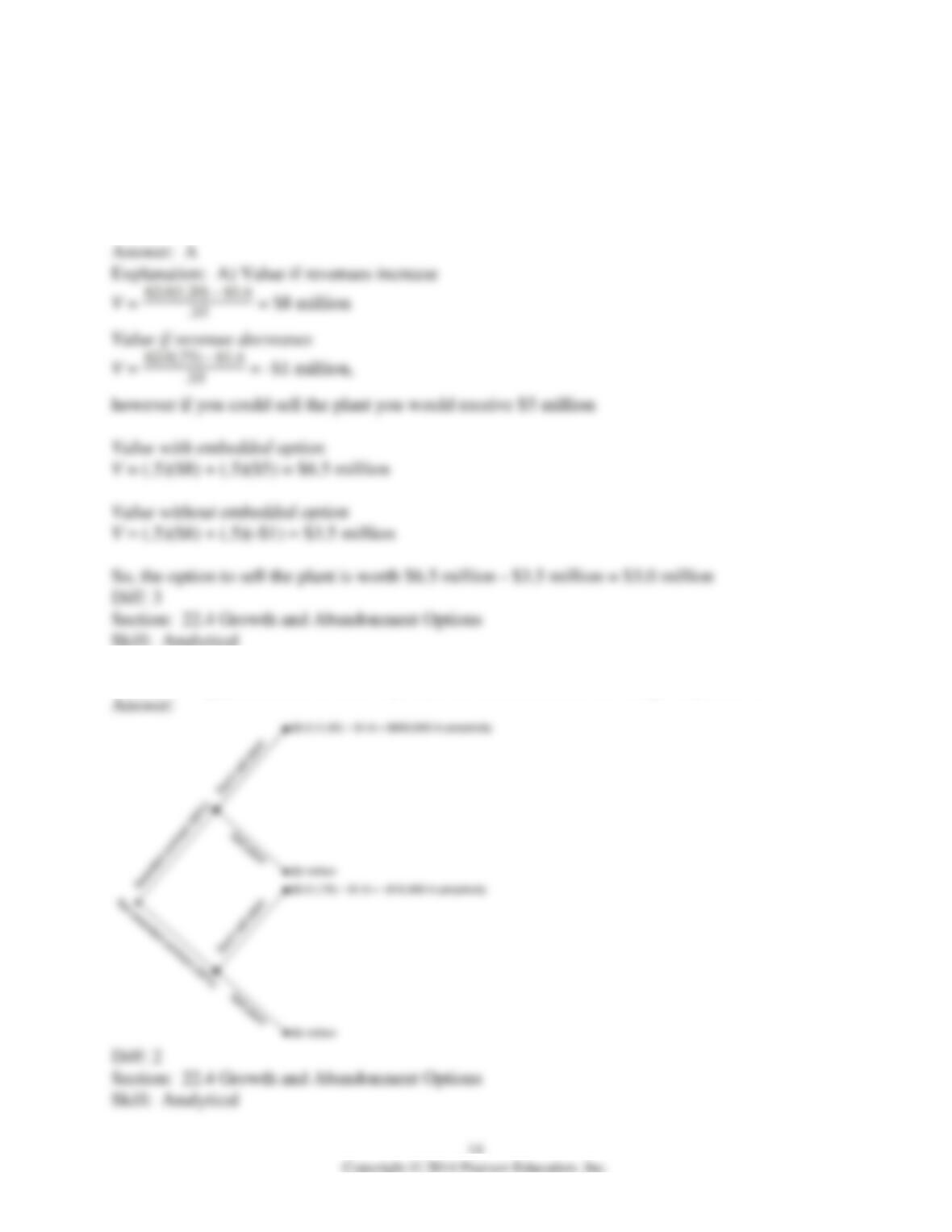
11) Assume that it will cost you $1 million to shut down the plant, but you are able to sell the
plant for $5 million at any time. The value of the option to sell the plant will be closest to:
A) $3.0 million
B) $6.0 million
C) $5.0 million
D) $0.5 million
12) Assuming you are able to see the plant, draw a decision tree detailing this problem.