Chapter 22: Accounting for Changes and Errors
1
Challenging
ACCT.WHAL.16.22.5 – LO: 22.5
United States – BUSPORG: Analytic
United States – OH – Default City – AICPA: FN-Measurement
Bloom’s: Analyzing
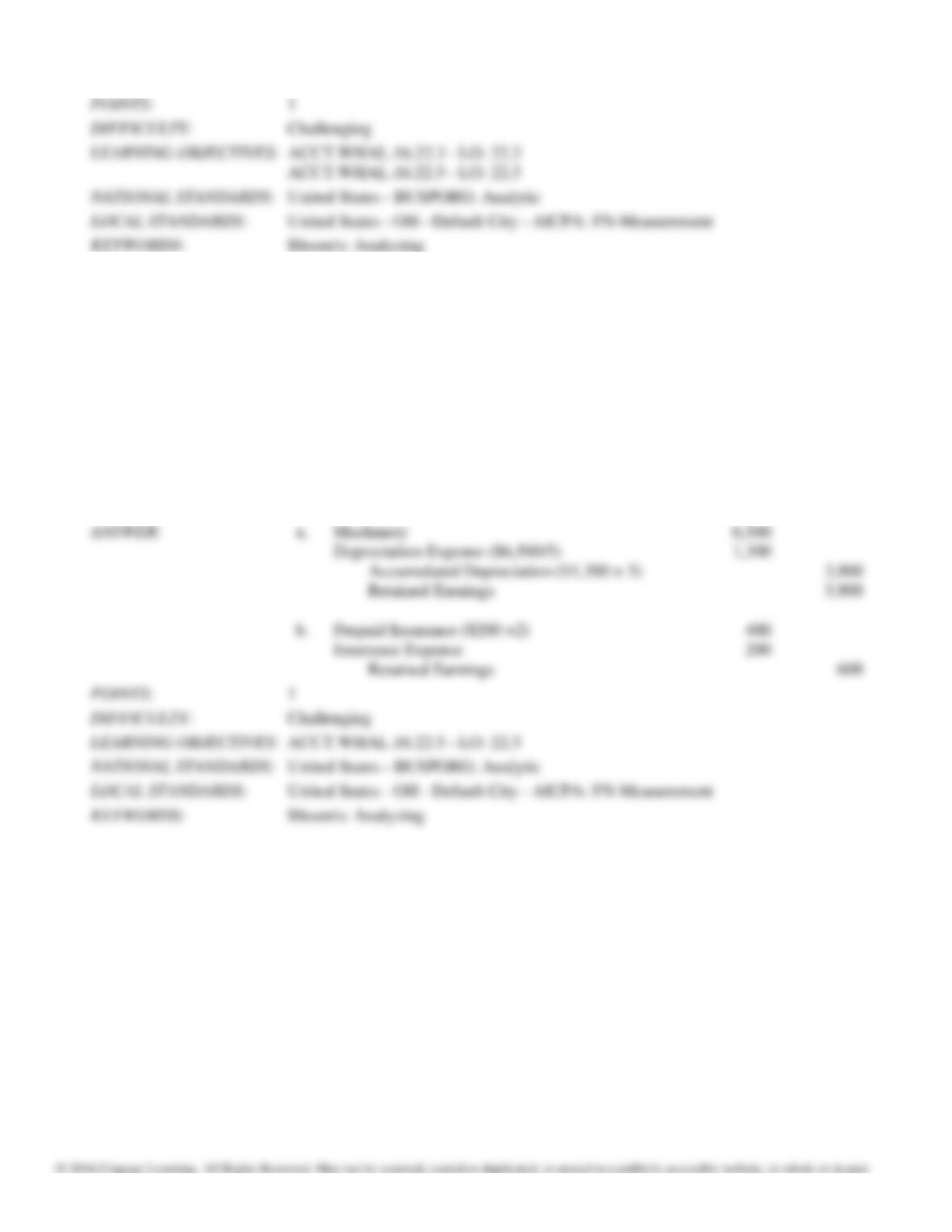
114. The Jessica Co. has the following errors on its books as of December 31, 2018. The books for 2018 have not yet been
closed.
a.
On January 1, 2016, a machine had been purchased for $6,500. The machine had an
estimated life of five years, but it was expensed in error. Straight-line depreciation with no
salvage value should have been used.
b.
On January 1, 2017, the company bought a four-year insurance policy for $800 and
immediately charged the full premium to expense.
Required:
Prepare journal entries to correct these errors on December 31, 2018. Ignore income taxes.
1
Challenging
ACCT.WHAL.16.22.5 – LO: 22.5
United States – BUSPORG: Analytic
United States – OH – Default City – AICPA: FN-Measurement
Bloom’s: Analyzing
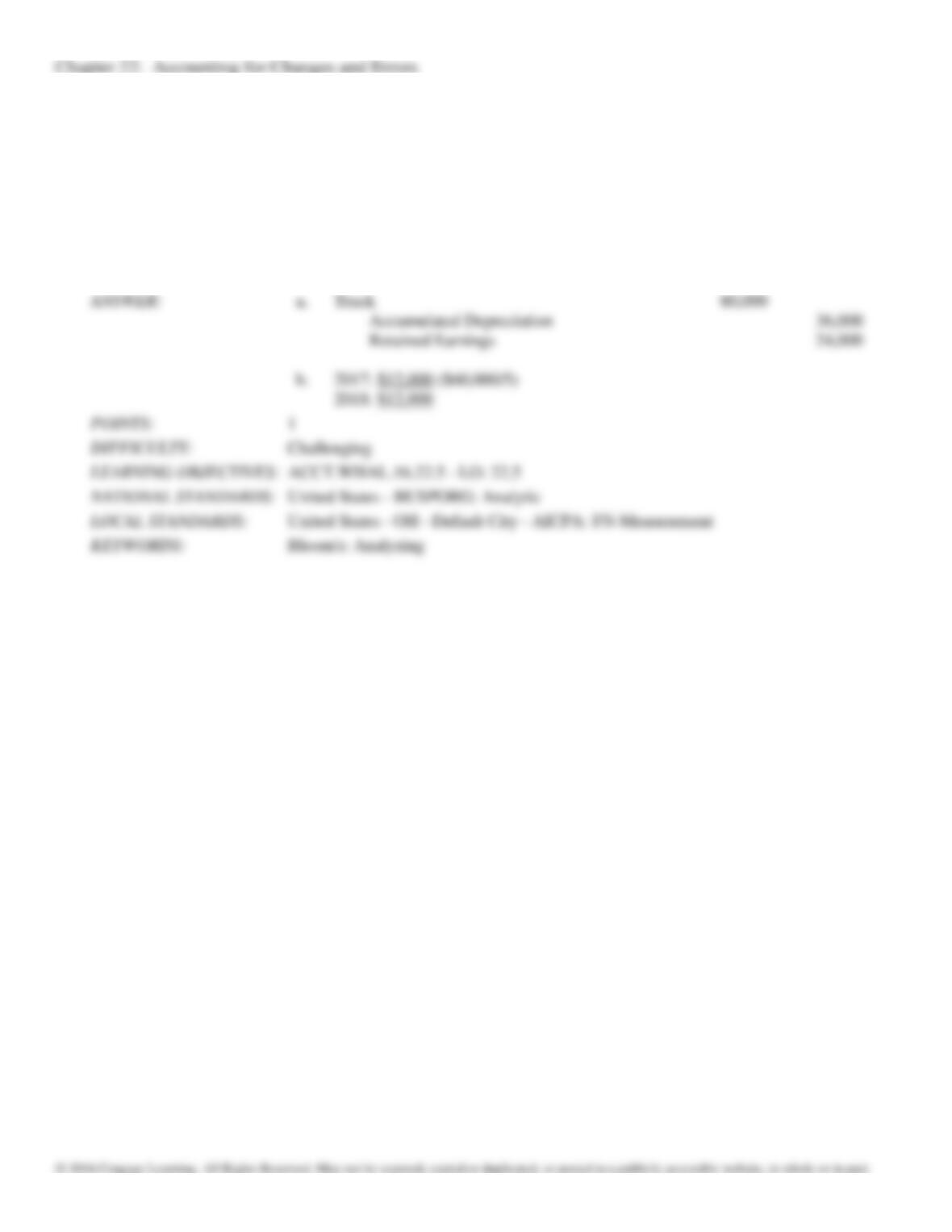
115. On January 1, 2016, Sarah Company purchased for $60,000 a truck that had an estimated life of five years and no
residual value at the end of its useful life. Sarah uses straight-line depreciation. The cost of the truck was charged to
Repairs Expense when purchased in 2016.
Required:
a.
Ignoring income taxes, prepare the journal entry to correct the error if it was discovered
and corrected on January 1, 2019 (Sarah’s year ends on December 31).
b.
When preparing the 2019 financial statements, how much depreciation expense should be
reported on the comparative 2017 and 2018 income statements?
ACCT.WHAL.16.22.5 – LO: 22.5
United States – OH – Default City – AICPA: FN-Measurement
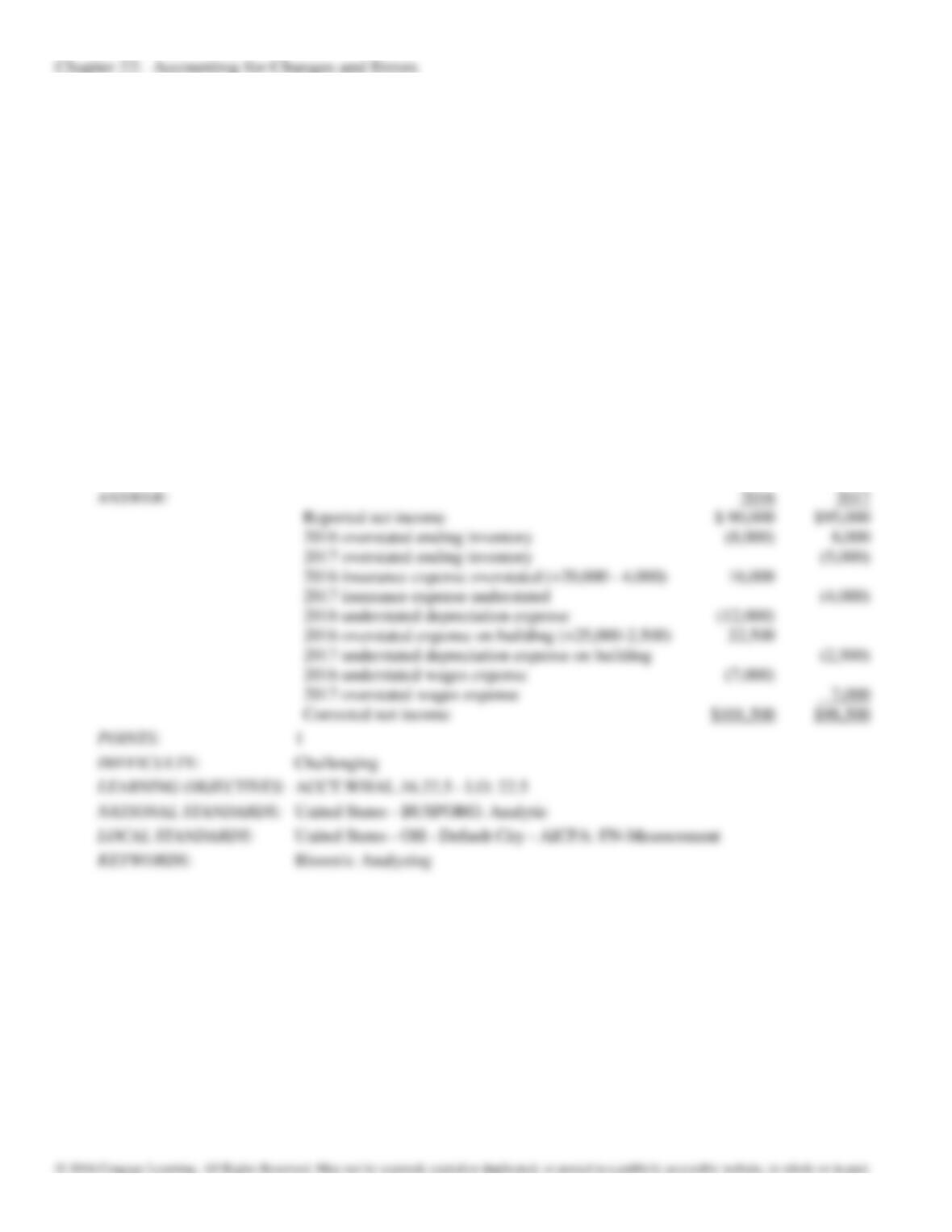
116. The 2016 and 2017 financial statements for Angelica Company had the following errors:
·
Ending inventory was overstated by $8,000 on December 31, 2016, and overstated by
$5,000 on December 31, 2017.
·
A five-year insurance policy costing $20,000 was charged to expense when paid in
advance on January 1, 2016.
·
Depreciation expense of $12,000 on new equipment was omitted from the 2016 financial
statements.
·
Major improvements to Angelica’s manufacturing plant costing $25,000 were charged to
expense in 2016 and should have been capitalized. Consequently, annual depreciation
expense of $2,500 was omitted from the 2016 and 2017 financial statements.
·
Wages of $7,000 earned in 2016 but not paid until 2017 were recorded as an expense in
2017 instead of 2016.
Angelica Company had reported net income of $90,000 in 2016 and $95,000 in 2017.
Required:
Prepare a schedule to determine the correct net income for 2016 and 2017. Begin the schedule with reported net
income for 2016 and 2017 and work to a corrected figure. Ignore income taxes.
Reported net income
2017 overstated ending inventory
2016 insurance expense overstated (+20,000 – 4,000)
2016 understated depreciation expense
2017 understated depreciation expense on building
2016 understated wages expense
Corrected net income
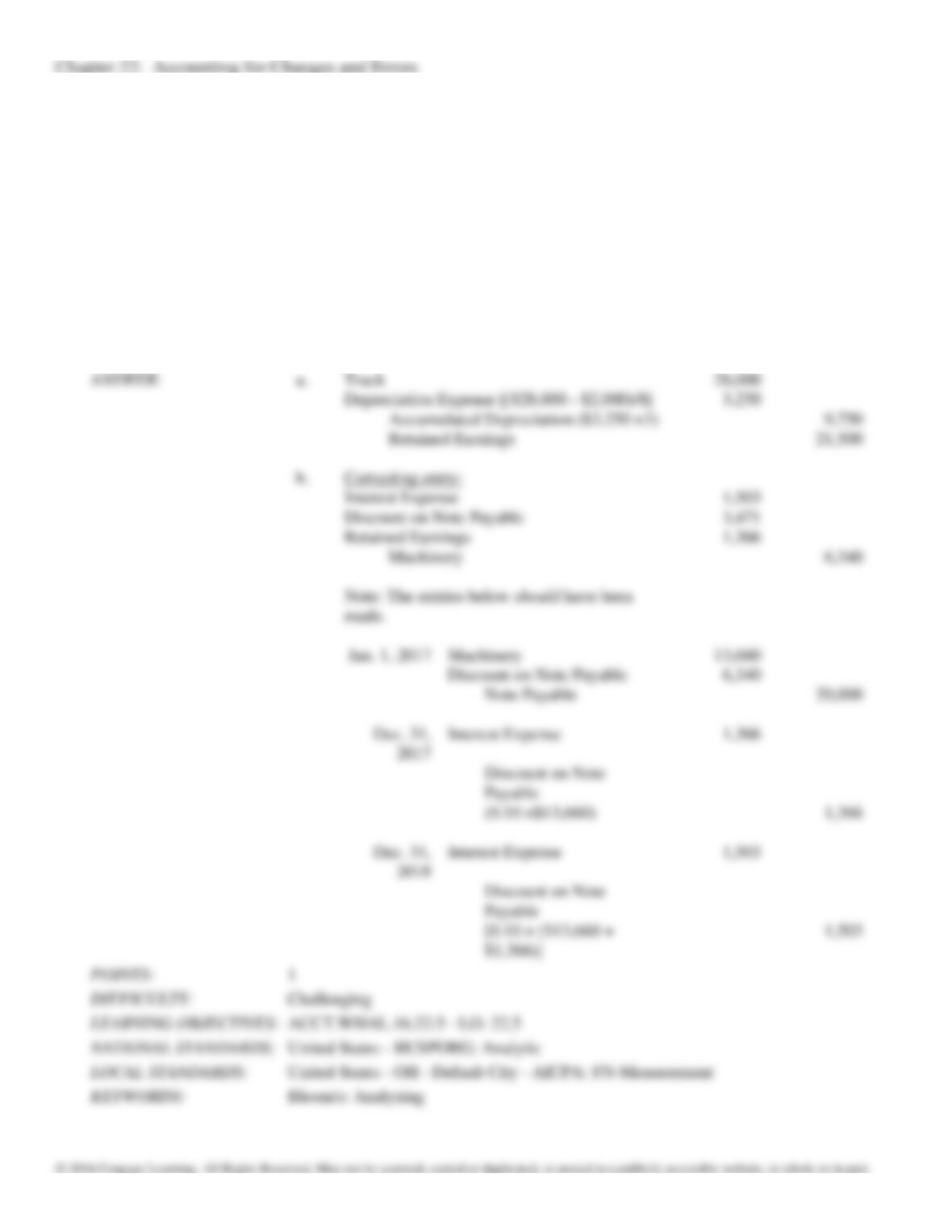
117. Meagan Co. has the following errors on its books as of December 31, 2018. The books for 2018 have not yet been
closed.
a.
On January 1, 2016, a truck had been purchased for $28,000. The truck had an estimated
life of eight years, but it was expensed in error. Straight-line depreciation with $2,000
salvage value should have been used.
b.
On January 1, 2017, the company recorded the purchase of a machine in exchange for a
four-year, noninterest-bearing note in the amount of $20,000. Interest rates were then 10%,
but no recognition was made of that fact. The present value of $1 at 10% for four periods is
0.683013. (Ignore depreciation.)
Required:
Prepare journal entries to correct these errors at December 31, 2018. Ignore income taxes.
1
Challenging
ACCT.WHAL.16.22.5 – LO: 22.5
United States – BUSPORG: Analytic
United States – OH – Default City – AICPA: FN-Measurement
118. The Laura Company has the following errors on its books as of December 31, 2017. The books for 2017 have not yet
been closed.
a.
In 2017, fully depreciated equipment (with no residual value) that originally cost $8,000
was sold for $700 as scrap. The company credited the $700 proceeds to Equipment.
b.
On January 1, 2016, the company recorded the purchase of equipment in exchange for a
three-year, noninterest-bearing note payable in the amount of $10,000. Interest rates were
then 8%, but no recognition was made of this fact. The present value of $1 at 8% for three
periods is 0.7938. (Ignore depreciation.)
Required:
Prepare journal entries to correct these errors at December 31, 2017. Ignore income taxes.
1
Challenging
ACCT.WHAL.16.22.5 – LO: 22.5
United States – BUSPORG: Analytic
United States – OH – Default City – AICPA: FN-Measurement
Bloom’s: Analyzing
119. Several errors are listed below.
Effect on 2016
Net Income
a.
Failed to record a 2016 expense.
+.
b.
Ending 2015 inventory is understated.
____
c.
Ending 2016 accrued expense is overstated.
____
d.
Ending 2016 inventory is overstated.
____
e.
Ending 2015 accrued revenue is understated.
____
f.
Ending 2016 prepaid expense is overstated.
____
g.
Ending 2015 unearned revenue is overstated.
____
h.
Ending 2016 accrued revenue was overstated.
____
i.
Ending 2015 prepaid expense was overstated.
____
j.
Ending 2015 accrued expense is overstated.
____
k.
Ending 2016 unearned revenue is understated.
____
Required:
Indicate the effect each error would have on 2016 net income by placing a plus sign (+), minus sign (−) or NI (no
impact) in the space provided. Part (a) has been completed as an example.
120. Several errors are listed below.
Effect on 2017
Net Income
a.
Failed to record a 2017 expense.
+ .
b.
Ending 2016 inventory was overstated.
____
c.
Ending 2017 accrued expense was understated.
____
d.
Ending 2017 inventory was understated.
____
e.
Ending 2016 accrued revenue was overstated.
____
f.
Ending 2017 prepaid expense was understated.
____
g.
Ending 2016 unearned revenue was understated.
____
h.
Ending 2017 accrued revenue was overstated.
____
i.
Ending 2016 accrued expense was understated.
____
j
Ending 2016 prepaid expense was overstated.
____
k.
Ending 2017 accrued expense was overstated.
____
Required:
Indicate the effect each error would have on 2017 net income by placing a plus sign (+), minus sign (−) or NI (no
impact) in the space provided. Part (a) has been completed as an example.
121. What are the three type of accounting changes defined by GAAP; provide a brief explanation of each?
122. What are the two methods for reporting changes as approved by GAAP provide a brief explanation of each?
123. According to GAAP how should items be reported in order that information is reported in a relevant manner?
124. When is a retrospective adjustment considered impractical to make?
125. Provide three examples of changes in principle.
126. What must be disclosed when making a retrospective adjustment?
127. What is the GAAP requirement of accounting for a change in estimates?
128. What is a change in reporting entity and how is an adjustment handled?
129. What are the 4 steps involved in the basic framework for the analysis and correction of an error?
130. What is the difference between counterbalancing errors and noncounterbalancing errors?
131. Most changes in accounting principles are accounted for retrospectively. Discuss how a change in accounting
principle that causes a retrospective adjustment impacts the comparative financial statements issued for the current
year.
132. Current GAAP defines three types of changes:
a.
Changes in accounting principle
b.
Changes in accounting estimate
c.
Changes in reporting entity
Define each item, give an example, and describe how it should be accounted for.
1
Challenging
United States – BUSPROG: Communication
United States – OH – Default City – AICPA: FN-Decision Modeling
Bloom’s: Evaluating
133. Explain the direct and indirect effects of a change in accounting principles.
134. Most errors are discovered automatically through proper use of the double-entry system or by the internal or external
auditors. However, some errors escape detection until after they have been included in the published financial
statements of a company.
Required:
Describe three types of errors that occur in financial statements and indicate the appropriate corrective action to take
when the errors are discovered.
135. What differences exist between U.S. GAAP and IFRS in their handling of accounting changes?