Biology: A Guide to the Natural World, 5e (Krogh)
Chapter 22 Fungi : The Diversity of Life 2
1) A branching web of hyphae is a:
A) spore.
B) mycelium.
C) root.
D) leaf.
2) Fungi are more closely related to:
A) plants.
B) photosynthetic protists.
C) animals.
D) archaea.
3) For fungi that produce mushrooms, the majority of the organism is located:
A) above ground.
B) in fruiting bodies.
C) in spores.
D) underground.
4) Where are the food materials digested by fungi located?
A) within their cells
B) within food vacuoles
C) externally
D) within their mitochondria

2
5) All fungi are:
A) unicellular.
B) multicellular.
C) autotrophic.
D) heterotrophic.
6) Yeast are an example of:
A) photosynthetic fungi.
B) unicellular fungi.
C) fungi-like bacteria.
D) fungi with no cell walls.
7) Fungi obtain food by:
A) engulfing food through phagocytosis and then digesting it within fungal cells.
B) producing antibiotics that internally destroy bacteria.
C) photosynthesis.
D) absorbing predigested material.
8) What is the best explanation of why we have identified only a small fraction of fungi species?
A) Most fungi species are unicellular and microscopic.
B) Fungi species lack chlorophyll and are transparent.
C) Fungi species have extremely short life spans and are seldom found alive.
D) Most fungi species grow underground and in inaccessible places.
9) Which statement about fungi and plant disease is most accurate?
A) Far more plant diseases are caused by fungi than bacteria.
B) About equal numbers of plant diseases are caused by fungi and bacteria.
C) Viruses cause more plant diseases than fungi.
D) Fungi rarely cause diseases.
10) An important role of fungi in human society is that fungi are the source of:
A) the anti-inflammatory drug ibuprofen.
B) immune-system-suppressing drugs important for organ transplants.
C) nutrition for farm animals.
D) bio-fuels.
11) Bacteria and fungi are important decomposers. However, which decomposition function is
almost entirely the work of fungi?
A) decomposition of bacterial mass
B) digestion of metallic materials in landfills
C) large-animal decomposition
D) final breakdown of woody material
12) Which of the following is a fungal skin disease?
A) dry rot
B) ringworm
C) Dutch elm disease
D) skin rust
13) A feature unique to some fungi is:
A) a lack of chlorophyll.
B) cells with three haploid nuclei.
C) dikaryotic cells.
D) diploid cells.
14) A major reason why fungi can grow and sprout mushrooms so quickly is that:
A) mushrooms are essentially fluid-filled bags and almost entirely water.
B) porous connections between cells allow rapid movement of materials toward the growing tips
of hyphae.
C) fungi cells divide more like bacteria than eukaryotic cells.
D) fungal spores contain large food reserves.
15) When club fungi reproduce sexually, which of the following occurs?
A) Two spores merge into a seed that produces hyphae.
B) Two mushroom caps from different fungi exchange genes.
C) Sperm and egg cells fuse.
D) Nuclei from two different fungi fuse.
16) The cell walls of fungi contain:
A) chitin.
B) cellulose.
C) phospholipids.
D) DNA.
17) A more or less circular ring of mushrooms appears in your yard, apparently overnight. The
circle is several yards in diameter. The most likely explanation for this circle of mushrooms is
that:
A) the mushrooms are all part of the same organism, with mycelia radiating out from the location
of a germinated spore.
B) a circle is nature’s most perfect shape for asexual reproduction structures.
C) one mushroom in the circle reproduced sexually to make all the other mushrooms in the
circle.
D) the fungus produces a toxin in the center to prevent too many mushrooms from being
produced.

18) Conspicuous shelf-like or saddle-like structures on the surface of a tree that indicate a fungus
is growing within the tree are for:
A) showy display to attract a mate.
B) defense from predators.
C) reproduction and spore dispersal.
D) pollination.
19) Fungi that reproduce by “budding” are:
A) prokaryotic.
B) yeasts.
C) autotrophic.
D) made of hyphae to form a reproductive mycelium.
20) A fungus is examined microscopically and found to have a “lollypop-shaped” sporangium.
This fungus must belong to:
A) chytrids.
B) basidiomycetes.
C) zygomycetes.
D) ascomycetes.
21) In which group are smuts and rusts found?
A) basidiomycetes
B) ascomycetes
C) zygomycetes
D) chytrids
22) The two most closely related groups of fungi are the:
A) zygomycetes and chytrids.
B) basidiomycetes and ascomycetes.
C) basidiomycetes and zygomycetes.
D) ascomycetes and zygomycetes.
23) The fungal group with the largest number of known species is:
A) zygomycetes.
B) ascomycetes.
C) basidiomycetes.
D) chytrids.
24) As part of your independent study of pond water samples, you notice one of the flagellated
organisms latch on to a pollen grain and eventually release spores. You initially thought you
were looking at a group exclusively made of protists, but upon further observation, you realize
the organism you have been observing is classified with the fungi. In which group would you
place this organism?
A) basidiomycetes
B) ascomycetes
C) zygomycetes
D) chytrids
25) An organism that obtains its nutrition from dead organic matter is a:
A) parasite.
B) saprophyte.
C) neophyte.
D) phytoplankton.
26) Lichens are:
A) a mutualistic association of algae or photosynthetic bacteria and fungi.
B) algae-like fungi.
C) fungi that grow on the roots of plants.
D) fungi adapted for life in rocky soil.
27) Mycorrhizae are a:
A) parasitic association between algae and fungi.
B) parasitic association between animals and fungi.
C) mutualistic association between plant roots and a fungus.
D) mutualistic association between algae and plant roots.
28) Ecologically speaking, most soil fungi are to plant roots as:
A) viruses are to animals.
B) smut fungi are to corn.
C) mosquitoes are to mammals.
D) intestinal bacteria are to humans.
29) Although some fungi are multicellular, most are unicellular.
30) Fungi obtain food exclusively by decomposing dead organisms.
31) Some antibiotics are important products of fungi.
32) Some fungi are photosynthetic.
33) Dikaryotic cells of a fungus contain diploid nuclei.
34) Spores are reproductive cells of a fungus.
35) Nearly all fungi reproduce using mushrooms as their reproductive structure.
36) A mycelium is characteristic of yeasts.
37) The cell walls of fungi contain chitin.
38) Yeasts are all members of the chytrids.

Match the following.
A) unicellular fungi
B) mobile fungi
C) sporangium-producing fungi
D) group in which “bread mold” is found
E) “sac fungi” group in which morel mushrooms are found
F) mushroom-producing “club fungi”
39) Zygomycetes
Topic: Section 22.4
Skill: Knowledge/Comprehension
40) Ascomycetes
Topic: Section 22.4
Skill: Knowledge/Comprehension
41) Basidiomycetes
Topic: Section 22.4
Skill: Knowledge/Comprehension
42) Yeasts
Topic: Section 22.4
Skill: Knowledge/Comprehension
43) Chytrids
Topic: Section 22.4
Skill: Knowledge/Comprehension
44) Zygomycetes
Topic: Section 22.4
Skill: Knowledge/Comprehension
Match the following.
A) most protist-like fungi
B) fungi with algae partners
C) a member of this group causes Dutch elm disease
D) fungi associated with plant roots
45) Ascomycetes
Topic: Section 22.4
Skill: Knowledge/Comprehension
46) Chytrids
Topic: Section 22.4
Skill: Application/Analysis
47) Mycorrhizae
Topic: Section 22.4
Skill: Knowledge/Comprehension
48) Lichens
Topic: Section 22.4
Skill: Knowledge/Comprehension
49) Most of the “body” of a fungus consists of slender, tube-like filaments called ________.
50) Most fungi are ________, or fixed in one spot.
51) Each nucleus is haploid in dikaryotic cells in certain fungi. What does this mean regarding
the chromosomes in each nucleus?
52) The cells released from reproductive structures such as mushrooms that can develop into a
new organism without fusing with another cell are called ________.
53) You are a biologist traveling with a group of explorers who encounter an ancient tomb. You
find an amazingly well-preserved mummy and notice a little fungus growing on some bandages.
When you examine your samples of the fungus back at the lab, you notice the fungus has small
sac-like, spore-releasing structures. Based on the information you have so far, you will start the
process of classifying this organism by placing it in this category of fungus: ________.
54) The spore-releasing structure found in the zygomycetes is called a ________.
55) Discuss the ways in which fungi are both helpful and harmful to human society.
56) Appraise and evaluate the following statement, and cite evidence from the chapter as
appropriate: Despite having a closer “outward” appearance to plants in some ways, evidence
support fungi as being far more closely related to animals than plants.
57) Fungi and plants have a long-term relationship in the history of life on Earth. Appraise the
evidence in support of this concept.
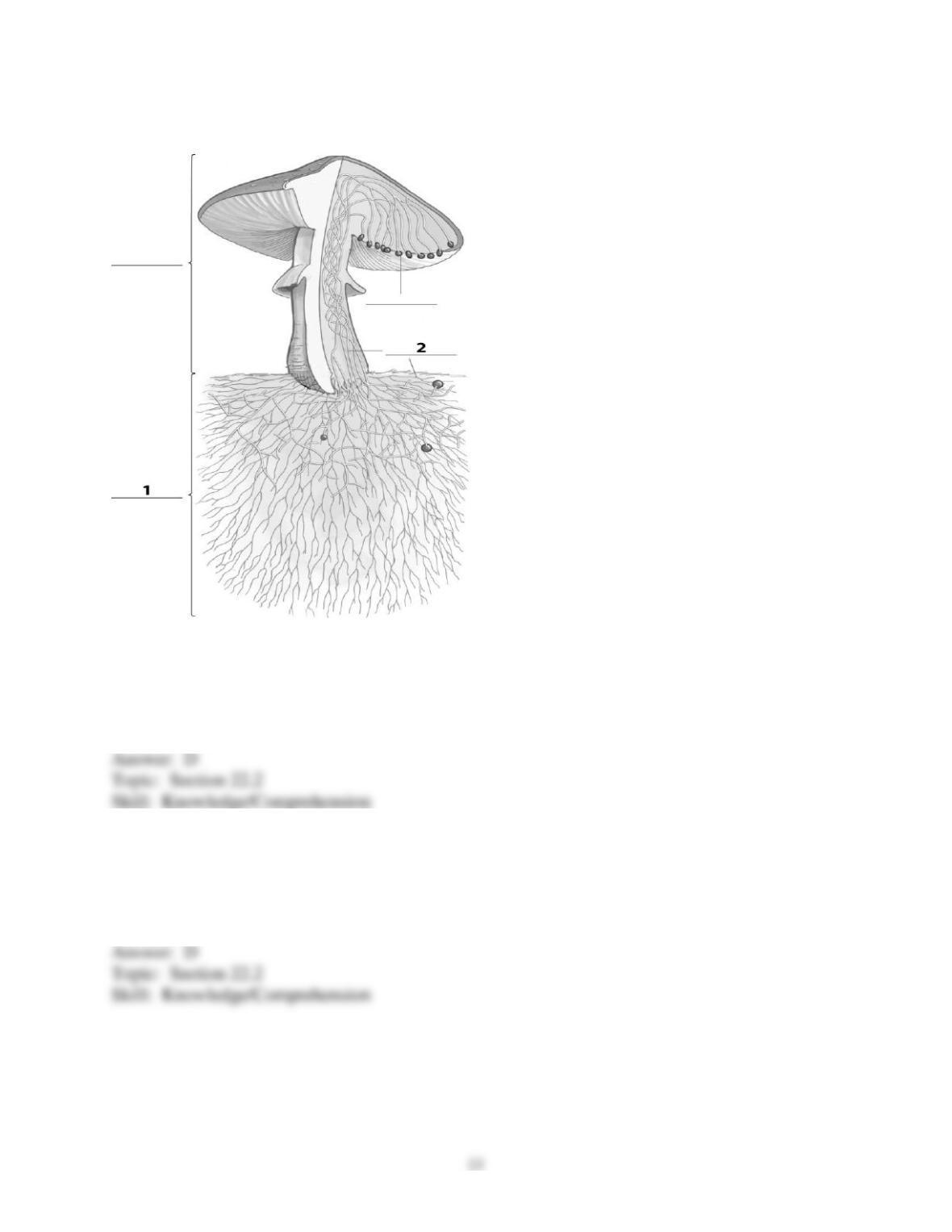
Refer to the figure below, and then answer the following question(s).
58) The missing label indicated by a “1” corresponds to:
A) a spore.
B) the fruiting body.
C) hyphae.
D) mycelium.
59) The missing label indicated by a “2” corresponds to:
A) a spore.
B) the fruiting body.
C) hyphae.
D) mycelium.