65. Granger Company makes portable DVD players. In its inventory, Granger found 200 DVD players that had
become obsolete. Each DVD player has a cost of $100. Granger can upgrade these DVD players for $15 each
after which they can be sold at a cost of $40 each. Granger has also received an offer to sell the DVD players, as
is, for a total of $4,000. Compared to just selling the 200 DVD players for a total of $4,000 as they are, what is
the net increase (decrease) in operating income if Granger upgrades the DVD players and then sells them?
D. $5,000 increase
66. CharCore mixes together wood chips and pine oil. After joint manufacturing costs of $2,000 have been
incurred, the mixture separates into two products, granulated charcoal and methyl alcohol. At the split-off point,
granulated charcoal can be sold for $5,000 and the alcohol can be sold for $9,000. The charcoal can be further
processed at a cost of $6,000 to make air filters which could be sold for $15,000. The alcohol can be further
processed at a cost of $7,000 to make a cleaning solvent which could be sold for $14,000. What is the net
increase (decrease) in operating income from air filters?
67. CharCore mixes together wood chips and pine oil. After joint manufacturing costs of $2,000 have been
incurred, the mixture separates into two products, granulated charcoal and methyl alcohol. At the split-off point,
granulated charcoal can be sold for $5,000 and the alcohol can be sold for $9,000. The charcoal can be further
processed at a cost of $6,000 to make air filters which could be sold for $15,000. The alcohol can be further
processed at a cost of $7,000 to make a cleaning solvent which could be sold for $14,000. What is the net
increase (decrease) in operating income from cleaning solvents?
68. CharCore mixes together wood chips and pine oil. After joint manufacturing costs of $2,000 have been
incurred, the mixture separates into two products, granulated charcoal and methyl alcohol. At the split-off point,
granulated charcoal can be sold for $5,000 and the alcohol can be sold for $9,000. The charcoal can be further
processed at a cost of $6,000 to make air filters which could be sold for $15,000. The alcohol can be further
processed at a cost of $7,000 to make a cleaning solvent which could be sold for $14,000. Which product
should be processed further?
69. In relation to the critical resource factor, a company will maximize net income by selling products that:
70. When managers are deciding how much of each product to sell to maximize net income, they should:
71. To maximize net income in a situation involving scarce resources, a company should:
72. The resource that limits operating capacity by its availability is the:
73. Hopson Company is located in a large city that has good access to both raw materials and a dependable
labor supply. Real estate in the city is extremely expensive, and Hopson’s warehouse is always full because the
company operates at 100% capacity. Hopson’s critical resource probably is:
74. Exhibit 22-5
Imperial Company manufactures two types of fruit drinks, Tropical and Hawaiian. The company can sell as
many bottles of each product as it can produce, but production is limited by the availability of direct labor
hours. The revenues, costs, and labor hours for the two products are as follows:
Tropical
Hawaiian
Selling price per 100 bottles
$1,200
$1,800
Variable costs per 100 bottles
$ 720
$1,200
Labor hours per 100 bottles
10
20
Refer to Exhibit 22-5. What is the contribution margin per 100 bottles of Hawaiian?
D. $1,200
75. Exhibit 22-5
Imperial Company manufactures two types of fruit drinks, Tropical and Hawaiian. The company can sell as
many bottles of each product as it can produce, but production is limited by the availability of direct labor
hours. The revenues, costs, and labor hours for the two products are as follows:
Tropical
Hawaiian
Selling price per 100 bottles
$1,200
$1,800
Variable costs per 100 bottles
$ 720
$1,200
Labor hours per 100 bottles
10
20
Refer to Exhibit 22-5. With 1,000 direct labor hours available for production, if Imperial Company uses the entire amount to produce Tropical, the
contribution margin in total dollars would be:
76. Exhibit 22-5
Imperial Company manufactures two types of fruit drinks, Tropical and Hawaiian. The company can sell as
many bottles of each product as it can produce, but production is limited by the availability of direct labor
hours. The revenues, costs, and labor hours for the two products are as follows:
Tropical
Hawaiian
Selling price per 100 bottles
$1,200
$1,800
Variable costs per 100 bottles
$ 720
$1,200
Labor hours per 100 bottles
10
20
Refer to Exhibit 22-5. How much larger or smaller would Imperial’s earnings be if the company produced Hawaiian instead of Tropical with the
1,000 available direct labor hours?
77. Tarver Corporation makes stools and tables. The company can sell as many stools and tables as it can
produce, but its machine-hour capacity is limited. Revenue and cost data for each unit are given as follows:
Stool
Table
Selling price
$7.50
$18.00
Variable costs
6.00
15.50
Contribution margin
$1.50
$ 2.50
It takes two machine hours to make a table and one machine hour per stool. Given this information, Tarver should:
78. The price charged for a product should normally be high enough to cover:
79. When making normal pricing decisions, management should consider:
80. When using the functional cost approach to set selling prices, the markup must cover:
81. When using the contribution approach to set selling prices, the markup must cover:
82. Exhibit 22-6
Newell Company presently has three product lines: paper, stamps, and printer ink. The company is considering
adding a new line of pens. Market research shows the following expected revenues and costs if the pen line
were added:
Sales revenue (expected annual sale of 15,000 units)
$ 65,000
Variable costs
(30,000)
Direct fixed costs
(12,000)
Common fixed costs
(9,000)
Net income
$ 14,000
Refer to Exhibit 22-6. What is the lowest selling price that Newell should consider that would still make it economically desirable to add this
product line?
83. Exhibit 22-6
Newell Company presently has three product lines: paper, stamps, and printer ink. The company is considering
adding a new line of pens. Market research shows the following expected revenues and costs if the pen line
were added:
Sales revenue (expected annual sale of 15,000 units)
$ 65,000
Variable costs
(30,000)
Direct fixed costs
(12,000)
Common fixed costs
(9,000)
Net income
$ 14,000
Refer to Exhibit 22-6. If Newell generally sets a markup of 20%, what is the lowest selling price that should be considered for the new pen line?

84. Exhibit 22-7
West Star Company is planning to market a new computer and must decide on a proper selling price. The
following cost information for the manufacture of one computer has been compiled:
Direct materials
$48
Direct labor
90
Variable manufacturing overhead
62
Variable selling and administrative expenses
40
Fixed manufacturing overhead
40
Refer to Exhibit 22-7. If the selling price is set at $400 and only variable costs are considered in the pricing decision, what is the markup percentage
based on selling price?
85. Exhibit 22-7
West Star Company is planning to market a new computer and must decide on a proper selling price. The
following cost information for the manufacture of one computer has been compiled:
Direct materials
$48
Direct labor
90
Variable manufacturing overhead
62
Variable selling and administrative expenses
40
Fixed manufacturing overhead
40
Refer to Exhibit 22-7. If the selling price is set at $400 and both variable and fixed costs are treated as product costs, what is the markup percentage
based on selling price?
86. You are the controller of Rugged Shoe Company. The company has excess snow boots in its inventory
because of a mild winter season. A large retail store chain has offered to buy 10,000 pairs of these boots at a
special price. The president of your company asks you to analyze the cost data for producing the boots and
estimate a minimum selling price below which the order from the retail chain should not be accepted. Cost
information for a pair of boots is as follows:
Direct
materials
$15
Direct
labor
8
Manufac
turing
overhead
:
Variable
5
Fixed
2
Selling
and
administ
rative
expenses
:
Variable
3
Fixed
5
a.
What is the minimum selling price the company should accept based only on the financial data presented above, ignoring qualitative
factors?
b.
How much increased profit would the company achieve if 10,000 pairs are sold to the retail chain at $31 per pair?
a.
Since the boots are already produced and in inventory, the only differential cost is variable selling and administrative costs, $3. Therefore,
b.
The increased profit would be $280,000 [($31 – $3) ´ 10,000 pairs].
87. Assume that the monthly capacity of a sporting goods business is 25,000 soccer balls. Current sales and
production are averaging 20,000 soccer balls per month, and the soccer balls sell for $40 each. The business
receives an offer from an exporter for 5,000 footballs at $36 each. Pricing policies in the domestic market will
not be affected, and production can be spread over three months. Variable costs per unit consist of $11.00 for
direct materials, $9.00 for direct labor, and $5.00 for variable manufacturing overhead. Fixed costs are $15.00
per unit. What is the differential income or loss from accepting the special order?
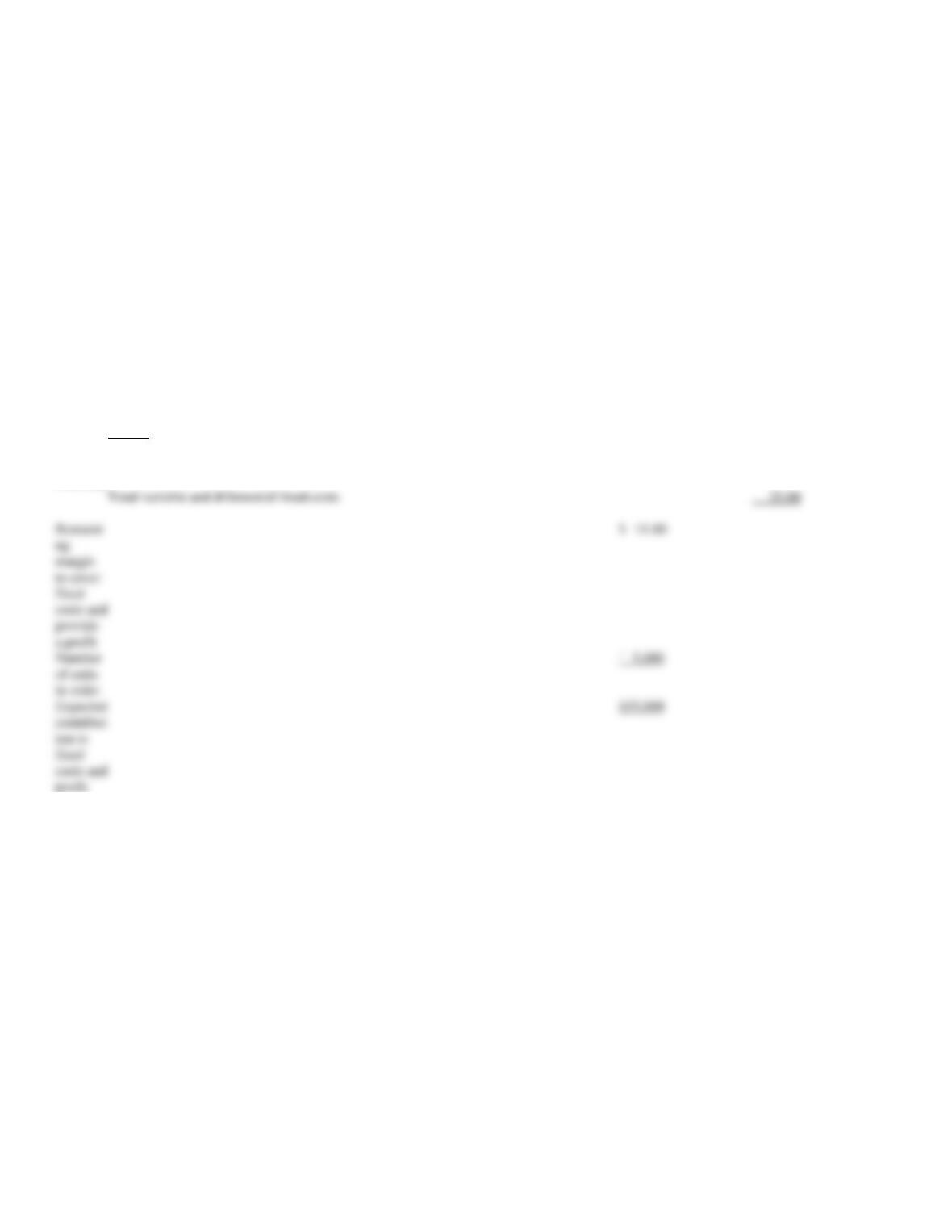
Sales
price
$ 36.00
Variable
and
differenti
al fixed
costs
Direct
materials
$11.00
Direct
labor
9.00
Variable
manufact
uring
overhead
5.00
to cover
fixed
provide
a profit
profit
88. Silverado Company needs 3,000 special cinches for a saddle that it designs and manufactures. If the
company buys the cinches from another company, it will have idle capacity in its plant that cannot otherwise be
used. The company factory space is sufficient to make the cinch if that is the logical choice. Indirect fixed
manufacturing overhead is 20% and will be incurred whether the buckles are purchased or manufactured by the
company. The relevant costs of making and buying the cinches are as follows:
Cost to
make the
cinches:
Direct materials
$ 8
Direct labor
13
Variable manufacturing overhead
5
Fixed manufacturing overhead (direct and indirect)
5
$33
Cost to
buy from
a cinch
company
$31
a.
Identify the differential costs of making the cinches.
b.
Should the cinches be purchased or manufactured? Explain your answer.
89. Tulare Company is operating at less than full capacity. The production manager is considering using this
excess capacity to make a part that he usually buys. The full costs of manufacturing the part are as follows:
Unit Cost
Direct materials
$ 24
Direct labor
45
Variable manufacturing overhead
18
Direct fixed manufacturing overhead
9
Indirect fixed manufacturing overhead
18
Totals
$114
Until now, Tulare has been buying 4,000 units of the part for a total of $408,000.
a.
What is the unit differential cost of making the part?
b.
What is the total differential cost of making the part?
c.
Should Tulare make the part or continue to buy?
a.
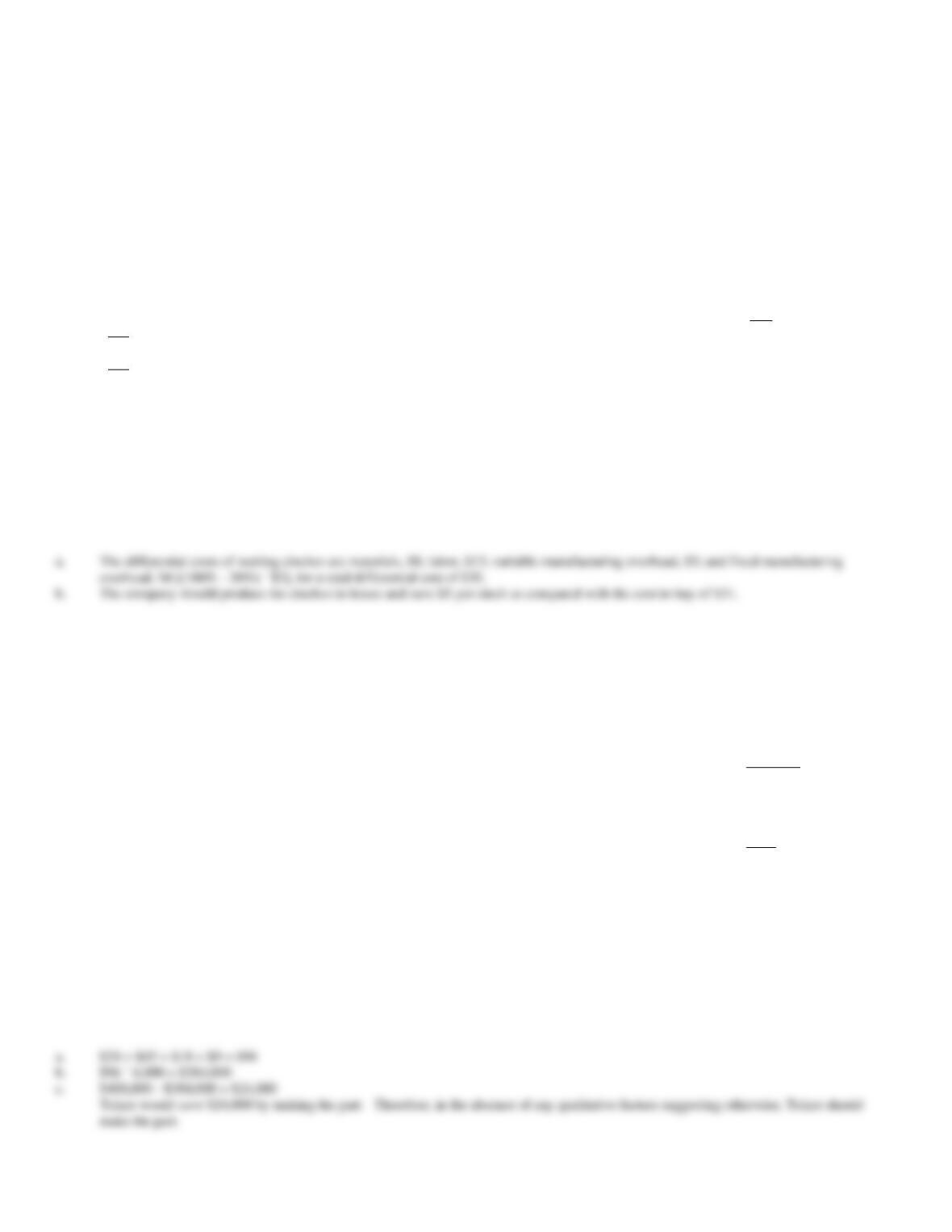
$24 + $45 + $18 + $9 = $96
c.
$408,000 – $384,000 = $24,000
Tulare would save $24,000 by making the part. Therefore, in the absence of any qualitative factors suggesting otherwise, Tulare should
b.
The company should produce the cinches in house and save $1 per cinch as compared with the cost to buy of $31.
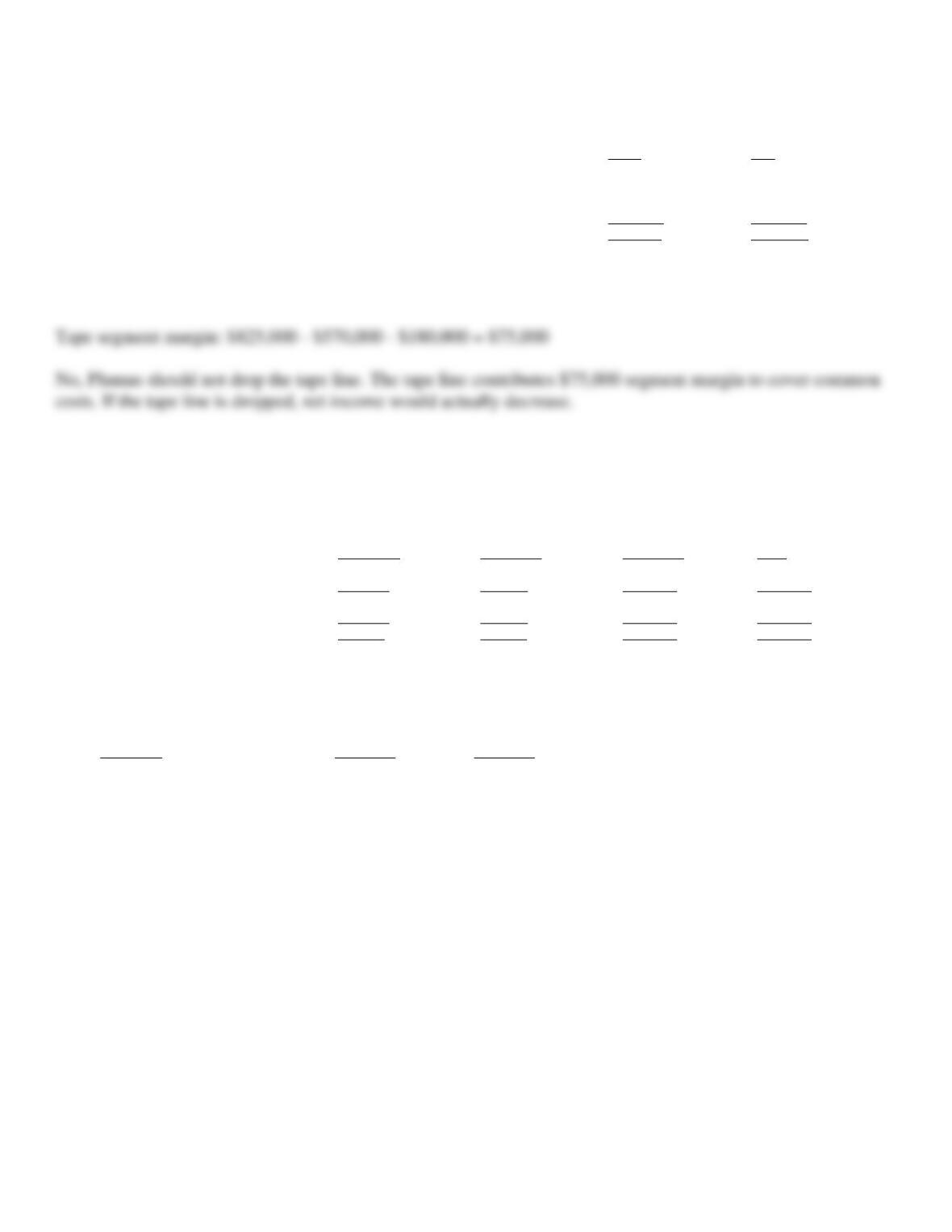
90. Plumas Company presently has two products: tapes and CDs. The company is considering discontinuing the
tape line. The following financial information is available for these two products:
Tapes
CDs
Sales revenue
$ 825,000
$ 684,000
Variable costs
(570,000)
(399,000)
Direct fixed costs
(180,000)
(120,000)
Common fixed costs
(120,000)
(90,000)
Net income (loss)
$ (45,000)
$ 75,000
Should Plumas Company discontinue the tape line? Explain your answer.
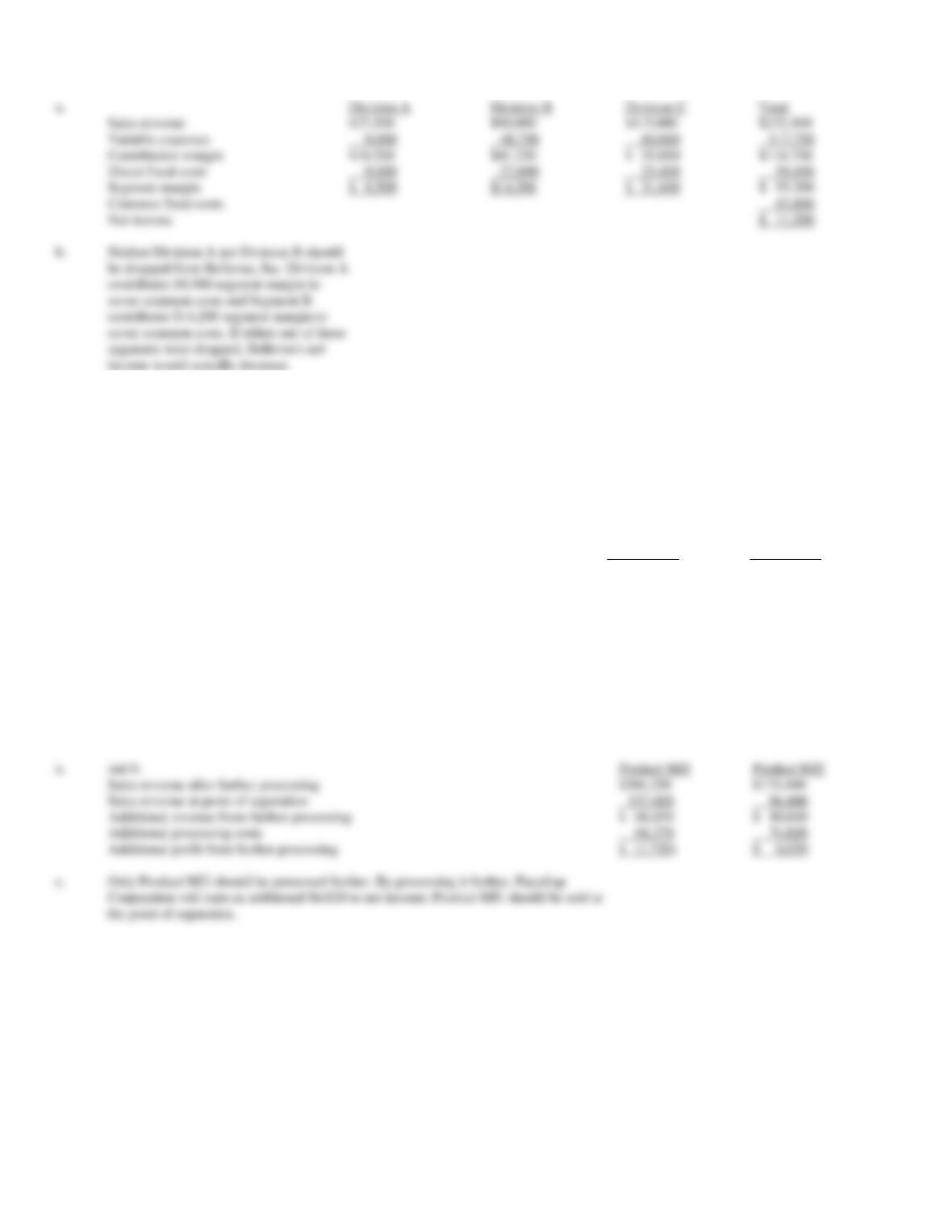
91. Bellevue, Inc. reported the following financial information for the year just ended:
Division A
Division B
Division C
Total
Sales revenue
$ 27,500
$90,000
$115,000
$232,500
Cost of goods sold
15,000
65,000
75,000
155,000
Gross margin
$ 12,500
$25,000
$ 40,000
$ 77,500
Operating expenses
15,000
27,000
24,000
66,000
Net income (loss)
$ (2,500)
$ (2,000)
$ 16,000
$ 11,500
Given this information, Bellevue is considering closing Division A and Division B. Before making a final decision, Bellevue’s controller decided to
separate the total costs into variable costs, direct fixed costs and common fixed costs. The following chart shows the controller’s list of separated
costs:
Division A
Division B
Division C
Cost of
good
sold:
Variable costs
60%
75%
80%
Direct fixed costs
40%
25%
20%
Operati
ng
expens
es
Direct fixed costs
20%
40%
35%
Common fixed costs
80%
60%
65%
a.
Prepare a modified report, showing Bellevue’s costs separated into variable, direct fixed, and common fixed.
b.
Should Division A and Division B be dropped? Explain your answer.
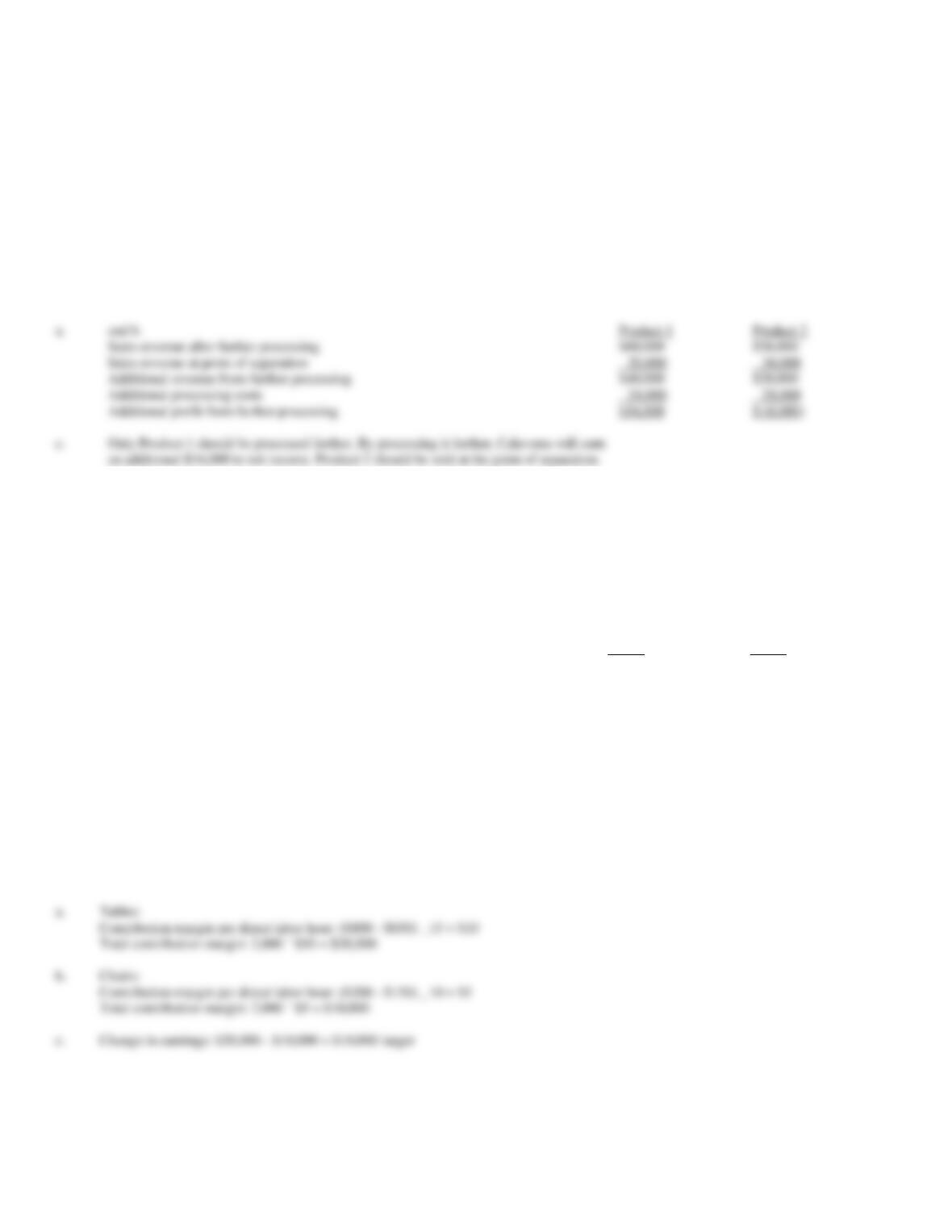
92. Puyallup Corporation makes two products in a joint manufacturing process. At the point of separation, costs
of $56,000 have been incurred. Each product can be sold at the separation point or processed further. The
following information is available for these products:
Product MJ1
Product MJ2
Sales value at separation point
$137,600
$ 94,600
Costs of further processing
68,370
74,820
Sales value after further processing
$204,250
$175,440
a.
What is the net increase (decrease) in operating income from processing Product MJ1 further?
b.
What is the net increase (decrease) in operating income from processing Product MJ2 further?
c.
Which product should be processed further. Explain your answer.
a.
and b.
Product MJ1
Product MJ2
Sales revenue after further processing
$204,250
$175,440
Sales revenue at point of separation
137,600
94,600
Additional revenue from further processing
$ 66,650
$ 80,840
Additional processing costs
68,370
74,820
Additional profit from further processing
$ (1,720)
$ 6,020
a.
Division A
Division B
Division C
Total
Variable expenses
9,000
48,750
60,000
117,750
Contribution margin
$18,500
$41,250
$ 55,000
$114,750
Direct fixed costs
9,000
27,050
23,400
59,450
Segment margin
$ 9,500
$14,200
$ 31,600
$ 55,300
Common fixed costs
43,800
Net income
$ 11,500
93. Calaveras makes two products in a joint manufacturing process. At the point of separation, costs of $8,000
have been incurred. Each product can be sold at the point of separation or processed further. At the split-off
point, Product 1 can be sold for $20,000 and Product 2 can be sold for $36,000. Product 1 can be further
processed at a cost of $24,000 to make Product 1a which could be sold for $60,000. Product 2 can be further
processed at a cost of $28,000 to make Product 2b which could be sold for $56,000.
a.
What is the net increase (decrease) in operating income from processing Product 1 further?
b.
What is the net increase (decrease) in operating income from processing Product 2 further?
c.
Which product should be processed further. Explain your answer.
94. Humboldt Company manufactures two types of products: tables and chairs. The company can sell as many
units of each product as it can produce, but production is limited by the availability of direct labor hours. The
revenues, costs, and labor hours for the two products are as follows:
Tables
Chairs
Selling price per unit
$800
$200
Variable costs per unit
$650
$150
Labor hours per unit
15
10
Humboldt Company has 2,000 direct labor hours available for production.
a.
If Humboldt Company uses the entire amount to produce tables, what is the contribution margin in total dollars?
b.
If Humboldt Company uses the entire amount to produce chairs, what is the contribution margin in total dollars?
c.
How much larger or smaller would Humboldt’s earnings be if the company produced tables instead of chairs with the 2,000 available direct
labor hours?
a.
Tables:
Contribution margin per direct labor hour: ($800 – $650) ¸ 15 = $10
Total contribution margin: 2,000 ´ $10 = $20,000
b.
Chairs:
Contribution margin per direct labor hour: ($200 – $150) ¸ 10 = $5
Total contribution margin: 2,000 ´ $5 = $10,000
c.
Change in earnings: $20,000 – $10,000 = $10,000 larger
a.
and b.
Product 1
Product 2
Sales revenue after further processing
$60,000
$56,000
Sales revenue at point of separation
20,000
36,000
Additional revenue from further processing
$40,000
$20,000
Additional processing costs
24,000
28,000
Additional profit from further processing
$16,000
$ (8,000)
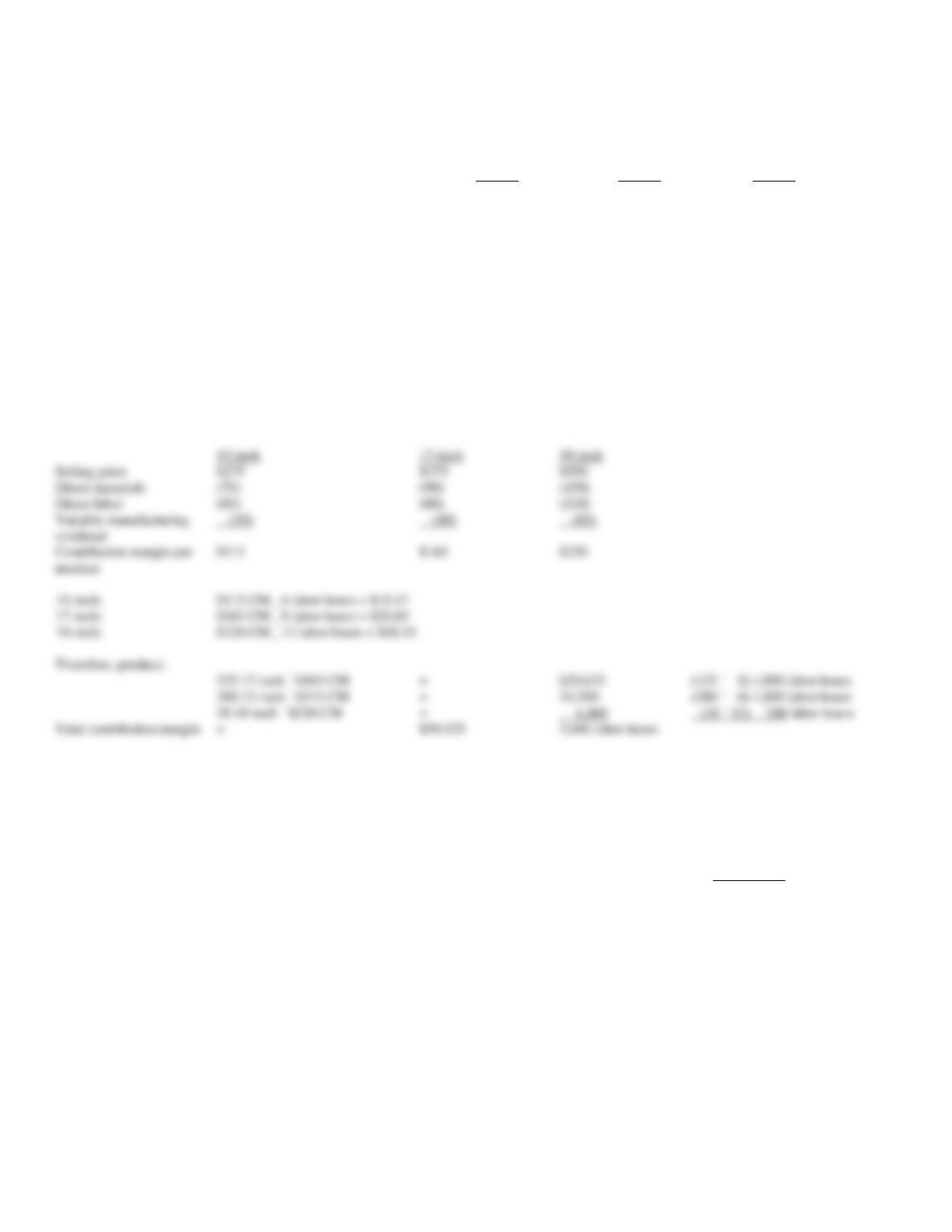
95. The Crystal Clear Company makes three sizes of computer monitors: 15-inch, 17-inch, and 19-inch. Due to
a labor strike, only 3,040 labor hours will be available next week. The direct labor wage rate is $10 per hour.
The revenue and cost information for all three sizes are listed below:
15-inch
17-inch
19-inch
Selling price
$275
$375
$550
Direct materials
70
90
150
Direct labor
60
80
120
Variable manufacturing overhead
30
40
60
Units ordered for next week
300
125
100
Given the units ordered for next week, how many of each monitor should Crystal produce to maximize profits?
Contribution margin per constrained resource:
96. Amador Company is pricing a new line of recliners. Production costs for each recliner are as follows:
Cost per unit
Direct materials
$ 150
Direct labor
$ 160
Variable manufacturing overhead
$ 120
Variable selling and administrative expenses
$ 80
Total fixed manufacturing overhead
$8,400
Total selling and administrative expenses
$3,600
Average number of recliners sold per year
120
a.
Assuming that Amador Company prices its products using a 40% markup on total variable costs, estimate the normal selling price for
Amador’s recliner.
b.
Assuming that Amador Company prices its products using a 30% markup on total manufacturing costs, estimate the normal selling price
for Amador’s recliner.
15-inch
17-inch
19-inch
Selling price
$275
$375
$550
Direct materials
(70)
(90)
(150)
Direct labor
(60)
(80)
(120)
Contribution margin per
$115
$165
$220
15-inch;
$115 CM ¸ 6 labor hours = $19.17
$165 CM ¸ 8 labor hours = $20.63
19-inch;
$220 CM ¸ 12 labor hours = $18.33
Therefore, produce:
125 17-inch ´ $165 CM
=
$20,625
(125 ´ 8) 1,000 labor hours
300 15-inch ´ $115 CM
=
34,500
(300 ´ 6) 1,800 labor hours
20 19-inch ´ $220 CM
=
4,400
(20 ´ 12) 240 labor hours
Total contribution margin
=
$59,525
3,040 labor hours
97. Inyo Company is planning to market a new product and must decide on a proper selling price. The
following cost information for the manufacture of one unit has been compiled:
Direct materials
$168
Direct labor
315
Variable manufacturing overhead
217
Variable selling and administrative expenses
140
Fixed manufacturing overhead
140
a.
Assuming that Inyo Company prices its products using a 25% markup on total costs, estimate the normal selling price for Inyo’s new
product.
b.
If the selling price is set at $1,400 and only variable costs are considered in the pricing decision, what is the markup percentage based on
selling price?
c.
If the selling price is set at $1,400 and both variable and fixed costs are treated as product costs, what is the markup percentage based on
selling price?
Cost per Unit
Direct materials
$ 168
Direct labor
315
Variable manufacturing overhead
217
Variable selling and administrative expenses
140
Total costs
$ 980
Markup (total cost ´ 25%)
245
Estimated normal selling price
$1,225
b.
Total variable costs: $168 + $315 + $217 + $140 = $840
Markup percentage: ($1,400 – $840) ¸ $1,400 = 40%
Total product costs: $168 + $315 + $217 + $140 + $140 = $980
Markup percentage: ($1,400 – $980) ¸ $1,400 = 30%
Cost per Unit
Direct labor
160
Variable manufacturing overhead
120
Variable selling and administrative expenses
80
Total variable costs
$510
Markup (variable cost ´ 40%)
204
Estimated normal selling price
$714
b.
Cost per Unit
Direct materials
$150
Direct labor
160
Variable manufacturing overhead
120
Fixed manufacturing overhead ($8,400 ¸ 120
70
Total manufacturing costs
$500
Markup (manufacturing cost ´ 30%)
150
Estimated normal selling price
$650