Cost Accounting: A Managerial Emphasis, 6e
Chapter 22 – Capital Budgeting: A Closer Look
Use the information below to answer the following question(s).
Barry operates a shop in a resort in an area known for its high inflation rate. The inflation rate for the last
few years has been averaging 3 percent a month. His long-term real rate of return is 12 percent, or 1
percent a month. On April 1 he anticipates that real dollar sales during the summer will be as follows:
June $40,000
July $50,000
August $36,000
11) What is the nominal rate of return on a monthly basis for Barry’s shop during the summer?
A) 0.0400
B) 0.0403
C) 0.0430
D) 0.0150
E) 0.0100
12) What will Barry’s sales figures be for each month, respectively, assuming the owner uses the real rate
approach?
A) $40,000; $50,000; and $36,000
B) $40,000; $51,500; and $38,192
C) $41,200; $53,044 rounded; and $39,338
D) $41,200; $51,500; and $39,338
E) $40,000; $51,500; and $39,338
Cost Accounting: A Managerial Emphasis, 6e
Chapter 22 – Capital Budgeting: A Closer Look
13) What will the sales figures be for each month, respectively, assuming the owner uses a nominal rate
approach?
A) $40,000; $50,000; and $36,000
B) $40,000; $51,500; and $38,192
C) $41,200; $53,045; and $39,338
D) $41,200; $51,500; and $39,338
E) $40,000; $51,500; and $39,338
14) Assume that in recent years a global economic crisis has produced a very high annual inflation rate of
25 percent. Kenyan Coffee has decided to use a nominal rate to determine capital budgeting decisions. Its
traditional real rate of return is 10 percent. What is the company’s nominal traditional rate of return?
A) 0.100
B) 0.250
C) 0.300
D) 0.350
E) 0.375

Cost Accounting: A Managerial Emphasis, 6e
Chapter 22 – Capital Budgeting: A Closer Look
Use the information below to answer the following question(s).
The owner of Leather Shoe cannot decide how to project the real costs of opening a new shoe store in a
community shopping centre. She knows the capital investment that will be made but is not sure of the
returns of a store in a new mall. Historically, the retail shoe business has had an inflation rate equal to the
economic norm. Both the selling prices and operating costs increase to some degree. The owner desires a
real rate of return of 10 percent. It is anticipated that inflation will be 3 percent during the next few years.
The company expects a new store to show a growth rate, without inflation, of 8 percent. Annual sales are
expected to be $800,000.
15) What is the nominal rate of return that the store must earn to achieve the owner’s objective?
A) 0.160
B) 0.133
C) 0.130
D) 0.103
E) 0.110
16) What will be the sales figures for years one and two, respectively, assuming the owner uses the
nominal rate approach and there is no growth in sales?
A) $880,000 and $968,000
B) $904,000 and $1,021,520
C) $824,000 and $848,720
D) $906,400 and $1,026,951
E) $906,400 and $1,113,920
Cost Accounting: A Managerial Emphasis, 6e
Chapter 22 – Capital Budgeting: A Closer Look
17) When cash flows are stated in real dollars and discounted using the a nominal rate,
A) this understates the Present Value of the future cash flows.
B) this overstates the Present Value of the future cash flows.
C) this neither understates nor overstates the Present Value of the future cash flows.
D) this increases the payback period and increases the RRR.
E) this is a normal adjustment made to account for risky projects.
18) The most frequently encountered error when accounting for inflation in capital budgeting is
A) determining the amount of net cash flows after taxes.
B) determining the nominal discount rate.
C) keeping net cash flows in real terms and using a nominal discount rate.
D) keeping net cash flows in nominal terms and using a real discount rate.
E) increasing the nominal rate by the inflation rate.
19) A company’s General Ledger recorded sales of $545,000 last year, when the inflation rate adjusted for
the year, was 4.0%. If the company’s required rate of return was 10%, what are the real cash flows, and
the nominal cash flows, respectively?
A) $478,070 and $514,151
B) $478,070 and $545,000
C) $495,455 and $545,000
D) $514,151 and $495,455
E) $524,038 and $545,000
20) If the nominal rate of interest is 16% and the inflation rate is 5%, the real rate of interest (rounded to
the nearest tenth of a percent) is:
Cost Accounting: A Managerial Emphasis, 6e
Chapter 22 – Capital Budgeting: A Closer Look
21) The strategic planning manager of Sports Discount Stores cannot decide how to project the real costs
of opening a new store. He knows the capital investment that will be made but is not sure of the returns.
In the retail business he knows there will be inflation most of the time. Both the selling prices and
operating costs will increase to some degree. Sports Discount Stores has a required rate of return of 15
percent. It is anticipated that inflation will be 4 percent during the next few years. The company expects a
new store to show a growth rate, without inflation, of 10 percent. First year sales are expected to be about
$500,000.
Required:
a. What is the nominal rate of return for Sports Discount Stores?
b. What will the sales figure for year three be, assuming the strategic planner uses the real rate
approach?
c. What will the sales figure for year three be, assuming the strategic planner uses the nominal rate
approach?
Cost Accounting: A Managerial Emphasis, 6e
Chapter 22 – Capital Budgeting: A Closer Look
22) Massey Corporation’s nominal rate of return for capital-budgeting projects is 20%, which includes a
10% inflation rate. The present value of $1 at 20% for one year is 0.833. Assume a 40% marginal tax rate.
Required:
Calculate the after-tax present value (expressed in nominal dollars) of:
a. Receiving inflation adjusted savings of $110,000 at the end of the first year; and,
b. CCA of $70,000 to be deducted one year from now.

Cost Accounting: A Managerial Emphasis, 6e
Chapter 22 – Capital Budgeting: A Closer Look
22–43
23) Carter Ltd. is considering purchasing a new machine which will increase its current capacity of
100,000 units by 20%. The new machine, which will be acquired on January 1 of year 1 costs $4,000,000.
Carter will also incur installation costs of $400,000 which are eligible for capital cost allowance. The new
machine will have a useful life of 5 years and an estimated residual value of $200,000. The current
machine has an undepreciated capital cost equal to its salvage value as at January 1, year 1 of $200,000.
Annual depreciation of $45,000 calculated on a straight line basis is being recorded. The applicable capital
cost allowance rate for both machines is 30%.
Budgeted unit cost data for Year 1 assuming an activity level of 90,000 units are as follows:
Selling price $300.00
Direct materials $60.00
Direct Labour $45.00
Variable Overhead $30.00
Fixed Overhead $30.00 $165.00
Gross Profit $135.00
Sales Commissions $45.00
Fixed Selling/Admin $20.00 $65.00
Profit $70.00
Taxes @ 40% $28.00
After Tax Profit $42.00
Additional information is as follows:
• Sales commissions are 15% of sales.
• Variable and fixed manufacturing overheads are applied on the basis of machine hours.
• The new machine is expected to reduce direct materials costs by 5% and direct labour costs by 20%
• It is estimated unit sales will increase by 3,000 units/year for years 1 to 5 inclusive.
• Inflation on selling prices and variable costs is predicted at 8%/year.
•∙ Inflation on fixed costs (excluding depreciation) is estimated at 4%/year.
• If the old machine is not replaced it will require maintenance expenses of $50,000 in year 2 and
another $30,000 in the year 4.
• The company requires a real return of 11%
• The asset will be sold before year end of year 5 and therefore will not be eligible for CCA in year 5.
Required:
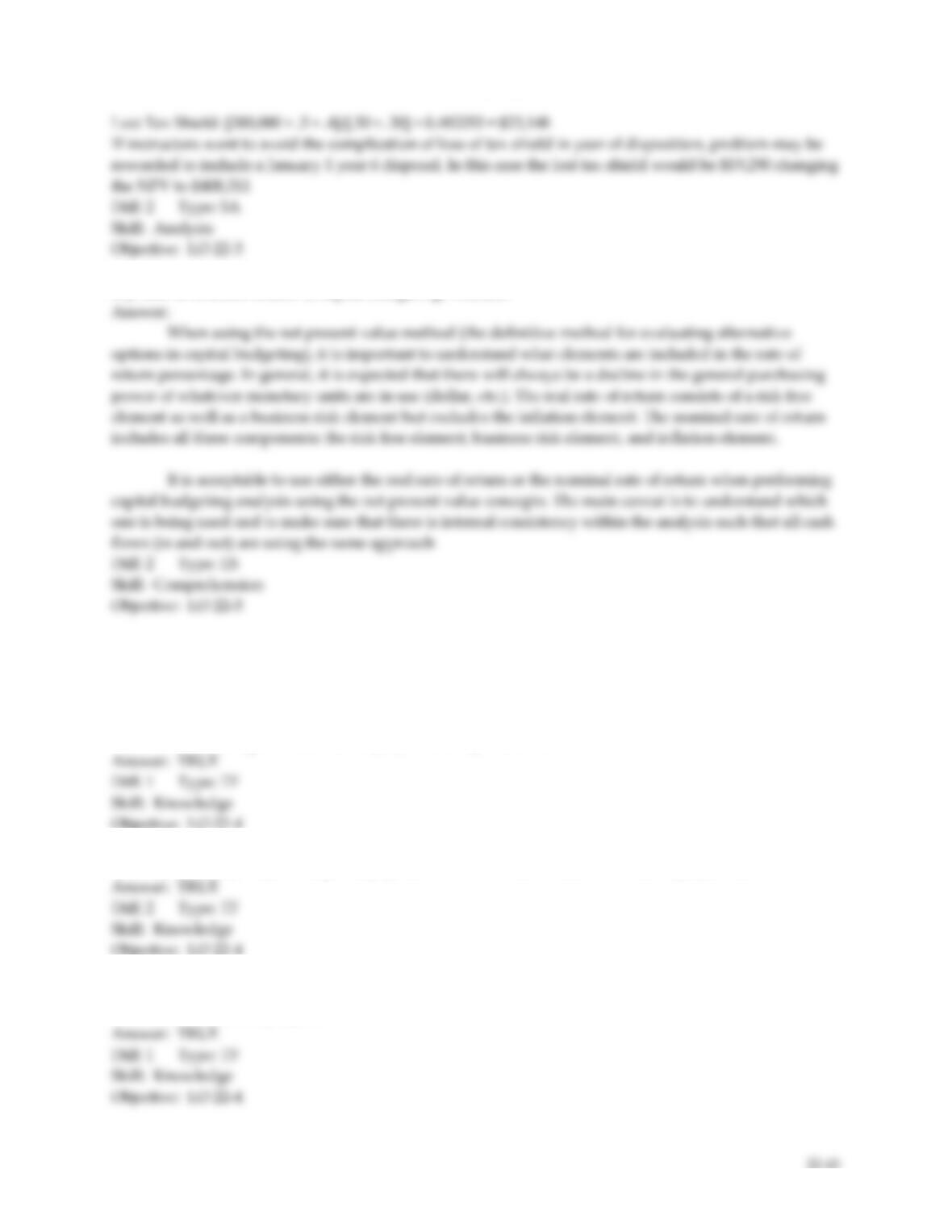
Should the new machine be purchased?
Cost Accounting: A Managerial Emphasis, 6e
Chapter 22 – Capital Budgeting: A Closer Look
Cost Accounting: A Managerial Emphasis, 6e
Chapter 22 – Capital Budgeting: A Closer Look
24) How is inflation related to capital budgeting? Discuss.
22.4 Analyze alternative approaches used to recognize the degree of risk in capital
budgeting projects.
1) The required rate of return is the rate of return that the firm forgoes by investing in a particular project
rather than investing in an alternative project of comparable risk.
2) Companies may vary the required payback in order to reflect different levels of project risk.
3) Some companies adjust the estimated future cash inflows for risks by reducing the estimated future
cash inflows of riskier projects.

Cost Accounting: A Managerial Emphasis, 6e
Chapter 22 – Capital Budgeting: A Closer Look
4) Adjusting the Required Rate of Return Approach involves examining the consequences of changing
key assumptions underlying a capital budgeting project.
5) Discounted cash flow analysis can be applied in a non-profit organization.
6) Sensitivity analysis can be used to assess how vulnerable a proposed capital project is to changes in its
estimates.
7) The certainty equivalent is calculate as the expected value based on the probability distribution of a
project’s cash flows.
8) The required rate of return is
A) the rate of return that the organization forgoes by investing in a particular project rather than in an
alternative project of comparable risk.
B) the rate of return required by shareholders.
C) the same as the internal rate of return.
D) a rate that is set by industry standards.
E) the rate the Canada Revenue Agency requires on overdue tax payments.

Cost Accounting: A Managerial Emphasis, 6e
Chapter 22 – Capital Budgeting: A Closer Look
9) The required rate of return is a critical variable in discounted cash flow analysis because it
A) measures the risk of the return.
B) sets the minimum which management will accept for a capital budgeting decision.
C) is the firm’s after-tax discount rate.
D) is the rate of return that the firm forgoes by investing in a particular project rather than investing in an
alternative project of comparable risk.
E) equals the accrual accounting rate of return, net of tax.
10) Which of the following methods is not used to adjust for risk in capital budgeting?
A) varying the payback period
B) adjusting the required rate of return
C) changing the method of depreciation to an accelerated method
D) estimating the probability distribution of future cash flows
E) adjusting the estimated future cash flows
11) Which of the following statements about non-profit organizations and capital budgeting is true?
A) Non-profit organizations discounted cash-flow analysis for short-term projects almost exclusively.
B) Only profit organizations must have required rates of return for capital budgeting decisions.
C) Because non-profit organizations are funded each year, they do not find capital budgeting to be
worthwhile on a cost-benefit basis.
D) Cost-benefit analysis is more important to non-profit organizations than capital budgeting analysis.
E) In the non-profit sector, there is a tendency to cut capital-budget projects first when there is a strong
push to balance a budget or cut a deficit.
12) Using the certainty equivalent approach means that
A) the expected cash flows are reduced for projects perceived to have higher risk.
B) the required rate of return is increased for projects perceived to have higher risk.
C) the expected cash flows are increased for projects perceived to have higher risk.
D) the expected cash flows are increased and the required rate of return is increased for projects
perceived to have higher risk.
E) the expected cash flows are reduced and the required rate of return is increased for projects perceived
to have higher risk.
Cost Accounting: A Managerial Emphasis, 6e
Chapter 22 – Capital Budgeting: A Closer Look
13) Discuss the ways a company can account for risk in its capital budgeting projects.
22.5 Explain the usefulness of excess present value index in capital budgeting and
explain why IRR and NPV may rank projects differently.
1) The excess present value index is the total present value of future net cash outflows of a project divided
by the total present value of cash inflows.
2) The NPV method always indicates the project or set of projects that maximizes the NPV of future cash
flows.
3) The excess present value index is also known as the profitability index.
4) The excess present value index is
A) the amount that present value exceeds future value in a decision model divided by the payback
period.
B) the total present value of future net cash inflows divided by the total present value of the initial
investment.
C) the total value of future cash flows divided by the number of years of the investment.
D) the investment divided by the payback period.
E) also called the certainty equivalent approach.
Cost Accounting: A Managerial Emphasis, 6e
Chapter 22 – Capital Budgeting: A Closer Look
5) For project Gemini of Space Company the net investment was be $400,000. The net present value of all
future net cash inflows was $800,000. The company’s tax rate is 40 percent. The profitability index was
A) 0.50
B) 0.83
C) 1.20
D) 2.00
E) 1.60
6) Which of the following statements is FALSE?
A) The net present value method always indicates the project that maximizes the net present value of
present and future cash flows.
B) The internal rate of return method can rank projects differently from the net present value method if
the alternative projects have uneven lives.
C) The profitability index is superior to the internal rate of return on small projects.
D) The internal rate of return assumes that the reinvestment rate is equal to the indicated rate of return.
E) The internal rate of return method can rank projects differently from the net present value method if
the alternative projects have unequal lives, or unequal investments.
7) For the capital budgeting decision regarding the acquisition of a new piece of equipment the following
is available: investment, $60,000; present value of net cash inflows, $40,000. What is the excess present
value index?
A) 0.00
B) 0.67
C) 1.50
D) 3.00
E) 1.00
Cost Accounting: A Managerial Emphasis, 6e
Chapter 22 – Capital Budgeting: A Closer Look
8) The profitability index
A) measures the profit per dollar invested.
B) is also called the excess present value index.
C) is useful in determining the risk adjusted rate of return.
D) is helpful when assessing projects with different risk.
E) measures the profit per dollar invested, and profitable projects are indicated by a profitability index of
greater than 100%.
9) The division manager of Bagley Company asked her assistant to gather information for a new
investment. She is impressed with all the information but is unsure about which investment to choose
because they are of such different sizes. Since the investments are mutually exclusive, she can choose only
one. As might be expected, she wants the one that will return the most for the money. The relevant
information for each project is as follows.
Project X Project Y
Net present value $218,000 $2,680,000
Internal rate of return 12 percent 14 percent
Estimated life 4 years 4 years
Investment $200,000 $2,500,000
Accounting rate of return 8 percent 8 percent
Payback period 3 years 3 years
Required:
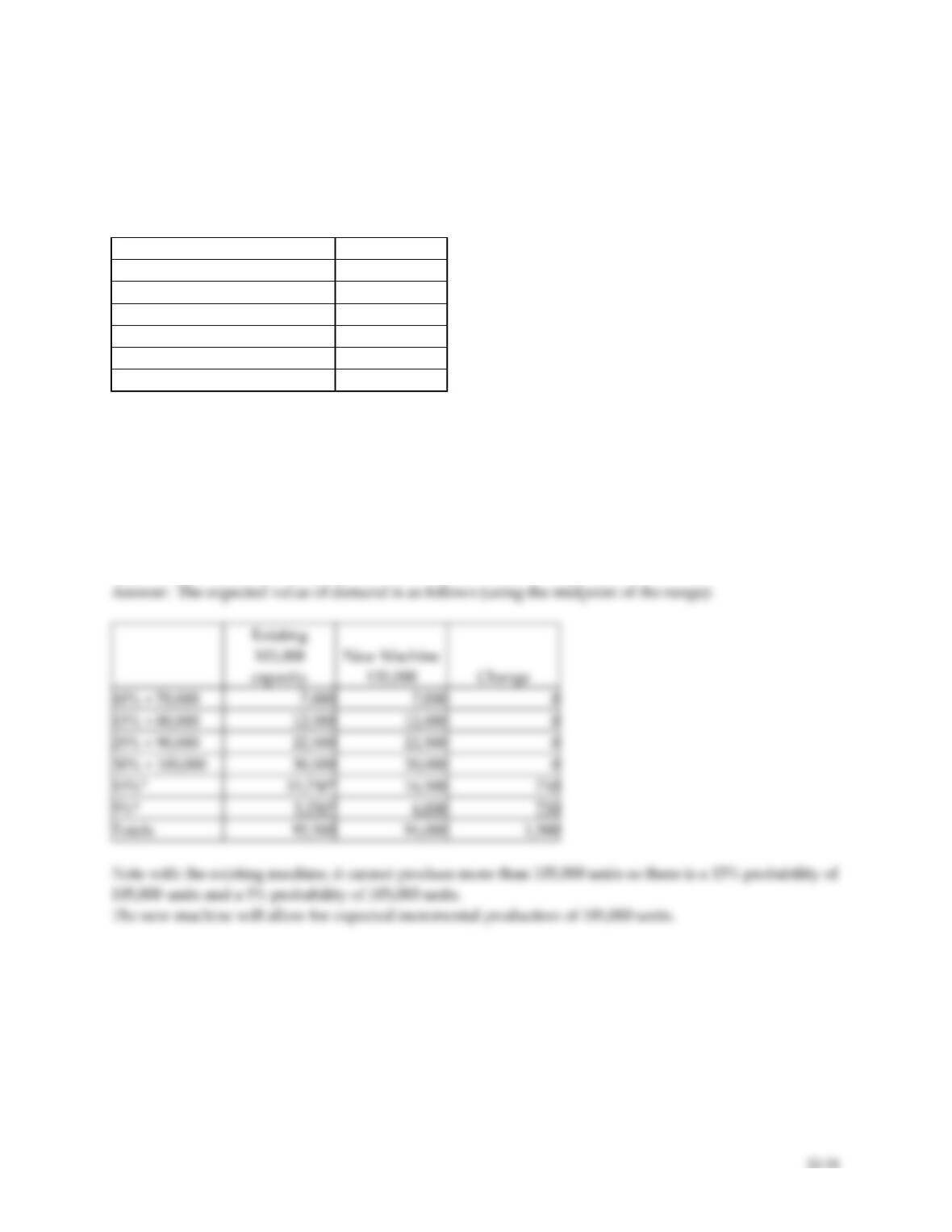
Someone told the manager the profitability index helped to solve decisions when the other factors were
confusing. What is the profitability index for each project?
10) Explain how the profitability index can be used to rank investments and how it might be used in
conjunction with NPV analysis.
Cost Accounting: A Managerial Emphasis, 6e
Chapter 22 – Capital Budgeting: A Closer Look
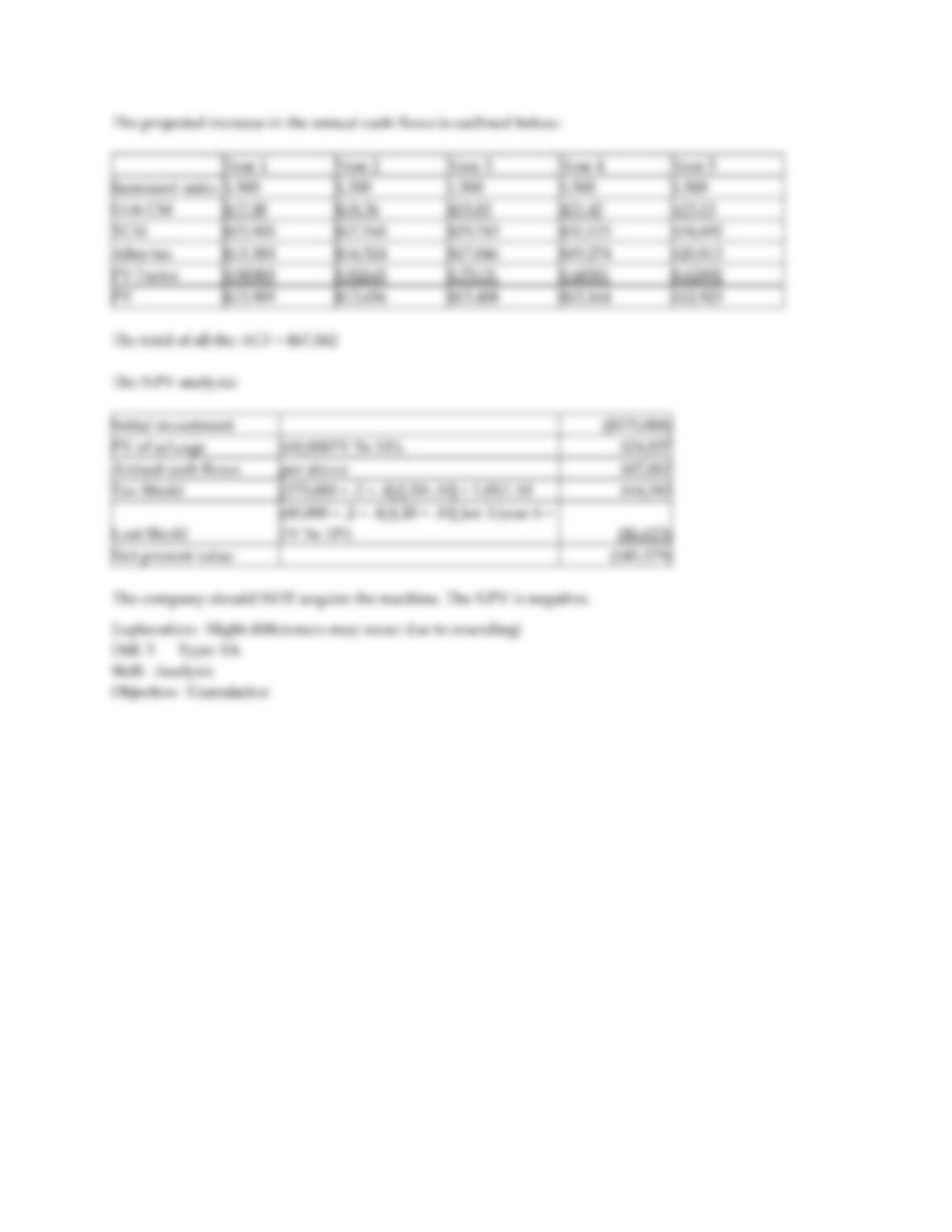
11) Broughton Ltd. manufactures and sells one product with a projected contribution margin of $17.00 for
year 1. The total budgeted fixed costs are $925,000. Selling prices and variable costs are projected to
increase by 8% per year, while fixed costs are forecast to grow at a rate of 5% per year. Existing
production capacity is 105,000 units.
The probability distribution on its forecasted demand is as follows:
Range
Probability
65,000 – 75,000 units
10%
75,000 – 85,000 units
15%
85,000- 95,000 units
25%
95,000- 105,000 units
30%
105,000 – 115,000 units
15%
115,000 – 125,000 units
5%
The company is considering purchasing a new machine which will increase its production capacity by
30,000 units. The machine costs $175,000 with a residual value of $40,000 after its useful life of 5 years.
The applicable Capital Cost Allowance rate is 20%. The company’s tax rate is 40% and it requires an after–
tax rate of return on capital of 10% (including provision for inflation).
Required:
Should Broughton purchase the new machine based on NPV analysis? Assume the machine will be sold
on January 1 of year 6 for tax purposes.
10% ∗ 70,000
15% ∗ 80,000
25% ∗ 90,000
30% ∗ 100,000
15%*
5%*
Totals
Cost Accounting: A Managerial Emphasis, 6e
Chapter 22 – Capital Budgeting: A Closer Look
22–52