
Elements of Ecology, 9e (Smith)
Chapter 22 Biogeochemical Cycles
22.1 Short Answer Questions
1) The two basic types of biogeochemical cycles are gaseous and ________.
2) Precipitation brings appreciable quantities of nutrients into ecosystems that are collectively
called ________.
3) Large quantities of nutrients are bound tightly in ________ structure; they are not readily
available until released by the activities of decomposers.
4) Some nutrients are ________ from the soil and carried out of ecosystems by underground
water flow to streams.
5) The element ________ is a basic constituent of all organic compounds and is involved in the
fixation of energy by photosynthesis.
6) The difference between the rate of carbon uptake in photosynthesis and the rate of carbon loss
due to autotrophic and heterotrophic respiration is the net ________ productivity.
7) The ability of the surface waters of the ocean to take up carbon dioxide is governed by the
reaction of carbon dioxide with the ________ ion to form bicarbonates.
8) Nitrogen is generally available to plants in only two forms: ammonium and ________.
9) Biological nitrogen fixation is accomplished by symbiotic ________ living in mutualistic
association with plants.
10) Nitrogen can be returned to the atmosphere when certain bacteria convert it from nitrate into
nitrogen gas, which is a process called ________.
11) Microbial decomposition of organic matter results in NH4+ production through a process
called ________.
12) ________ is the most common form of nitrogen exported from terrestrial ecosystems in
stream water.
13) Nearly all of the phosphorus in terrestrial ecosystems comes from the ________ of calcium
phosphate minerals.
14) In aquatic ecosystems, the phosphorous cycle moves through three states: particulate organic
phosphorous, dissolved organic phosphates, and ________ phosphates.
15) The major source of free oxygen that supports life on Earth is the ________.
16) The main reservoirs of oxygen are water and ________.
17) The branch of chemistry dealing with the quantitative relationships of elements in
combination is called ________.
22.2 Multiple-Choice Questions
1) In ecosystems, internal cycling is dominated by
A) global nutrient turnover.
B) wet and dry deposition.
C) decomposition and biological uptake.
D) photosynthesis and weathering.
2) In ________ biogeochemical cycles, the main reservoirs of nutrients are the atmosphere and
the oceans.
A) sedimentary
B) gaseous
C) aquatic
D) terrestrial
3) Which of the following cycles have particles deposit from the atmosphere in both a dryfall and
a wetfall?
A) nitrogen
B) oxygen
C) carbon dioxide
D) sulfur

4) Which of the following contains the most nutrients?
A) dryfall
B) wetfall in an open prairie
C) wetfall on a forest floor
D) wetfall in the ocean
5) Nutrients deposited on leaves as dust and materials leached from leaves through insect action
are most often transported to the forest floor by
A) animal activity.
B) throughfall.
C) wind action.
D) sap flow.
6) Fire results in the production of ash from vegetation and soil organic matter. This ash contains
nutrients that are most often
A) lost from ecosystems almost immediately following the fire.
B) devoid of elements required for plant growth.
C) unavailable for mineralization causing nutrient retention in the system.
D) available for plant uptake and vulnerable to loss if not taken up by recovering vegetation.
7) Which of the following represents a loss of nutrients from an aquatic ecosystem?
A) leaves falling into a stream
B) fish feeding on surface insects
C) tadpoles metamorphosing out of the water
D) shredding insects breaking down leaf litter
8) Biogeochemical cycles should be regarded
A) primarily within a terrestrial ecosystem.
B) primarily within an oceanic ecosystem.
C) primarily linking terrestrial and oceanic ecosystems.
D) with a global perspective.

9) Which of the two basic types of biogeochemical cycles is most likely to have global cycle
patterns?
A) atmospheric
B) aquatic
C) gaseous
D) sedimentary
10) Which of the following nutrients is most closely linked to the energy cycle in ecosystems?
A) carbon
B) nitrogen
C) lead
D) sulfur
11) The source of all carbon in living organisms is
A) simple sugars.
B) carbon dioxide from atmosphere and water.
C) carbon-fixing bacteria.
D) sedimentary rocks.
12) Carbon is released into the atmosphere as carbon dioxide through the process of
A) photosynthesis.
B) primary production.
C) respiration.
D) fixation.
13) A primary measure of productivity is linked to
A) carbon.
B) nitrogen.
C) oxygen.
D) water.
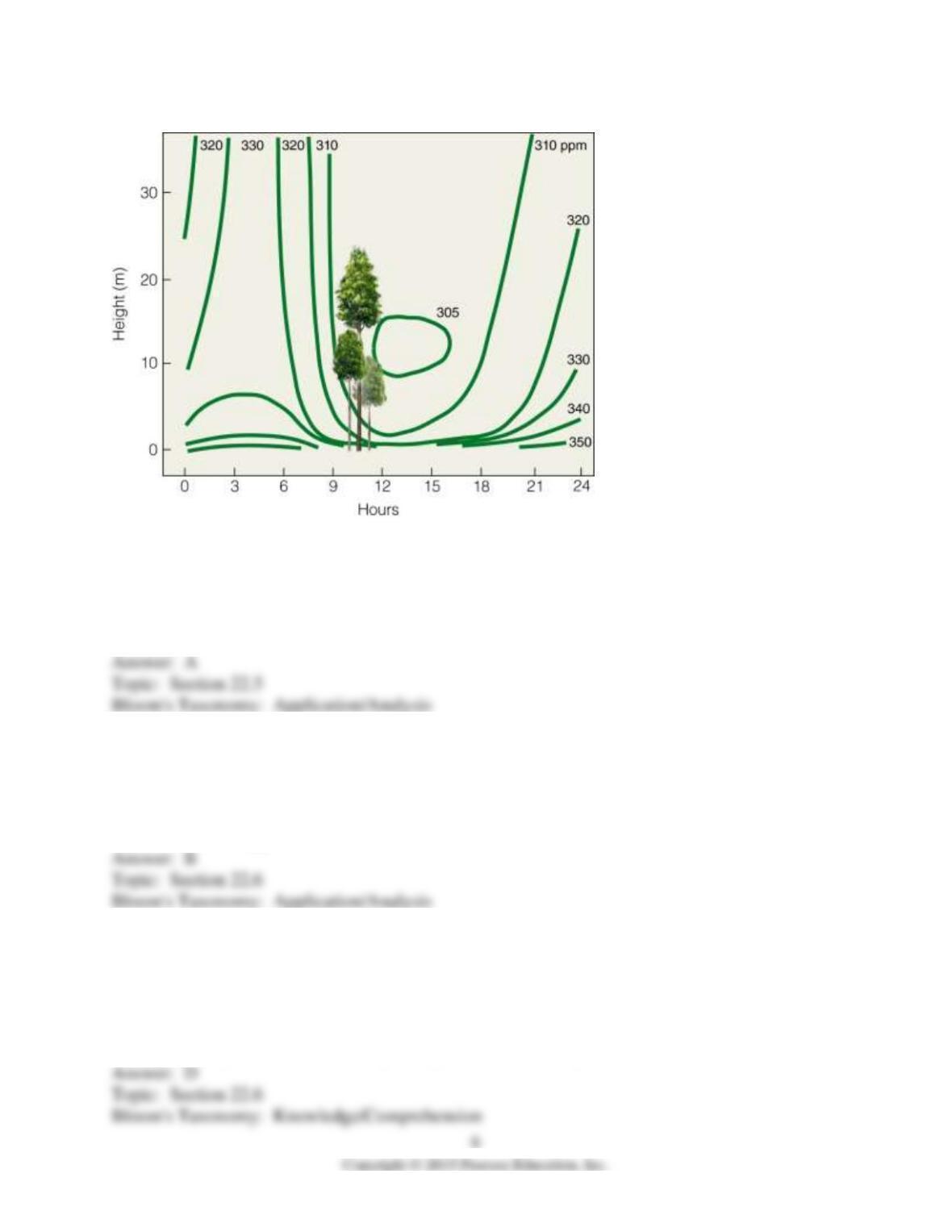
14)
According to the figure, when is atmospheric CO2 the highest?
A) at night
B) during the day
C) when trees are present
D) at high altitudes
15) Why are carbon dioxide fluctuations more pronounced in the Northern Hemisphere?
A) larger CO2 emissions
B) more terrestrial habitat
C) more humans
D) more solar energy absorbed
16) Carbon dioxide concentrations fluctuate in predictable seasonal patterns on the surface of the
planet largely as a result of
A) the influence of vegetation patterns in tropical systems.
B) weathering of rock surfaces following seasonal rain events.
C) vegetation growth and flux patterns in aquatic systems.
D) large-scale patterns of terrestrial plant uptake and dormancy.

17) The largest active carbon pool is
A) the atmosphere.
B) the oceans.
C) living organisms.
D) dead organisms.
18) Consider the following: on an annual basis, C exchange from photosynthesis is 120 Gt,
decomposition is 60 Gt, respiration is 60 Gt, ocean uptake of CO2 is 92 Gt of C, ocean release is
91 Gt of C, release of C to the atmosphere from anthropogenic sources (fossil fuel use and land
use change) is 6 Gt, and the atmosphere is increasing by 3.2 Gt of C. If terrestrial processes are
responsible for the remaining C for net balance of the C cycle, then which of the following is
likely?
A) The terrestrial surface is a net sink of 1.8 Gt of C.
B) The terrestrial surface is a net source of 1.8 Gt of C.
C) The terrestrial surface is a net sink of 2.8 Gt of C.
D) The terrestrial surface is a net source of 2.8 Gt of C.
19) Which region contains the largest amount of the global carbon pool?
A) fossil fuels
B) aboveground terrestrial systems
C) ocean
D) atmosphere
20) Which region contains the largest amount of the global nitrogen pool?
A) fossil fuels
B) aboveground terrestrial systems
C) ocean
D) atmosphere

21) Biological nitrogen fixation is accomplished by
A) protozoans.
B) bacteria.
C) fungi.
D) plants.
22) The waste product of microbial decomposition is converted to what in acidic soils?
A) NH4+
B) NH3
C) NO42-
D) NO3–
23) Plant roots compete with Nitrosomonas and Nitrobacter for ammonium in soil. When these
bacterial groups acquire the ammonium, they turn it into
A) N2 gas through nitrification.
B) N2 gas through denitrification.
C) NO3– through nitrification.
D) NO3– through denitrification.
24) Global estimates of denitrification in terrestrial ecosystems vary widely but are of the order
200 × 1012 g/yr, and more than half of that total occurs in wetland ecosystems. If restoration
results in an increase in wetland area by approximately 25 percent, it would be expected that
losses of nitrogen through denitrification would be closer to
A) 175 × 1012 g/yr.
B) 225 × 1012 g/yr.
C) 275 × 1012 g/yr.
D) 325 × 1012 g/yr.

25) Which of the following nutrients has a cycle that does not contain an appreciable
atmospheric phase?
A) carbon
B) nitrogen
C) phosphorus
D) sulfur
26) The major process regulating phosphorus availability for net primary production is the
internal cycling of phosphorus from
A) organic to inorganic forms.
B) inorganic to organic forms.
C) atmospheric fixation.
D) rock weathering.
27) Which region contains the largest amount of the global phosphorus pool?
A) fossil fuels
B) aboveground terrestrial systems
C) ocean
D) atmosphere
28) Which group is responsible for converting H2S into sulfates?
A) purple bacteria
B) cyanobacteria
C) soil fungi
D) plants
29) Hydrogen sulfide is transformed into sulfate or elemental sulfur by
A) protozoans.
B) bacteria.
C) fungi.
D) algae.

30) Which of the following represents the largest anthropogenic source of sulfur released to the
atmosphere?
A) fixation for agricultural fertilizer
B) burning of fossil fuels
C) trash-burning incinerators
D) biomass burning
31) What is the dominant sulfur gas emitted from freshwater wetlands?
A) dimethylsulfide
B) S2
C) SO4
D) H2S
32) Which of the following cycles is thought to be most under biological control?
A) oxygen
B) phosphorus
C) sulfur
D) lead
33) Which chemical is responsible for breaking down ozone in the atmosphere?
A) CO2
B) CH3
C) CFC
D) CO4
34) Which of the following elements is a limiting reagent in forming rubisco?
A) O
B) C
C) Ca
D) N
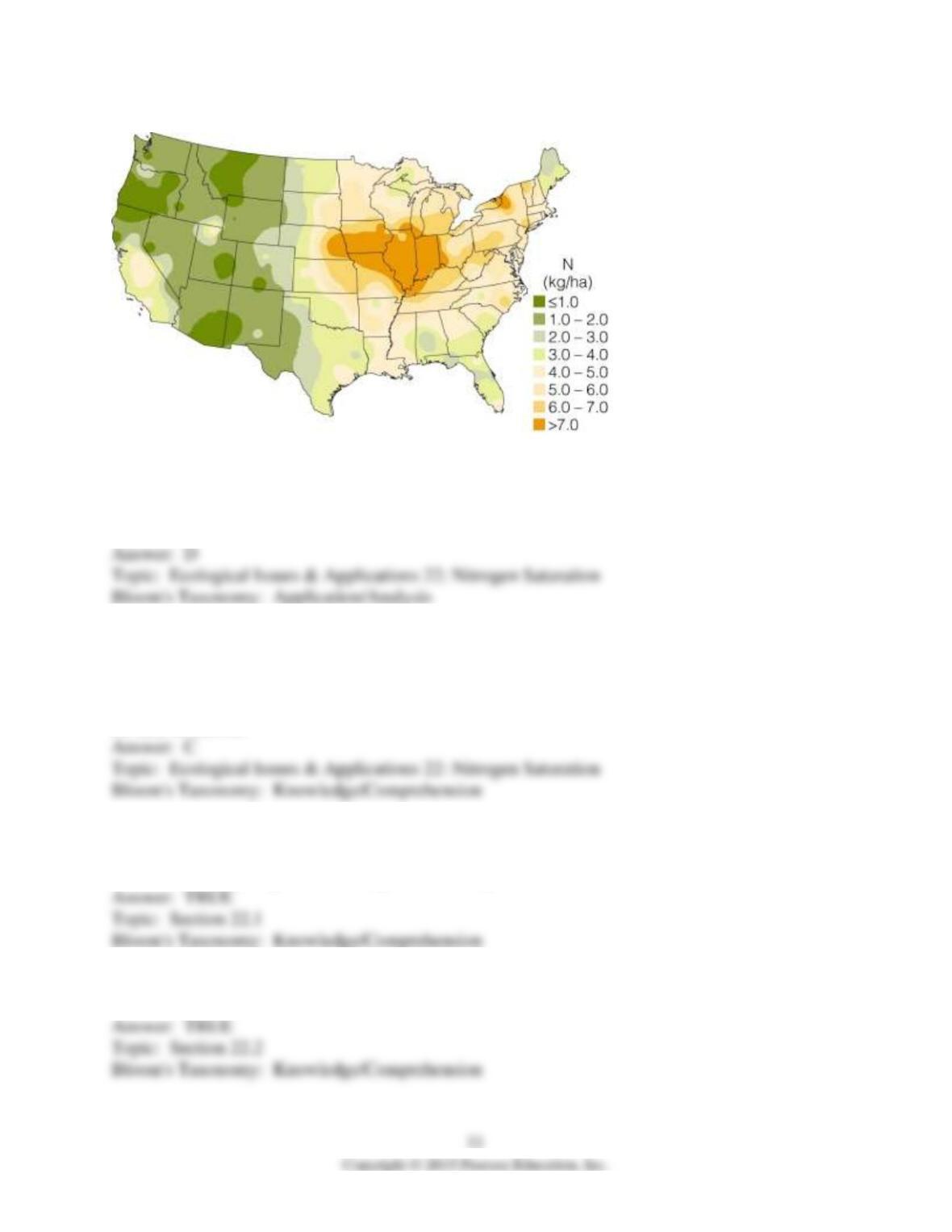
35)
Which area has the highest nitrogen deposition?
A) East Coast
B) West Coast
C) South
D) Midwest
36) A danger of nitrogen saturation is
A) increased productivity.
B) basic soils.
C) acidic soils.
D) lack of carbon.
22.3 True/False Questions
1) Without the cycling of water, biogeochemical cycles would cease.
2) Soil formation and soil characteristics have major influence on the processes of nutrient
retention and release.

3) Flowing-water aquatic systems (streams and rivers) contain high levels of organic matter so
are rarely dependent on inputs from terrestrial systems.
4) Precipitation can be a significant input of nutrients in ecosystems.
5) The biogeochemical cycles of one ecosystem are typically independent from those of other
ecosystems.
6) Carbon cycles more quickly through cold and dry ecosystems than it does through warm and
wet ecosystems.
7) Fossil fuels develop as a result of complete decomposition of organic matter in swamps and
marshes.
8) Atmospheric carbon dioxide concentrations in a forest are greater during the day than during
the night.
9) Seasonal fluctuations in atmospheric carbon dioxide concentrations are greater in the Northern
Hemisphere than in the Southern Hemisphere.
10) Most carbon is buried in sedimentary rocks.

11) There is more carbon per unit of soil in cold polar regions than in the warm tropics.
12) The nitrogen cycle is a series of chemical transformations, which makes it relatively
insensitive to environmental conditions such as temperature and moisture.
13) Lightning converts N2 to a nitrogen form that enters soil and can be readily assimilated by
plants.
14) The process of nitrification produces a form of nitrogen that is easily lost from soil through
leaching.
15) Humans have altered the nitrogen cycle by burning fossil fuels.
16) The phosphorus cycle is a sedimentary cycle with essentially no gaseous cycle.
17) The main reservoir of plant-available phosphorus is organic matter in the soil.
18) Phosphorus is typically in short supply in aquatic and terrestrial ecosystems.
19) The sulfur biogeochemical cycle is a sedimentary cycle with essentially no gaseous cycle.

20) One way that sulfur enters the atmosphere is through volcanic activity.
21) Atmospheric sulfur dioxide returns to Earth in rain as weak sulfuric acid.
22) Oceans represent the largest natural source of sulfur gases released to the atmosphere.
23) Oxygen is taken up by plants during photosynthesis.
24) Most aerobic autotrophs produce and consume oxygen in order to live.
25) Undecomposed organic matter in the form of fossil fuels and carbon in sedimentary rocks
represents a net positive flux of oxygen to the atmosphere.
26) Stratospheric ozone shields the planet from biologically harmful ultraviolet radiation.
27) Although nitrogen can act as a fertilizer initially, too much nitrogen added to a forest system
can cause forest decline.

28) In the later stages of nitrogen saturation, soils tend to become more acidic, which increases
the concentration of aluminum ions in the soil solution.
22.4 Essay Questions
1) Explain the difference between the two basic types of biogeochemical cycles, using specific
examples of each.
2) First describe three ways that nutrients can be lost from an ecosystem; then describe how
nutrients are replaced in those systems.
3) Describe how atmospheric carbon dioxide levels fluctuate daily, seasonally, and
geographically. Explain why such fluctuation occurs.
4) Describe a pathway of nitrogen from the atmosphere into the body tissue of an herbivore.
5) Describe how an atom of phosphorus might move from the crystal lattice of a mineral in a
rock through a plant and into the ocean.
6) List and describe three inputs of sulfur into the atmosphere. Be sure to describe the
mechanism by which sulfur is liberated to move into the atmosphere.
7) Bacteria are major players in biogeochemical cycles. Describe the way in which the
environment will determine the rate at which nutrients become available through impacts on
bacteria. Provide explicit examples for the N, P, and S cycles.
8) Describe how ozone is formed at different levels of the atmosphere and how biological
organisms are affected by ozone.