
13) Assume that you are not able to sell the plant, but you are able to shut down the plant at no
cost at any time. Draw a decision tree detailing this problem.
22.5 Applications to Multiple Projects
1) Which of the following statements is FALSE?
A) Traditionally, managers have used the equivalent annual benefit method to choose between
projects of different lives.
B) The equivalent annual benefit method ignores the value of any real options because it
assumes that the projects will always be replaced at their original terms.
C) If the future costs (or benefits) are certain with mutually exclusive projects, then we must use
a real options approach to determine the correct decision.
D) The equivalent annual benefit method accounts for the difference in project lengths by
calculating the constant payment over the life of the project that is equivalent to receiving the
NPV today and then selecting the project with the higher equivalent annual benefit.

2) The constant annuity payment over the life of a project that is equivalent to receiving the NPV
today is the:
A) annualized annuity.
B) independent annual benefit.
C) equivalent annual profitability.
D) equivalent annual benefit.
3) Assume the NPV of a project is $1.5 million. The project is expected to last five years. What
is the equivalent annual benefit if the discount rate is 8%?
A) $375,685
B) $300,000
C) $347,856
D) $324,000
4) Rylan Inc is considering a project that has an initial cost of $2 million. It is expected to
generate cash flows for the firm of $500,000 per year for 6 years. Assuming a discount rate of
7%, what is the equivalent annual benefit?
A) $75,148
B) $80,408
C) $85,889
D) $91,901
5) When the value of one project depends on the outcome of one or more other projects, this is
known as:
A) mutually independent investments.
B) equivalent annual investments.
C) staged dependent investments.
D) mutually dependent investments.

6) Mutually dependent investments occur when:
A) the value of one project depends upon the outcome of one or other projects.
B) the value of one project is independent of any other projects.
C) a firm depends on another firm to provide materials for a project.
D) consumers and producers depend on each other’s investments.
Use the table for the question(s) below.
Consider the following mutually exclusive projects:
Project
Year 0
C/F
Year 1
C/F
Year 2
C/F
Year 3
C/F
Year 4
C/F
Year 5
C/F
Year 6
C/F
Year 7
C/F
Discount
Rate
A
-79
20
25
30
35
40
N/A
N/A
15%
B
-80
25
25
25
25
25
25
25
15%
7) The NPV of project A is closest to:
A) $21.70
B) $24.00
C) $18.10
D) $16.90

8) The NPV of project B is closest to:
A) $18.10
B) $21.70
C) $24.00
D) $16.90
9) The equivalent annual benefit of project A is closest to:
A) $21.70
B) $5.05
C) $24.00
D) $3.40
10) The equivalent annual benefit of project B is closest to:
A) $5.05
B) $5.75
C) 3.45
D) $3.40

11) Using the equivalent annual benefit method, which project would you select and why?
22.6 Rules of Thumb
Use the following information to answer the question(s) below.
Rearden Metal can invest in a risk-free technology that requires an up-front investment of $1
million. Rearden’s managers are hesitant to invest because of uncertainty over future interest
rates. Suppose that all interest rates will be either 8% or 4% in one year and remain there forever.
The risk-neutral probability that interest rates will drop to 4% is 40%. The one-year risk-free
interest rate is 5% and today’s rate on a risk-free perpetual bond is 6%. The rate on an equivalent
perpetual bond that is repayable at any time (the callable annuity rate) is 7.65%.
1) Assuming that this project will provide Rearden with perpetual annual cash flows of $55,000,
the NPV of investing in the project today is closest to:
A) -281,000
B) -150,000
C) -83,000
D) +83,000
E) +281,000
2) Assuming that this project will provide Rearden with perpetual annual cash flows of $55,000,
the NPV of investing in the project next year is closest to:
A) -281,000
B) -83,000
C) +46,000
D) +83,000
E) +143,000

3) Assuming that this project will provide Rearden with perpetual annual cash flows of $55,000,
the NPV of investing in the project today using the hurdle rate is closest to:
A) -281,000
B) -150,000
C) -83,000
D) +83,000
E) +281,000
4) Assuming that this project will provide Rearden with perpetual annual cash flows of $45,000,
Rearden should:
A) invest today since the NPV is positive.
B) invest today since the NPV is negative.
C) invest today since the NPV using the hurdle rate is negative.
D) delay investing since the NPV using the hurdle rate is negative.
E) delay investing since the NPV using the hurdle rate is positive.
5) Assuming that this project will provide Rearden with perpetual annual cash flows of $65,000,
the NPV of investing in the project today is closest to:
A) -281,000
B) -83,000
C) +46,000
D) +83,000
E) +143,000
6) Assuming that this project will provide Rearden with perpetual annual cash flows of $65,000,
the NPV of investing in the project next year is closest to:
A) -281,000
B) +46,000
C) +83,000
D) +143,000
E) +238,000
7) Assuming that this project will provide Rearden with perpetual annual cash flows of $65,000,
the NPV of investing in the project today using the hurdle rate is closest to:
A) -281,000
B) -150,000
C) -83,000
D) +83,000
E) +281,000
8) Assuming that this project will provide Rearden with perpetual annual cash flows of $65,000,
Rearden should:
A) invest today since the NPV is positive.
B) invest today since the NPV is negative.
C) invest today since the NPV using the hurdle rate is positive.
D) delay investing since the NPV using the hurdle rate is negative.
E) delay investing since the NPV using the hurdle rate is positive.

9) Assuming that this project will provide Rearden with perpetual annual cash flows of $80,000,
the NPV of investing in the project today using the hurdle rate is closest to:
A) -281,000
B) +46,000
C) +83,000
D) +143,000
E) +238,000
10) Assuming that this project will provide Rearden with perpetual annual cash flows of
$80,000, Rearden should:
A) invest today since the NPV is positive.
B) invest today since the NPV is negative.
C) invest today since the NPV using the hurdle rate is positive.
D) delay investing since the NPV using the hurdle rate is negative.
E) delay investing since the NPV using the hurdle rate is positive.
11) Which of the following statements is FALSE?
A) The profitability index rule of thumb raises the bar on the NPV to take into account the option
to wait.
B) In practice, correctly modeling the sources of uncertainty and the appropriate dynamic
decisions usually requires an extensive amount of time and financial expertise.
C) Some firms use the following rule of thumb: Invest whenever the profitability index is below
a specified level.
D) Instead of raising the bar on the NPV, the hurdle rate rule raises the discount rate.

12) Which of the following statements is FALSE?
A) When the investment cannot be delayed, the optimal rule is to invest whenever the
profitability index is greater than zero.
B) It is often better to wait too long (use a profitability index criterion that is too high) than to
invest too soon (use a profitability index criterion that is too low).
C) When the source of uncertainty that creates a motive to wait is interest rate uncertainty, the
hurdle rate is relatively easy to calculate.
D) When there is an option to delay, a good rule of thumb is to invest only when the profitability
index is at least 1.
13) Which of the following statements is FALSE?
A) The hurdle rate rule for projects with the option to delay uses a lower discount rate than the
cost of capital to compute the NPV, but then applies the regular NPV rule: Invest whenever the
NPV calculated using this lower discount rate is positive.
B) While using a hurdle rate rule for deciding when to invest might be a cost-effective way to
make investment decisions, it is important to remember that this rule does not provide an
accurate measure of value.
C) When the cash flows are constant and perpetual, and the reason to wait derives solely from
interest rate uncertainty, the hurdle rate rule of thumb is always exact. However, when these
conditions are not satisfied, the rule of thumb merely approximates the correct decision.
D) When a firm faces the same uncertainty for most of its investment decisions, using a single
profitability index criterion for all projects can provide a useful rule of thumb to account for cash
flow uncertainty.
14) The rate on a risk-free annuity that can be called at any time is known as the:
A) callable annuity rate.
B) callable auction rate.
C) callable hurdle rate.
D) risk-free rate.
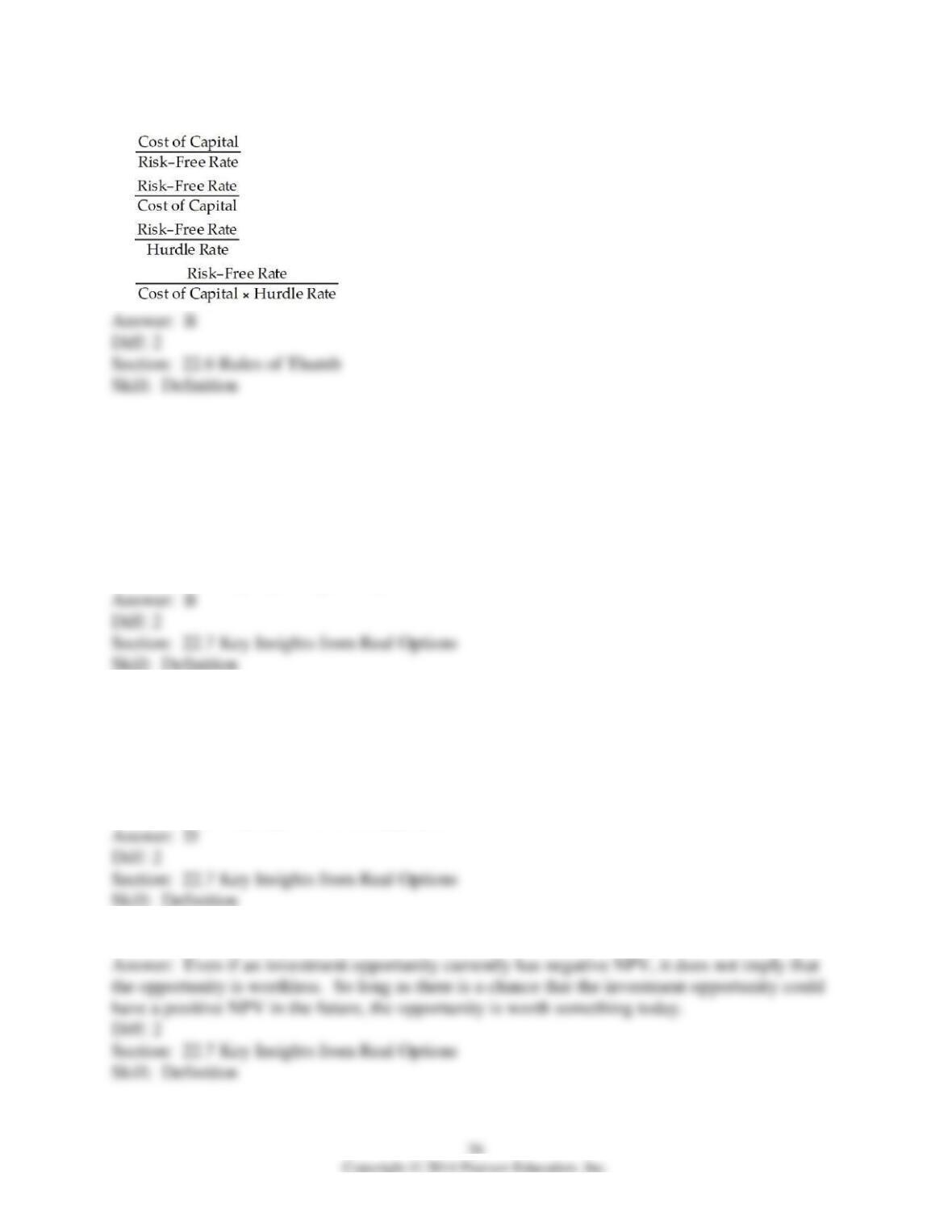
15) The callable annuity rate can be calculated as:
A) × Hurdle Rate
B) × Hurdle Rate
C) × Cost of Capital
D)
22.7 Key Insights from Real Options
1) The major principles to remember when considering real options include all of the following
EXCEPT:
A) out-of-the-money real options have value.
B) in-the-money real options need to be exercised immediately.
C) waiting is valuable.
D) create value by exploiting real options.
2) Which of the following is an example of a way in which companies can create value by
exploiting real options?
A) Abandoning good projects in favor of newer projects
B) Acting quickly to take on new projects, even if there is no cost to waiting
C) Exercising in-the-money real options immediately
D) Optimally delaying or abandoning projects
3) Do out-of-the-money real options have value?

4) Can value be created by waiting for uncertainty to resolve?