280)
Which of the following would be a fixed input to an automobile firm?
280)
A)
engineers
B)
a factory in Detroit
C)
car batteries
D)
steel
281)
Which of the following would NOT be considered a fixed cost of production?
281)
A)
the opportunity cost of capital
B)
insurance payments on plant and equipment
C)
interest payments on a loan
D)
wages paid to labor
282)
If, in the short run, the level of output is zero, which of the following statement is TRUE?
282)
A)
Total fixed cost will also be zero at first but will rise once output rises.
B)
Total variable cost is zero but total cost equals total fixed cost, and both of the latter exceed
zero.
C)
Total cost and total fixed cost graphs will begin at the origin.
D)
none of the above
283)
Which of the following is TRUE for a firm in the long run?
283)
A)
The law of diminishing marginal product holds.
B)
Variable costs will equal marginal cost at all output levels.
C)
Variable costs will initially increase and then decrease.
D)
All costs are variable costs.
284)
Which of the following would be an example of a fixed cost?
284)
A)
the electric and gas bills
B)
expenditures on imported raw materials
C)
wages paid to temporary workers
D)
property insurance premiums
285)
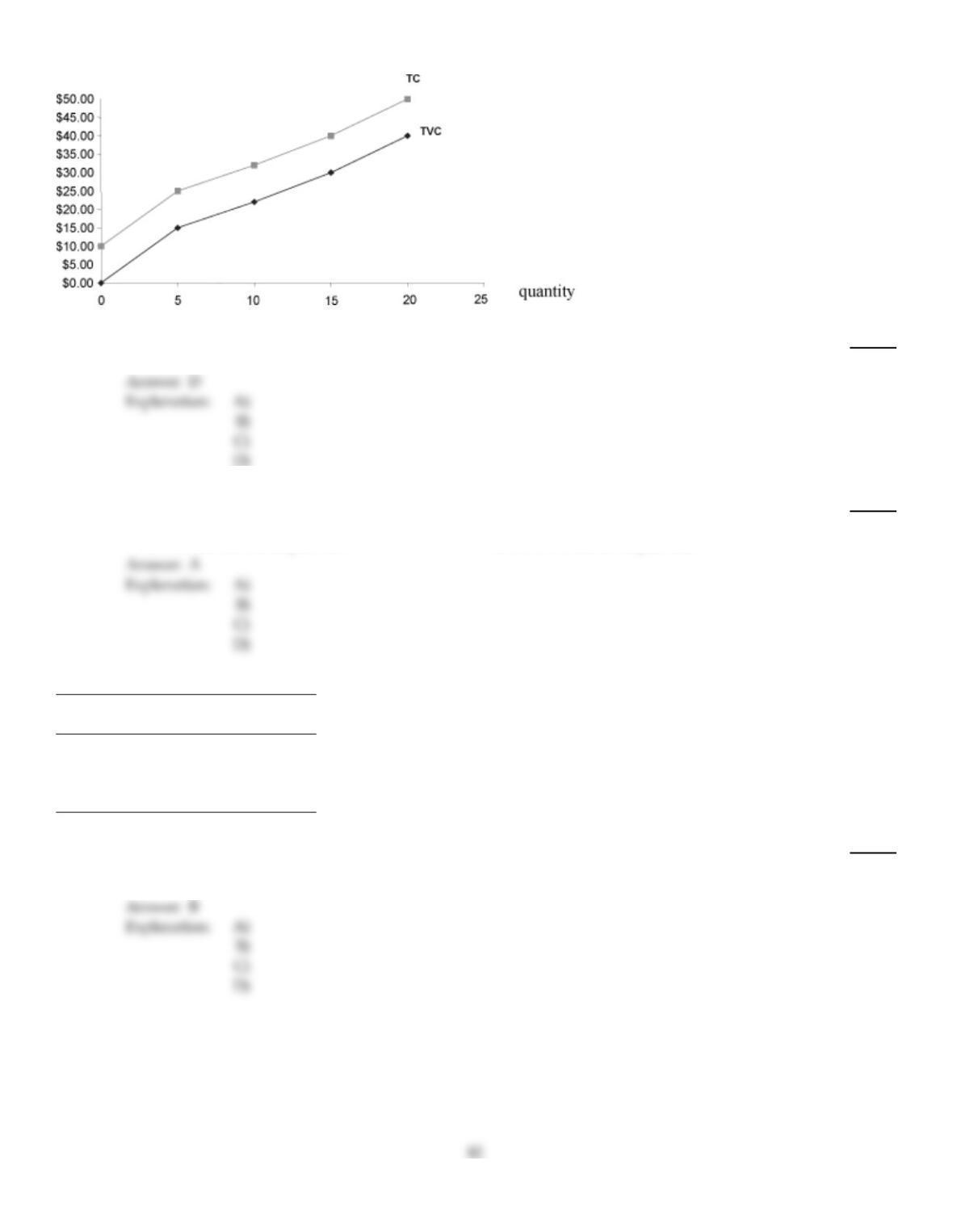
Use the above figure. The ATC at output 5 is
285)
A)
$2.00.
B)
$25.00.
C)
$3.00.
D)
$5.00.
286)
Average fixed costs will
286)
A)
fall as output rises.
B)
rise as output rises.
C)
rise then fall as output rises.
D)
fall then rise as output rises.
Quantity of Total
Labor Product
120
246
363
472
287)
Refer to the above table. When the quantity of labor equals 4, what does the average product equal?
287)
A)
9
B)
18
C)
216
D)
72
288)
MC = AVC and MC = ATC at points at which
288)
A)
the AVC and ATC curves are at their respective maximums.
B)
the distance between the ATC and AVC curves is at its maximum.
C)
the distance between the ATC and AVC curves is at its minimum.
D)
the AVC and ATC curves are at their respective minimums.
289)
The locus of points representing the minimum unit cost of producing any given rate of output is the
289)
A)
short–run average total cost curve.
B)
long–run average cost curve.
C)
long–run marginal cost curve.
D)
short–run total cost curve.
Explanation:
290)
A decrease in long–run average costs resulting from increases in output is
290)
A)
attributed to the law of diminishing marginal product.
B)
attributed to diseconomies to scale.
C)
attributed to economies of scale.
D)
attributed to constant returns to scale.
Explanation:
QTFC TVC TC
0$90 $ 0 $ 90
190 25 115
290 32 122
390 42 132
490 64 154
590 95 185
291)
Refer to the above table. At an output of 2 units, average total costs are
291)
A)
$61.
B)
$45.
C)
$122.
D)
$16.
Explanation:
Explanation:
292)
Refer to the above table. When output rises from 2 units to 3 units, marginal costs are
292)
A)
$7.
B)
$41.
C)
$10.
D)
$22.
293)
When total product is rising
293)
A)
marginal product must be negative.
B)
marginal product must be positive.
C)
variable cost must be declining.
D)
fixed cost must be rising.
B
294)
For a hotdog vendor, the hotdog stand represents his
294)
A)
fixed input.
B)
diseconomies of scale.
C)
variable input.
D)
none of the above.
A
295)
Assume that in the short run a firm is producing 100 units of output, has average total costs of $100,
and average variable costs of $50. The firm’s total fixed costs are
295)
A)
$150.
B)
$5,000.
C)
$50.
D)
$15,000.
B
C
Quantity of Total Average Marginal
Workers Product Product Product
0 0
1 3
2 7
312
416
518
618
296)
In the above table, the law of diminishing marginal product sets in after the ________ worker.
296)
A)
sixth
B)
third
C)
fourth
D)
first
297)
For an economist, the short run means a time period
297)
A)
during which new firms are prohibited from entering the industry.
B)
that is between one and five years.
C)
during which the firm is unable to change its plant size.
D)
during which firms are not allowed to change the amount of imported resources they use.
Quantity of Total Average Marginal
Labor Product Product Product
122 22 22
2 52 26 30
3 81 27 29
4100 25 19
5115 23 15
6126 21 11
298)
Refer to the above table. At what quantity of labor does the average variable cost curve start to
increase?
298)
A)
after 6 units
B)
after 2 units
C)
after 1 unit
D)
after 3 units
299)
The ratio of total costs to the quantity produced is referred to as
299)
A)
average variable costs.
B)
average total costs.
C)
average fixed costs.
D)
marginal costs.
300)
Suppose that one worker can produce 15 cookies, two workers can produce 35 cookies together,
and three workers can produce 60 cookies together. What is the marginal product of the 2nd
worker?
300)
A)
15 cookies
B)
35 cookies
C)
25 cookies
D)
20 cookies
301)
If a firm can vary all of its factors of production, it is operating in
301)
A)
the immediate run.
B)
the long run.
C)
equilibrium.
D)
the short run.
302)
When long–run average costs decline as output increases, the firm is experiencing
302)
A)
economies of scale.
B)
diseconomies of scale.
C)
negative returns to scale.
D)
constant returns to scale.
303)
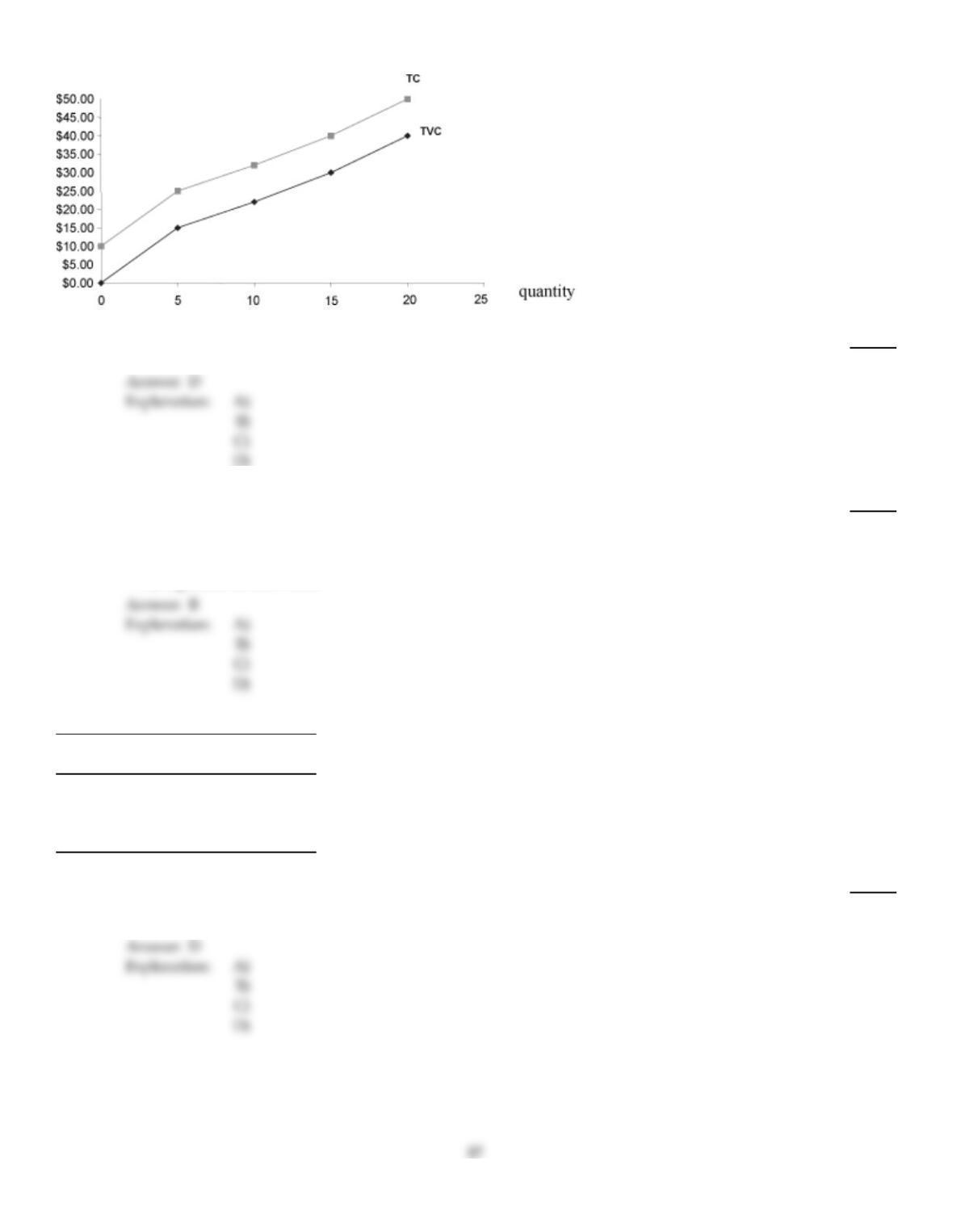
Use the above figure. The AVC at output 10 is
303)
A)
$20.00.
B)
$3.00.
C)
$1.00.
D)
$2.00.
304)
The average fixed cost curve
304)
A)
is the distance between the TC and TVC curves.
B)
slopes downward as output increases.
C)
increases as the cost of inputs rise.
D)
is parallel to the x–axis.
Quantity of Total
Labor Product
120
246
363
472
305)
Refer to the above table. What does the marginal product equal when the quantity of labor goes
from 2 to 3?
305)
A)
189
B)
21
C)
63
D)
17
Quantity of Total Average Marginal
Workers Product Product Product
0 0
1 3
2 7
312
416
518
618
306)
In the above table, the average product for 5 workers and the marginal product of the 5th worker is
306)
A)
2; 0.6.
B)
16; 2.
C)
0.72; 1.
D)
3.6; 2.
307)
Which of the following statements is NOT true about the production function?
307)
A)
A new production function does not have to be developed when there is technical progress
since technology is included in the function.
B)
The production function depends upon the level of technology available to the firm.
C)
It specifies the cost of inputs necessary to produce a certain level of outputs.
D)
It gives the maximum output that can be obtained for a given level of inputs.
Fixed Variable Total Average Average Marginal
Output Costs Costs Costs Total Costs Variable Costs Costs
0$0 $100
130
250
3 60
4 120
5200
308)
In the above table, what is the average total cost to produce 3 units of output?
308)
A)
$55
B)
$53.33
C)
$20
D)
$33.33
309)
Summing all of the costs that do not change as output varies yields
309)
A)
fixed costs.
B)
implicit costs.
C)
explicit costs.
D)
variable costs.
310)
Which of the following is a long–run adjustment?
310)
A)
A company builds a new manufacturing plant.
B)
A bank hires a new CEO.
C)
A company hires ten new management trainees.
D)
A restaurant hires a new chef.
Explanation:
311)
The time period during at least one input cannot be changed is the
311)
A)
production time.
B)
long run.
C)
calendar year.
D)
short run.
Explanation:
QTFC TVC TC
0$90 $ 0 $ 90
190 25 115
290 32 122
390 42 132
490 64 154
590 95 185
312)
Refer to the above table. When output rises from 3 units to 4 units, marginal costs are
312)
A)
$22.
B)
$10.
C)
$16.
D)
$31.
Explanation:
Explanation:
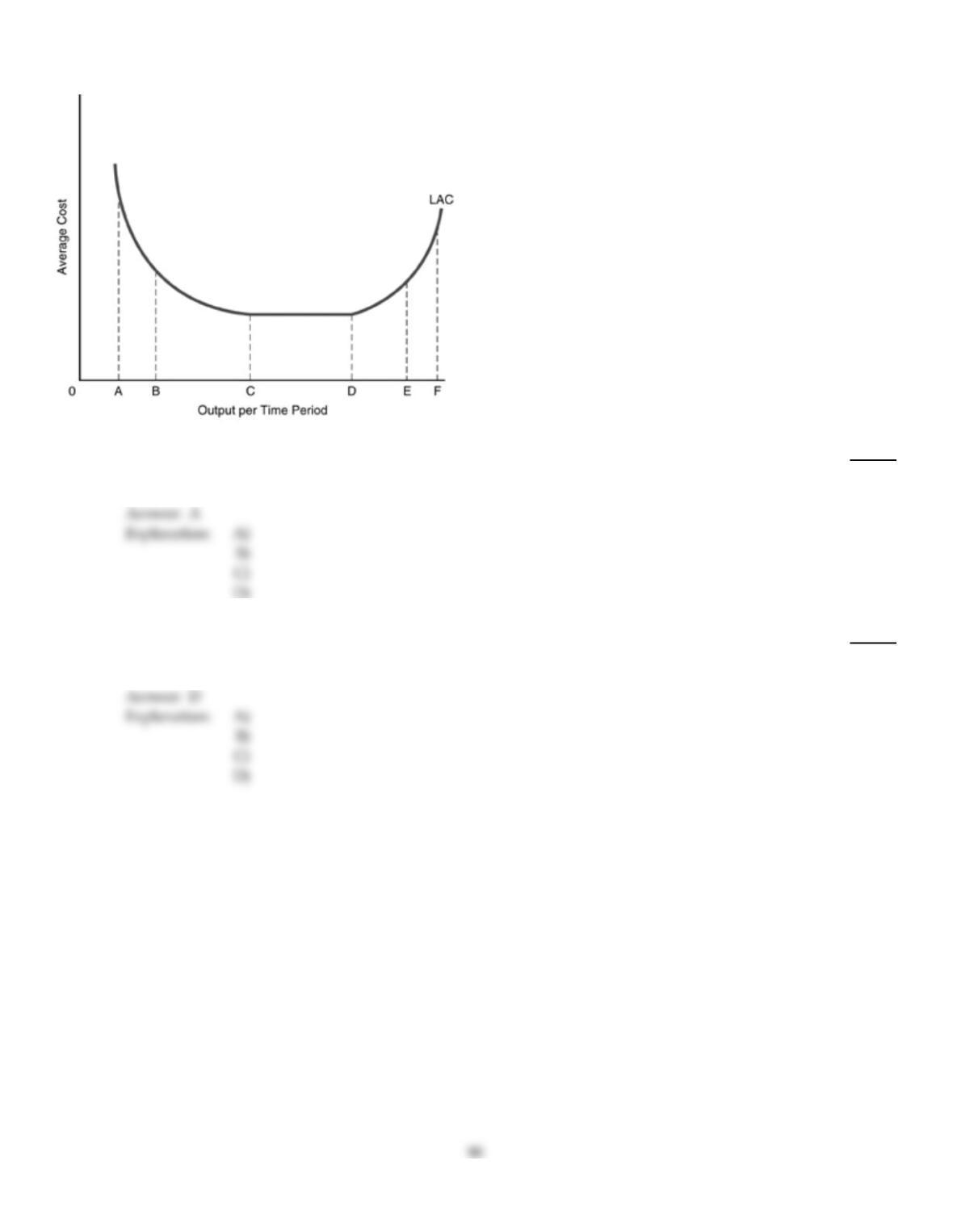
313)
In the above figure, the long–run cost curve between points E and F illustrates
313)
A)
diseconomies of scale.
B)
diminishing marginal product.
C)
constant returns to scale.
D)
economies of scale.
314)
If the firm can vary all factors of production, it is operating
314)
A)
at a zero economic profit.
B)
in the short run.
C)
at a profit.
D)
in the long run.
Explanation:
Explanation:
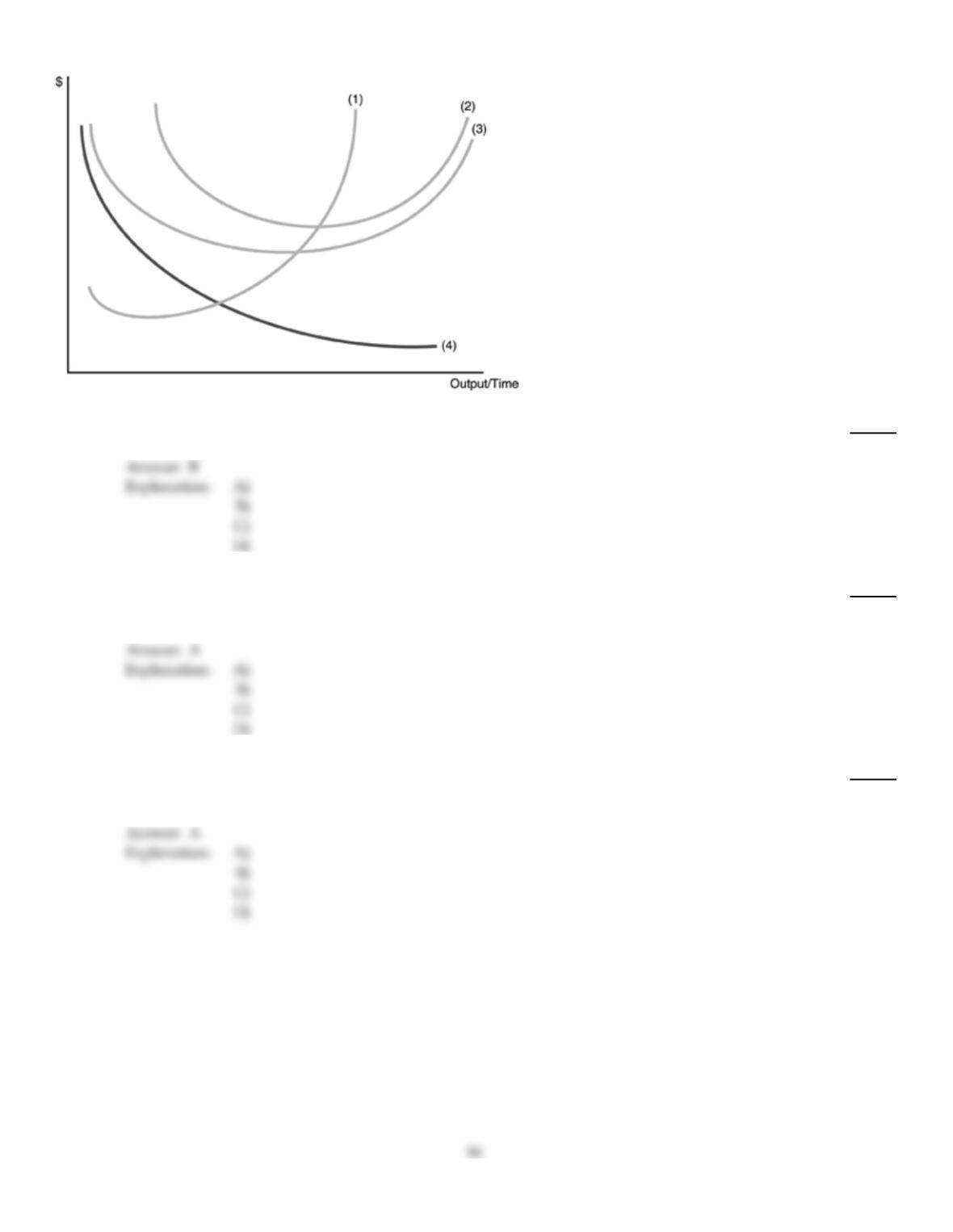
315)
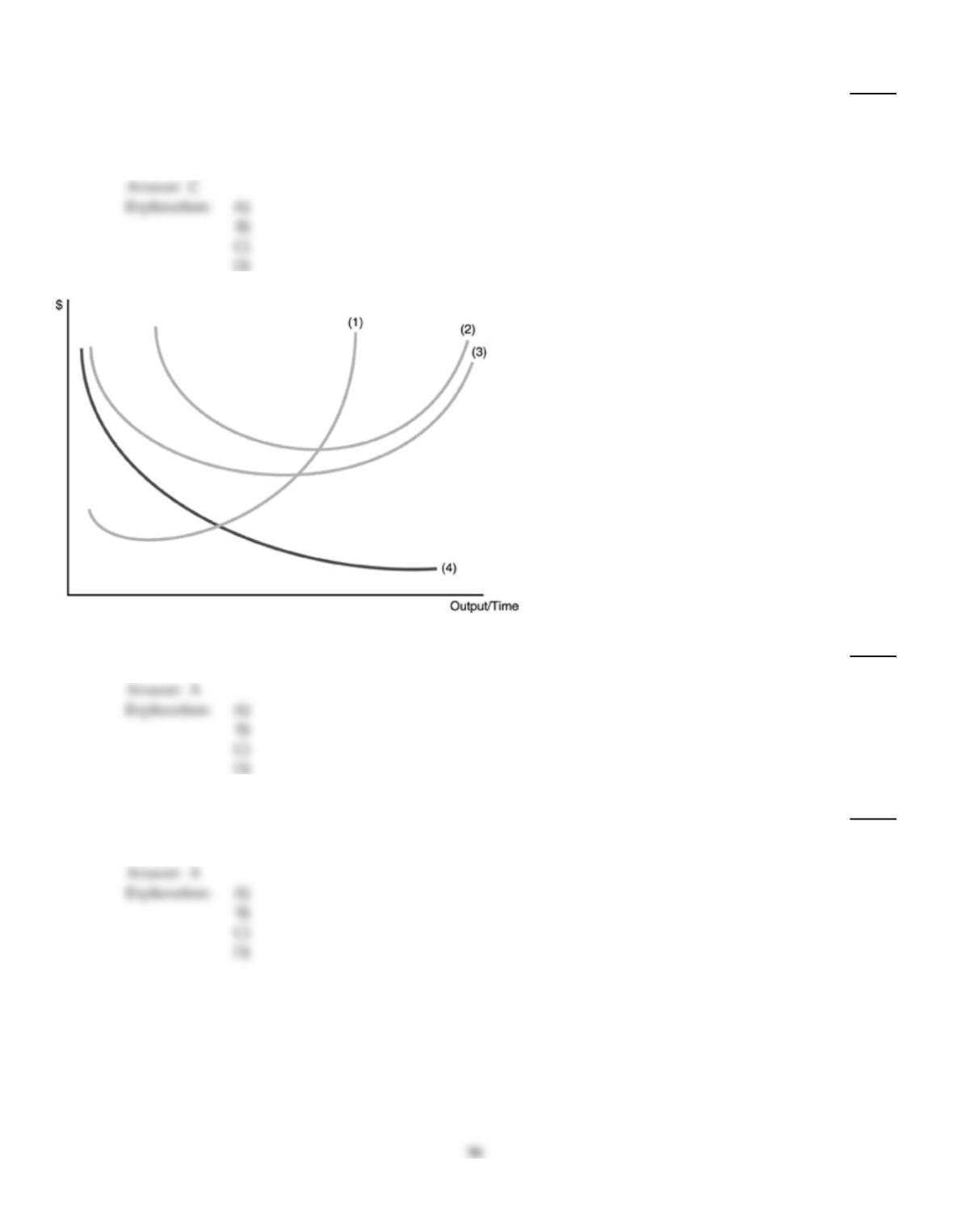
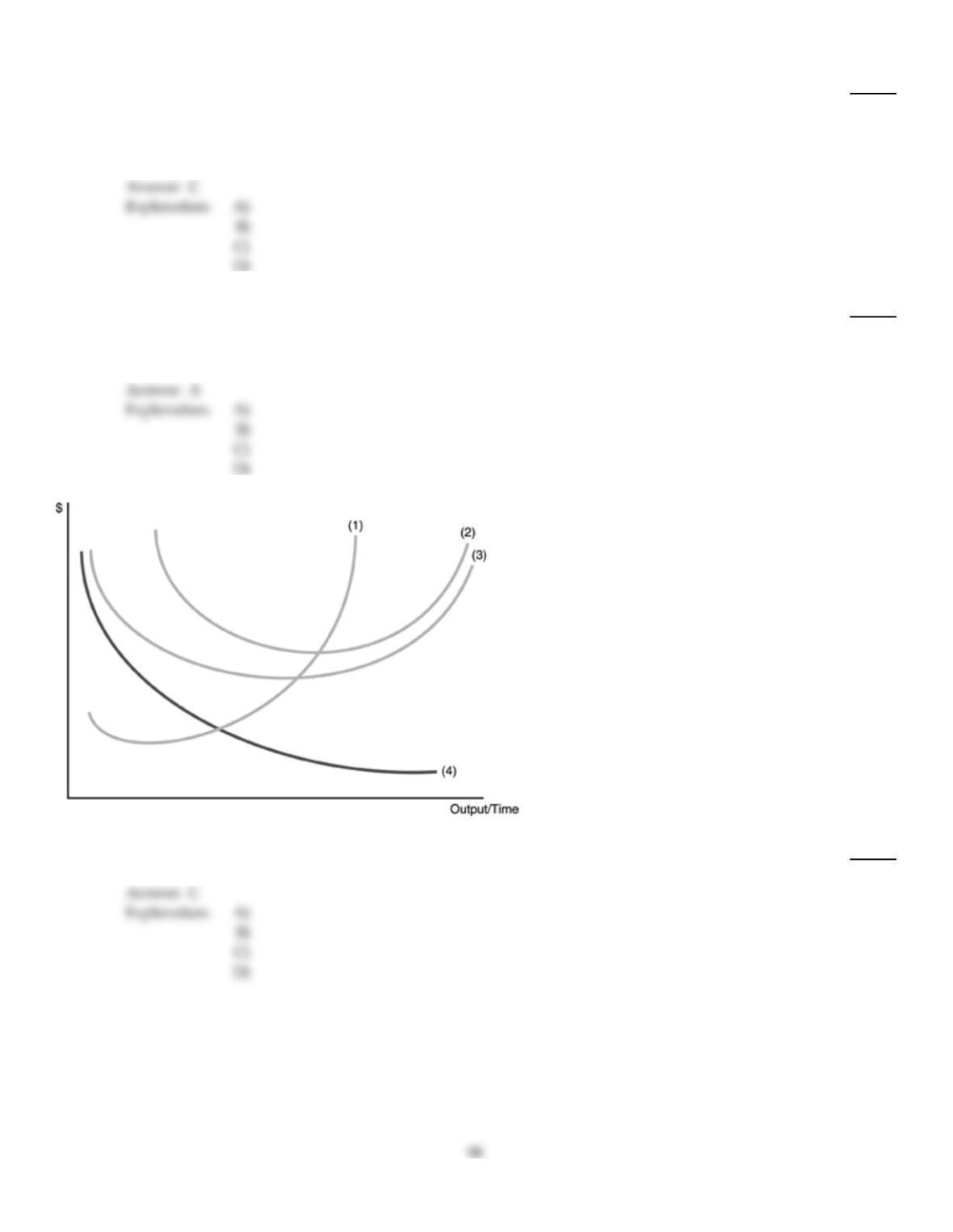
Refer to the above figure. Average total costs are represented by curve
315)
A)
1.
B)
2.
C)
3.
D)
4.
316)
The focus of firm decisions in the short run is primarily on
316)
A)
variable inputs.
B)
capital investment.
C)
economies of scale.
D)
plant size.
317)
When total product is increasing at an increasing rate, marginal product is
317)
A)
positive and increasing.
B)
constant.
C)
positive and decreasing.
D)
negative.
318)
A single–plant firm trying to select the rate of output consistent with an overall plant size that
yields the minimum efficient scale will choose a rate of output for which
318)
A)
long–run average total cost is lowest at that rate of output.
B)
the long–run marginal cost curve crosses the long–run average fixed cost curve at that rate of
output.
C)
the short–run marginal cost curve crosses the short–run average total cost curve at that rate of
output.
D)
total fixed cots are minimized at that rate of output.
319)
Which of the following would NOT be a short–run decision for the firm?
319)
A)
Place an order with a supplier for additional raw materials.
B)
Have labor work two hours overtime each day in order to expand output
C)
Recall workers who were previously laid–off.
D)
Build another wing on the plant in order to add a new assembly line.
Explanation:
320)
Marginal product is
320)
A)
the change in total output from using an additional unit of all variable inputs.
B)
the total output divided by the number of units of the variable input.
C)
the change in total output divided by the number of units of the variable input, holding
constant all other inputs.
D)
the change in total output from using an additional unit of one variable input, holding other
inputs constant.
Explanation:
Explanation:
A firm has the following production relationship between labor and output, for a fixed capital stock.
Labor Output
0 0
1 5
211
318
423
526
321)
According to the above table, what is the marginal product of the 4th unit of labor?
321)
A)
3
B)
5
C)
6
D)
7
322)
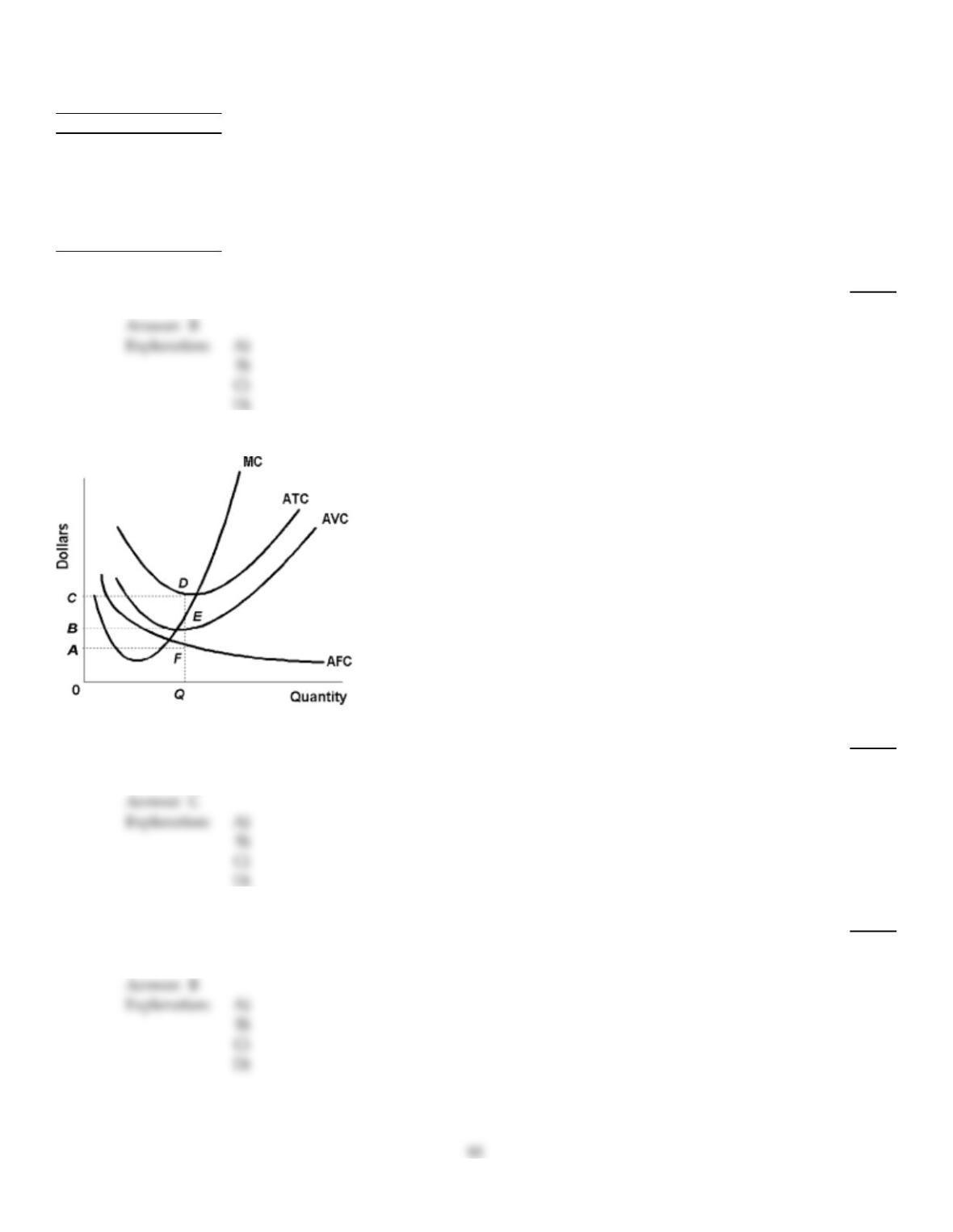
Use the above figure. At an output equal to “Q” the average fixed cost for the firm will be the line
segment
322)
A)
AB.
B)
BE.
C)
DE.
D)
CD.
323)
If average total cost is decreasing as more and more units are produced, then marginal cost must be
323)
A)
constant.
B)
below average total cost.
C)
negative.
D)
rising.
324)
For a firm, we define the short run as a period of time during which
324)
A)
all inputs cannot be changed.
B)
only the plant size can be changed.
C)
at least one input cannot be changed.
D)
all inputs can be changed.
325)
When the marginal physical product is rising
325)
A)
average total cost is increasing.
B)
marginal cost is rising.
C)
marginal cost is falling.
D)
total cost is falling.
C
326)
Short–run total cost is defined as
326)
A)
price of labor per unit multiplied by the number of labor units.
B)
total capital cost only.
C)
the sum of marginal cost and total variable cost.
D)
total fixed cost plus total variable cost.
D
327)
When long–run average costs rise as output increases, the firm is experiencing
327)
A)
economies of scale.
B)
constant returns to scale.
C)
diseconomies of scale.
D)
diminishing returns.
C
C
328)
Notice the costs of production for a firm in the table below. What are the total costs for outputs of 7
units and 8 units respectively?
Total Output Total Fixed Costs Total Variable Costs
(Q/day) (TFC) (TVC)
0 $10 $0
1 $10 $3.50
2 $10 $4.75
3 $10 $5.80
4 $10 $6.40
5 $10 $7.25
6 $10 $8.32
7 $10 $9.33
8$10 $10.12
328)
A)
$17.25; $18.32
B)
$19.33; $20.12
C)
$20.12; $19.33
D)
$9.33; $10.12
329)
When marginal product is rising
329)
A)
marginal cost is rising.
B)
average fixed cost is rising.
C)
marginal cost is falling.
D)
total product is falling.
330)
The time period during which a firm’s capital is fixed but its labor is variable is called
330)
A)
the long run.
B)
the very long run.
C)
the planning horizon.
D)
the short run.
331)
When marginal costs are rising
331)
A)
marginal physical product is also rising.
B)
average physical product is rising.
C)
average physical product is falling.
D)
marginal physical product is falling.
332)
Total fixed cost is
332)
A)
the wages paid to consultants.
B)
the expenditure on imported raw materials.
C)
the cost that does not change as output changes.
D)
the cost of buying and installing new machinery.
333)
Refer to the above figure. Marginal costs are represented by curve
333)
A)
1.
B)
2.
C)
3.
D)
4.
334)
A firm has average fixed costs of $0.20 and average variable costs of $2.50 at an output of 500 units.
The firm’s total costs are therefore
334)
A)
$1,350.
B)
$1,150.
C)
$1,500.
D)
$1,250.
335)
The average product of labor is equal to
335)
A)
total product divided by quantity of labor.
B)
change in total product divided by change in quantity of labor.
C)
change in total product divided by quantity of labor.
D)
total product divided by change in quantity of labor.
336)
Recently Apple Computer developed Apple’s new iTunes Music Store, which offers more than
200,000 songs from five major record labels, for use with Apple’s iPod and iMac. More than a
million songs were downloaded the first week alone! In economic terms, CEO Tim Cook helped
convert capital and labor inputs into products consumers use. Any activity that results in the
conversion of resources into products that can be used in consumption is
336)
A)
demand.
B)
production.
C)
not profitable.
D)
a start up venture.
Input of Labor Total Product
(no. of workers (no. of snowboards
in weeks) produced)
0 0
1 30
2 68
3110
4140
5 135
337)
In the above table, the marginal product of the second worker is
337)
A)
38.
B)
68.
C)
98.
D)
It cannot be determined.
338)
Which of the following statements is correct?
338)
A)
TC = average physical product – marginal physical product
B)
TC = TFC – TVC
C)
TC = TFC + TVC
D)
TC = average product + marginal product
339)
Suppose that one worker can produce 15 cookies, two workers can produce 35 cookies together,
and three workers can produce 60 cookies together. What is the average product of the first two
workers?
339)
A)
17.5 cookies
B)
15 cookies
C)
35 cookies
D)
20 cookies
340)
Refer to the above figure. Average variable costs are represented by curve
340)
A)
1.
B)
2.
C)
3.
D)
4.