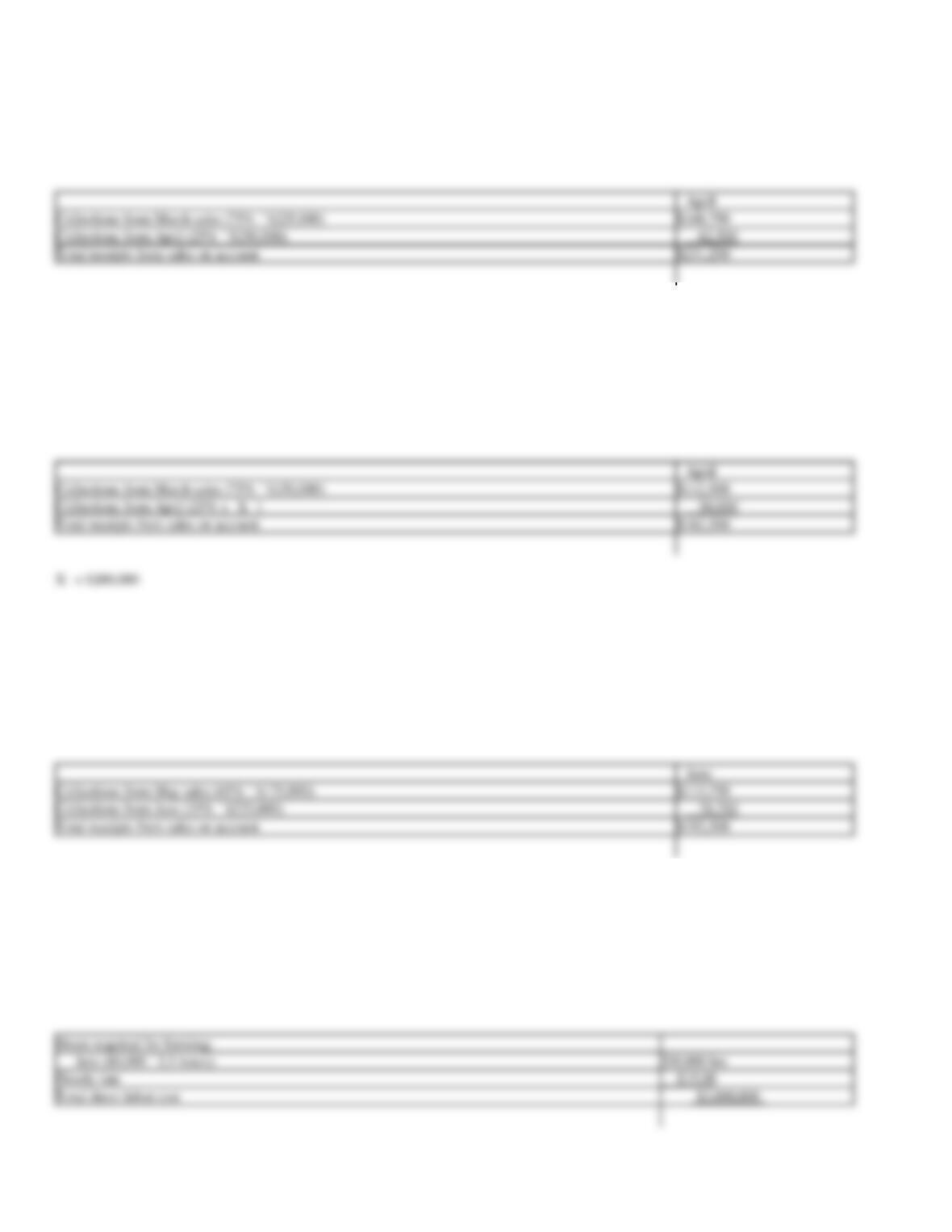
164. Big Wheel, Inc. collects 25% of its sales on account in the month of the sale and 75% in the month
following the sale. If sales on account are budgeted to be $225,000 for March and $250,000 for April, what are
the budgeted cash receipts from sales on account for April?
165. Big Wheel, Inc. collects 25% of its sales on account in the month of the sale and 75% in the month
following the sale. If sales on account are budgeted to be $150,000 for March and receipts from sales on
account total $162,500 in April, what are budgeted sales on account for April?
166. Flanders Industries collects 35% of its sales on account in the month of the sale and 65% in the month
following the sale. If sales on account are budgeted to be $175,000 for May and $225,000 for June, what are the
budgeted cash receipts from sales on account for June?
167. Cuisine Inc. manufactures flatware sets. The budgeted production is for 80,000 sets in 2012. Each set
requires 2.5 hours to polish the material. If polishing labor costs $15.00 per hour, determine the direct labor
budget for 2012.
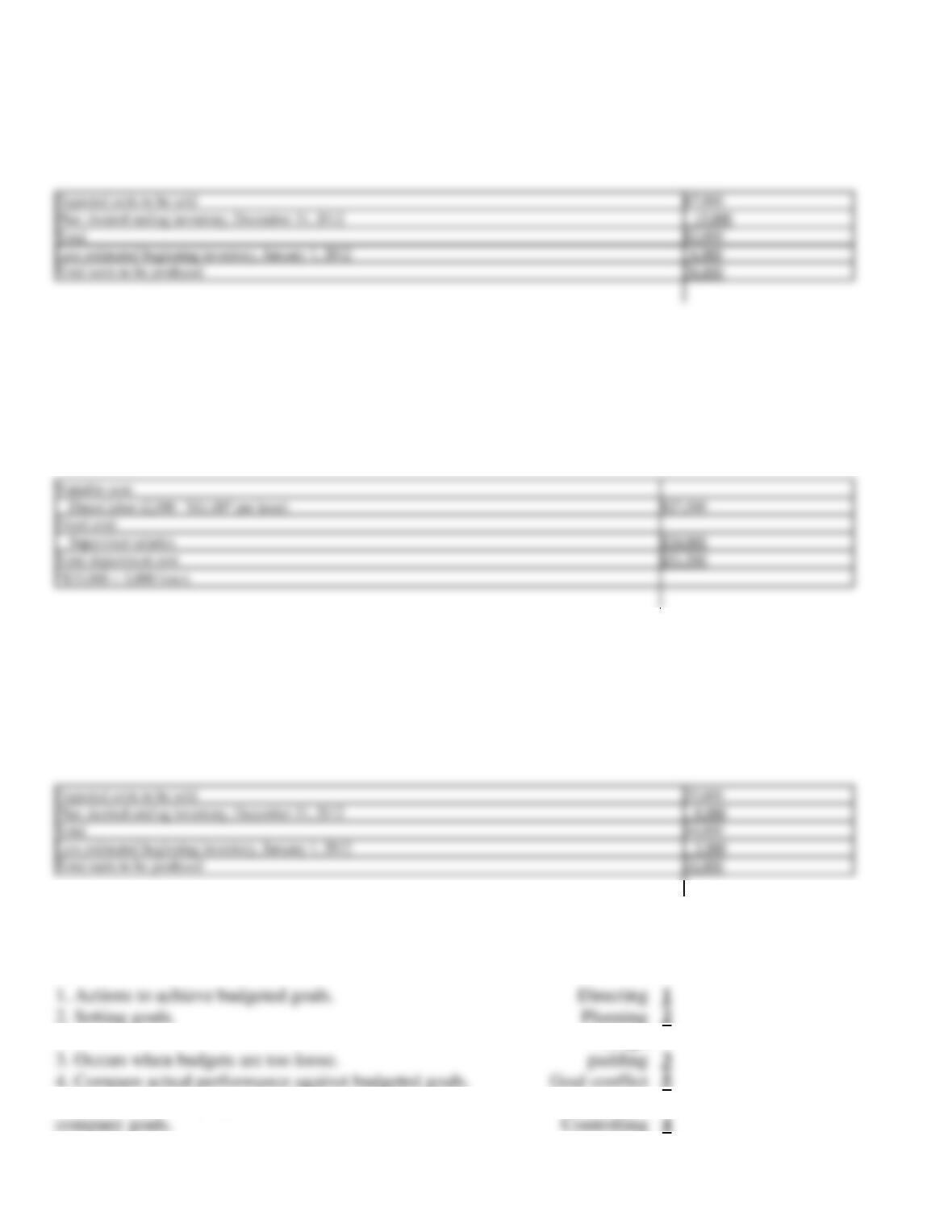
168. Callon Industries has projected sales of 67,000 machines for 2012. The estimated January 1, 2012,
inventory is 6,000 units, and the desired December 31, 2012, inventory is 15,000 units. What is the budgeted
production (in units) for 2012?
169. At the beginning of the period, the Molding Department budgeted direct labor of $33,000 and supervisor
salaries of $24,000 for 3,000 hours of production. The department actually completed 2,500 hours of
production. Determine the budget for the department assuming that it uses flexible budgeting?
170. Maxim Technologies projected sales of 35,000 computers for 2012. The estimated January 1, 2012,
inventory is 3,000 units, and the desired December 31, 2012, inventory is 9,000 units. What is the budgeted
production (in units) for 2012?
171. Match the following terms with the best definition given.
Budget
5. Occurs when employee self-interests are different from
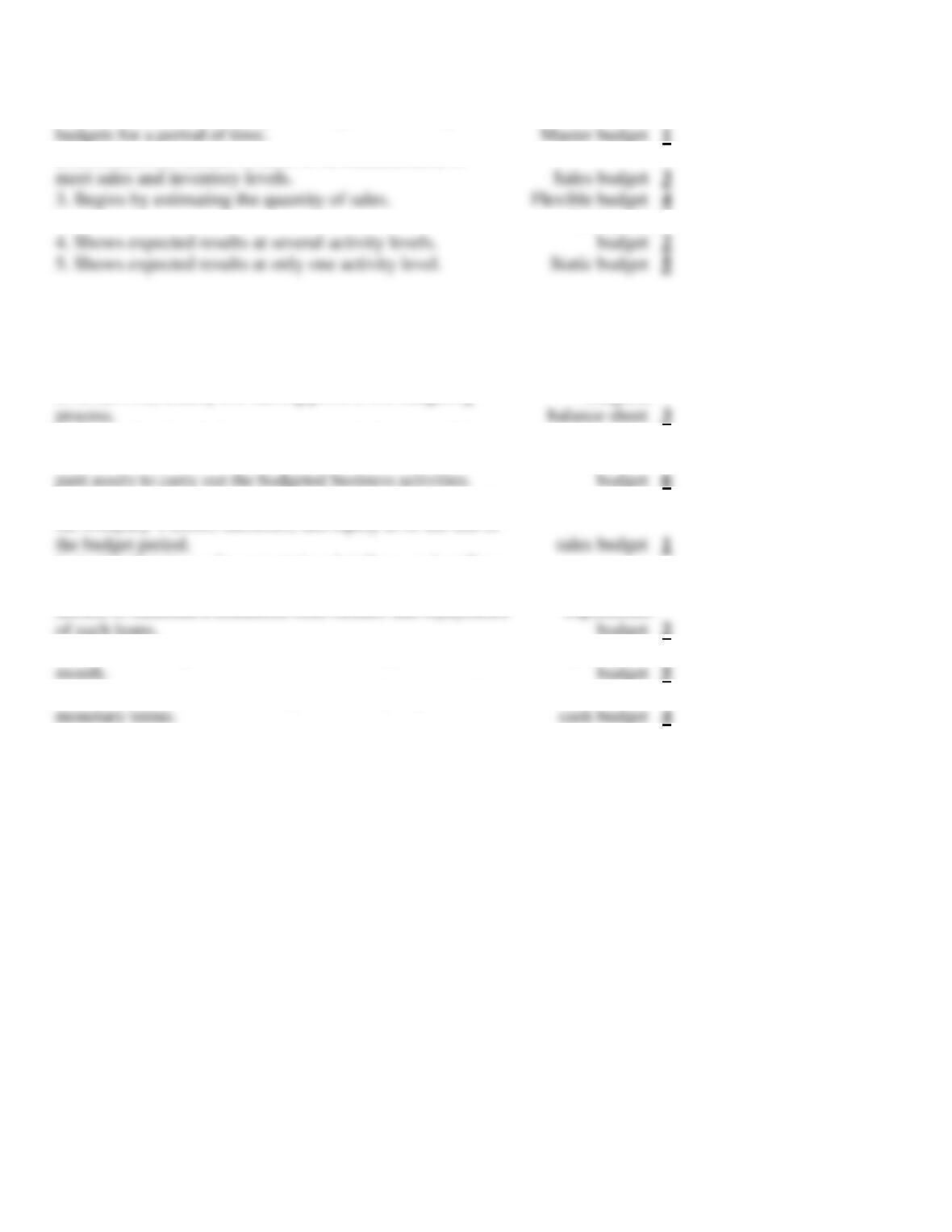
172. Match the following terms with the best definition given.
1. Integrated set of operating, investing and financing
meet sales and inventory levels.
3
3. Begins by estimating the quantity of sales.
4
2. Estimates the number of units to be manufactured to
4. Shows expected results at several activity levels.
2
5. Shows expected results at only one activity level.
5
Production
173. Match the following terms with the best definition given.
3
1. A plan showing the units of goods to be sold and the sales
to be derived; usually the starting point in the budgeting
budgeted
pant assets to carry out the budgeted business activities.
6
2. A plan that lists dollar amounts to be both received from
disposing of plant assets and spent on purchasing additional
the budget period.
1
3. An accounting report that presents predicted amounts of
the company’s assets, liabilities, and equity as of the end of
4. A plan that shows the expected cash inflows and outflows
during the budget period, including receipts from loans
needed to maintain a minimum cash balance and repayments
of such loans.
capital
expenditure
budget
2
month.
budget
5
5. A plan showing the number of units to be produced each
production
monetary terms.
4
6. A formal statement of future plans, usually expressed in
1
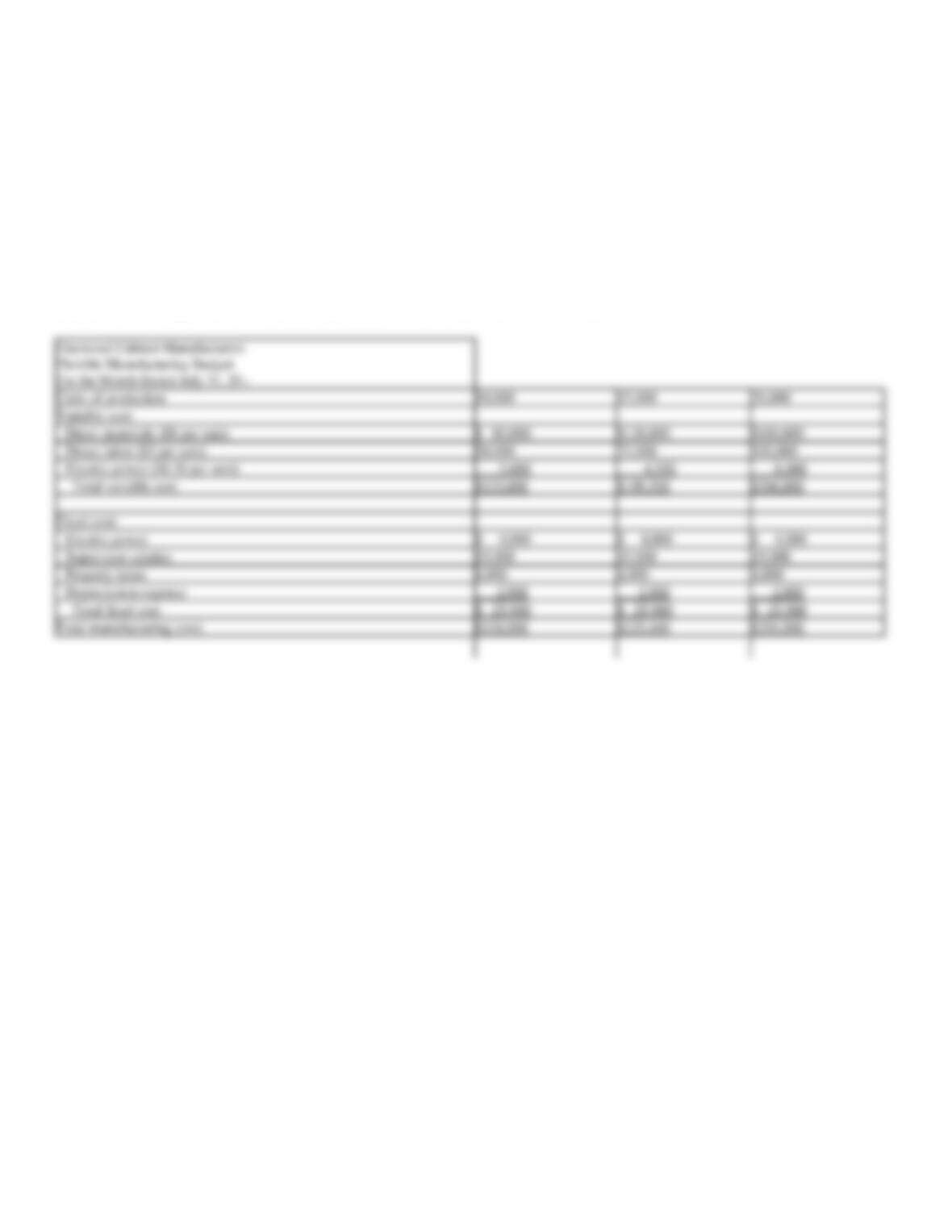
174. Finewood Cabinet Manufacturers uses flexible budgets that are based on the following manufacturing data
for the month of July:
Direct materials
$8 per unit
Direct labor
$5 per unit
Electric power (variable)
$0.30 per unit
Electric power (fixed)
$4,000 per month
Supervisor salaries
$15,000 per month
Property taxes on factory
$4,000 per month
Straight-line depreciation
$2,900 per month
Prepare a flexible budget for Finewood based on production of 10,000, 15,000, and 20,000 units.
Units of production
10,000
15,000
20,000
Variable cost:
Direct materials ($8 per unit)
$ 80,000
$120,000
$160,000
Direct labor ($5 per unit)
50,000
75,000
100,000
Electric power ($0.30 per unit)
3,000
4,500
6,000
Total variable cost
$133,000
$199,500
$266,000
Fixed cost:
Electric power
$ 4,000
$ 4,000
$ 4,000
Supervisor salaries
15,000
15,000
15,000
Property taxes
4,000
4,000
4,000
Depreciation expense
2,900
2,900
2,900
Total fixed cost
$ 25,900
$ 25,900
$ 25,900
Total manufacturing costs
$158,900
$225,400
$291,900
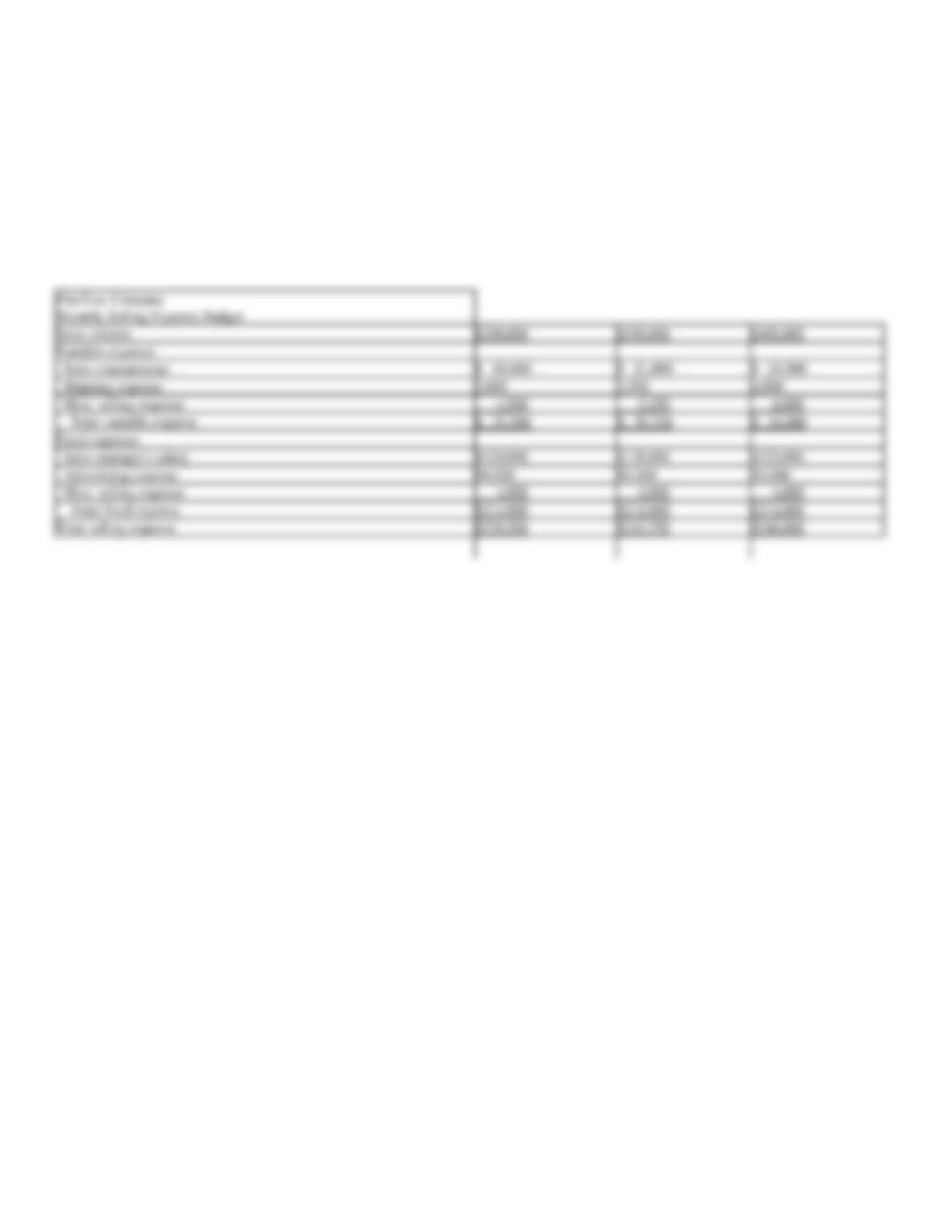
175. Prepare a monthly flexible selling expense budget for PineTree Company for sales volumes of $300,000,
$350,000, and $400,000, based on the following data:
Sales commissions
6% of sales
Sales manager’s salary
$120,000 per month
Advertising expense
$ 90,000 per month
Shipping expense
1% of sales
Miscellaneous selling expense
$4,000 per month plus 1.5% of sales
Sales volume
$300,000
$350,000
$400,000
Variable expense:
Sales commissions
$ 18,000
$ 21,000
$ 24,000
Misc. selling expense
4,500
5,250
6,000
Total variable expense
$ 25,500
$ 29,750
$ 34,000
Fixed expense:
Sales manager’s salary
$120,000
$120,000
$120,000
Advertising expense
90,000
90,000
90,000
Misc. selling expense
4,000
4,000
4,000
Total fixed expense
$214,000
$214,000
$214,000
Total selling expense
$239,500
$243,750
$248,000
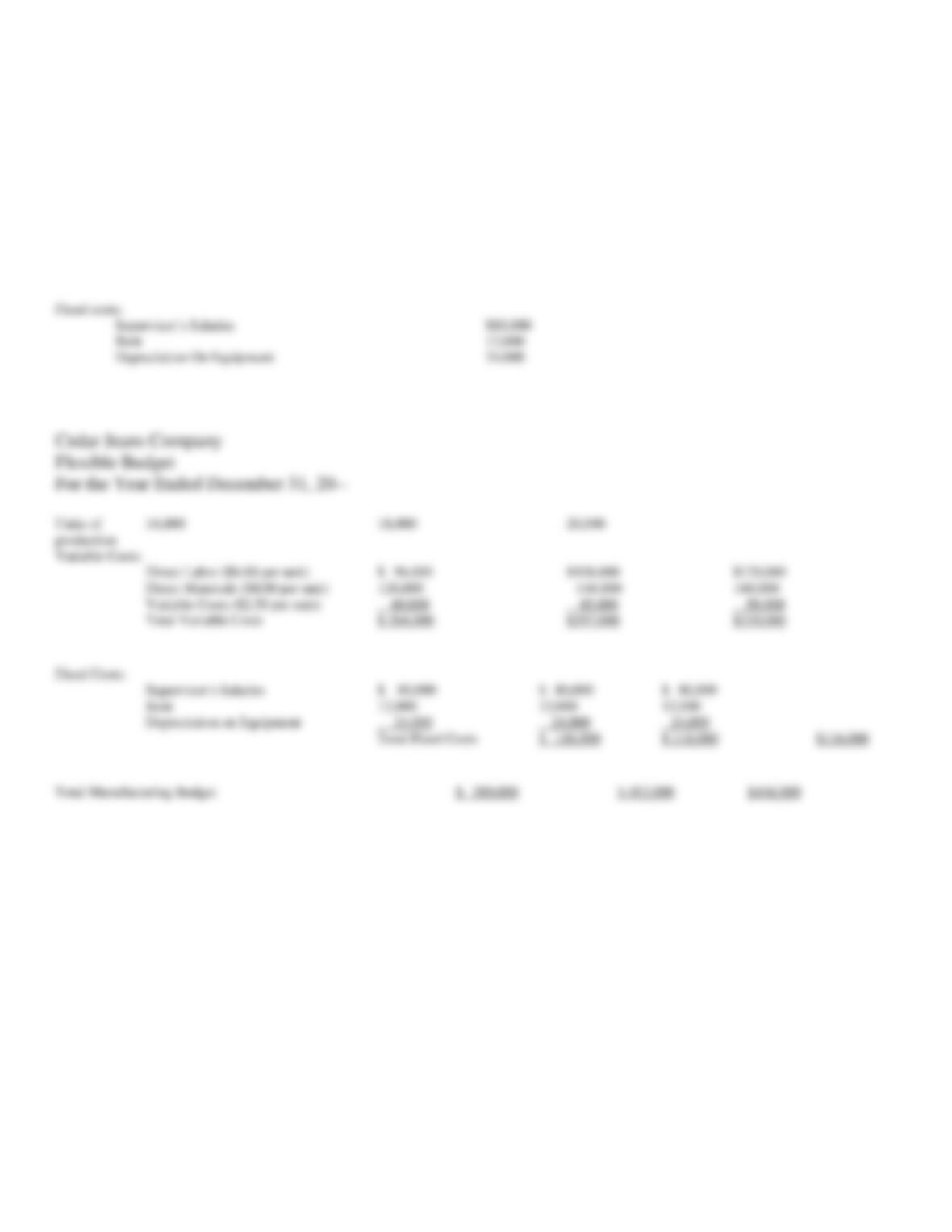
176. Prepare a flexible budget for Cedar Jeans Company using production levels of 16,000, 18,000, and 20,000
units produced. The following is additional information necessary to complete the budget:
Variable costs:
Direct
Labor
($6.00 per
unit)
Direct Materials ($8.00 per unit)
Variable Manufacturing Costs ($2.50 per unit)
$80,000
Rent
12,000
Variable Costs:
Direct Labor ($6.00 per unit)
$ 96,000
$108,000
$120,000
Variable Costs ($2.50 per unit)
40,000
45,000
50,000
Total Variable Costs
$ 264,000
$297,000
$330,000
$ 80,000
$ 80,000
$ 80,000
Rent
12,000
12,000
12,000
Depreciation on Equipment
24,000
24,000
24,000
Total Manufacturing Budget
$ 380,000
$ 413,000
$446,000
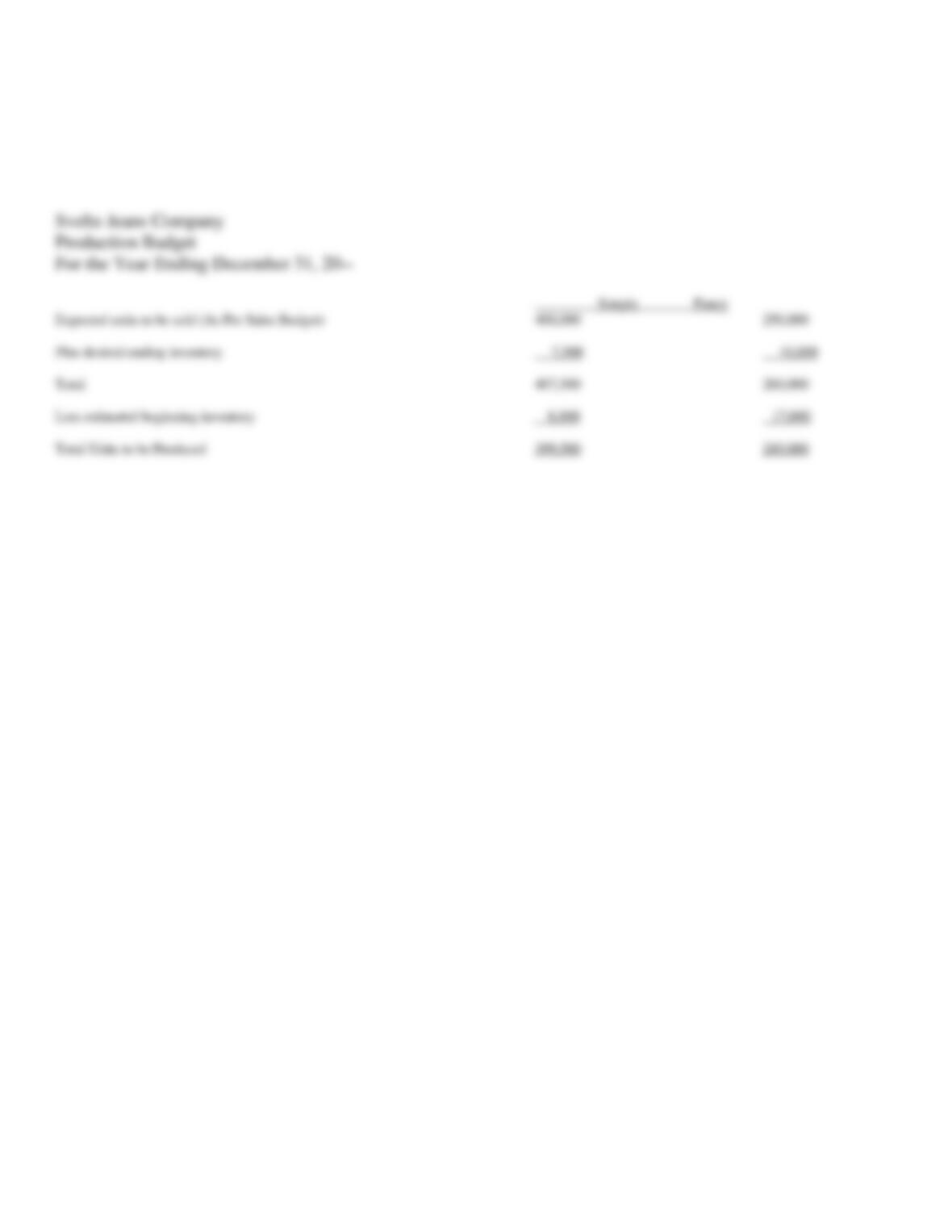
177. The Svelte Jeans Company produces two different types of jeans. One is called the “Simple Life” and the
other is called the “Fancy Life”. The company sales budget estimates that 400,000 of the Simple Life Jeans and
250,000 of the Fancy Life will be sold during 20—. The company begins with 8,000 Simple Life Jeans and
17,000 Fancy Life Jeans. The company desires ending inventory of 7,500 of Simple Life Jeans and 10,000
Fancy Life Jeans. Prepare a Production Budget for the 20—.
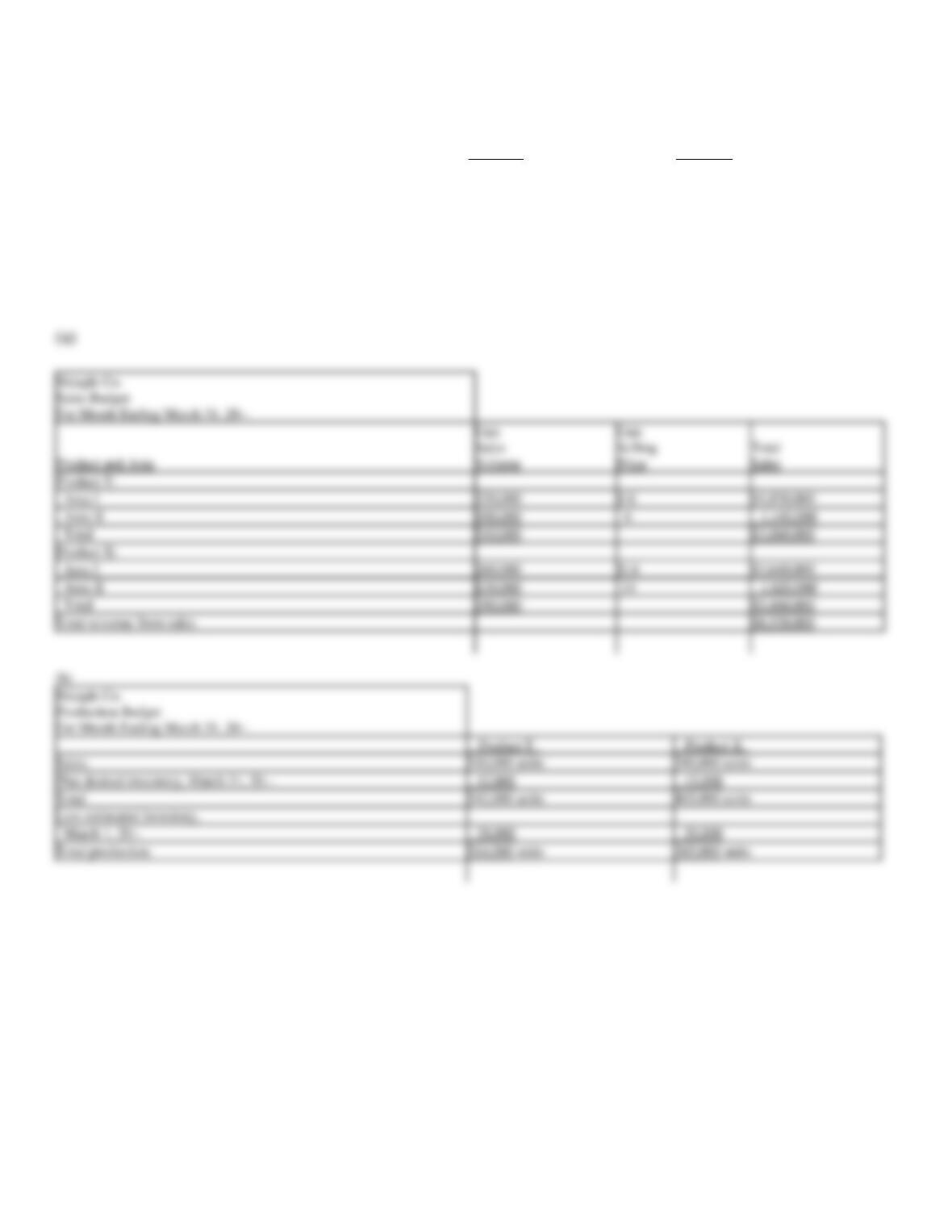
178. Based on the following production and sales data of Shingle Co. for March of the current year, prepare (a)
a sales budget and (b) a production budget.
Product T
Product X
Estimated inventory, March 1
28,000 units
20,000 units
Desired inventory, March 31
32,000 units
15,000 units
Expected sales volume:
Area I
320,000 units
260,000 units
Area II
190,000 units
130,000 units
Unit sales price
$6
$14
Product T:
Area I
320,000
$ 6
$1,920,000
Area II
190,000
6
1,140,000
Total
510,000
$3,060,000
Product X:
Area I
260,000
$3,640,000
Area II
130,000
1,820,000
Total
390,000
$5,460,000
Total revenue from sales
$8,520,000
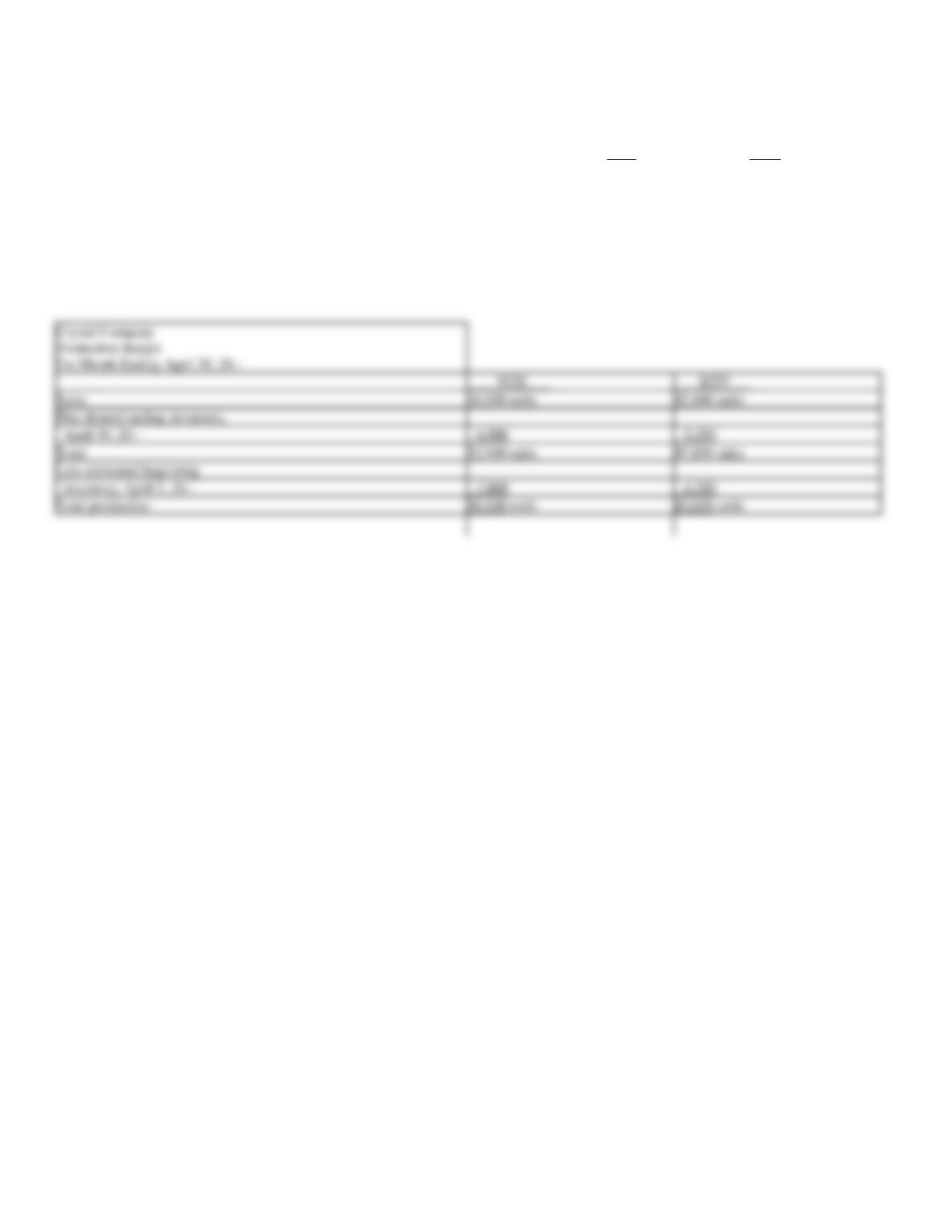
Product T
Product X
Sales.
510,000 units
390,000 units
Plus desired inventory, March 31, 20—
32,000
15,000
Total
542,000 units
405,000 units
Less estimated inventory,
March 1, 20—
28,000
20,000
Total production
514,000 units
385,000 units
179. Crystal Company manufactures two models of microcassette recorders, VCH and MTV. Based on the
following production data for April of the current year, prepare a production budget for April.
VCH
MTV
Estimated inventory (units), April 1
2,800
4,200
Desired inventory (units), April 30
6,900
5,250
Expected sales volume (units):
Eastern zone
12,500
12,960
Midwest zone
19,000
19,800
Western zone
14,500
9,840
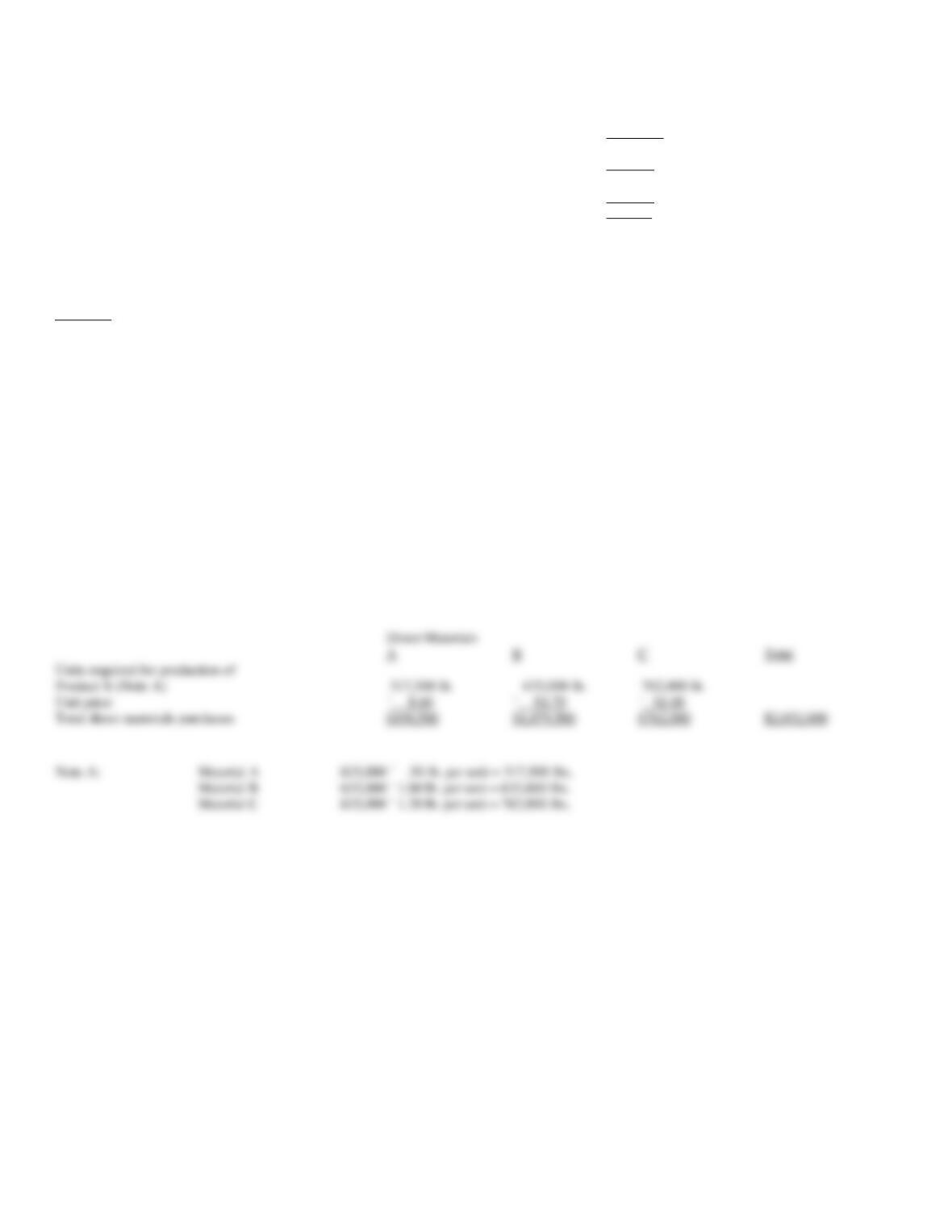
VCH
MTV
Sales
46,000 units
42,600 units
Plus desired ending inventory,
April 30, 20—
6,900
5,250
Total
52,900 units
47,850 units
Less estimated beginning
inventory, April 1, 20—
2,800
4,200
Total production
50,100 units
43,650 units
180. Purple Inc. production budget for Product X for the year ended December 31 is as follows:
Product X
Sales
640,000
units
Plus desired ending inventory
85,000
Total
725,000
Less estimated beginning inventory, Jan. 1
90,000
Total production
635,000
In Purple’s production operations, Materials A, B, and C are required to make Product X. The quantities of direct materials expected to be used for
each unit of product are as follows:
Product X
Material A
.50 pound per unit
Material B
1.00 pound per unit
Material C
1.20 pound per unit
The prices of direct
materials are as follows:
Material A
$0.60 per pound
Material B
1.70 per pound
Material C
1.00 per pound
Prepare a direct materials purchases budget for Product X, assuming that there are no beginning or ending inventories for direct materials (all units
purchased are used in production).
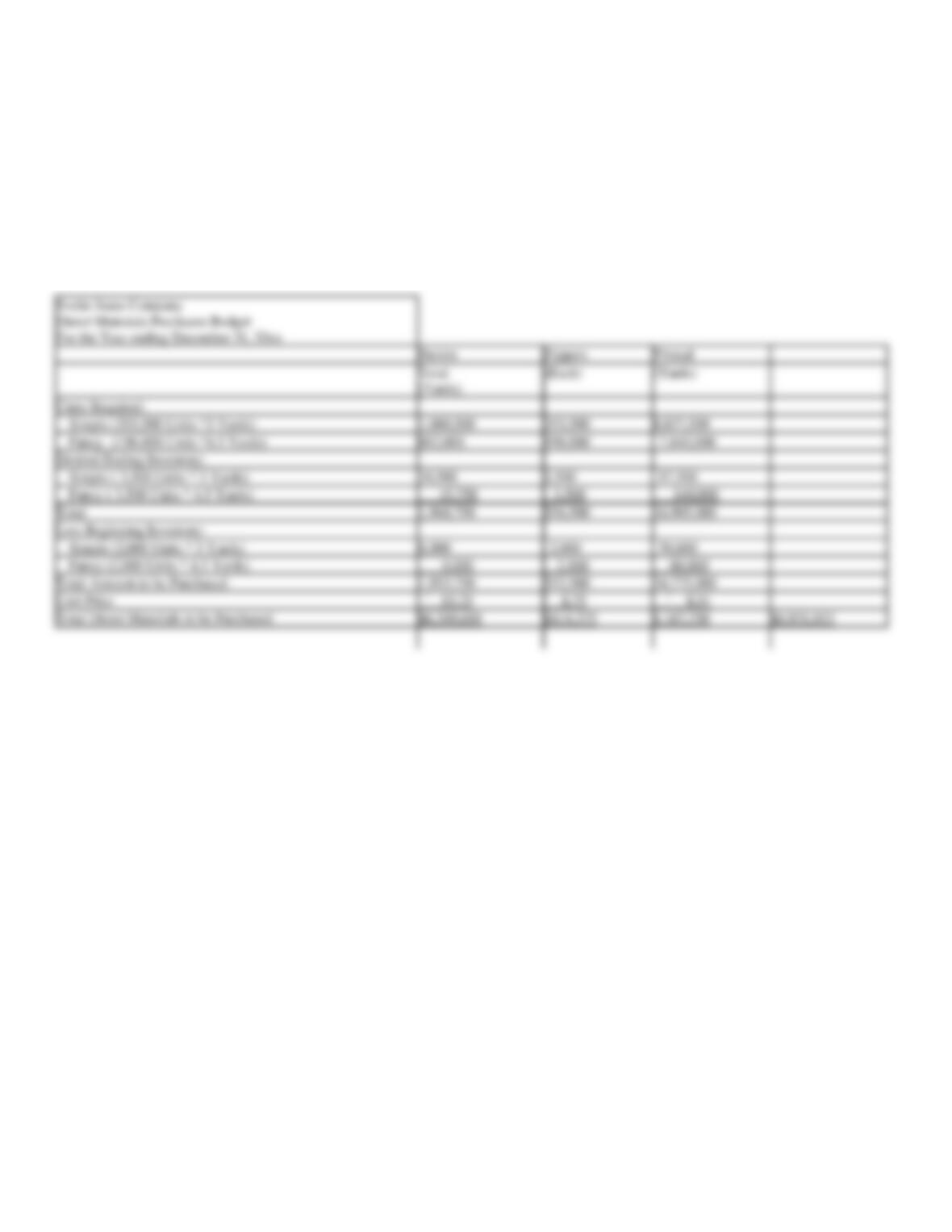
Direct Materials
A
B
C
Total
Units required for production of
Product X (Note A)
317,500 lb.
635,000 lb.
762,000 lb.
Unit price
´ $.60
´ $1.70
´ $1.00
Total direct materials purchases
$190,500
$1,079,500
$762,000
$2,032,000
Note A:
Material A
635,000 ´ .50 lb. per unit = 317,500 lbs.
Material B
635,000 ´ 1.00 lb. per unit = 635,000 lbs.
Material C
635,000 ´ 1.20 lb. per unit = 762,000 lbs.
181. The Svelte Jeans Company produces two different types of jeans. One is called the “Simple Life” and the
other is called the “Fancy Life”. The company sales budget estimates that 350,000 of the Simple Life Jeans and
200,000 of the Fancy Life will be sold during 20xx. The Production Budget requires 353,500 units of Simple
Life jeans and 196,000 Fancy Life jeans be manufactured. The Simple Life jeans require 3 yards of denim
material, a zipper, and 25 yards of thread. The Fancy Life jeans require 4.5 yards of denim material, a zipper,
and 40 yards of thread. Each yard of denim material costs $3.25, the zipper costs $.75 each, and the thread is
$.01 per yard. There is enough material to make 2,000 jeans of each type at the beginning of the year. The
desired amount of materials left in ending inventory is to have enough to manufacture 3,500 jeans of each type.
Prepare a Direct Materials Purchases Budget.
182. The treasurer of Systems Company has accumulated the following budget information for the first two
months of the coming year:
March
April
Sales.
$450,000
$520,000
Manufacturing costs
290,000
350,000
Selling and administrative expenses
41,400
46,400
Capital additions
250,000
—
The company expects to sell about 35% of its merchandise for cash. Of sales on account, 80% are expected to be collected in full in the month of the
sale and the remainder in the month following the sale. One-fourth of the manufacturing costs are expected to be paid in the month in which they are
incurred and the other three-fourths in the following month. Depreciation, insurance, and property taxes represent $6,400 of the probable monthly
selling and administrative expenses. Insurance is paid in February and a $40,000 installment on income taxes is expected to be paid in April. Of the
remainder of the selling and administrative expenses, one-half are expected to be paid in the month in which they are incurred and the balance in the
following month. Capital additions of $250,000 are expected to be paid in March.
Current assets as of March 1 are composed of cash of $45,000 and accounts receivable of $51,000. Current liabilities as of March 1 are composed of
accounts payable of $121,500 ($102,000 for materials purchases and $19,500 for operating expenses). Management desires to maintain a minimum
cash balance of $20,000.
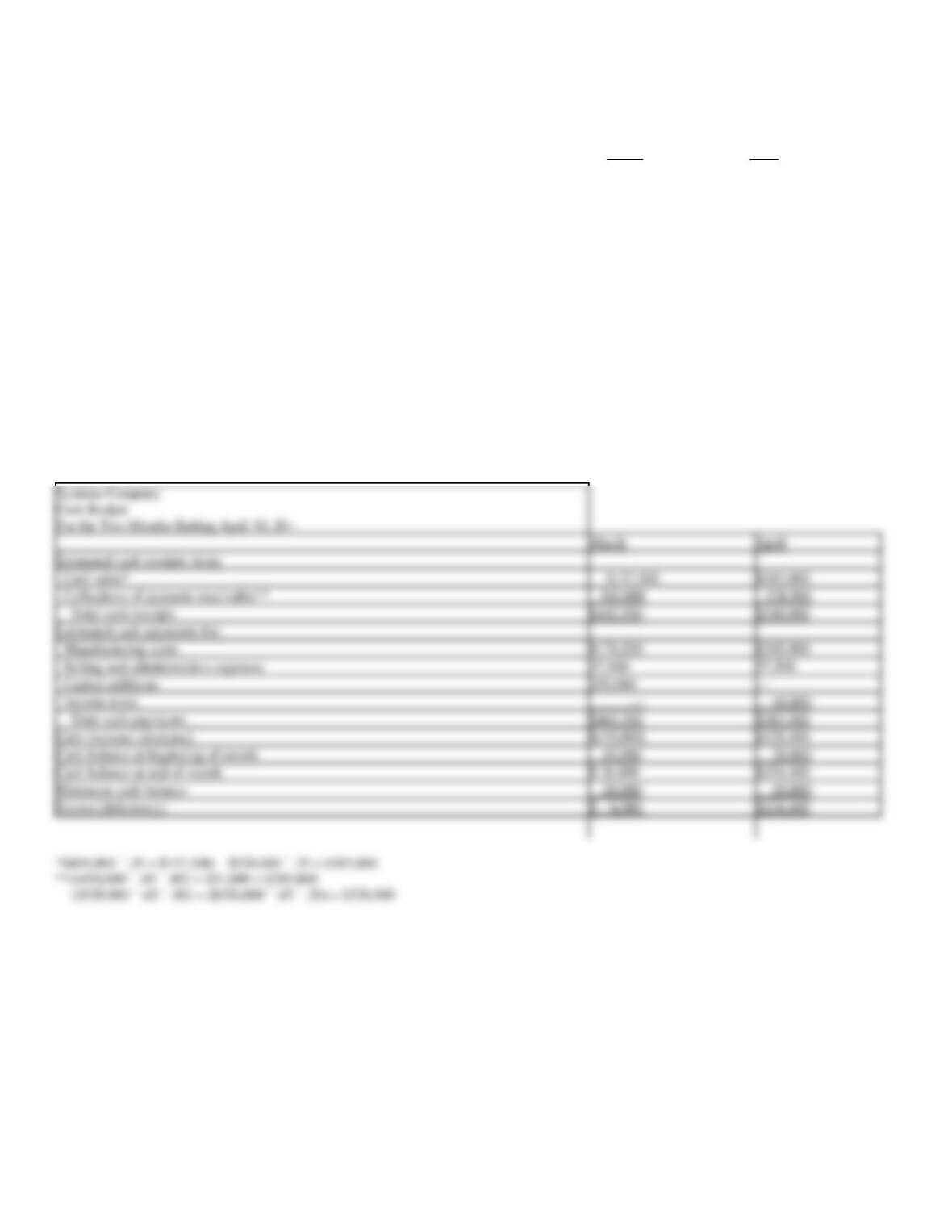
Prepare a monthly cash budget for March and April.
March
April
Estimated cash receipts from:
Cash sales*
$157,500
$182,000
Collections of accounts receivable**
285,000
328,900
Total cash receipts
$442,500
$510,900
Estimated cash payments for:
Manufacturing costs
$174,500
$305,000
Selling and administrative expenses
37,000
37,500
Capital additions
250,000
—
Income taxes
40,000
Total cash payments
$461,500
$382,500
Cash increase (decrease)
$(19,000)
$128,400
Cash balance at beginning of month
45,000
26,000
Cash balance at end of month
$ 26,000
$154,400
Minimum cash balance
20,000
20,000
Excess (deficiency)
$ 6,000
$134,400
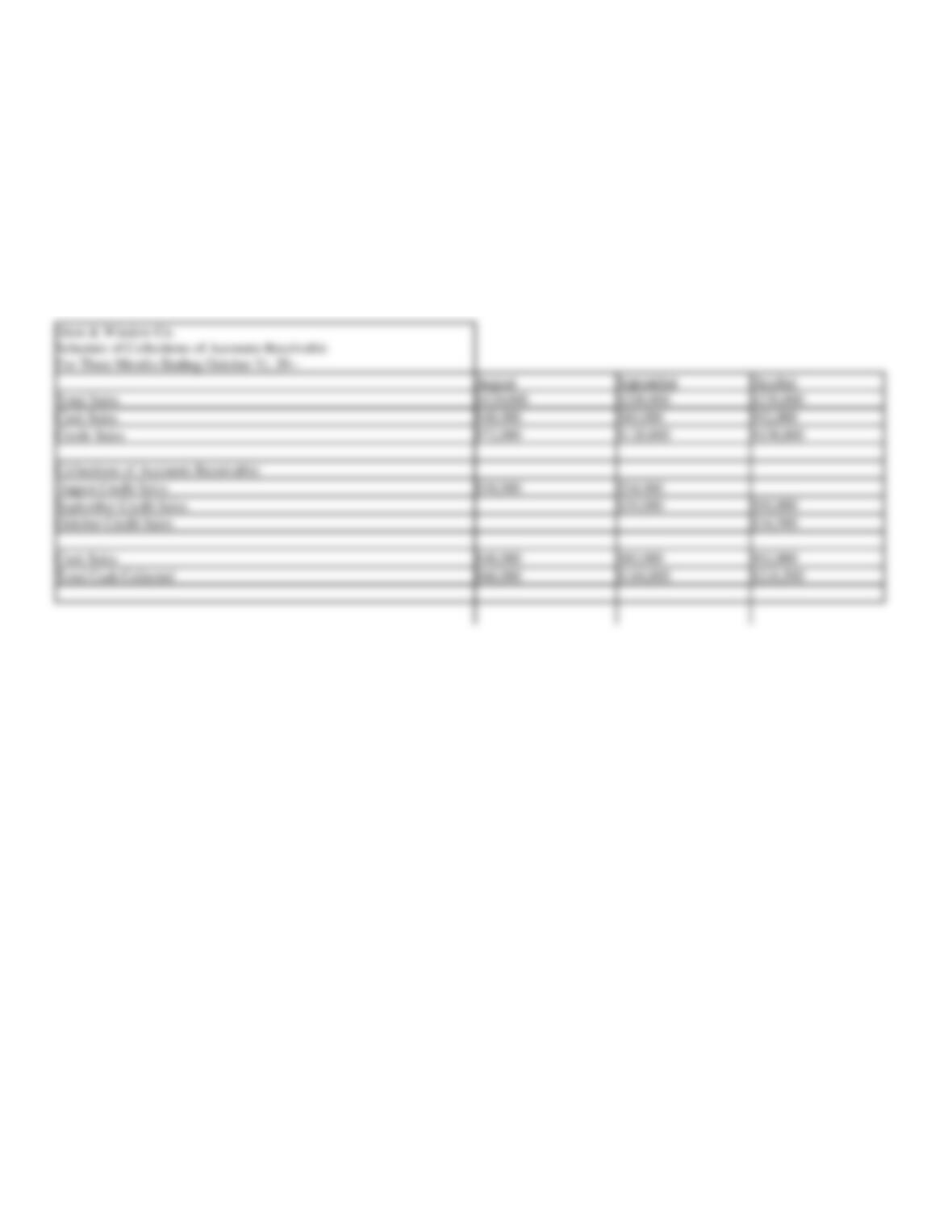
183. Door & Window Co. was organized on August 1 of the current year. Projected sales for the next three
months are as follows:
August
$120,000
September
200,000
October
230,000
The company expects to sell 40% of its merchandise for cash. Of the sales on account, 25% are expected to be collected in the month of the sale and
the remainder in the following month.
Prepare a schedule indicating total cash collections for August, September, and October.
August
September
October
Total Sales
$120,000
$200,000
$230,000
Cash Sales
$48,000
$80,000
$92,000
Credit Sales
$72,000
$120,000
$138,000
Collections of Accounts Receivable:
August Credit Sales
$18,000
$54,000
September Credit Sales
$30,000
$90,000
October Credit Sales
$34,500
Cash Sales
$48,000
$80,000
$92,000
Total Cash Collected
$66,000
$164,000
$216,500
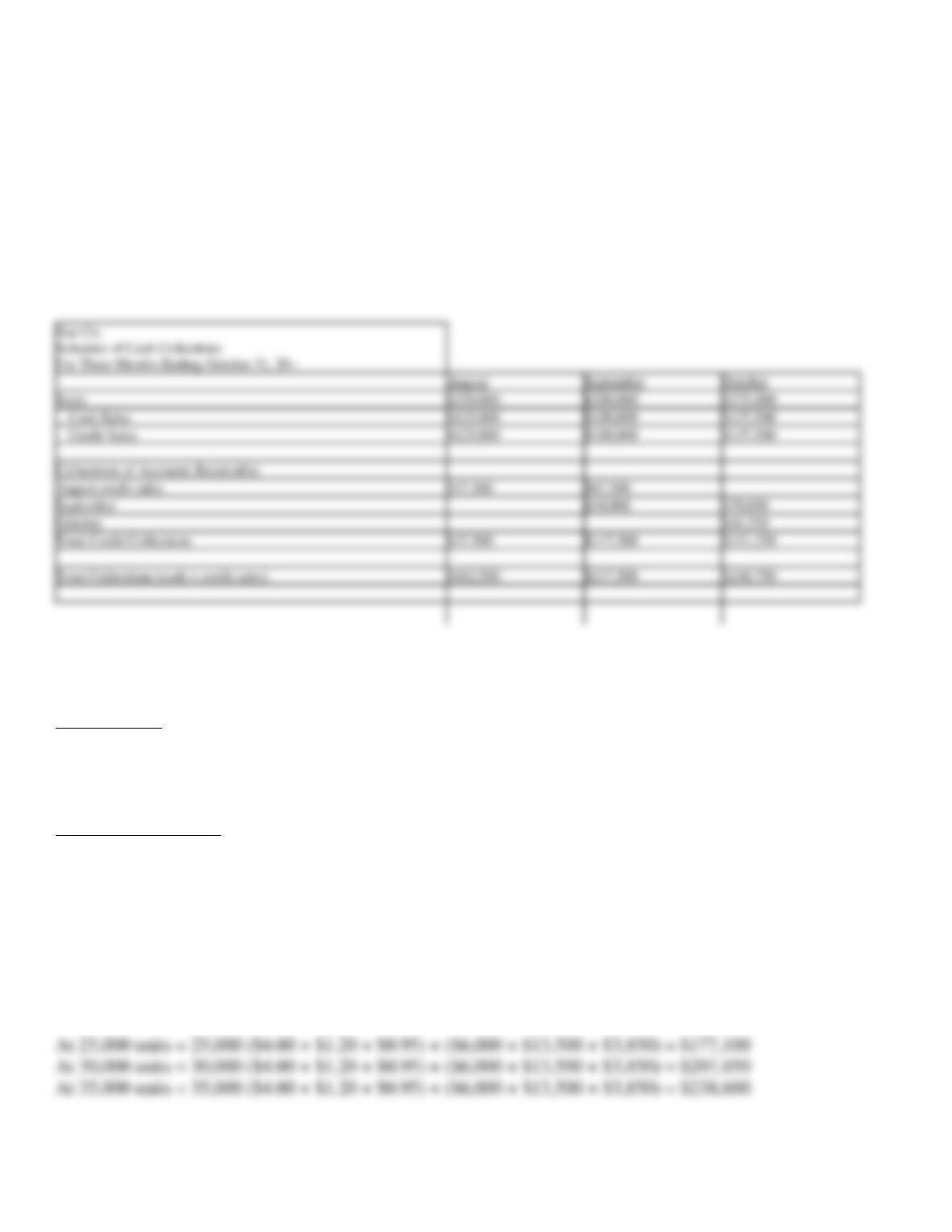
184. Star Co. was organized on August 1 of the current year. Projected sales for the next three months are as
follows:
August
$250,000
September
200,000
October
275,000
The company expects to sell 50% of its merchandise for cash. Of the sales on account, 30% are expected to be collected in the month of the sale and
the remainder in the following month.
Prepare a schedule indicating cash collections for August, September, and October.
185. Doran Technologies produces a single product. Expected manufacturing costs are as follows:
Variable costs
Direct materials $4.00 per unit
Direct labor $1.20 per unit
Manufacturing overhead $0.95 per unit
Fixed costs per month
Depreciation $6,000
Supervisory salaries $13,500
Other fixed costs $3,850
Required:
Estimate manufacturing costs for production levels of 25,000 units, 30,000 units, and 35,000 units per month.
August
September
October
Sales
$250,000
$200,000
$275,000
Cash Sales
$125,000
$100,000
$137,500
Credit Sales
$125,000
$100,000
$137,500
Collections of Accounts Receivable:
August credit sales
$37,500
$87,500
September
$30,000
$70,000
October
$41,250
Total Credit Collections
$37,500
$117,500
$111,250
Total Collections (cash + credit sales)
$162,500
$217,500
$248,750
186. Describe at least five benefits of budgeting.
187. Describe a master budget and the sequence in which the individual budgets within the master budget are
prepared.
188. Why is the sales budget usually prepared first?
189. What is a capital expenditures budget?
190. What is a cash budget? How does management use a cash budget?