QTFC TVC TC
0$90 $ 0 $ 90
190 25 115
290 32 122
390 42 132
490 64 154
590 95 185
137)
Refer to the above table. When output rises from 4 units to 5 units, marginal costs are
137)
A)
$22.
B)
$31.
C)
$10.
D)
$19.
138)
Which of the following statements is correct?
138)
A)
Average fixed costs are constant.
B)
Average variable costs always exceed average total costs.
C)
Average variable cost reaches its minimum when average product equals its maximum.
D)
Average fixed costs are always less than average variable costs.
139)
Average variable costs equal
139)
A)
the change in marginal costs from producing another unit of output.
B)
total variable costs divided by marginal costs.
C)
output divided by the change in total costs.
D)
total variable costs divided by output.
140)
The relationship between inputs and outputs is known as
140)
A)
marginal product.
B)
business.
C)
manufacturing.
D)
a production function.
Input of Labor Total Product
(no. of workers (no. of snowboards
in weeks) produced)
0 0
1 30
2 68
3110
4140
5 135
141)
In the above table, the average product of the fifth worker is
141)
A)
27.
B)
135.
C)
35.
D)
–5.
Answer:
A
Explanation:
A)
B)
C)
D)
142)
The law of diminishing marginal product shows the relationship
142)
A)
between inputs and outputs for a firm in the long run.
B)
between accounting and economic profits.
C)
between inputs and outputs for a firm in the short run.
D)
between short–run and long–run outputs of a firm.
Q (output) TFC TVC TC AFC AVC ATC MC
0$0 – – – –
1$10
2$5 $15
3$15
4$16.75
143)
Using the above table, the AFC, the AVC, and the ATC when output is 1 unit are
143)
A)
$5, $10, and $5, respectively.
B)
$5, $10, and $15, respectively.
C)
$10, $10, and $20, respectively.
D)
$0, $10, and $10, respectively.
Answer:
B
Explanation:
A)
B)
C)
D)
42
Answer:
C
Explanation:
A)
B)
C)
D)
144)
The lowest rate of output per unit of time at which long–run average costs for a particular firm are
at a minimum is
144)
A)
economies of scale.
B)
constant returns of scale.
C)
diseconomies of scale.
D)
minimum efficient scale.
Quantity of Total Average Marginal
Labor Product Product Product
122 22 22
2 52 26 30
3 81 27 29
4100 25 19
5115 23 15
6126 21 11
145)
Refer to the above table. At what quantity of labor does the marginal cost curve start to increase?
145)
A)
after 6 units
B)
after 1 unit
C)
after 2 units
D)
after 3 units
Average
Labor Output Product Marginal Product
110 –
212
315
4 52
5 9
146)
Using the above table, the average product and marginal product when 4 workers are employed
are
146)
A)
13 and 9, respectively.
B)
13 and 13, respectively.
C)
14 and 13, respectively.
D)
13 and 14, respectively.
147)
The concept of the production function implies that a firm using resources inefficiently will
147)
A)
not be subject to diminishing marginal product.
B)
obtain less output than the theoretical production function shows.
C)
obtain more output than the theoretical production function shows.
D)
obtain exactly the amount that the theoretical production function shows.
QTFC TVC TC AFC AVC ATC
1
2$75 $25
3$40
148)
Refer to the above table. What are total variable costs at an output of 3 units?
148)
A)
$270
B)
$120
C)
$150
D)
$90
149)
Assume that in the short run a firm is producing 100 units of output, has average total costs of $100,
and average fixed costs of $20. The firm’s total variable cost at this output level is
149)
A)
$12,000.
B)
$8,000.
C)
$120.
D)
$80.
150)
The law of diminishing marginal product indicates that
150)
A)
marginal product will eventually decrease.
B)
resources are inefficient.
C)
average product will eventually decrease.
D)
total product will eventually decrease.
Total Output Total Costs
0 $10
1 18
2 21
3 23
4 24
5 26
6 29
7 33
8 38
9 44
10 51
151)
In the above table, when output is 8 units, average total costs are
151)
A)
$38.
B)
$28.
C)
$3.50.
D)
$4.75.
152)
Mr. James‘ company produces candy bars. Which is NOT a variable input for this firm?
152)
A)
the big chocolate–stirring machines
B)
sugar
C)
packaging materials
D)
assembly line workers
153)
In the above figure, if this firm produces output level Q2, it has average variable costs of
153)
A)
OF.
B)
OD.
C)
OC.
D)
OE.
Quantity of Total
Labor Product
120
246
363
472
154)
Refer to the above table. What does the marginal product equal when the quantity of labor goes
from 1 to 2?
154)
A)
23
B)
92
C)
46
D)
26
155)
Minimum efficient scale
155)
A)
is the point at which diseconomies of scale begin for a particular firm.
B)
applies only to firms with U–shaped long–run average cost curves.
C)
is the lowest rate of output per unit of time at which long–run average costs reach a minimum
for a particular firm.
D)
is the point at which economies of scale begin for a particular firm.
C
Fixed Variable Total Average Average Marginal
Output Costs Costs Costs Total Costs Variable Costs Costs
0$0 $100
130
250
3 60
4 120
5200
156)
In the above table, what is the average total cost to produce 5 units of output?
156)
A)
$60
B)
$55
C)
$80
D)
$40
A
D
157)
Economies of scale occur when there are
157)
A)
increases in long–run average costs when output increases.
B)
decreases in output resulting from decreases in input.
C)
no changes in long–run average costs when output increases.
D)
decreases in long–run average costs resulting from increases in output.
158)
A negative value for the marginal physical product would indicate that
158)
A)
total output increased by a significant amount.
B)
total output increased, but the increase was very small.
C)
total output decreased when the extra unit of the variable input was added.
D)
the company has not yet reached the point of saturation.
Explanation:
159)
An increase in output would result in no change in long–run average costs when there are
159)
A)
economies of scale.
B)
diseconomies to scale.
C)
diminishing marginal product.
D)
constant returns to scale.
Explanation:
160)
Economists generally define the short run as being
160)
A)
that period of time in which all inputs are variable.
B)
that period of time in which at least one of the firm’s inputs, usually plant size, is fixed.
C)
any period of time less than six months.
D)
any period of time less than one year.
Explanation:
161)
If a farmer seeks to buy one–hundred more acres for her kiwi fruit farm, she is making a
161)
A)
long–run decision.
B)
variable–input decision.
C)
short–run decision.
D)
immediate–run decision.
Explanation:
Explanation:
162)
When a firm is at its minimum efficient scale of operation, it produces the
162)
A)
maximum rate of output consistent with lowest long–run marginal cost.
B)
minimum rate of output at which long–run average cost is minimized.
C)
maximum rate of output at which long–run average cost is minimized.
D)
minimum rate of output consistent with lowest long–run marginal cost.
163)
The long run is defined as the time period in which
163)
A)
the firm can vary only one input.
B)
all factors of production can be altered.
C)
the firm can make positive economic profits.
D)
the firm can alter its rate of production.
Use the information from the below table to answer following question(s).
Input of Total
Labor Product
0 0
120
2 50
380
4105
5125
6140
7150
164)
In the above table, the marginal product of the sixth worker is
164)
A)
15.
B)
10.
C)
25.
D)
20.
Quantity of Total Average Marginal
Workers Product Product Product
0 0
1 3
2 7
312
416
518
618
165)
In the above table, the average product of the 6th worker is
165)
A)
5.
B)
3.
C)
0.
D)
4.
166)
When El Torito Restaurant is deciding how many waiters to hire for a holiday weekend, it is
making a ________ decision.
166)
A)
long–run
B)
short–run
C)
plant–size
D)
fixed–input
Explanation:
167)
If marginal product is negative, then
167)
A)
average profit is rising.
B)
total product is rising.
C)
total product is falling.
D)
marginal cost is falling.
Explanation:
168)
The production function does not provide information about
168)
A)
the relationship between changes in quantity of inputs and changes in the quantity of output.
B)
the types of inputs used in the production process.
C)
the profits of producing a good.
D)
the technology used in the production process.
Explanation:
Explanation:
169)
Which of the following activities is not included in the production process?
169)
A)
transporting the goods
B)
determining the value of the goods
C)
making the goods
D)
packaging the goods
170)
At Phil’s Hot Dog Stand, we found the following:
4 laborers produced 66 hot dogs
5 laborers produced 76 hot dogs
6 laborers produced 85 hot dogs
7 laborers produced 88 hot dogs
What was the marginal product of the sixth laborer?
170)
A)
3 hot dogs
B)
9 hot dogs
C)
10 hot dogs
D)
6 hot dogs
171)
Fixed costs are
171)
A)
costs that increase at a constant rate when output increases.
B)
not actually costs since they do not affect the decisions of a firm.
C)
costs that never change.
D)
costs that a firm incurs even when output is zero.
172)
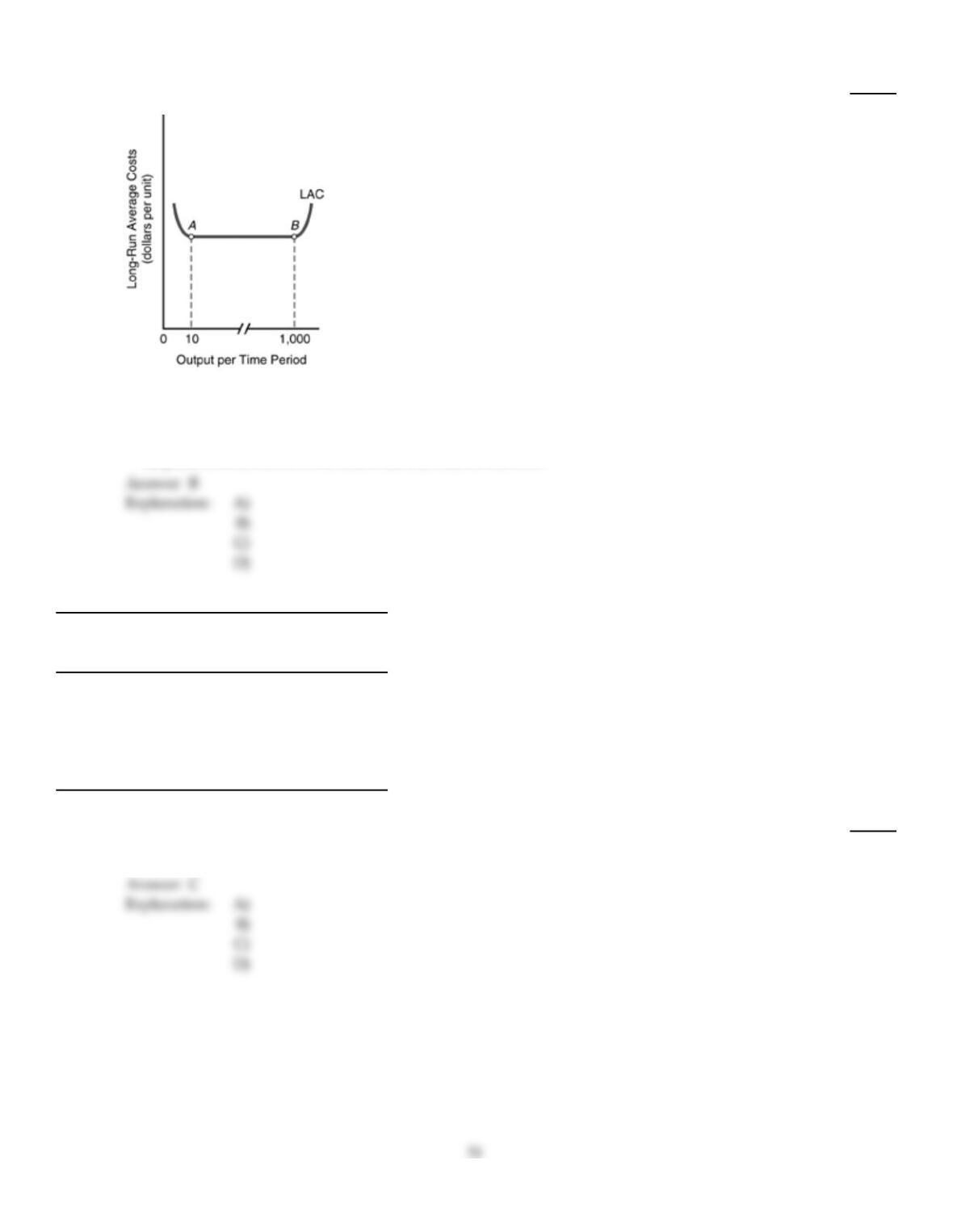
The minimum efficient scale in the figure below shows that
172)
A)
the long–run average cost curve (LAC) reaches a minimum point at B.
B)
point A is the minimum efficient scale (MES) for the firm.
C)
the minimum efficient scale (MES) illustrates maximum average costs.
D)
point B is the minimum efficient scale (MES) for the firm.
Input of Labor Total Product
(no. of workers (no. of snowboards
in weeks) produced)
0 0
1 30
2 68
3110
4140
5 135
173)
In the above table, average product is 30 snowboards when
173)
A)
3 workers are employed.
B)
2 workers are employed.
C)
1 worker is employed.
D)
4 workers are employed.
174)
A decrease in the long–run average costs resulting from increasing output is referred to as
174)
A)
diseconomies of scale.
B)
constant return to scale.
C)
economies of scale.
D)
a scale invariant process.
175)
What happens at a firm‘s point of saturation?
175)
A)
The market for a firm’s output has been saturated and sales fall to zero.
B)
The firm’s total costs exceed its revenues.
C)
Workers cannot take on any additional tasks without working overtime hours.
D)
For the first time, hiring an additional worker decreases total product.
176)
The production function
176)
A)
shows the relationship between input prices and amount of input used.
B)
always shows increasing marginal product of labor.
C)
shows the maximum level of output for a given set of inputs.
D)
is an economic relationship between revenue and cost.
177)
At an output at which ATC is greater than MC
177)
A)
the ATC curve is downward sloping.
B)
the AFC curve is upward sloping.
C)
the AVC curve is upward sloping.
D)
the ATC curve is upward sloping.
178)
When a firm uses technological improvements to increase output from the same amount of inputs,
the result is
178)
A)
diseconomies of scale.
B)
losses.
C)
guaranteed profits.
D)
a new production function.
179)
In economics, a fixed cost is a cost that
179)
A)
goes up as the level of output goes up.
B)
goes down as the level of output goes up.
C)
does not vary with the level of output.
D)
is present only in the short run.
180)
The marginal cost curve intersects
180)
A)
the average total cost curve at its maximum.
B)
the minimum of the average fixed cost, average variable cost and the average total cost
curves.
C)
the minimum of the average variable cost and average total cost curves.
D)
the average fixed cost curve at its minimum.
181)
If total costs are $50,000 when 1000 units are produced, and total costs are $50,100 when 1001 units
are produced, we can conclude that
181)
A)
average fixed costs are $100.
B)
average total costs are $100.
C)
marginal costs are $100.
D)
average variable costs are $100.
182)
A production function is a(n)
182)
A)
cost relationship.
B)
accounting relationship.
C)
technological relationship.
D)
economic relationship.
183)
An increase in long–run average costs resulting from increases in output is
183)
A)
attributed to the law of diminishing marginal product.
B)
attributed to diseconomies to scale.
C)
attributed to constant returns to scale.
D)
attributed to economies of scale.
184)
If in the short run total product is decreasing as more workers are hired, then the marginal physical
product is
184)
A)
positive.
B)
negative.
C)
increasing.
D)
zero.
Average
Labor Output Product Marginal Product
110 –
212
315
4 52
5 9
185)
Using the above table, the marginal product of the 2nd worker is
185)
A)
12.
B)
13.
C)
14.
D)
15.
186)
Suppose that a firm is currently producing 500 units of output. At this level of output, TVC = $1,000
and TFC = $2,500. What is the firms ATC?
186)
A)
$10
B)
$2
C)
$5
D)
$7
187)
Suppose there are fixed costs and marginal costs that are constant. Then we know that
187)
A)
average total costs are also constant.
B)
average variable costs decrease continuously as output increases, and lie above the marginal
cost curve.
C)
average total costs decrease continuously as output increases, and lie above the average
variable cost curve, which is constant.
D)
average total costs decrease continuously as output increases, and lie above the average
variable cost curve, which also is decreasing continuously.
188)
When average variable costs are rising
188)
A)
average physical product is rising.
B)
marginal costs is falling.
C)
marginal physical product is also rising.
D)
average physical product is falling.
189)
Suppose that when the level of output for the firm increases from 100 to 110 units, its variable costs
increase from $500 to $700. What is the firm’s marginal cost?
189)
A)
$5
B)
$200
C)
$7
D)
$20
Fixed Variable Total Average Average Marginal
Output Costs Costs Costs Total Costs Variable Costs Costs
0$0 $100
130
250
3 60
4 120
5200
190)
In the above table, what is the marginal cost to produce the 4th unit of output?
190)
A)
$60
B)
$55
C)
$30
D)
$20
191)
At Phil’s Hot Dog Stand, we found the following:
4 laborers produced 66 hot dogs
5 laborers produced 76 hot dogs
6 laborers produced 85 hot dogs
7 laborers produced 88 hot dogs
What was the marginal physical product of the seventh laborer?
191)
A)
10 hot dogs
B)
3 hot dogs
C)
9 hot dogs
D)
none of the above due to insufficient information
192)
The best way to think of the short run and the long run is as
192)
A)
a concept that only accountants are concerned with.
B)
specific periods of time, although the time periods may differ across industries.
C)
planning terms that apply to managers.
D)
concepts that apply to all people who work for a firm.
193)
Diseconomies of scale occur
193)
A)
only in the short run.
B)
because of fixed costs.
C)
only in the long run.
D)
none of the above.
C
Total Output Total Costs
0 $10
1 18
2 21
3 23
4 24
5 26
6 29
7 33
8 38
9 44
10 51
194)
In the above table, the marginal cost of the fourth unit is
194)
A)
$6.00.
B)
$1.00.
C)
$24.00.
D)
$2.00.
B
195)
Marginal cost equals
195)
A)
TC/Q.
B)
TVC/Q.
C)
TFC/Q.
D)
change in total cost/change in output.
D
B
196)
When output is 100 units, the firm’s total fixed cost is $500. What will this firm’s total fixed cost be if
output doubles to 200 units?
196)
A)
$500
B)
$250
C)
$1,000
D)
Can’t tell from the information provided.
Quantity of Total Average Marginal
Workers Product Product Product
0 0
1 3
2 7
312
416
518
618
197)
In the above table, the marginal product of the 3rd worker is
197)
A)
4.
B)
12.
C)
3.
D)
5.
198)
Which of the following is NOT a reason why a firm may experience economies of scale?
198)
A)
dimensional factors
B)
increased levels of management
C)
improved productive equipment
D)
productive specialization
199)
An increase in long–run average costs resulting from decreases in output is
199)
A)
attributed to constant returns to scale.
B)
attributed to the law of diminishing marginal product.
C)
attributed to economies of scale.
D)
attributed to diseconomies to scale.
Quantity of Total Average Marginal
Workers Product Product Product
0 0
1 3
2 7
312
416
518
618
200)
In the above table, the average product of the 3rd worker is
200)
A)
5.
B)
12.
C)
3.
D)
4.
Total Output Total Costs
0 $10
1 18
2 21
3 23
4 24
5 26
6 29
7 33
8 38
9 44
10 51
201)
In the above table, the marginal cost of the seventh unit is
201)
A)
$3.00.
B)
$5.00.
C)
$33.00.
D)
$4.00.
202)
When total product is decreasing, marginal product is
202)
A)
constant.
B)
negative.
C)
positive and increasing.
D)
positive and decreasing.
Q (output) TFC TVC TC AFC AVC ATC MC
0$0 – – – –
1$10
2$5 $15
3$15
4$16.75
203)
Using the above table, the TVC, the TC, and the MC when output is 4 units are
203)
A)
$67, $72, and $22, respectively.
B)
$16.75, $21.75, and $30, respectively.
C)
$16.75, $21.75, and $22, respectively.
D)
$67, $62, and $22, respectively.
204)
During the short run, a firm cannot
204)
A)
purchase more raw materials.
B)
increase its use of labor.
C)
change its variable costs.
D)
change its plant size.
205)
The change in total variable cost which accompanies one extra unit of output is
205)
A)
the average total cost.
B)
marginal cost.
C)
the average variable cost.
D)
the average fixed cost.
206)
Which of the following statements is NOT true about the short run and the long run?
206)
A)
The firm is always operating in the short run.
B)
In the short run, the firm can change the amount of variable inputs.
C)
The short run for a firm is today while the long run is next week.
D)
These terms apply to the planning decisions of firms.
207)
Average product is calculated by dividing total product by the
207)
A)
quantity of the variable input.
B)
amount of variable and fixed inputs employed.
C)
production function.
D)
quantity of the fixed input.
208)
The marginal product of labor is calculated assuming other factor inputs
208)
A)
increase more than proportionately.
B)
decrease.
C)
increase less than proportionately.
D)
remain constant.
209)
When Super Stuff Corporation produces 5,000 units, total costs equal $150,000 and total variable
costs equal $75,000. At this level of output, what is Super Stuff‘s average fixed cost?
209)
A)
$15
B)
$225,000
C)
$75,000
D)
$30
210)
Changes in production functions are associated with changes in
210)
A)
the level of output.
B)
technology.
C)
the levels of costs.
D)
demand.
211)
Assume it takes 10 units of labor to produce 4 units of output. When the price of labor is $6 per unit
and fixed costs equal $60, what is the total cost of those 4 units of output?
211)
A)
$120
B)
$60
C)
$84
D)
$70