14
50) Radiation is detected by its ________ properties.
A) gravitational
B) ionizing
C) kinetic
D) thermal
51) Which one of the following instruments would be the least suitable for detecting particles
given off in radioactive decay?
A) electron microscope
B) Geiger counter
C) photographic film
D) scintillation counter
52) Which one of the following is most penetrating?
A) alpha particles
B) beta particles
C) gamma rays
D) positrons
53) A becquerel is
A) the amount of sample that undergoes 1 disintegration per second.
B) the amount of sample that undergoes 3.7 × 10¹⁰ disintegrations per second.
C) the amount of tissue damage done by radiation.
D) equal to 0.01 J of energy absorbed per kilogram of tissue.
54) A gray is
A) The Joules of energy absorbed per kilogram of tissue.
B) equal to 0.01 Ci.
C) the number of disintegrations per second.
D) 0.01 rem.
55) A sievert is
A) the amount of sample that undergoes 1 disintegration per second.
B) the amount of sample that undergoes 3.7 × 10¹⁰ disintegrations per second.
C) the amount of tissue damage done by radiation.
D) equal to 0.01 J of energy absorbed per kilogram of tissue.
56) A curie is
A) the amount of sample that undergoes 1 disintegration per second.
B) the amount of sample that undergoes 3.7 × 10¹⁰ disintegrations per second.
C) the amount of tissue damage done by radiation.
D) equal to 0.01 J of energy absorbed per kilogram of tissue.
57) What is the abbreviation used for the curie, a unit used in the measurement of nuclear
disintegrations per unit time?
A) Cu
B) Cr
C) Ci
D) Ce
58) A rad is
A) the amount of sample that undergoes 1 disintegration per second.
B) the amount of sample that undergoes 3.7 × 10¹⁰ disintegrations per second.
C) the amount of tissue damage done by radiation.
D) equal to 0.01 J of energy absorbed per kilogram of tissue.
59) Which unit of radiation describes the amount of radiation emitted by a radioactive substance?
A) becquerel
B) gray
C) rad
D) rem
16
60) Which unit of radiation describes the amount of energy absorbed by a kilogram of tissue
exposed to a radiation source?
A) becquerel
B) curie
C) gray
D) rem
61) Which unit of radiation is frequently used in medicine to describe the amount of tissue
damage caused by a radioactive substance?
A) becquerel
B) curie
C) rad
D) rem
62) The effects of ionizing radiation depend on
A) length of exposure to radiation.
B) location of source (internal or external).
C) type and energy of radiation.
D) All of these
63) Ionizing radiation having the lowest energy is exhibited by
A) α particles.
B) β particles.
C) γ rays.
D) X-rays.
64) A few sheets of ordinary paper can form an effective shield against what type of radiation?
A) alpha particles
B) cosmic rays
C) gamma rays
D) neutrons
65) A small block of wood or heavy clothing can form an effective shield against what type of
radiation?
A) beta particles
B) cosmic rays
C) gamma rays
D) neutrons
66) What type of shielding can be used to protect against gamma rays?
A) cloth
B) lead
C) wood
D) No shielding is effective against gamma rays.
67) Which is more dangerous in terms of short-lived exposure to radiation? One mole of
A) 89Sr, β–, t1/2 = 50.5 days.
B) 90Sr, β–, t1/2 = 28.5 years.
C) 91Sr, β–, t1/2 = 9.5 hours.
D) 94Sr, β–, t1/2 = 74 seconds.
68) Which type of radiation is not used for medical applications?
A) alpha emission
B) beta emission
C) gamma radiation
D) positron emission
69) Which type of radiation source would pose the greatest health risk when used internally for a
medical procedure?
A) an alpha emitter, t1/2 = 6 hours
B) a beta emitter, t1/2 = 6 hours
C) a beta emitter, t1/2 = 15 days
D) a gamma emitter, t1/2 = 6 hours
70) Most of the radiation to which people are exposed comes from
A) atmospheric testing of nuclear weapons.
B) emissions from nuclear power plants.
C) medical procedures.
D) natural sources.
71) Radiation is dangerous to organisms because
A) all radionuclides are poisonous.
B) it causes electrolysis of water in the cells.
C) it causes nuclear reactions in the cells.
D) it ionizes molecules in the cells.
72) Carbon-14, which is present in all living tissue, radioactively decays via a first-order process.
A one-gram sample of wood taken from a living tree gives a rate for carbon-14 decay of 13.6
counts per minute. If the half-life for carbon-14 is 5715 years, how old is a wood sample that
gives a rate for carbon-14 decay of 3.9 counts per minute?
A) 4.6 × 10³ yr
B) 6.6 × 10³ yr
C) 1.0 × 10⁴ yr
D) 2.9 × 10⁴ yr
73) An archeological artifact was subjected to radiocarbon dating. The artifact showed a carbon-
14 decay rate of 13.8 disintegrations/min per gram of carbon. Carbon-14 has a half-life of 5715
years, and currently living organisms decay at the rate of 15.3 disintegrations/min per gram of
carbon. What is the approximate age of the artifact?
A) 257 years old
B) 371 years old
C) 591 years old
D) 851 years old
74) The ratio of 238U to 206Pb is used to date old mineral samples. Each 1.000 g of 238U that
decays eventually produces 0.866 g of 206Pb. If the half-life of 238U is 4.468 × 10⁹ years, what
is the age of a mineral that has a 238U/206Pb mass ratio of 2.00?
A) 2.94 × 10⁹ years
B) 3.60 × 10⁹ years
C) 3.87 × 10⁹ years
D) 4.47 × 10⁹ years
75) If a log contains 60.0% of the 14C present in a living tree, how long has the log been dead?
The half-life of 14C is 5715 years.
A) 2290 years
B) 3430 years
C) 4210 years
D) 7560 years
76) The practical limit for 14C dating occurs when its activity falls to 0.20% of its original value
due to interference in detectors by natural background radiation. If the half-life is 5715 years,
what is the maximum age of a sample that can be dated by 14C without interference?
A) 1.3 × 10⁴ years
B) 2.9 × 10⁴ years
C) 5.1 × 10⁴ years
D) 2.9 × 10⁶ years
77) If the age of the Earth is 4.5 billion years and the half-life of 40K is 1.26 billion years, what
percent of the Earth’s original amount of 40K remains today?
A) 4.2%
B) 8.2%
C) 12%
D) 16%
22.2 Algorithmic Questions
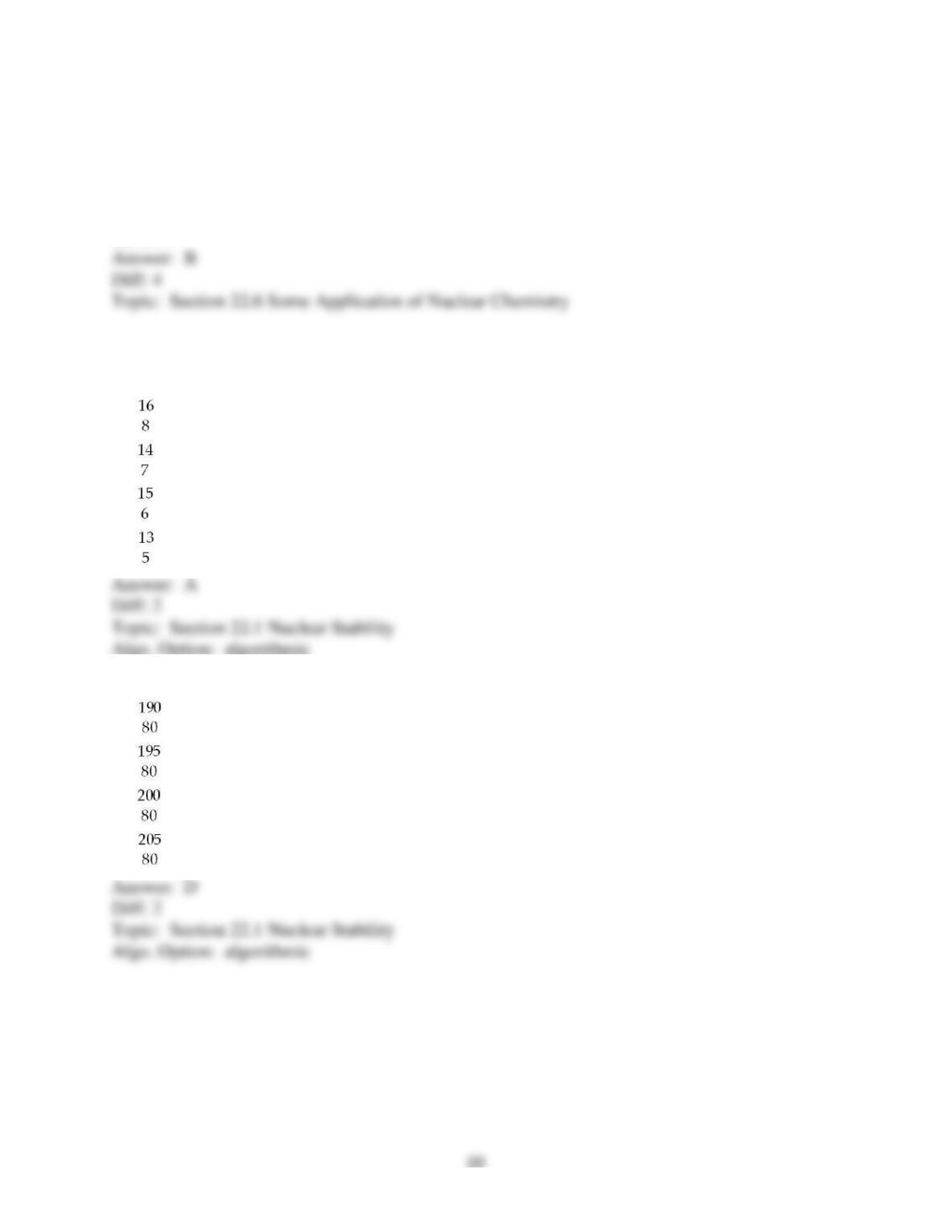
1) Which of the following elements would be expected to be particularly stable?
A) O
B) N
C) C
D) B
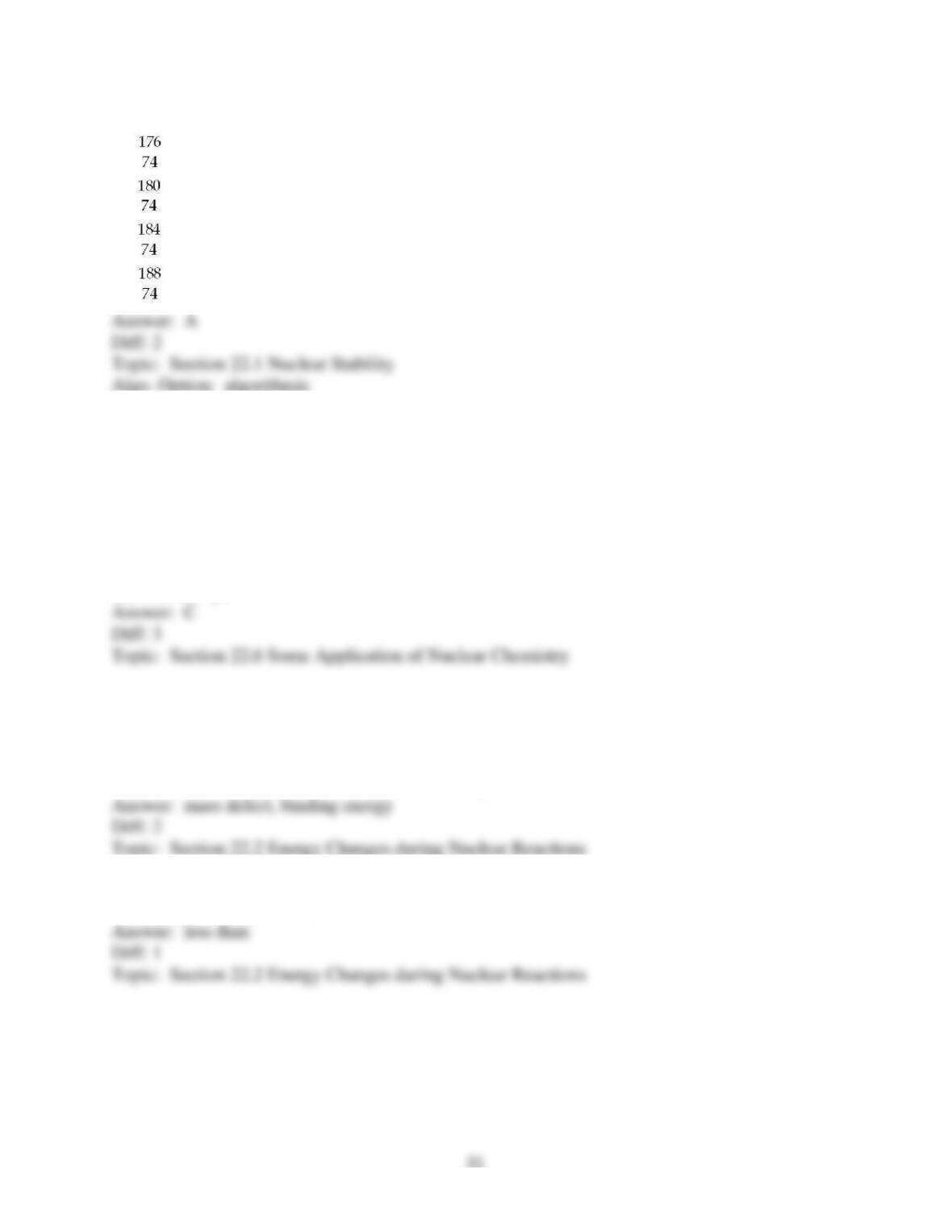
2) Which of the following nuclides is most likely to undergo beta decay?
A) Hg
B) Hg
C) Hg
D) Hg
3) Which nuclide below is most likely to decay by electron capture?
A) W
B) W
C) W
D) W
4) Carbon-14, which is present in all living tissue, radioactively decays via a first-order process.
A one-gram sample of wood taken from a living tree gives a rate for carbon-14 decay of 13.6
counts per minute. If the half-life for carbon-14 is 5715 years, how old is a wood sample that
gives a rate for carbon-14 decay of 11.9 counts per minute?
A) 5.3 × 10² yr
B) 7.6 × 10² yr
C) 1.1 × 10³ yr
D) 9.4 × 10³ yr
22.3 Short Answer Questions
1) The loss in mass that occurs when protons and neutrons combine to form a nucleus is called
the ________ of the nucleus, and the corresponding energy released during the formation of that
nucleus is the ________ that holds the nucleus together.
2) The mass of a helium-4 nucleus is ________ (greater than, less than, the same as) the sum of
the masses of two protons plus two neutrons.
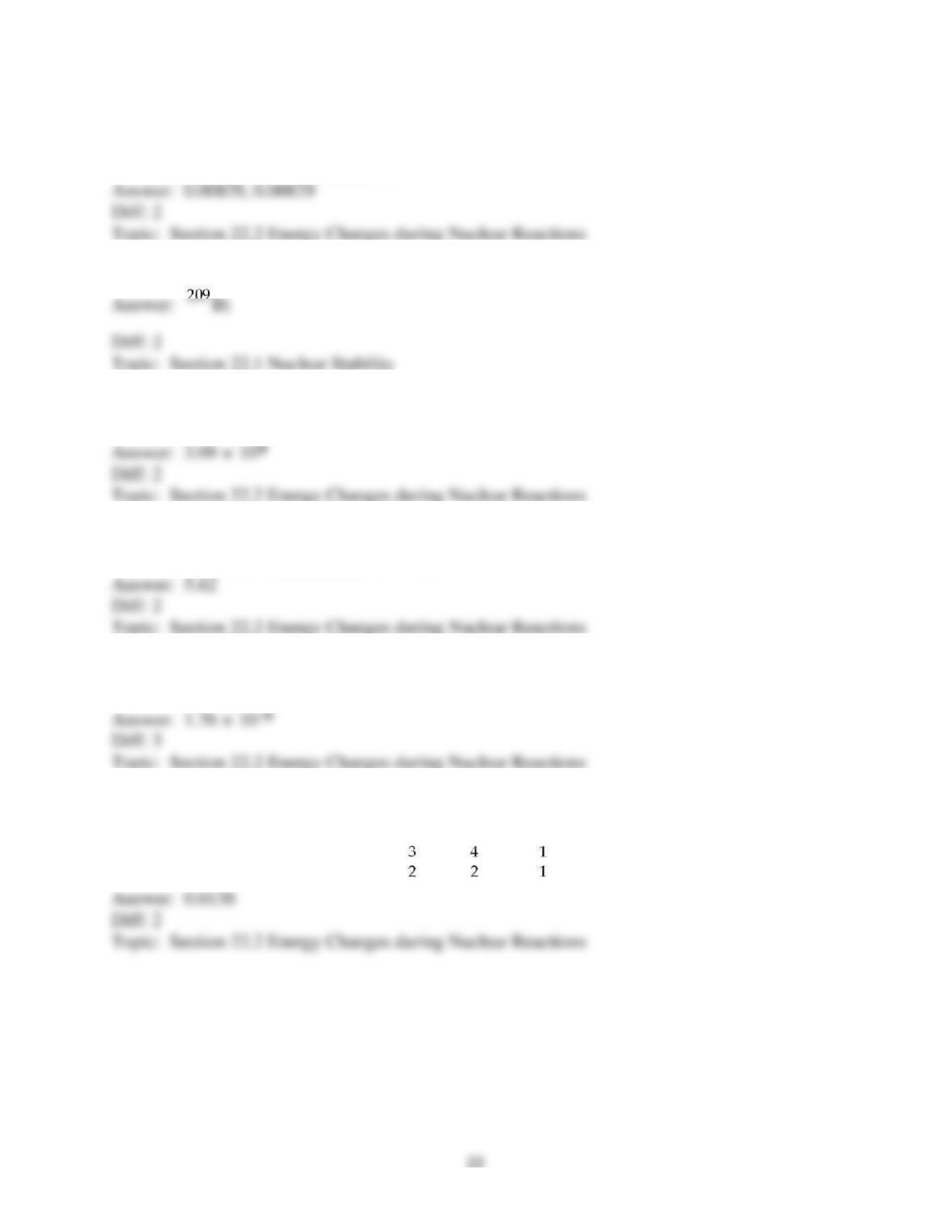
3) Helium-3, an electron, a neutron, and a proton have masses of 3.016029 amu, 5.486 × 10⁻⁴
amu, 1.00866 amu, and 1.00728 amu, respectively. The mass defect for the formation of helium-
3 is ________ amu or ________ g/mol.
4) All nuclei heavier than ________ are radioactive.
5) The mass defect for the formation of lithium-6 is 0.0343 g/mol. The binding energy for
lithium-6 nuclei is ________ kJ/mol.
6) The binding energy for lithium-7 nuclei is 3.79 × 10¹² J/mol. The binding energy per nucleon
for lithium-7 nuclei is ________ MeV/nucleon.
7) The mass defect for the chemical reaction shown below is ________ g.
2 F → F2 E = -159 kJ/mol
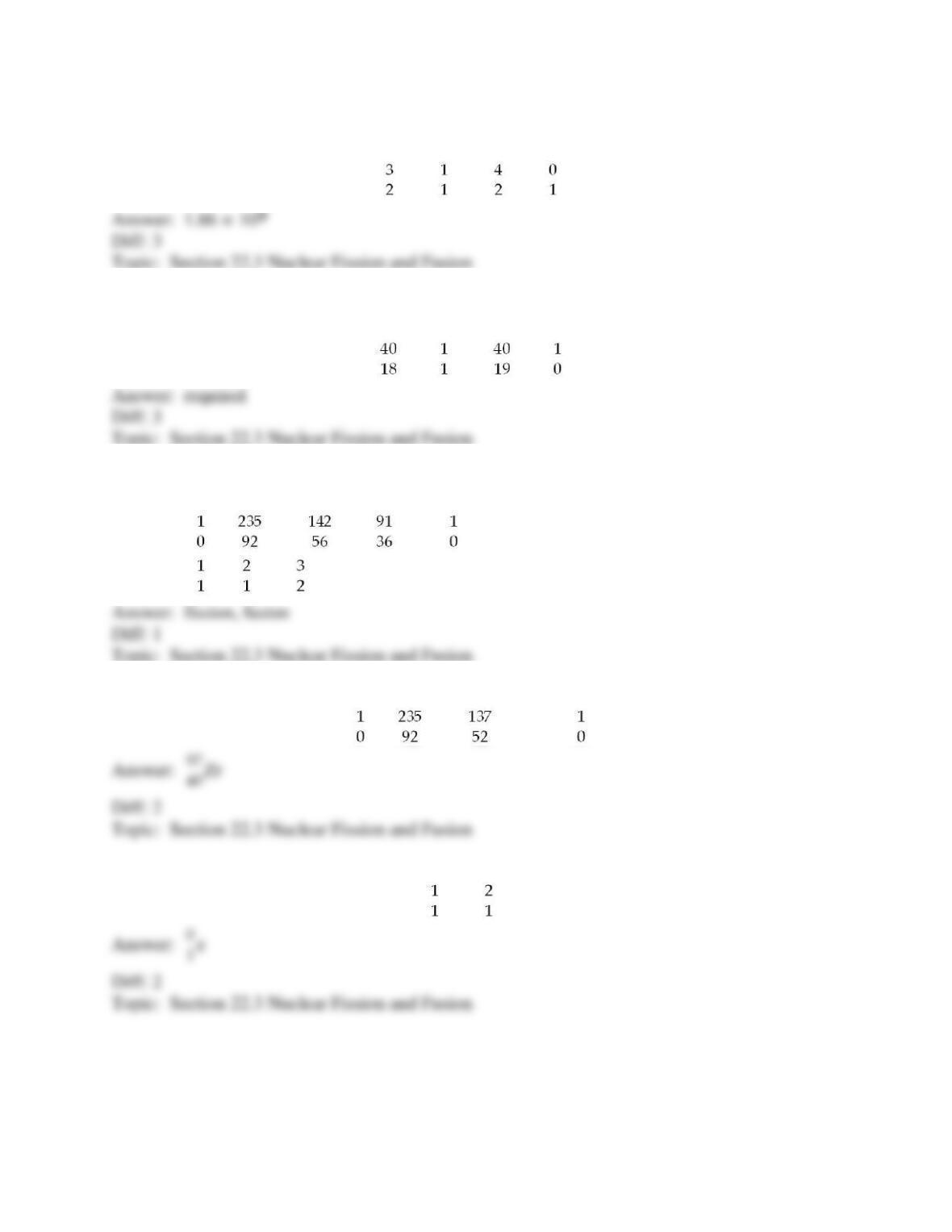
8) The mass change for the reaction shown below is ________ amu. The atomic masses are 3He
(3.0160), 4He (4.0026), 1H (1.0078).
2 He → He + 2 H
23
9) The reaction below releases ________ kJ/mol. The atomic masses are 3He (3.0160), 1H
(1.0078), 4He (4.0026), 0e (0.0005486).
He + H → He + e
10) Energy is ________ (released, required) in the transmutation reaction shown below. The
atomic masses are 40Ar (39.9624), 1H (1.0078), 40K (39.9640), 1n (1.0087).
Ar + H → Kr + n
11) The two reactions shown below are classified as (1) nuclear ________ and (2) nuclear
________.
(1) n + U → Ba + Kr + 3 n
(2) H + H → He
12) What is needed to balance the nuclear fission reaction below?
n + U → Te + ? + 2 n
13) What is needed to balance the nuclear fusion reaction below?
2 H → H + ?
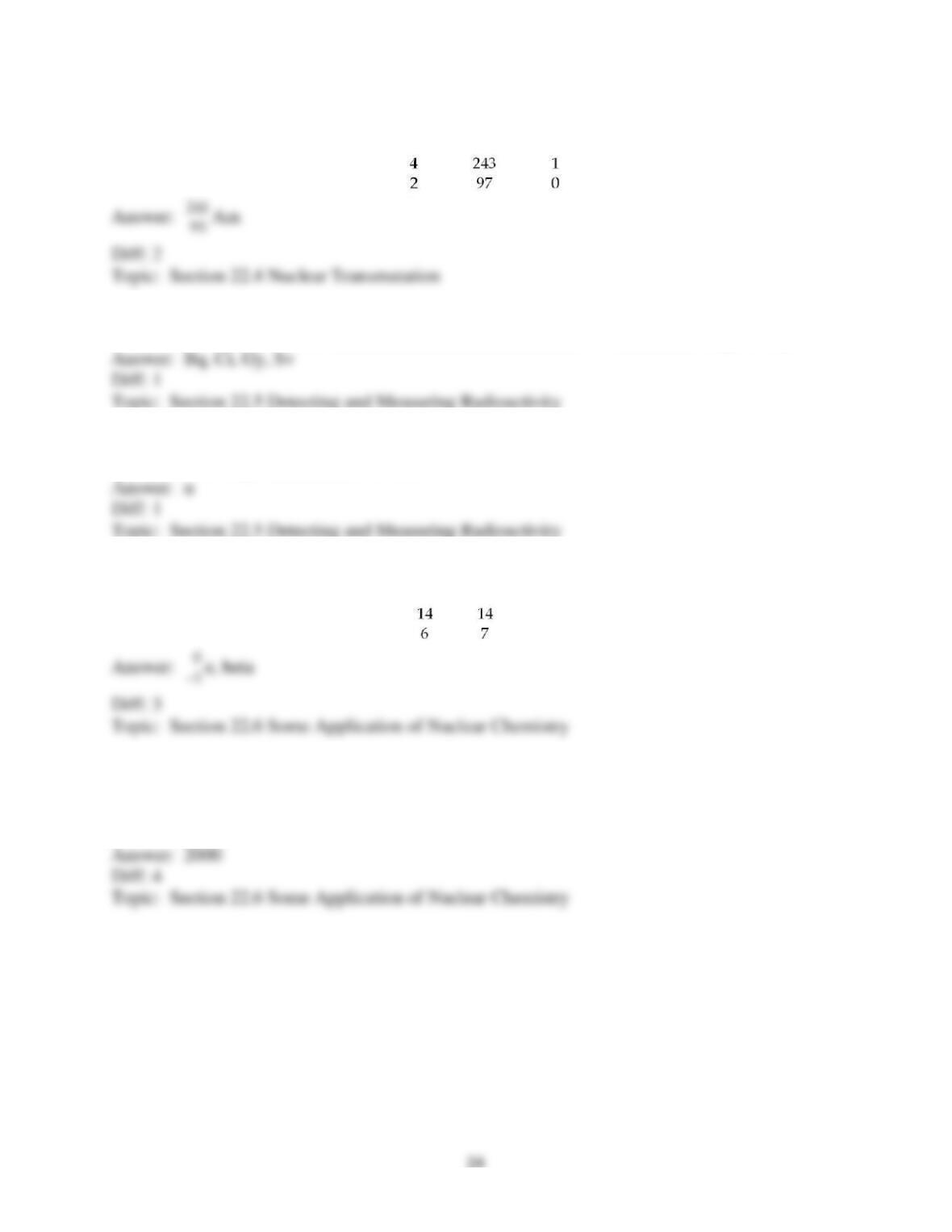
14) In the transmutation reaction that results in the formation of berkelium-243, shown below,
the nucleus that is bombarded by alpha particles is ________.
? + He → Bk + 2 n
15) Units used for measuring radiation include the becquerel, the curie, the gray, and the sievert,
which have the abbreviations ________, ________, ________, and ________, respectively.
16) Among the types of radiation, α, β, γ, and X, the one that requires the least amount of
protective clothing is ________ radiation.
17) Radiocarbon dating involves the unbalanced equation shown below. Needed to balance this
equation is ________. This is an example of ________ decay.
C → N + ?
18) Carbon-14 has a half-life of 5715 years. Currently living organisms decay at a rate of 15.3
disintegrations/ min per gram of carbon. If an archeological artifact has a carbon-14 decay rate of
12.0 disintegrations/ min per gram of carbon, the approximate age of the artifact is ________
years old.
19) Human bones found on the west coast of the United States were thought to be remains of a
prospector who lived in the 19th century. The bones were subjected to carbon-14 dating. Carbon-
14 has a half-life of 5715 years. Living organisms decay at a rate of 15.3 disintegrations per
minute per gram of carbon. The bones had a carbon-14 decay rate of 5.13 disintegrations per
minute per gram of carbon. To one significant figure the age of the bones is ________ years old,
so the person ________ (did, did not) live in the 19th century.
20) An average person receives 40 mrem of radiation from medical procedures annually. If a
dose as low as 25 rem can lead to a decrease in white blood cell count, what is the maximum
number of medical procedures that involve radiation allowable before white blood cell count
decrease occurs?
21) 201Tl is used in myocardial perfusion imaging. It undergoes beta decay with a half-life of 73
hours generating 80 keV X-rays. A typical dose is 2.5 mCi which is equal to ________ Bq.