B) 2 N2(g) + O2(g) → 2 NO(g)
C) NH4NO3(l) → N2O(g) + 2 H2O(g)
D) 2 NO2(g) → N2O4(g)
82) What statement about nitric acid is not true?
A) It is a strong oxidizing agent.
B) It is one of the more common strong acids and is essentially 100% dissociated in water.
C) It often has a yellow color due to the formation of NO2.
D) Its anhydride is N2O3.
83) What are the signs are expected for the entropy change ΔS and free energy change ΔG for the reaction
below?
N2H4(l) + N2O4(l) → 3 N2(g) + 4 H2O(g) ΔH = -1049 kJ
A) ΔS = + and ΔG = +
B) ΔS = + and ΔG = –
C) ΔS = – and ΔG = +
D) ΔS = – and ΔG = –
22
84) A 0.010 M solution of which of the following would have the lowest pH?
A) CH3NH2 (Kb = 3.7 × 10⁻⁴)
B) NH2OH (Kb = 9.1 × 10⁻⁹)
C) NH3 (Kb = 1.8 × 10⁻⁵)
D) N2H4 (Kb = 8.0 × 10⁻⁷)
85) A 0.010 M solution of which of the following would have the highest pH?
A) CH3NH2 (Kb = 3.7 × 10⁻⁴)
B) (CH3)2NH (Kb = 5.4 × 10⁻⁴)
C) (CH3)3N (Kb = 1.8 × 10⁻⁵)
D) NH3 (Kb = 6.5 × 10⁻⁵)
86) What is the structure of white phosphorus?
A) cage system of Px molecules
B) discrete P atoms
C) discrete P4 molecules
D) polymeric chain-like structure
87) What is not a characteristic of white phosphorus?
A) At temperatures less than 0°C it is converted to red phosphorus.
B) It bursts into flames when exposed to air, thus it is stored under water.
C) It has a low melting point (44°C).
D) It is soluble in nonpolar solvent such as carbon disulfide CS2.
88) What is not an appropriate method of making phosphoric acid?
A) PH3(g) + 2 O2(g) → H3PO4(l)
B) PCl5(s) + 4 H2O(l) → H3PO4(aq) + 5 HCl(aq)
C) P4O10(s) + 6 H2O(l) → 4 H3PO4(aq)
D) P4(s) + 16 H2O(l) → 4 H3PO4(aq) + 2 H2(g)
89) What is an appropriate method for the synthesis of phosphorus?
A) 2 Ca3(PO4)2(s) + 10 C(s) + 6 SiO2(s) + heat → P4(g) + 10 CO(g) + 6 CaSiO3(l)
B) 4 PCl5(s) + heat → P4(g) + 10 Cl2(g)
C) 4 PH3(g) + heat → P4(g) + 6 H2(g)
D) P4O6(s) + heat → P4(g) + 3 O2(g)
90) What is the most acidic oxide of phosphorus?
A) PO2
B) PO3
C) P4O6
D) P4O10
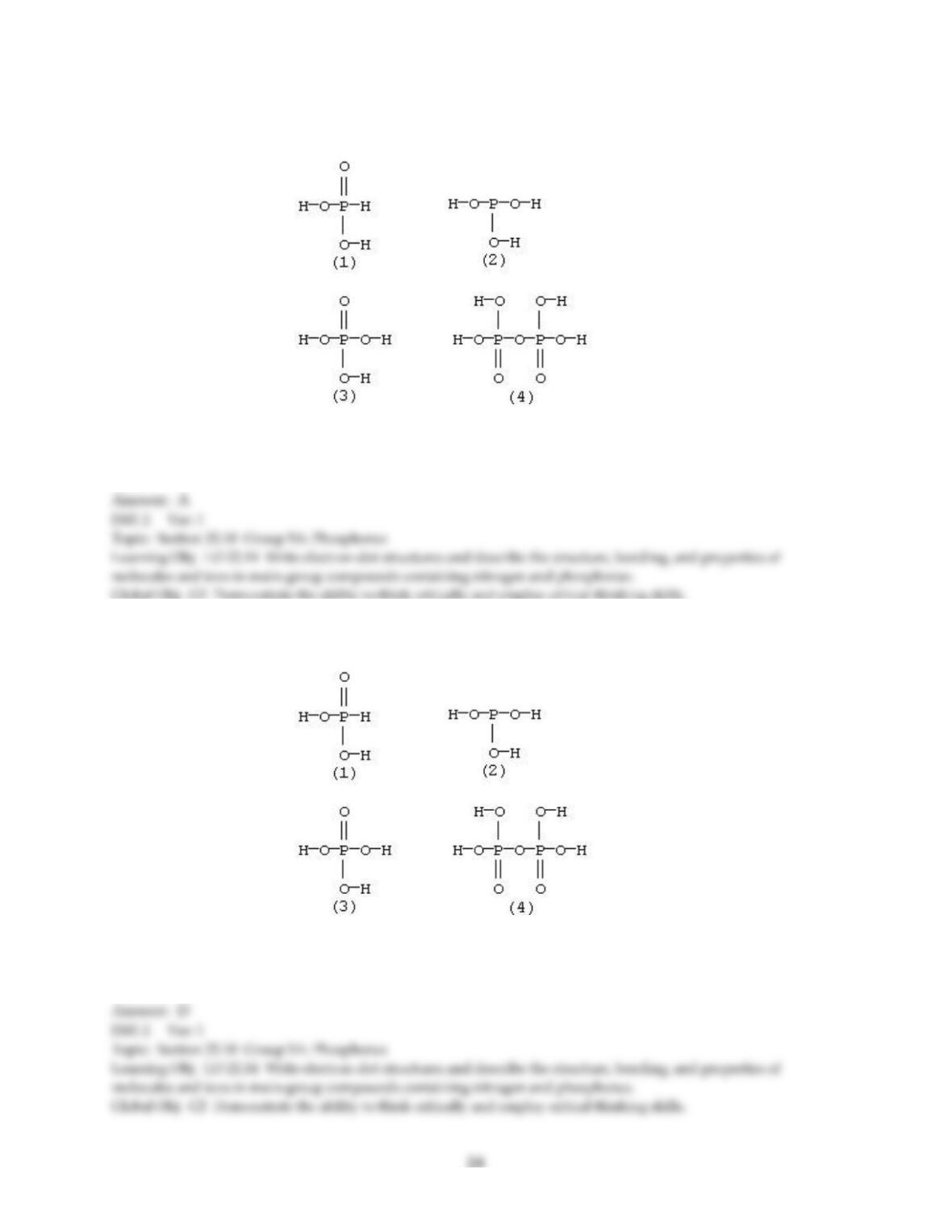
91) What is the molecular structure of phosphorous acid?
A) 1
B) 2
C) 3
D) 4
92) What are the molecular structures of orthophosphoric acid and pyrophosphoric acid?
A) 1 and 2
B) 1 and 3
C) 2 and 3
D) 3 and 4
93) What statement is not characteristic about group 6A elements?
A) Oxygen, sulfur, and selenium are typical nonmetals while tellurium is a semi-metal.
B) Oxygen is a powerful oxidizing agent but H2Se and H2Te are good reducing agents.
C) S, Se, and Te are much less electronegative than oxygen and commonly have positive oxidation states.
D) The favored oxidation state of Te and Po is +2.
94) Which elements of group 6A are oxidizing agents and which are reducing agents?
A) O and S are oxidizing agents while Se and Te are reducing agents.
B) O and Se are oxidizing agents while S and Te are reducing agents.
C) O and S are reducing agents while Se and Te are oxidizing agents.
D) O and Se are reducing agents while S and Te are reducing agents.
95) Which is not true about elemental oxygen?
A) Oxygen exists in two allotropic forms.
B) Oxygen has a double bond.
C) Oxygen is a reducing agent.
D) Solid oxygen melts at -219 degrees Celsius.
96) There are three isotopes of oxygen 16O, 17O and 18O. Indicate the number of different types of
isotopically substituted diatomic oxygen.
A) 3
B) 5
C) 6
D) 9
97) There are three different isotopes of hydrogen 1H, 2H, 3H and three different isotopes of oxygen 16O,
17O, 18O. Indicate the number of different types of isotopically substituted water, H2O, that could be
formed.
A) 9
B) 12
C) 15
D) 18
98) Using the three different isotopes of oxygen 16O, 17O, 18O and the major isotope of hydrogen, 1H.
Determine the number of different types of isotopically substituted hydrogen peroxide, H2O2, that could
be formed.
A) 3
B) 5
C) 6
D) 9
99) Commercially oxygen is usually obtained by
A) decomposition of mercury(II) oxide.
B) decomposition of potassium chlorate.
C) electrolytic decomposition of water.
D) fractional distillation of air.
100) Which one of the following binary oxides is the most basic?
A) B2O3
B) Al2O3
C) Ga2O3
D) In2O3
101) Which reaction is not consistent with the chemistry of binary oxides?
A) Na2O(s) + H2O(l) → 2 Na+(aq) + 2 OH–(aq)
B) SiO2(s) + 2 OH–(aq) → SiO32-(aq) + H2O(l)
C) Al2O3(s) + 6 H+(aq) → 2 Al3+(aq) + 3 H2O(l)
D) N2O5(aq) + 2 H+(aq) → 2 NO2+(aq) + H2O(l)
102) When sodium metal is heated in excess oxygen it tends to form
A) an oxide.
B) a peroxide.
C) a superoxide.
D) an oxide and a superoxide.
103) What is the chemical formula for the superoxide ion?
A) O–
B) O2-
C) O2–
D) O22-
104) Which of the following is a peroxide?
A) Li2O
B) K2O2
C) CaO
D) CsO2
105) What is the oxidation number of oxygen in KO2?
A) 0
B) -1/2
C) -1
D) -2
106) What is the oxidation number of oxygen in BaO2?
A) 0
B) -1/2
C) -1
D) -2
107) In which compound does oxygen have a -1 oxidation state?
A) H2O
B) H2O2
C) O2
D) MgO
108) What is the chemical formula of “fool’s gold”?
A) cinnabar, HgS
B) galena, PbS
C) gypsum, CaSO4↔2H2O
D) pyrite, FeS2
109) What is the structure of rhombic sulfur?
A) crown shaped S8 molecules
B) discrete S atoms
C) discrete S2 molecules
D) polymeric Sn chains
110) What are appropriate methods for the generation of H2S?
Reaction 1: FeS(s) + 2 H+(aq) → H2S(g) + Fe2+(aq)
Reaction 2: CH3C(CS)NH2(aq) + H2O(l) + heat → CH3(CO)NH2(aq) + H2S(aq)
Reaction 3: 3 S(g) + 2 H2O(g) → SO2(g) + 2 H2S(g)
Reaction 4: 2 SO2(g) + 2 H2O(g) → 2 H2S(g) + 3 O2(g)
A) Reactions 1 and 2
B) Reactions 1 and 3
C) Reactions 2 and 3
D) Reactions 2 and 4
111) Describe the color changes when sulfur (melting point 113°C, boiling point 445°C) is heated from
25°C to 500°C? It turns from a yellow solid to a
A) dark reddish brown liquid and then boils.
B) reddish brown solid and then into reddish brown liquid and then boils.
C) straw colored liquid which turns dark reddish brown and then it boils.
D) yellow liquid and then it boils.
112) The increased viscosity of molten sulfur at 160-195°C is due to the
A) melting of S8 to give discrete S8 units.
B) merging of the S8 rings to give interlocking S8 rings.
C) opening of the S8 rings to give smaller S units.
D) opening of the S8 rings which then polymerize into long chains.
113) What is a convenient synthetic method for the preparation of SO2?
A) 2 SO3(g) + heat → 2 SO2(g) + O2(g)
B) S8(s) + 8 O2(g) + heat → 8 SO2(g)
C) H2SO3(aq) ⇌ H2O(l) + SO2(aq)
D) FeSO3(s) + heat → FeO(s) + SO2(g)
114) What is the anhydride of sulfuric acid?
A) SO2
B) SO3
C) S2O3
D) S2O5
115) What is the name of the commercial process for the preparation of sulfuric acid?
A) Contact process
B) Haber process
C) Mond process
D) Ostwald process
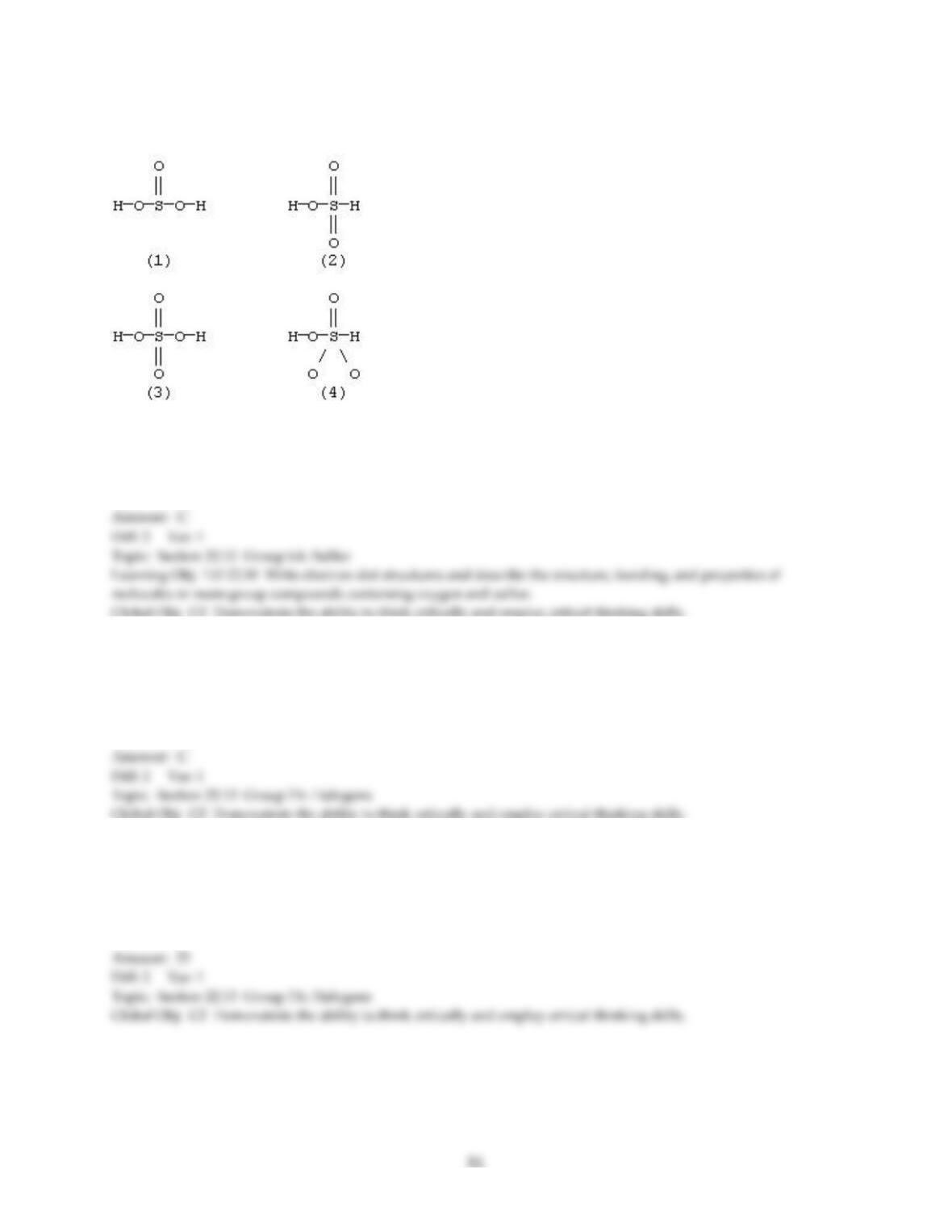
116) What is the structure of sulfuric acid?
A) 1
B) 2
C) 3
D) 4
117) Which of the following elements is a liquid at room temperature?
A) fluorine
B) chlorine
C) bromine
D) iodine
118) Which of the following elements is a solid at room temperature?
A) fluorine
B) chlorine
C) bromine
D) iodine
32
119) Which group of elements are found as diatomic molecules?
A) alkali metals
B) alkaline earth metals
C) halogens
D) noble gases
120) Both chlorine and bromine can be produced in the laboratory by reacting the halides with
manganese(IV) oxide. If the following equation is balanced in an acidic solution, then the MnO2 is acting
as a(n) ________ and the coefficient in front of H+ is ________.
________ MnO2(s) + ________ Cl–(aq) + ________ H+(aq) → ________ Mn2+(aq) + ________ Cl2(g) +
________ H2O(l)
A) oxidizing agent, 2
B) oxidizing agent, 3
C) oxidizing agent, 4
D) reducing agent, 3
121) Metals tend to react with the halogens to form metal halides. What is the reactivity order for the
halogens?
A) F2 > Cl2 > Br2 > I2
B) Cl2 > F2 > Br2 > I2
C) Br2 > I2 > Cl2 > F2
D) I2 > Br2 > Cl2 > F2
122) Which of the hydrogen halide acids is used to etch glass?
A) HF
B) HCl
C) HBr
D) HI
123) Which of the following reactions is inconsistent with the chemistry of the halogens?
A) H2(g) + Cl2(g) → 2 HCl(g)
B) Fe(s) + F2(g) → FeF2(s)
C) Br2(l) + 2 Cl–(aq) → 2 Br–(aq) + Cl2(g)
D) I2(s) + 3 Cl2(g) → 2 ICl3(s)
124) Interhalogen compounds can be produced by reacting two different halogens together. Which one of
the following compounds does not exist?
A) ClF
B) ClBr
C) ClBr3
D) IF3
125) Predict the product(s) of the reaction of Br2(aq) with I–(aq).
A) No reaction
B) IBr3–(aq)
C) BrO3–(aq) and I2(aq)
D) Br–(aq) and I2(aq)
126) Which of the halogens forms more than one perhalic acid?
A) F
B) Cl
C) Br
D) I
127) A 0.01 M aqueous solution of which of the following is the most basic?
A) NaClO
B) NaClO2
C) NaClO3
D) NaClO4
128) Using principles discussed in chapters 15 and 19, determine which of the following is the strongest
acid.
A) HClO
B) HClO2
C) HClO3
D) HClO4
129) Using principles discussed in chapters 15 and 19, determine which of the following is the strongest
acid.
A) HClO2
B) HClO3
C) HBrO3
D) HIO3
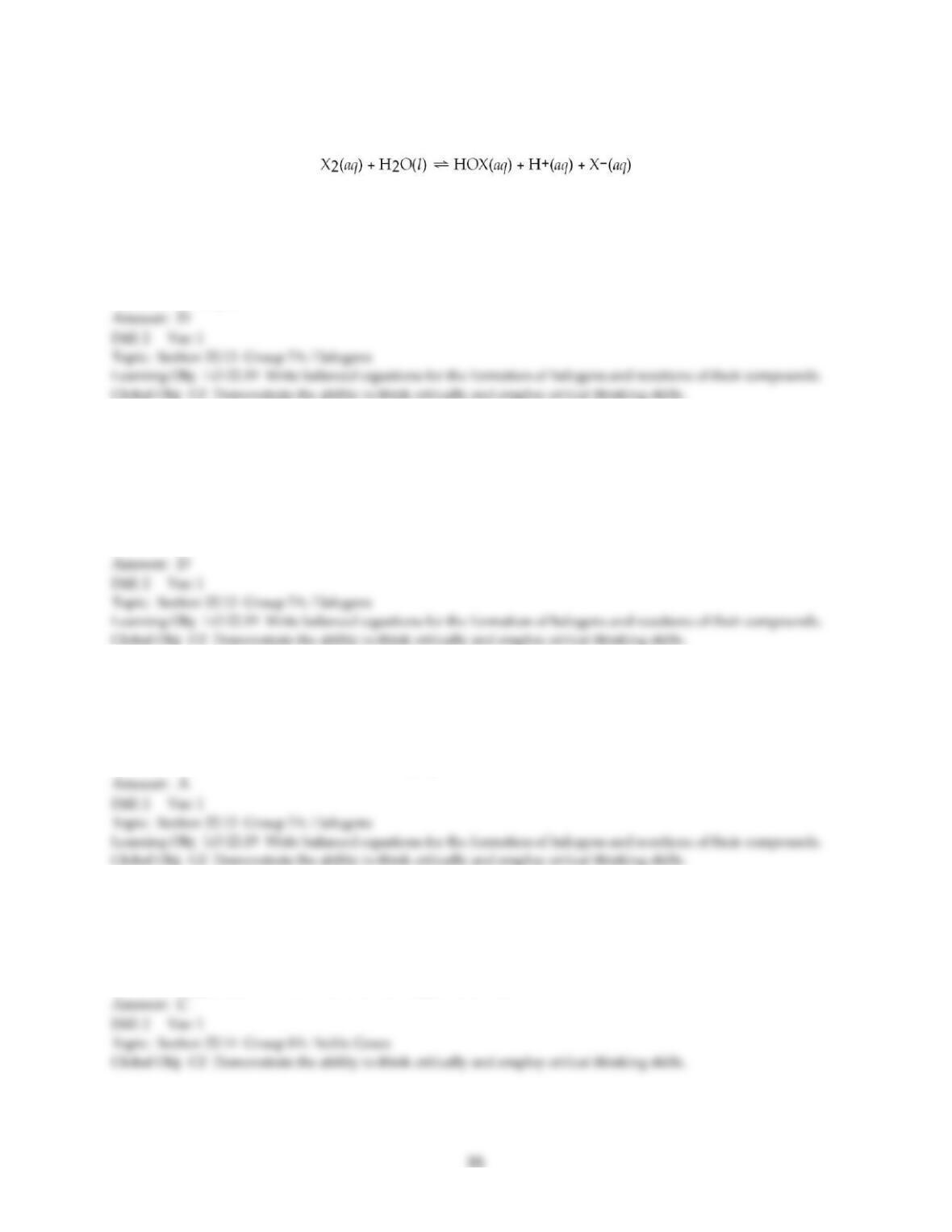
130) Given that hypohalous acids form by the following reaction,
which of the following changes will increase the yield of HOX?
A) add water
B) add X–
C) decrease the pH
D) increase the pH
131) What are the products of the reaction of chlorine gas with hot aqueous sodium hydroxide?
A) Cl– and H2O
B) ClO3– and H2O
C) Cl– and ClO3–
D) Cl–, ClO3– and H2O
132) How would one synthesize a perchlorate salt?
A) Electrolytic oxidation of a solution of chorate salt.
B) Electrolytic oxidation of a solution of chorite salt.
C) Electrolytic oxidation of a solution of hypochlorite salt.
D) Oxidation of a solution of chlorate salt by a perbromate salt.
133) Which of the following statements about helium is inconsistent with its chemistry?
A) A helium oxygen mixture is used as a deep-sea diving gas instead of compressed air.
B) In its liquid form it is used as a cryogenic coolant for superconductors.
C) It is one of the more reactive elements of its group.
D) Its melting point is -272.2°C and its boiling point is -268.9°C.
134) Which statement is inconsistent with the chemistry of the noble gases?
A) Both helium and radon are radioactive.
B) Helium and neon are both lighter than air.
C) Neon and argon are used in decorative or designer lights.
D) Xenon and krypton react with fluorine to form fluorides.
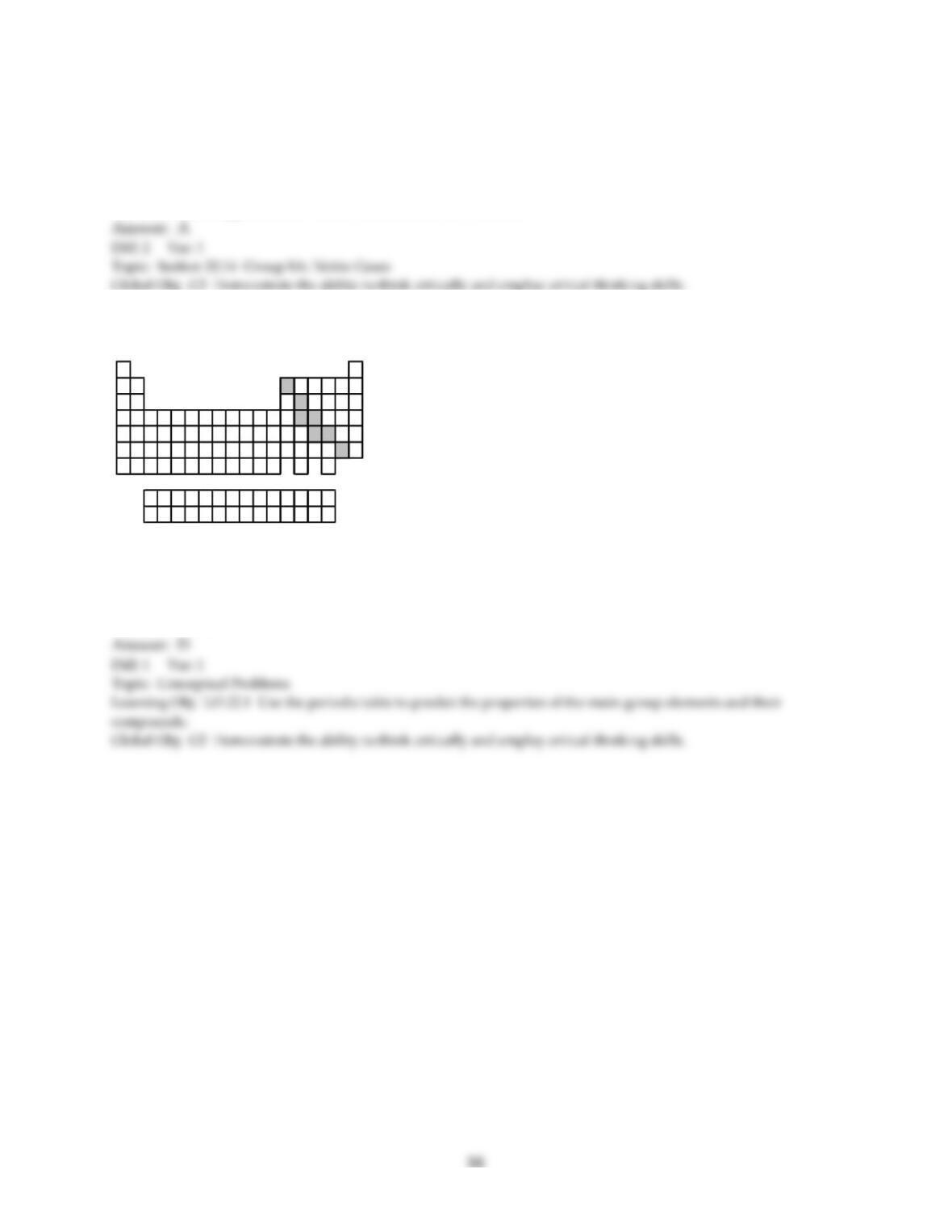
135) The elements indicated by the shaded area in the following periodic table are all
A) gases.
B) metals.
C) nonmetals.
D) semimetals.
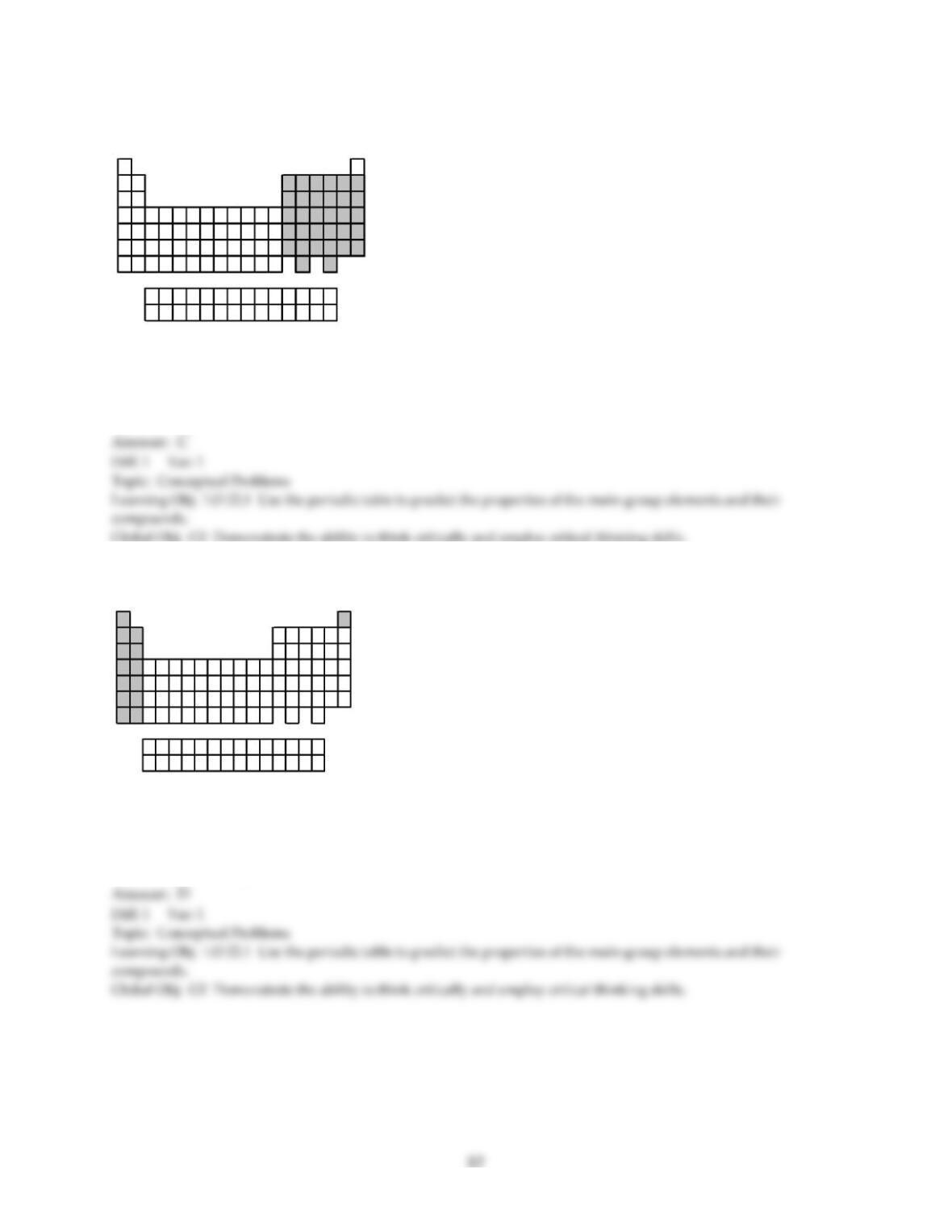
136) The elements indicated by the shaded area in the following periodic table are all
A) metals.
B) nonmetals.
C) p-block elements.
D) s–block elements.
137) The elements indicated by the shaded area in the following periodic table are all
A) metals.
B) nonmetals.
C) p-block elements.
D) s-block elements.
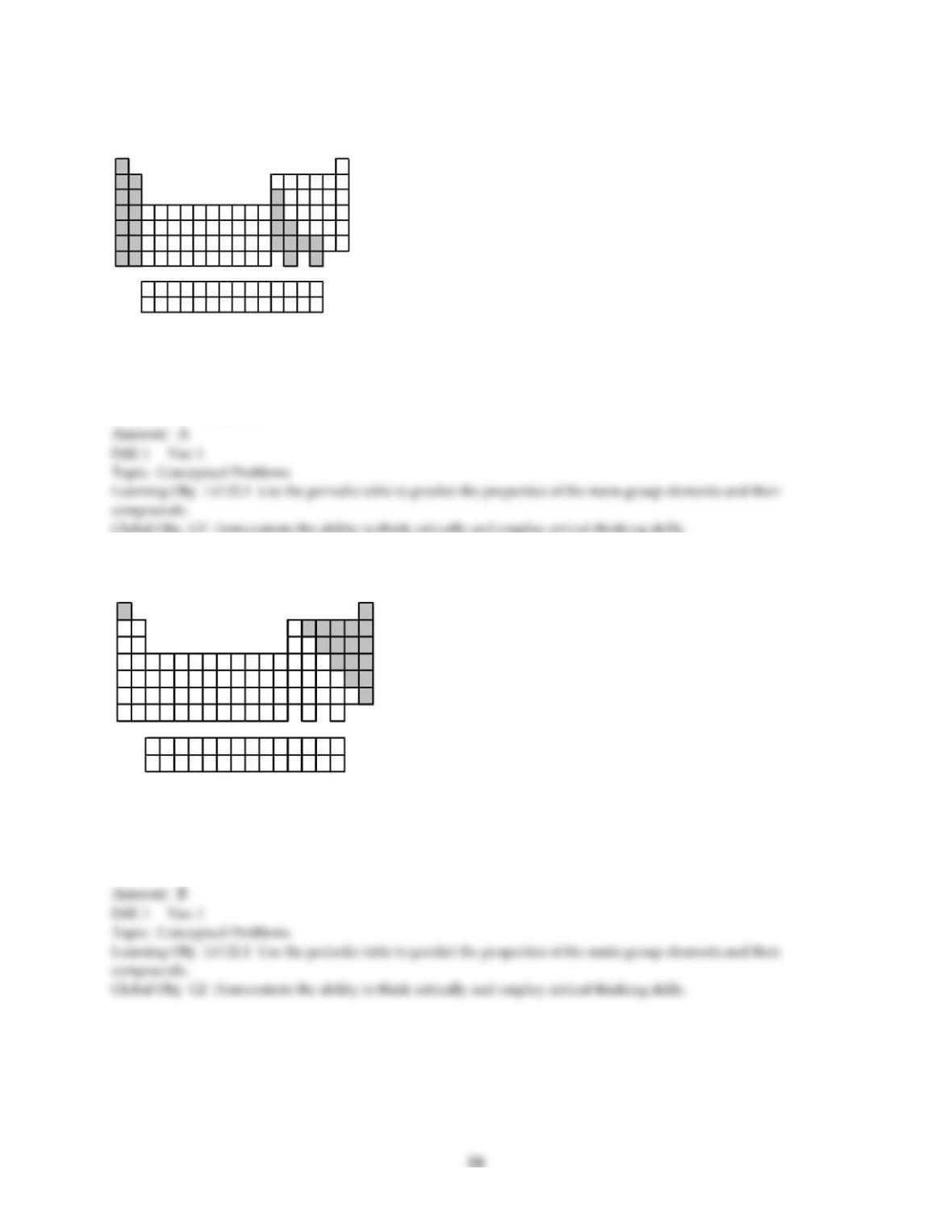
138) The elements indicated by the shaded area in the following periodic table are all
A) main-group elements.
B) p-block elements.
C) s-block elements.
D) transition elements.
139) The elements indicated by the shaded area in the following periodic table are all
A) main-group metals.
B) nonmetals.
C) p-block elements.
D) semimetals.
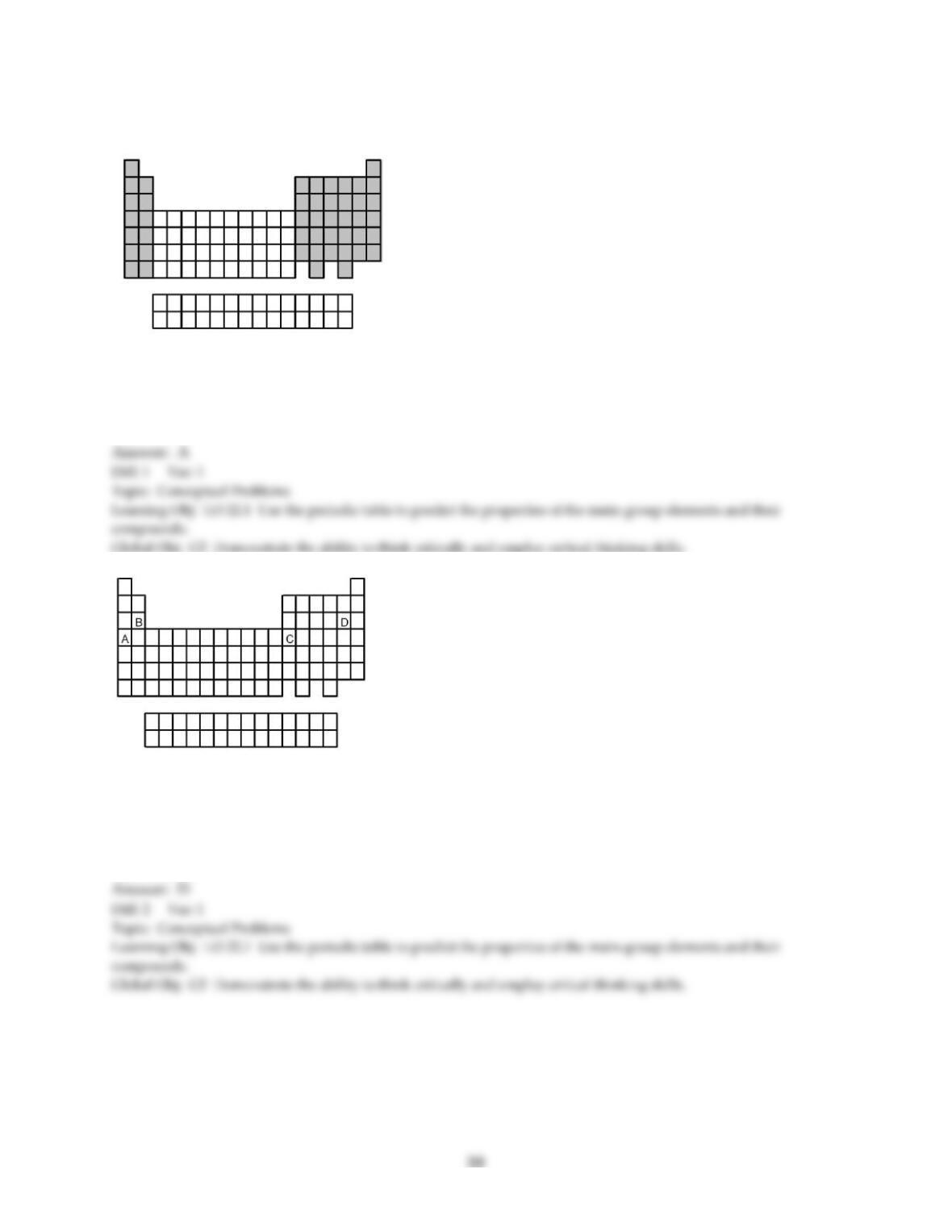
140) The elements indicated by the shaded area in the following periodic table are all
A) main-group elements.
B) main-group metals.
C) nonmetals.
D) semimetals.
141) Which of the elements indicated on the above periodic table has the highest ionization energy?
A) element A
B) element B
C) element C
D) element D
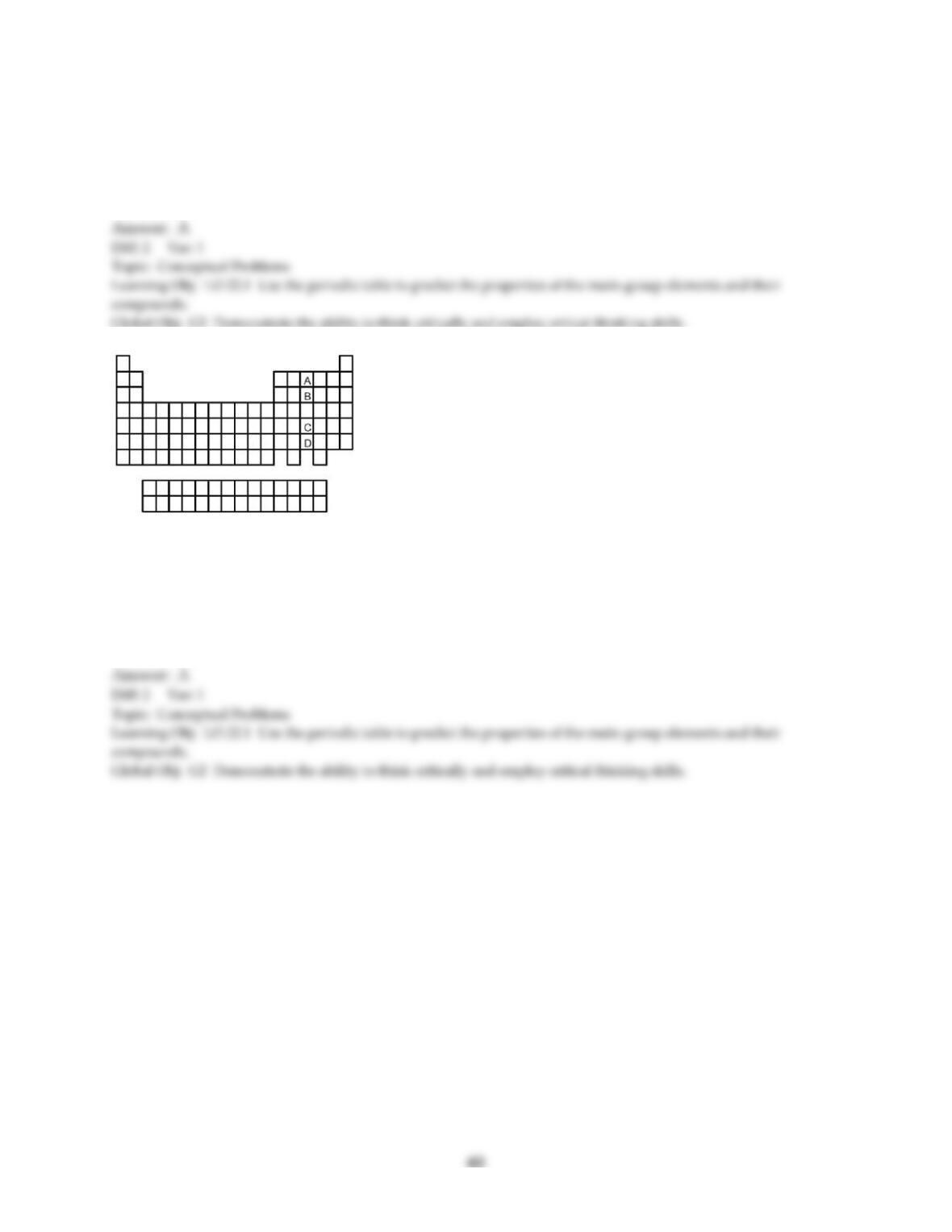
142) Which of the elements indicated on the above periodic table is least electronegative?
A) element A
B) element B
C) element C
D) element D
143) Which of the elements indicated on the above periodic table is the group 5A element with the
smallest atomic radius?
A) element A
B) element B
C) element C
D) element D