69)
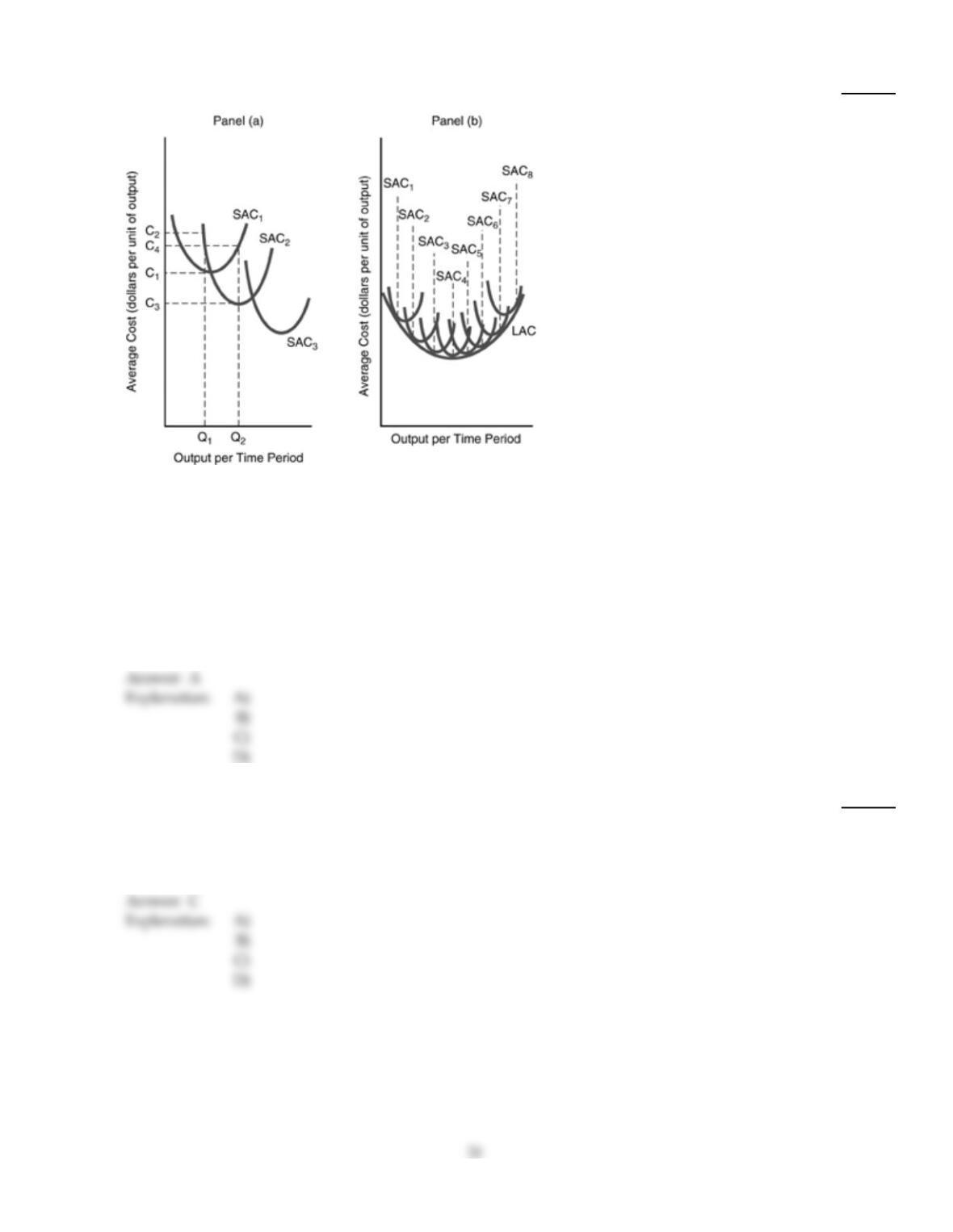
Which of the following statements with respect to the figure below is INCORRECT?
69)
A)
If the permanent rate of output increases to Q2 in panel (a), it will be more profitable to have
a plant size corresponding to SAC3.
B)
The long–run average cost curve LAC in panel (b) is sometimes called the planning curve
representing the locus (path) of points.
C)
All the possible short–run average cost curves that correspond to the different plant sizes are
shown as SAC1– SAC8.
D)
If the anticipated permanent rate of output per unit time period is Q1 in panel (a), the optimal
plant would correspond to SAC1.
70)
Marginal cost is equal to average variable cost
70)
A)
when average variable cost is getting larger.
B)
when marginal cost is at its minimum value.
C)
when average variable cost is at its minimum value.
D)
when average variable cost is getting smaller.
71)
In a graph showing the short–run cost curves, the one curve which declines continuously as we
expand output is called
71)
A)
the marginal cost curve.
B)
the average total cost curve.
C)
the average variable cost curve.
D)
the average fixed cost curve.
72)
The difference between the short run and the long run is
72)
A)
that in the short run at least one factor of production cannot be varied while in the long run all
factors of production can be varied.
B)
economic and accounting profits are not equal in the short run but are equal in the long run.
C)
the short run is a period less than a year while the long run is a period greater than a year.
D)
economic profits are negative in the short run and positive in the long run.
Explanation:
A firm has the following production relationship between labor and output, for a fixed capital stock.
Labor Output
0 0
1 5
211
318
423
526
73)
According to the above table, what is the marginal product of the 5th unit of labor?
73)
A)
5.2
B)
3
C)
4
D)
5
Explanation:
74)
The lowest rate of output per unit of time at which long–run average costs for a firm are at a
minimum defines
74)
A)
allowable efficient scale.
B)
maximum efficient scale.
C)
minimum efficient scale.
D)
short–run efficient scale.
Explanation:
Explanation:
75)
The firm’s short–run costs contain
75)
A)
only variable costs.
B)
only fixed costs.
C)
only opportunity costs.
D)
both variable and fixed costs.
76)
If the long–run average cost curve continuously slopes upward as output rises, minimum efficient
scale would be
76)
A)
at the midpoint of the long–run average cost curve.
B)
zero.
C)
at the rate of output associated with the smallest sized plant the firm can build.
D)
nonexistent.
77)
When total product is increasing at a decreasing rate, marginal product is
77)
A)
positive and decreasing.
B)
negative.
C)
positive and increasing.
D)
constant.
78)
Marginal physical product of labor equals
78)
A)
marginal cost times the wage.
B)
the wage.
C)
marginal cost divided by the wage.
D)
the wage divided by marginal cost.
79)
If the marginal product of an input is falling, then
79)
A)
average total cost is constant.
B)
marginal cost is falling.
C)
marginal cost is rising.
D)
average fixed cost is constant.
80)
As successive equal increases in a variable factor of production are added to fixed factors of
production, there will be a point beyond which the extra product that can be attributed to each
additional unit of the variable factor of production will decline. This is known as the law of
80)
A)
diminishing total product.
B)
decreasing product.
C)
diminishing marginal product.
D)
diminishing average product.
81)
The marginal product of labor may increase rapidly initially as more
81)
A)
the amount of other inputs is held constant.
B)
workers will get crowded in a fixed factory.
C)
workers are able to specialize.
D)
total product is decreasing.
82)
The change in total costs due to a one–unit change in the production rate is
82)
A)
marginal cost.
B)
total variable cost.
C)
total fixed cost.
D)
average total cost.
83)
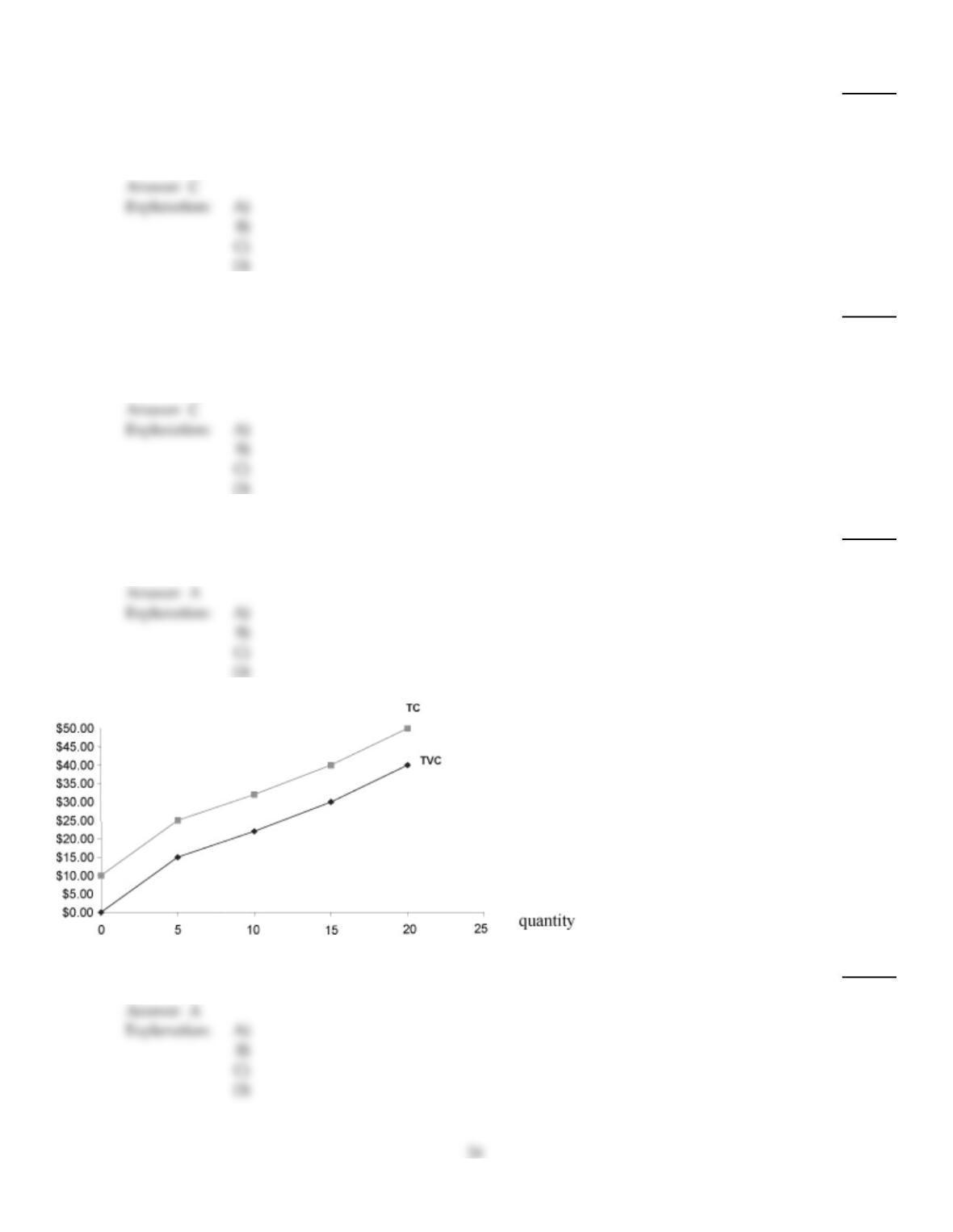
Use the above figure. The ATC at output 10 is
83)
A)
$3.00.
B)
$2.67.
C)
$2.00.
D)
$30.00.
A firm has the following production relationship between labor and output, for a fixed capital stock.
Labor Output
0 0
1 5
211
318
423
526
84)
According to the above table, what is the average product of labor when three laborers are
employed?
84)
A)
3
B)
4
C)
5
D)
6
QTFC TVC TC AFC AVC ATC
1
2$75 $25
3$40
85)
Refer to the above table. What are total fixed costs at an output of 2 units?
85)
A)
$200
B)
$100
C)
$50
D)
$150
86)
Marginal costs are defined as
86)
A)
the change in the decisions that are made by households and firms.
B)
the change in total costs due to a one–unit change in production.
C)
costs that are viewed as marginal; of little or small importance.
D)
costs that represent a change, but one that cannot be measured correctly.
87)
Fred’s Franks originally sold hotdogs and soft drinks from a cart located in front of City Hall. Then
Fred purchased another hotdog cart and hired someone to sell hotdogs and soft drinks near the
high school. Both locations have been successful. When Fred’s Franks expanded to two locations,
which of the following did NOT occur?
87)
A)
Production increased.
B)
The company increased the inputs it employs.
C)
The firm employed additional capital.
D)
Fred’s production function changed.
Fixed Variable Total Average Average Marginal
Output Costs Costs Costs Total Costs Variable Costs Costs
0$0 $100
130
250
3 60
4 120
5200
88)
In the above table, what is the average variable cost to produce 3 units of output?
88)
A)
$10
B)
$30
C)
$60
D)
$20
Input of Labor Total Product
(no. of workers (no. of snowboards
in weeks) produced)
0 0
1 30
2 68
3110
4140
5 135
89)
In the above table, when the firm employs 3 workers, the marginal product will be
89)
A)
30 snowboards.
B)
208 snowboards.
C)
42 snowboards.
D)
36.67 snowboards.
90)
If the marginal product curve is intersecting the average product curve, we know that
90)
A)
the marginal cost curve is intersecting the average total cost curve.
B)
the average total cost curve lies above the marginal cost curve.
C)
the marginal cost curve is intersecting the average fixed cost curve.
D)
the average variable cost curve is intersecting the average total cost curve.
91)
The short run is
91)
A)
a period of time during which all inputs can be changed.
B)
a period of time shorter than one year.
C)
a period of time during which at least one input cannot be changed.
D)
a period of time during which no inputs can be changed.
Quantity of Total Average Marginal
Labor Product Product Product
1 22 22 22
2 52 26 30
381 27 29
4100 25 19
5115 23 15
6126 21 11
92)
Refer to the above table. At what quantity of labor is the average product of labor maximized?
92)
A)
2 units
B)
3 units
C)
6 units
D)
1 unit
93)
The law of diminishing marginal product is a statement
93)
A)
that relates to plant size.
B)
that concerns the long run.
C)
that concerns changes in profits.
D)
that concerns changes in variable input and changes in output.
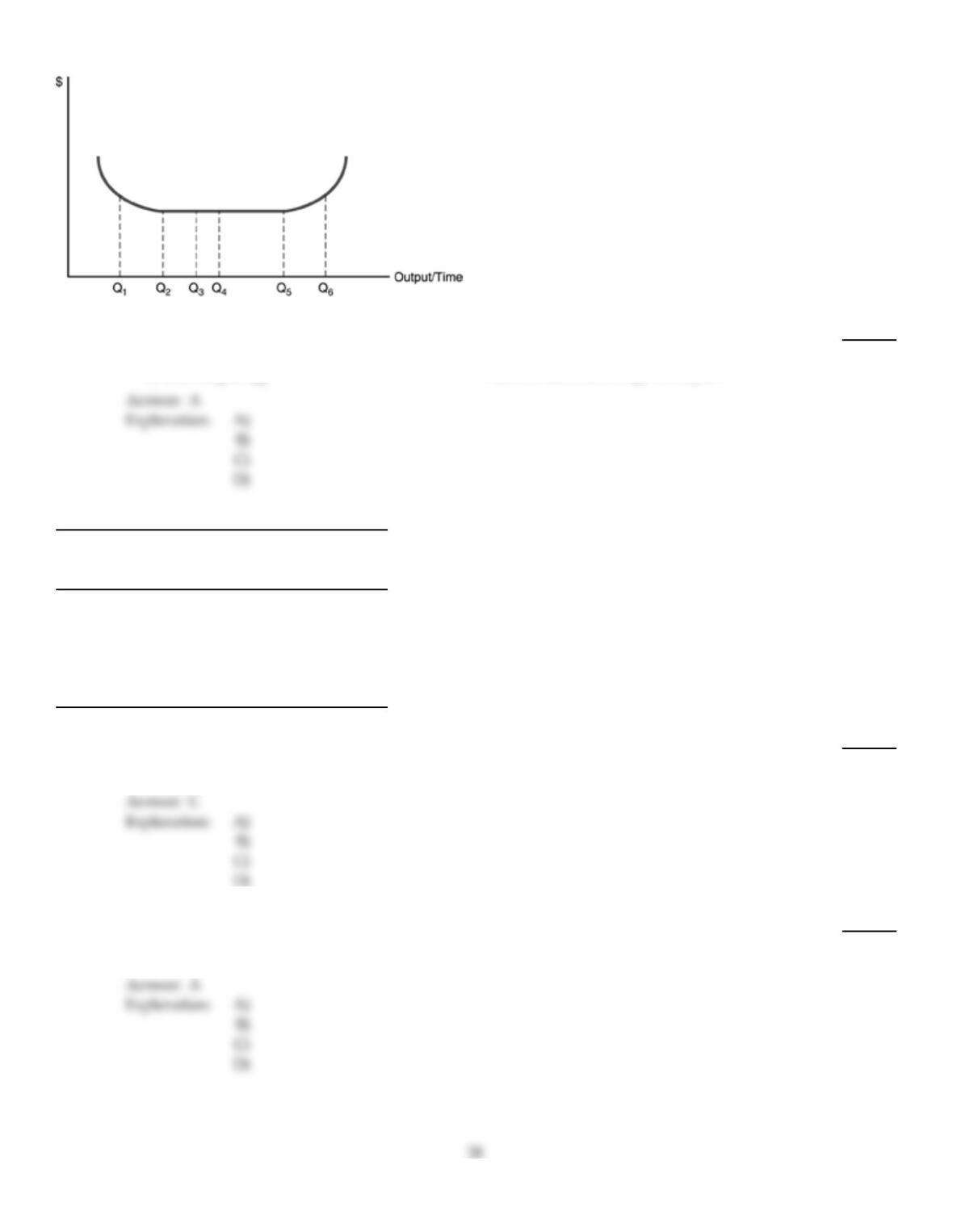
94)
Refer to the above figure. Economies of scale exist
94)
A)
up to output Q2.
B)
from output Q2 to Q5.
C)
after output Q5.
D)
over the entire range of output.
Input of Labor Total Product
(no. of workers (no. of snowboards
in weeks) produced)
0 0
1 30
2 68
3110
4140
5 135
95)
In the above table, how many workers are employed when marginal product reaches its
maximum?
95)
A)
1
B)
2
C)
3
D)
4
96)
At an output at which MC is greater than ATC
96)
A)
the ATC curve is upward sloping.
B)
the AFC curve is upward sloping.
C)
the AVC curve is downward sloping.
D)
the ATC curve is downward sloping.
97)
Which of the following is TRUE about the long run?
97)
A)
All resources are variable.
B)
At least one resource is fixed.
C)
All resources are fixed.
D)
None of the above
QTFC TVC TC
0$90 $ 0 $ 90
190 25 115
290 32 122
390 42 132
490 64 154
590 95 185
98)
Refer to the above table. At an output of 4 units, average variable costs are
98)
A)
$38.50.
B)
$16.
C)
$44.
D)
$22.
99)
Average total cost equals
99)
A)
TC/Q.
B)
TVC/Q.
C)
TFC/Q.
D)
change in total cost/change in output.
QTFC TVC TC
0$90 $ 0 $ 90
190 25 115
290 32 122
390 42 132
490 64 154
590 95 185
100)
Refer to the above table. What is MC when output rises from 0 unit to 1 unit?
100)
A)
$25
B)
$0
C)
$90
D)
$115
101)
After some point successive equal increases in a variable factor of production, when added to a
fixed amount of inputs, will result in smaller increases in output. This is known as
101)
A)
short run average cost.
B)
the long run.
C)
marginal physical product.
D)
the law of diminishing marginal product.
102)
As the amount of a variable input increases, while all other inputs are held constant, total product
will
102)
A)
always increase.
B)
always decrease.
C)
initially increase and then decrease.
D)
initially decrease and then increase.
103)
Due to extremely large fixed costs, an electricity generating plant probably experiences which of
the following returns to size?
103)
A)
economies of scale
B)
constant returns to scale
C)
diminishing marginal product
D)
diseconomies of scale
104)
Another term for the total quantity of output is
104)
A)
total product.
B)
average product.
C)
marginal product.
D)
average variable product.
105)
The observation that after some point, successive equal size increases in a variable factor of
production, such as labor, added to fixed factors of production, will result in smaller increases in
output is the
105)
A)
law of diminishing marginal product.
B)
streamlining production function.
C)
theory of increasing marginal utility.
D)
consumer equilibrium.
Quantity of Total Average Marginal
Labor Product Product Product
1 22 22 22
2 52 26 30
381 27 29
4100 25 19
5115 23 15
6126 21 11
106)
Refer to the above table. At what quantity of labor does the law of diminishing marginal product
set in?
106)
A)
after 3 units
B)
after 1 unit
C)
after 2 units
D)
after 6 units
Input of Labor Total Product
(no. of workers (no. of snowboards
in weeks) produced)
0 0
1 30
2 68
3110
4140
5 135
107)
In the above table, marginal product becomes negative after employing the
107)
A)
fourth worker.
B)
second worker.
C)
third worker.
D)
fifth worker.
108)
The law of diminishing marginal product states that
108)
A)
output will continue to increase indefinitely if more variable factors of production are added
to an existing stock of fixed factors.
B)
variable costs tend to decrease with output.
C)
a doubling all inputs will double output.
D)
successive equal–sized increases in labor, when added to fixed factors of production, will
result in smaller increases of output.
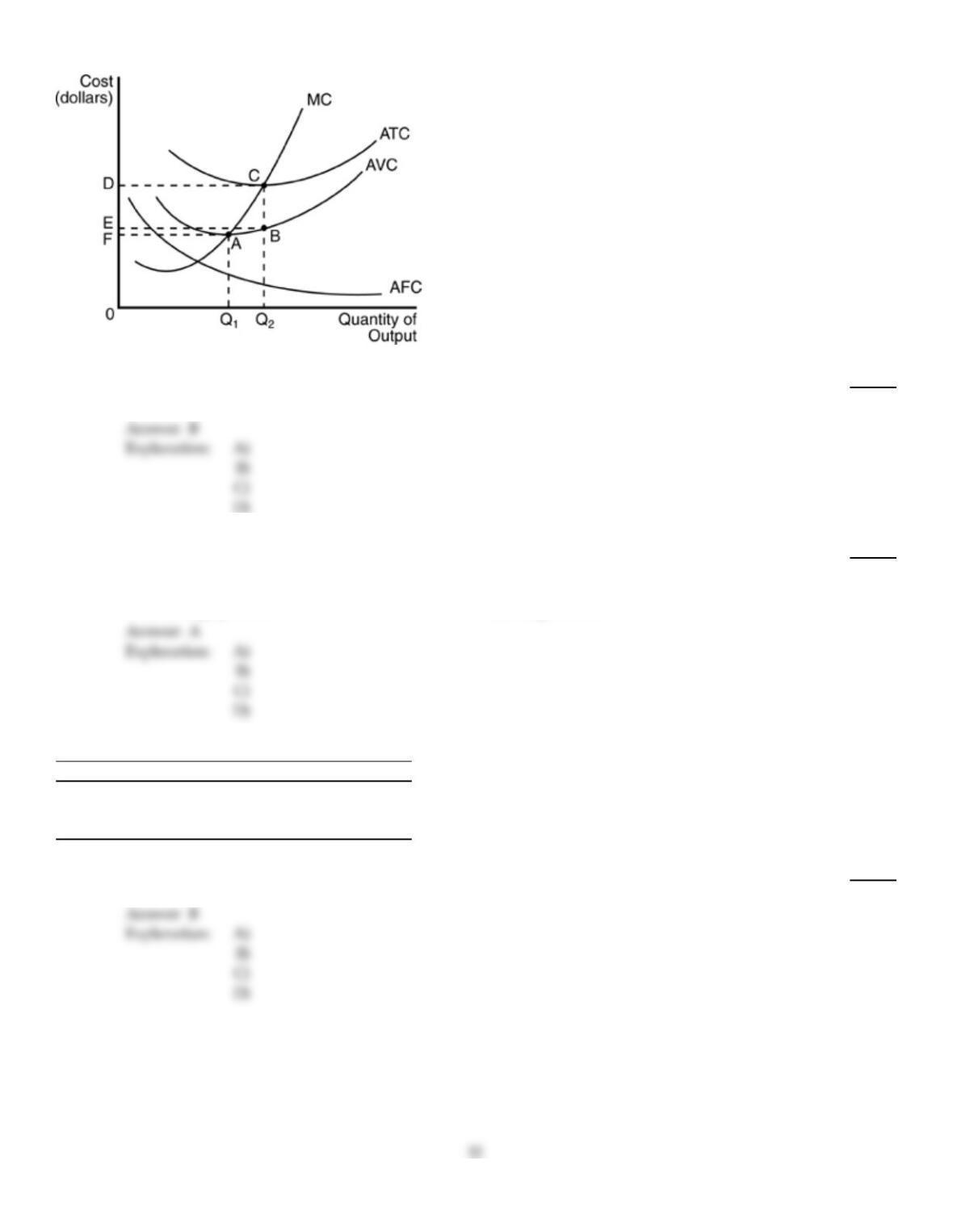
109)
In the above figure, at an output level of Q1, total variable cost is
109)
A)
OD times Q2.
B)
OF times Q1.
C)
OF minus DF.
D)
OF.
110)
In the short run, the additional output that results from hiring an additional unit of a variable input
is the
110)
A)
marginal product.
B)
average variable cost.
C)
average product.
D)
marginal cost.
QTFC TVC TC AFC AVC ATC
1
2$75 $25
3$40
111)
Refer to the above table. What are total fixed costs at an output of 3 units?
111)
A)
$270
B)
$150
C)
$90
D)
$120
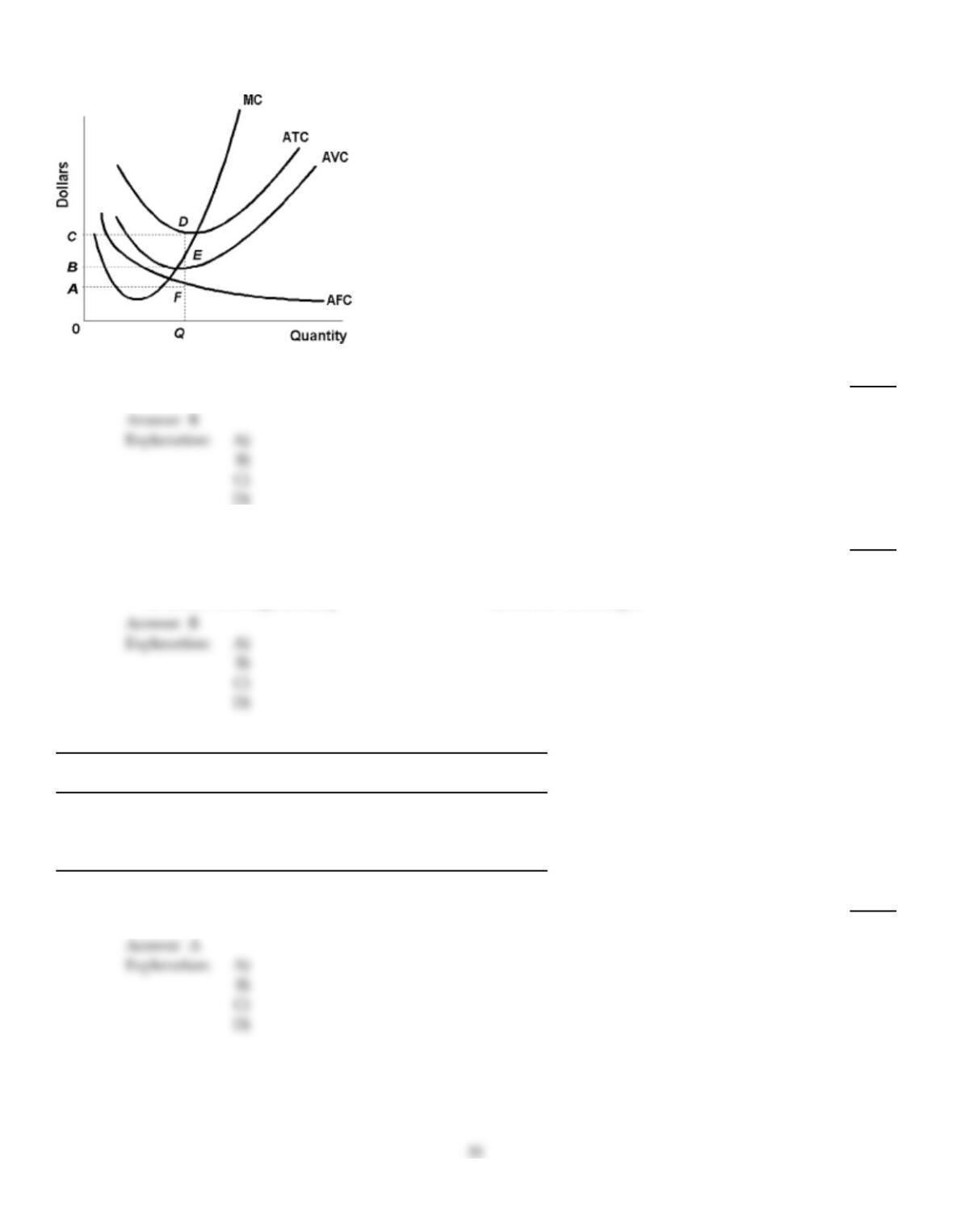
112)
Use the above figure. At an output equal to “Q” the total cost for the firm will be the area
112)
A)
OQBC.
B)
OQDC.
C)
OQEB.
D)
OQFA.
113)
The observation that beyond some point, successive increases in a variable factor of production
added to a fixed factor of production lead to smaller and smaller increases in output is
113)
A)
the law of opportunity costs.
B)
the law of diminishing marginal product.
C)
the law of marginal utility.
D)
the law of averages.
Quantity of Total Average Marginal
Labor Product Product Product
1320
2335
3338
4320
114)
Refer to the above table. What does total product equal when 4 units of labor are used?
114)
A)
1328
B)
960
C)
320
D)
332
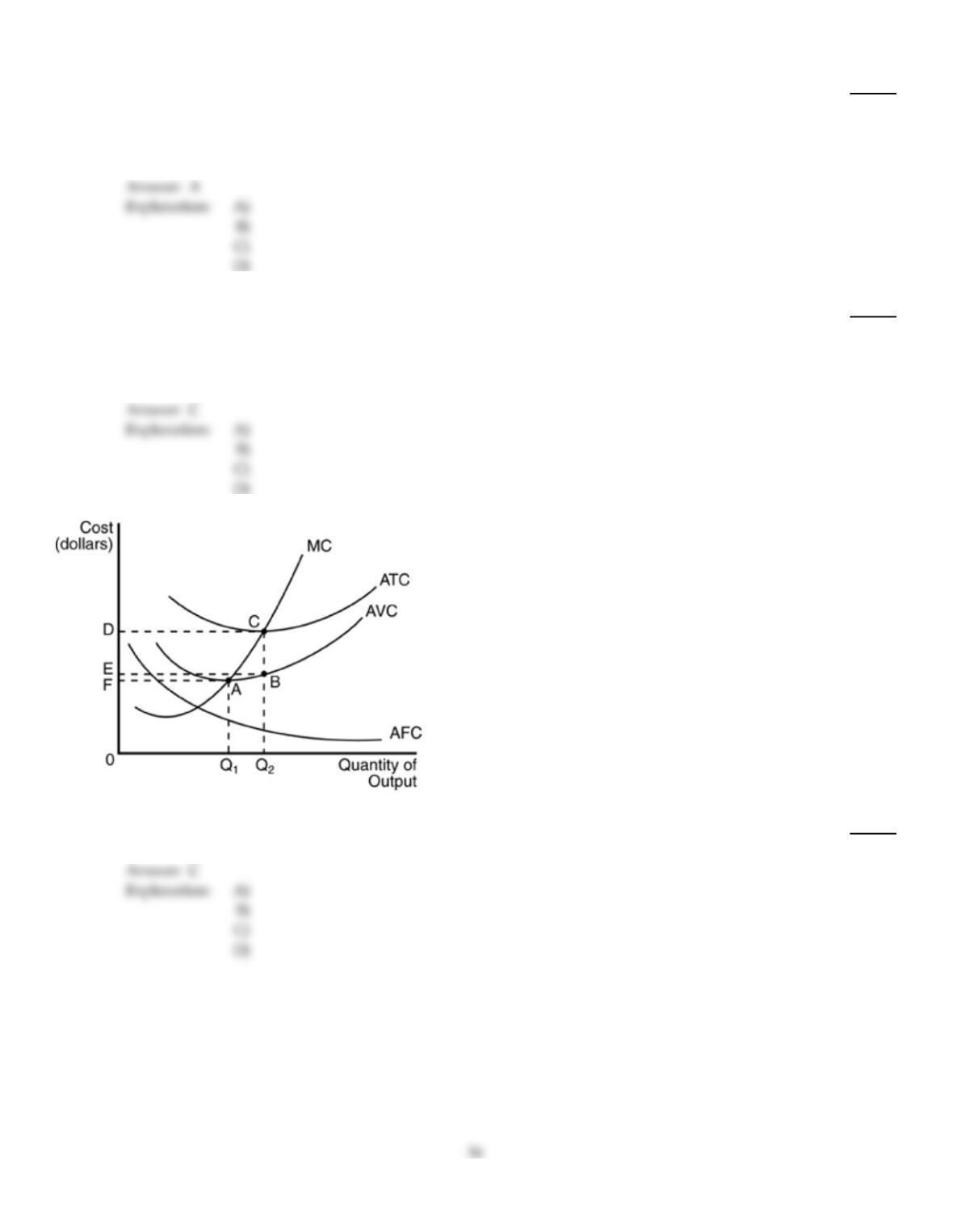
115)
The production function
115)
A)
gives the maximum amount of output for a given level of inputs.
B)
gives the amount of time necessary to reach the long run.
C)
allows us to compute the difference between accounting and economic profits.
D)
gives the implicit costs for all inputs.
116)
Marginal product and average product are measured in
116)
A)
profit terms.
B)
dollars.
C)
units of production.
D)
the same units as marginal cost and average total cost.
117)
In the above figure, if this firm produces output level Q2, it has average total costs of
117)
A)
OE.
B)
OC.
C)
OD.
D)
OF.
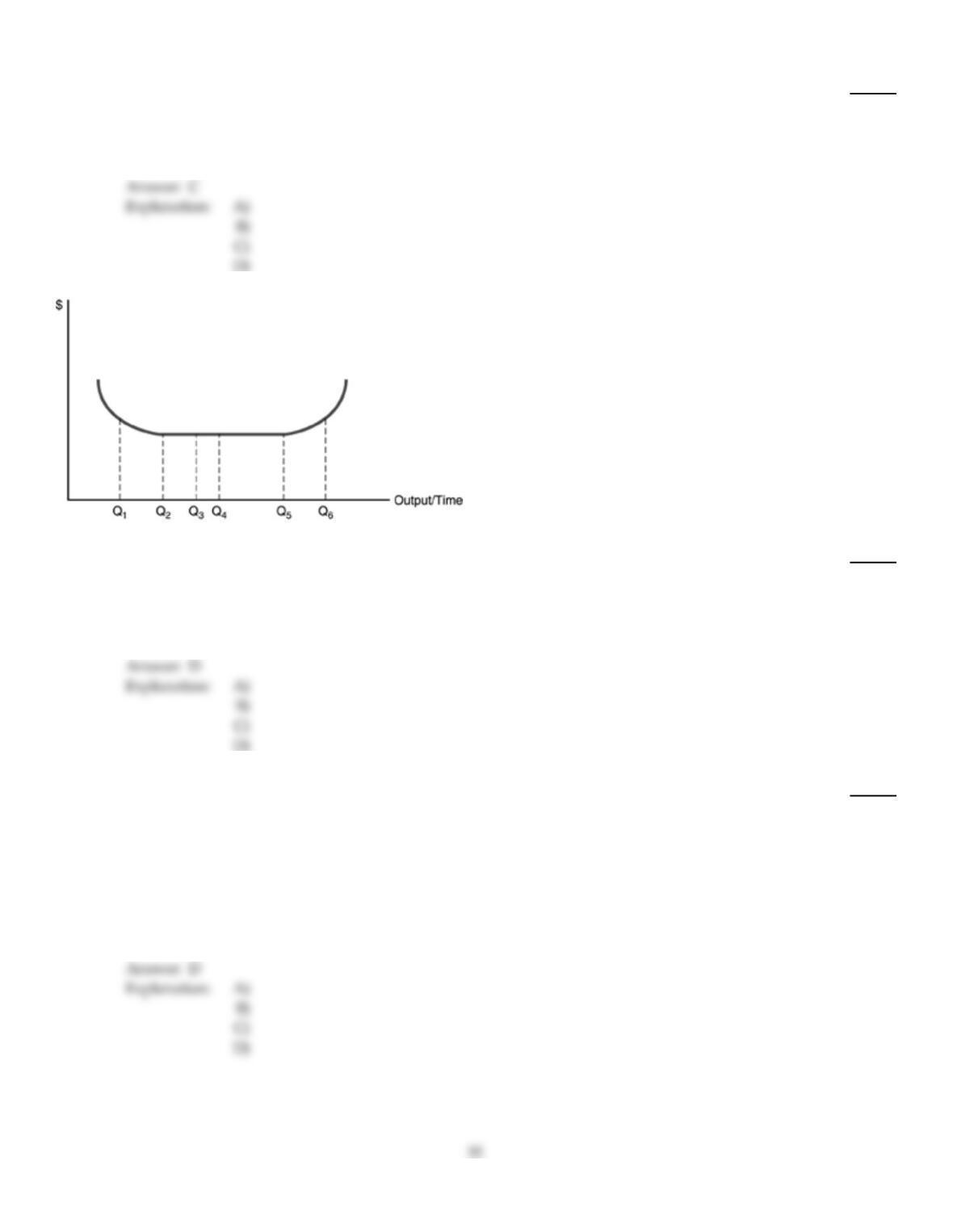
118)
The main source of diseconomies of scale is
118)
A)
specialization of labor.
B)
constant returns to scale.
C)
limits to the efficient functioning of management.
D)
dimensional factors associated with many physical relationships.
119)
Refer to the above figure. Constant returns to scale exist
119)
A)
up to output Q2.
B)
after Q5.
C)
over the entire long–run average cost curve.
D)
from Q2 to Q5.
120)
If the marginal product curve is increasing from workers 1–89 and then decreases steadily, crossing
the horizontal axis at 190 workers, we know that
120)
A)
diminishing marginal product sets in with the 190th worker.
B)
the total output curve increases from workers 1–89, decreases from workers 90–189, and
becomes 0 at the 190th worker.
C)
the total output curve is increasing throughout, although at an increasing rate for the first 190
workers and at a decreasing rate after the 190th worker.
D)
the total output curve is increasing at an increasing rate from workers 1–89, then increases at
a decreasing rate until the 190th worker, after which it decreases.
121)
In the table below, what are the marginal costs of the fourth unit of output?
Total Total
Output Variable Cost
0 $0
1 $10,000
2 $20,000
3 $30,000
4 $40,000
121)
A)
$30,000
B)
$40,000
C)
$20,000
D)
$10,000
QTFC TVC TC
0$90 $ 0 $ 90
190 25 115
290 32 122
390 42 132
490 64 154
590 95 185
122)
Refer to the above table. When output rises from 2 units to 5 units, marginal costs are
122)
A)
$31.
B)
$26.50.
C)
$21.
D)
$63.
Input of Labor Total Product
(no. of workers (no. of snowboards
in weeks) produced)
0 0
1 30
2 68
3110
4140
5 135
123)
In the above table, diminishing marginal product occurs after employing the
123)
A)
second worker.
B)
third worker.
C)
fourth worker.
D)
first worker.
124)
In the above table, when the firm employs 4 workers, the marginal product will be
124)
A)
208 snowboards.
B)
30 snowboards.
C)
35 snowboards.
D)
140 snowboards.
125)
When the minimum efficient scale occurs at a high level of industry output
125)
A)
there will be a lot of firms in this industry.
B)
there will only be a few firms in the industry.
C)
the government will have to take over the production of the good since it will be unprofitable
for firms.
D)
the firms in the industry will be producing in the diseconomies of scale portion of the curve.
126)
An increase in output would result in a rise in long–run average costs when there are
126)
A)
constant returns to scale.
B)
the law of diminishing marginal product.
C)
economies of scale.
D)
diseconomies to scale.
127)
All of the following are reasons for economies of scale EXCEPT
127)
A)
improved production equipment.
B)
specialization.
C)
dimensional factors.
D)
diminishing marginal product.
Fixed Variable Total Average Average Marginal
Output Costs Costs Costs Total Costs Variable Costs Costs
0$0 $100
130
250
3 60
4 120
5200
128)
In the above table, what is the average variable cost to produce 4 units of output?
128)
A)
$20
B)
$55
C)
$60
D)
$30
129)
The law of diminishing marginal product
129)
A)
does not hold in the short run because of fixed costs.
B)
does not hold in the long run because there are no fixed inputs in the long run.
C)
holds in the short run and the long run because as you increase the amount of variable inputs
eventually the increases in output will decrease.
D)
holds in the short and long run because of economies to scale.
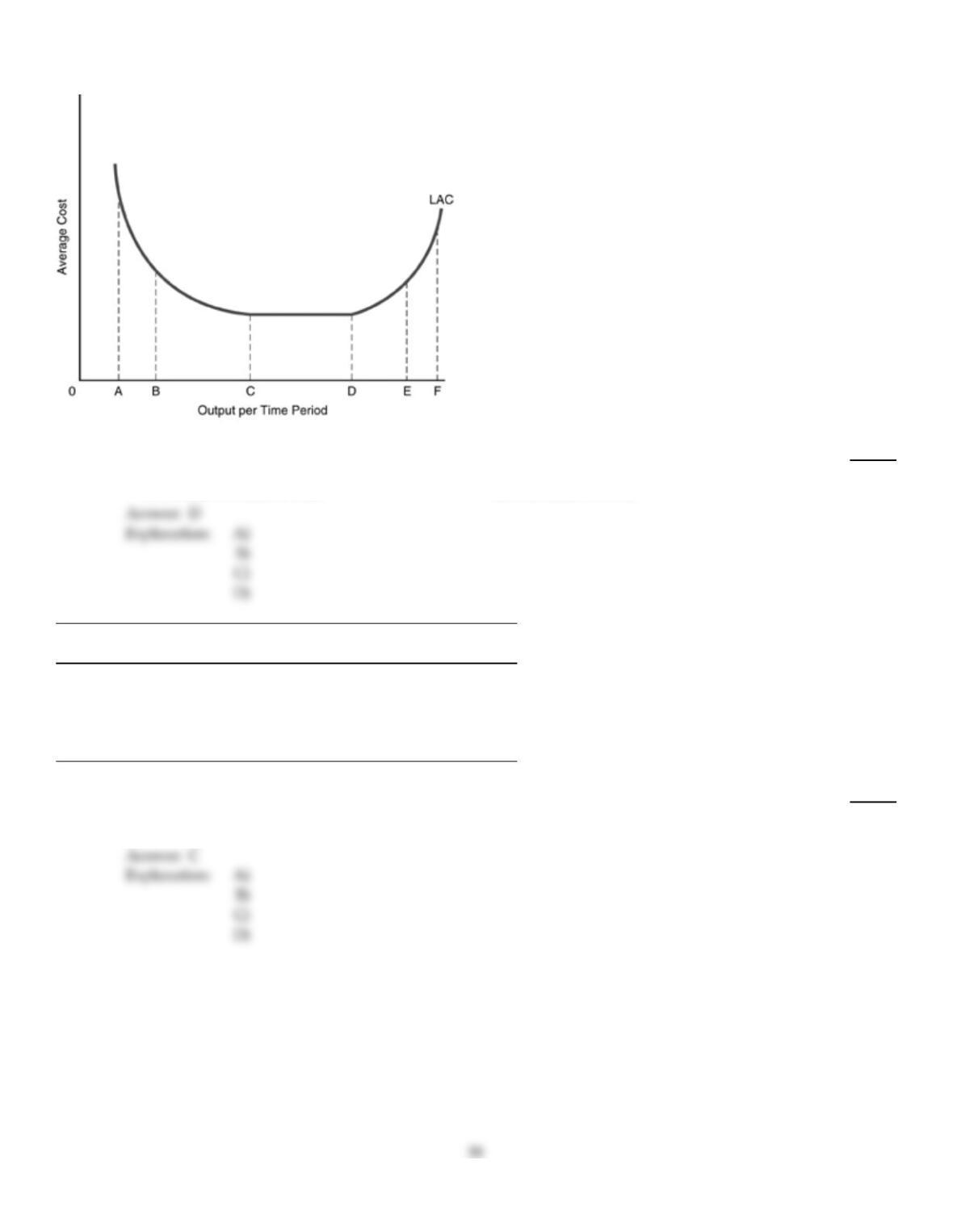
130)
In the above figure, the long–run cost curve between points A and B illustrates
130)
A)
diseconomies of scale.
B)
diminishing marginal product.
C)
constant returns to scale.
D)
economies of scale.
Average
Labor Output Product Marginal Product
110 –
212
315
4 52
5 9
131)
Using the above table, the total product and average product when 3 workers are employed are
131)
A)
40 and 10, respectively.
B)
37 and 27, respectively.
C)
39 and 13, respectively.
D)
36 and 12, respectively.
132)
Ajax Corporation has recently finished building a new factory. They moved into the factory a
month ago and found that it is the perfect size given the amount they want to produce. Ajax is
operating in the
132)
A)
corporation time.
B)
long run.
C)
short run.
D)
production time.
133)
Which of the following statements is TRUE about the planning horizon?
133)
A)
Costs do not exist.
B)
All inputs are variable.
C)
All inputs are fixed.
D)
There are fixed and variable inputs.
134)
The long run for a business is a period of time
134)
A)
longer than a year.
B)
when labor is the only input used by the business.
C)
when most inputs are variable.
D)
when all inputs can change.
135)
In economics, how long is the long run?
135)
A)
more than 12 months
B)
24 months or longer
C)
whatever time it takes a firm to vary all inputs
D)
5 years or more
136)
If the price of labor is constant and a firm experiences diminishing marginal product, then its
136)
A)
marginal costs decrease.
B)
marginal costs increase.
C)
fixed costs increase.
D)
total costs decrease.