
Test Bank for Intermediate Accounting, Sixteenth Edition
22 – 20
MULTIPLE CHOICE—CPA Adapted
68. Which of the following should be reported as a prior period adjustment?
Change in Change from
Estimated Lives Unaccepted Principle
of Depreciable Assets to Accepted Principle
a. Yes Yes
b. No Yes
c. Yes No
d. No No
69. On December 31, 2018, Grantham, Inc. appropriately changed its inventory valuation
method to FIFO cost from weighted-average cost for financial statement and income tax
purposes. The change will result in a $3,500,000 increase in the beginning inventory at
January 1, 2018. Assume a 30% income tax rate. The cumulative effect of this accounting
change on beginning retained earnings is
a. $0.
b. $1,050,000.
c. $2,450,000.
d. $3,000,000.
70. On January 1, 2018, Frost Corp. changed its inventory method to FIFO from LIFO for both
financial and income tax reporting purposes. The change resulted in a $900,000 increase
in the January 1, 2018 inventory. Assume that the income tax rate for all years is 30%.
The cumulative effect of the accounting change should be reported by Frost in its 2018
a. retained earnings statement as a $630,000 addition to the beginning balance.
b. income statement as a $630,000 cumulative effect of accounting change.
c. retained earnings statement as a $900,000 addition to the beginning balance.
d. income statement as a $900,000 cumulative effect of accounting change.
71. On January 1, 2016, Lake Co. purchased a machine for $1,980,000 and depreciated it by
the straight-line method using an estimated useful life of eight years with no salvage
value. On January 1, 2019, Lake determined that the machine had a useful life of six
years from the date of acquisition and will have a salvage value of $180,000. An
accounting change was made in 2019 to reflect these additional data. The accumulated
depreciation for this machine should have a balance at December 31, 2019 of
a. $1,095,000.
b. $1,155,000.
c. $1,200,000.
d. $1,320,000.

Accounting Changes and Error Analysis
22 – 21
72.On January 1, 2016, Hess Co. purchased a patent for $1,904,000. The patent is being
amortized over its remaining legal life of 15 years expiring on January 1, 2031. During
2019, Hess determined that the economic benefits of the patent would not last longer than
ten years from the date of acquisition. What amount should be reported in the balance
sheet for the patent, net of accumulated amortization, at December 31, 2019?
a. $1,142,400
b. $1,305,600
c. $1,344,000
d. $1,396,400
73. During 2017, a textbook written by Mercer Co. personnel was sold to Roark Publishing,
Inc., for royalties of 10% on sales. Royalties are receivable semiannually on March 31, for
sales in July through December of the prior year, and on September 30, for sales in
January through June of the same year.
• Royalty income of $243,000 was accrued at 12/31/17 for the period July-December
2017.
• Royalty income of $270,000 was received on 3/31/18, and $351,000 on 9/30/18.
• Mercer learned from Roark that sales subject to royalty were estimated at $4,860,000
for the last half of 2018.
In its income statement for 2018, Mercer should report royalty income at
a. $621,000.
b. $648,000.
c. $837,000.
d. $864,000.
74. On January 1, 2017, Janik Corp. acquired a machine at a cost of $900,000. It is to be
depreciated on the straight-line method over a five-year period with no residual value.
Because of a bookkeeping error, no depreciation was recognized in Janik’s 2017 financial
statements. The oversight was discovered during the preparation of Janik’s 2018 financial
statements. Depreciation expense on this machine for 2018 should be
a. $0.
b. $180,000.
c. $225,000.
d. $360,000.
75. On December 31, 2018, special insurance costs, incurred but unpaid, were not recorded.
If these insurance costs were related to work in process, what is the effect of the omission
on accrued liabilities and retained earnings in the December 31, 2018 balance sheet?
Accrued Liabilities Retained Earnings
a. No effect No effect
b. No effect Overstated
c. Understated No effect
d. Understated Overstated

Test Bank for Intermediate Accounting, Sixteenth Edition
22 – 22
76.Black, Inc. is a calendar-year corporation whose financial statements for 2017 and 2018
included errors as follows:
Year Ending Inventory Depreciation Expense
2017 $324,000 overstated $270,000 overstated
2018 128,000 understated 90,000 understated
Assume that purchases were recorded correctly and that no correcting entries were made
at December 31, 2017, or at December 31, 2018. Ignoring income taxes, by how much
should Black’s retained earnings be retroactively adjusted at January 1, 2019?
a. $308,000 increase
b. $92,000 increase
c. $38,000 decrease
d. $16,000 increase
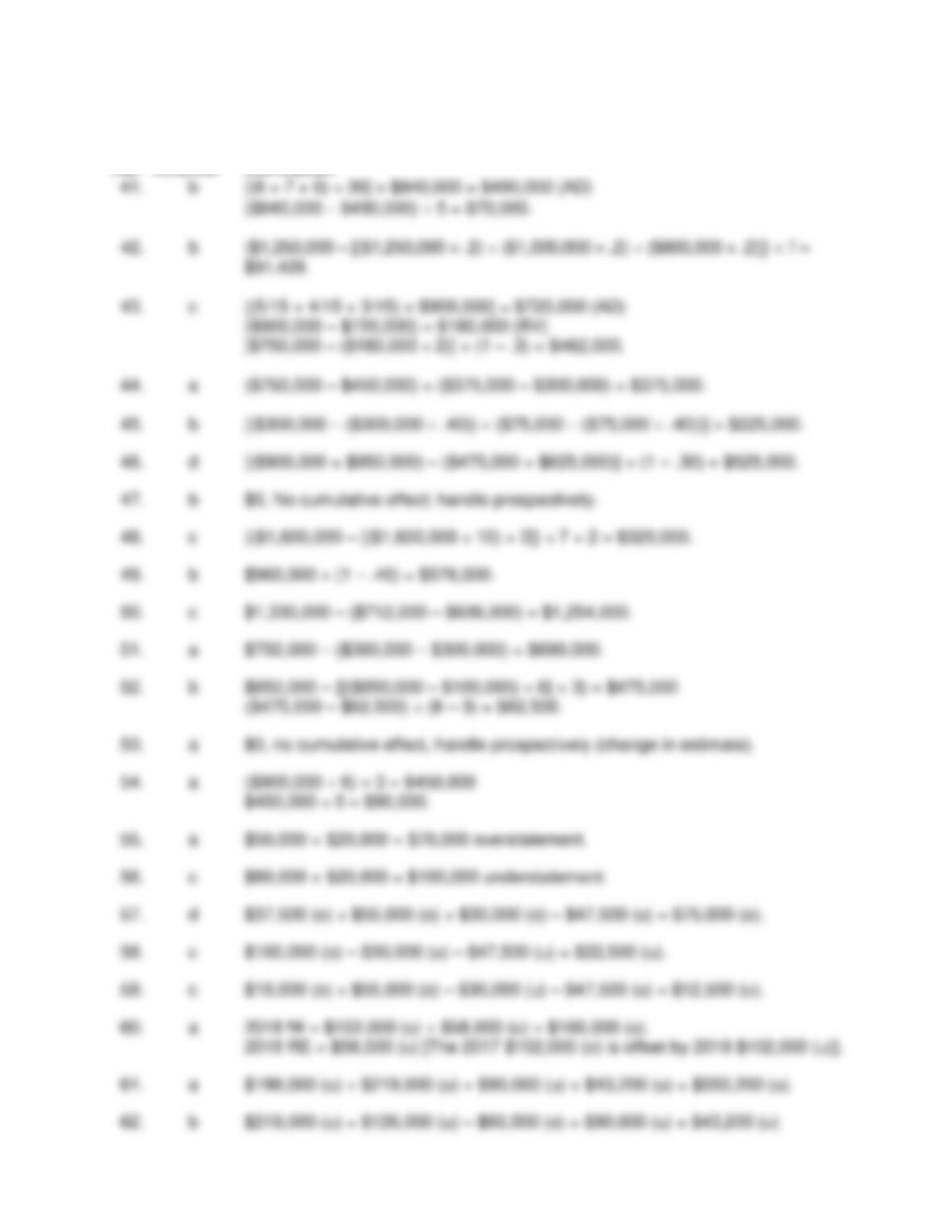
Multiple Choice Answers—CPA Adapted
Item
Ans.
Item
Ans.
Item
Ans.
Item
Ans.
Item
Ans.
Accounting Changes and Error Analysis
22 – 23
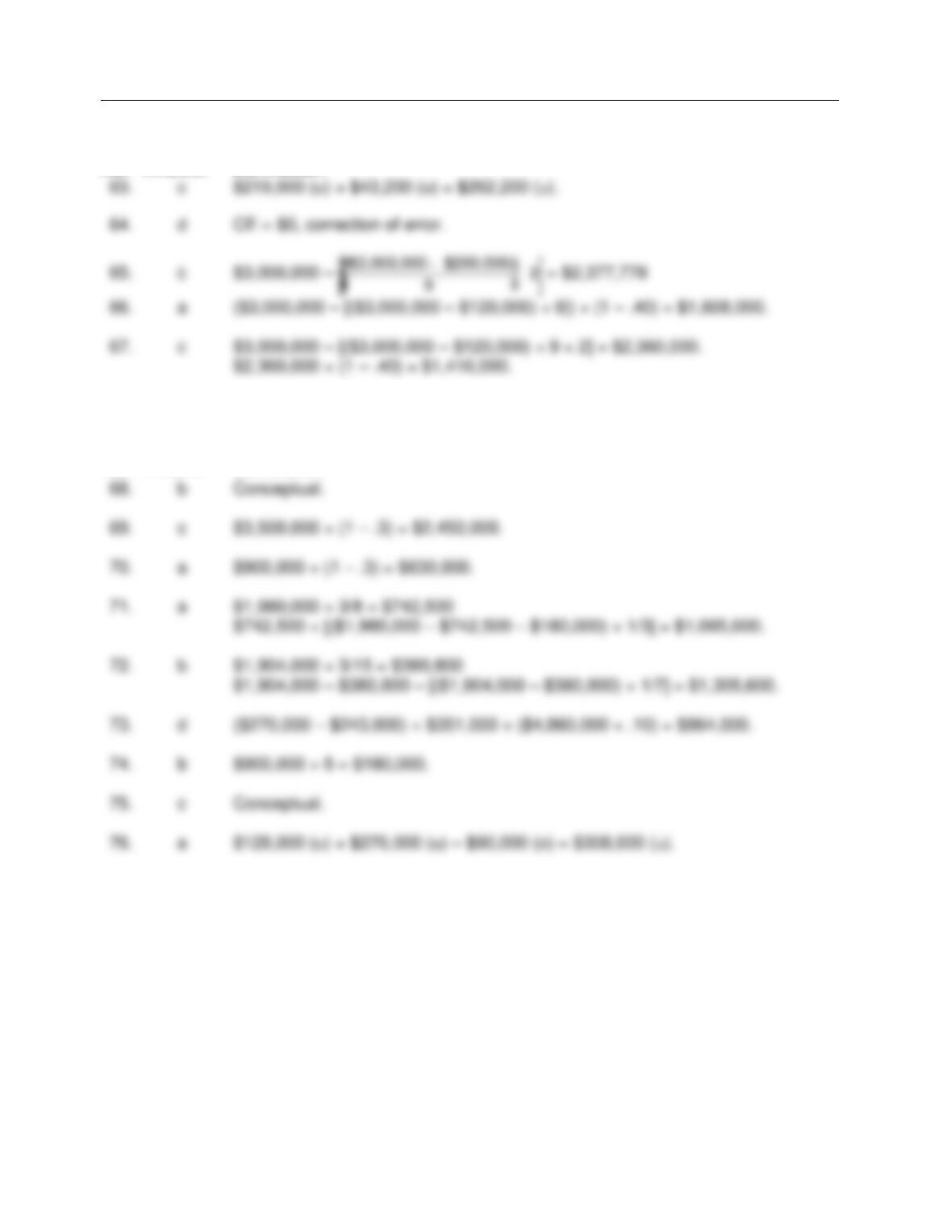
DERIVATIONS — Computational
No. Answer Derivation
Test Bank for Intermediate Accounting, Sixteenth Edition
22 – 24
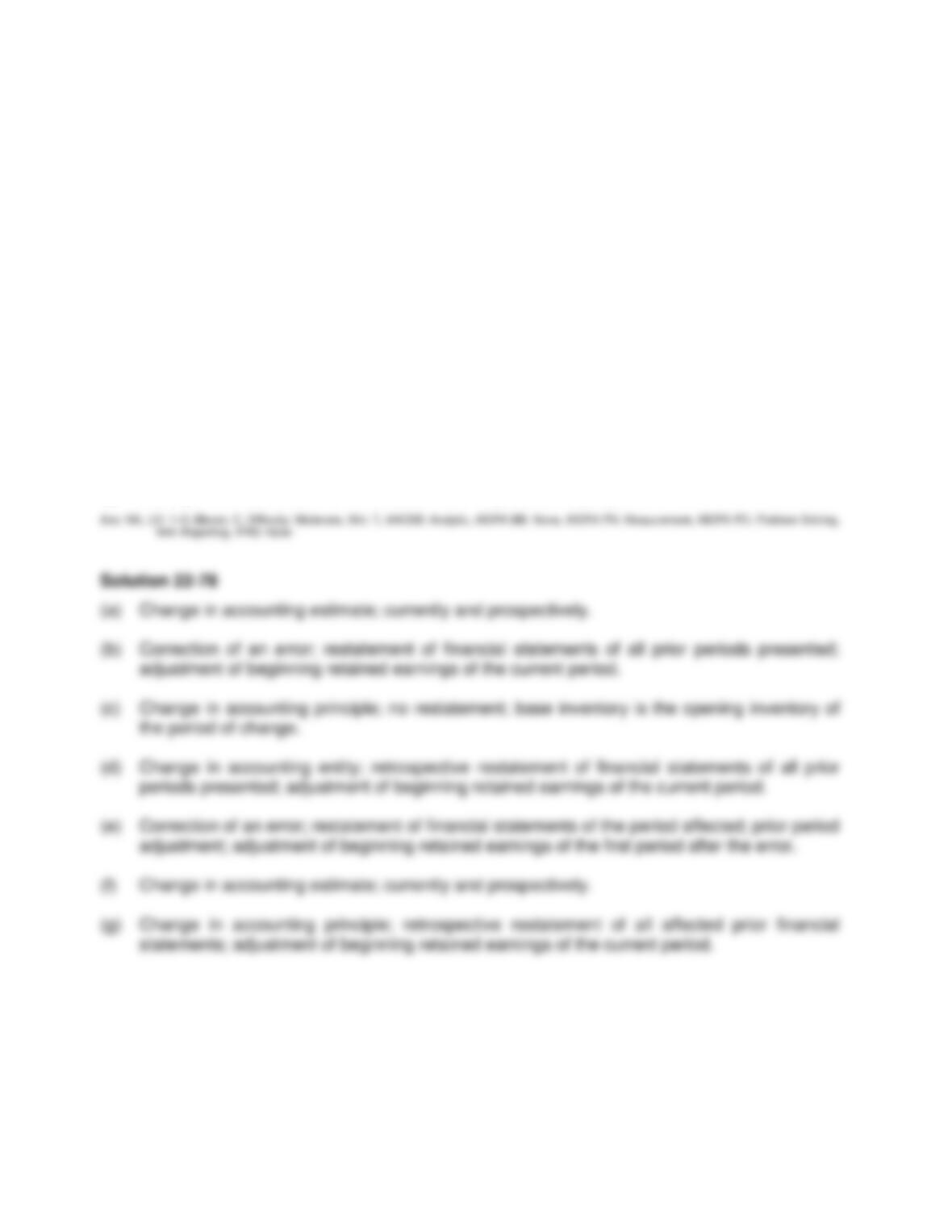
DERIVATIONS — Computational (cont.)
No. Answer Derivation
DERIVATIONS — CPA Adapted
No. Answer Derivation

Accounting Changes and Error Analysis
22 – 25
BRIEF EXERCISES
BE. 22-77—Matching accounting changes to situations.
The four types of accounting changes, including error correction, are:
Code
a. Change in accounting principle.
b. Change in accounting estimate.
c. Change in reporting entity.
d. Error correction.
Instructions
Following are a series of situations. You are to enter a code letter to the left to indicate the type of
change.
____ 1. Change from presenting nonconsolidated to consolidated financial statements.
____ 2. Change due to charging a new asset directly to an expense account.
____ 3. Change from expensing to capitalizing certain costs, due to a change in periods
benefited.
____ 4. Change from FIFO to LIFO inventory procedures.
____ 5. Change due to failure to recognize an accrued (uncollected) revenue.
____ 6. Change in amortization period for an intangible asset.
____ 7. Changing the companies included in combined financial statements.
____ 8. Change in the loss rate on warranty costs.
____ 9. Change due to failure to recognize and accrue income.
____ 10. Change in residual value of a depreciable plant asset.
____ 11. Change from an unacceptable to an acceptable accounting principle.
____ 12. Change in both estimate and acceptable accounting principles.
____ 13. Change due to failure to recognize a prepaid asset.
____ 14. Change from straight-line to sum-of-the-years’-digits method of depreciation.
____ 15. Change in life of a depreciable plant asset.
____ 16. Change from one acceptable principle to another acceptable principle.
____ 17. Change due to understatement of inventory.
____ 18. Change in expected recovery of an account receivable.
Test Bank for Intermediate Accounting, Sixteenth Edition
22 – 26
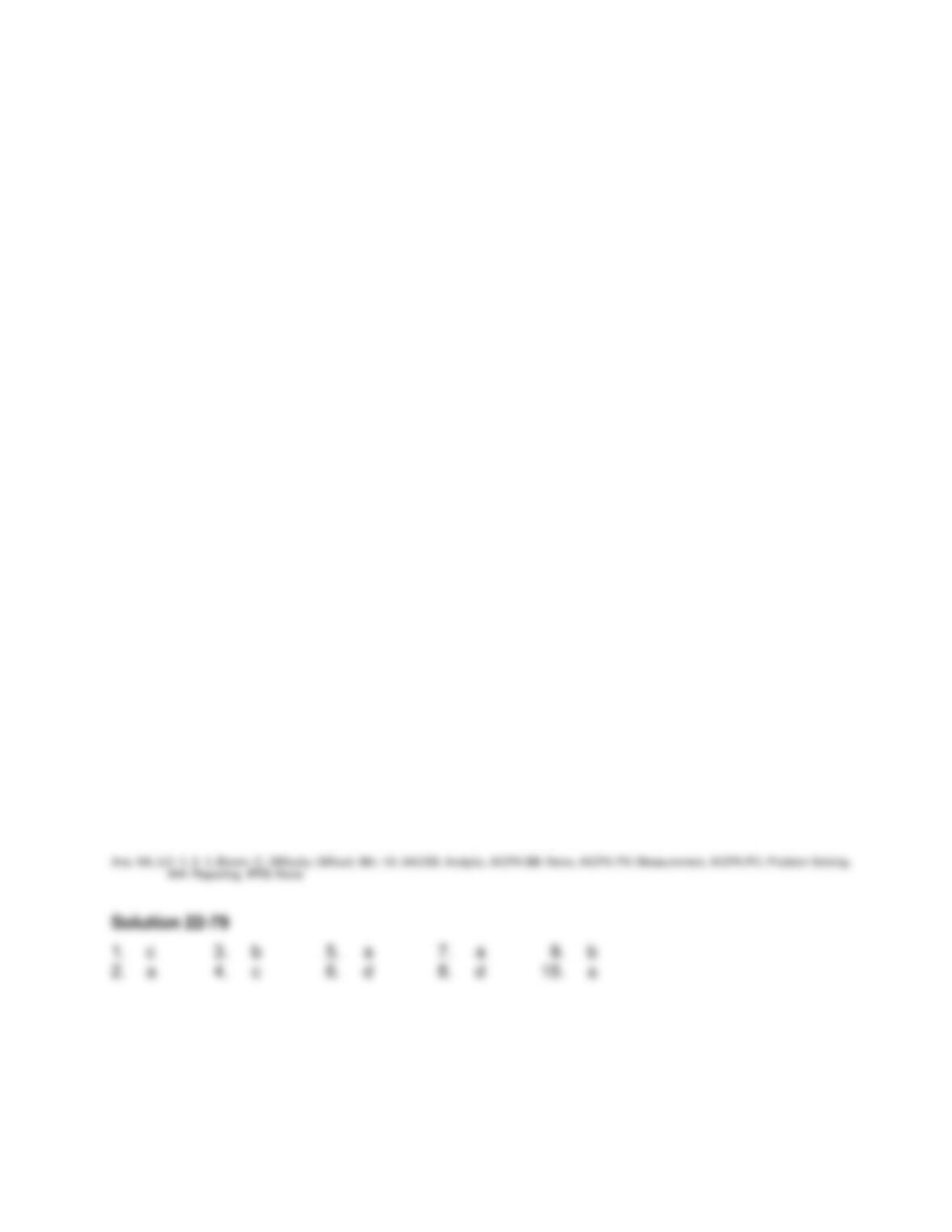
BE. 22-78—How changes or corrections are recognized.
For each of the following items, indicate the type of accounting change and how each is
recognized in the accounting records in the current year.
(a) Change from straight-line method of depreciation to sum-of-the-years’-digits
(b) Change from the cash basis to accrual basis of accounting
(c) Change from FIFO to LIFO method for inventory valuation purposes (retrospective
application impractical)
(d) Change from presentation of statements of individual companies to presentation of
consolidated statements
(e) Change due to failure to record depreciation in a previous period
(f) Change in the realizability of certain receivables
(g) Change from LIFO to FIFO method for inventory valuation purposes
Accounting Changes and Error Analysis
22 – 27
BE. 22-79—Matching disclosures to situations.
In the blank to the left of each question, fill in the letter from the following list which best describes
the presentation of the item on the financial statements of Helton Corporation for 2018.
a. Change in estimate
b. Prior period adjustment (not due to change in principle)
c. Retrospective type accounting change with note disclosure
d. None of these choices
____ 1. In 2018, the company changed its method of recognizing income from the
completed-contract method to the percentage-of-completion method.
____ 2. At the end of 2018, an audit revealed that the corporation’s allowance for doubtful
accounts was too large and should be reduced to 2%. When the audit was made in
2017, the allowance seemed appropriate.
____ 3. Depreciation on a truck, acquired in 2015, was understated because the service life
had been overestimated. The understatement had been made in order to show
higher net income in 2016 and 2017.
____ 4. The company switched from a LIFO to a FIFO inventory valuation method during the
current year.
____ 5. In the current year, the company decides to change from expensing certain costs to
capitalizing these costs, due to a change in the period benefited.
____ 6. During 2018, a long-term bond with a carrying value of $3,600,000 was retired at a
cost of $4,100,000.
____ 7. After negotiations with the IRS, income taxes for 2016 were established at $42,900.
They were originally estimated to be $28,600.
____ 8. In 2018, the company incurred interest expense of $29,000 on a 20-year bond issue.
____ 9. In computing the depreciation in 2016 for equipment, an error was made which
overstated income in that year $75,000. The error was discovered in 2018.
____ 10. In 2018, the company changed its method of depreciating plant assets from the
double-declining balance method to the straight-line method.
Test Bank for Intermediate Accounting, Sixteenth Edition
22 – 28
EXERCISES
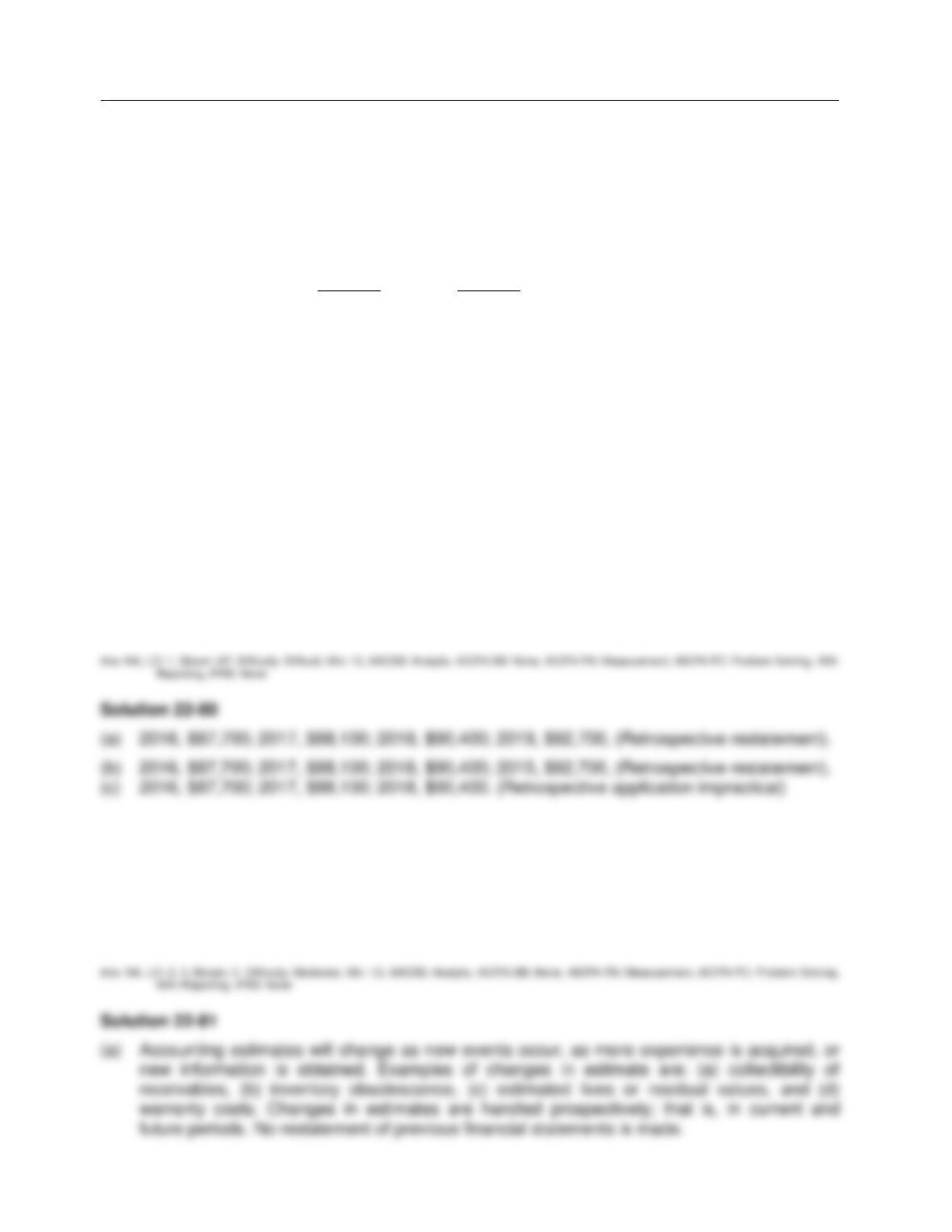
Ex. 22-80—Change in accounting principle.
In 2019, Fischer Corporation changed its method of inventory pricing from LIFO to FIFO. Net
income computed on a LIFO as compared to a FIFO basis for the four years involved is: (Ignore
income taxes.)
LIFO FIFO
2016 $78,200 $87,700
2017 84,500 88,100
2018 87,000 90,400
2019 92,500 92,700
Instructions
(a) Indicate the net income that would be shown on comparative financial statements issued at
12/31/19 for each of the four years, assuming that the company changed to the FIFO
method in 2019.
(b) Assume that the company had switched from the average cost method to the FIFO method
with net income on an average cost basis for the four years as follows: 2016, $80,400; 2017,
$86,120; 2018, $90,300; and 2015, $93,600. Indicate the net income that would be shown
on comparative financial statements issued at 12/31/19 for each of the four years under
these conditions.
(c) Assuming that the company switched from the FIFO to the LIFO method, what would be the
net income reported on comparative financial statements issued at 12/31/19 for 2016, 2017,
and 2018?
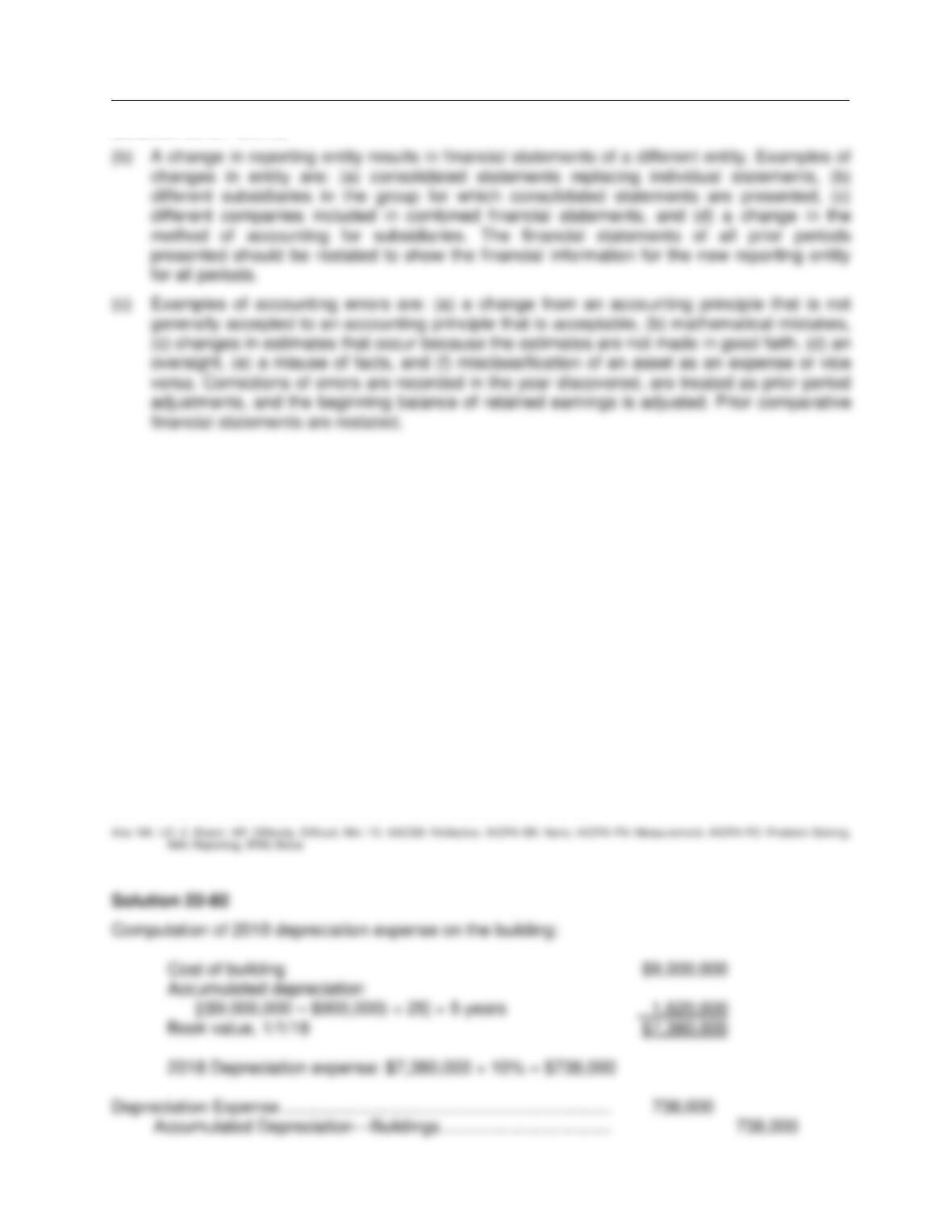
Ex. 22-81—Change in estimate, change in reporting entity, correction of errors.
Discuss the accounting procedures for and illustrate the following:
(a) Change in estimate
(b) Change in reporting entity
(c) Correction of an error
Accounting Changes and Error Analysis
22 – 29
Solution 22-81 (cont.)
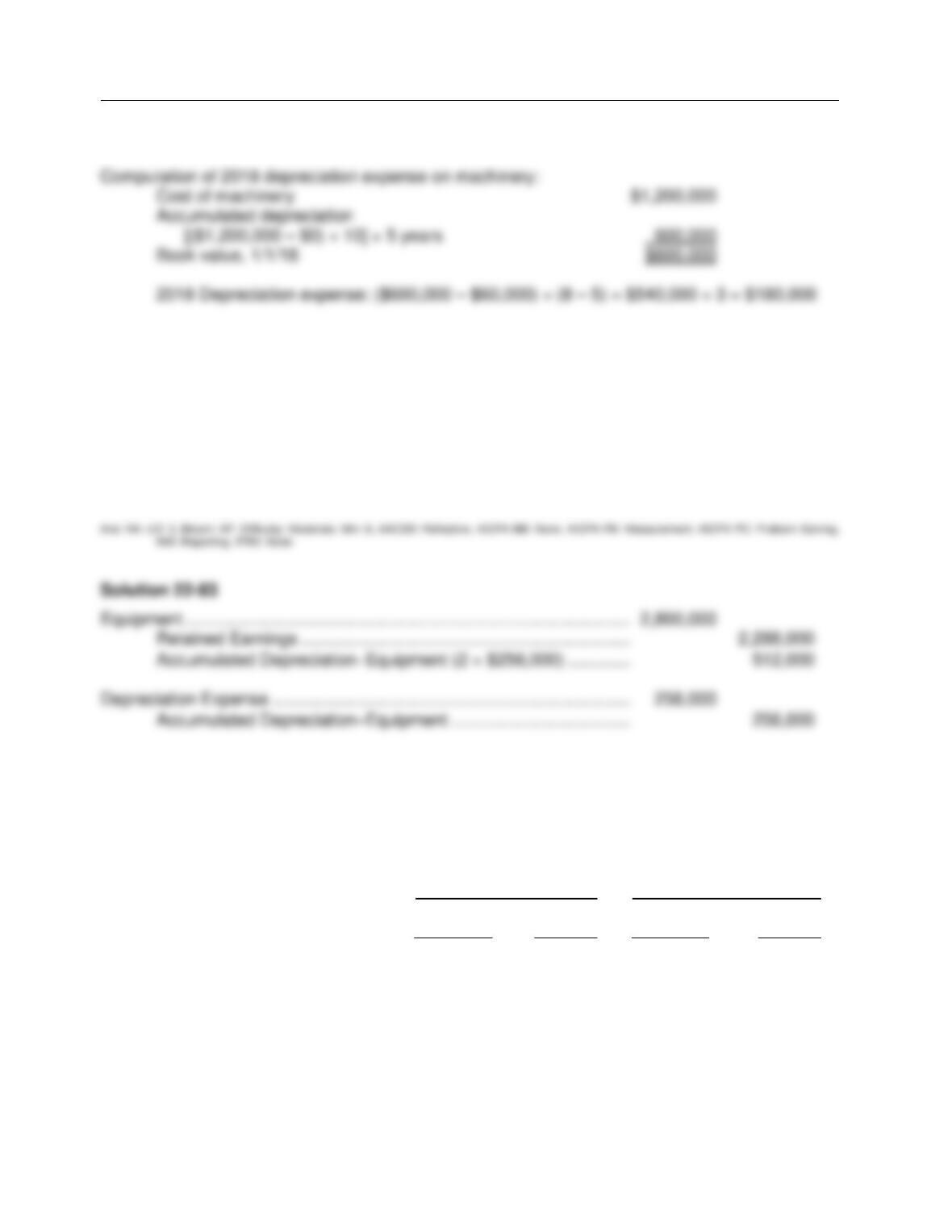
Ex. 22-82—Changes in depreciation methods, estimates.
On January 1, 2013, Powell Company purchased a building and machinery that have the
following useful lives, salvage value, and costs.
Building, 25-year estimated useful life, $9,000,000 cost, $900,000 salvage value
Machinery, 10-year estimated useful life, $1,200,000 cost, no salvage value
The building has been depreciated under the straight-line method through 2017. In 2018, the
company decided to switch to the double-declining balance method of depreciation for the
building. Powell also decided to change the total useful life of the machinery to 8 years, with a
salvage value of $60,000 at the end of that time. The machinery is depreciated using the straight–
line method.
Instructions
(a) Prepare the journal entry necessary to record the depreciation expense on the building in
2018.
(b) Compute depreciation expense on the machinery for 2018.
Test Bank for Intermediate Accounting, Sixteenth Edition
22 – 30
Solution 22-82 (cont.)
Ex. 22-83—Noncounterbalancing error.
Quigley Co. bought a machine on January 1, 2016 for $2,800,000. It had a $240,000 estimated
residual value and a ten-year life. An expense account was debited on the purchase date.
Quigley uses straight-line depreciation. This was discovered in 2018.
Instructions
Prepare the entry or entries related to the machine for 2018. Ignore taxes.
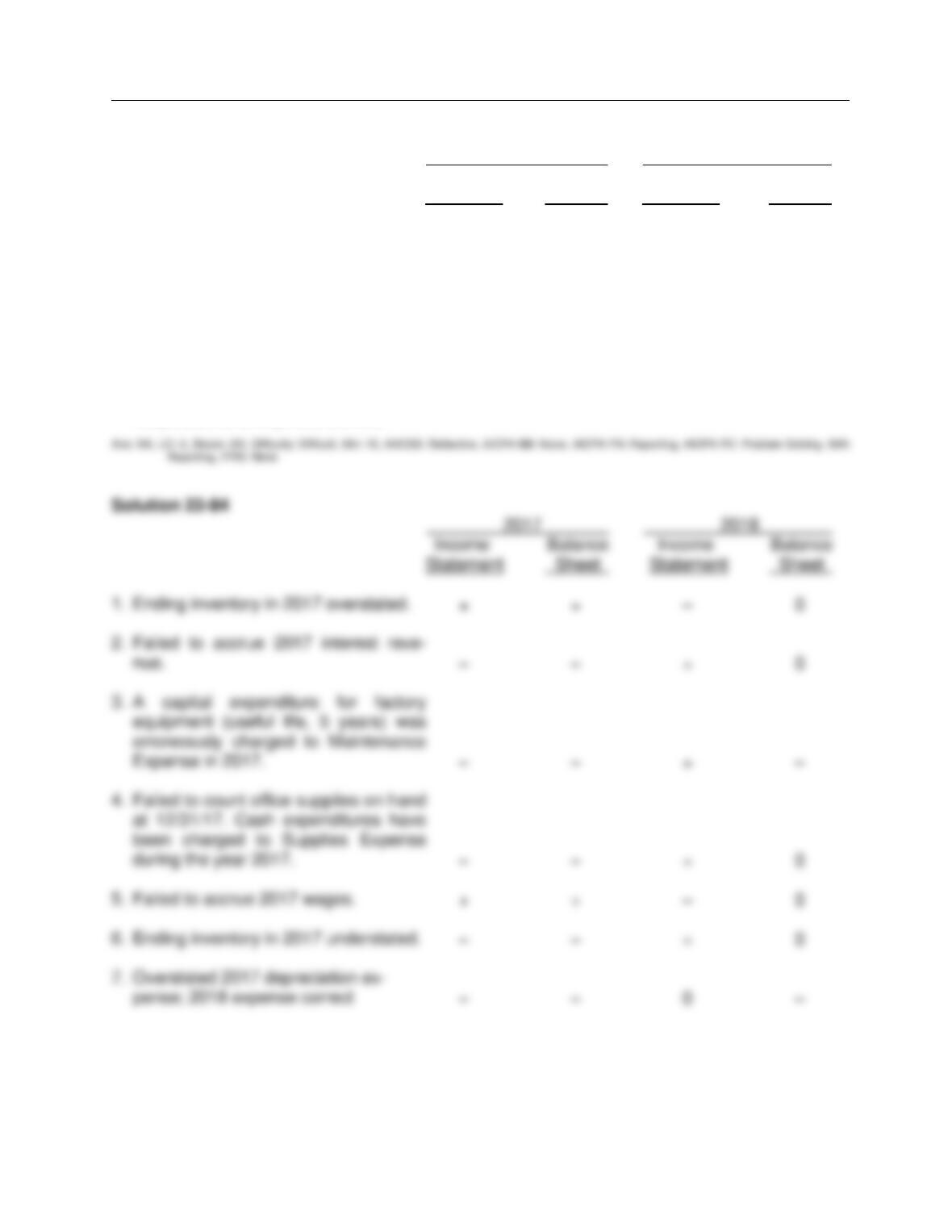
Ex. 22-84—Effects of errors.
Show how the following independent errors will affect net income on the Income Statement and
the stockholders’ equity section of the Balance Sheet using the symbol + (plus) for overstated, –
(minus) for understated, and 0 (zero) for no effect.
2017 2018
Income Balance Income Balance
Statement Sheet Statement Sheet
1. Ending inventory in 2017 overstated.
2. Failed to accrue 2017 interest
revenue.
3. A capital expenditure for factory
equipment (useful life, 5 years) was
erroneously charged to Maintenance
Expense in 2017.
Accounting Changes and Error Analysis
22 – 31
Ex. 22-84 (cont.)
2017 2017
Income Balance Income Balance
Statement Sheet Statement Sheet
4. Failed to count office supplies on hand
at 12/31/17. Cash expenditures have
been charged to Supplies Expense
during the year 2017.
5. Failed to accrue 2017 wages.
6. Ending inventory in 2017 understated.
7. Overstated 2017 depreciation
expense; 2018 expense correct.
Test Bank for Intermediate Accounting, Sixteenth Edition
22 – 32
Ex. 22-85—Effects of errors.
Joseph Co. began operations on January 1, 2017. Financial statements for 2017 and 2018
contained the following errors:
Dec. 31, 2017 Dec. 31, 2018
Ending inventory $80,000 overstated $114,000 overstated
Depreciation expense 48,000 understated —
Accumulated depreciation 48,000 understated 48,000 understated
Insurance expense 42,000 overstated 42,000 understated
Prepaid insurance 42,000 understated
In addition, on December 26, 2018 fully depreciated equipment was sold for $53,000, but the sale
was not recorded until 2019. No corrections have been made for any of the errors.
Instructions
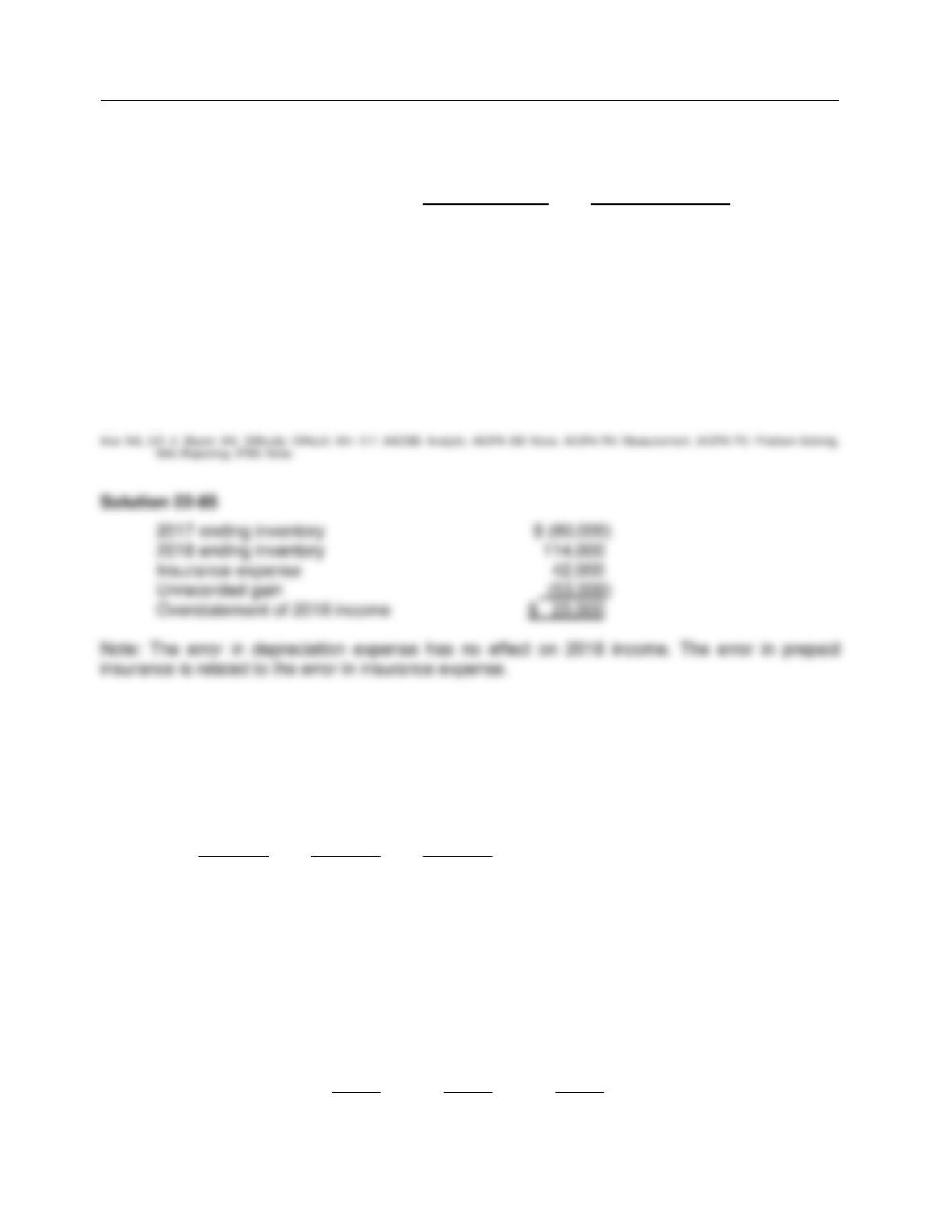
Ignoring income taxes, show your calculation of the total effect of the errors on 2018 net income.
PROBLEMS
Pr. 22-86—Accounting for changes and error corrections.
Dyke Company’s net incomes for the past three years are presented below (ignore taxes):
2019 2018 2017
$480,000 $450,000 $360,000
During the 2019 year-end audit, the following items come to your attention:
1. Dyke bought equipment on January 1, 2016 for $490,000 with a $40,000 estimated salvage
value and a six-year life. The company debited an expense account and credited cash on the
purchase date for the entire cost of the asset. (Straight-line method)
2. During 2019, Dyke changed from the straight-line method of depreciating its cement plant to
the double-declining balance method. The following computations present depreciation on
both bases:
2019 2018 2017
Straight-line 36,000 36,000 36,000
Double-declining 46,080 57,600 72,000
Accounting Changes and Error Analysis
22 – 33
Pr. 22-86 (cont.)
The net income for 2019 was computed using the double-declining balance method, on the
January 1, 2019 book value, over the useful life remaining at that time. The depreciation
recorded in 2019 was $72,000.
3. Dyke, in reviewing its provision for uncollectibles during 2019, has determined that 1% is the
appropriate amount of bad debt expense to be charged to operations. The company had used
1/2 of 1% as its rate in 2017 and 2018 when the expense had been $18,000 and $12,000,
respectively. The company recorded bad debt expense under the new rate for 2019. The
company would have recorded $6,000 less of bad debt expense on December 31, 2019
under the old rate.
Instructions
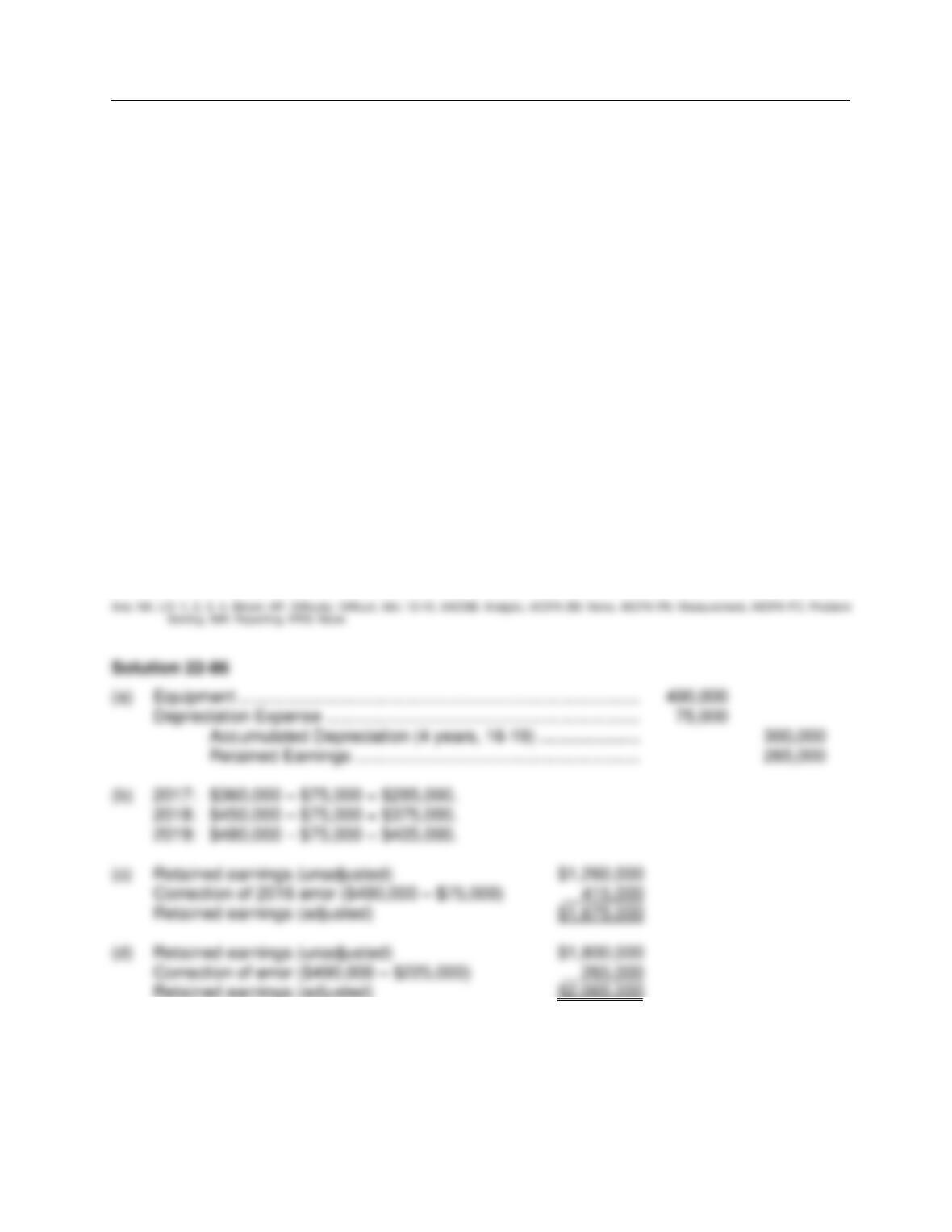
(a) Prepare in general journal form the entry necessary to correct the books for the transaction
in part 1 of this problem, assuming that the books have not been closed for the current year.
(b) Compute the net income to be reported each year 2017 through 2019. Ignore taxes.
(c) Assume that the beginning retained earnings balance (unadjusted) for 2017 was
$1,260,000. At what adjusted amount should this beginning retained earnings balance for
2017 be stated, assuming that comparative financial statements were prepared?
(d) Assume that the beginning retained earnings balance (unadjusted) for 2019 is $1,800,000
and that non-comparative financial statements are prepared. At what adjusted amount
should this beginning retained earnings balance be stated?
Test Bank for Intermediate Accounting, Sixteenth Edition
22 – 34
Pr. 22-87—Correction of errors.
Vance Company reported net incomes for a three-year period as follows:
2016, $191,000; 2017, $199,000; 2018, $180,000.
In reviewing the accounts in 2019 after the books for the prior year have been closed, you find
that the following errors have been made in summarizing activities:
2016 2017 2018
Overstatement of ending inventory $42,000 $51,000 $31,000
Understatement of accrued advertising expense 6,600 12,000 7,200
Instructions
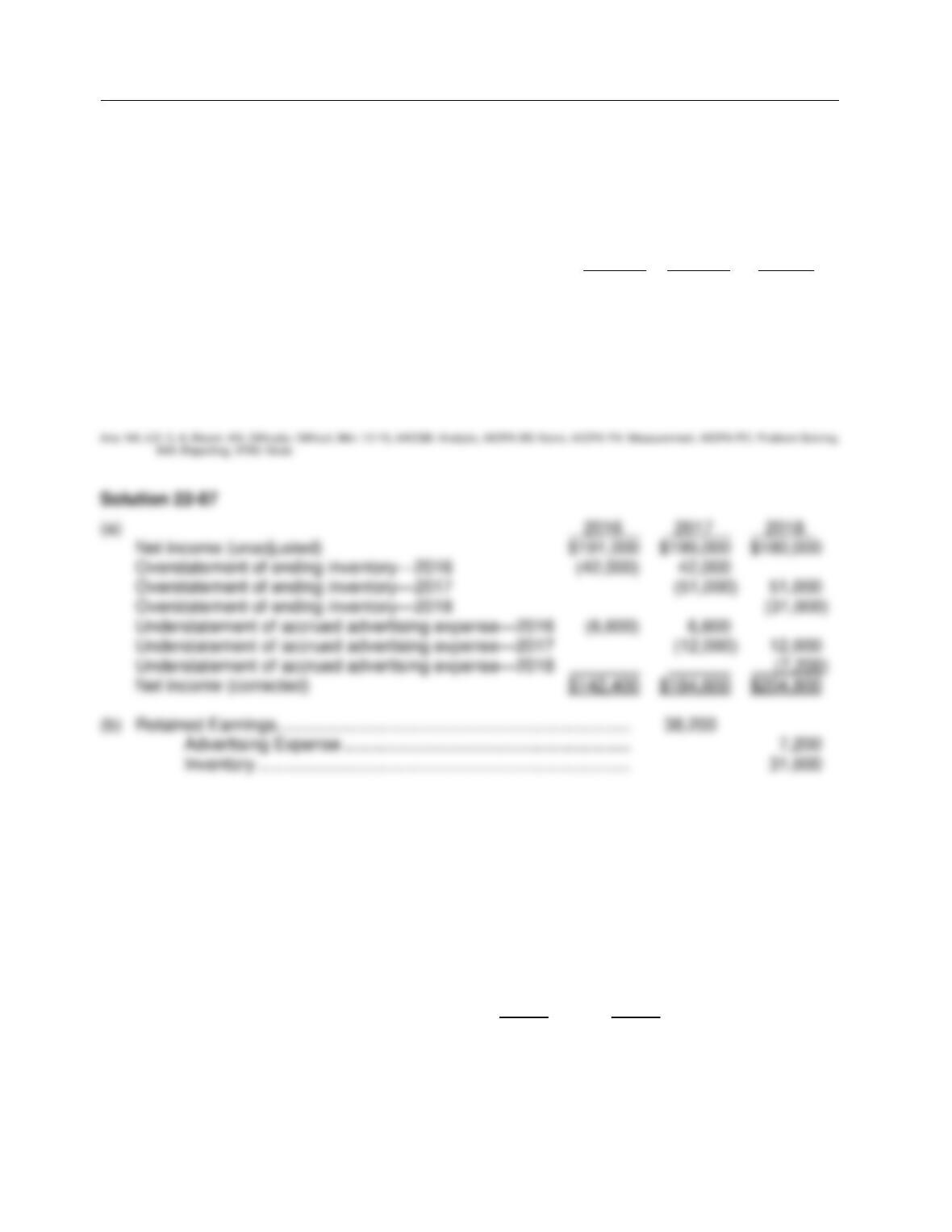
(a) Determine corrected net incomes for 2016, 2017, and 2018.
(b) Give the entry to bring the books of the company up to date in 2019, assuming that the
books have been closed for 2018.
Pr. 22-88—Error corrections and adjustments.
The controller for Haley Corporation is concerned about certain business transactions that the
company experienced during 2018. The controller, after discussing these matters with various
individuals, has come to you for advice. The transactions at issue are presented below.
1. The company has decided to switch from the direct write-off method in accounting for bad
debt expense to the percentage-of-receivables approach. Assume that Haley Corporation has
recognized bad debt expense as the receivables have actually become uncollectible in the
following way:
2017 2018
From 2017 sales 31,800 20,000
From 2018 sales 45,000
The controller estimates that an additional $60,400 will be charged off in 2019: $11,400
applicable to 2017 sales and $49,000 to 2018 sales.
Accounting Changes and Error Analysis
22 – 35
Pr. 22-88 (cont.)
2. Starting in 2018, inventory has been shipped on consignment. These transactions have been
recorded as ordinary sales and billed as such on account. At December 31, 2018, inventory
billed and in the hands of consignees amounted to $450,000. The percentage markup on
selling price is 20%. Assume that consigned inventory is sold the following year. The
company uses the perpetual inventory system.
Instructions
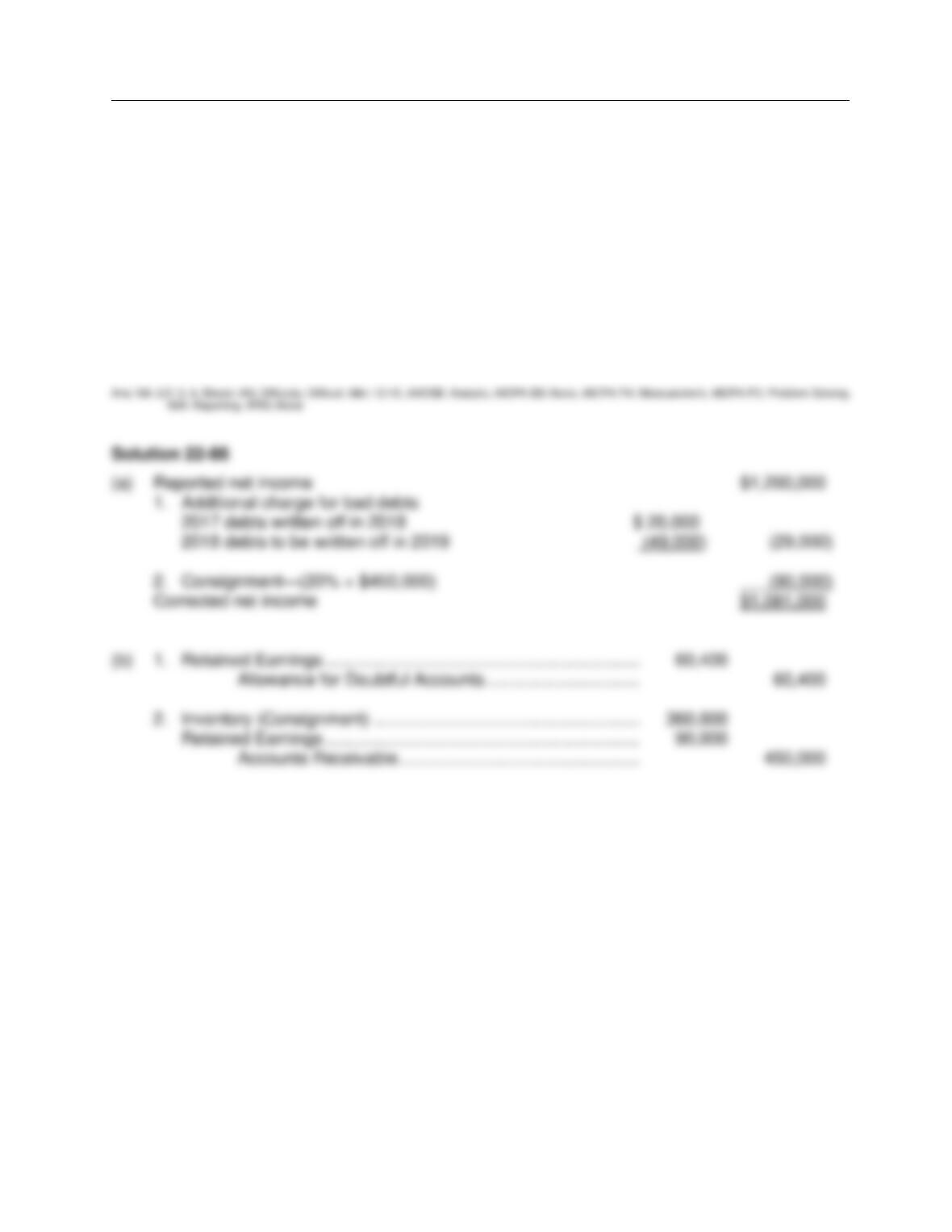
(a) Assume that Haley Corporation reported net income of $1,200,000 for 2018. Present a
schedule showing the corrected net income after reviewing the above transactions.
(b) Prepare the journal entries necessary at December 31, 2018, assuming that the books have
been closed.
Test Bank for Intermediate Accounting, Sixteenth Edition
22 – 36
IFRS QUESTIONS
True/False
1. IFRS requires that changes in estimate be accounted for using the retrospective method.
2. IFRS requires that any indirect effect of a change in accounting policy, such as increased
royalty payments, be recognized in income in the year of the change in policy.
3. Under IFRS, the direct effects of changes in the accounting policies are applied
retrospectively.
4. Both IFRS and GAAP allow that if determining the effect of a change in accounting principle is
considered impracticable, then a company should report the effect of the change in the period
in which it believes it practicable to do so.
5. Under IFRS, errors in financial statements are considered as an accounting change.
Answers to True/False:
Multiple Choice
6. Is the following exception applicable to IFRS or GAAP?
“If determining the effect of a change in accounting principle is considered impracticable, then
a company should report the effect of the change in the period in which it believes it
practicable to do so.”
IFRS U.S. GAAP
a. Yes Yes
b. Yes No
c. No Yes
d. No No

Accounting Changes and Error Analysis
22 – 37
7. Is the following exception applicable to IFRS or GAAP?
“If determining the effect of a correction of an error is considered impracticable, then a
company should report the effect of the error correction in the period in which it believes it
practicable to do so.”
IFRS GAAP
a. Yes Yes
b. Yes No
c. No Yes
d. No No
8. Detailed guidance regarding the accounting and reporting for the indirect effects of changes in
accounting principle is available under
a. both GAAP and IFRS.
b. neither GAAP nor IFRS.
c. GAAP only.
d. IFRS only.
9. Ridge, Inc. follows IFRS for its external financial reporting, and Cannon Company follows
GAAP for its external financial reporting. During 2018, both companies changed depreciation
methods, from double-declining balance to straight-line. Compared to double-declining
balance, for Ridge, Inc. the change resulted in a decrease in reported depreciation expense
of $90,000, and for Cannon Company the change resulted in a reported decrease in
depreciation expense of $105,000. The remaining useful lives of the assets impacted by the
change in depreciation method is 10 years for both companies. How would this change
impact the net income reported by Ridge, Inc. and Cannon Company for the year ended
December 31, 2018?
Ridge, Inc. Cannon Company
a. Decrease $90,000 Decrease $105,000
b. Increase $9,000 Increase $10,500
c. Increase $90,000 Increase $105,000
d. Increase $90,000 Increase $10,500
10. Mars, Inc. follows IFRS for its external financial reporting, while Jerome Company uses
GAAP for its external financial reporting. During the year ended December 31, 2018, both
companies changed from using the completed-contract method of revenue recognition for
long-term construction contracts to the percentage-of-completion method. Both companies
experienced an indirect effect, related to increased profit-sharing payments in 2018, of
$30,000. As a result of this change, how much expense related to the profit-sharing payment
must be recognized by each company on the income statement for the year ended
December 31, 2018?
Mars, Inc. Jerome Company
a. $30,000 $30,000
b. $30,000 $-0-
c. $-0- $-0-
d. $-0- $30,000

Test Bank for Intermediate Accounting, Sixteenth Edition
22 – 38
Answers to multiple choice:
Short Answer
11. Briefly describe some of the similarities and differences between GAAP and IFRS with
respect to reporting accounting changes.
1. The FASB has issued guidance on changes in accounting principles, changes in
estimates, and corrections of errors, which essentially converges GAAP to IAS 8. Key
remaining differences are as follows:
• One area in which IFRS and GAAP differ is the reporting of error corrections in
previously issued financial statements. While both standards require restatement, GAAP
is an absolute standard – that is, there is no exception to this rule.
• Under GAAP and IFRS, if determining the effect of a change in accounting principle is
considered impracticable, then a company should report the effect of the change in the
period in which it believes it practicable to do so, which may be the current period. Under
IFRS, the impracticality exception applies to both changes in accounting principles and
to the correction of errors. Under GAAP, this exception only applies to changes in
accounting principle.
• IAS 8 does not specifically address the accounting and reporting for indirect effects of
changes in accounting principles. As indicated in the chapter, GAAP has detailed
guidance on the accounting and reporting of indirect effects.