112. Below is budgeted production and sales information for Bluebird Company for the month of December:
Product XXX
Product ZZZ
Estimated beginning inventory
30,000 units
18,000 units
Desired ending inventory
32,000 units
15,000 units
Anticipated sales
520,000 units
460,000 units
The unit selling price for product XXX is $5 and for product ZZZ is $14.
Budgeted production for product XXX during the month is:
113. Below is budgeted production and sales information for Bluebird Company for the month of December:
Product XXX
Product ZZZ
Estimated beginning inventory
30,000 units
18,000 units
Desired ending inventory
32,000 units
15,000 units
Anticipated sales
520,000 units
460,000 units
The unit selling price for product XXX is $5 and for product ZZZ is $14.
Budgeted production for product ZZZ during the month is:
114. Production and sales estimates for June are as follows:
Estimated inventory (units), June 1
16,000
Desired inventory (units), June 30
18,000
Expected sales volume (units):
Area X
4,000
Area Y
6,000
Area Z
5,500
Unit sales price
$20
The number of units expected to be manufactured in June is:
115. If the expected sales volume for the current period is 9,000 units, the desired ending inventory is 200 units,
and the beginning inventory is 300 units, the number of units set forth in the production budget, representing
total production for the current period, is:
116. Consider the following budget information: materials to be used totals $64,750; direct labor totals
$198,400; factory overhead totals $394,800; work in process inventory January 1, 2012, was expected to be
$189,100; and work in progress inventory on December 31, 2012, is expected to be $197,600. What is the
budgeted cost of goods manufactured?
117. The budgeted finished goods inventory and cost of goods sold for a manufacturing company for the year
2012 are as follows: January 1 finished goods, $765,000; December 31 finished goods, $540,000; cost of goods
sold for the year, $2,560,000. The budgeted costs of goods manufactured for the year is?
118. The budgeted finished goods inventory and cost of goods sold for a manufacturing company for the year
2012 are as follows: January 1 finished goods, $765,000; December 31 finished goods, $640,000; cost of goods
sold for the year, $2,560,000. The budgeted costs of goods manufactured for the year is?
119. The Warbler Jeans Company produces two different types of jeans. One is called the “Simple Life” and the
other is called the “Fancy Life” The company’s Production Budget requires 353,500 units of Simple jeans and
196,000 Fancy jeans to be manufactured. It is estimated that 2.5 direct labor hours will be needed to
manufacture one pair of Simple Life jeans and 3.75 hours of direct labor hours for each pair of Fancy Life jeans.
What is the total number of direct labor hours needed for both lines of jeans?
120. Woodpecker Co. has $296,000 in accounts receivable on January 1. Budgeted sales for January are
$860,000. Woodpecker Co. expects to sell 20% of its merchandise for cash. Of the remaining 80% of sales on
account, 75% are expected to be collected in the month of sale and the remainder the following month. The
January cash collections from sales are:
121. Estimated cash payments are planned reductions in cash from all of the following except:
122. Management accountants usually provide for a minimum cash balance in their cash budgets for which of
the following reasons:
123. Nuthatch Corporation began its operations on September 1 of the current year. Budgeted sales for the first
three months of business are $260,000, $375,000, and $400,000, respectively, for September, October, and
November. The company expects to sell 30% of its merchandise for cash. Of sales on account, 80% are
expected to be collected in the month of the sale and 20% in the month following the sale.
124. Nuthatch Corporation began its operations on September 1 of the current year. Budgeted sales for the first
three months of business are $260,000, $375,000, and $400,000, respectively, for September, October, and
November. The company expects to sell 30% of its merchandise for cash. Of sales on account, 80% are
expected to be collected in the month of the sale and 20% in the month following the sale.
The cash collections in October from accounts receivable are:
125. Nuthatch Corporation began its operations on September 1 of the current year. Budgeted sales for the first
three months of business are $260,000, $375,000, and $400,000, respectively, for September, October, and
November. The company expects to sell 30% of its merchandise for cash. Of sales on account, 80% are
expected to be collected in the month of the sale and 20% in the month following the sale.
The cash collections in November from accounts receivable are:
126. Finch Company began its operations on March 31 of the current year. Finch Co. has the following
projected costs:
April
May
June
Manufacturing costs(1)
$156,800
$195,200
$217,600
Insurance expense (2)
$1,000
$1,000
$1,000
Depreciation expense
$2,000
$2,000
$2,000
Property tax expense(3)
$500
$500
$500
(1) 3/4 of the manufacturing costs are paid for in the month they are incurred. 1/4 is paid in the following month.
(2) Insurance expense is $1,000 a month, however, the insurance is paid four times yearly in the first month of the quarter, i.e. January, April, July,
and October.
(3) Property tax is paid once a year in November.
The cash payments for Finch Company in the month of April are:
127. Finch Company began its operations on March 31 of the current year. Finch Co. has the following
projected costs:
April
May
June
Manufacturing costs(1)
$156,800
$195,200
$217,600
Insurance expense (2)
$1,000
$1,000
$1,000
Depreciation expense
$2,000
$2,000
$2,000
Property tax expense(3)
$500
$500
$500
(1) 3/4 of the manufacturing costs are paid for in the month they are incurred. 1/4 is paid in the following month.
(2) Insurance expense is $1,000 a month, however, the insurance is paid four times yearly in the first month of the quarter, i.e. January, April, July,
and October.
(3) Property tax is paid once a year in November.
The cash payments for Finch Company in the month of May are:
128. Finch Company began its operations on March 31 of the current year. Finch Co. has the following
projected costs:
April
May
June
Manufacturing costs(1)
$156,800
$195,200
$217,600
Insurance expense (2)
$1,000
$1,000
$1,000
Depreciation expense
$2,000
$2,000
$2,000
Property tax expense(3)
$500
$500
$500
(1) 3/4 of the manufacturing costs are paid for in the month they are incurred. 1/4 is paid in the following month.
(2) Insurance expense is $1,000 a month, however, the insurance is paid four times yearly in the first month of the quarter, i.e. January, April, July,
and October.
(3) Property tax is paid once a year in November.
The cash payments for Finch Company in the month of June are:
129. Planning for capital expenditures is necessary for all of the following reasons except:
130. As of January 1 of the current year, the Grackle Company had accounts receivables of $50,000. The sales
for January, February, and March of 2012 were as follows: $120,000, $140,000 and $150,000. 20% of each
month’s sales are for cash. Of the remaining 80% (the credit sales), 60% are collected in the month of sale, with
remaining 40% collected in the following month. What is the total cash collected (both from accounts
receivable and for cash sales) in the month of January?
131. As of January 1 of the current year, the Grackle Company had accounts receivables of $50,000. The sales
for January, February, and March were as follows: $120,000, $140,000 and $150,000. 20% of each month’s
sales are for cash. Of the remaining 80% (the credit sales), 60% are collected in the month of sale, with
remaining 40% collected in the following month. What is the total cash collected (both from accounts
receivable and for cash sales) in the month of February?
132. As of January 1 of the current year, the Grackle Company had accounts receivables of $50,000. The sales
for January, February, and March were as follows: $120,000, $140,000 and $150,000. 20% of each month’s
sales are for cash. Of the remaining 80% (the credit sales), 60% are collected in the month of sale, with
remaining 40% collected in the following month. What is the total cash collected (both from accounts
receivable and for cash sales) in the month of March?
133. As of January 1 of the current year, the Grackle Company had accounts receivables of $50,000. The sales
for January, February, and March of 2012 were as follows: $120,000, $140,000 and $150,000. 20% of each
month’s sales are for cash. Of the remaining 80% (the credit sales), 60% are collected in the month of sale, with
remaining 40% collected in the following month. What is the accounts receivable balance as of March 31?
134. Dove Corporation began its operations on September 1 of the current year. Budgeted sales for the first
three months of business are $250,000, $320,000, and $410,000, respectively, for September, October, and
November. The company expects to sell 25% of its merchandise for cash. Of sales on account, 70% are
expected to be collected in the month of the sale, 30% in the month following the sale.
The cash collections in October are:
135. Dove Corporation began its operations on September 1 of the current year. Budgeted sales for the first
three months of business are $250,000, $320,000, and $410,000, respectively, for September, October, and
November. The company expects to sell 25% of its merchandise for cash. Of sales on account, 70% are
expected to be collected in the month of the sale, 30% in the month following the sale.
The cash collections in November are:
136. Fashion Jeans, Inc. sells two lines of jeans; Simple Life and Fancy Life. Simple Life sells for $85.00 a pair
and Fancy Life sells for $100.00 a pair. The company sells all of its jeans on credit and estimates that 60% is
collected in the month of the sale, 35% is collected in the following month, and the rest is considered to be
uncollectible. The estimated sales for Simple are as follows: January 20,000 jeans, February 27,500 jeans, and
March 25,000 jeans. The estimated sales for Fancy are as follows: January 18,000 jeans, February 19,000, and
March 20,500 jeans. What are the expected cash receipts for the month of March?
137. The operating budgets of a company include:
138. A company is preparing its their Cash Budget. The following data has been provided for cash receipts and
payments.
January
February
March
Cash Receipts
$1,061,200
$1,182,400
$1,091,700
Cash Payments
$984,500
$1,210,000
$1,075,000
The company’s cash balance at January 1st is $290,000. This company desires a minimum cash balance of $340,000.
What is the amount of excess cash or deficiency of cash (after considering the minimum cash balance required) for January?
139. A company is preparing its their Cash Budget. The following data has been provided for cash receipts and
payments.
January
February
March
Cash Receipts
$1,061,200
$1,182,400
$1,091,700
Cash Payments
$984,500
$1,210,000
$1,075,000
The company’s cash balance at January 1st is $290,000. This company desires a minimum cash balance of $340,000.
What is the amount of excess cash or deficiency of cash (after considering the minimum cash balance required) for February?
140. A company is preparing its their Cash Budget. The following data has been provided for cash receipts and
payments.
January
February
March
Cash Receipts
$1,061,200
$1,182,400
$1,091,700
Cash Payments
$984,500
$1,210,000
$1,075,000
The company’s cash balance at January 1st is $290,000. This company desires a minimum cash balance of $340,000.
What is the amount of excess cash or deficiency of cash (after considering the minimum cash balance required) for March?
141. An August sales forecast projects 6,000 units are going to be sold at a price of $11.50 per unit. The desired
ending iventory in units is 15% higher than the beginning inventory of 1,000 units. Total August sales are
anticipated to be:
142. A department store has budgeted sales of 12,000 men’s suits in September. Management wants to have
6,000 suits in inventory at the end of the month to prepare for the winter season. Beginning inventory for
September is expected to be 4,000 units. What is the dollar amount of the purchase of suits? Each suit has a
cost of $75.
143. A sporting goods store purchased $7,000 of ski boots in October. The store had $3,000 of ski boots in
inventory at the beginning of October, and expects to have $2,000 of ski boots in inventory at the end of
October to cover part of anticipated November sales. What is the budgeted cost of goods sold for October?
144. Truliant co. sells a product called Withall and has predicted the following sales for the first four months of
the current year:
January
February
March
April
Sales in units
1,700
1,900
2,100
1,600
Ending inventory for each month should be 20% of next month’s sales, and the December 31 inventory is consistent with that policy. How many
units should be purchased in February?
145. Yadkin Valley’s April sales forecast projects that 6,000 units will sell at a price of $10.50 per unit. The
desired ending inventory is 30% higher than the beginning inventory, which was 1,000 units. Budgeted
purchases of units in April would be:
146. Next year’s sales forecast shows that 20,000 units of Product A and 22,000 units of Product B are going to
be sold for prices of $10 and $12 per unit, respectively. The desired ending inventory of Product A is 20%
higher than its beginning inventory of 2,000 units. The beginning inventory of Product B is 2,500 units. The
desired ending inventory of B is 3,000 units.
Total budgeted sales of both products for the year would be:
147. Next year’s sales forecast shows that 20,000 units of Product A and 22,000 units of Product B are going to
be sold for prices of $10 and $12 per unit, respectively. The desired ending inventory of Product A is 20%
higher than its beginning inventory of 2,000 units. The beginning inventory of Product B is 2,500 units. The
desired ending inventory of B is 3,000 units.
Budgeted purchases of Product A for the year would be:
148. Next year’s sales forecast shows that 20,000 units of Product A and 22,000 units of Product B are going to
be sold for prices of $10 and $12 per unit, respectively. The desired ending inventory of Product A is 20%
higher than its beginning inventory of 2,000 units. The beginning inventory of Product B is 2,500 units. The
desired ending inventory of B is 3,000 units.
Budgeted purchases of Product B for the year would be:
149. Heedy Company is trying to decide how many units of merchandise to order each month. The company
policy is to have 20% of the next month’s sales in inventory at the end of each month. Projected sales for
August, September, and October are 30,000 units, 20,000 units, and 40,000 units, respectively. How many
units must be purchased in September?
150. If budgeted beginning inventory is $8,300, budgeted ending inventory is $9,400, and budgeted cost of
goods sold is $10,260, budgeted purchases should be:
151. When preparing the cash budget, all the following should be considered except:
152. Which of the following would not be used in preparing a cash budget for October?
153. Southern Company is preparing a cash budget for April. The company has $12,000 cash at the beginning
of April and anticipates $30,000 in cash receipts and $34,500 in cash disbursements during April. Southern
Company has an agreement with its bank to maintain a cash balance of at least $10,000. To maintain the
$10,000 required balance, during April the company must:
154. Tara Company’s budget includes the following credit sales for the current year: September, $25,000;
October, $36,000; November, $30,000; December, $32,000. Experience has shown that payment for the credit
sales is received as follows: 15% in the month of sale, 60% in the first month after sale, 20% in the second
month after sale, and 5% is uncollectible. How much cash can Tara Company expect to collect in November as
a result of current and past credit sales?
155. A company’s history indicates that 20% of its sales are for cash and the rest are on credit. Collections on
credit sales are 20% in the month of the sale, 50% in the next month, 25% the following month, and 5% is
uncollectible. Projected sales for December, January, and February are $60,000, $85,000, and $95,000,
respectively. The February expected cash receipts from all current and prior credit sales is:
156. Gilbert’s expects its September sales to be 20% higher than its August sales of $150,000. Purchases were
$100,000 in August and are expected to be $120,000 in September. All sales are on credit and are collected as
follows: 30% in the month of the sale and 70% in the following month. Merchandise purchases are paid as
follows: 25% in the month of purchase and 75% in the following month. The beginning cash balance on
September 1 is $7,500. The ending balance on September 30 would be:
157. At the beginning of the period, the Cutting Department budgeted direct labor of $30,000 and supervisor
salaries of $20,000 for 3,000 hours of production. The department actually completed 5,000 hours of
production. Determine the budget for the department assuming that it uses flexible budgeting?
158. Crow Manufacturers, Inc. projected sales of 75,000 bicycles for 2012. The estimated January 1, 2012,
inventory is 5,000 units, and the desired December 31, 2012, inventory is 8,000 units. What is the budgeted
production (in units) for 2012?
159. To meet projected annual sales, Greenleaf Manufacturers, Inc. needs to produce 75,000 machines for 2012.
The estimated January 1, 2012, inventory is 7,000 units, and the desired December 31, 2012, inventory is
12,000 units. What are projected sales units for 2012?
160. Magnolia, Inc. manufactures bedding sets. The budgeted production is for 55,000 comforters in 2012. Each
comforter requires 7 yards of material. The estimated January 1, 2012, beginning inventory is 31,000 yards. The
desired ending balance is 30,000 yards of material. If the material costs $4.00 per yard, determine the materials
budget for 2012.
161. Sweet Dreams, Inc. manufactures bedding sets. The budgeted production is for 52,000 comforters in 2012.
Each comforter requires 1.5 hours to cut and sew the material. If cutting and sewing labor costs $11.00 per
hour, determine the direct labor budget for 2012.
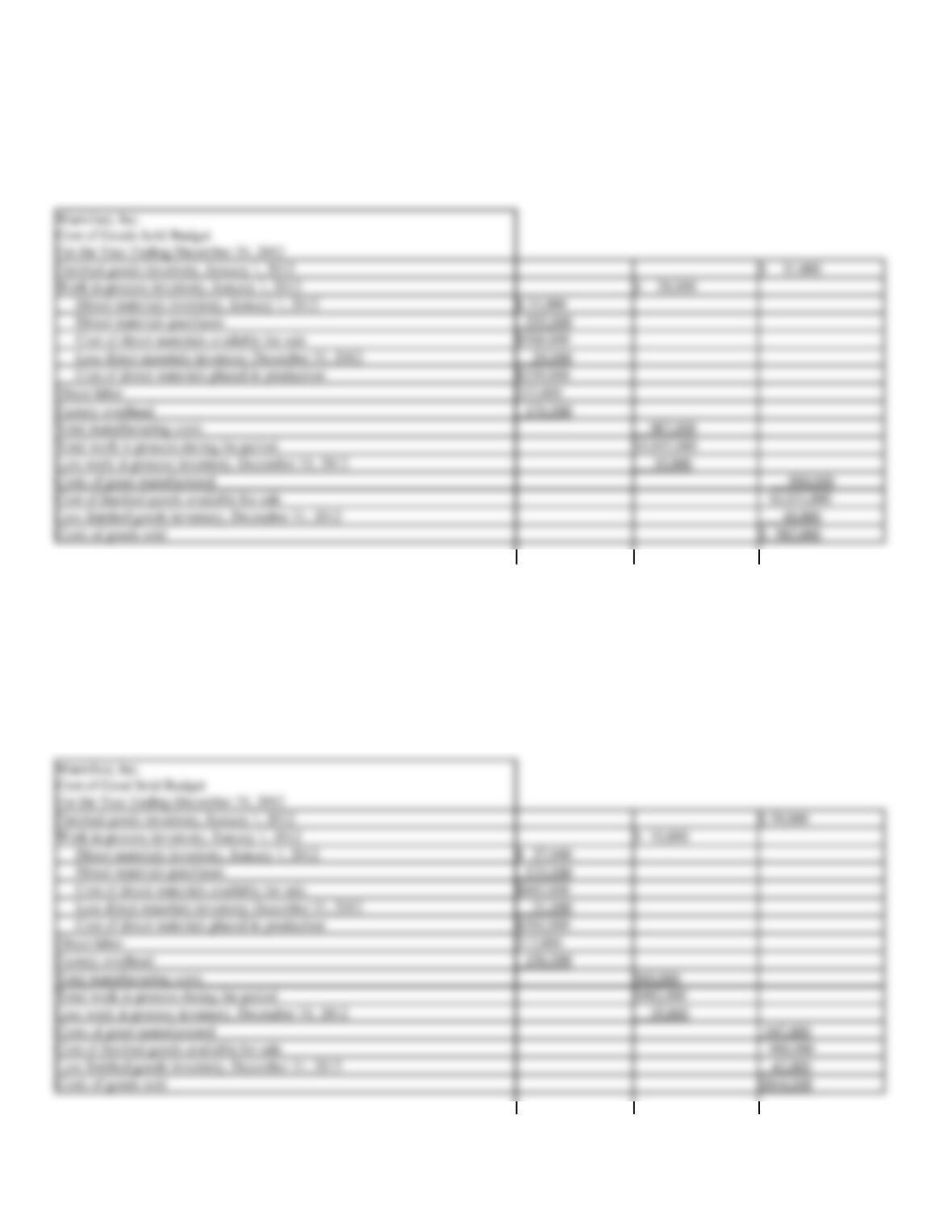
162. Warmfeet manufactures comforters. Assume the estimated inventories on January 1, 2012, for finished
goods, work in process, and materials were $51,000, $28,000 and $33,000 respectively. Also assume the desired
inventories on December 31, 2012, for finished goods, work in process, and materials were $48,000, $35,000
and $29,000 respectively. Direct material purchases were $555,000. Direct labor was $252,000 for the year.
Factory overhead was $176,000. Prepare a cost of goods sold budget for Warmfeet, Inc.
163. Warmfeet manufactures comforters. Assume the estimated inventories on January 1, 2012, for finished
goods, work in process, and materials were $39,000, $33,000 and $27,000 respectively. Also assume the desired
inventories on December 31, 2012, for finished goods, work in process, and materials were $42,000, $35,000
and $21,000 respectively. Direct material purchases were $575,000. Direct labor was $212,000 for the year.
Factory overhead was $156,000. Prepare a cost of goods sold budget for Warmfeet, Inc.