15) What potential difference is required to cause 4.00 A to flow through a resistance of 330 Ω?
A) 12.1 V
B) 82.5 V
C) 334 V
D) 1320 V
16) What is the voltage drop across a 5.0-Ω resistor if the current through it is 5.0 A?
A) 100 V
B) 25 V
C) 4.0 V
D) 1.0 V
17) A 4000-Ω resistor is connected across a 220-V power source. What current will flow
through the resistor?
A) 0.055 A
B) 1.8 A
C) 5.5 A
D) 18 A
18) A light bulb operating at 110 V draws 1.40 A of current. What is its resistance?
A) 12.7 Ω
B) 78.6 Ω
C) 109 Ω
D) 154 Ω
19) A 12-V battery is connected across a 100-Ω resistor. How many electrons flow through the
wire in 1.0 min? (e = 1.60 × 10⁻¹⁹ C)
A) 1.5 × 10¹⁹
B) 2.5 × 10¹⁹
C) 3.5 × 10¹⁹
D) 4.5 × 10¹⁹
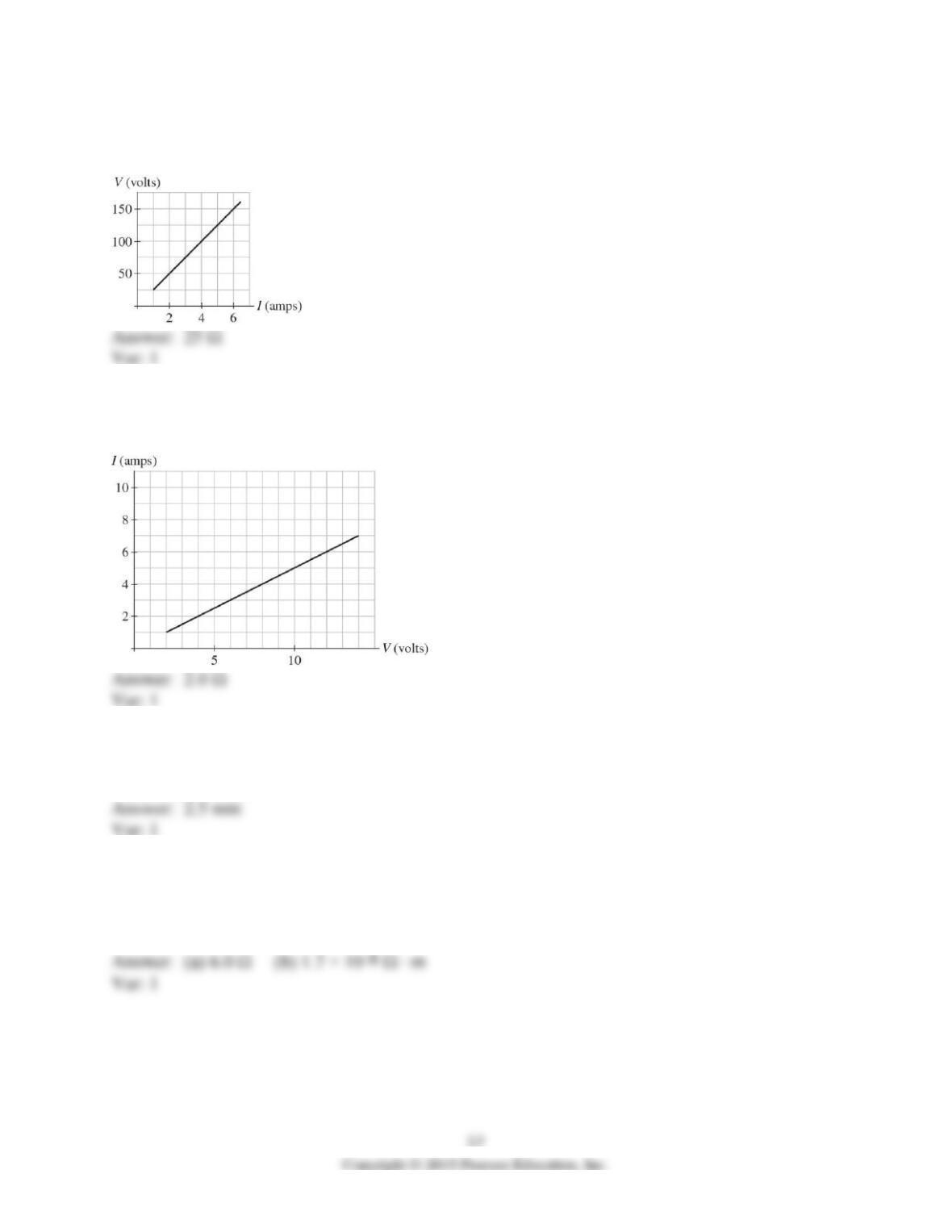
20) The graph shown in the figure shows the results of measurements of the dc current through a
circuit device for various potential differences across it. Assume that all the numbers shown are
accurate to two significant figures. What is the resistance of this device?
21) The graph shown in the figure shows the results of measurements of the dc current through a
circuit device for various potential differences across it. Assume that all the numbers shown are
accurate to two significant figures. What is the resistance of this device?
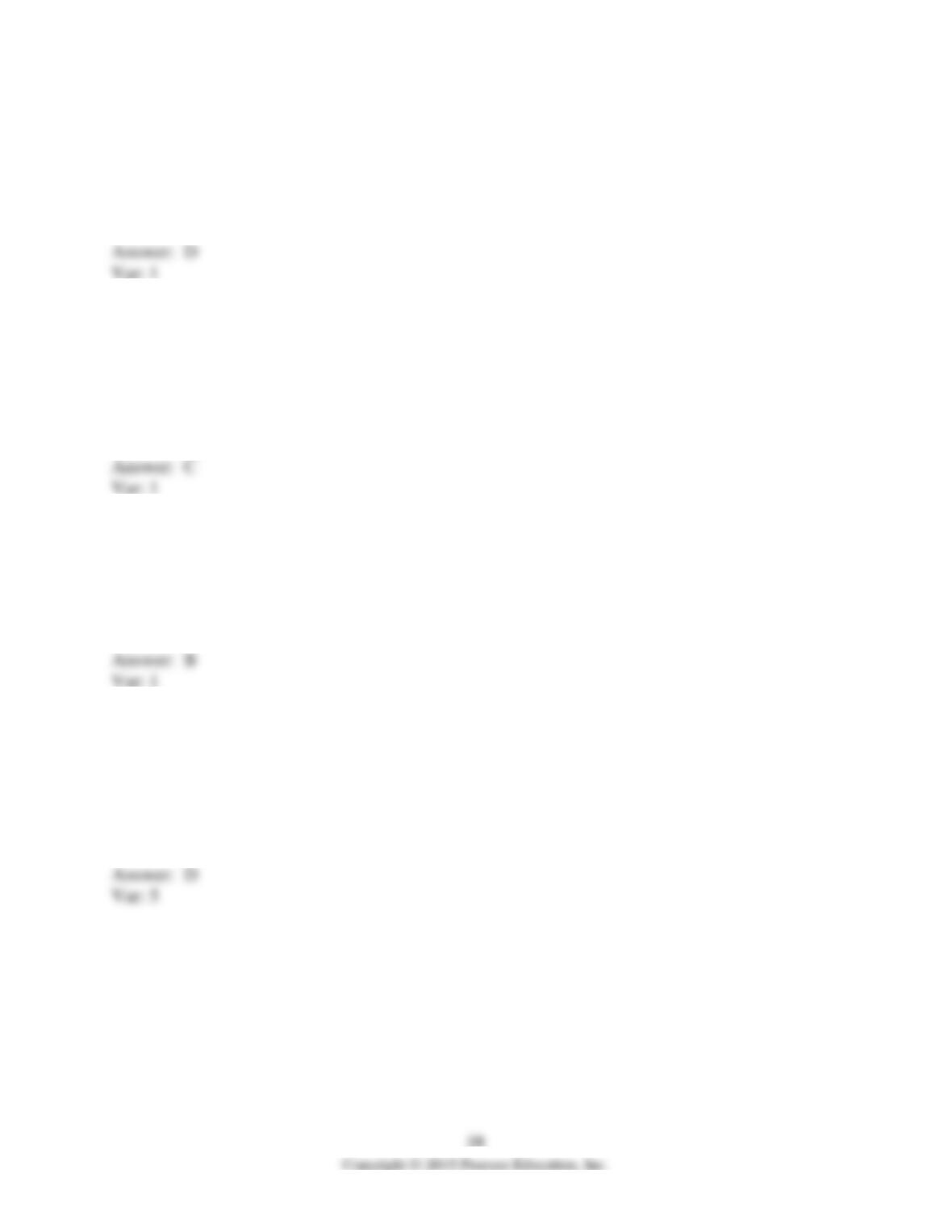
22) When a thin copper wire that is 178 m long is connected between a 1.2-V potential
difference, a current of 2.0 amps flows through the wire. What is the diameter of this wire? The
resistivity of copper is 1.72 × 10⁻⁸ Ω ∙ m.
23) A 25-m wire of diameter 0.30 mm draws 0.499 A when connected across a 3.0-V potential
difference.
(a) What is the resistance of the wire?
(b) What is the resistivity of the material from which the wire is made?
24) A certain metal wire has a cross-sectional area of 1.0 cm2 and a resistivity of 1.7 × 10⁻⁸ Ω ∙
m. How long would it have to be to have a resistance of 1.0 Ω?
A) 5.9 × 10⁶ m
B) 5.9 m
C) 5.9 × 10⁴ m
D) 590 m
E) 5.9 km
25) What is the resistance of 1.0 m of a solid cylindrical metal cable having a diameter of 0.40
inches and a resistivity of 1.68 × 10⁻⁸ Ω ∙ m?
A) 0.00012 Ω
B) 0.00021 Ω
C) 0.0012 Ω
D) 0.0021 Ω
26) What is the resistance of a cylindrical metal rod 1.0 cm in diameter and 45 m long, if the
resistivity of the metal is 1.4 × 10⁻⁸ Ω ∙ m?
A) 0.0063 Ω
B) 0.0080 Ω
C) 0.80 Ω
D) 6.3 Ω
27) A certain metal has a resistivity of 1.68 × 10⁻⁸ Ω ∙ m. You have a long spool of wire made
from this metal. If this wire has a diameter of 0.15 mm, how long should you cut a segment so its
resistance will be 15 Ω?
A) 16 mm
B) 16 cm
C) 1.6 m
D) 16 m
28) A 120-m long metal wire having a resistivity of 1.68 × 10⁻⁸ Ω ∙ m has a resistance of 6.0 Ω.
What is the diameter of the wire?
A) 0.065 mm
B) 0.65 mm
C) 0.65 cm
D) 0.65 m
29) A rod is 4.0 m long and has a square cross-section that is 1.5 cm on each side. An ohmmeter
measures 0.040 Ω across its ends. What is the resistivity of the material from which this rod is
made?
A) 0.023 Ω ∙ m
B) 0.015 Ω ∙ m
C) 1.5 × 10⁻⁴ Ω ∙ m
D) 2.3 × 10⁻⁶ Ω ∙ m
30) Calculate the current through a 10.0-m long 22-gauge nichrome wire with a radius of 0.321
mm if it is connected across a 12.0-V battery. The resistivity of the nichrome is 1.00 × 10⁻⁶ Ω ∙
m.
A) 30.9 A
B) 61.8 A
C) 0.388 A
D) 0.776 A
31) A metal bar is 20 cm long and has a rectangular cross-section measuring 1.0 cm × 2.0 cm.
What is the voltage drop along its length when it carries a 4000-A current? The resistivity of the
metal is 1.68 × 10⁻⁸ Ω ∙ m.
A) 0.67 V
B) 0.34 V
C) 0.067 V
D) 0.034 V
32) A 1.0-m length of nichrome wire has a radius of 0.50 mm and a resistivity of 1.0 × 10⁻⁶ Ω ∙
m. When this wire carries a current of 0.50 A, what is the voltage across its ends?
A) 0.0030 V
B) 0.32 V
C) 0.64 V
D) 1.6 V
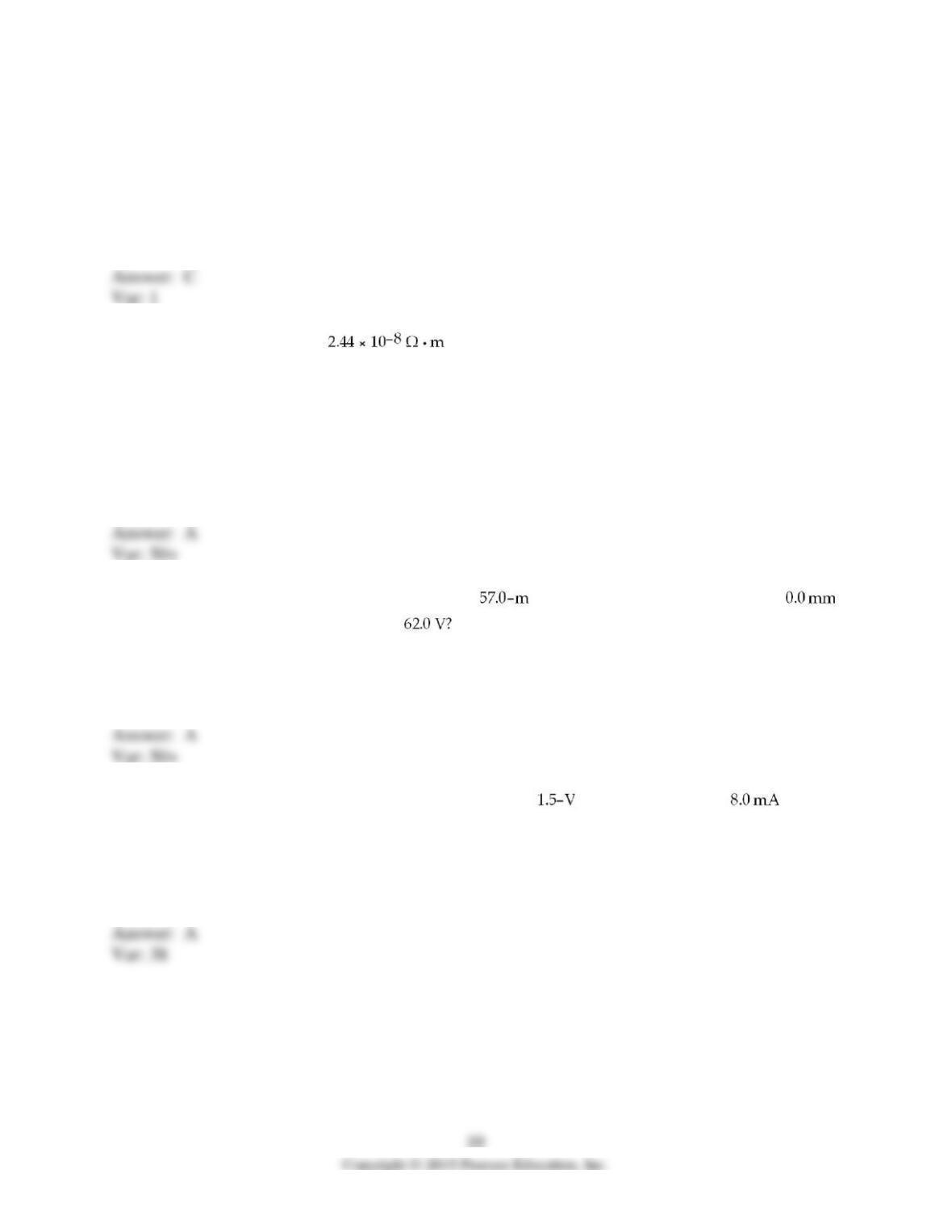
33) A 1.0-mm diameter extension cord is made of metal having a resistivity of 1.68 × 10⁻⁸ Ω ∙
m. When it carries a current of 15 A, what is the potential difference between two points in the
cord that are 100 m apart?
A) 12 V
B) 23 V
C) 32 V
D) 41 V
34) The resistivity of gold is at a temperature of 20°C. A gold wire that is 0.50
mm in diameter and 44 cm long carries a current of 380 mA. How many electrons each second
pass a given cross section of the wire at 20°C? (e = 1.60 × 10⁻¹⁹ C)
A) 2.4 × 10¹⁸
B) 2.4 × 10¹⁷
C) 1.2 × 10²²
D) 2.8 × 10¹⁴
E) 6.3 × 10¹⁵
35) How much current will be flowing through a length of copper wire with radius
if it is connected to a source supplying The resistivity of the metal is 1.68 × 10⁻⁸ Ω ∙ m.
A) 0 A
B) 0 × 108 A
C) 0 nA
D) 0 A
36) When a 1.0-m length of metal wire is connected to a battery, a current of flows
through it. What is the diameter of the wire? The resistivity of the metal is 2.24 × 10⁻⁸ Ω ∙ m.
A) 12 μm
B) 6.0 μm
C) 24 μm
D) 2.2 μm
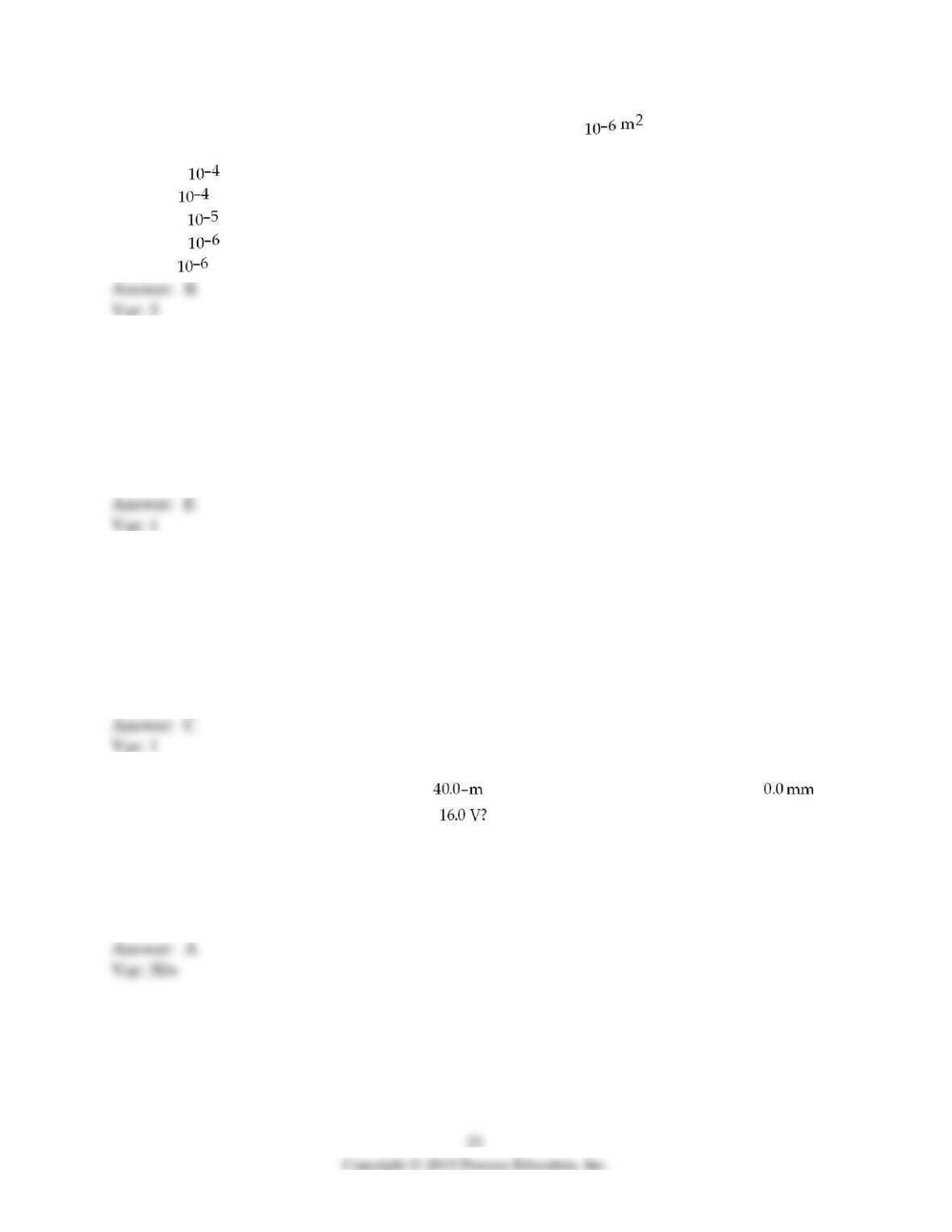
37) The resistance of a 100-cm wire of cross sectional area 2 × is 400 Ω. What is the
resistivity of the material from which this wire is made?
A) 0.80 × Ω ∙ m
B) 8.0 × Ω ∙ m
C) 0.80 × Ω ∙ m
D) 0.80 × Ω ∙ m
E) 8.0 × Ωv
38) The resistivity of the material of a wire is 1.76 × 10⁻⁸ Ω ∙ m. If the diameter of the wire is
2.00 mm and its length is 2.00 m, what is its resistance?
A) 112 Ω
B) 11.2 Ω
C) 1.12 Ω
D) 0.112 Ω
E) 0.0112 Ω
39) The resistivity of a 1.0 m long copper wire is 1.72 × 10⁻⁸ Ω ∙ m and its cross sectional area is
2.0 × 10⁻⁶ m2. If the wire carries a current of 0.20 A, what is the voltage across the wire?
A) 17 mV
B) 0.90 mV
C) 1.7 mV
D) 10 mV
E) 90 mV
40) How much current will flow through a length of metal wire with a radius of if
it is connected to a power source supplying The resistivity of the metal is 1.68 × 10⁻⁸ Ω ∙
m.
A) 0 A
B) 0 x 108 A
C) 0 nA
D) 0 A
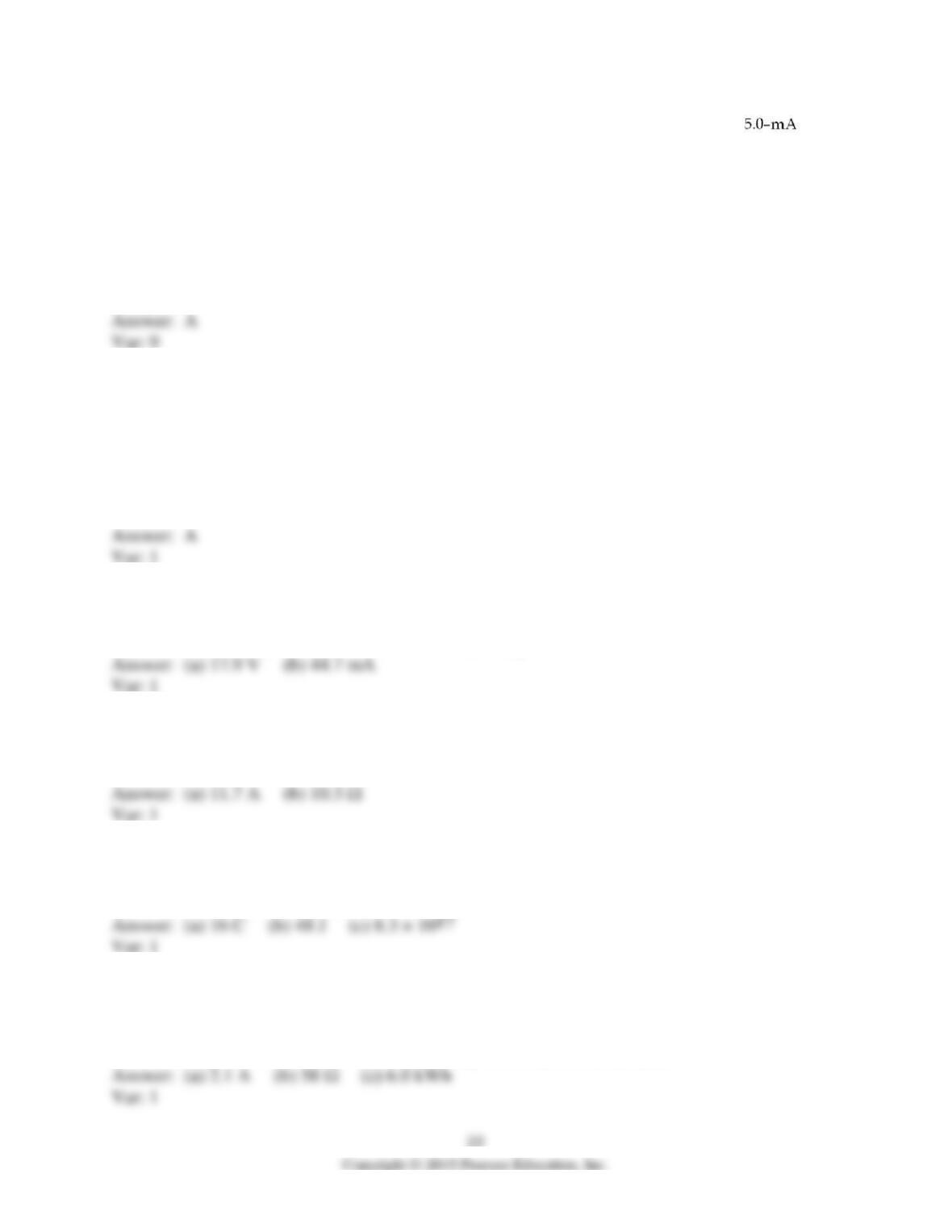
41) When a potential difference is applied across a piece of wire made of metal A, a
current flows. If the metal-A wire is replaced with a wire made of metal B having twice the
diameter of the metal-A wire, how much current will flow through the metal-B wire? The lengths
of both wires are the same, and the voltage difference remains unchanged. The resistivity of
metal A is 1.68 × 10⁻⁸ Ω ∙ m, and the resistivity of metal B is 1.59 × 10⁻⁸ Ω ∙ m.
A) 21 mA
B) 19 mA
C) 11 mA
D) 5.3 mA
42) A tube of mercury with resistivity 9.84 × 10⁻⁷ Ω ∙ m has a uniform electric field of 23 N/C
inside the mercury. How much current is flowing in the tube, if the radius of the tube is 0.495
mm?
A) 18 A
B) 180 A
C) 29 A
D) 280 A
43) The power rating of a 400-Ω resistor is 0.800 W.
(a) What is the maximum safe voltage across this resistor?
(b) What is the maximum current the resistor can safely draw?
44) A resistor operated at 120 V dc is rated at 1.40 kW.
(a) What is the normal operating current through the resistor?
(b) What is the resistance of the resistor?
45) A flashlight draws 0.133 A from a 3.0-V battery pack. In 2.0 minutes (a) how much charge
flows from the battery, (b) how much energy does the battery supply, and (c) how many
electrons have passed any point in the circuit every second?
46) An instrument is rated at 250 W if it is connected across a 120-V dc power supply.
(a) What current does it draw under normal operation?
(b) What is its resistance?
(c) How many kilowatt-hours does it use in a day if it is left on all the time?
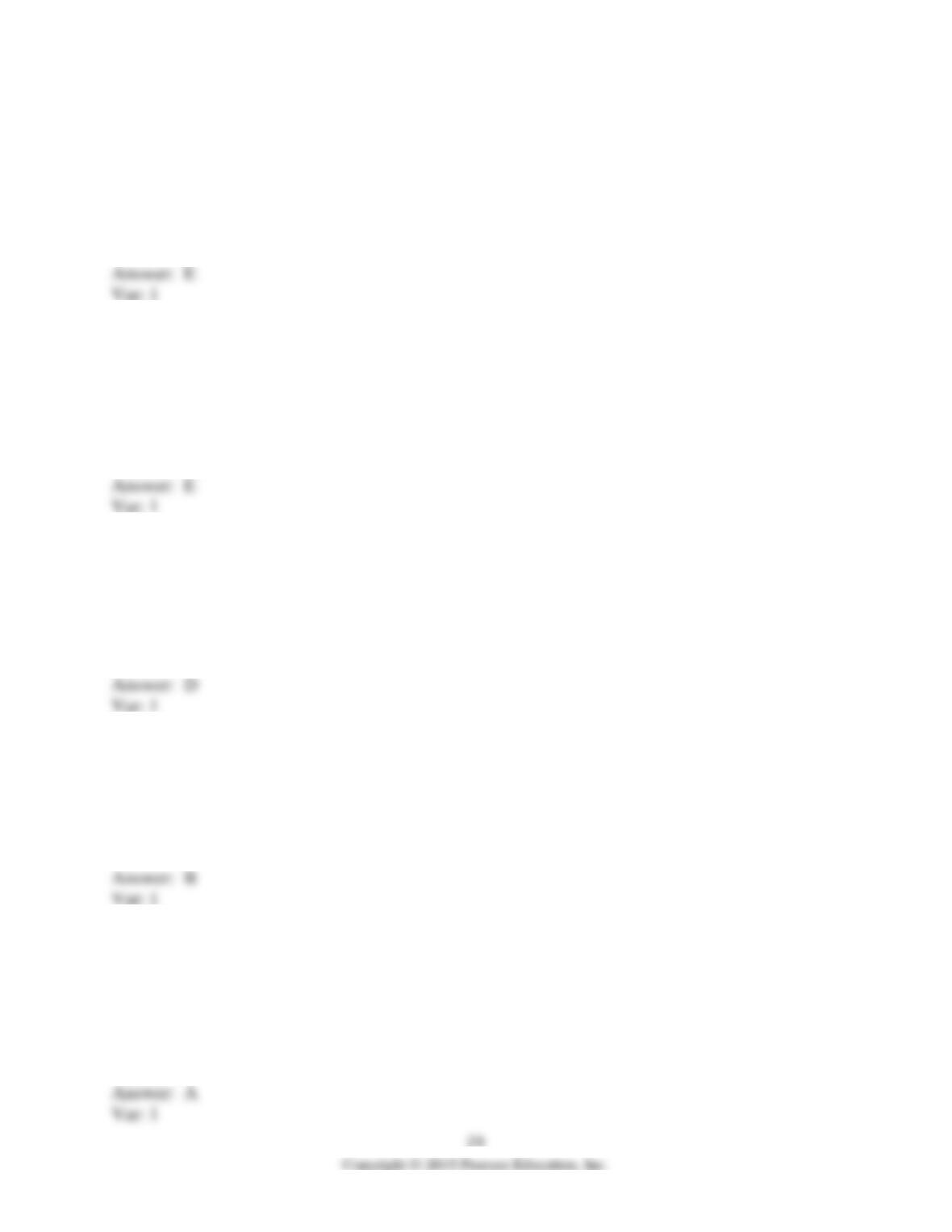
47) A 200-W light bulb is connected across a 110-V dc power supply. What current will flow
through this bulb?
A) 0.90 A
B) 0.36 A
C) 0 A
D) 0.60 A
E) 1.8 A
48) A 100-W resistance heater is connected to a 110-V dc source. What current flows through
the heater?
A) 1.1 A
B) 2.2 A
C) 3.3 A
D) 4.4 A
E) 0.91 A
49) A 100-W light bulb is operated by a 110-V dc source. What is the resistance of this bulb?
A) 100 Ω
B) 8.0 × 10⁻³ Ω
C) 6.0 × 10⁻³ Ω
D) 120 Ω
E) 240 Ω
50) If the power rating of a 400-Ω resistor is 0.800 W, what is the maximum voltage that can
safely be connected across the resistor?
A) 110 V
B) 17.9 V
C) 170 V
D) 1.80 V
51) If the power rating of a 400-Ω resistor is 0.80 W, what is the maximum current it can safely
draw?
A) 45 mA
B) 18 mA
C) 4.4 mA
D) 2.0 mA
E) 320 mA
52) A light bulb operating at a dc voltage of 120 V has a power rating of 60 W. How much
current is flowing through this bulb?
A) 1.5 A
B) 2.5 A
C) 0.50 A
D) 2.0 A
E) 1.0 A
53) A light bulb operating at a dc voltage of 120 V has a resistance of 200 Ω. How much power
is dissipated in this bulb?
A) 100 W
B) 60 W
C) 72 W
D) 14 mW
E) 7.2 W
54) The power rating of a 400-Ω resistor is 0.25 W. What is the maximum voltage you can safely
connect across its ends?
A) 10 V
B) 20 V
C) 30 V
D) 40 V
E) 50 V
55) When 5.00 A is flowing through an 10.0-Ω device, how much power is being dissipated in
the device?
A) 50.0 W
B) 250 W
C) 500 W
D) 2.50 kW
56) A resistance heater is rated at 1200 W when operating at 110 V dc. What current will it
draw?
A) 0.090 A
B) 1.0 A
C) 11 A
D) 12 A
57) A 150-W light bulb is designed to operate at 110 V dc. How much current does it draw?
A) 0.73 A
B) 1.4 A
C) 2.0 A
D) 15 A
58) What is the resistance of a 0.100-kW light bulb designed to be used in a 120-V circuit dc?
A) 12.0 Ω
B) 144 Ω
C) 1.2 Ω
D) 0.83 Ω
59) A toaster is rated at 800 W when operating at 120 V dc. What is the resistance of its heating
element?
A) 16 Ω
B) 18 Ω
C) 6.7 Ω
D) 0.15 Ω
60) A 200-Ω resistor is rated at 1/4 W. What is the maximum current it can safely draw?
A) 0.035 A
B) 0.35 A
C) 50 A
D) 0.25 A
61) A 25-W soldering iron runs on 110 V dc. What is its resistance?
A) 0.0020 Ω
B) 4.4 Ω
C) 0.48 kΩ
D) 2.8 kΩ
62) How much does it cost to operate a 25-W soldering iron for 8.0 hours if energy costs
8.0¢/kWh?
A) $1.50
B) 25¢
C) 16¢
D) 1.6¢
63) How much energy does a 100-W light bulb use in 8.0 hours?
A) 0.0080 kWh
B) 0.80 kWh
C) 13 kWh
D) 800 kWh
64) A 1500-W heater is connected to a 120-V line for 2.0 hours. How much heat energy is
produced?
A) 1.5 kJ
B) 3.0 kJ
C) 0.18 MJ
D) 11 MJ
65) A battery is rated at 12 V and 160 A-h. How much energy does this battery store?
A) 1.9 kJ
B) 6.0 kJ
C) 1.9 MJ
D) 6.9 MJ
66) An electronic component with a 17-Ω resistor is rated for use at power levels not exceeding
How much current can safely flow through the component?
A) 0.91 A
B) 1.21 A
C) 238 A
D) 0.22 A
67) A 100-W driveway light bulb is on 10 hours per day. If the power company charges 10¢ for
each kilowatt-hour of electricity used, estimate the yearly cost to operate the bulb if it is used
every day for a 365-day year.
A) $3.65
B) $7.30
C) $37
D) $73
68) A 400-W computer (including its monitor) is turned on for 8.0 hours per day. If electricity
costs 10¢ per kWh, how much does it cost to run the computer annually for a 365-day year?
A) $120
B) $1200
C) $15
D) $150
69) The nichrome heating element in an electric drier operates on 240 V and generates heat at the
rate of 2.0 kW. The heating element shorts out and, in repairing it, the repairman shortens the
nichrome wire by 10%. (Assume the temperature is unchanged. In reality, the resistivity of the
wire will depend on its temperature.) What effect will the repair have on the power dissipated in
the heating element?
A) The power is still 2.0 kW.
B) The power increases to 2.2 kW.
C) The power decreases to 1.8 kW.
D) None of the given answers is correct.
70) When a 14.0-A current flows through an 8.00-Ω device for 24.0 hours, how much does this
cost if energy costs $0.0900 per kW ∙ h?
A) $0.24
B) $1.04
C) $2.16
D) $3.39
71) A 9.0-V battery costs $1.49 and will run a portable CD player for 6.0 hours before running
down and needing to be replaced. If this battery supplies a current of 25 mA to the player, what
is the cost of the energy provided by the battery in dollars per kWh?
A) $11/kWh
B) $110/kWh
C) $1100/kWh
D) $11,000/kWh
72) A 200-Ω resistor is rated at 1/4 W. What is the maximum voltage that can safely be
connected across it?
A) 0.71 V
B) 7.1 V
C) 50 V
D) 0.25 V
73) A simple circuit has a total resistance of 30 Ω. If a 2.0-A current is maintained in this circuit,
how much energy is dissipated in this circuit in 4.0 seconds?
A) 24 J
B) 4.8 J
C) 48 J
D) 480 J
E) 6.0 J
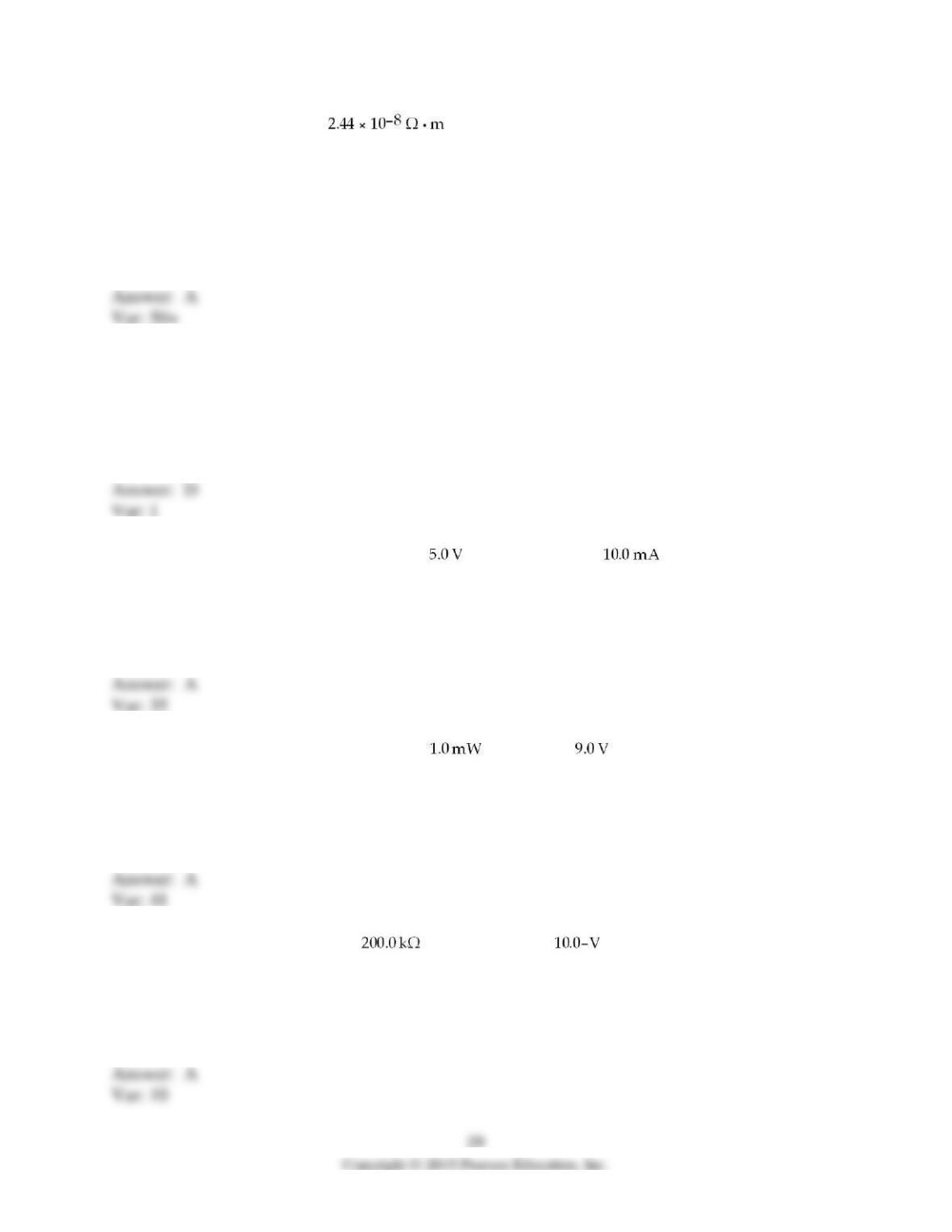
74) The resistivity of gold is at a temperature of 20°C. A gold wire, 1.8 mm in
diameter and 14 cm long, carries a current of 480 mA. What power is dissipated in this wire at
20°C?
A) 0.31 mW
B) 0.077 mW
C) 0.14 mW
D) 0.19 mW
E) 0.25 mW
75) A 120-Ω laboratory resistor is rated at 0.25 W. How much current can safely flow through
the resistor?
A) 30 A
B) 2.1 mA
C) 22 mA
D) 46 mA
76) The voltage drop across a metal bar is while a current of flows through it. How
much power does this bar dissipate?
A) 50 mW
B) 500 μW
C) 2.5 kW
D) 0.50 kW
77) A battery is rated such that it provides of power at when fully charged. How
much current can it deliver?
A) 0.11 mA
B) 81 kA
C) 0.33 mA
D) 9.1 kA
78) A device with a resistance of is connected to a battery. How much power does
the device use?
A) 0.50 mW
B) 20,000 kW
C) 0.050 mW
D) 2000 kW
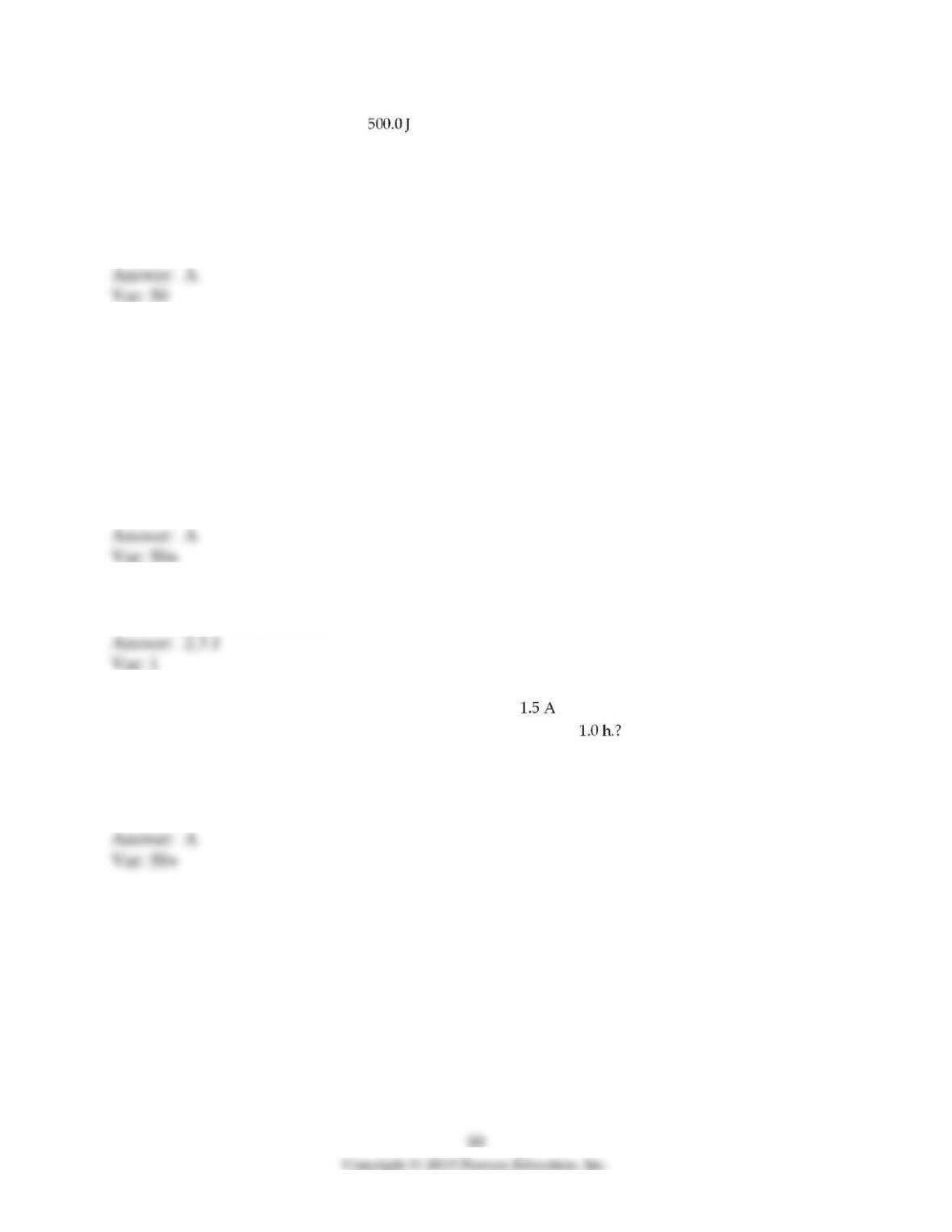
79) A 6.0-V battery that can store of energy is connected to a resistor. How much charge
must flow between the battery’s terminals to completely drain the battery if it is fully charged?
Assume that the voltage of the battery remains the same until it is totally drained.
A) 83 C
B) 0.010 C
C) 3000 C
D) 0.07 C
80) The heating element of a toaster is a 5.4-m length of nichrome wire of diameter 0.48 mm.
The resistivity of nichrome at the operating temperature of the toaster is 1.3 × 10⁻⁶ Ω ∙ m. The
toaster is designed to operate at a voltage of 120 V. How much power does it draw in normal
operation?
A) 370 W
B) 360 W
C) 380 W
D) 400 W
E) 410 W
81) A battery supplies 6.0 mA to a 12-Ω resistor for 1.5 h. How much electric energy does this
resistor dissipate in this time?
82) A 5.0-V battery storing 43.0 kJ of energy supplies of current to a circuit. How much
energy does the battery have left after powering the circuit for
A) 16 kJ
B) 27 kJ
C) 43 kJ
D) 41 kJ