Exam
Name___________________________________
MULTIPLE CHOICE. Choose the one alternative that best completes the statement or answers the question.
1)
If a firm is experiencing diseconomies of scale, then
1)
A)
proportional increases in all inputs result in proportional increases in output.
B)
the long–run average cost curve is rising as output expands.
C)
the firm should expand the size of its operation.
D)
the long–run average cost curve is decreasing as output expands.
2)
The production function
2)
A)
always shows increasing marginal product of labor.
B)
shows the relationship between input prices and amount of input used.
C)
shows the maximum level of output for a given set of inputs.
D)
is an economic relationship between revenue and cost.
3)
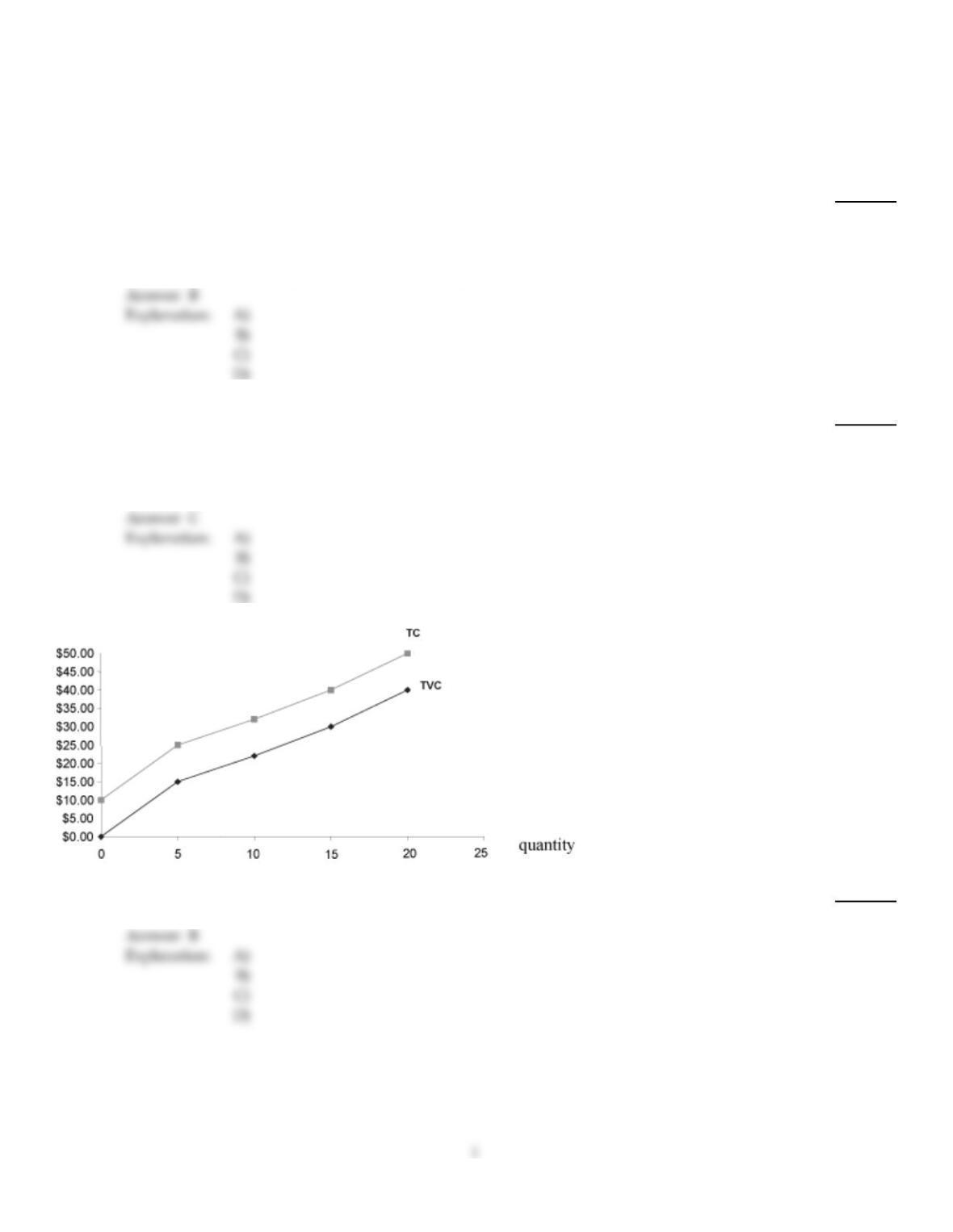
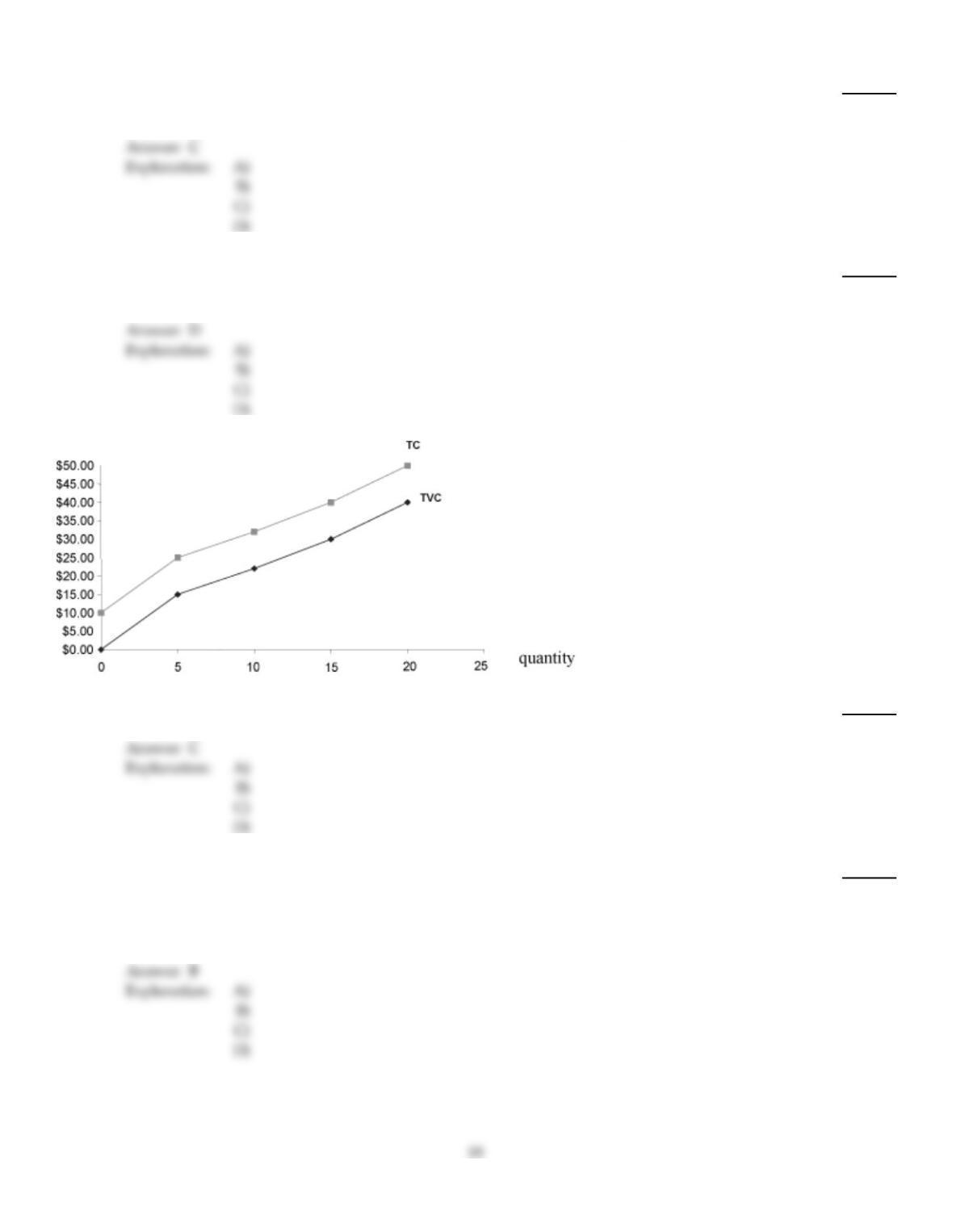
Use the above figure. The AVC at output 5 is
3)
A)
$35.00.
B)
$3.00.
C)
$2.00.
D)
$5.00.
4)
Refer to the above table. What is AVC at an output of 2 units?
4)
A)
$7
B)
$45
C)
$61
D)
$16
5)
Which of the following is TRUE for a firm in the long run?
5)
A)
The law of diminishing marginal product holds.
B)
Variable costs will equal marginal cost at all output levels.
C)
Variable costs will initially increase and then decrease.
D)
All costs are variable costs.
6)
As the quantity of labor increases while the amount of other inputs are held constant, marginal
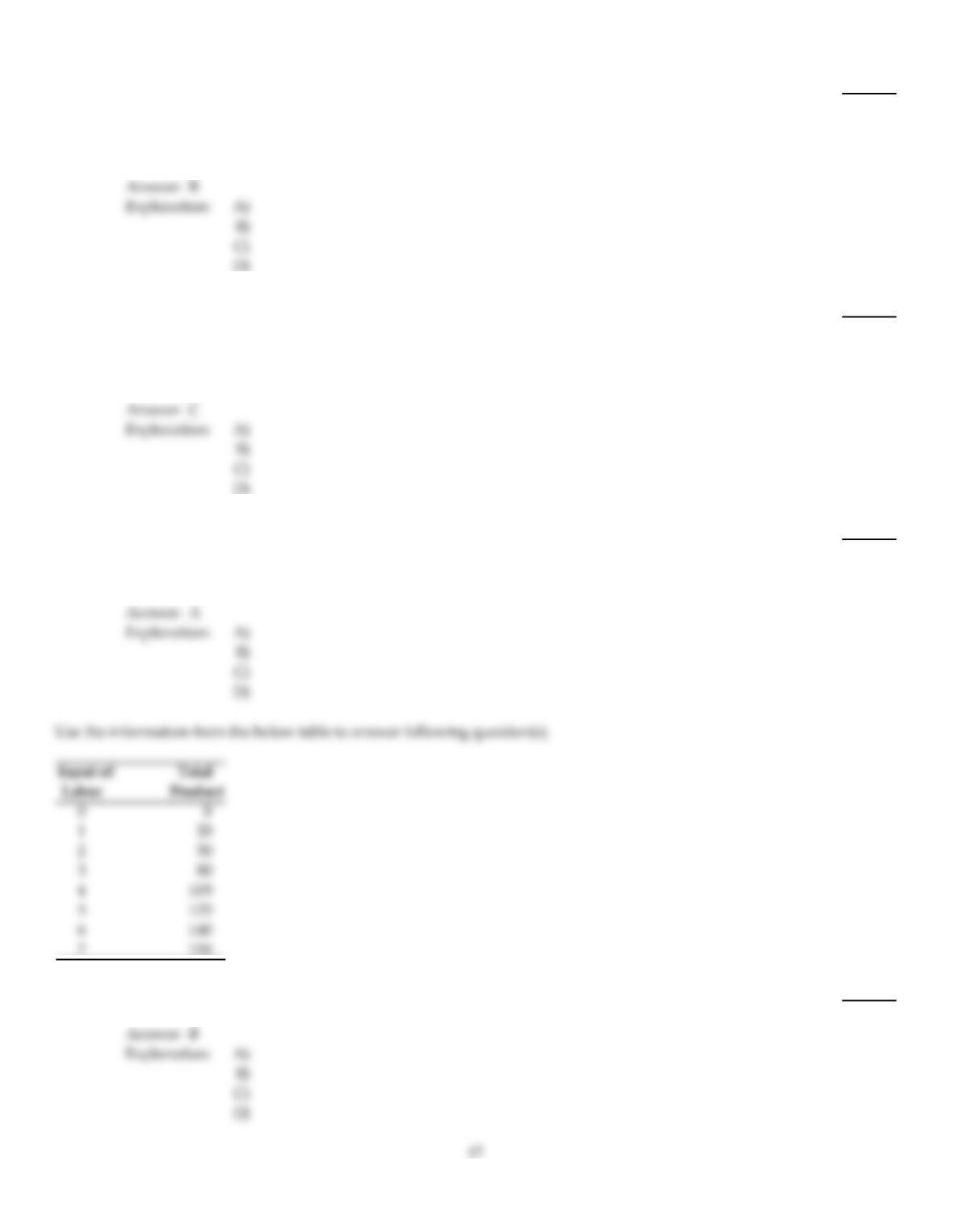
product of labor will
6)
A)
initially decrease and then increase.
B)
increase continuously.
C)
initially increase and then decrease.
D)
decrease continuously.
7)
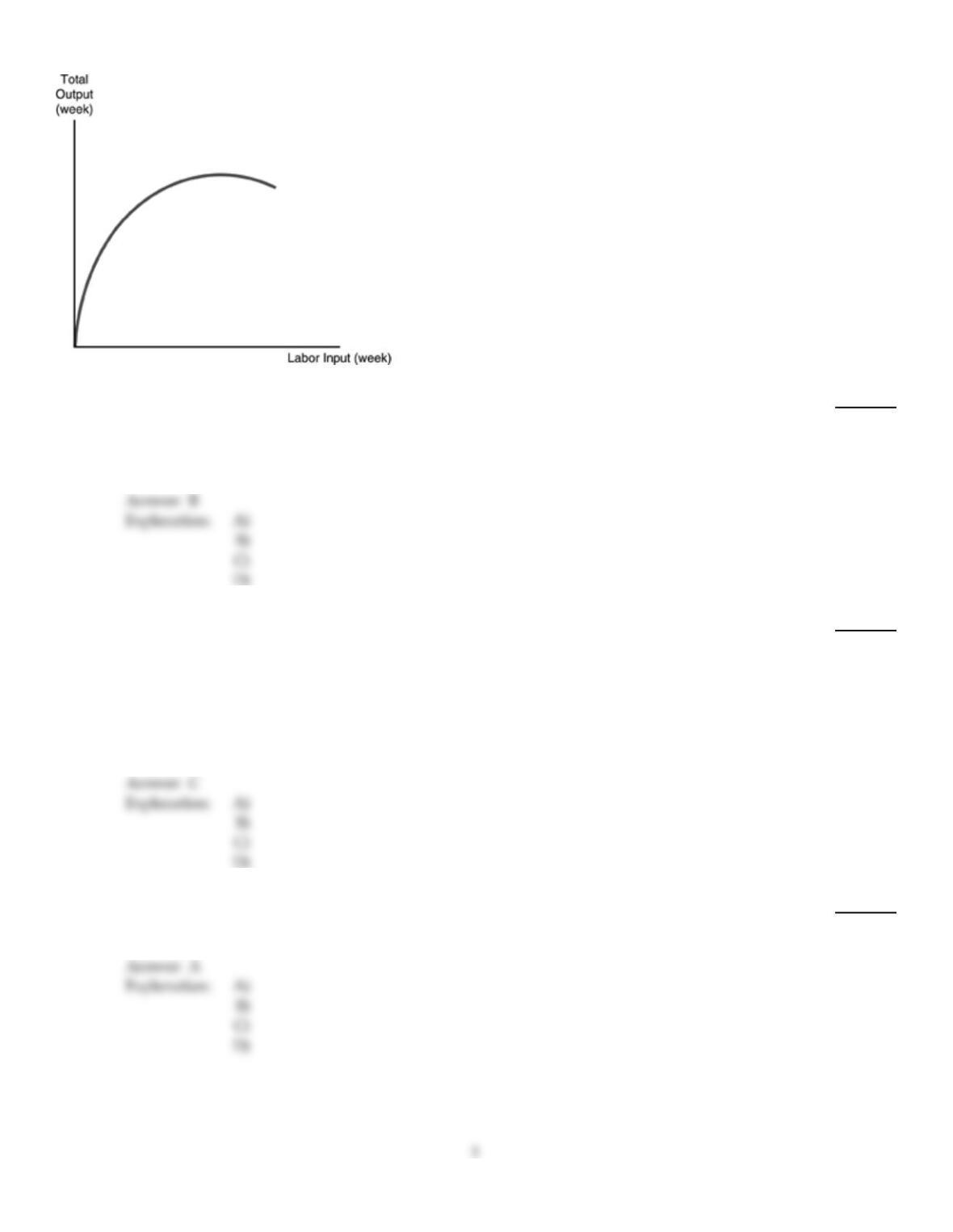
Refer to the above figure. The curve reflects
7)
A)
the law of diminishing marginal product in capital.
B)
the law of diminishing marginal product in labor.
C)
the law of increasing marginal product in capital.
D)
the law of increasing marginal product in labor.
8)
A single–plant firm trying to select the rate of output consistent with an overall plant size that
yields the minimum efficient scale will choose a rate of output for which
8)
A)
the long–run marginal cost curve crosses the long–run average fixed cost curve at that rate of
output.
B)
the short–run marginal cost curve crosses the short–run average total cost curve at that rate of
output.
C)
long–run average total cost is lowest at that rate of output.
D)
total fixed cots are minimized at that rate of output.
Explanation:
9)
Which of the following is TRUE about the long run?
9)
A)
All resources are variable.
B)
At least one resource is fixed.
C)
All resources are fixed.
D)
None of the above.
Explanation:
Explanation:
10)
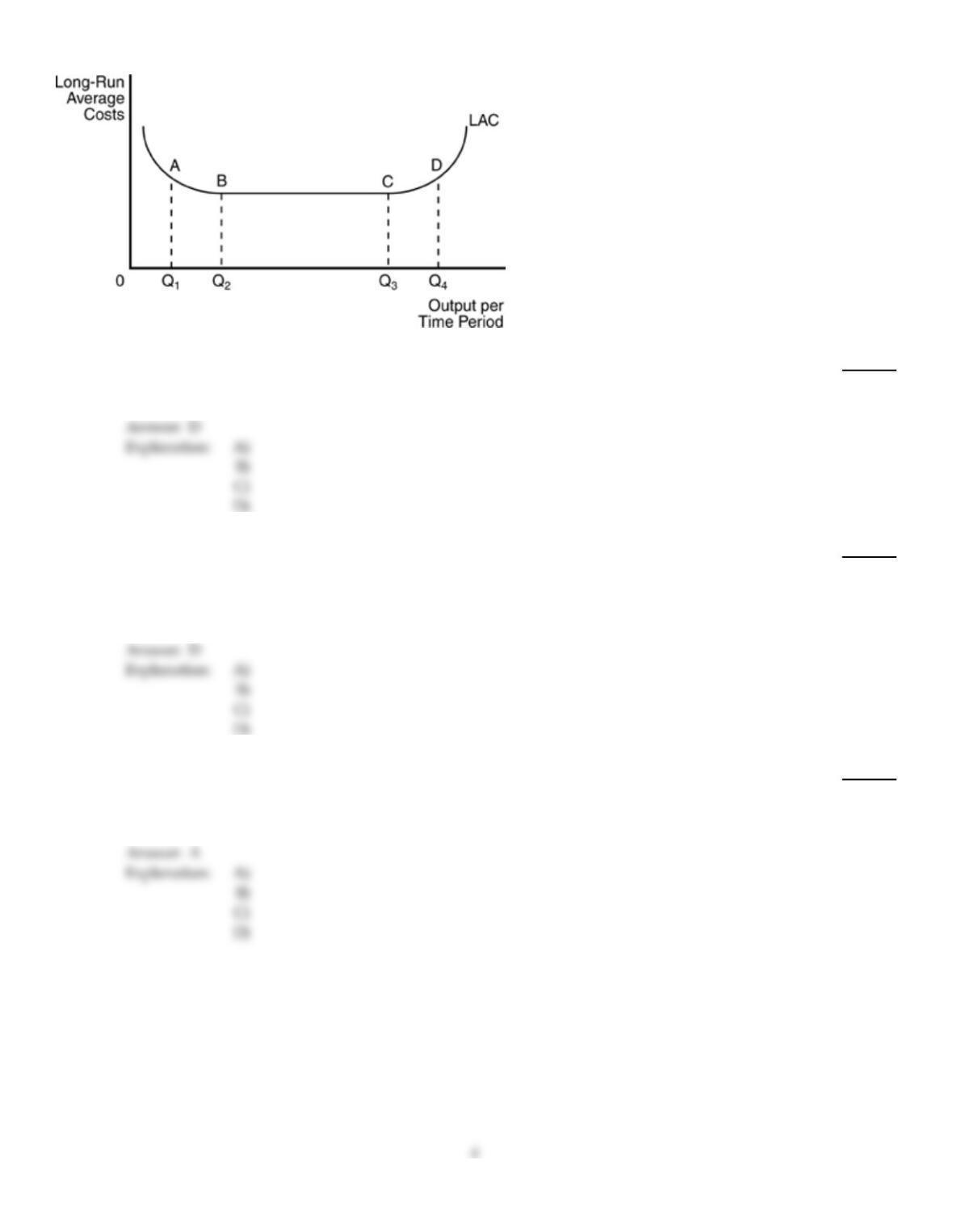
In the above figure, for any output level less than Q2, this firm experiences
10)
A)
decreasing long run average costs.
B)
constant economies of scale.
C)
diseconomies of scale.
D)
economies of scale.
11)
The law of diminishing marginal product is a statement
11)
A)
that concerns the long run.
B)
that concerns changes in profits.
C)
that relates to plant size.
D)
that concerns changes in variable input and changes in output.
12)
Phil found that as he continued to crowd laborers into his hot dog stand, the extra output he was
receiving from each additional laborer was beginning to fall off. This is an example of the
12)
A)
law of diminishing product.
B)
law of increasing opportunities.
C)
law of diminishing marginal utility.
D)
law of demand.
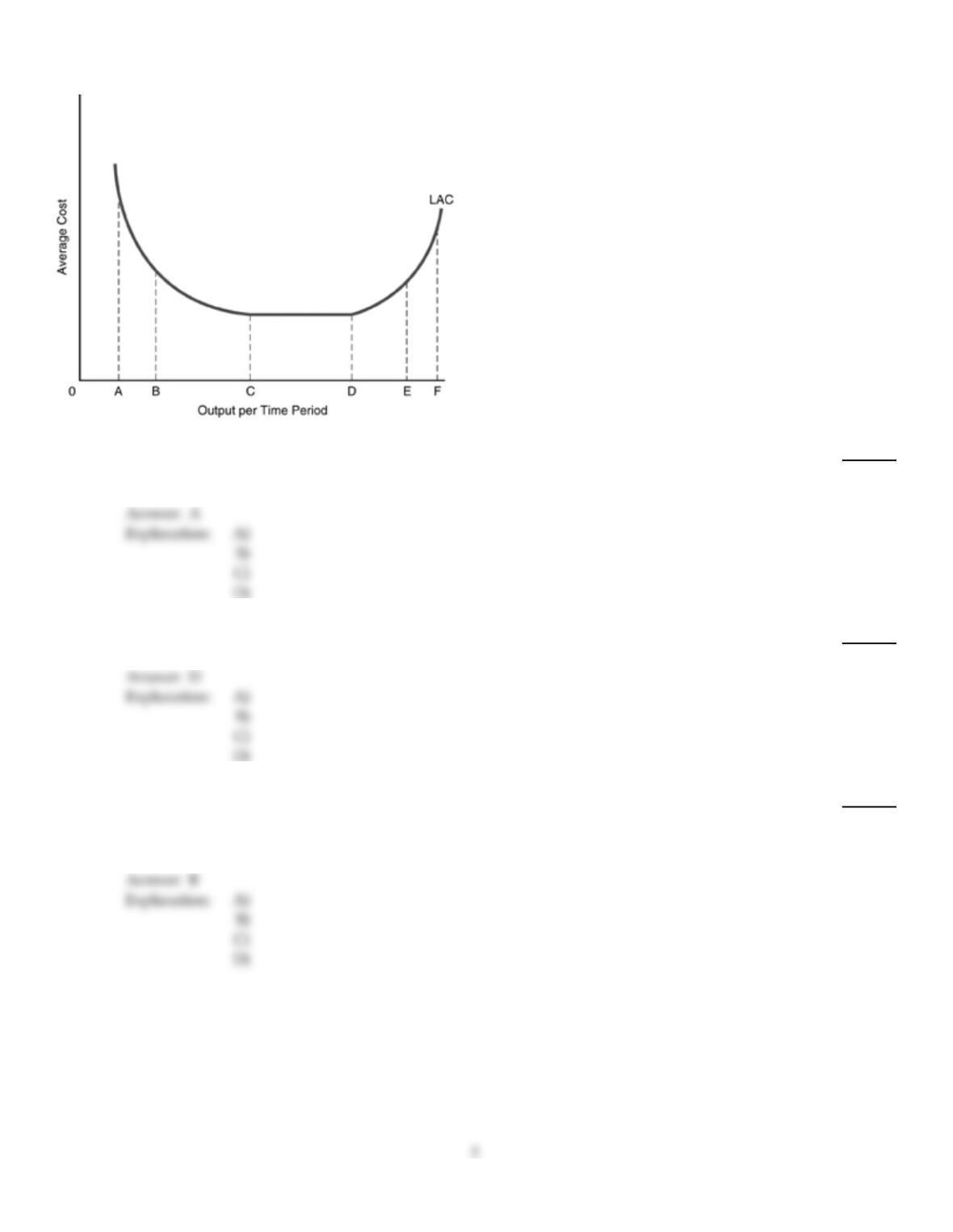
13)
In the above figure, the long–run cost curve between points E and F illustrates
13)
A)
diseconomies of scale.
B)
economies of scale.
C)
diminishing marginal product.
D)
constant returns to scale.
14)
All of the following are most likely to be fixed costs EXCEPT the cost relating to
14)
A)
taxes.
B)
rent.
C)
insurance.
D)
packaging.
15)
Suppose the manager of a restaurant notices that when she has too many waiters on the floor for a
shift that the waiters get in each other’s way and fewer dinners are served. This is an example of
15)
A)
diminishing marginal utility.
B)
diminishing marginal product.
C)
diminishing marginal inputs.
D)
diminishing marginal workforce.
16)
Total product divided by the variable input is
16)
A)
average physical product.
B)
marginal physical product.
C)
marginal cost.
D)
average total cost.
17)
The marginal cost curve intersects
17)
A)
the average total cost curve at its maximum.
B)
the minimum of the average fixed cost, average variable cost and the average total cost
curves.
C)
the minimum of the average variable cost and average total cost curves.
D)
the average fixed cost curve at its minimum.
18)
Which of the following is a short–run decision for a firm?
18)
A)
Firing workers
B)
Downsizing the firm’s manufacturing plant
C)
Investing in a new addition to the firm’s manufacturing plant
D)
Expanding the firm’s distribution network of long–haul freight trucks and smaller delivery
trucks.
19)
Refer to the above table. At what quantity of labor does the average variable cost curve start to
increase?
19)
A)
After 2 units
B)
After 6 units
C)
After 3 units
D)
After 1 unit
20)
In the above table, the marginal cost of the seventh unit is
20)
A)
$5.00.
B)
$33.00.
C)
$4.00.
D)
$3.00.
21)
Refer to the above table. When output rises from 4 units to 5 units, marginal costs are
21)
A)
$31.
B)
$22.
C)
$10.
D)
$19.
22)
The point of saturation occurs when a firm
22)
A)
maximizes its total returns.
B)
first encounters negative marginal product.
C)
has total returns equal to zero.
D)
first experiences positive marginal product.
23)
An increase in long–run average costs resulting from decreases in output is
23)
A)
attributed to diseconomies to scale.
B)
attributed to constant returns to scale.
C)
attributed to economies of scale.
D)
attributed to the law of diminishing marginal product.
24)
The change in total costs due to a one–unit change in the production rate is
24)
A)
marginal cost.
B)
total fixed cost.
C)
total variable cost.
D)
average total cost.
25)
When average variable costs are rising,
25)
A)
average physical product is rising.
B)
marginal physical product is also rising.
C)
average physical product is falling.
D)
marginal costs is falling.
26)
Economies of scale occur when there are
26)
A)
decreases in output resulting from decreases in input.
B)
increases in long–run average costs when output increases.
C)
decreases in long–run average costs resulting from increases in output.
D)
no changes in long–run average costs when output increases.
27)
In the above table, what is the average variable cost to produce 3 units of output?
27)
A)
$30
B)
$10
C)
$20
D)
$60
28)
The average fixed cost curve
28)
A)
is parallel to the x–axis.
B)
slopes downward as output increases.
C)
increases as the cost of inputs rise.
D)
is the distance between the TC and TVC curves.
29)
A fixed resource is one that
29)
A)
is physically tied to a specific location.
B)
cannot be varied in the short run.
C)
costs more than the average daily revenue of the firm.
D)
can be disposed of only if the firm goes out of business.
30)
The lowest rate of output per unit of time at which long–run average costs for a firm are at a
minimum defines
30)
A)
allowable efficient scale.
B)
maximum efficient scale.
C)
short–run efficient scale.
D)
minimum efficient scale.
31)
Due to extremely large fixed costs, an electricity generating plant probably experiences which of
the following returns to size?
31)
A)
economies of scale
B)
diminishing marginal product
C)
diseconomies of scale
D)
constant returns to scale
32)
What happens at a firm‘s point of saturation?
32)
A)
Workers cannot take on any additional tasks without working overtime hours.
B)
The firm’s total costs exceed its revenues.
C)
The market for a firm’s output has been saturated and sales fall to zero.
D)
For the first time, hiring an additional worker decreases total product.
33)
Which of the following statements is not true about the production function?
33)
A)
The production function depends upon the level of technology available to the firm.
B)
It gives the maximum output that can be obtained for a given level of inputs.
C)
A new production function does not have to be developed when there is technical progress
since technology is included in the function.
D)
It specifies the cost of inputs necessary to produce a certain level of outputs.
34)
The marginal product of labor may increase rapidly initially as more
34)
A)
workers are able to specialize.
B)
total product is decreasing.
C)
workers will get crowded in a fixed factory.
D)
the amount of other inputs is held constant.
35)
When total product is decreasing, marginal product is
35)
A)
negative.
B)
positive and increasing.
C)
constant.
D)
positive and decreasing.
36)
If the marginal product curve is increasing from workers 1–89 and then decreases steadily, crossing
the horizontal axis at 190 workers, we know that
36)
A)
the total output curve is increasing throughout, although at an increasing rate for the first 190
workers and at a decreasing rate after the 190th worker.
B)
diminishing marginal product sets in with the 190th worker.
C)
the total output curve increases from workers 1–89, decreases from workers 90–189, and
becomes 0 at the 190th worker.
D)
the total output curve is increasing at an increasing rate from workers 1–89, then increases at
a decreasing rate until the 190th worker, after which it decreases.
37)
Fred’s Franks originally sold hotdogs and soft drinks from a cart located in front of City Hall. Then
Fred purchased another hotdog cart and hired someone to sell hotdogs and soft drinks near the
high school. Both locations have been successful. When Fred’s Franks expanded to two locations,
which of the following did NOT occur?
37)
A)
The firm employed additional capital.
B)
Fred’s production function changed.
C)
The company increased the inputs it employs.
D)
Production increased.
38)
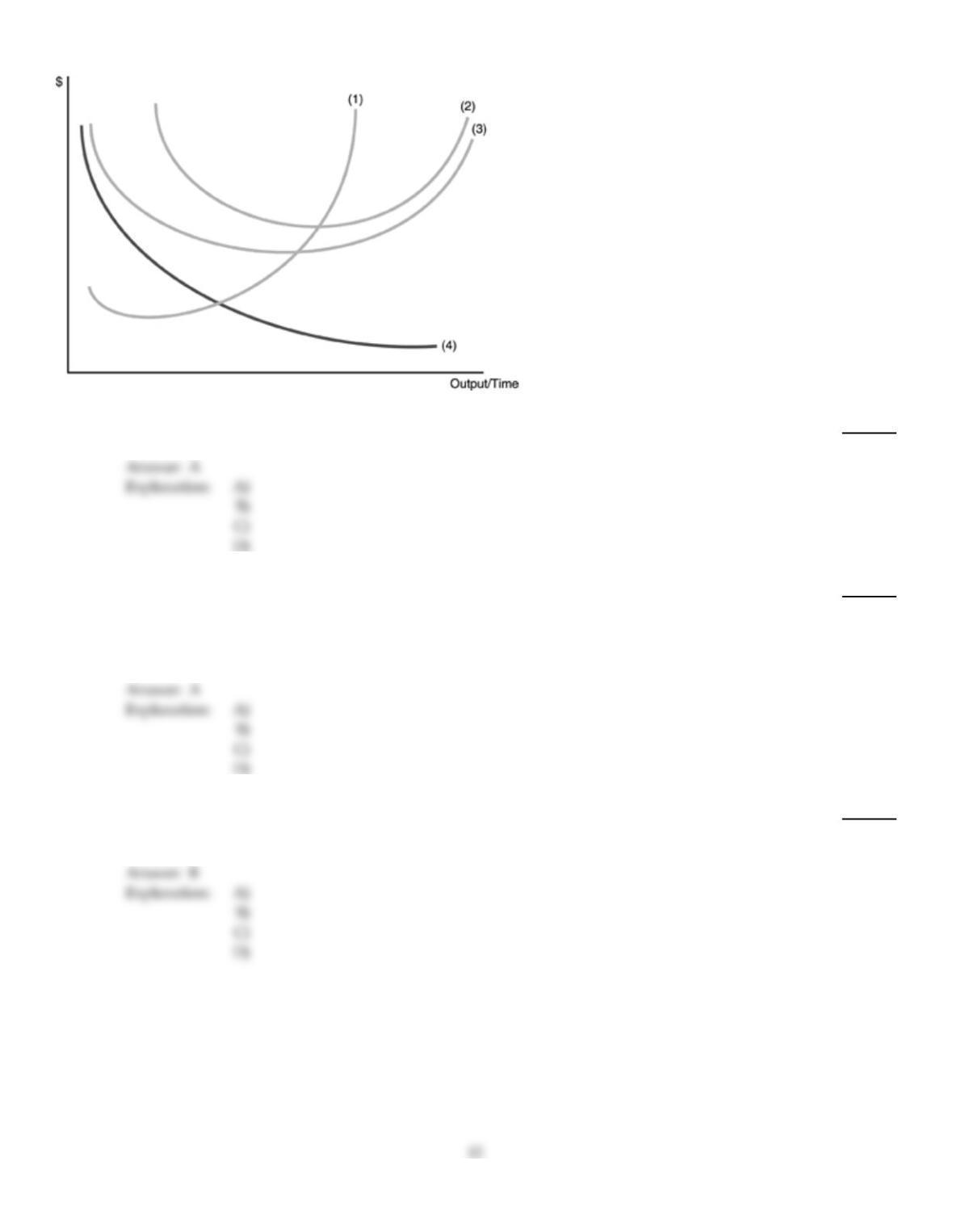
Refer to the above figure. Marginal costs are represented by curve
38)
A)
1.
B)
2.
C)
3.
D)
4.
39)
In the short run, average total cost is
39)
A)
higher than average variable cost.
B)
less than average variable cost.
C)
equal to average variable cost.
D)
sometimes higher and sometimes lower than average variable cost.
A
40)
If the price of labor is constant and a firm experiences diminishing marginal product, then its
40)
A)
total costs decrease.
B)
marginal costs increase.
C)
fixed costs increase.
D)
marginal costs decrease.
B
A
41)
Refer to the above table. At an output of 3 units, average variable costs are
41)
A)
$14.
B)
$44.
C)
$42.
D)
$30.
42)
The production function illustrates the amount of total physical product that can be produced with
a given set of
42)
A)
inputs.
B)
marginal input.
C)
outputs.
D)
marginal product.
43)
In the above table, the average physical product of 2 workers and the marginal physical product of
the 2nd worker is
43)
A)
3.5; 3.5.
B)
4; 1.
C)
2; 2.
D)
3.5; 4.
44)
Average fixed costs will
44)
A)
fall then rise as output rises.
B)
fall as output rises.
C)
rise then fall as output rises.
D)
rise as output rises.
45)
As long as marginal product of labor exceeds the average product of labor, then average product of
labor
45)
A)
must rise.
B)
will be at its maximum value.
C)
must fall.
D)
will stay unchanged.
46)
Which of the following statements is correct?
46)
A)
Average variable costs always exceed average total costs.
B)
Average fixed costs are always less than average variable costs.
C)
Average fixed costs are constant.
D)
Average variable cost reaches its minimum when average product equals its maximum.
47)
When the minimum efficient scale occurs at a high level of industry output
47)
A)
there will be a lot of firms in this industry.
B)
the government will have to take over the production of the good since it will be unprofitable
for firms.
C)
the firms in the industry will be producing in the diseconomies of scale portion of the curve.
D)
there will only be a few firms in the industry.
48)
As the amount of a variable input increases, while all other inputs are held constant, total product
will
48)
A)
initially decrease and then increase.
B)
initially increase and then decrease.
C)
always decrease.
D)
always increase.
49)
Notice the costs as given in the table below. What is the marginal cost when total cost is $23?
Total Output Total Costs
0 $10
1 $15
2 $18
3 $20
4 $21
5 $23
49)
A)
$3
B)
$1
C)
$2
D)
$5
50)
Refer to the above table. What are total costs at an output of 2 units?
50)
A)
$150
B)
$200
C)
$100
D)
$50
51)
Refer to the above table. What does total product equal when 4 units of labor are used?
51)
A)
332
B)
1328
C)
320
D)
960
52)
Which of the following activities is not included in the production process?
52)
A)
Packaging the goods
B)
Transporting the goods
C)
Determining the value of the goods
D)
Making the goods
53)
Assume that in the short run a firm is producing 100 units of output, has average total costs of $100,
and average variable costs of $50. The firm’s total fixed costs are
53)
A)
$15,000.
B)
$150.
C)
$50.
D)
$5,000.
54)
Total product will start to decrease
54)
A)
when average physical product decreases.
B)
at the quantity where the law of diminishing returns starts.
C)
when marginal physical product increases.
D)
when marginal physical product becomes negative.
55)
Any activity that results in the conversion of resources into products that can be used in
consumption is
55)
A)
investment.
B)
planning.
C)
production.
D)
discounting.
56)
The minimum possible short–run average costs are equal to long–run average costs when
56)
A)
short–run and long–run costs are declining.
B)
the plant is producing at its short–run minimum point.
C)
the long–run curve is at a minimum point.
D)
production is at any point on the LAC curve.
57)
Minimum efficient scale is defined as
57)
A)
the point at which economies of scale are at their maximum.
B)
the lowest output level at which long–run average costs are at their minimum.
C)
the amount of labor that maximizes the marginal product of labor.
D)
the point at which marginal cost, average variable cost, and average fixed cost are all equal.
58)
Which equation is used by a manager when considering total cost?
58)
A)
total costs (TC) = average fixed costs (AFC) + number of workers
B)
total costs (TC) = average total costs (ATC)
C)
total costs (TC) = total fixed costs (TFC) + total variable costs (TVC)
D)
total costs (TC) = consumption (C) + investment (I) + government (G)
59)
If total costs are $50,000 when 1000 units are produced, and total costs are $50,100 when 1001 units
are produced, we can conclude that
59)
A)
marginal costs are $100.
B)
average variable costs are $100.
C)
average fixed costs are $100.
D)
average total costs are $100.
60)
In the above table, the marginal product of the sixth worker is
60)
A)
25.
B)
15.
C)
10.
D)
20.
61)
When El Torito Restaurant is deciding how many waiters to hire for a holiday weekend, it is
making a ________ decision.
61)
A)
short–run
B)
plant–size
C)
long–run
D)
fixed–input
62)
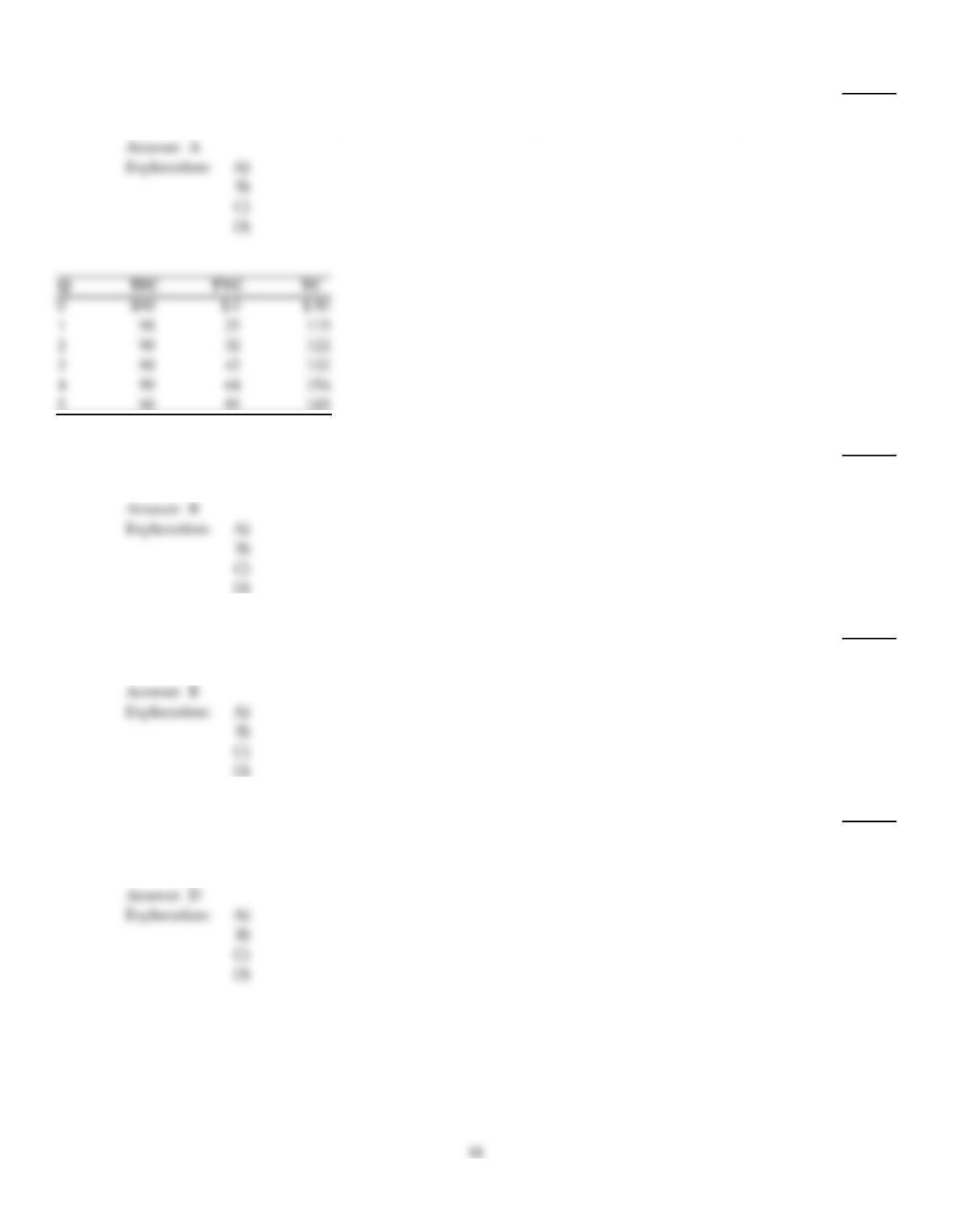
Refer to the above table. MC is the lowest
62)
A)
between 0 and 1 units of output.
B)
between 1 and 2 units of output.
C)
at 0 units of output.
D)
between 3 and 4 units of output.
63)
When long–run average costs decline as output increases, the firm is experiencing
63)
A)
diseconomies of scale.
B)
economies of scale.
C)
constant returns to scale.
D)
negative returns to scale.
64)
If the average product of 20 workers is 100 bushels of wheat and the average product of 21 workers
of wheat is 99 bushels of wheat, then the marginal product of the 21st worker was
64)
A)
5 bushels of wheat.
B)
99 bushels of wheat.
C)
–1 bushel of wheat.
D)
79 bushels of wheat.
65)
A decrease in the long–run average costs resulting from increasing output is referred to as
65)
A)
constant return to scale.
B)
diseconomies of scale.
C)
economies of scale.
D)
a scale invariant process.
66)
A firm has average fixed costs of $0.20 and average variable costs of $2.50 at an output of 500 units.
The firm’s total costs are therefore
66)
A)
$1,250.
B)
$1,500.
C)
$1,150.
D)
$1,350.
67)
Use the above figure. The ATC at output 10 is
67)
A)
$30.00.
B)
$2.00.
C)
$3.00.
D)
$2.67.
68)
Economies to scale are illustrated by
68)
A)
an upward sloping long–run average cost curve.
B)
a downward sloping long–run average cost curve.
C)
a long–run average cost curve that is shaped like an upside down U.
D)
a horizontal long–run average cost curve.