Environment: Science Behind the Stories, 2e Cdn. Ed. (Withgott)
Chapter 22 Environmental Policy: Decision Making and Problem Solving
22.1 Graph and Figure Interpretation Questions
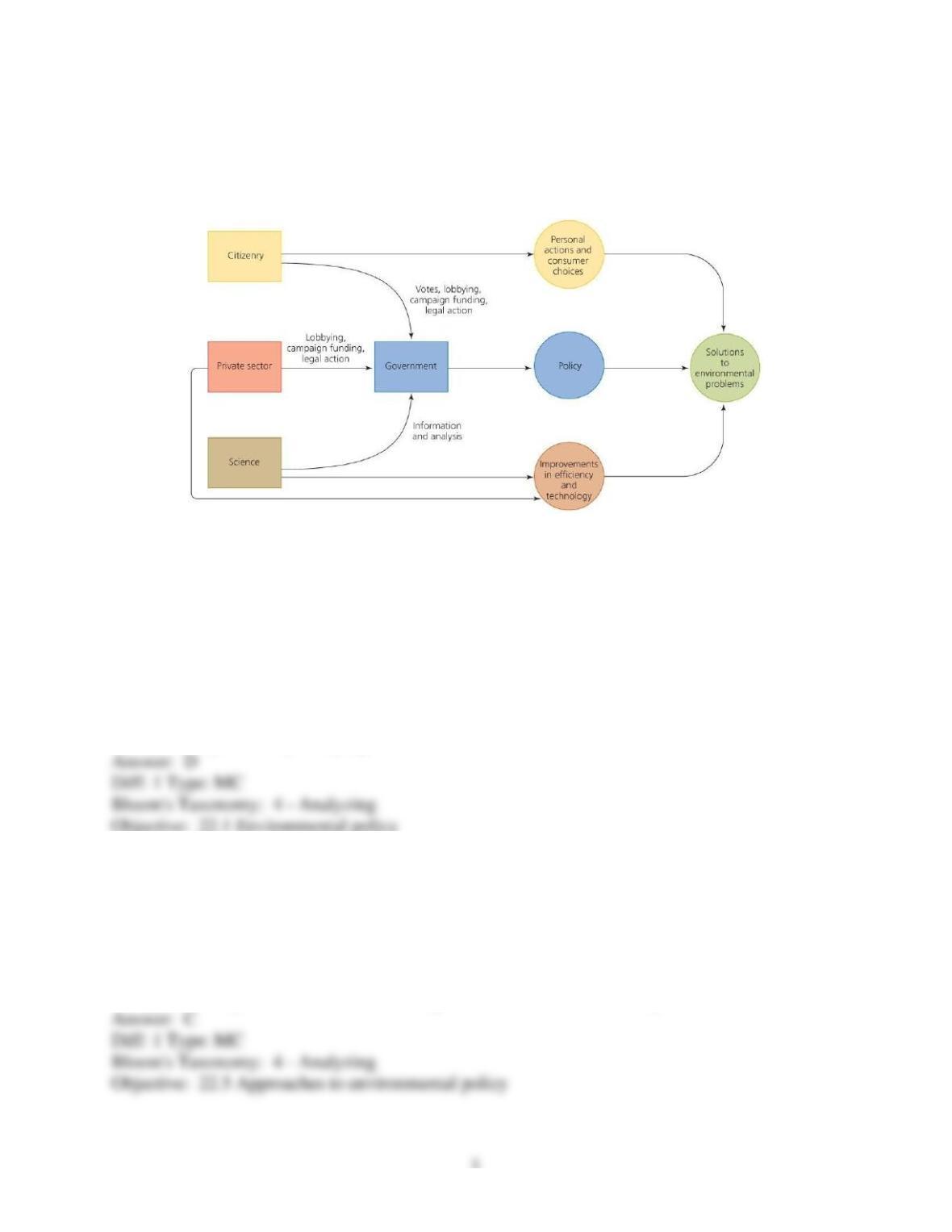
Figure 22.1
Use Figure 22.1 to answer the following questions.
1) Refer to Figure 22.1. According to the figure, the basis for government policy regarding
environmental issues ________.
A) comes only from the natural and social sciences and is acted upon without bias
B) comes primarily from the private sector
C) comes from both the public and the private sectors
D) comes from the sciences, with additional input from the public and private sectors
E) is primarily driven by lobbying
2) Refer to Figure 22.1. The distinction of scientific study’s input into the governmental solution
of environmental problems is that it ________.
A) is modified by consumer incentives, such as rebates and tax breaks
B) is the product of both consumer advocacy and industrial goals
C) is independent of any other influences in its effect on forming government policy
D) bypasses the private sector in making improvements to technology
E) bypasses the public sector in determining consumer choices and lifestyles
3) Refer to Figure 22.1. Regarding the issue of global warming, until the hurricane season of
2005, the United States federal government’s official stance (and Canada believed the same) was
that the information available from the scientific community was neither conclusive nor
persuasive. This governmental position was probably due to ________.
A) the lack of good, measurable data from the scientific community
B) the private sector’s use of its lobbying power to prevent the government from stopping
industry from emitting greenhouse gases for free
C) the consumer opinion polls
D) lobbying efforts on the part of environmental organizations
E) laws passed by voters
22.2 Matching Questions
Match the following.
A) regulations
B) environmental clauses
C) public policy
D) acts
E) customary law
F) conventional law
G) statutory law
H) summary of the ecological research
I) policy
J) state of the environment reporting
K) statutes
L) treaties
1) A formal set of general plans and principles intended to address problems and guide decision
making in specific instances
2) Agreements with foreign countries
3) Specific rules established by governments to allow
them to implement, enforce, and achieve the objectives of
environmental acts
4) Specific legal instructions, passed by a federal or provincial parliament, for use by its
respective agencies
5) International law that arises from long-standing practices
6) SOER stands for
Diff: 3 Type: MA
Bloom’s Taxonomy: 1 – Remembering
Objective: 22.3 Evolution of environmental policies
22.3 Short Answer Questions
1) Political boundaries do not always match environmental boundaries. What does this mean for
environmental protection in each country?
2) Name a few international ENGOs active in Canada.
3) What are the impacts of NAFTA on the environment?
4) What is the Car Heaven program and where did it start?
5) How does the WTO affect the environment? Give an example.
6) What are the five questions answered by SOER?
7) Who owns water in Canada? What are Canada’s water management models?
8) Previous court rulings serve as ________, or legal guides, for later cases.
9) What are two different historical/legal concepts that determine who has the right to withdraw
water from rivers?
10) What is OPEC and what is its influence on environmental policies?
11) What is the role of the National Round Table on the Environment and the Economy
(NRTEE)?
12) Give some examples of environmental regulation and enforcement at the municipal level.
13) List examples of ecolabelled products.
14) What is a federal environmental impact assessment (EIA)? Who has to complete it and why
is it done?
22.4 Multiple-Choice Questions
1) Environmental policy aims to ________.
A) use natural resources for economically important industrial products
B) protect the values of the landowner
C) promote fairness among people and groups in the use of resources
D) preserve all present natural areas in their pristine condition
E) promote economic growth
2) The primary role of the United Nations is to ________.
A) maintain international environmental education standards
B) develop international business cooperatives
C) make international laws regarding commerce and the environment
D) regulate international travel, emigration, and immigration among member states
E) cooperate in solving international economic, social, cultural, and humanitarian problems
3) Which of the following is NOT true about marketable trade permits?
A) They have been tried in Europe to meet the targets of the Kyoto Protocol.
B) They are the cornerstone of the current Canadian federal policies to meet the targets of the
Kyoto Protocol.
C) They have run into implementation problems in Europe.
D) They may increase the degree of monopolization of the market by blocking new entries into
the market that are not able to purchase the necessary permits.
E) They may be unable to prevent local pollution hot spots.
4) “Green taxes” are NOT ________.
A) similar to “sin taxes”
B) the cornerstone of the current Canadian federal policies to meet the targets of the Kyoto
Protocol
C) an economic tool that can be used to achieve environmental goals
D) one of the alternatives to the command-and-control approach
E) designed to penalize heavy polluters and provide competitive advantage to the companies that
reduce their environmental footprint
5) Laws, or statutes, are passed by ________.
A) federal preemption
B) the legislative branch
C) CEOs
D) the prime minister of Canada
E) voters
6) The judicial system is important for environmental policy because ________.
A) grassroots and other nongovernmental organizations have brought lawsuits to correct
environmental damage
B) it regulates administrative agencies
C) it mandates that environmental law preempts other federal laws
D) it allows corporations in the other NAFTA states to disregard the environmental laws of
Canada
E) its purpose is to assist corporations to negotiate with the legislative branch
7) If you are an oil producer from the Middle East and you have problems with exporting your
oil to the United States because your oil exceeds the limit of contaminants allowed by the U.S.
environmental regulation, which of the following institutions would you most likely use to
declare these U.S. environmental regulations illegal?
A) NAFTA
B) WTO
C) OPEC
D) World Bank
E) ENGO
8) In the pressure state response model, which would be the correct examples of pressure
(denoted by “P”) and state (“S”) and/or response(“R”)?
A) P: Growing agricultural crops; P: Households saving energy
B) P: Energy generation; S: Water availability
C) P: Energy generation; S: Households saving energy
D) P: Energy generation; R: Water availability
E) P: Growing agricultural crops; P: Government regulation
9) The environmental justice movement is ________.
A) currently required by most legislative bodies as they consider new laws
B) based on the notion of fairness toward people of all races, cultures, and economic
backgrounds
C) provided for by the income from carbon taxes
D) currently illegal in most provinces
E) composed of lawyers and judges concerned with environmental issues
11
10) Environment Canada was established in ________.
A) 1980
B) 1990
C) 1971
D) 1866
E) 1900
11) The Canadian Environmental Protection Act ________.
A) has been subjected to major overhauls in the last century
B) provided broad environmental legislation as well as providing for citizen input into policy
decisions
C) provided free equipment to promote mining in the West
D) ensured that mining operations would repair and restore an area when they were done with it
E) allowed mining companies to drill on land held by private citizens without needing to
compensate them
12) Which of the following is most likely to support unsustainable projects in developing
countries?
A) WTO
B) World Bank
C) NAFTA
D) ENGO
E) OPEC
13) Rachel Carson’s book Silent Spring, published in the 1960s, ________.
A) awakened the Canadian public to the negative effects of artificial hormones
B) was the beginning of the first wave of Canadian environmental policy
C) focused on chemical pollutants, including industrial chemicals
D) focused on the effects of acid rain on ecosystems
E) was concerned with birth defects in humans
14) The Canadian Environmental Assessment Act of 1992 ________.
12
A) was proposed by Mackenzie King
B) requires compensation to be given to anyone harmed by deliberate pollution from any
business or corporate entity
C) altered the amount of chemicals allowed in water as a result of industrial pollution
D) put all federal land under stringent environmental protection
E) required environmental impact statements for any projects funded by the federal or provincial
governments
15) Environment Canada and Health Canada together ________.
A) oversee the production of pharmaceuticals
B) oversee the production of food additives
C) protect mineral rights of property owners
D) protect water quality
E) encourage water usage by agriculture for improved crops
16) To control pollution, industry has been given limits and been threatened with punishment if
these limits are violated. This approach is called ________.
A) end of the alley
B) carrot and stick
C) command and control
D) limit and manage
E) last chance
17) Greenpeace is an environmental organization founded in Vancouver and it ________.
A) compiles data on tax laws that encourage or shelter polluters
B) reported that less than $1 million is spent annually on environmentally harmful subsidies
C) supports conservative, right-wing groups interested in cutting government
D) is a branch of the government
E) compiles data and actively demonstrates for environmental issues
18) The sewage found in the Tijuana River watershed was/is ________.
A) caused primarily by Mexican-owned maquiladoras
B) a transboundary problem
C) caused by the pressure on American companies to hire American workers
D) easy to legislate once the causes were found
E) dramatically improved once subsidies were in place
19) “Green taxes” are used to ________.
A) defer environmental costs
B) internalize environmental costs
C) externalize environmental costs
D) generate money to fund “green” administrations such as Environment Canada
E) encourage the creation of green spaces through tax credits
20) International environmental law arises from ________.
A) democratic voting procedures to choose and ratify laws
B) informal agreements reached by multinational corporations
C) bidding on subsidies
D) distribution and use of pollution permits
E) international conventions or treaties
21) The UNEP ________.
A) is the environmental arm of the United Nations
B) has a mission of economic development
C) has three subsections that govern international laws, treaties, and regulations
D) is a federal agency based in Montreal
E) is primarily concerned with the education of children on environmental issues