
College Physics: A Strategic Approach, 3e (Knight)
Chapter 22 Current and Resistance
22.1 Conceptual Questions
1) If a quantity you calculated has units of A ∙ s, what is that quantity?
A) potential
B) resistivity
C) resistance
D) capacitance
E) charge
2) When current is flowing in an ordinary metal wire, the magnitude of the average velocity of
the electrons is closest to
A) 10 m/s.
B) the speed of light.
C) 1 mm/s.
D) 1 km/s.
E) 1 m/s.
3) When a current flows through a metal wire, the moving charges are
A) only protons.
B) only electrons.
C) both protons and electrons.
D) positive metal ions.
E) negative metal ions.
4) When a current flows through an ionic liquid such as salty water, the moving charges are
A) only protons.
B) only electrons.
C) only negative ions.
D) only positive ions.
E) both positive and negative ions.
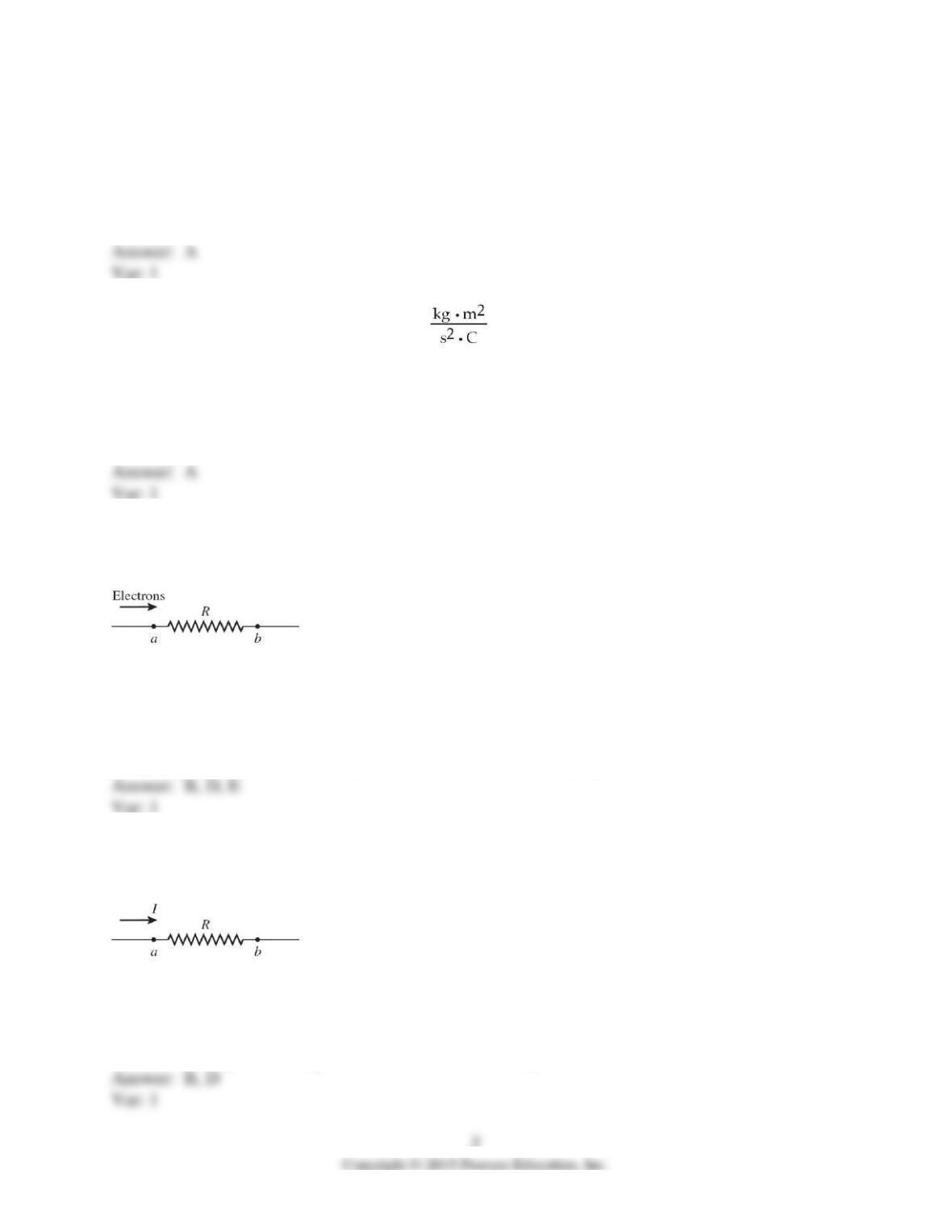
5) If a quantity you calculated has units of Ω ∙ m what is that quantity?
A) potential
B) resistivity
C) resistance
D) capacitance
E) charge
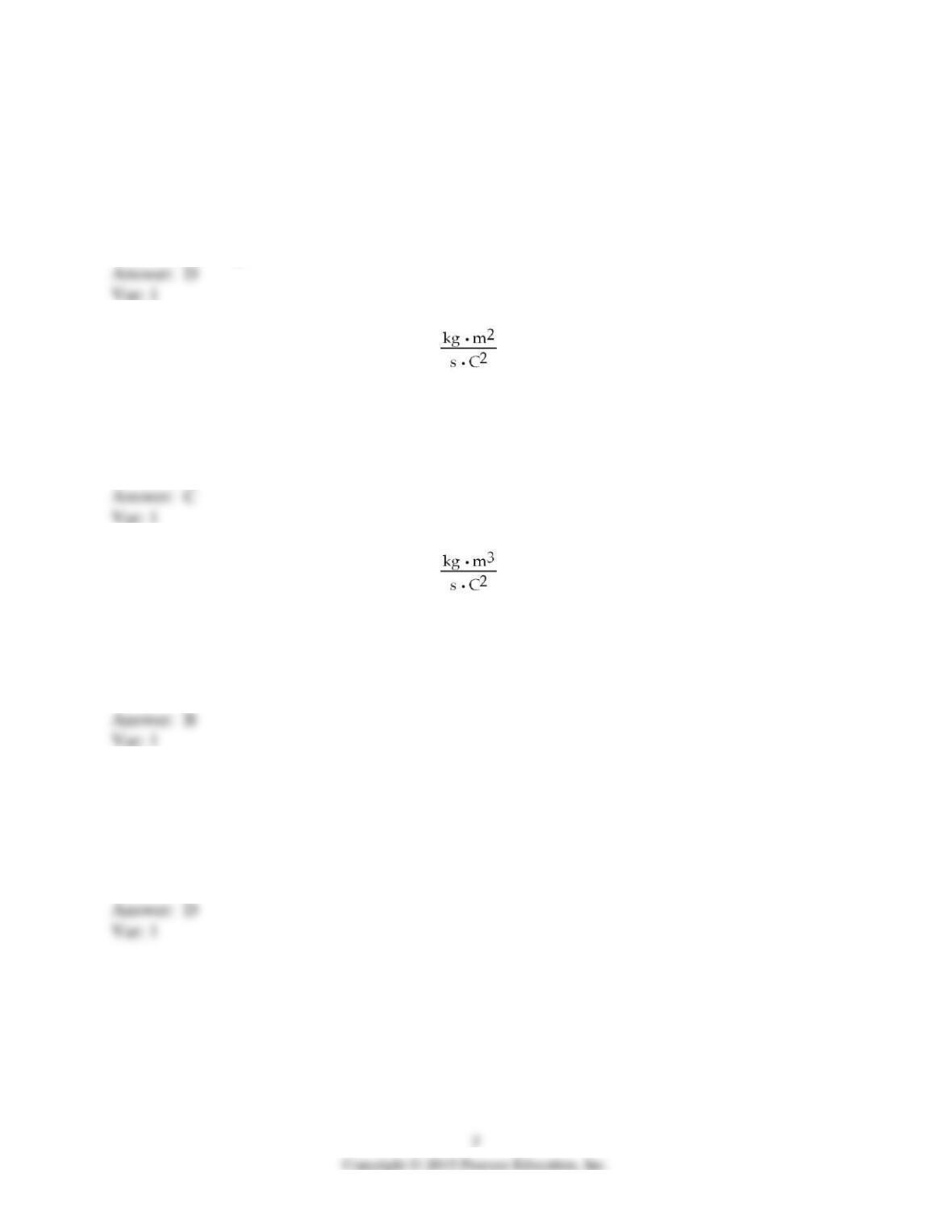
6) If a quantity you calculated has units of , what is that quantity?
A) potential
B) resistivity
C) resistance
D) capacitance
E) charge
7) The figure shows electrons passing through a resistor. The arrow shows the direction in which
the electrons are moving. Which of the following statements are correct? (There could be more
than one correct choice.)
A) The electrons are moving slower at point b than at point a.
B) The electric potential is higher at point b than at point a.
C) The electric potential is lower at point b than at point a.
D) The electrons are losing electric potential energy as they move through the resistor from a to
b.
E) The speed of the electrons at point b is the same as it is at point a.
8) The figure shows conventional current passing through a resistor. The arrow shows the
direction in which this conventional current is flowing. Which of the following statements are
correct? (There could be more than one correct choice.)
A) The charges are moving slower at point b than at point a.
B) The electric potential is lower at point b than at point a.
C) The electric potential is higher at point b than at point a.
D) The current at point b is the same as the current at point a.
E) The electric potential at point b is the same as it is at point a.
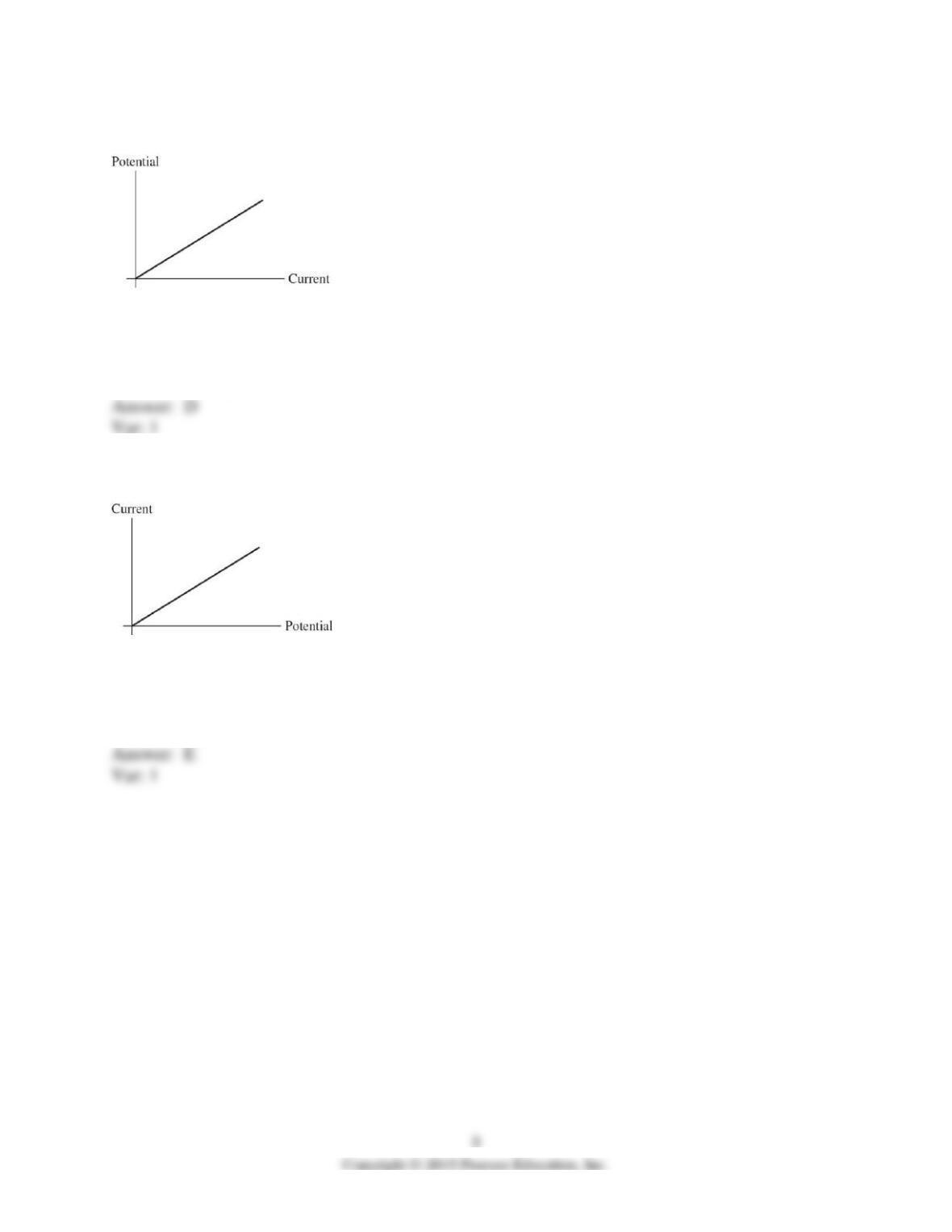
9) For the graph shown in the figure, what physical quantity does the slope of the graph represent
for ohmic material?
A) power
B) resistivity
C) 1/(resistivity)
D) resistance
E) 1/(resistance)
10) For the graph shown in the figure, what physical quantity does the slope of the graph
represent for ohmic material?
A) power
B) resistivity
C) 1/(resistivity)
D) resistance
E) 1/(resistance)
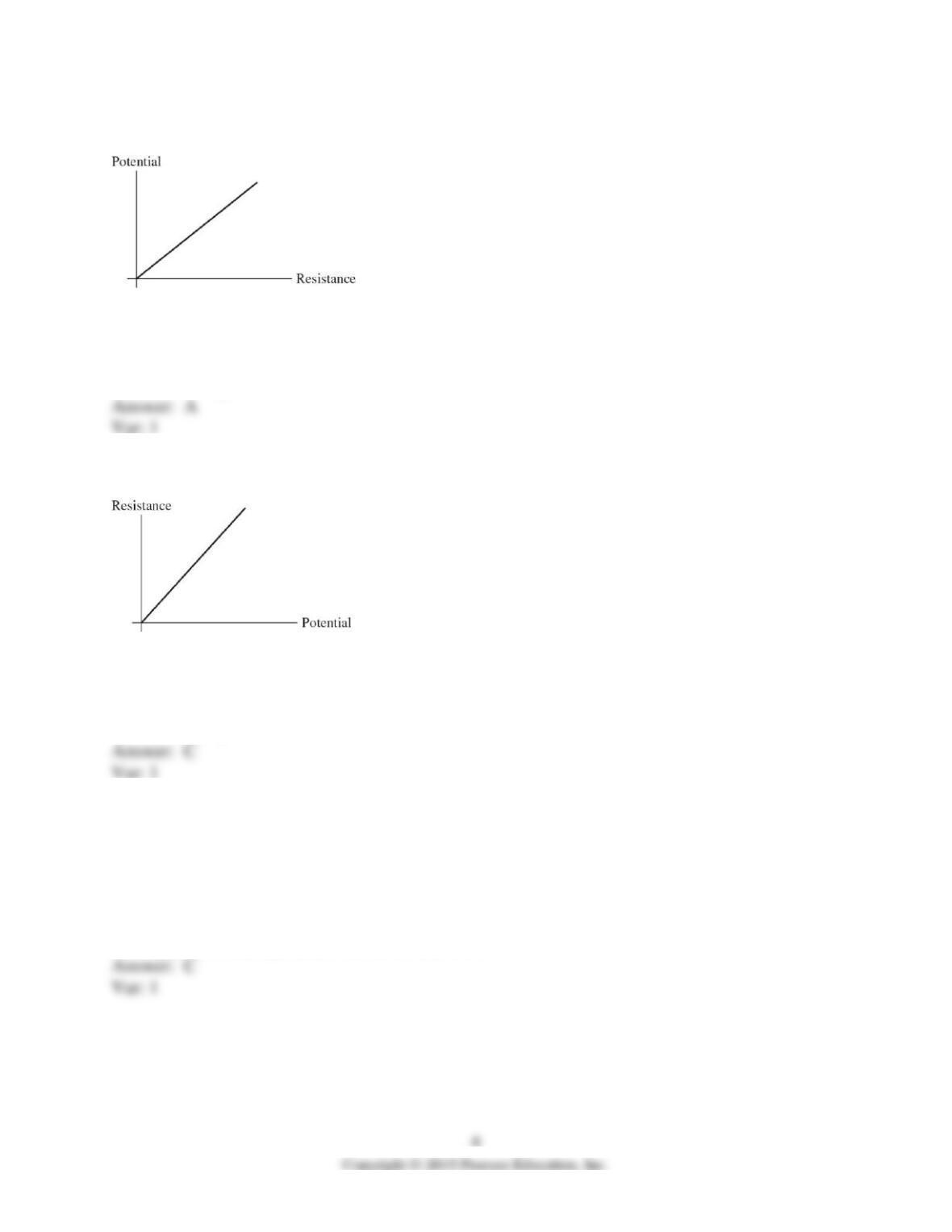
11) For the graph shown in the figure, what physical quantity does the slope of the graph
represent for ohmic material?
A) current
B) resistivity
C) 1/(current)
D) power
E) 1/(resistivity)
12) For the graph shown in the figure, what physical quantity does the slope of the graph
represent for ohmic material?
A) current
B) resistivity
C) 1/(current)
D) power
E) 1/(resistivity)
13) You are given a copper bar of dimensions 3 cm × 5 cm × 8 cm and asked to attach leads to it
in order to make a resistor. If you want to achieve the smallest possible resistance, you should
attach the leads to the opposite faces that measure
A) 3 cm × 5 cm.
B) 3 cm × 8 cm.
C) 5 cm × 8 cm.
D) Any pair of faces produces the same resistance.
14) You are given a copper bar of dimensions 3 cm × 5 cm × 8 cm and asked to attach leads to it
in order to make a resistor. If you want to achieve the largest possible resistance, you should
attach the leads to the opposite faces that measure
A) 3 cm × 5 cm.
B) 3 cm × 8 cm.
C) 5 cm × 8 cm.
D) Any pair of faces produces the same resistance.
15) Copper wire #1 has a length L and a radius b. Copper wire #2 has a length 2L and a radius
2b. Which statement about the resistance across the ends of the wires is true?
A) The resistance of wire #1 is twice as high as that of wire #2.
B) The resistance of wire #1 is equal to that of wire #2.
C) The resistance of wire #1 is half that of wire #2.
D) The resistance of wire #1 is four times higher than that of wire #2.
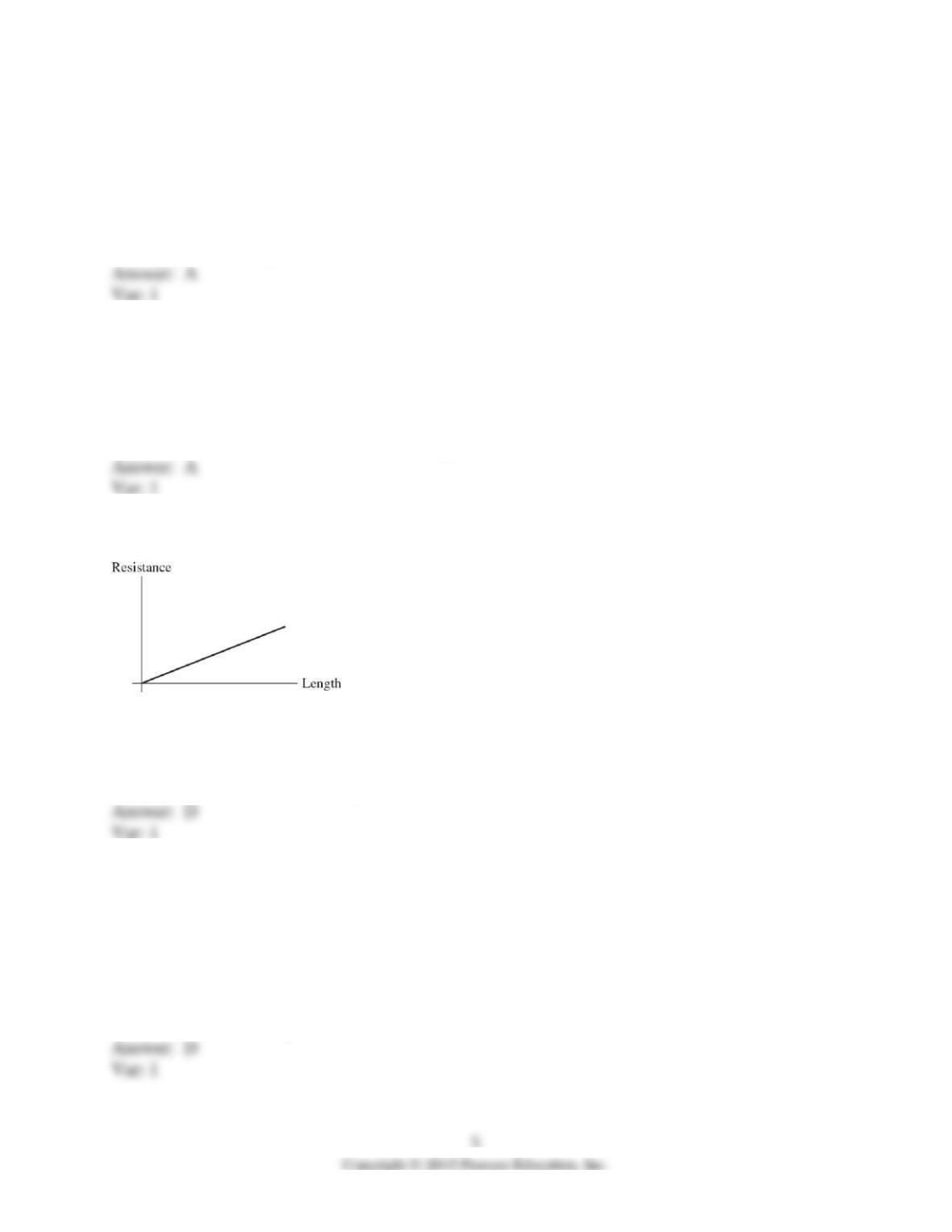
16) The figure shows a graph of the resistance of a wire as a function of its length. What physical
quantities does the slope of this graph represent?
A) the cross-sectional area of the wire
B) the resistivity of the material of which the wire is made
C) the product of the resistivity and the cross-sectional area of the wire
D) the resistivity of the material divided by the cross-sectional area of the wire
E) the reciprocal of the resistivity of the material
17) A wire of resistivity ρ must be replaced in a circuit by a wire of the same material but four
times as long. If, however, the total resistance is to remain as before, the diameter of the new
wire must
A) be the same as the original diameter.
B) be one-half the original diameter.
C) be one-fourth the original diameter.
D) be two times the original diameter.
E) be four times the original diameter.
18) The length of a certain wire is kept same while its radius is doubled. What is the new
resistance of this wire?
A) It is increased by a factor of 2.
B) It is increased by a factor of 4.
C) It is reduced by a factor of 2.
D) It is reduced by a factor of 4.
E) It is reduced by a factor of 8.
19) The length of a certain wire is kept same while its radius is doubled. What is the new
resistivity of this wire?
A) It is increased by a factor of 2.
B) It is increased by a factor of 4.
C) It is reduced by a factor of 2.
D) It is reduced by a factor of 4.
E) It does not change.
20) The length of a certain wire is doubled while its radius is kept constant. What is the new
resistance of this wire?
A) It stays the same.
B) It is 2 times as large.
C) It is 3 times as large.
D) It is 4 times as large.
E) It is 1/2 as large.
21) The length of a certain wire is doubled and at the same time its radius is also doubled. What
is the new resistance of this wire?
A) It stays the same.
B) It is 2 times as large.
C) It is 4 times as large.
D) It is 1/2 as large.
E) It is 1/4 as large.
22) The length of a certain wire is doubled and at the same time its radius is reduced by a factor
of 2. What is the new resistance of this wire?
A) It is 2 times as large.
B) It is 4 times as large.
C) It is 6 times as large.
D) It it 8 times as large.
E) It is 1/2 as large.
23) If a quantity you calculated has units of what is that quantity?
A) potential
B) resistivity
C) resistance
D) capacitance
E) current
24) If a quantity you calculated has units of what is that quantity?
A) potential
B) resistivity
C) resistance
D) capacitance
E) current
25) Which one of the following quantities is equivalent to 1 Ω?
A) 1 J/s
B) 1 W/A
C) 1 V ∙ A
D) 1 V/A
E) 1 A ∙ s

26) If the length and diameter of a wire of circular cross section are both tripled, the resistance
will be
A) unchanged.
B) tripled.
C) increased by a factor of 9.
D) 1/3 of what it originally was.
E) 1/9 of what it originally was.
27) Consider two copper wires of equal cross-sectional area. One wire has 3 times the length of
the other. How do the resistivities of these two wires compare?
A) Both wires have the same resistivity.
B) The longer wire has 3 times the resistivity of the shorter wire.
C) The longer wire has 9 times times the resistivity of the shorter wire.
D) The longer wire has 27 times times the resistivity of the shorter wire.
28) Consider two copper wires of equal cross-sectional area. One wire has 3 times the length of
the other. How do the resistances of these two wires compare?
A) Both wires have the same resistance.
B) The longer wire has 1/3 the resistance of the shorter wire.
C) The longer wire has 3 times the resistance of the shorter wire.
D) The longer wire has 9 times times the resistance of the shorter wire.
E) The longer wire has 27 times times the resistance of the shorter wire.
29) Consider two copper wires of equal length. One wire has twice the cross-sectional area of
the other. How do the resistances of these two wires compare?
A) The thicker wire has twice the resistance of the thinner wire.
B) The thicker wire has eight times the resistance of the thinner wire.
C) The thicker wire has one-half the resistance of the thinner wire.
D) The thicker wire has four times the resistance of the thinner wire.
E) The thicker wire has one-fourth the resistance of the thinner wire.
30) Consider two copper wires with circular cross-sections and equal lengths. One wire has 3
times the diameter of the other. How do the resistances of these two wires compare?
A) The thicker wire has 1/3 the resistance of the thinner wire.
B) The thicker wire has 1/9 the resistance of the thinner wire.
C) The thicker wire has 3 times the resistance of the thinner wire.
D) The thicker wire has 9 times the resistance of the thinner wire.
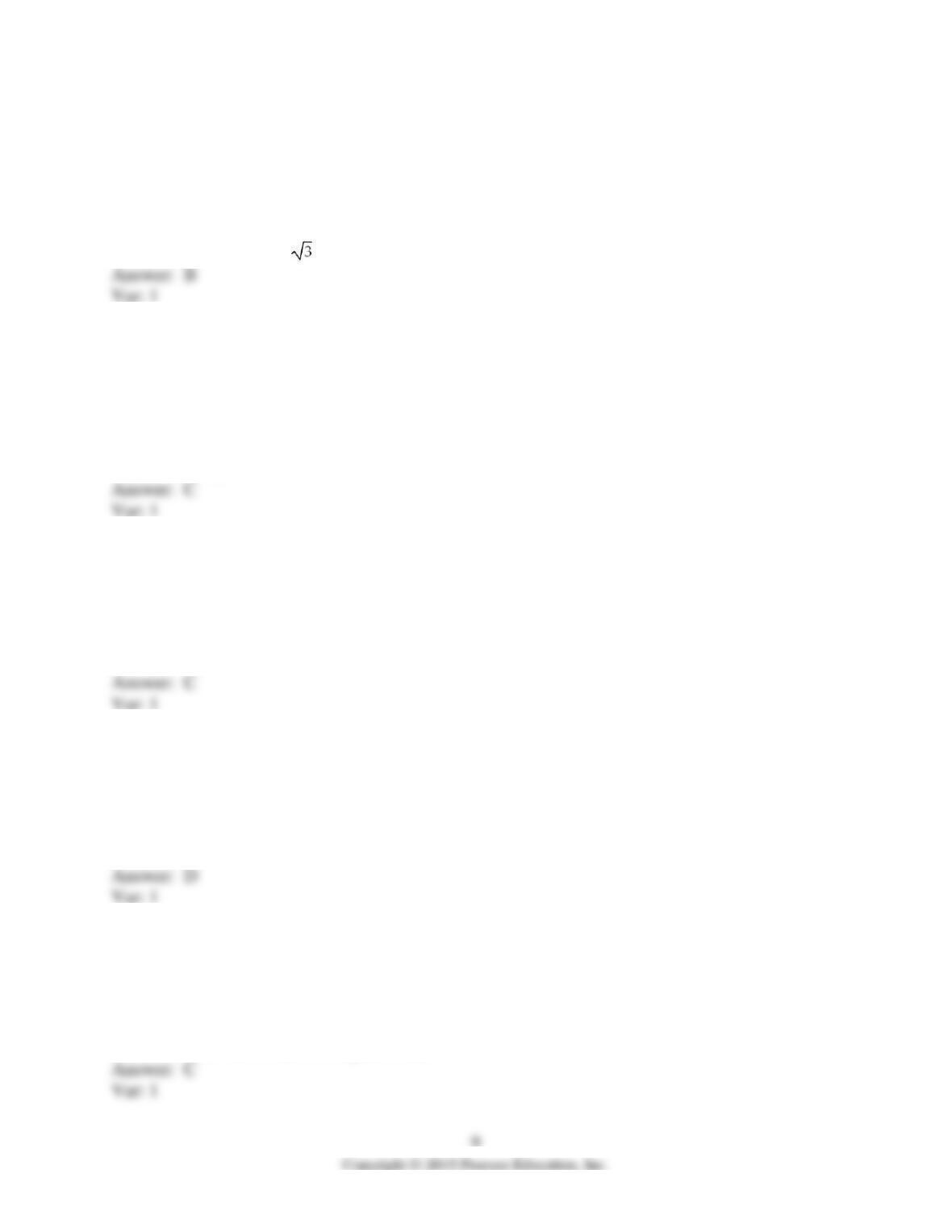
E) The thicker wire has times the resistance of the thinner wire.
31) When the current through a resistor is increased by a factor of 4, the power dissipated by the
resistor
A) decreases by a factor of 4.
B) decreases by a factor of 16.
C) increases by a factor of 16.
D) increases by a factor of 4.
E) increases by a factor of 2.
32) Which one of the following quantities is equivalent to 1 W?
A) 1 V/A
B) 1 Ω ∙ m
C) 1 V ∙ A
D) 1 V/Ω
E) 1 A ∙ s
33) A kilowatt-hour is equivalent to
A) 1000 W.
B) 3600 J.
C) 3,600,000 J/s.
D) 3,600,000 J.
E) 3600 J/s
34) If the resistance in a constant voltage circuit is doubled, the power dissipated by that circuit
will
A) increase by a factor of two.
B) increase by a factor of four.
C) decrease to one-half its original value.
D) decrease to one-fourth its original value.

35) If the voltage across a circuit of constant resistance is doubled, the power dissipated by that
circuit will
A) be four times as large.
B) be two times as large.
C) decrease to one-half the original power.
D) decrease to one-fourth the original power.
36) If we double the resistance in a circuit but keep the current in it constant, the power
dissipated by that circuit will
A) be four times as great.
B) be two times as great.
C) be one-half as great.
D) be one-fourth as great.
37) If the current flowing through a circuit of constant resistance is doubled, the power dissipated
by that circuit will
A) quadruple in magnitude.
B) double in magnitude.
C) decrease to one-half of what it was.
D) decrease to one-fourth of what it was.
38) During a period of high power demand, the voltage output of the power company is reduced
by 5.0%. By what percentage is the power in a resistor decreased?
A) 2.5%
B) 5.0%
C) 10%
D) 15%
E) 90%
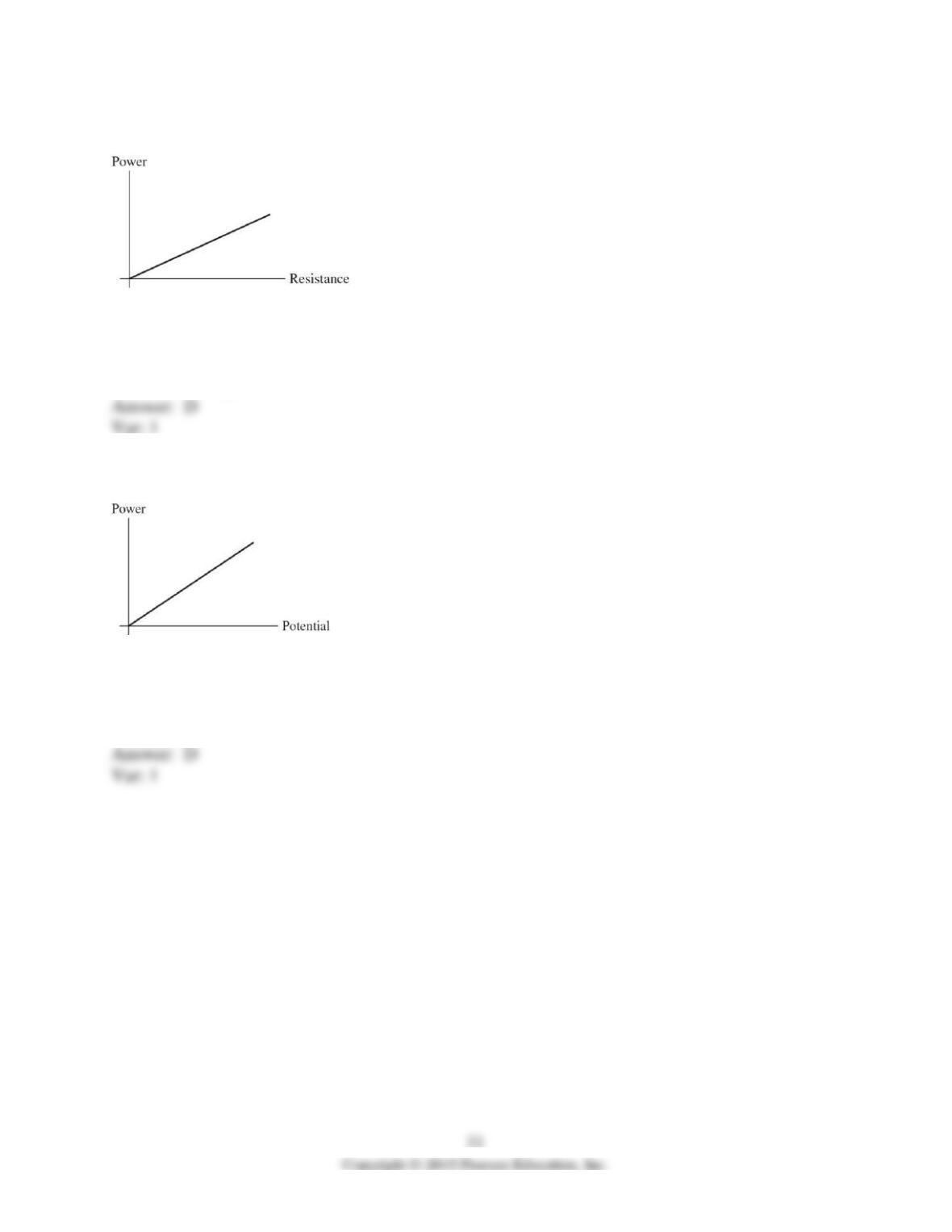
39) The figure shows a graph of the power dissipated in a resistor as a function of the resistance.
What quantity does the slope of this graph represent?
A) the current in the resistor
B) the potential difference across the resistor
C) the reciprocal of the current in the resistor
D) the square of the current in the resistor
E) the resistivity of the resistor
40) For the graph shown in the figure, what physical quantity does the slope of the graph
represent for a dc circuit?
A) resistivity
B) resistance
C) energy
D) current
E) capacitance
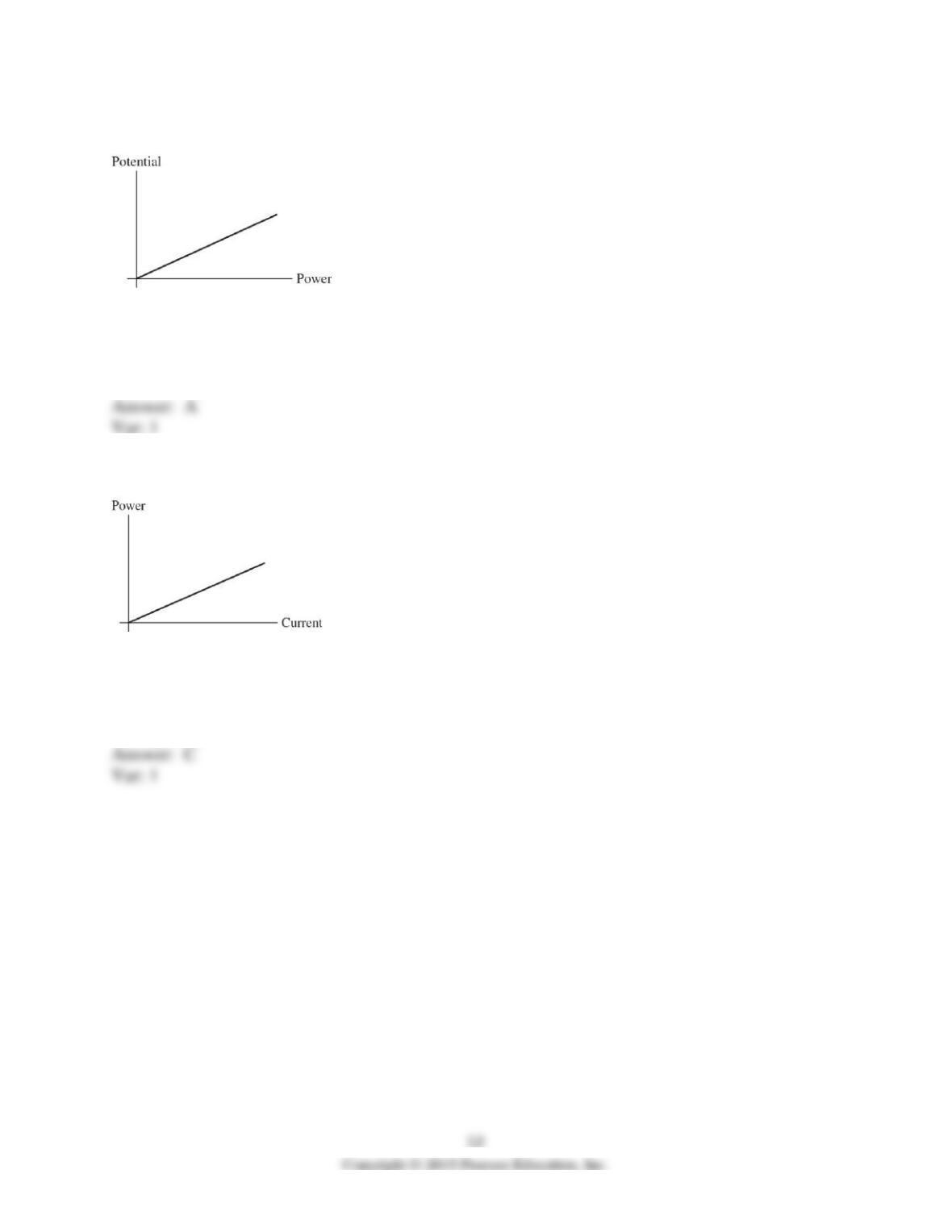
41) For the graph shown in the figure, what physical quantity does the slope of the graph
represent for a dc circuit?
A) 1/(current)
B) resistance
C) 1/(resistance)
D) current
E) resistivity
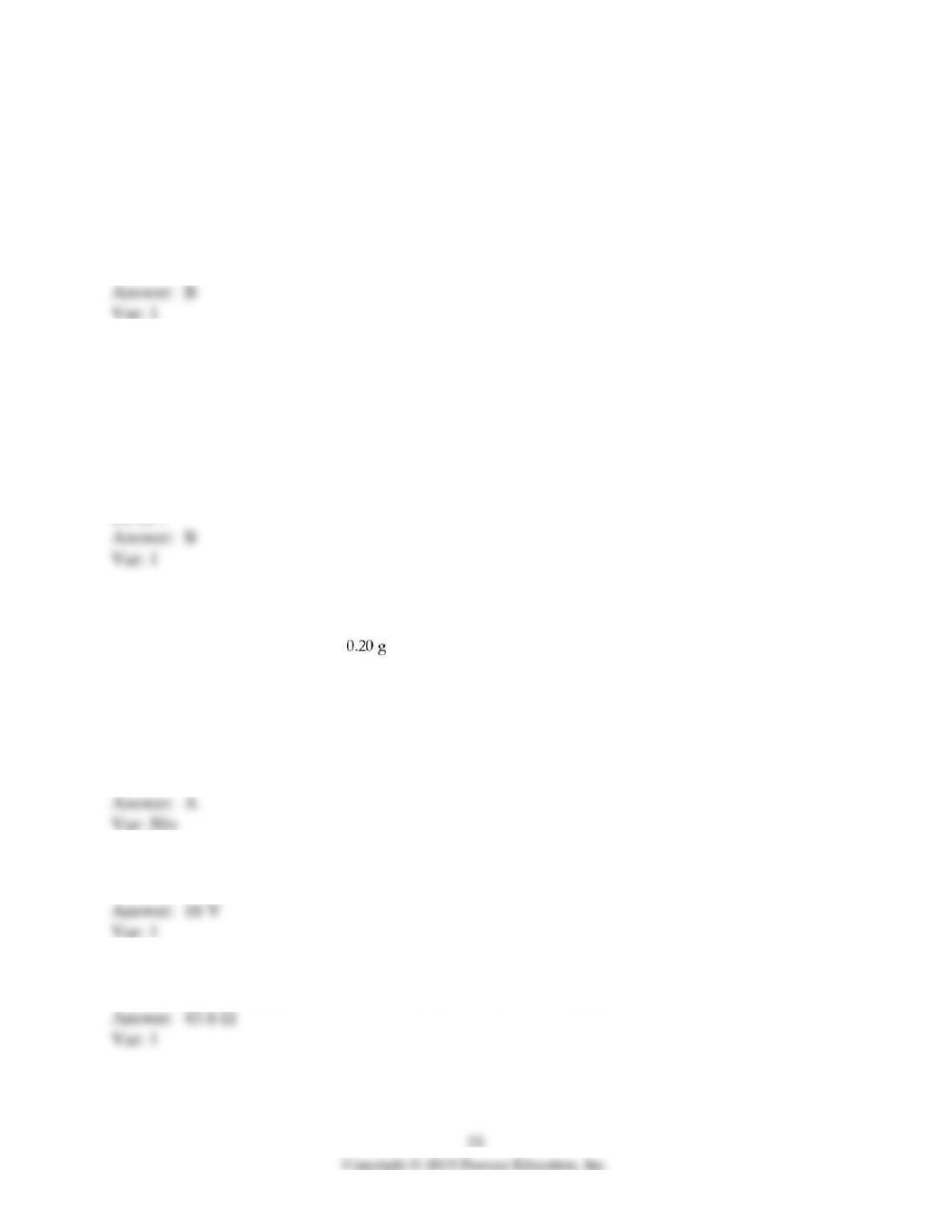
42) For the graph shown in the figure, what physical quantity does the slope of the graph
represent for a dc circuit?
A) 1/(resistance)
B) resistance
C) potential
D) (potential)2
E) 1/(potential)
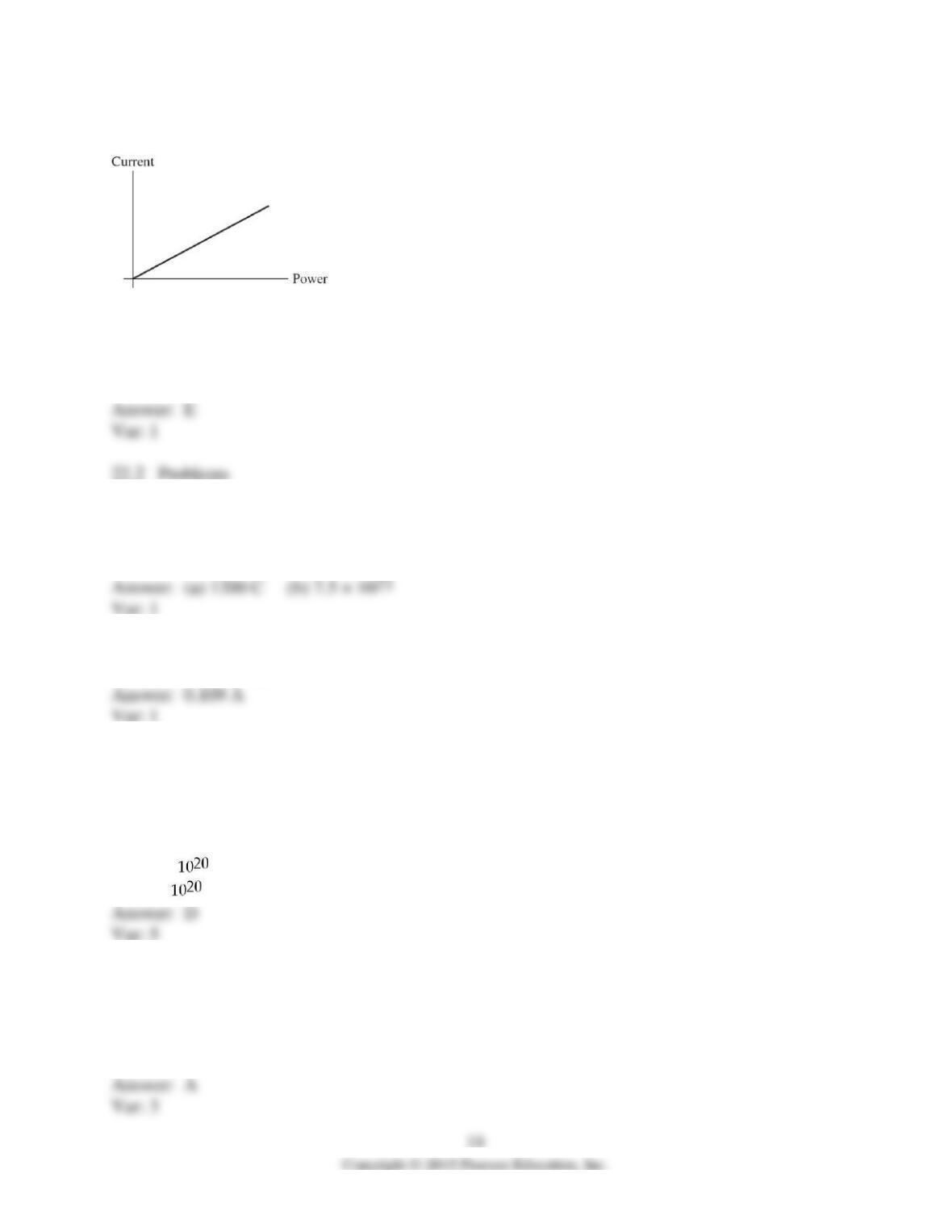
43) For the graph shown in the figure, what physical quantity does the slope of the graph
represent for a dc circuit?
A) 1/(resistance)
B) resistance
C) potential
D) (potential)2
E) 1/(potential)
1) A 10-A current flows through a wire for 2.0 min. (e = 1.60 × 10⁻¹⁹ C)
(a) How much charge has passed through this wire?
(b) How many electrons have passed any point in the wire?
2) If a charge of 11.4 C passes through a computer in 1.75 min, what is the average current
through the computer?
3) A current of 5.0 A flows through an electrical device for 10 seconds. How many electrons
flow through this device during this time? (e = 1.60 × 10⁻¹⁹ C)
A) 0.20
B) 20
C) 2.0
D) 3.1 x
E) 31 x
4) What current is flowing in a wire if 0.67 C of charge pass a point in the wire in 0.30 s?
A) 2.2 A
B) 0.67 A
C) 0.30 A
D) 0.20 A

5) A charge of 12 C passes through an electroplating apparatus in 2.0 min. What is the average
current in the apparatus?
A) 0.10 A
B) 0.60 A
C) 1.0 A
D) 6.0 A
6) How much charge must pass by a point in a wire in 10 s for the current inb the wire to be 0.50
A?
A) 20 C
B) 2.0 C
C) 5.0 C
D) 0.050 C
7) A total of 2.0 × 10¹³ electrons pass a given point in a wire in 15 s. What is the current in the
wire? (e = 1.60 × 10⁻¹⁹ C)
A) 1.3 mA
B) 1.3 A
C) 0.21 μA
D) 3.2 μA
8) What current is flowing in a resistor if 4.0 × 10¹⁶ electrons pass a point in the resistor in 0.50
s? (e = 1.60 × 10⁻¹⁹ C)
A) 0.013 A
B) 0.31 A
C) 6.3 A
D) 78 A
9) If 3.0 × 10¹⁵ electrons flow through a section of a wire of diameter 2.0 mm in 4.0 s, what is
the current in the wire? (e = 1.60 × 10⁻¹⁹ C)
A) 0.12 mA
B) 0.24 mA
C) 7.5 × 10⁷ A
D) 7.5 × 10¹⁴ A
10) A electric heater that draws 13.5 A of dc current has been left on for 10 min. How many
electrons that have passed through the heater during that time? (e = 1.60 × 10⁻¹⁹ C)
A) 1.5 × 10²²
B) 5.1 × 10²²
C) 1.8 × 10³
D) 8.1 × 10³
E) 1.0 × 10²³
11) In an electroplating process, it is desired to deposit 40 mg of silver on a metal part by using a
current of 2.0 A. How long must the current be allowed to run to deposit this much silver? The
silver ions are singly charged, and the atomic mass of silver is 108 g/mol. (e = 1.60 × 10⁻¹⁹ C,
NA = 6.02 × 10²³ atoms/mol)
A) 16 s
B) 18 s
C) 20 s
D) 22 s
12) A jeweler needs to electroplate gold, having an atomic mass of 196.97 g/mol, onto a bracelet.
He knows that the charge carriers in the ionic solution are singly-ionized gold ions, Au+, and has
calculated that he must deposit of gold to reach the necessary thickness. How much current
does he need to plate the bracelet in 3.0 hours? (e = 1.60 × 10⁻¹⁹ C, NA = 6.02 × 10²³
atoms/mol)
A) 9.1 mA
B) 540 mA
C) 33 A
D) 1800 mA
13) What potential difference is required across an 8.0-Ω resistor to cause 2.0 A to flow through
it?
14) The current through a piece of lab equipment must be limited to 2.75 A when it is run by a
120-V dc power supply. What must be the resistance of this equipment?