General Chemistry: Atoms First, 2e (McMurry and Fay)
Chapter 22 Nuclear Chemistry
22.1 Multiple Choice Questions
1) When more than 3600 known nuclides are plotted on a neutron/proton grid they make up a
group called
A) the “island of stability.”
B) the “peninsula of nuclear stability.”
C) the “sea of instability.”
D) none of these
2) Which is the only element that contains more protons than neutrons in its most abundant
stable isotope?
A) boron
B) carbon
C) hydrogen
D) mercury
3) As the atomic number of the elements increases, the ratio of neutrons to protons in stable
nuclei
A) decreases.
B) stays the same.
C) increases.
D) is unrelated to stability.
4) Which one of the following statements about isotopes is false?
A) The ratio of neutrons to protons is about 1:1 for elements lighter than Ca.
B) The ratio of neutrons to protons is > 1:1 for elements heavier than Ca.
C) Nonradioactive isotopes generally have an odd number of neutrons.
D) All isotopes beyond 209Bi are radioactive.
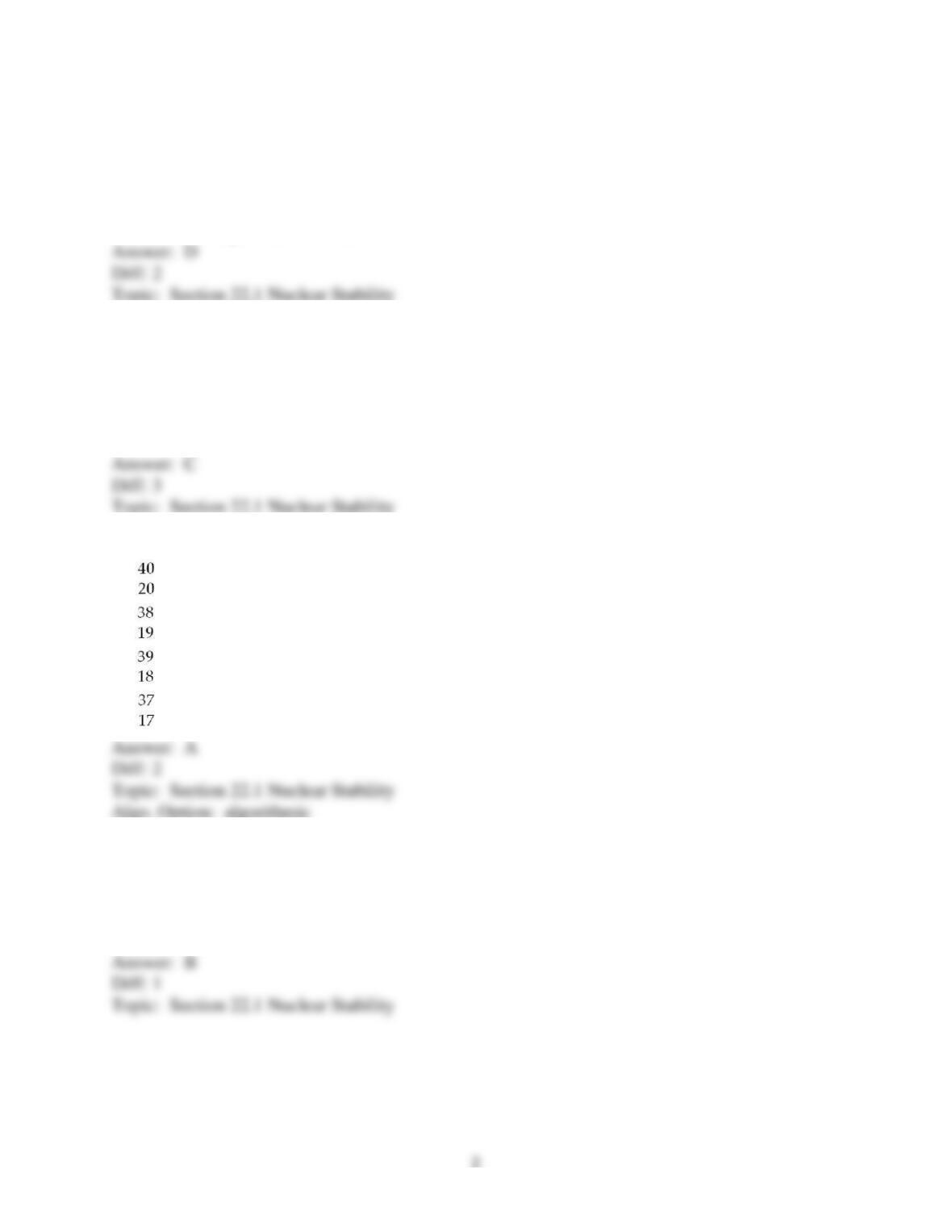
5) Which one of the following combinations of neutrons/protons results in the lowest number of
nonradioactive (stable) isotopes?
A) even number protons/even number neutrons
B) even number protons/odd number neutrons
C) odd number protons/even number neutrons
D) odd number protons/odd number neutrons
6) Which of the following elements would you expect to have the largest number of stable
isotopes? Element number:
A) 48
B) 49
C) 50
D) 51
7) Which of the following elements would be expected to be particularly stable?
A) Ca
B) K
C) Ar
D) Cl
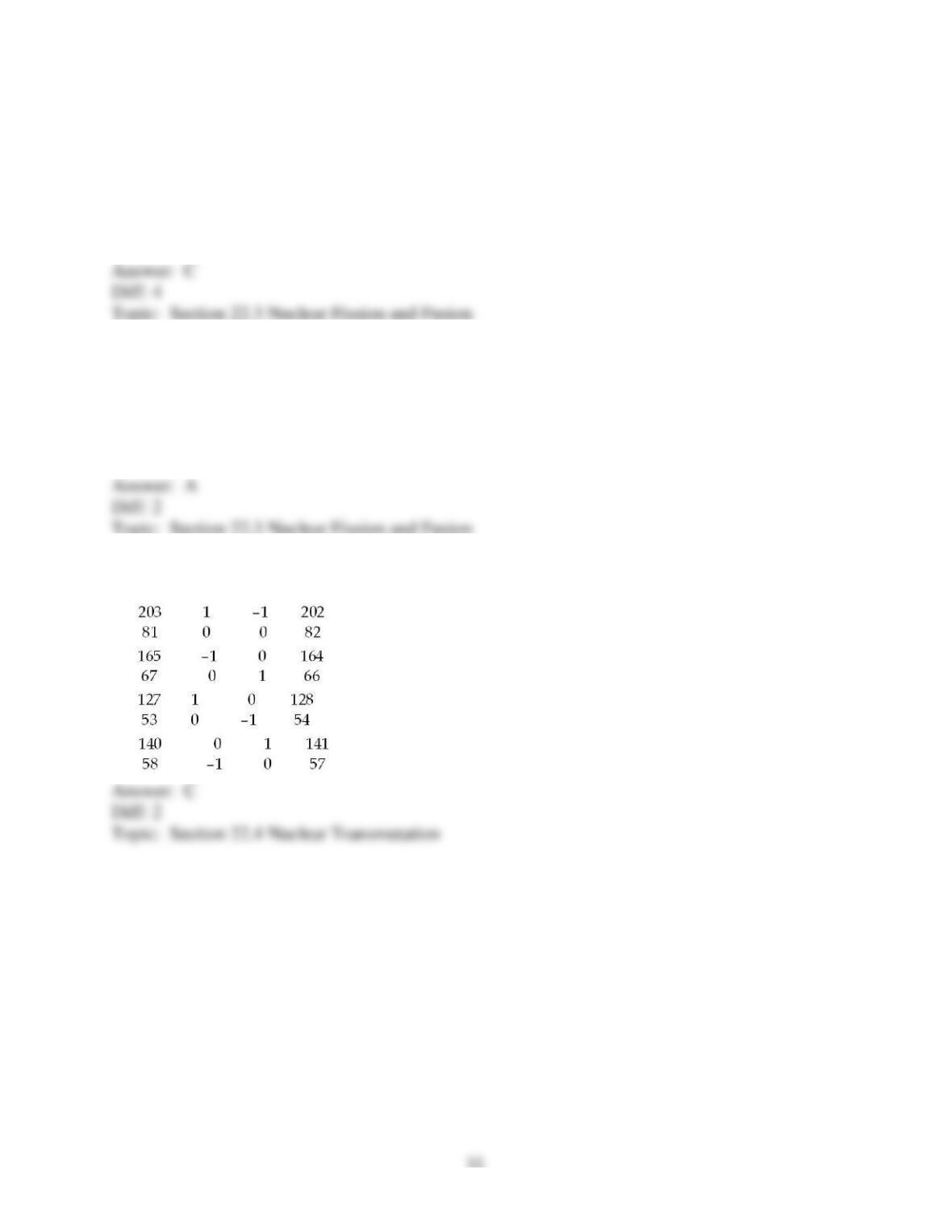
8) Which process decreases the neutron/proton ratio?
A) alpha emission
B) beta emission
C) electron capture
D) positron emission
9) A radioisotope has a neutron/proton ratio which is too low. Which of the following processes
will not occur for such a nucleus?
A) alpha emission
B) beta emission
C) electron capture
D) positron emission
10) A radioisotope which is neutron poor and very heavy is most likely to decay by
A) alpha emission, electron capture, or positron emission.
B) only alpha emission.
C) only electron capture.
D) only positron emission.
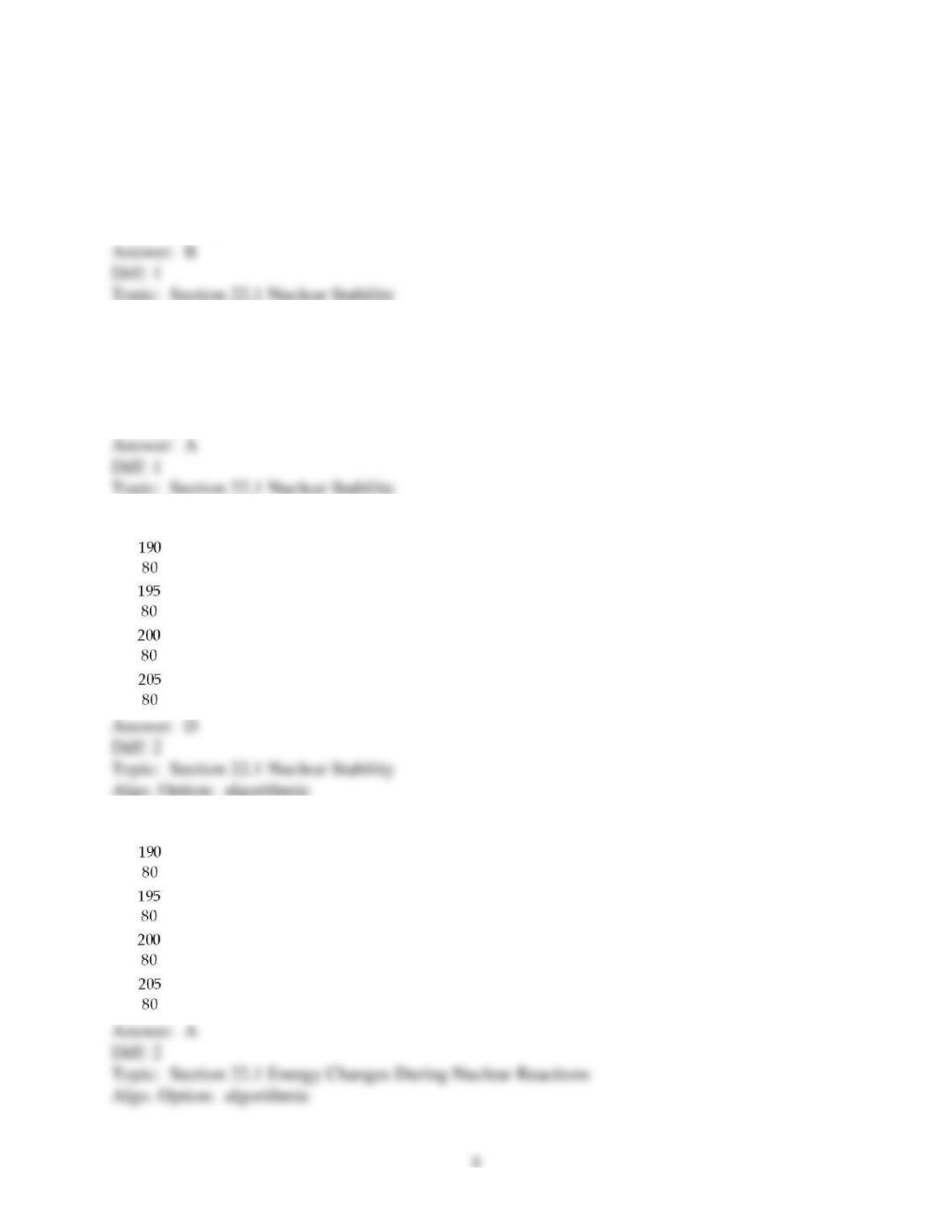
11) Which of the following nuclides is most likely to undergo beta decay?
A) Hg
B) Hg
C) Hg
D) Hg
12) Which of the following nuclides is most likely to decay by electron capture?
A) Hg
B) Hg
C) Hg
D) Hg
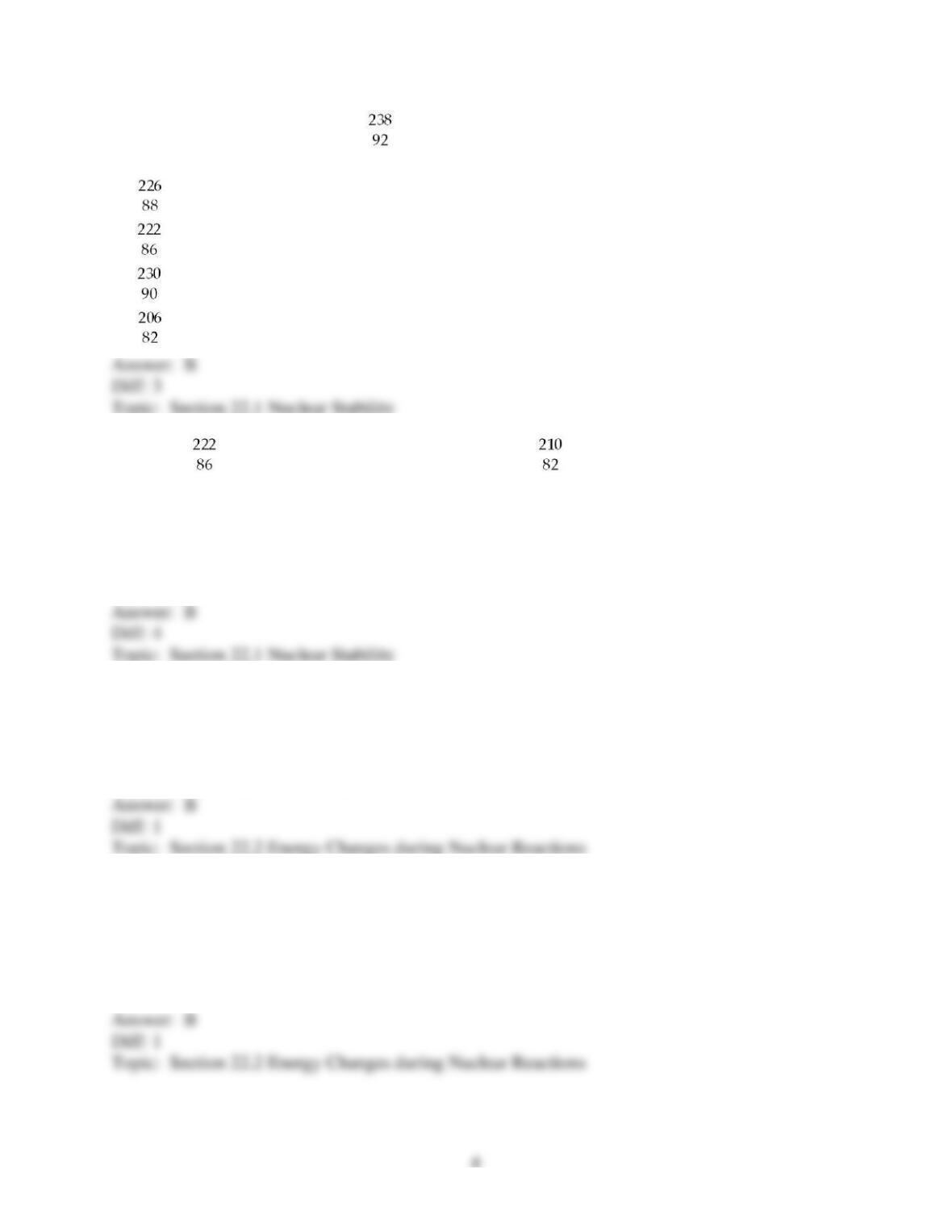
13) What nuclide is formed when U undergoes a portion of the decay series: alpha, beta,
beta, alpha, alpha, alpha.
A) Ra
B) Rn
C) Th
D) Pb
14) When Rn decays in a 5-step series the product is Pb. How many alpha and beta
particles are emitted in the decay series?
A) 2 α, 3 β–
B) 3 α, 2 β–
C) 4 α, 1 β–
D) 1 α, 4 β–
15) Mass defect is the mass lost when
A) an atom is formed from individual protons, neutrons, and electrons.
B) a nucleus is formed from individual protons and neutrons.
C) electrons are removed from an atom.
D) electrons are added to an atom.
16) The sum of the masses of the protons and neutrons in a given nucleus minus the mass of that
nucleus is always
A) negative.
B) positive.
C) temperature dependent.
D) zero.
17) The binding energy is defined as
A) the amount of energy absorbed when electrons are added to an ion.
B) the amount of energy absorbed when protons and neutrons form a nucleus.
C) the amount of energy released when electrons are removed from the atom.
D) the amount of energy required to break apart a nucleus into individual protons and neutrons.
18) Which of the following nuclei has the highest binding energy per nucleon?
A) Fe
B) K
C) Au
D) O
19) If the mass of one neutron is 1.00866 amu, the mass of one proton is 1.00728 amu, and the
mass of 137Cs nucleus is 136.8316 amu, calculate the binding energy for the 137Cs nucleus.
A) 8.719 MeV/nucleon
B) 4.831 MeV/nucleon
C) 8.442 MeV/nucleon
D) 4.688 MeV/nucleon
20) If the mass of one neutron is 1.00866 amu, the mass of one proton is 1.00728 amu, and the
mass of 131I nucleus is 130.8342 amu, calculate the binding energy for the 131I nucleus.
A) 8.749 MeV/nucleon
B) 4.703 MeV/nucleon
C) 8.402 MeV/nucleon
D) 4.612 MeV/nucleon
21) A binding energy curve is a plot of binding energy per nucleon versus atomic number. In
what region of the binding energy curve are the most stable elements found?
A) in the lower left region (low atomic mass)
B) in the central top region (moderate atomic mass)
C) in the lower right region (heavy atomic mass)
D) binding energy is not dependent on atomic mass
22) Which of the following isotopes is the most stable?
A) 6He, 4.89 MeV/nucleon
B) 20Ne, 8.03 MeV/nucleon
C) 28Si, 8.44 MeV/nucleon
D) 232Th, 7.62 MeV/nucleon
23) Which of the following isotopes is the least stable?
A) 7Be, 5.37 MeV/nucleon
B) 23Na, 8.11 MeV/nucleon
C) 94Zr, 8.67 MeV/nucleon
D) 240Pu, 7.26 MeV/nucleon
24) The total binding energies for 3He, 4He, and 6He are 7.72 MeV, 28.29 MeV, and 29.26 MeV
respectively. Arrange the 3 isotopes in increasing order of binding energy per nucleon.
A) 3He < 4He < 6He
B) 6He < 4He < 3He
C) 4He < 3He < 6He
D) 3He < 6He < 4He
25) Calculate the mass defect for the formation of phosphorus-31. The mass of a phosphorus-31
nucleus is 30.973765 amu. The masses of a proton and a neutron are 1.00728 and 1.00866 amu,
respectively.
A) 0.13015 amu
B) 0.15404 amu
C) 0.27261 amu
D) 0.27399 amu
26) If the mass of one neutron is 1.00866 amu, the mass of one proton is 1.00728 amu, and the
mass of 14C nucleus is 13.99995 amu, calculate the binding energy for the 14C nucleus.
A) 9.92 × 10⁹ kJ/mol
B) 1.02 × 10¹⁰ kJ/mol
C) 5.54 × 10¹¹ kJ/mol
D) 5.95 × 10¹¹ kJ/mol
27) If the mass of one neutron is 1.00866 amu, the mass of one proton is 1.00728 amu, and the
mass of 12C nucleus is 11.99671 amu, calculate the binding energy for the 12C nucleus.
A) 8.90 × 10⁹ kJ/mol
B) 8.90 × 10¹² kJ/mol
C) 1.10 × 10¹⁵ kJ/mol
D) 1.10 × 10¹⁸ kJ/mol
28) What is the mass change in grams for the reaction The enthalpy for the
reaction is -57.2 kJ.
A) -6.36 × 10⁻¹³ g
B) -6.36 × 10⁻¹⁰ g
C) -1.91 × 10⁻⁷ g
D) -1.91 × 10⁻⁴ g
29) How much energy is released for alpha decay of 236U? The masses of 4He, 232Th, and
236U are 4.002604, 232.038124, and 236.045637 amu, respectively.
A) 1.473 × 10⁸ kJ/mol
B) 4.418 × 10⁸ kJ/mol
C) 4.909 × 10⁸ kJ/mol
D) 7.209 × 10⁸ kJ/mol
30) Which does not apply to a nuclear fusion reaction?
A) Atoms of one element cannot be converted to atoms of another element.
B) Energy is conserved.
C) Matter is conserved.
D) None of these apply to a nuclear fusion reaction.
31) Which of the following is not an advantage of fusion reactions over fission reactions for
power generation?
A) cheap and plentiful fuel
B) ease of reaction initiation
C) Fusion products are non-polluting
D) Fusion products are nonradioactive
32) Relative to the amount of energy released in a typical chemical reaction, the amount of
energy released in a typical fission reaction is about
A) the same.
B) 10 times greater.
C) 108 times greater.
D) 1010 times greater.
33) Breaking a chemical bond requires approximately 102 kJ/mol of energy. What is closest to
the order of magnitude of the energy required to split a nucleus in to its individual protons and
neutrons?
A) 103 kJ/mol
B) 104 kJ/mol
C) 108 kJ/mol
D) 1010 kJ/mol
34) Elements with ________ atomic mass are best possible candidates for a fusion reaction.
A) very low
B) moderate
C) moderate to heavy
D) very heavy
35) Elements with ________ atomic mass are best possible candidates for a fission reaction.
A) very low
B) moderate
C) moderate to heavy
D) very heavy
36) Four heavy elements (A, B, C, and D) will fission when bombarded by neutrons. In addition
to fissioning into two smaller elements, A also gives off a beta particle, B gives off gamma rays,
C gives off neutrons, and D gives off alpha particles. Which element would make a possible fuel
for a nuclear reactor?
A) element A
B) element B
C) element C
D) element D
37) What does the term “critical mass” mean? It is the
A) amount of fissionable material which will self-sustain a nuclear chain reaction.
B) difference between mass of individual protons and neutrons and the mass of the nucleus.
C) energy which holds the nucleus together.
D) mass of fuel in a nuclear reactor core.
38) What mass percent of 235U (the fissionable isotope) is used in the fuel in nuclear power
plants?
A) 3%
B) 14%
C) 27%
D) 83%
39) In fusion reactions to make superheavy elements, energy is required to bring the two nuclei
together and to form additional mass. How much energy must be converted into mass for the
alpha bombardment of 253Es to form 257Md? (The isotopic masses are 253Es = 253.08294
amu, 4He = 4.00260 amu, 257Md = 257.09558 amu.)
A) 3.01 × 10⁶ kJ/mol
B) 9.04 × 10⁸ kJ/mol
C) 3.59 × 10¹¹ kJ/mol
D) 7.21 × 10¹¹ kJ/mol
40) Nitrogen-14 (14.003074 amu) is synthesized in the sun by fusion of 13C (13.003355 amu)
and 1H (1.007825 amu). How much energy is released in this nuclear reaction?
A) 2.432 × 10⁶ kJ/mol
B) 7.295 × 10⁸ kJ/mol
C) 9.141 × 10¹⁰ kJ/mol
D) 1.807 × 10¹¹ kJ/mol
41) Oxygen-16 (15.994915 amu) is synthesized in the sun by fusion of 12C (12.000000 amu)
and 4He (4.00260 amu). How much energy is released in this nuclear reaction?
A) 2.48 × 10³ kJ/mol
B) 2.30 × 10⁶ kJ/mol
C) 6.92 × 10⁸ kJ/mol
D) 7.20 × 10¹¹ kJ/mol
42) The masses of 4He, 6Li, and 10B are 4.0015, 6.0135, and 10.0102 amu respectively. The
fission of a boron-10 nucleus into He-4 and Li-6 would
A) absorb energy.
B) evolve energy.
C) result in no energy change.
D) Need more information
43) Which of the following reactions correctly shows the transmutation of an element by neutron
absorption followed by beta emission?
A) Tl + n → e + Pb
B) Tl + e → n + Dy
C) I + n → e + Xe
D) Ce + e → n + La
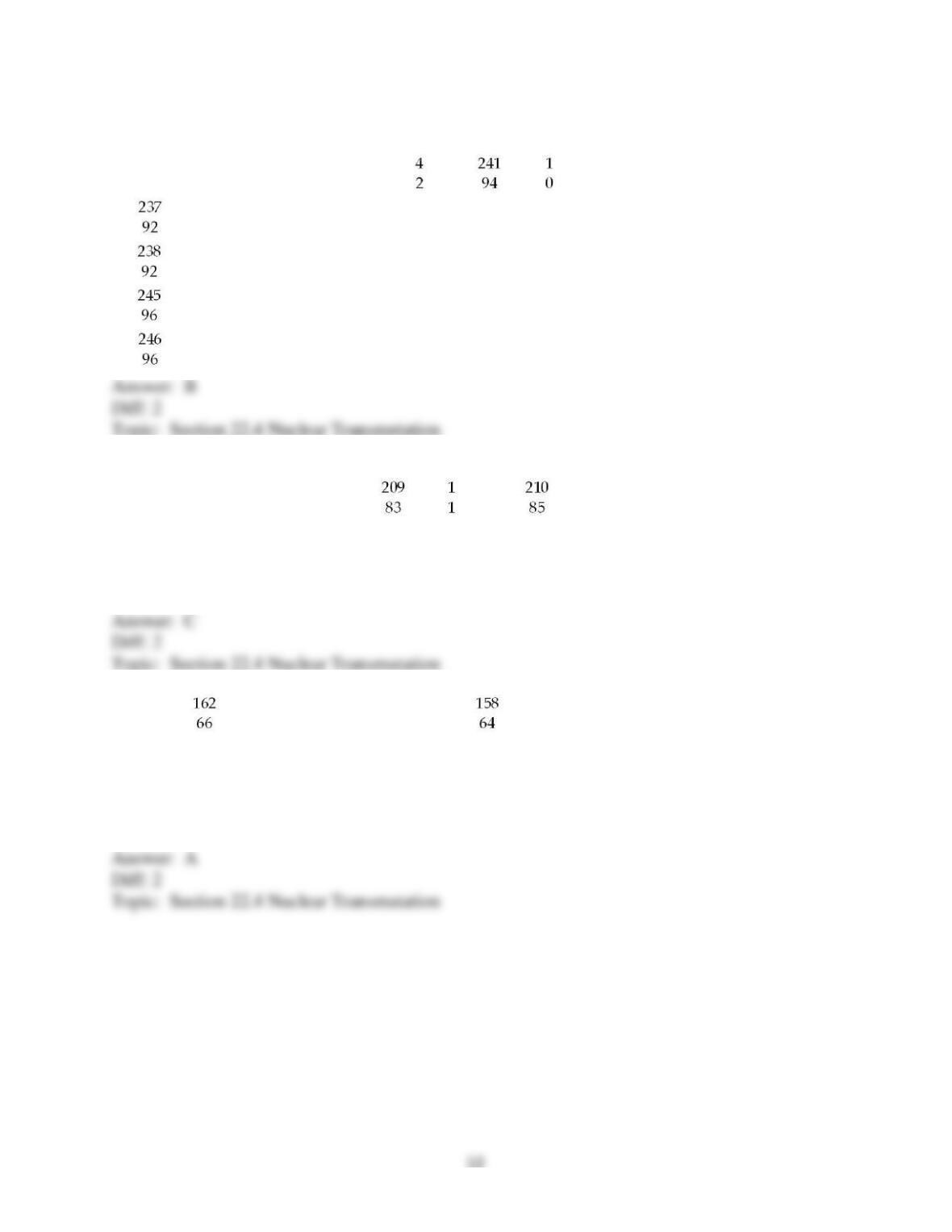
44) The nuclear transmutation reaction that leads to the synthesis of plutonium-241 is shown
below. What is the identity of the α-particle bombardment target in this reaction?
? + He → Pu + n
A) U
B) U
C) Cm
D) Cm
45) What is the missing product of the nuclear reaction?
Bi + p → ? + Po
A) α
B) β+
C) β–
D) n
46) When Dy is formed by bombardment of Gd, what particle(s) was (were) used for the
bombardment?
A) one α
B) two β–
C) 4 neutrons
D) 2 protons
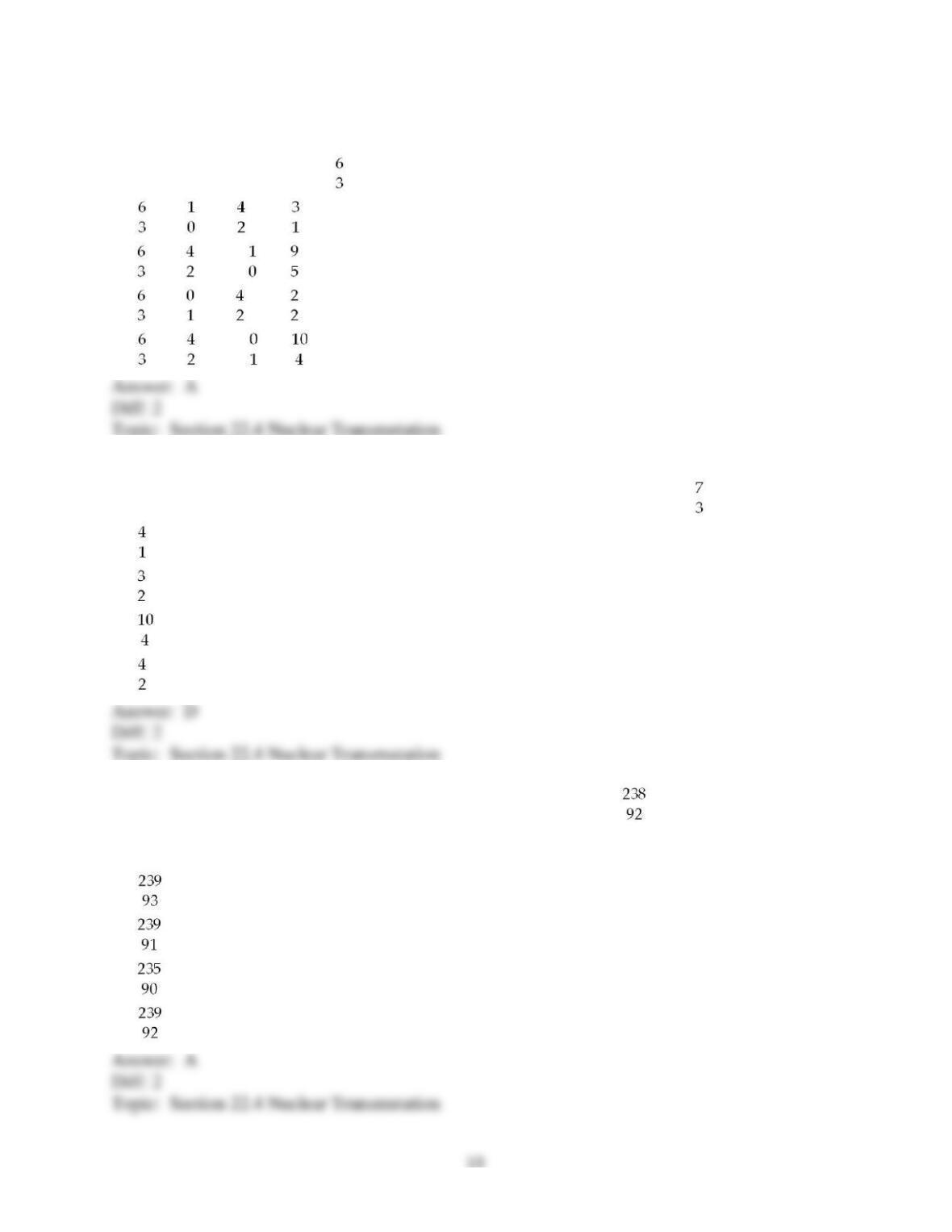
47) A shorthand way of writing transmutation equations is to show the bombarding particle and
the subsequent emitted particle in parentheses. Which of the following equations shows the
balanced nuclear reaction for Li (n, α)?
A) Li + n → He + H
B) Li + He → n + B
C) Li + n → He + He
D) Li + He → n + Be
48) A shorthand way of writing transmutation equations is to show the bombarding particle and
the subsequent emitted particle in parentheses. Which particle is produced by Li (p, α)?
A) H
B) He
C) Be
D) He
49) The first transuranium element was synthesized by bombarding U with neutrons. After
capturing one neutron, the resulting nuclide was unstable and decayed by beta emission. What
was the product of these two nuclear reactions?
A) Np
B) Pa
C) Th
D) U