Exam
Name___________________________________
MULTIPLE CHOICE. Choose the one alternative that best completes the statement or answers the question.
1)
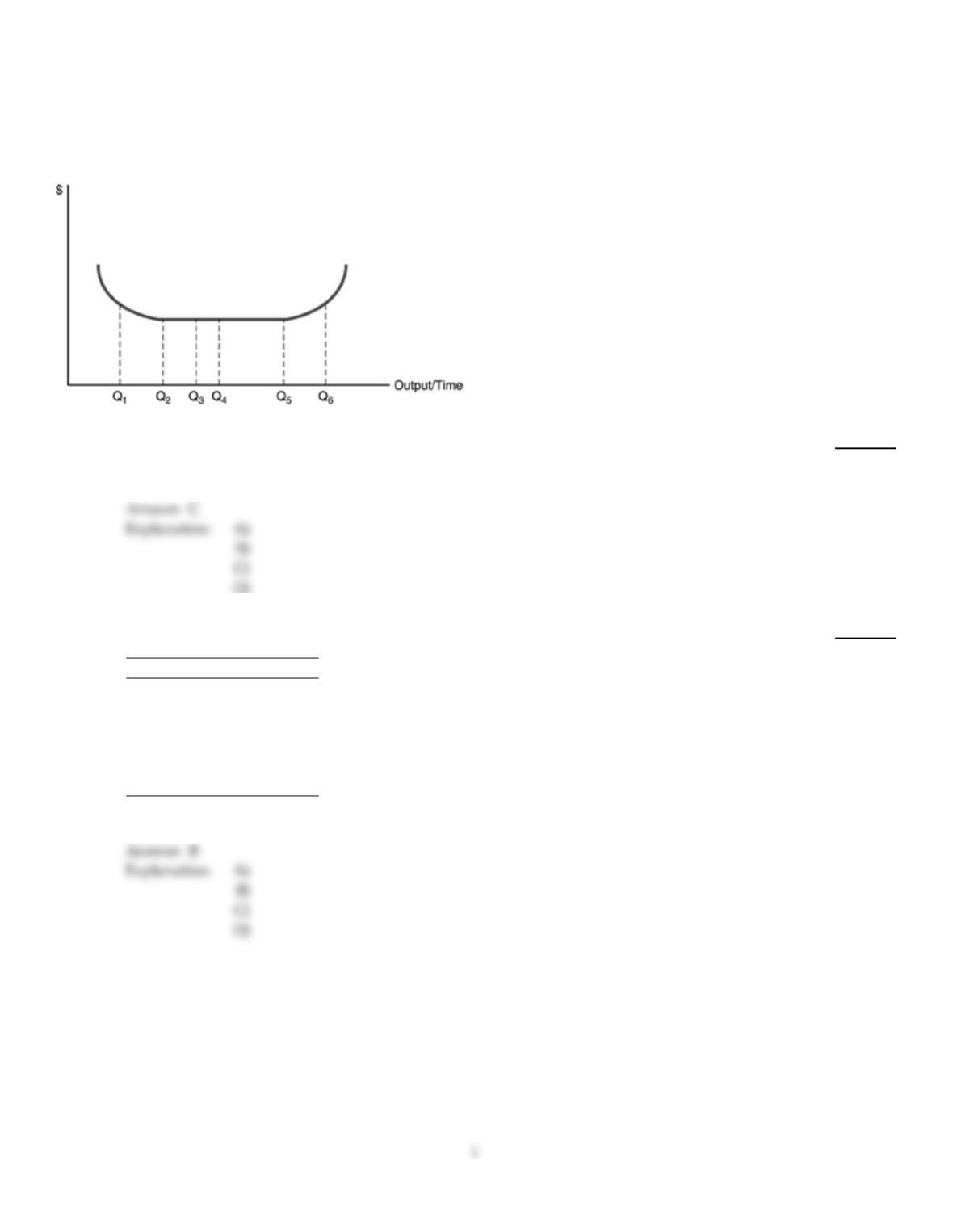
Refer to the above figure. Diseconomies of scale exist
1)
A)
over the entire range of output.
B)
up to output Q2.
C)
after output Q5.
D)
from output Q2 to Q5.
2)
Notice the costs as given in the table below. What is the total fixed cost in the table below?
Total Output Total Costs
0 $10
1 $15
2 $18
3 $20
4 $21
5 $23
2)
A)
$9
B)
$10
C)
$0
D)
$5
Quantity of Total
Labor Product
120
246
363
472
3)
Refer to the above table. What does the marginal product equal when the quantity of labor goes
from 3 to 4?
3)
A)
72
B)
9
C)
18
D)
216
4)
The long run is defined as a time period during which full adjustment can be made to any change
in the economic environment. Thus in the long run, all factors of production are variable. Long–run
curves are sometimes called planning curves, and the long run is sometimes called the
4)
A)
non–adjustment period.
B)
foreseeable future.
C)
planning horizon.
D)
minimum efficient time period.
5)
Marginal physical product of the first worker is 100, 120 for the second, 80 for the third, 30 for the
fourth, 5 for the fifth, 3 for the sixth, 2 for the seventh, 1 for the eighth, and 0 for the ninth. What is
total product for the fifth worker and the ninth worker respectively?
5)
A)
0; 5
B)
5; 0
C)
335; 341
D)
335; 0
Quantity of Total
Labor Product
120
246
363
472
6)
Refer to the above table. When the quantity of labor equals 3, what does the average product equal?
6)
A)
21
B)
63
C)
189
D)
17
7)
In economics, the planning horizon is defined as
7)
A)
10 years for every firm.
B)
the period of time for which technology is fixed.
C)
the long run, during which all inputs are variable.
D)
the longest time period over which the firm can make decisions.
8)
A decrease in long–run average costs resulting from decreases in output is
8)
A)
attributed to constant returns to scale.
B)
attributed to the law of diminishing marginal product.
C)
attributed to economies of scale.
D)
attributed to diseconomies to scale.
9)
The marginal cost curve always intersects the average total cost curve at the point at which the
average total cost curve
9)
A)
is at its maximum.
B)
is zero.
C)
has a vertical slope.
D)
is at its minimum.
10)
The minimum possible short–run average costs are equal to long–run average costs when
10)
A)
production is at any point on the LAC curve.
B)
short–run and long–run costs are declining.
C)
the plant is producing at its short–run minimum point.
D)
the long–run curve is at a minimum point.
11)
A basic distinction between the long run and the short run is that
11)
A)
the opportunity costs of production are lower in the short run than in the long run.
B)
in the short run, complete adjustment of all inputs is impossible, while in the long run all
inputs can be adjusted.
C)
in the long run, some inputs are fixed, while in the short run, all inputs are variable.
D)
if a firm produces no output in the long run, it still incurs a cost.
12)
If four laborers were hired and we discovered that we could produce 88 units of production, what
is the average physical product of labor?
12)
A)
11
B)
44
C)
352
D)
22
13)
Suppose that a firm is currently producing 500 units of output. At this level of output, AVC is $1
per unit, and TFC is $500. What is the firm’s TC?
13)
A)
$1,500
B)
$1,000
C)
$501
D)
$500
14)
All of the following are most likely to be fixed costs EXCEPT the cost relating to
14)
A)
packaging.
B)
insurance.
C)
rent.
D)
taxes.
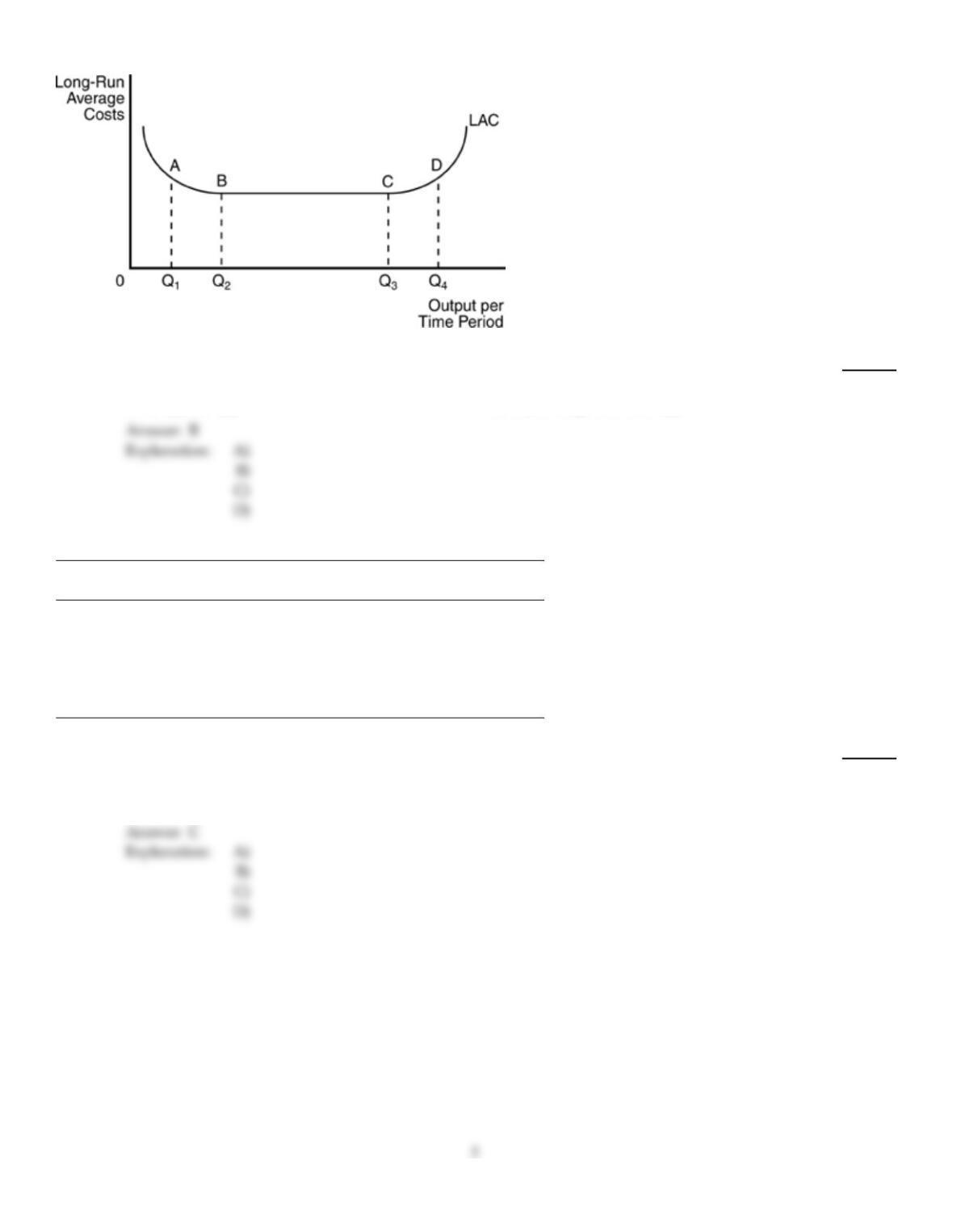
15)
In the above figure, the firm experiences constant returns to scale between output levels of
15)
A)
zero and Q1.
B)
Q2 and Q3.
C)
Q3 and Q4.
D)
any level greater than Q4.
Quantity of Total Average Marginal
Labor Product Product Product
1 22 22 22
2 52 26 30
381 27 29
4100 25 19
5115 23 15
6126 21 11
16)
Refer to the above table. At what quantity of labor does it become obvious that the law of
diminishing marginal product has set in?
16)
A)
worker number 21
B)
worker number 5
C)
worker number 3
D)
worker number 4
A firm has the following production relationship between labor and output, for a fixed capital stock.
Labor Output
0 0
1 5
211
318
423
526
17)
According to the above table, at what usage of labor does diminishing marginal product begin?
17)
A)
1
B)
2
C)
4
D)
5
Use the information from the below table to answer following question(s).
Input of Total
Labor Product
0 0
120
2 50
380
4105
5125
6140
7150
18)
In the above table, the average product for 3 units of labor is
18)
A)
25.0.
B)
30.0.
C)
26.3.
D)
26.7.
Q (output) TFC TVC TC AFC AVC ATC MC
0$0 – – – –
1$10
2$5 $15
3$15
4$16.75
19)
Using the above table, the TC, the AFC, and the TVC when output is 2 units are
19)
A)
$20, $2.50, and $15, respectively.
B)
$30, $2.50, and $40, respectively.
C)
$35, $2.50, and $30, respectively.
D)
$35, $2.50, and $20, respectively.
20)
If marginal product is zero, we know that
20)
A)
average product is constant.
B)
total product is also zero.
C)
total output is maximized.
D)
average product is also zero.
QTFC TVC TC AFC AVC ATC
1
2$75 $25
3$40
21)
Refer to the above table. What are total costs at an output of 2 units?
21)
A)
$200
B)
$150
C)
$50
D)
$100
Fixed Variable Total Average Average Marginal
Output Costs Costs Costs Total Costs Variable Costs Costs
0$0 $100
130
250
3 60
4 120
5200
22)
In the above table, what is the marginal cost to produce the 5th unit of output?
22)
A)
$80
B)
$20
C)
$60
D)
$55
Q (output) TFC TVC TC AFC AVC ATC MC
0$0 – – – –
1$10
2$5 $15
3$15
4$16.75
23)
Using the above table, the TVC, the TC, and MC when output is 3 units are
23)
A)
$45, $18, and $15, respectively.
B)
$15, $20, and $15, respectively.
C)
$45, $50, and $15, respectively.
D)
$15, $45, and $15, respectively.
24)
In the short run, total costs equal
24)
A)
the sum of total fixed costs and total explicit costs.
B)
the sum of total fixed costs and total implicit costs.
C)
the sum of total variable costs and total implicit costs.
D)
the sum of total fixed costs and total variable costs.
25)
The long run is
25)
A)
over five years.
B)
the time period in which all factors of production can be varied.
C)
over one year.
D)
when all factors of production are fixed.
26)
The law of diminishing marginal product is responsible for
26)
A)
economies of scale.
B)
none of the long–run relationships.
C)
constant returns to scale.
D)
diseconomies of scale.
27)
Any activity that results in the conversion of resources into products that can be used in
consumption is
27)
A)
discounting.
B)
production.
C)
planning.
D)
investment.
28)
If a firm gets so large that management of employees and other resources becomes a costly
problem, it will be experiencing
28)
A)
constant returns to scale.
B)
economies of scale.
C)
diminishing marginal product.
D)
diseconomies of scale.
29)
As long as output increases,
29)
A)
average variable costs decrease.
B)
marginal costs decrease.
C)
average fixed costs decrease.
D)
average total costs decrease.
30)
Which of the following is a short–run decision for a firm?
30)
A)
firing workers
B)
investing in a new addition to the firm’s manufacturing plant
C)
expanding the firm’s distribution network of long–haul freight trucks and smaller delivery
trucks
D)
downsizing the firm’s manufacturing plant
31)
In a map showing short–run cost functions, one curve begins at the origin and rises as output
expands. It is called the
31)
A)
the total fixed cost curve.
B)
the marginal cost curve.
C)
the total cost curve.
D)
the total variable cost curve.
D
32)
At the output rate at which diminishing marginal product begins, a firm will experience
32)
A)
increasing marginal costs.
B)
decreasing average variable costs.
C)
constant average total costs.
D)
increasing average fixed costs.
A
33)
Which of the following statements is FALSE?
33)
A)
The production function presents the technically efficient methods of combining inputs to
produce output.
B)
The production function shows the technical relationship between a firm’s inputs and
outputs.
C)
Included in the firm’s short–run production function are both fixed and variable inputs.
D)
An efficient firm can obtain more output than the production function shows.
D
34)
Costs that do not vary with output are
34)
A)
variable costs.
B)
total costs.
C)
fixed costs.
D)
marginal costs.
C
A
35)
Which of the following physical relationships might generate economies of scale?
35)
A)
Larger equipment tends to weigh more and use more fuel on a per–unit–of–output basis.
B)
Proportionally larger pipes can transport more than a proportional increase in oil.
C)
Each lift truck requires one lift truck driver.
D)
A doubling of all inputs leads to a doubling of output.
36)
A horizontal long–run average cost curve indicates
36)
A)
diseconomies of scale.
B)
constant returns to scale.
C)
constant marginal physical product.
D)
economies of scale.
37)
If a firm is experiencing diseconomies of scale, then
37)
A)
the firm should expand the size of its operation.
B)
proportional increases in all inputs result in proportional increases in output.
C)
the long–run average cost curve is rising as output expands.
D)
the long–run average cost curve is decreasing as output expands.
38)
Every point on the long–run average cost curve is
38)
A)
on a short–run average total cost curve.
B)
on a short–run average variable cost curve.
C)
on a short–run marginal cost curve.
D)
also a minimum point on a short–run average cost curve.
QTFC TVC TC
0$90 $ 0 $ 90
190 25 115
290 32 122
390 42 132
490 64 154
590 95 185
39)
Refer to the above table. MC is the lowest
39)
A)
at 0 units of output.
B)
between 0 and 1 units of output.
C)
between 3 and 4 units of output.
D)
between 1 and 2 units of output.
40)
As the quantity of labor increases while the amount of other inputs are held constant, marginal
product of labor will
40)
A)
decrease continuously.
B)
initially increase and then decrease.
C)
increase continuously.
D)
initially decrease and then increase.
41)
The planning horizon is the
41)
A)
point where production begins.
B)
long run.
C)
short run.
D)
point where diminishing marginal product starts.
42)
If average variable costs are increasing while average total costs are decreasing, then
42)
A)
marginal cost must lie between average variable and average total costs.
B)
marginal cost must equal average variable cost.
C)
fixed costs must be zero.
D)
marginal cost must equal average total cost.
43)
Which of the following statements regarding the relationship between average and marginal costs
is INCORRECT?
43)
A)
When marginal costs are less than average costs, the latter must fall.
B)
There is no way for average variable costs to fall when marginal costs are falling.
C)
When marginal costs are greater than average costs, the latter must rise.
D)
There is always a definite relationship between average and marginal cost.
44)
Production
44)
A)
is a process by which resources are transferred into goods and services.
B)
is carried on by corporations, but not by sole proprietorships.
C)
is a process by which resources are produced.
D)
only applies to manufacturing of goods.
A
45)
Refer to the above figure. Curve (4) is the
45)
A)
marginal product curve.
B)
total fixed cost curve.
C)
average variable cost curve.
D)
average fixed cost curve.
D
B
46)
Increases in long–run average cost that result from output increases is
46)
A)
the law of diminishing marginal product.
B)
diseconomies of scale.
C)
constant returns to scale.
D)
economies of scale.
47)
The distance between the TC and the TVC curve
47)
A)
is constant.
B)
increases as output increases.
C)
is the MC curve.
D)
decreases as output increases.
48)
The time frame in which all factors of production can vary is
48)
A)
the long run.
B)
the short run.
C)
indeterminate.
D)
the intermediate run.
49)
Which of the following changes a firm’s production function?
49)
A)
hiring additional workers
B)
adopting new technology
C)
acquiring additional physical capital
D)
adding a second production facility exactly like its first production site
50)
Which of the following statements is TRUE?
50)
A)
Diseconomies of scale is a short–run concept, while economies of scale is a long–run concept.
B)
A firm can experience diminishing marginal product and economies of scale at the same time.
C)
No firm would ever operate at a level of output for which it experiences diseconomies of
scale.
D)
If a firm is experiencing economies of scale, diminishing marginal product has not set in yet.
51)
Economies of scale exist where the long–run average cost curve is
51)
A)
upward sloping.
B)
tangent to the marginal cost curve.
C)
horizontal.
D)
downward sloping.
Fixed Variable Total Average Average Marginal
Output Costs Costs Costs Total Costs Variable Costs Costs
0$0 $100
130
250
3 60
4 120
5200
52)
In the above table, what is the average total cost to produce 4 units of output?
52)
A)
$30
B)
$55
C)
$60
D)
$20
53)
If we add successive laborers to work a given amount of land on a wheat farm, eventually
53)
A)
the increases in wheat harvested will rise at a constant rate.
B)
the increases in wheat harvested will get larger and larger.
C)
average total cost will fall to zero.
D)
the increases in wheat harvested will get smaller and smaller.
54)
Fixed costs include all but
54)
A)
property tax on the existing buildings.
B)
machines that have been producing output.
C)
temporary labor.
D)
a normal rate of return on investment.
55)
When the average physical product is rising
55)
A)
total cost is falling.
B)
average variable cost is falling.
C)
marginal cost is always rising.
D)
average total cost is increasing.
Total Output Total Costs
0 $10
1 18
2 21
3 23
4 24
5 26
6 29
7 33
8 38
9 44
10 51
56)
In the above table, the marginal cost of the ninth unit is
56)
A)
$5.00.
B)
$7.00.
C)
$6.00.
D)
$4.00.
C
57)
Which equation is used by a manager when considering total cost?
57)
A)
total costs (TC) = consumption (C) + investment (I) + government (G)
B)
total costs (TC) = total fixed costs (TFC) + total variable costs (TVC)
C)
total costs (TC) = average total costs (ATC)
D)
total costs (TC) = average fixed costs (AFC) + number of workers
B
B
58)
Refer to the above table. When the quantity of labor equals 2, what does the average product equal?
58)
A)
92
B)
23
C)
26
D)
46
59)
As a firm’s production increases in the short run, the average total cost curve eventually slopes
upward because
59)
A)
average physical product rises with increases in output.
B)
marginal physical product eventually declines as output increases.
C)
average fixed cost declines with increases in output.
D)
marginal cost eventually declines as output increases.
60)
With a given plant size, an increase in output will NOT result in an increase in
60)
A)
average variable cost.
B)
total fixed cost.
C)
average fixed cost.
D)
total cost.
61)
When the marginal physical product is falling
61)
A)
total costs are falling.
B)
average variable costs are falling.
C)
marginal cost is rising.
D)
average fixed costs are rising.
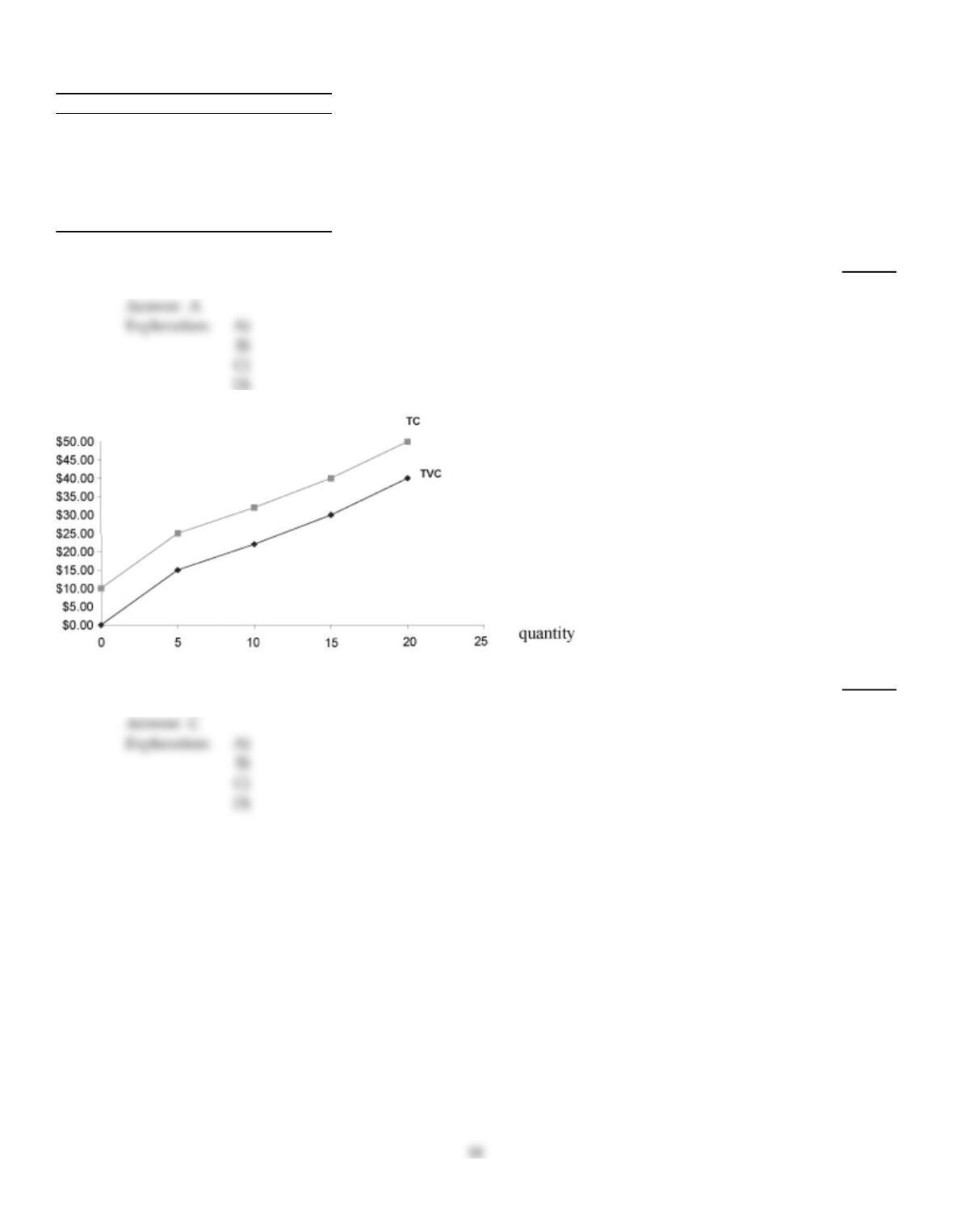
QTFC TVC TC
0$90 $ 0 $ 90
190 25 115
290 32 122
390 42 132
490 64 154
590 95 185
62)
Refer to the above table. At an output of 5 units, average total costs are
62)
A)
$37.
B)
$19.
C)
$185.
D)
$18.
63)
Use the above figure. The TFC at output level 10 is
63)
A)
$3.
B)
$2.
C)
$10.
D)
$1.
A firm has the following production relationship between labor and output, for a fixed capital stock.
Labor Output
0 0
1 5
211
318
423
526
64)
According to the above table, what is the average product of labor when five laborers are
employed?
64)
A)
6
B)
3
C)
5.75
D)
5.2
65)
The production function illustrates the amount of total product that can be produced with a given
set of
65)
A)
outputs.
B)
marginal product.
C)
marginal input.
D)
inputs.
Quantity of Total Average Marginal
Labor Product Product Product
1320
2335
3338
4320
66)
Refer to the above table. What does total product equal when 3 units of labor are used?
66)
A)
338
B)
3
C)
336
D)
1008
QTFC TVC TC
0$90 $ 0 $ 90
190 25 115
290 32 122
390 42 132
490 64 154
590 95 185
67)
Refer to the above table. At an output of 3 units, average variable costs are
67)
A)
$14.
B)
$44.
C)
$42.
D)
$30.
68)
Suppose the total output curve increases at an increasing rate for workers 1–50, increases at a
decreasing rate from workers 51–101, and decreases beyond 101 workers. We would know that
68)
A)
marginal product is increasing from workers 1–50 and then becomes negative after worker
51.
B)
marginal product is decreasing from workers 1–101, becoming negative at the 102nd worker.
C)
marginal product is increasing from workers 1–50, constant from workers 51 to 101, and is
decreasing after that.
D)
marginal product is increasing from workers 1–50, decreasing after 51 workers, and becomes
negative after the 101st worker.