CHAPTER 22
ACCOUNTING CHANGES AND ERROR ANALYSIS
TRUE-FALSE—Conceptual
Answer No. Description
MULTIPLE CHOICE—Conceptual
Answer No. Description
Test Bank for Intermediate Accounting, Sixteenth Edition
22 – 2
MULTIPLE CHOICE—Conceptual (cont.)
Answer No. Description
MULTIPLE CHOICE—Computational
Answer No. Description
MULTIPLE CHOICE—CPA Adapted
Answer No. Description

Accounting Changes and Error Analysis
22 – 3
BRIEF EXERCISES
Item Description
BE22-77 Matching accounting changes to situations.
BE22-78 How changes or corrections are recognized.
BE22-79 Matching disclosures to situations.
EXERCISES
E22-80 Change in accounting principle.
E22-81 Change in estimate, change in reporting entity, corrections of errors.
E22-82 Changes in depreciation methods, estimates.
E22-83 Noncounterbalancing error.
E22-84 Effects of errors.
E22-85 Effects of errors.
PROBLEMS
Item Description
P22-86 Accounting for changes and error corrections.
P22-87 Corrections of errors.
P22-88 Error corrections and adjustments.
CHAPTER LEARNING OBJECTIVES
1. Identify types of accounting changes and understand the accounting for changes in
accounting principles.
2. Describe the accounting for changes in estimates and changes in the reporting entity.
3. Describe the accounting for correction of errors.
4. Analyze the effect of errors.
5. Make the computations and prepare the entries necessary to record a change from or to
the equity method of accounting.
6. Compare the procedures for accounting changes and error analysis under GAAP and
IFRS.

Test Bank for Intermediate Accounting, Sixteenth Edition
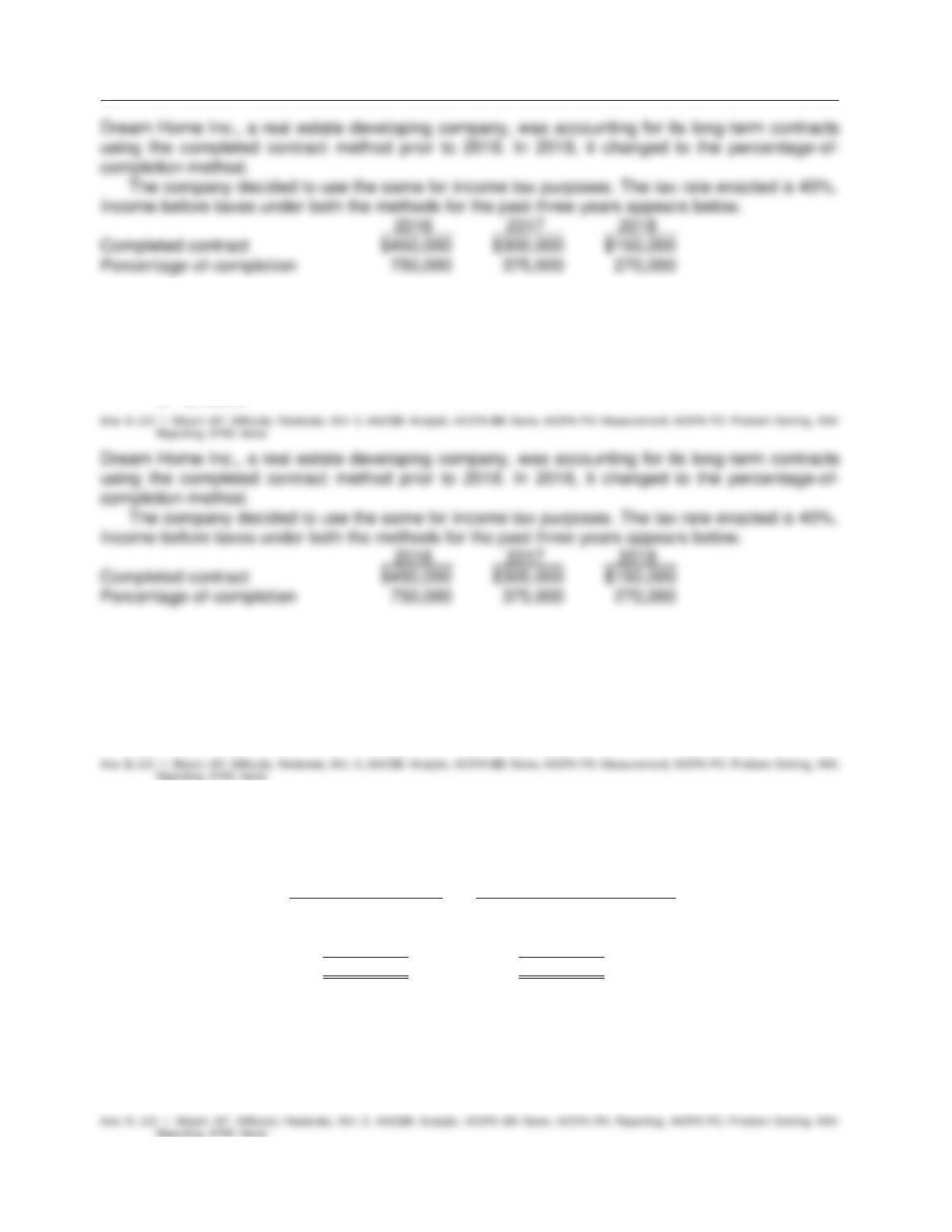
22 – 4
SUMMARY OF QUESTIONS BY LEARNING OBJECTIVES AND BLOOM’S TAXONOMY
Item
LO
BT
Item
LO
BT
Item
LO
BT
Item
LO
BT
Item
LO
BT
TRUE-FALSE STATEMENTS
1.
1
K
5.
1
K
9.
2
K
13.
2
K
17.
4
K
2.
1
K
6.
1
K
10.
2
K
14.
3
C
18.
4
K
3.
1
K
7.
1
K
11.
2
K
15.
3
K
19.
4
K
4.
1
K
8.
1
K
12.
2
C
16.
3
K
20.
5
K
MULTIPLE CHOICE QUESTIONS
21.
1
C
33.
2
C
45.
1
AP
57.
4
AN
69.
1
AP
22.
1
C
34.
2
K
46.
1
AP
58.
4
AN
70.
1
AP
23.
1
C
35.
2
C
47.
1
AP
59.
4
AN
71.
2
AP
24.
1
C
36.
2
C
48.
1
AP
60.
4
AN
72.
2
AP
25.
1
AP
37.
3
C
49.
1
AP
61.
4
AN
73.
2
AP
26.
1
K
38.
4
K
50.
1
AP
62.
4
AN
74.
3
AP
27.
1
AP
39.
4
C
51.
1
AP
63.
4
AN
75.
4
AN
28.
1
K
40.
5
C
52.
2
AP
64.
4
AP
76.
4
AN
29.
1
C
41.
1
AP
53.
2
AP
65.
4
AN
30.
2
K
42.
1
AP
54.
2
AP
66.
4
AN
31.
2
K
43.
1
AN
55.
3
AN
67.
4
AN
32.
2
C
44.
1
AP
56.
3
AN
68.
1
K
BRIEF EXERCISES
77.
2, 3
C
78.
1–3
C
79.
1, 2,
3
C
EXERCISES
80.
1
AP
82.
2
AP
84.
4
AN
81.
2, 3
C
83.
3
AP
85.
4
AN
PROBLEMS
86.
1, 2,
3, 4
AP
87.
3, 4
AN
88.
3,4
AN

Accounting Changes and Error Analysis
22 – 5
TRUE-FALSE—Conceptual
1. A change in accounting principle is a change that occurs as the result of new information
or additional experience.
2. Errors in financial statements result from mathematical mistakes or oversight or misuse of
facts that existed when preparing the financial statements.
3. Adoption of a new principle in recognition of events that have occurred for the first time or
that were previously immaterial is treated as an accounting change.
4. Retrospective application refers to the application of a different accounting principle to
recast previously issued financial statements—as if the new principle had always been
used.
5. When a company changes an accounting principle, it should report the change by
reporting the cumulative effect of the change in the current year’s income statement.
6. One of the disclosure requirements for a change in accounting principle is to show the
cumulative effect of the change on retained earnings as of the beginning of the earliest
period presented.
7. An indirect effect of an accounting change is any change to current or future cash flows of
a company that result from making a change in accounting principle that is applied
retrospectively.
8. Retrospective application is considered impracticable if a company cannot determine the
prior period effects using every reasonable effort to do so.
9. Companies report changes in accounting estimates retrospectively.
10. When it is impossible to determine whether a change in principle or change in estimate
has occurred, the change is considered a change in estimate.
Test Bank for Intermediate Accounting, Sixteenth Edition
22 – 6
11. Companies account for a change in depreciation methods as a change in accounting
principle.
12. When companies make changes that result in different reporting entities, the change is
reported prospectively.
13. Changing the cost or equity method of accounting for investments is an example of a
change in reporting entity.
14. Accounting errors include changes in estimates that occur because a company acquires
more experience, or as it obtains additional information.
15. Companies record corrections of errors from prior periods as an adjustment to the
beginning balance of retained earnings in the current period.
16. If an FASB standard creates a new principle, expresses preference for, or rejects a
specific accounting principle, the change is considered clearly acceptable.
17. Companies must make correcting entries for noncounterbalancing errors, even if they
have closed the prior year’s books.
18. Counterbalancing errors are those errors that take longer than two periods to correct
themselves.
19. For counterbalancing errors, restatement of comparative financial statements is necessary
even if a correcting entry is not required.
*20. When changing from the equity method to the fair value method, a company must
eliminate the balance in Unrealized Holding Gain or Loss.

Accounting Changes and Error Analysis
22 – 7
True-False Answers—Conceptual
Item
Ans.
Item
Ans.
Item
Ans.
Item
Ans.
MULTIPLE CHOICE—Conceptual
21. Accounting changes are often made and the monetary impact is reflected in the financial
statements of a company even though, in theory, this may be a violation of the accounting
concept of
a. materiality.
b. consistency.
c. conservatism.
d. objectivity.
22. Which of the following is not accounted for as a change in accounting principle?
a. A change from LIFO to FIFO for inventory valuation
b. A change to a different method of depreciation for plant assets
c. A change from full-cost to successful efforts in the extractive industry
d. A change from the completed-contract to the percentage-of-completion method
23. Which of the following is not a retrospective-type accounting change?
a. Completed-contract method to the percentage-of-completion method for long-term
construction contracts
b. LIFO method to the FIFO method for inventory valuation
c. Sum–of-the-years’-digits method to the straight-line method
d. “Full cost” method to another method in the extractive industry
24. Which of the following is accounted for as a change in accounting principle?
a. A change in the estimated useful life of plant assets.
b. A change from the cash basis of accounting to the accrual basis of accounting.
c. A change from expensing immaterial expenditures to deferring and amortizing them as
they become material.
d. A change in inventory valuation from average cost to FIFO.

Test Bank for Intermediate Accounting, Sixteenth Edition
22 – 8
25. A company changes from the straight-line method to an accelerated method of calculating
depreciation, which will be similar to the method used for tax purposes. The entry to
record this change will include a
a. credit to Accumulated Depreciation.
b. debit to Retained Earnings in the amount of the difference on prior years.
c. debit to Deferred Tax Asset.
d. credit to Deferred Tax Liability.
26. Which of the following disclosures is required for a change from sum-of-the-years-digits to
straight-line depreciation method?
a. The cumulative effect on prior years, net of tax, in the current retained earnings
statement
b. Restatement of prior years’ income statements
c. Recomputation of current and future years’ depreciation
d. All of these are required.
27. A company changes from percentage-of-completion to completed-contract method, which
is used for tax purposes. The entry to record this change should include a
a. debit to Construction in Process.
b. debit to Loss on Long-term Contracts in the amount of the difference on prior years,
net of tax.
c. debit to Retained Earnings in the amount of the difference on prior years, net of tax.
d. credit to Deferred Tax Liability.
28. Which of the following disclosures is required for a change from LIFO to FIFO?
a. The cumulative effect on prior years, net of tax, in the current retained earnings
statement
b. The justification for the change
c. Restated prior year income statements
d. All of these are required.
29. Stone Company changed its method of pricing inventories from FIFO to LIFO. What type
of accounting change does this represent?
a. A change in accounting estimate for which the financial statements for prior periods
included for comparative purposes should be presented as previously reported.
b. A change in accounting principle for which the financial statements for prior periods
included for comparative purposes should be presented as previously reported.
c. A change in accounting estimate for which the financial statements for prior periods
included for comparative purposes should be restated.
d. A change in accounting principle for which the financial statements for prior periods
included for comparative purposes should be restated.

Accounting Changes and Error Analysis
22 – 9
30. Which type of accounting change should always be accounted for in current and future
periods?
a. Change in accounting principle
b. Change in reporting entity
c. Change in accounting estimate
d. Correction of an error
31. Which of the following is (are) the proper time period(s) to record the effects of a change
in accounting estimate?
a. Current period and prospectively
b. Current period and retrospectively
c. Retrospectively only
d. Current period only
32. When a company decides to switch from the double-declining balance method to the
straight-line method, this change should be handled as a
a. change in accounting principle.
b. change in accounting estimate.
c. prior period adjustment.
d. correction of an error.
33. The estimated life of a building that has been depreciated for 30 years of an originally
estimated life of 50 years has been revised to a remaining life of 10 years. Based on this
information, the accountant should
a. continue to depreciate the building over the original 50-year life.
b. depreciate the remaining book value over the remaining life of the asset.
c. adjust accumulated depreciation to its appropriate balance, through net income, based
on a 40-year life, and then depreciate the adjusted book value as though the
estimated life had always been 40 years.
d. adjust accumulated depreciation to its appropriate balance through retained earnings,
based on a 40-year life, and then depreciate the adjusted book value as though the
estimated life had always been 40 years.
34. Which of the following statements is correct?
a. Changes in accounting principle are always handled in the current or prospective
period.
b. Prior statements should be restated for changes in accounting estimates.
c. A change from expensing certain costs to capitalizing these costs due to a change in
the period benefited, should be handled as a change in accounting estimate.
d. Correction of an error related to a prior period should be considered as an adjustment
to current year net income.

Test Bank for Intermediate Accounting, Sixteenth Edition
22 – 10
35. Which of the following describes a change in reporting entity?
a. A company acquires a subsidiary that is to be accounted for as a purchase.
b. A manufacturing company expands its market from regional to nationwide.
c. A company divests itself of a European branch sales office.
d. Changing the companies included in combined financial statements.
36. Presenting consolidated financial statements this year when statements of individual
companies were presented last year is
a. a correction of an error.
b. an accounting change that should be reported prospectively.
c. an accounting change that should be reported by restating the financial statements of
all prior periods presented.
d. not an accounting change.
37. An example of a correction of an error in previously issued financial statements is a
change
a. from the FIFO method of inventory valuation to the LIFO method.
b. in the service life of plant assets, based on changes in the economic environment.
c. from the cash basis of accounting to the accrual basis of accounting.
d. in the tax assessment related to a prior period.
38. Counterbalancing errors do not include
a. errors that correct themselves in two years.
b. errors that correct themselves in three years.
c. an understatement of purchases.
d. an overstatement of unearned revenue.
39. If, at the end of a period, a company using perpetual inventory erroneously excluded
some goods from its ending inventory and also erroneously did not record the purchase of
these goods in its accounting records, these errors would cause
a. the ending inventory and retained earnings to be understated.
b. the ending inventory, cost of goods sold, and retained earnings to be understated.
c. no effect on net income, working capital, and retained earnings.
d. cost of goods sold and net income to be understated.
*40. In the process of conversion from the equity method to the fair value method, the earnings
or losses that the investor previously recognized under the equity method should:
a. be ignored.
b. be subtracted from the carrying value of the securities.
c. remain as a part of the carrying amount of the investment.
d. be shown in the income statement.

Accounting Changes and Error Analysis
22 – 11
Multiple Choice Answers—Conceptual
Item
Ans.
Item
Ans.
Item
Ans.
Item
Ans.
Item
Ans.
Item
Ans.
Item
Ans.
MULTIPLE CHOICE—Computational
41. On January 1, 2016, Neal Corporation acquired equipment at a cost of $840,000. Neal
adopted the sum-of-the-years’-digits method of depreciation for this equipment and had
been recording depreciation over an estimated life of eight years, with no residual value.
At the beginning of 2019, a decision was made to change to the straight-line method of
depreciation for this equipment. The depreciation expense for 2019 would be
a. $43,750.
b. $70,000.
c. $105,000.
d. $168,000.
42. On January 1, 2016, Knapp Corporation acquired machinery at a cost of $1,250,000.
Knapp adopted the double-declining balance method of depreciation for this machinery
and had been recording depreciation over an estimated useful life of ten years, with no
residual value. At the beginning of 2019, a decision was made to change to the straight-
line method of depreciation for the machinery. The depreciation expense for 2019 would
be
a. $64,000.
b. $91,429.
c. $125,000.
d. $178,570.
43. On January 1, 2016, Piper Co., purchased a machine (its only depreciable asset) for
$900,000. The machine has a five-year life, and no salvage value. Sum-of-the-years’-
digits depreciation has been used for financial statement reporting and the elective
straight-line method for income tax reporting. Effective January 1, 2019, for financial
statement reporting, Piper decided to change to the straight-line method for depreciation
of the machine. Assume that Piper can justify the change.
Piper’s income before depreciation, before income taxes, and before the cumulative effect
of the accounting change (if any), for the year ended December 31, 2019, is $750,000.
The income tax rate for 2019, as well as for the years 2016-2018, is 30%. What amount
should Piper report as net income for the year ended December 31, 2019?
a. $180,000
b. $273,000
c. $462,000
d. $525,000
Test Bank for Intermediate Accounting, Sixteenth Edition
22 – 12
44. What amount will be debited to Construction in Process account, to record the change at
beginning of 2018?
a. $375,000
b. $150,000
c. $225,000
d. $75,000
45. Which of the following will be included in the journal entry made by Dream Home to record
the income effect?
a. A debit to Retained Earnings for $225,000
b. A credit to Retained Earnings for $225,000
c. A credit to Retained Earnings for $150,000
d. A debit to Retained Earnings for $150,000
46. During 2018, a construction company that began operations in 2016 changed from the
completed-contract method to the percentage-of-completion method for accounting
purposes but not for tax purposes. Gross profit figures under both methods for the past
three years appear below:
Completed-Contract Percentage–of-Completion
2016 $ 475,000 $ 900,000
2017 625,000 950,000
2018 700,000 1,050,000
$1,800,000 $2,900,000
Assuming an income tax rate of 30% for all years, the effect of this accounting change on
prior periods should be reported by a credit of
a. $770,000 on the 2018 income statement.
b. $525,000 on the 2018 income statement.
c. $770,000 on the 2018 retained earnings statement.
d. $525,000 on the 2018 retained earnings statement.
Accounting Changes and Error Analysis
22 – 13
47. Assuming a 30% tax rate, the cumulative effect of this accounting change on beginning
retained earnings, is
a. $179,200.
b. $0.
c. $210,560.
d. $300,800.
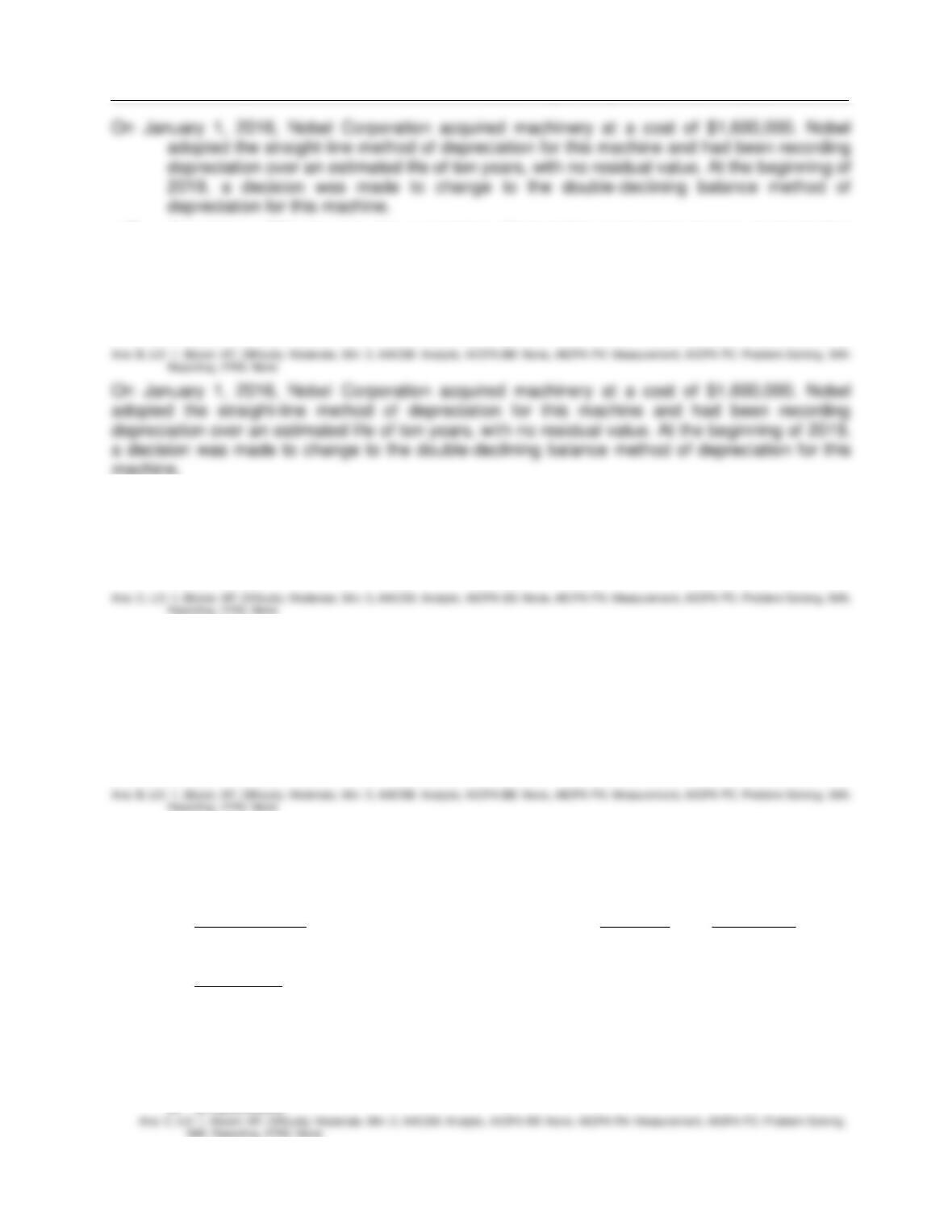
48. The amount that Nobel should record as depreciation expense for 2019 is
a. $160,000.
b. $224,000.
c. $320,000.
d. $280,000.
49. On December 31, 2018 Dean Company changed its method of accounting for inventory
from weighted average cost method to the FIFO method. This change caused the 2018
beginning inventory to increase by $960,000. The cumulative effect of this accounting
change to be reported for the year ended 12/31/18, assuming a 40% tax rate, is
a. $960,000.
b. $576,000.
c. $384,000.
d. $0.
50. Heinz Company began operations on January 1, 2017, and uses the FIFO method in
costing its raw material inventory. Management is contemplating a change to the LIFO
method and is interested in determining what effect such a change will have on net
income. Accordingly, the following information has been developed:
Final Inventory 2017 2018
FIFO $640,000 $ 712,000
LIFO 560,000 636,000
Net Income (computed under the FIFO method) 980,000 1,330,000
Based on the above information, a change to the LIFO method in 2018 would result in net
income for 2018 of
a. $1,370,000.
b. $1,330,000.
c. $1,254,000.
d. $1,250,000.
Test Bank for Intermediate Accounting, Sixteenth Edition
22 – 14
51. Lanier Company began operations on January 1, 2017, and uses the FIFO method in
costing its raw material inventory. Management is contemplating a change to the LIFO
method and is interested in determining what effect such a change will have on net
income. Accordingly, the following information has been developed:
Final Inventory 2017 2018
FIFO $320,000 $360,000
LIFO 240,000 300,000
Net Income (computed under the FIFO method) 500,000 750,000
Based upon the above information, a change to the LIFO method in 2018 would result in
net income for 2018 of
a. $690,000.
b. $750,000.
c. $770,000.
d. $810,000.
52. Equipment was purchased at the beginning of 2016 for $850,000. At the time of its
purchase, the equipment was estimated to have a useful life of six years and a salvage
value of $100,000. The equipment was depreciated using the straight-line method of
depreciation through 2018. At the beginning of 2019, the estimate of useful life was
revised to a total life of eight years and the expected salvage value was changed to
$62,500. The amount to be recorded for depreciation for 2019, reflecting these changes in
estimates, is
a. $51,562.
b. $82,500.
c. $95,000.
d. $98,438.
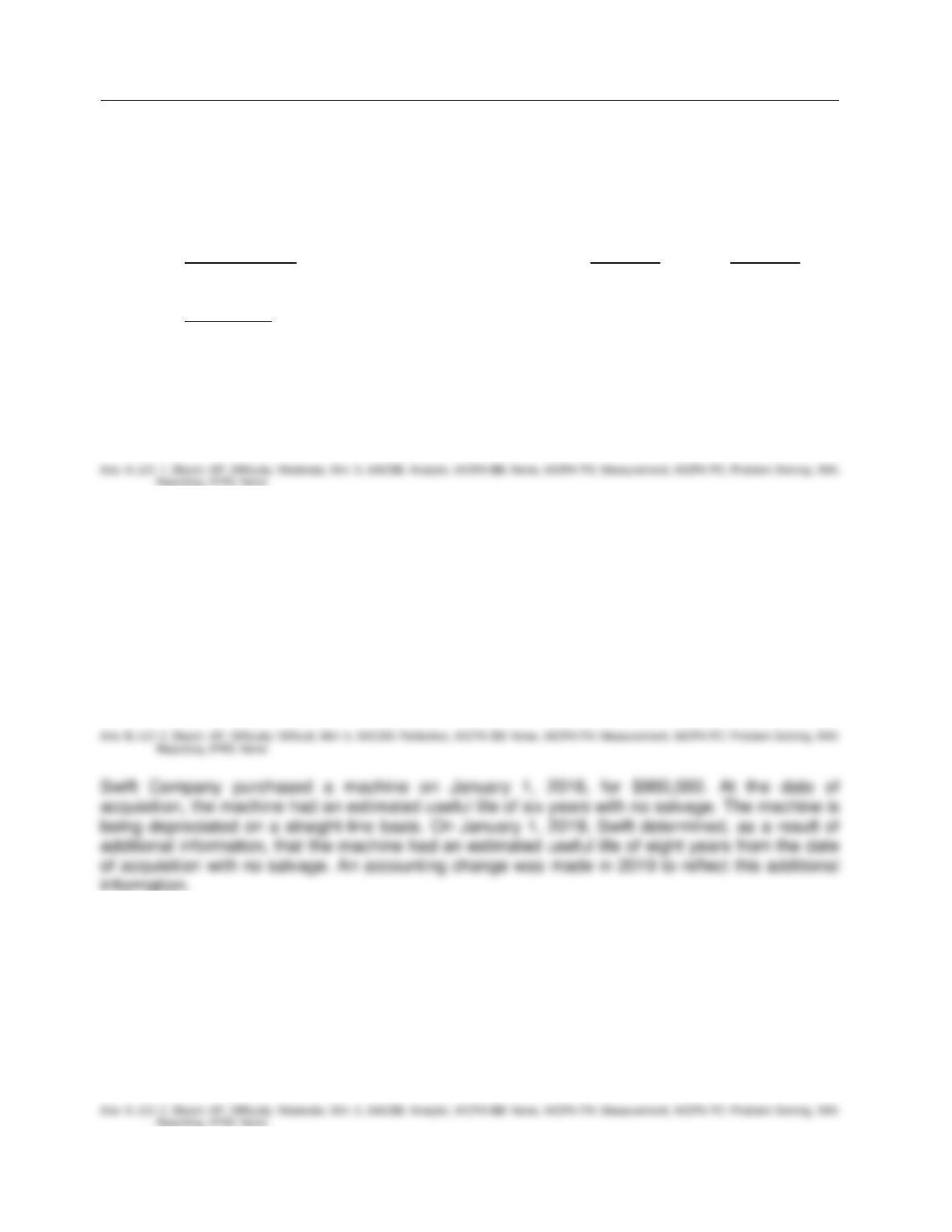
53. Assume that the direct effects of this change are limited to the effect on depreciation and
the related tax provision, and that the income tax rate was 30% in 2016, 2017, 2018, and
2019. What should be reported in Swift’s income statement for the year ended December
31, 2019, as the cumulative effect on prior years of changing the estimated useful life of
the machine?
a. $0
b. $60,000
c. $90,000
d. $315,000
Accounting Changes and Error Analysis
22 – 15
54.What is the amount of depreciation expense on this machine that should be charged in Swift’s
income statement for the year ended December 31, 2019?
a. $90,000
b. $112,500
c. $180,000
d. $225,000
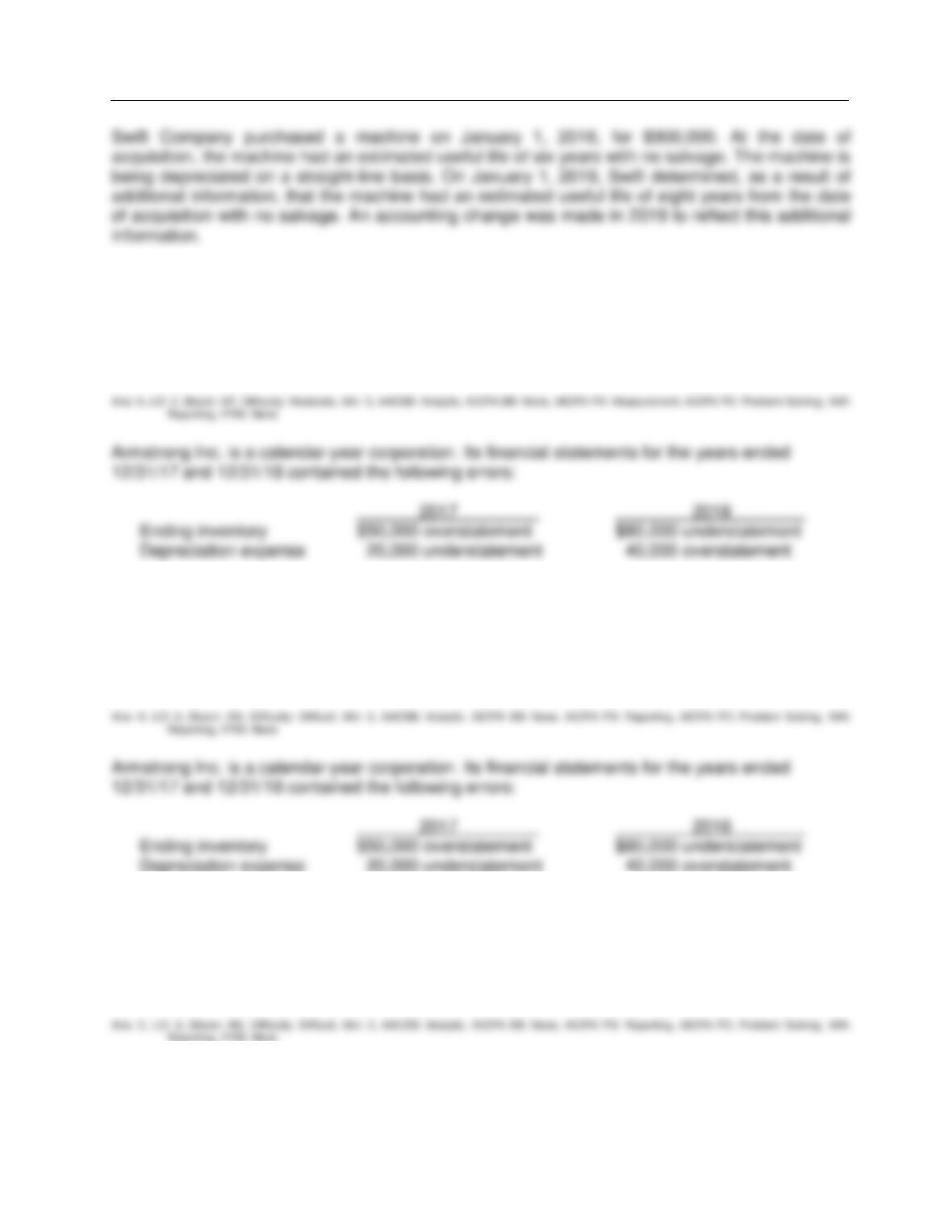
55. Assume that the 2017 errors were not corrected and that no errors occurred in 2016. By
what amount will 2017 income before income taxes be overstated or understated?
a. $70,000 overstatement
b. $30,000 overstatement
c. $70,000 understatement
d. $30,000 understatement
56. Assume that no correcting entries were made at 12/31/17, or 12/31/18. Ignoring income
taxes, by how much will retained earnings at 12/31/18 be overstated or understated?
a. $80,000 overstatement
b. $70,000 overstatement
c. $100,000 understatement
d. $30,000 understatement
Test Bank for Intermediate Accounting, Sixteenth Edition
22 – 16
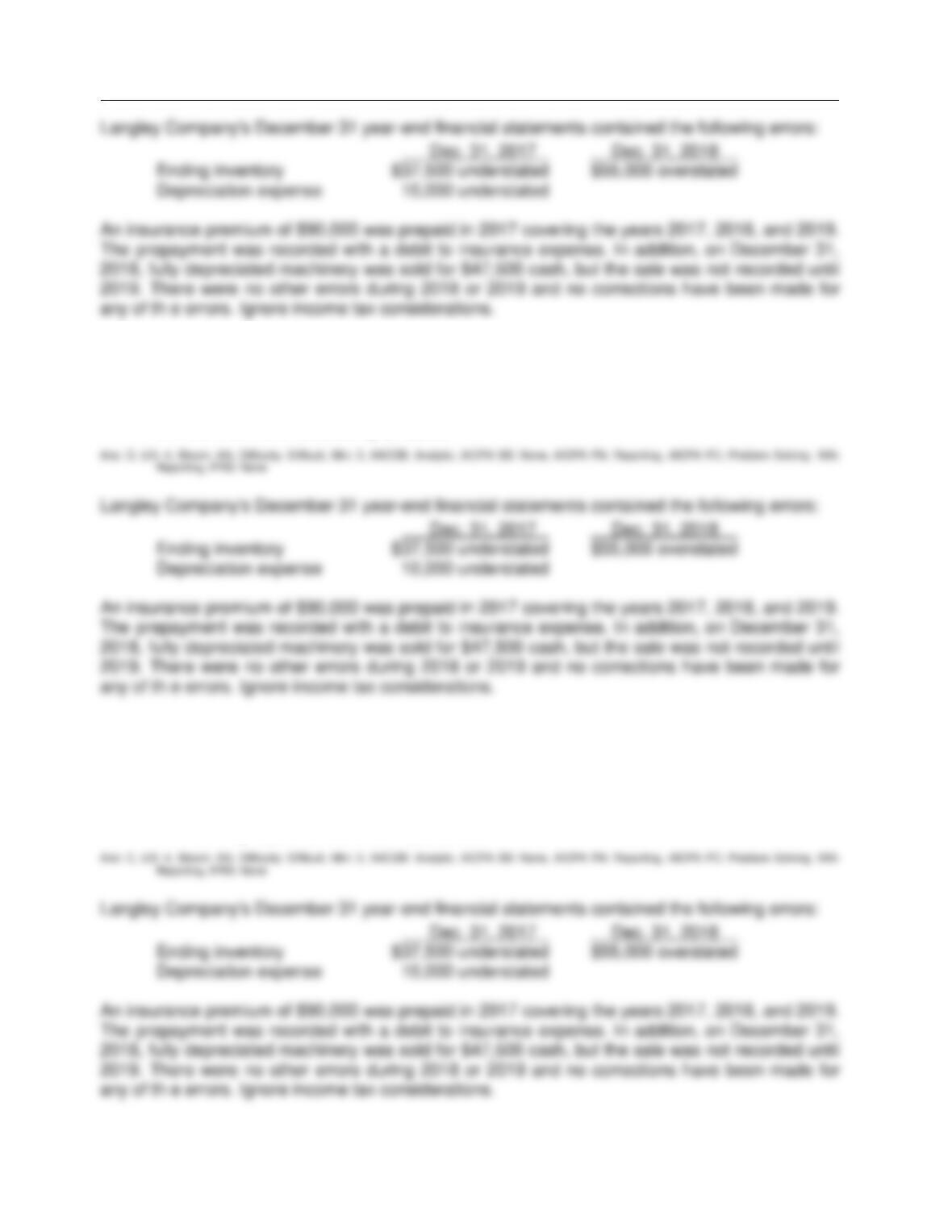
57.What is the total net effect of the errors on Langley’s 2018 net income?
a. Net income understated by $72,500.
b. Net income overstated by $37,500.
c. Net income overstated by $65,000.
d. Net income overstated by $75,000.
58. What is the total net effect of the errors on the amount of Langley‘s working capital at
December 31, 2018?
a. Working capital overstated by $25,000
b. Working capital overstated by $7,500
c. Working capital understated by $22,500
d. Working capital understated by $60,000
Accounting Changes and Error Analysis
22 – 17
59. What is the total effect of the errors on the balance of Langley’s retained earnings at
December 31, 2018?
a. Retained earnings understated by $50,000
b. Retained earnings understated by $22,500
c. Retained earnings understated by $12,500
d. Retained earnings overstated by $17,500
60. Accrued salaries payable of $102,000 were not recorded at December 31, 2017. Office
supplies on hand of $58,000 at December 31, 2018 were erroneously treated as expense
instead of supplies inventory. Neither of these errors was discovered nor corrected. The
effect of these two errors would cause
a. 2018 net income to be understated $160,000 and December 31, 2018 retained
earnings to be understated $58,000.
b. 2017 net income and December 31, 2017 retained earnings to be understated
$102,000 each.
c. 2017 net income to be overstated $44,000 and 2018 net income to be understated
$58,000.
d. 2018 net income and December 31, 2018 retained earnings to be understated
$58,000 each.
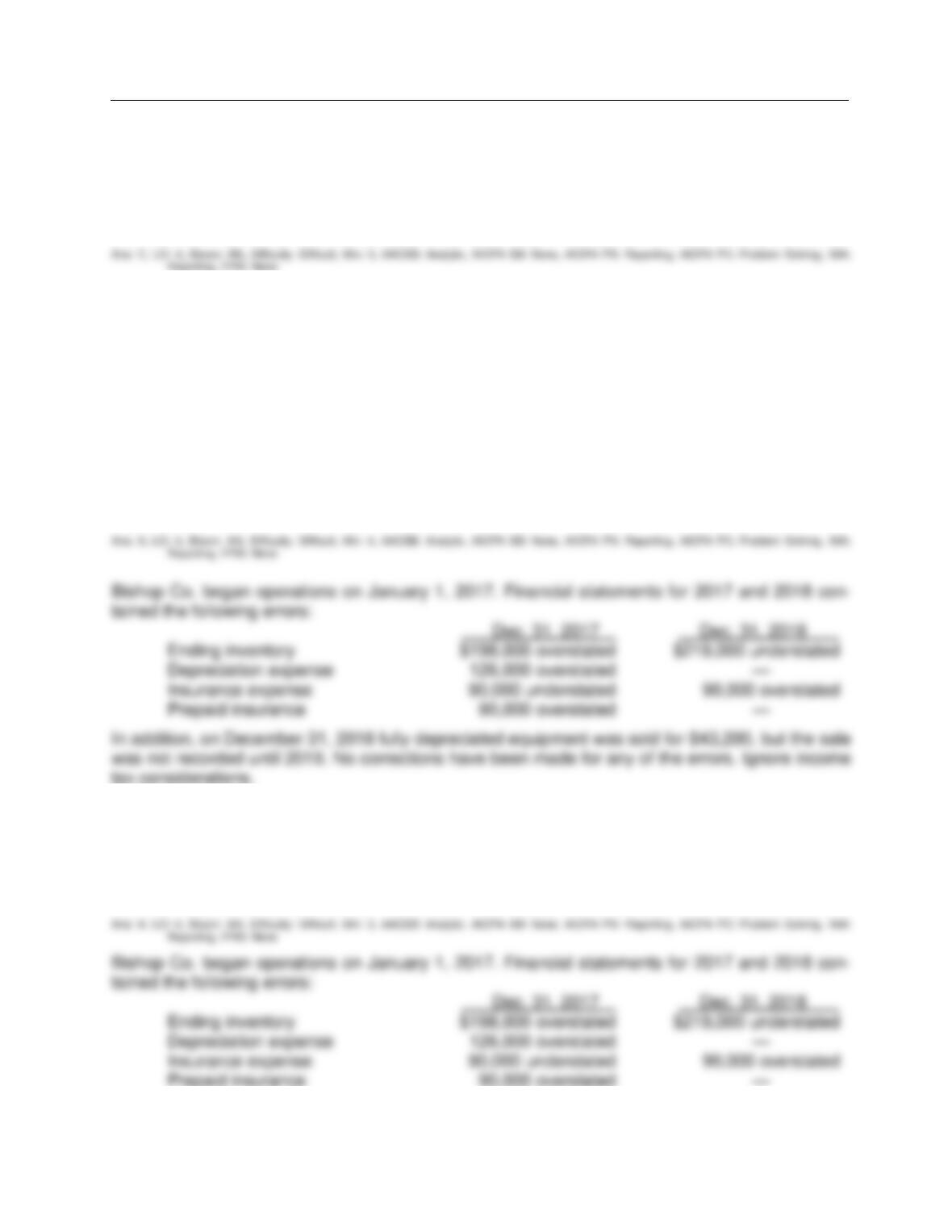
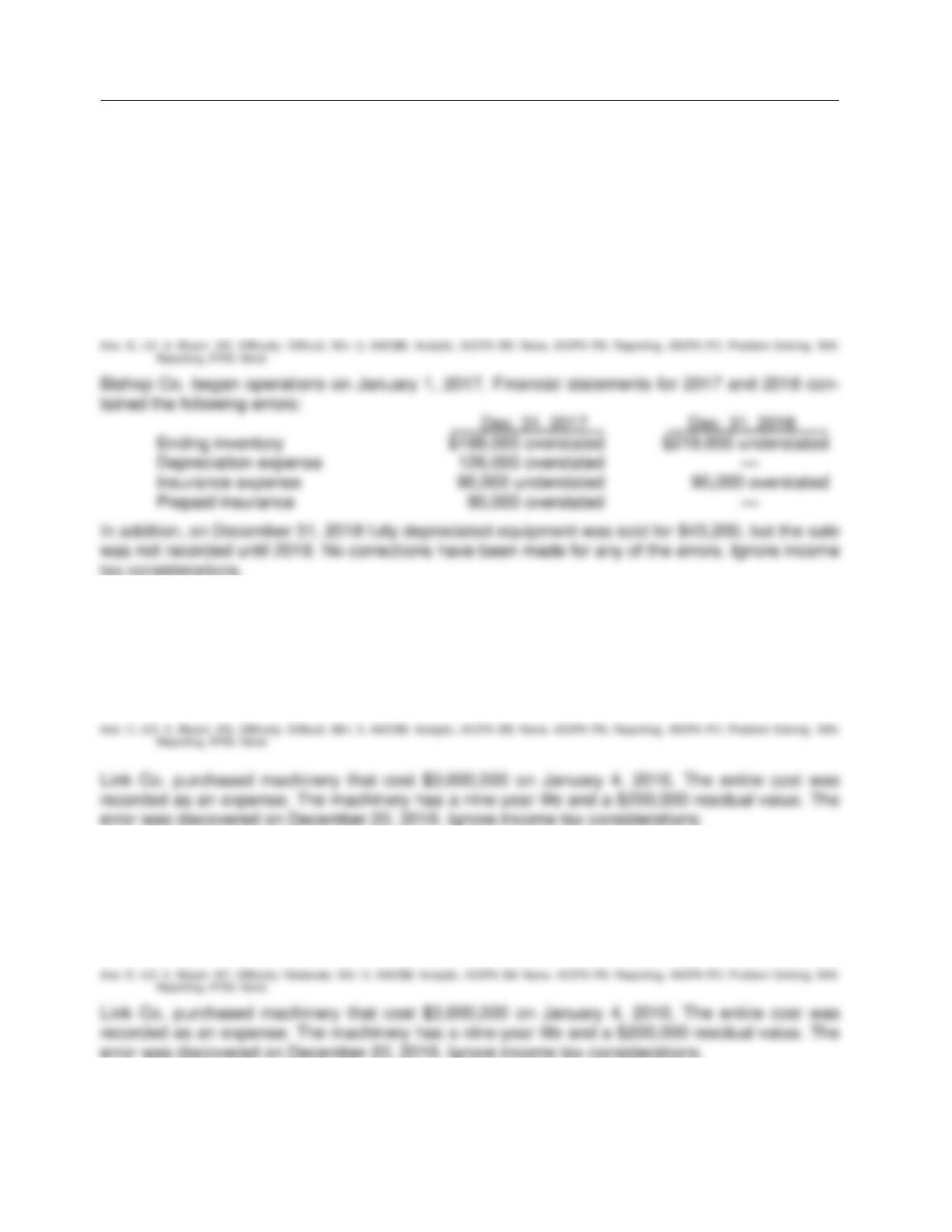
61. The total effect of the errors on Bishop’s 2018 net income is
a. understated by $550,200.
b. understated by $352,200.
c. overstated by $175,800.
d. overstated by $373,800.
Test Bank for Intermediate Accounting, Sixteenth Edition
22 – 18
In addition, on December 31, 2018 fully depreciated equipment was sold for $43,200, but the sale
was not recorded until 2019. No corrections have been made for any of the errors. Ignore income
tax considerations.
62. The total effect of the errors on the balance of Bishop’s retained earnings at December
31, 2018 is understated by
a. $478,200.
b. $388,200.
c. $262,200.
d. $190,200.
63. The total effect of the errors on the amount of Bishop’s working capital at December 31,
2018 is understated by
a. $586,200.
b. $460,200.
c. $262,200.
d. $172,200.
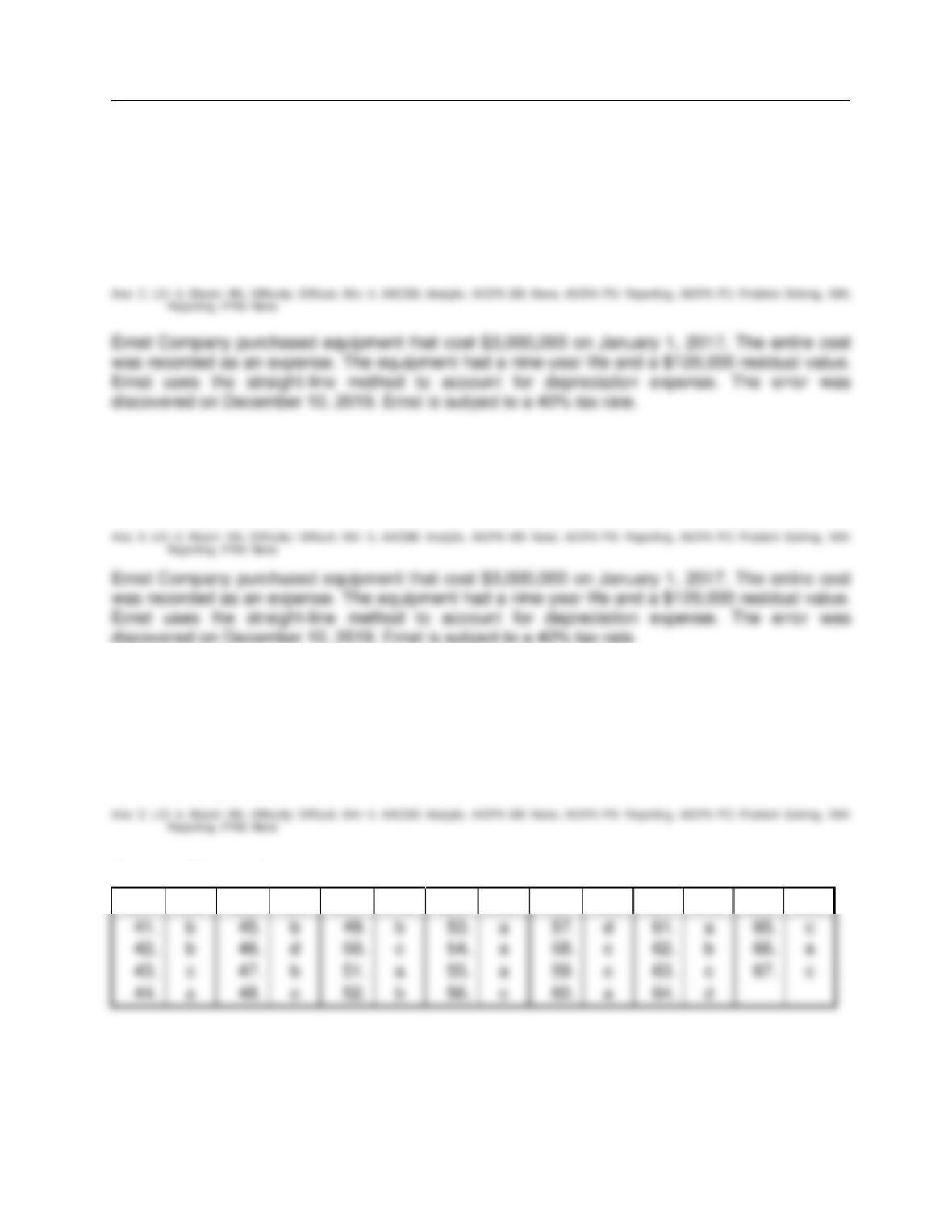
64. Link’s income statement for the year ended December 31, 2018, should show the
cumulative effect of this error in the amount of
a. $2,333,333.
b. $2,377,778.
c. $2,066,667.
d. $0.
Accounting Changes and Error Analysis
22 – 19
65.Before the correction was made, and before the books were closed on December 31, 2018,
retained earnings was understated by
a. $3,000,000.
b. $2,333,333.
c. $2,377,778.
d. $2,066,667.
66. Ernst’s net income for the year ended December 31, 2017, was understated by
a. $1,608,000.
b. $1,800,000.
c. $2,680,000.
d. $3,000,000.
67. Before the correction was made and before the books were closed on December 31,
2019, retained earnings was understated by
a. $1,328,000.
b. $1,344,000.
c. $1,416,000.
d. $1,800,000.
Multiple Choice Answers—Computational
Item
Ans.
Item
Ans.
Item
Ans.
Item
Ans.
Item
Ans.
Item
Ans.
Item
Ans.